Back to School Part II #9: National Lampoon’s Animal House (dir by John Landis)


NATIONAL-LAMPOONS-ANIMAL-HOUSE

You know what?  I’m going to start this review with the assumption that you’ve already seen the classic 1978 college comedy, National Lampoon’s Animal House.  At the very least, I’m going to assume that you’ve heard of it and that you know the general details.  Animal House was not only a huge box office success but it’s also one of the most influential films ever made.  Almost every comedy released since 1978 owes a debt to the success of Animal House.  Just as every subsequent high school film was directly descended from American Graffiti, every college film features at least a little Animal House in its DNA.

So, with that in mind, who is your favorite member of Delta House?

toga

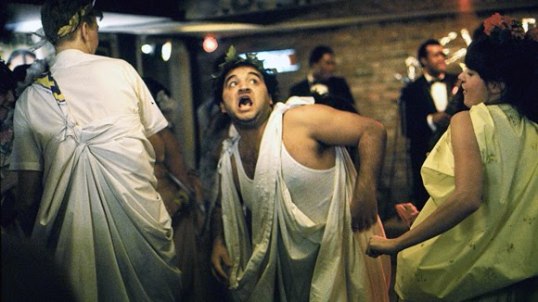
Most people, I think, would automatically say Bluto (played by John Belushi) and certainly, Bluto is the best known and perhaps best-remembered member of the cast.  As played by Belushi, Bluto is the film’s rampaging ID and he’s such a force of nature that, whenever I rewatch Animal House, I’m surprised to be reminded of the fact that he’s not really in the film that much.  He’s present for the parties, of course.  He imitates a zit and starts a food fight.  He gives a rousing speech, in which he reminds the members of the Delta House that America didn’t give up after “the Germans bombed Pearl Harbor!”  He destroys a folk singer’s guitar and I personally love the scene where he tries to cheer up a despondent pledge by smashing a beer bottle over his head.  But really, Bluto is used very sparingly and he’s one of the few members of the ensemble not to get his own subplot.  Bluto’s great but he’s not my favorite member of Delta House.

Hoover

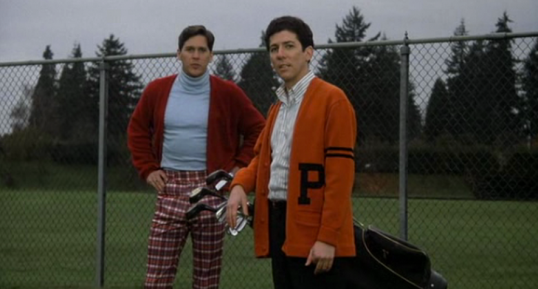
Believe it or not, my favorite member of Delta House is Robert Hoover (James Widdoes).  Hoover is the president of Delta House and, when we first meet him, he seems like he’s way too clean-cut to be in charge of the “worst house” on campus.  But then, as the film progresses, we discover that Hoover may not be as openly crazy as everyone else but he’s definitely a Delta.  Just watch him in the Toga party scene.  Just look at him in the picture that shows up during the closing credits.  It took me a while to realize that Hoover, the future public defender, was giving the camera the finger.  Hoover may look uptight but he’s secretly a wild man!

animal-house 1

One of the things that I love about Animal House is that it truly is an ensemble film.  There’s not a weak performance to be found in the entire movie.  No matter how wild or over-the-top the humor gets, the entire cast commits to their roles and, as a result, they keep this movie grounded.  You actually find yourself caring about whether or not they get kicked off campus.  You truly believe that the members of Delta House have been friends for years but, even more importantly, you believe the same thing about their rivals at Omega House.  For that matter, it may be easy to make fun of Dean Wormer (John Vernon, setting the template for all evil deans to come) but you never doubt that he’s been in charge of Faber College for years and that he’s planning on being in charge for years to come.  As played by the deep-voiced and sinister-looking Vernon, Wormer becomes every unreasonable authority figure.  When he explains the concept of super secret probation, he does so with a smug pleasure that is practically chilling.  When he mentions that the members of Delta House can now be drafted, the smile on his face is terrifying.

Wormer

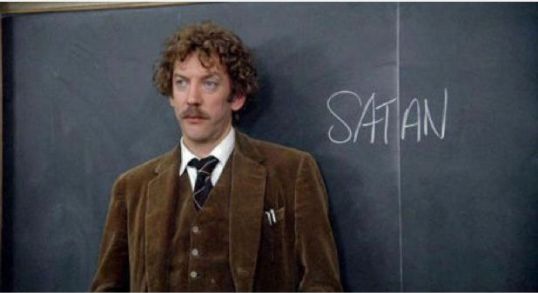
You know who else gives a really good performance in Animal House?  Donald Sutherland.  At the time, Sutherland was the biggest star in the film.  He was offered either a percentage of the grosses or a flat fee.  Sutherland thought the film would flop, took the flat fee, and missed out on millions as a result. Sutherland plays Prof. Jennings, an English teacher who, in the only scene actually set in a classroom, desperately tries to get his bored students to pay attention to him.  There’s something so poignant about the way Jennings begs his students to turn in their papers.  “I’m not joking,” he sputters, “this is my job!”

Jennings

Jennings turns out to be free thinker.  He turns Boone (Peter Riefert), Katie (Karen Allen), and Pinto (Tom Hulce) onto marijuana.  There’s an anachronistic peace sign hanging in his apartment (Animal House takes place in 1963) but no matter.  Far worse is the fact that he temporarily breaks up Boone and Katie!  Everyone knows those two belong together!

Bluto and Flounder

You know who else doesn’t get enough credit for his performance in Animal House?  Stephen Furst.  He plays Flounder, a new pledge.  Flounder is just so enthusiastic about everything and he doesn’t even seem to be upset when Wormer tells him, “Fat, drunk, and stupid is no way to go through life.”  I love the enthusiastic way that Furst delivers simple lines like, “What’s my Delta Chi name?” and “Brother Bluto!  Brother D-Day!  What are you doing here!?” My favorite Flounder moment comes when he accidentally gives a horse a heart attack.  Technically, it shouldn’t be funny but it is because Furst, Belushi, and Bruce McGill (playing the role of D-Day) so thoroughly throw themselves into their roles.  For that matter, the horse did a pretty good job too.

Boone and Otter

But that’s not all!  How can I praise the ensemble of Animal House without mention Tim Matheson, who plays Otter, the future Beverly Hills gynecologist?  Or what about Kevin Bacon, playing Omega pledge Chip Diller?  This was Bacon’s first role and who can forget him shouting, “Thank you, sir, may I have another!” while being initiated into Omega House?  Or how about James Daughton and Mark Metcalf, as the two leaders of Omega House?  They were villains truly worth hissing!

Omega House

And yes, I know that a lot of the humor in Animal House is not politically correct but who cares?  It’s a hilarious movie, one that is full of good actors at their absolute best.  Yes, they’re all a bunch of privileged sexists blah blah blah, but I’d still party with the Delta House.  They know how to have fun and, even if they did wreck the Homecoming Parade, they had a good reason!

parade

And so is the movie.  Every time I see Animal House, I feel good about the world.  In 1978, The Deer Hunter was named best picture by the Academy.  Well, you know what?  With all due respect to that long epic about the tragedy of America’s involvement in the Vietnam War,  all the Oscars should have gone to Animal House!

Animal-House-e1349570128550

In conclusion … SING IT!

Let me t-t-tell you ’bout some friends I know
They’re kinda crazy but you’ll dig the show
They can party ’till the break of dawn
at Delta Chi you can’t go wrong

Otter, he’s the ladies man
Every girl falls into his hands
Boon and Katy playing “Cat and Mouse”

and Mrs. Wormer, she’s the queen of the
ANIMAL HOUSE

ANIMAL HOUSE

ANIMAL HOUSE

That Pinto he’s a real swell guy
Clorette was jailbait but he gave her a try
Chip, Doug, and Greg, they’re second to none
They studied under Attila the Hun

Mr. Jennings has got his wig on tight
Flouder’s left shoe’s always on his right
Babs and Mandy are having a pillow fight
With D-Day, Hoover, Otis Day and the Knights

DO THE BLUTO

Come on baby, dance with me
Maybe if we do the Bluto
We will get an “A” in lobotomy

DO THE BLUTO
DO THE BLUTO

DO THE BLUTO
DO THE BLUTO

Aw, come on!
Let me tell ya
Dean Wormer tried to shut us down
But he fell and he broke his crown
He didn’t know about the Delta spunk
He came in handy when we were short a skunk

At the

ANIMAL HOUSE

5650948_std

Let’s Get Physical: Lee Marvin in POINT BLANK (MGM 1967)


gary loggins's avatarcracked rear viewer

point1

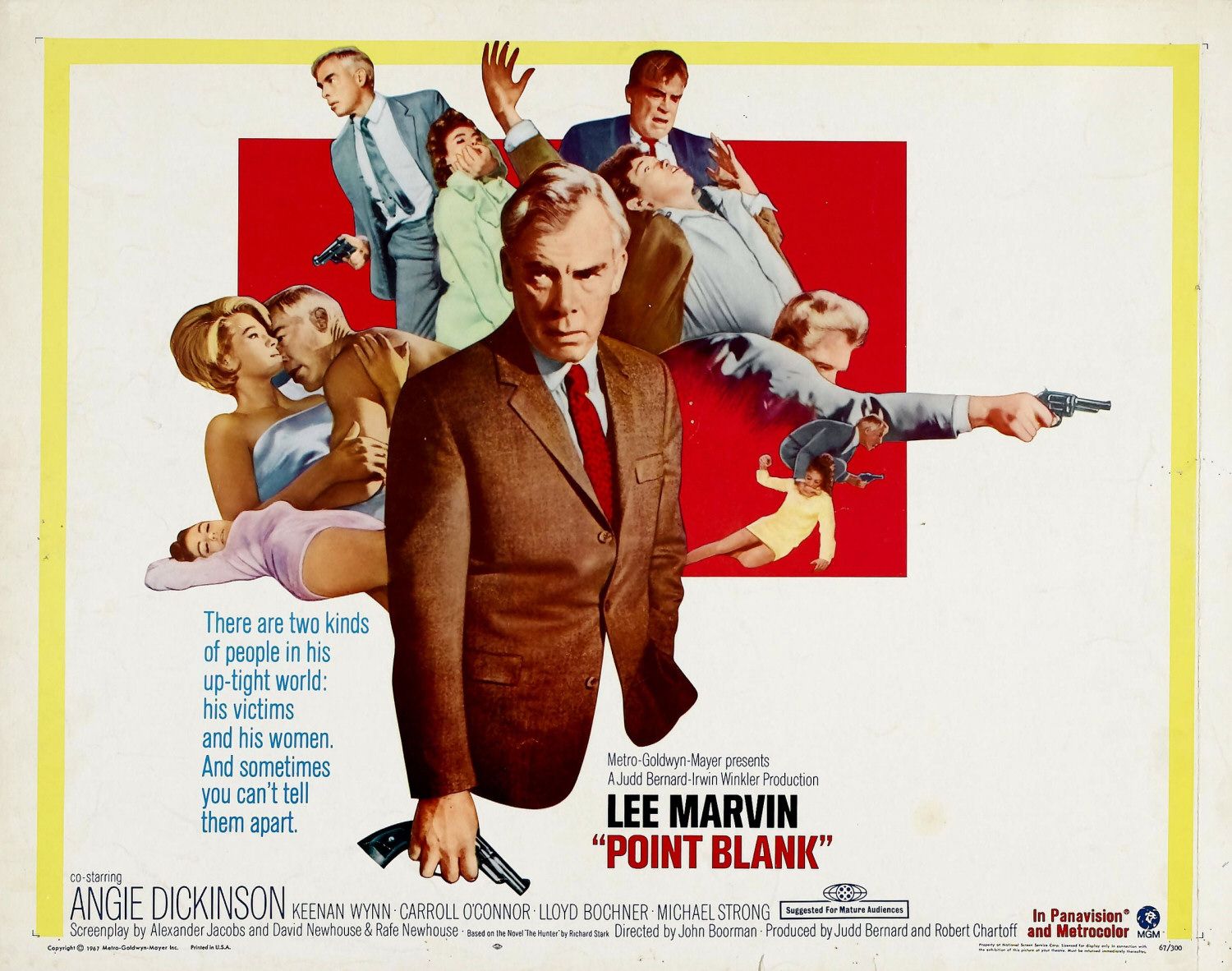
Lee Marvin  was one tough son of a bitch both onscreen and off, awarded the Purple Heart after being wounded by a machine gun blast in WWII.  The ex-Marine stumbled into acting post-war, and Hollywood beckoned in the 1950’s. His imposing presence typecast him as a villain in films like HANGMAN’S KNOT, THE BIG HEAT , and BAD DAY AT BLACK ROCK. A three season stint in TV’s M SQUAD brought Marvin more acclaim, and he solidified that with his Oscar-winning role in CAT BALLOU, parodying his own tough-guy image. Marvin was now a star that could call his own shots, and used that clout in POINT BLANK, throwing out the script and collaborating with a young director he had faith in, John Boorman.

point2

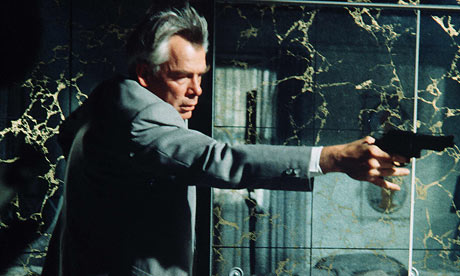
POINT BLANK is a highly stylized revenge drama centering on Marvin’s character of Walker. The nightmarish opening sequence shows how Walker was left for dead on deserted Alcatraz Island by…

View original post 488 more words

Boobs, Music, and Sci-Fi: Heavy Metal (1981, directed by Gerald Potterton)


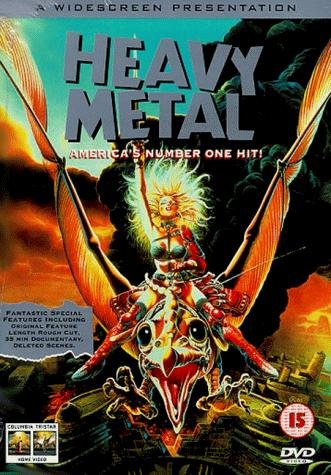
Heavy MetalI think I was twelve when I first saw Heavy Metal.  It came on HBO one night and I loved it.  So did all of my friends.  Can you blame us?  It had everything that a twelve year-old boy (especially a 12 year-old boy who was more than a little on the nerdy side) could want out of a movie: boobs, loud music, and sci-fi violence.  It was a tour of our secret fantasies.  The fact that it was animated made it all the better.  Animated films were not supposed to feature stuff like this.  When my friends and I watched Heavy Metal, we felt like we were getting away with something.
Based on stories from the adults-only Heavy Metal Magazine, Heavy Metal was divided into 8 separate segments:

Soft Landing (directed by Jimmy T. Murakami and John Bruno, written by Dan O’Bannon)

Heavy Metal opens brilliantly with a Corvette being released from a space shuttle and then flying down to Earth, surviving reentry without a scratch.  Who, after watching this, has not wanted a Space Corvette of his very own?

Grimaldi (directed by Harold Whitaker)

On Earth, a terrified young girl listens a glowing green meteorite called the Loc-Nar tells her that it is the source of all evil in the universe.  This sets up the rest of the film, which is made up of stories that the Loc-Nar tells about its influence.  The Loc-Nar is the film’s MacGuffin and, seen today, one of Heavy Metal’s biggest problems is that it has to find a way to force the Loc-Nar into every story, even if it meant sacrificing any sort of consistency about what the Loc-Nar was capable of doing.  Even when I was twelve, I realized that the Loc-Nar was not really that important.

Harry Canyon (directed by Pino Van Lamsweerde, written by Daniel Goldberg)

In this neo-noir tale, futuristic cabby Harry Canyon (voiced by Richard Romanus) is enlisted to help an unnamed girl (voiced by Susan Roman) to find the Loc-Nar.  Slow and predictable, Harry Canyon does feature the voice of John Candy as a police sergeant who attempts to charge Harry for police work.

den_1268427864Den (directed by Jack Stokes, written by Richard Corben)
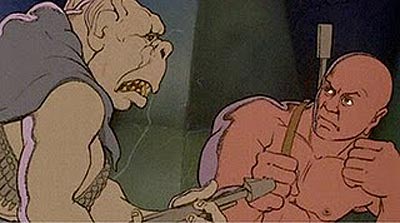
Nerdy teenager David (voiced by John Candy) finds a piece of the Loc-Nar and is transported to the world of Neverwhere, where he is transformed into Den, a muscular, bald warrior.  As Den, David gets to live out the fantasies of Heavy Metal‘s target audience.  On his new planet, Den rescues an Earth woman from being sacrificed, overthrows an evil queen and a sorcerer, and gets laid.  A lot.  Den is the best segment in Heavy Metal, largely because of the endearing contrast between the action onscreen and John Candy’s enthusiastic narration.

Captain Sternn (directed by Paul Sebella and Julian Harris, written by Bernie Wrightson)

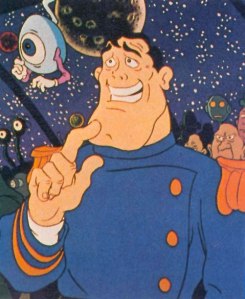
heavy-metal_captain-sternOn a space station orbiting the Earth, Captain Lincoln F. Sternn is on trail for a countless number of offenses.  Though guilty, Captain Sternn expects to be acquitted because he has bribed the prosecution’s star witness, Hanover Fiste.  However, Hanover is holding the Loc-Nar in his hand and it causes him to tell the truth about Captain Sternn and eventually turn into a bloodthirsty giant. Captain Sternn saves the day by tricking Hanover into getting sucked out of an air lock.
Captain Sternn was a reoccurring character in Heavy Metal Magazine and his segment is one of the best.  Eugene Levy voices Captain Sternn while Joe Flaherty voices his lawyer and Dean Wormer himself, John Vernon, is the prosecutor.  Even National Lampoon co-founder Douglas Kenney provided a voice.

 B-17 (directed by Barrie Nelson, written by Dan O’Bannon)

After the Loc-Nar enters Earth’s atmosphere, it crashes into a bullet-riddled World War II bomber, causing the dead crewmen within to reanimate as zombies.  Scored to Don Felder’s Heavy Metal (Takin’ a Ride), B-17 is one of the shorter segments and its dark and moody animation holds up extremely well.

So Beautiful and So Dangerous (directed by John Halas, written by Angus McKie)

Nubile Pentagon secretary Gloria is beamed aboard a spaceship that looks like a giant smiley face.  While she has sex with the ship’s robot captain, the two crew members (voiced by Harold Ramis and Eugene Levy) pour out a long line of cocaine and shout “Nosedive!” before snorting up every flake.  So Beautiful and So Dangerous is so juvenile and so ridiculous that it is actually all kinds of awesome.

Taarna

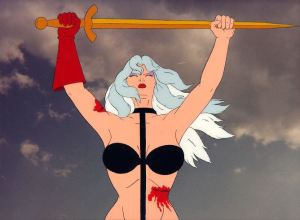
SacrificedIn the film’s final and most famous segment, Taarna, the blond warrior was featured on Heavy Metal‘s poster, rides a pterodactyl across a volcanic planet, killing barbarians, and finally confronting the Loc-Nar.  She sacrifices herself to defeat the Loc-Nar but no worries!  We return to Earth where, for some reason, the Loc-Nar explodes and the girl from the beginning of the film is revealed to be Taarna reborn.  She even gets to fly away on her pterodactyl.  Taarna was really great when I was twelve but today, it is impossible to watch it without flashing back to the Major Boobage episode of South Park.
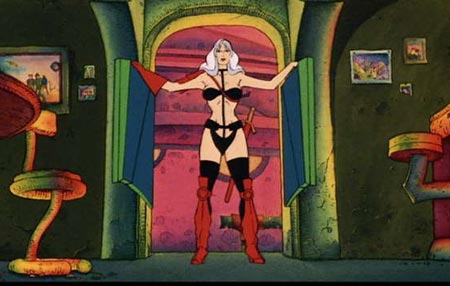
Much like Taarna, Heavy Metal seems pretty silly when I watch it today.  But when I was twelve, it was the greatest thing ever.

Taarna_Heavy_Metal


Back to School #33: Savage Streets (dir by Danny Steinmann)


Savage Streets

“Too bad you’re not double-jointed…because then you’d be able to bend over and kiss your ass goodbye!” — Brenda (Linda Blair) in Savage Streets (1984)

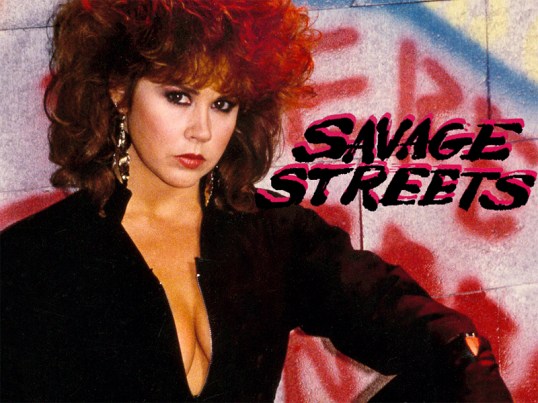
The year is 1984 and the streets are…savage!  As in Savage Streets, a low-budget exploitation film that combines high school melodrama with vigilante justice.

Savage Streets tells the story of big-haired Brenda (played by Linda Blair of Exorcist fame), a tough high school senior who attends one of the most graffiti-covered schools in America.  Seriously, I’ve seen a lot of bad high schools in a lot of not-so-good movies since I started this Back To School series but it’s hard to think of any of them that look quite as bad as the high school in Savage Streets.  The halls are dirty.  A fight breaks out every few seconds.  Students sit in class and light up cigarettes.  Can anyone be surprised that Principal Underwood (John Vernon) spends all of his time wandering the hallways and growling out lines like, “Go fuck an iceberg!”  When he and Brenda have a confrontation in his office, Principal Underwood smirks and says, “You’re a tough little bitch, aren’t you?”

What’s truly sad is that, as bad as Underwood is, he’s still nicer than just about every other man in the movie.

Brenda has a lot to deal with.  For one thing, it appears that she’s only enrolled in three classes.  The first class is a gym class where apparently, the teacher has just written down “Aerobics” on every page of her lesson plan.  While Brenda and her friends work out, local dumb jock Wes (Brian Mann) shows up to stare at her.  When Wes’s girlfriend, Cindy (Rebecca Perle), confronts Brenda in the changing room after class, Brenda replies, “I wouldn’t fuck him if he had the last dick on Earth.”  Cindy responds by going, “AAAAAAAAAAGHHHHH!” and then attacking her.  Brenda’s other class appears to be a science class of some sort.  It turns out that Cindy’s in that class, too.  So, once again, it’s time for another fight…

If you’re getting the feeling that everybody at this school has nothing better to do than fight — well, you’re right.

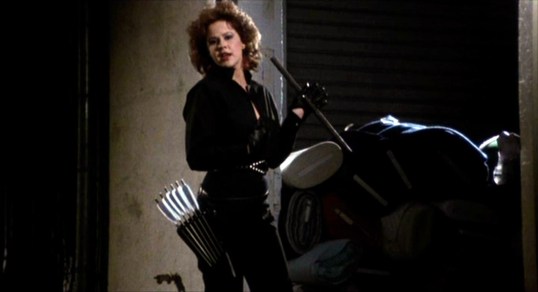
Brenda has other problems as well.  Brenda’s younger sister (future horror mainstay Linnea Quigley, giving the closest thing to a truly good performance to be found in this particular film) is a deaf mute and Brenda’s best friend is pregnant and getting married.  When a really pathetic gang of losers known as the Scars assault her sister and kill her best friend, Brenda responds by dressing up in black leather, grabbing a crossbow, and giving the Scars some real scars to worry about…

Savage Streets is one of those films about people with ugly thoughts doing ugly things in largely ugly settings.  In many ways, it’s a surprisingly mean-spirited film and not one that I would suggest for anyone who is easily offended.  (Following his work here, director Danny Stienmann was hired to direct Friday the 13th — A New Beginning, which is perhaps the most unapologetically exploitative of all the Friday the 13th films.)  And yet, at the same time, I appreciated the fact that Savage Streets not only featured a woman kicking ass but also doing it without the help of a man.  Even better, not only does Brenda not need a man to help her but she doesn’t want one either.  Brenda is unique for being totally independent and, whatever else one might say about this frequently messy and amateurish movie, it celebrates that independence.

So, does that make Savage Streets into a secretly subversive feminist film?

No.

But it still makes Savage Streets better than your average vigilante-with-a-crossbow film.

savage-streets-2

Film Review: Dirty Harry (dir. by Don Siegel)


Dirty Harry is obviously just a genre film but this action genre has always had fascist potential and it has finally surfaced…Dirty Harry is a deeply immoral movie.” — Pauline Kael

“It’s not about a man who stands for violence.  It’s about a man who can’t understand society tolerating violence.” — Clint Eastwood

I decided that I wanted to review the Dirty Harry film franchise about two seconds after Clint Eastwood finished giving his speech at the Republican National Convention last month. 

It had nothing to do with the politics of Eastwood’s speech because, quite frankly, I think a good film is a work of art and art is always more important than politics.  Instead, as I watched Eastwood give his speech, I was reminded that Clint Eastwood is about as close to a living icon as we have in America.  There aren’t many actors who could get away with giving a speech to an empty chair and, despite the predictable outraged tweets from Roger Ebert, Eastwood is one of them.  And, if Eastwood is an icon, Harry Callahan is perhaps the most iconic role of his career.

Now, I have to admit that, as I started this project, I knew more about Harry Callahan as a character than I did about the films he had actually appeared in.  I had seen both Dirty Harry and The Dead Pool because, for whatever reason, they both seem to turn up on AMC every other week.  I knew that Harry Callahan was a police inspector who was based in San Francisco.  I knew that he was willing to go to extremes when it came to fighting criminals.  I knew that, in his first film appearance, Harry had a really impressive head of hair that had pretty much vanished by the time that he reached his final appearance in The Dead Pool.  And, finally, I knew that, at some point in the film series, Harry growled the line, “Go ahead, make my day.”

So, for me, reviewing every film in the Dirty Harry franchise gave me a chance to discover why Harry has become such an iconic character and why people still ask Eastwood to repeat that “make my day” line.  When I started watching the films, Jeff warned me that the Dirty Harry films got worse as you went along and I discovered that, in many ways, he was right.  But I still enjoyed the experience and I hope that you enjoy reading my reviews over the next few days.

But, first things first.  Let’s take a look at the film that started the entire series, 1971’s Dirty Harry.

I have to admit that it’s a bit intimidating to try to review Dirty Harry because, quite frankly, what’s left to be said about this film?  It’s one of the most influential movies of all time. Any time you see a cop in a TV show or a movie getting yelled at by his superiors for not going “by the book,” it means that you’re watching a movie or an episode that is directly descended from Dirty Harry.  And yet, despite all the imitations, it’s a movie that remains as exciting and visceral today as when it was first released. 

Dirty Harry tells the story of two outsiders, two men who seem to exist solely to reveal the dark impulses of conventional society.  Both of these men are killers and both of these men are motivated by a rage against what they perceive society as being. 

One of these men calls himself Scorpio.  As played by Andy Robinson (who gives one of the definitive cinematic psycho performances here), Scorpio is a jittery mass of nerves, an unkempt man who wears a peace sign as a belt buckle but who also writes letters to the Mayor of San Francisco (played by John Vernon) in which he threatens to kill one innocent person a day unless he’s paid off.  When he first appears, he’s on a rooftop, aiming a rifle at an unaware woman in a swimming pool. At one point, the phallic barrel of rifle seems to be pointed directly at the camera (and by extension, at us in the audience).  When he fires the rifle, we see the mortally wounded woman silently sink under the water.  It’s a scene that still disturbs me every time I see it, one that establishes early on that we’re all potentially vulnerable to the Scorpios of the world.

In the next scene, we see San Francisco Police Inspector Harry Callahan (Clint Eastwood, of course) investigating the crime scene.  The difference between Harry and Scorpio is striking.  Whereas Scorpio is only calm while killing, Callahan inspects the crime scene (and goes through almost the entire film) without showing a hint of emotion.  While Scorpio looks like a madman, Callahan looks like a professional.  And yet, when Callahan foils a bank robbery (and delivers his famous “Do you feel lucky?” monologue to wounded bank robber played by Albert Popwell), it becomes obvious that he does have something in common with Scorpio.  They’re both willing to shoot to kill.  The only difference is that, as a police officer, Callahan is ostracized for his willingness to kill while Scorpio, as an American citizen, is protected by the U.S. Constitution.

It would be foolish to pretend that Dirty Harry isn’t a political film.  One need only watch the scene where a law professor explains to Harry why his pursuit and arrest of Scorpio violated Scorpio’s constitutional rights.  (The way that Eastwood snarls during this scene is priceless.)  As one can tell from the quote from Pauline Kael at the beginning of this review, Dirty Harry was a film that upset a lot of liberals when it was first released (much as Clint Eastwood’s empty chair speech managed to upset Roger Ebert).  However, as the years have passed, Dirty Harry has come to be acknowledged as a classic by critics on both sides of the political divide.

The success of Dirty Harry goes beyond politics.  I think any film students who aspires to direct an action film should be required to watch Dirty Harry a few dozen times before he graduates.  What makes the film work is not just what director Don Siegel does but what he doesn’t do.  As opposed to some of the later films in the franchise, Dirty Harry is a fast-paced film that tells its story with a minimum amount of padding.  It’s hard to think of a single scene that isn’t necessary to tell the story that the film wants to tell.  Even the oft-criticized scene where Harry, on a stake out, spies on some naked lesbians, works as a parallel to Scorpio’s own voyeurism at the start of the film.

Much as in a classic western, Harry and Scorpio are presented as two sides of the same coin.  Both of them are outsiders who refuse to follow the rules of society and the film’s violent and mournful climax is powerful precisely because, by this point, the audience understands that the Scorpios of the world can not exist without the Harrys and vice versa.

Along with generated a lot of controversy, Dirty Harry was a huge box office success.  Not surprisingly, a sequel would follow.

We’ll look at Magnum Force tomorrow.