In 1988’s The Undertaker, a small college town is rocked by a serious of viscous, sexually-charged murders. While the professors and the students deal with their own dramas on campus, the bodies are piling up at the local funeral home. Who could the murderer be?
Well, Joe Spinell’s in the film. That really should be the only clue you need.
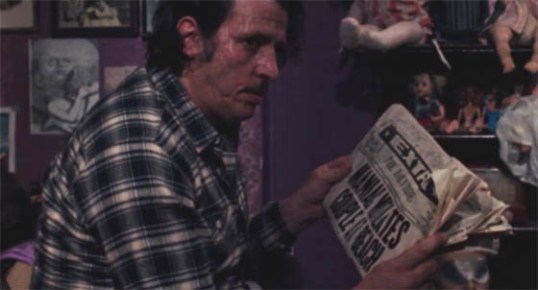
Spinell plays Roscoe, the town undertaker who has issues with his mother, cries at random, talks to dead bodies, watches movies featuring sacrifices, and occasionally performs what appears to be some sort of a ritual with his victims. This film was Spinell’s final film and he gives a performance that alternates between being perfunctory and being fully committed. On the one hand, there are plenty of scenes where Spinell appears to be making up his lines as he goes along, In the scenes in which he appears in his office, it’s appears that Spinell is literally reading his lines off of the papers on top of his desk. Then there are other scenes where Spinell suddenly seems to wake up and he flashes the unhinged intensity that made him such a fascinating character actor. In the 70s and 80s, there were many actors who frequently played dangerous people. Spinell was the only one who really came across like he might have actually killed someone on the way to the set. Spinell was in poor health for most of his life and he also struggled with drug addiction. In The Undertaker, he doesn’t always look particularly healthy. Even by Joe Spinell standards, he sweats a lot. And yet, in those scenes were actually commits himself to the character, we see the genius that made him so unforgettable.
As for the film itself, it’s basically Maniacbut without the New York grit that made that film memorable. Instead, it takes place in a small town and Spinell, with his rough accent and his button man mustache, seems so out-of-place that the film at times starts to feel like an accidental satire. Roscoe is obviously guilty from the first moment that we see him and yet no one else can seem to figure that out. Only his nephew suspect Roscoe but that problem is quickly taken care of. Whenever anyone dies, their body is brought to Rosco’s funeral home. Roscoe puts on his black suit, plasters down his hair, and tries to look somber. Roscoe spends a good deal of the film talking to himself. When a victim runs away from Roscoe, Spinell looks at a nearby dead body and shrugs as if saying, “What can you do, huh?”
If you’re into gore, this film has a lot of it and, for the most part, it’s pretty effective. In the 80s, even the cheapest of productions still found money to splurge on blood and flayed skin effects. If you’re looking for suspense or a coherent story, this film doesn’t really have that to offer. It does, however, offer up Joe Spinell in his final performance, sometimes bored and yet sometimes brilliant.
First released in 1980, Maniac stars Joe Spinell as Frank Zito.
Frank lives in a run-down New York apartment. The grimy walls are covered with pictures that appear to have been cut out of magazines. The sheets on the bed look like they haven’t been washed in over a year and, for that matter, the sweaty and greasy Frank Zito looks like he could definitely use a shower as well. Frank lives alone but he has several blood-stained mannequins. He talks to the mannequins, cooing about how he just wants them to be nice to him and to stop abusing him. Just looking at the apartment, one can imagine the nauseating odor of sweet, blood, and who knows what else that seeps out whenever Frank Zito opens his door.
Frank Zito is also a murderer. The majority of the film is taken up with scenes of him stalking his victims. One extended sequences features him stalking a nurse through a subway station. Another scene features a rather nightmarish moment in which Frank, in slow motion, jumps on the hood of a car and shoots a man point blank with a shotgun. (The man is played by Tom Savini, who was also responsible for the film’s gore effects.) An innocent model is killed after Frank breaks into her apartment. “I just want to talk to you,” he says and maybe he actually believes that at first.
Frank has a chance meeting with a glamorous and beautiful photographer named Anna (Caroline Munro, playing a role that was rejected by Daria Nicolodi). Somewhat improbably, Anna is charmed by the socially awkward Frank and even agrees to go out with him. She’s touched when Frank shows up at the funeral of the model that he killed. “She didn’t have many friends,” Anna tells Frank.
Meanwhile, at the cemetery, Frank’s fate awaits….
Maniac is one of the most infamous and controversial grindhouse films ever made. The film’s atmosphere and the bleak visuals are the equivalent of being forced to look at New York while wearing glasses that somebody found floating in the sewer. The deaths are drawn out and Savini’s gore effects are disturbingly convincing. It’s a nearly plotless film about a man who hates women and what makes it scary as opposed to just exploitive is the fact that there are men like Frank Zito out there. Joe Spinell, who was one of the great character actors of the 70s, appeared in everything from The Godfather to Taxi Driver to Rocky but, in the end, it’s his performance as Frank Zito that he seems to be destined to be most-remembered for. Spinell is frightening, convincing, and disturbing as Frank Zito. Spinell was planning on doing a sequel before his untimely death, at the age of 52, in 1989.
(Spinell was a hemophiliac who bled to death after slipping in the shower. According to Maniac director William Lustig, when the police entered Spinell’s apartment, the first thing they saw was a huge amount of blood. The second thing they saw was a life-like replica of Spinell’s head sitting on top of the television. The head was a prop from Maniac and so convincing that the police originally assumed someone had broken into the apartment and decapitated him. Spinell’s death not only prevented him from playing Frank Zito for a second time but also kept him from reprising his role as Willie Cicci in The Godfather Part III.)
Maniac is not an easy film to defend but, if I had to, I would point out that Frank Zito is portrayed as being an unsympathetic loser throughout the entire film. He’s not some evil genius like Hannibal Lecter. He’s not a nonstop quip machine like Freddy Krueger. He’s not even enigmatic or superhuman like Michael Myers or Jason Voorhees. Instead, he’s a pathetic loser who can’t even win an argument with the voices in his head. Horror films all too often glorify or make excuses for serial killers. (Just look at all of the Ted Bundy films.) Maniac does not present Frank Zito as being anything other than a pathetic and twisted man and, as such, it’s probably one of the most realistic portrayals of a serial killer to be found on film. Frank Zito is not meant to be glorified, though I’m sure that went over the heads of more than a few people who saw this film when it first opened. It’s an ugly film but it’s about an ugly subject. It’s exploitive but ultimately it’s on the side of Zito’s victims.
The film was an early directorial credit of William Lustig, who worked as a production assistant on Dario Argento’s Inferno in order to see how Argento deal with shooting on location in New York. It was while working on Inferno that Lustig met Daria Nicolodi and offered her the part of Anna in Maniac. (Anna’s last name is D’Antoni, a clear nod to Nicolodi’s Italian roots.) Nicolodi was disgusted by the script and turned it down. (Caroline Munro accepted the role and was reunited with her Starcrashco-star, Joe Spinnell. Interestingly enough, even after all of the controversy created by Maniac, Munro and Spinell went on to co-star in The Last Horror Movie.) Lustig based his serial killer on David “Son of Sam” Berkowitz and named him after director Joe Zito, who would go on to direct Friday the 13th — The Final Chapter.
For all the controversy that has dogged Maniac over the years, it’s easy to forget that the film itself is surprisingly well-directed and acted. Caroline Munro bring some much needed class to the proceedings, even if the script requires her character to make some truly dumb decisions. And Joe Spinell was simply horrifying as Frank Zito. It’s not a pleasant film and if you ever find yourself in a home where the owner has a Maniac poster on the wall, I would suggest leaving immediately. It is, however, a landmark of grindhouse filmmaking.
Though the Academy of Motion Picture Arts and Sciences claim that the Oscars honor the best of the year, we all know that there are always worthy films and performances that end up getting overlooked. Sometimes, it’s because the competition too fierce. Sometimes, it’s because the film itself was too controversial. Often, it’s just a case of a film’s quality not being fully recognized until years after its initial released. This series of reviews takes a look at the films and performances that should have been nominated but were, for whatever reason, overlooked. These are the Unnominated.
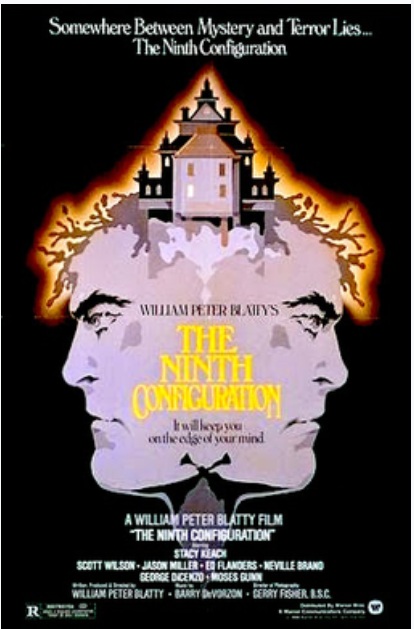
Some films defy easy description and that’s certainly the case with 1980’s The Ninth Configuration.
The film opens with a shot of a castle sitting atop of a fog-shrouded mountain. A voice over tells us that, in the early 70s, the castle was used by the U.S. government to house military personnel who were suffering from mental illness. Inside the castle, the patients appear to be left to their own devices. Lt. Reno (Jason Miller) is trying to teach dog how to perform Shakespeare. Astronaut Billy Cutshaw (Scott Wilson) is haunted by the thought of being alone in space and refuses to reveal why he, at the last minute, refused to go to the moon. The men are watched over by weary and somewhat sinister-look guards, who are played by actors like Joe Spinell and Neville Brand.
Colonel Kane (Stacy Keach) shows up as the new commandant of the the castle. From the first minute that we see Kane, we get the feeling that there might be something off about him. Though he says that his main concern is to help the patients, the man himself seems to be holding back secrets of his own. With the help of Colonel Fell (Ed Flanders, giving an excellent performance), Kane gets to know the patients and the guards. (Despite the objections of the guards, Kane says that his office must always be unlocked and open to anyone who want to see him.) He takes a special interest in Cutsaw and the two frequently debate the existence of God. The formerly religious Cutshaw believes the universe is empty and that leaving Earth means being alone. Kane disagrees and promises that, should he die, he will send proof of the afterlife. At night, though, Kane is haunted by dreams of a soldier who went on a murderous rampage in Vietnam.
The film start out as a broad comedy, with Keach’s smoldering intensity being matched with things like Jason Miller trying to get the dogs to perform Hamlet. As things progress, the film becomes a seriously and thoughtful meditation on belief and faith, with characters like Kane, Billy, and Colonel Fell revealing themselves to be quite different from who the viewer originally assumed them to be. By the time Kane and Cutshaw meet a group of villainous bikers (including Richard Lynch), the film becomes a horror film as we learn what one character is truly capable of doing. The film then ends with a simple and emotional scene, one that is so well-done that it’ll bring tears to the eyes of those who are willing to stick with the entire movie.
Considering all of the tonal shifts, it’s not surprising that the Hollywood studios didn’t know what to make of The Ninth Configuration. The film was written and directed by William Peter Blatty, the man who wrote the novel and the script for The Exorcist. (The Ninth Configuration was itself based on a novel that Blatty wrote before The Exorcist.) By most reports, the studio execs to whom Blatty pitched the project were hoping for another work of shocking horror. Instead, what they got was an enigmatic meditation on belief and redemption. The Ninth Configuration had the same themes as The Exorcist but it dealt with them far differently. (Because he wrote genre fiction, it’s often overlooked that Blatty was one of the best Catholic writers of his time.) In the end, Blatty ended up funding and producing the film himself. That allowed him complete creative control and it also allowed him to make a truly unique and thought-provoking film.
The Ninth Configuration was probably too weird for the Academy. Though it received some Golden Globe nomination, The Ninth Configuration was ignored by the Oscars. Admittedly, 1980 was a strong year and it’s hard to really look at the films that were nominated for Best Picture and say, “That one should be dropped.” Still, one can very much argue that both Blatty’s script and the atmospheric cinematography were unfairly snubbed. As well, it’s a shame that there was no room for either Stacy Keach or Scott Wilson amongst the acting nominee. Keach, to date, has never received an Oscar nomination. Scott Wilson died in 2018, beloved from film lovers but never nominated by the Academy. Both of them give career-best performances in The Ninth Configuration and it’s a shame that there apparently wasn’t any room to honor either one of them.
The Ninth Configuration is not a film for everyone but, if you have the patience, it’s an unforgettable viewing experience.
In the 1976 film StayHungry, Jeff Bridges plays Craig Blake.
When we first meet Craig, he doesn’t have much of a personality, though we still like him because he’s played by Jeff Bridges. Living in Alabama, he’s a young rich kid who, after the death of his parents, divides his time between his nearly empty mansion and his country club. Craig suffers from a good deal of ennui and seems to spend a lot of time writing letters to his uncle in which he promises that he’s going to eventually get his life together. Craig eventually gets a job at a real estate firm that is managed by Jabo (Joe Spinell). We know that the real estate firm is shady because Joe Spinell works there.
Craig is assigned to handle the purchase of a small gym so that he can eventually close the place and allow it to be torn down to make room for an office building. However, Craig soon falls for the gang of colorful eccentrics whose lives revolve around the gym and bodybuilder Joe Santo (Arnold Schwarzenegger, who gets an “introducing” credit, even though this was his fourth film). The friendly Franklin (Robert Englund) is Santo’s “grease” man. Anita (Helena Kallianiotes) is tough and can kick anyone’s ass. The receptionist, Mary Tate (Sally Field), is a free spirit with whom Craig soon falls in love. In fact, the only less than likable person at the gym is the former owner, Thor Erickson (R.G. Armstrong), a heavy-drinking perv who has a hole in the floor of his office that he uses to peek down at the women’s locker room.
There’s not much of a plot here. Instead, the film plays out in a rather laid back manner, with Santo befriending Craig and showing him the joy of embracing life. Arnold Schwarzenegger actually won an award (well, a Golden Globe) for his performance here and it must be said that he’s very good as the gentle and easy-going Santo. Because he’s huge and he’s Schwarzenegger, we expect him to be intimidating. Instead, he’s a soft-spoken guy who is quick to smile and who doesn’t even get upset when he finds out that Mary Tate and Craig are now involved. There’s even a surprising scene where Joe Santo picks up a fiddle and starts playing with a bluegrass band. Schwarzenegger is so likable here that it’s easy to wonder where his career might have gone if he hadn’t become an action star. Even early in his career (and when he was still speaking with a very thick accent), Schwarzenegger shows off a natural comic timing. He’s fun to watch.
In fact, he’s so much fun that the rest of the film suffers whenever he’s not onscreen. The cast is full of talented people but the film’s loose, plotless structure keeps us from truly getting too invested in any of them. (Santo is training for Mr. Universe so at least he gets an actual storyline.) Sally Field and Jeff Bridges are cute together but their romance is never quite as enchanting as it seems like it should be. The main problem with the film is that, when it ends, one still feels like Craig will eventually get bored with the gym and return back to his mansion and his country club. One doesn’t get the feeling that Craig has been changed so much as Craig just seems to be slumming for the heck of it.
There are charming moments in StayHungry. I’m a Southern girl so I can attest that the film captured the feel of the South better than most films. If you’re a Schwarzenegger fan, you have to see this film because it really does feature Arnie at his most charming and natural. Unfortunately, despite all that, the film itself never really comes together.
Every Monday night at 9:00 Central Time, my wife Sierra and I host a “Live Movie Tweet” event on X using the hashtag #MondayMuggers. We rotate movie picks each week, and our tastes are quite different. Tonight, Monday June 2nd, we are showing FAREWELL, MY LOVELY (1975) starring Robert Mitchum, Charlotte Rampling, John Ireland, Sylvia Miles, Anthony Zerbe, Harry Dean Stanton, Jack O’Halloran, Joe Spinell, and Sylvester Stallone.
FAREWELL, MY LOVELY finds Los Angeles private eye Philip Marlowe being hired by paroled convict Moose Malloy to find his girlfriend Velma, a former seedy nightclub dancer. All kinds of intrigue ensues as Robert Mitchum puts his droopy-eyed, world-weary spin on the famous detective!
So join us tonight for #MondayMuggers and watch FAREWELL, MY LOVELY! It’s on Amazon Prime. The trailer is included below:
I’m guessing it started with JAWS (1975) and JAWS 2 (1978) since they played often on Fox-16 out of Little Rock when I was a kid, but I’ve been a fan of actor Roy Scheider for as long as I can remember. He’s one of those actors who has his own section in my massive collection of physical movie media. I’ve read about every film he’s ever made, and I’ve watched most of them. Surprisingly, THE SEVEN-UPS is the first Roy Scheider film I’ve written about on The Shattered Lens.
NYPD detective Buddy Manucci (Roy Scheider) leads a team of elite cops, known as the “seven-ups.” They’ve acquired this nickname because most of the criminals they arrest receive sentences that are 7 years and longer, which makes their superiors on the force very happy. Granted, the team does use a variety of unorthodox methods to find and arrest the criminals, which can also rub their superiors and some of their fellow cops the wrong way. Buddy’s childhood friend Vito Lucia (Tony Lo Bianco), an undertaker by trade who has his finger on the pulse of the criminal activities in his community, serves as an important snitch for the team, with his information often leading to major busts. Unbeknownst to Buddy, prominent members of various organized crime families and other white-collar criminals start getting kidnapped and held for ransom in the community. Buddy’s unaware of the full extent of the kidnappings, but he asks his old friend / snitch Vito about this when he actually witnesses the abduction of a crooked bail bondsman he’s following named Festa. We know that Vito is the mastermind behind all of the kidnappings, and his two main henchmen, Moon (Richard Lynch) and Bo (Bill Hickman), are impersonating cops just long enough to confuse and abduct the various criminals. When the Seven-Ups stake out a funeral meeting of various mobsters in the area, squad member Ansel (Ken Kercheval) is killed as part of a screwed-up abduction attempt. Buddy spots Moon and Bo trying to flee the area and tries to chase them down in an incredible car chase that ends when Buddy is almost decapitated in a violent collision with a parked 18-wheeler. With one of their own dead and with the wild chases through the streets, the members of the team are placed on suspension and even investigated as suspects for the kidnappings. Not content to just lay low during their suspensions, the seven-ups continue to try to figure out what’s going on, doing whatever it takes to get the information they need. When Buddy and his group start applying incredible pressure to some of the local mobsters about who shot Ansel, he gets information that ties the killing and the kidnappings to his friend Vito. This time when he meets with Vito, Buddy feeds him false information, thus setting a trap to bring the whole operation down.
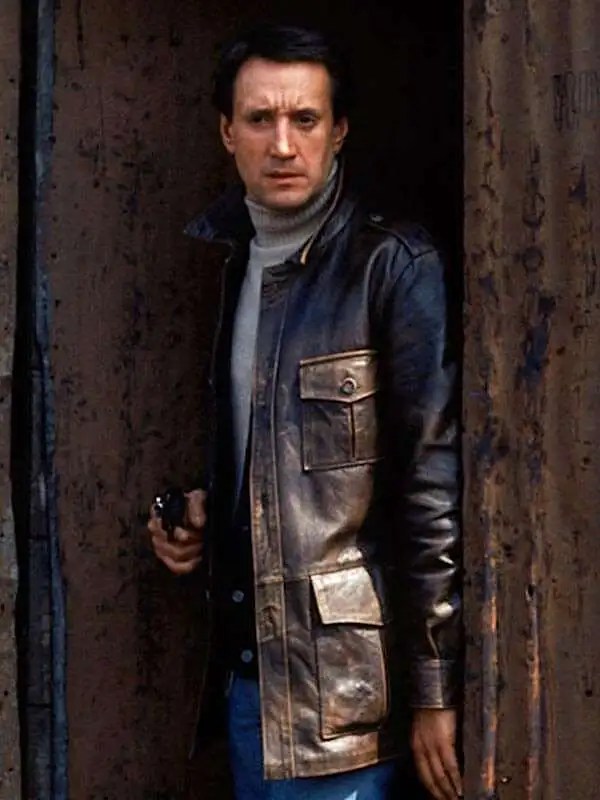
After viewing THE SEVEN-UPS again for the first time in a while, it continues to be my opinion that this movie is severely underrated. It’s a great cop film from the early 70’s, anchored by an excellent lead performance from Roy Scheider, who’s wearing one of the coolest leather jackets in the history of cinema. Coming in hot off the heels of THE FRENCH CONNECTION (1971), and with many connections to the Oscar winner, it seems that somehow this great film has fallen through the cracks over the years. I mean, how often do you hear people talk about this movie? THE SEVEN-UPS is directed by Philip D’Antoni, his only directorial credit, although he did serve as the Producer for both BULLITT (1968) and THE FRENCH CONNECTION. D’Antoni clearly values a good car chase sequence. THE SEVEN-UPS contains a thrilling car chase, which really isn’t that big of a surprise when you learn that stunt coordinator Bill Hickman, who plays the bad guy Bo in this film, coordinated the car chase sequences in BULLITT and THE FRENCH CONNECTION. This film features my personal favorite car chase sequence from any film that I’ve seen to date. Don Ellis composed the memorable musical score, a service that he also provided in THE FRENCH CONNECTION. I point out all of these ties to THE FRENCH CONNECTION because, in my humble opinion, the talent behind that film created another classic in THE SEVEN-UPS.
Complimenting Roy Scheider’s lead performance, THE SEVEN-UPS has a strong supporting cast. Tony Lo Bianco, Ken Kercheval (of DALLAS fame), Bill Hickman, and Richard Lynch are all quite memorable in their respective roles. I also like the 1973 New York City setting for the film. In movies like this and the following year’s DEATH WISH, we get to see a New York that no longer exists. To me, this only adds to the gritty realism of the film.
Overall, THE SEVEN-UPS is a movie I recommend without any reservations. If you’re a fan of 70’s cop thrillers, you simply can’t go wrong with this one.
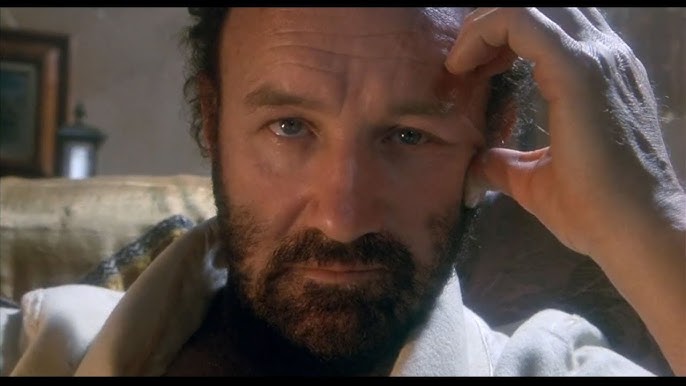
I’ve been thinking a lot about Gene Hackman as he recently celebrated his 95th birthday. He’s an incredible actor who has been a part of my life since I first really discovered my love of movies beginning in the mid-80’s. I’ve also been writing about Rutger Hauer every Sunday here on the Shattered Lens. Hackman and Hauer made a movie together back in 1983 called EUREKA, and to be honest, I almost forgot about it. It’s a movie I watched a long time ago and hadn’t watched again until today. It seemed like the perfect time for a revisit.
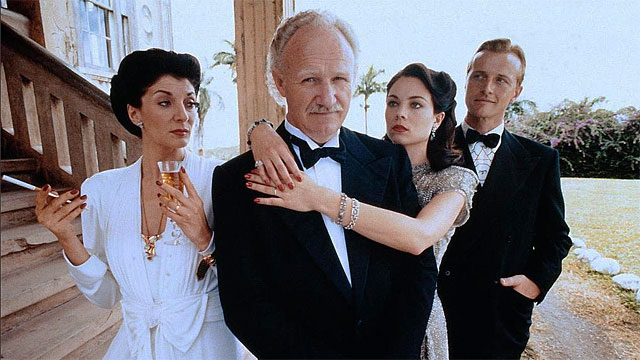
EUREKA opens with a stunning aerial shot that descends upon obsessed gold prospector Jack McCann (Gene Hackman) who’s fighting with a man on a snow-covered mountain in the Yukon territory. The man has asked Jack to partner with him in their search for gold, and Jack makes it clear that he will never “make a nickel on another man’s sweat.” Next, we see Jack as he’s walking through a nearly deserted town. In another unforgettable shot, Jack watches a man, who’s clearly gone mad, commit suicide just outside of the local “Claims office.” Before watching again today, that was the only scene that I could remember from my initial viewings of the film so many years ago. Next, we see Jack lying down below a tree at night, in windy, frigid temperatures, just about to freeze to death. Three hungry wolves have even approached ready for dinner. And this is where things get strange. Out of the blue, this clairvoyant madam (Helena Kallianiotes) from a local brothel sees him in her crystal ball, as a mysterious stone falls right next to him, starting a fire that warms him and drives away the wolves. He goes to see the madam at the brothel where she tells him that he will strike gold, but he “will be alone now.” Jack leaves the next morning and finds gold, rivers of gold. It’s another stunning sequence showing the obsessed man, who’s been searching for gold for 15 long and hard years, finally finding the object of his obsession.
Cut to 20 years in the future, where Jack is now the richest man on earth, living on his own Caribbean island. It also appears he may also be the unhappiest man on earth. He has all the money in the world, but there is no peace in his heart or soul. His wife Helen (Jane Lapotaire), who he was once deeply in love with, is now detached and addicted to alcohol. His daughter Tracy (Theresa Russell) has fallen in love and married Claude Maillot Van Horn (Rutger Hauer). Jack cannot stand Claude as he suspects that he seduced and married Tracy so he could get to his money. His best friend Charles (Ed Lauter) has somehow gotten mixed in with Miami mobsters, led by a guy named Mayakofsky (Joe Pesci) and his lawyer Aurelio D’Amato (Mickey Rourke), who want to force Jack to sell them land on his island so they can build a casino. Jack feels like everybody just wants a piece of him and his money. He has lost the joy in his life. The rest of the film plays out against this backdrop as Jack tries to separate Tracy from Claude, and as the mobsters try to force Jack to sell to them by any means necessary.
EUREKA is not a film that everyone will love, but I enjoyed watching it again after so many years. Director Nicolas Roeg, who also directed PERFORMANCE (1970), DON’T LOOK NOW (1973) and FULL BODY MASSAGE (1995), creates some truly amazing and brutal images that once seen are not easily forgotten. The scene where Jack McCann finds his huge vein of gold is so beautiful, but there are alternatively horrific scenes of brutal violence that play out almost to the point of overkill. The movie also takes some surprising twists and turns in the third act that you may not see coming. I always like it when a movie surprises me. It’s a melodramatic film that doesn’t have a lot of likable characters, but with a cast this good, I’m willing to go along with the filmmakers. In addition to the excellent work of Gene Hackman and Rutger Hauer, Theresa Russell has the important role as the daughter stuck between the man she loves and the dad who adores her. Her acting style exemplifies the melodrama of Roeg’s vision, so it works well in the context of this film. Jane Lapotaire has a couple of strong moments as Hackman’s alcoholic wife who yearns for days long gone when they were so in love. We were quite spoiled in the early 80’s when a movie could round out its already impressive cast with actors like Joe Pesci, Mickey Rourke, Ed Lauter, Corin Redgrave and Joe Spinell.
Nicolas Roeg appears to be trying to make deep statements about the meaning of life in EUREKA. I’m not a person who generally consumes films for deep meaning, but I thought it might be fun to at least take a surface-level view of some of the items I noticed while watching the movie. Jack spouts a lot of profound things throughout the movie, things that he feels describe him as a person. I mentioned one earlier when Jack tells the competing prospector prior to finding gold that, “I’ll never make a nickel off of another man’s sweat.” He will continue to use this saying throughout the film, even after he’s a rich, jaded, older man. The truth is that he would not have found the gold without the help of the clairvoyant madam, with her even passing away right after he hits the jackpot. In another scene at an extremely awkward dinner party, Jack tells his guests that the only rule that matters is the Golden Rule, “Do unto others as you would have them do unto you.” While I agree with the importance of this rule, Jack does not seem to follow the Golden Rule in any way that helps others or gives him any sense of peace or connection. Jack does not seem to understand the contradictions in his use of these phrases as played out in his own life, but I also think that his lack of understanding helps to illustrate a truth that plays out at times in many of our own lives. So often we’ll claim certain beliefs and values, but our lives as lived will be much more complex and often hypocritical. We can see them in Jack, but can we always see them in ourselves?
EUREKA also seems to be a movie that’s open to different interpretations based on who’s viewing the movie and where they are in life at that specific time. In a moment of clarity with his wife, Jack seems to recognize the hypocrisy in his life when he tells her “I once had it all… now I just have everything.” Jack is finally reflecting on the important things in his life, rather than dwelling on his current distrust of everyone around him. This final quote got me to thinking about my own life and just how different I am as a man in my early 50’s compared that naïve 20-year-old who first watched this film. I didn’t know what it was like to chase my dreams, catch them, and then try to figure out how to keep striving with a purpose. I didn’t know what it was like to be married with the responsibility of loving my wife and genuinely caring about her needs, through both the good times and the bad times. I didn’t know what it was like to be a dad who wanted nothing but true happiness for his children. Jack has lived through these specific opportunities in life, and we can see how he’s dealt with them. Each of these things have now played out in my own life. There have been times that I’ve failed, and there have been times that I’ve succeeded. I just keep reminding myself to try to focus on the things that matter and not get distracted by the things that don’t. Even now, it’s not always easy to do.
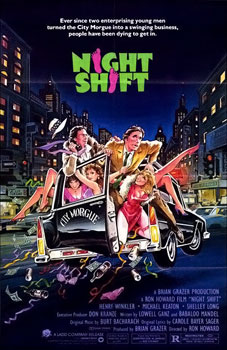
Chuck Lumley (Henry Winkler) was a Wall Street wizard until the stress of the job started to give him ulcers. He dropped out of the rat race, got a less stressful job as an attendant at a New York City morgue, and eventually met and became engaged to Charlotte (Gina Hecht). When Chuck’s supervisor decides to give Chuck’s day shift to his new guy, Chuck is promoted to the night shift. “He has the same last name as you,” Chuck says when he learns the about the new employee. “Yeah, I think he’s my nephew or something,” his supervisor replies.
Chuck finds himself working nights with “Billy Blaze” Blazejowski (Michael Keaton), a hyperactive “idea man,” who has so many brilliant plans that he has to carry around a tape recorder so he doesn’t forget them. A typical Billy Blaze idea is to battle litter by creating edible paper. Another one is to rent out the hearse as a limo and give rides to teenagers. Chuck may not be happy about his new shift or coworker but he is happy that he shares his new work schedule with his upstairs neighbor, Belinda Keaton (Shelley Long). Belinda is a high-class prostitute who first meets Chuck when she comes by the morgue to identify the body of her pimp. When Chuck discovers that Belinda needs a new pimp, he and Billy take on the job themselves, which brings them into conflict with not only the vice cops but also with Pig (Richard Belzer) and Mustafa (Grand L. Bush).
Raunchy but good-hearted, Night Shift has always been one of my favorite comedies. Along with being Ron Howard’s first movie for grown-ups, it also featured Michael Keaton in his first lead role. Keaton is both funny and surprisingly poignant as Billy. He’s hyperactive and impulsive and doesn’t think things through but his friendship with Chuck is real and later on in the movie, he reveals himself to have more depth than he lets on. Also giving good performances are Henry Winkler and Shelley Long, two performers better-known for their television work than their film roles. With his role here, Winkler proved that he was capable of playing more than just the Fonz. Shelley Long has probably never been better (or sexier) than she was in this film. The scene where she makes breakfast for Chuck is unforgettable. Even though she’s playing a stock character, the prostitute with a heart of gold, Shelley Long brings her own unique charm to the role and makes Belinda seem like a real person.
Night Shift starts out strong but falters slightly during its second hour, when Chuck and Billy seem to magically go from being nerdy morgue attendants to successful pimps overnight. Some of the violence feels out-of-place in what is essentially a buddy comedy with a dash of romance. It’s still a funny movie that is full of memorable one liners and good performances. As you might expect from Ron Howard, Night Shift is a surprisingly good-hearted look at the business of sex. Ron Howard has directed a lot of films since but few of them are as much fun as Night Shift.
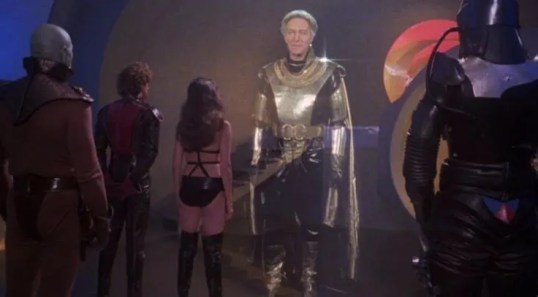
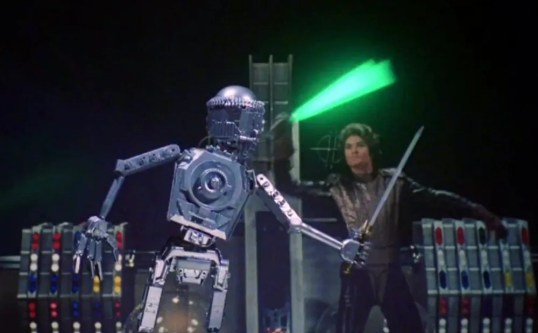
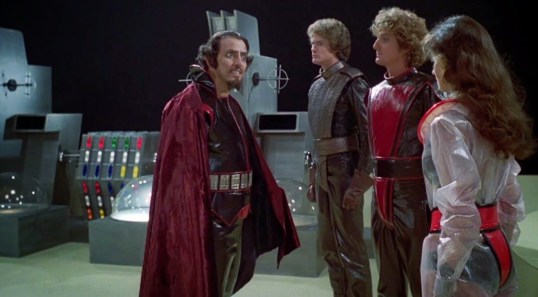
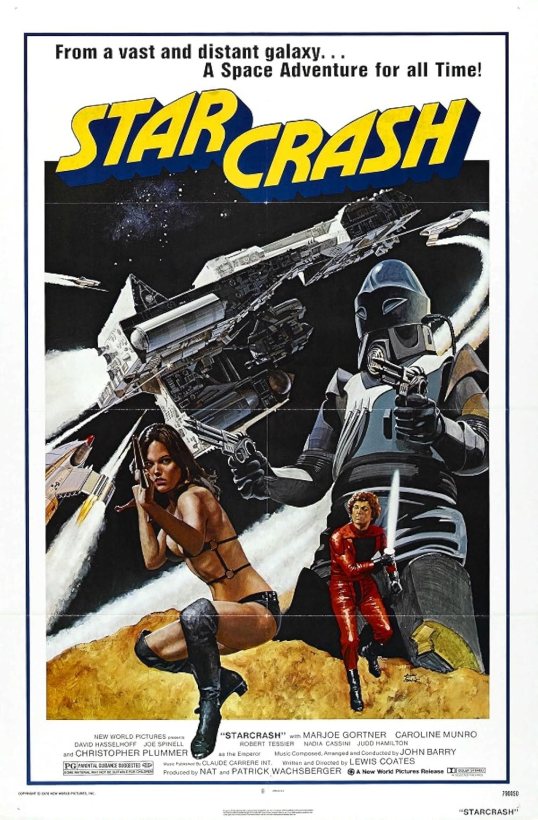
First released in 1978, Starcrash takes place in a galaxy that is probably far, far away. The evil Count Zath Arn (Joe Spinell) is attempting to overthrow the benevolent Emperor (Christopher Plummer). Zath Arn has built a weapon that is so large and so powerful that it can only be hidden inside of another planet. (“Like a Death Star?” you say. Hush, don’t go there….) The Emperor’s son, Prince Simon (David Hasselhoff), led an expedition in search of the weapon but a surprise attack of glowing red lights led to his ship crashing on the unknown planet. Simon is missing and Zath Arn’s power is growing.
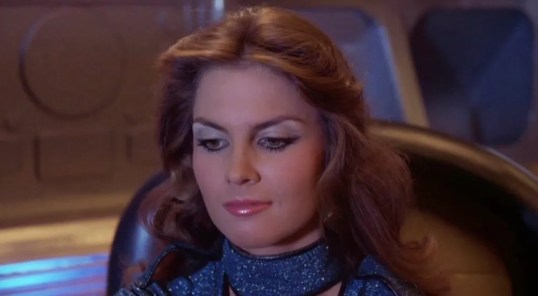
Two legendary smugglers — Stella Starr (Caroline Munro) and the enigmatic Akton (Marjoe Gortner) — are released from prison and tasked with tracking down both the weapon and Simon. (Stella was already in the process of escaping when she got the news of her release.) Accompanied by the duplicitous Thor (Robert Tessier) and the loyal Elle (Judd Hamilton), a robot with a thick Southern accent, Stella and Akton set out to explore the haunted stars.
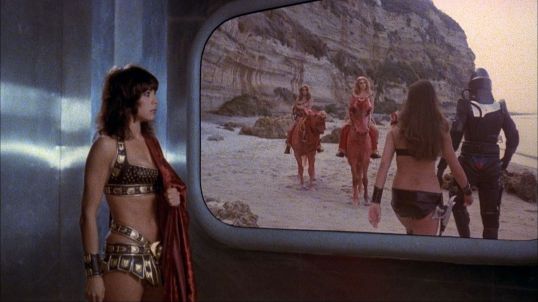
It’s a journey that leads them to …. well, actually, it only leads them to three planets. It turns out that the weapon wasn’t that well-hidden after all. Still, one planet is populated by Amazons and protected by a giant, tin robot. Another planet is populated by cannibals who wear stone masks. And then there’s an ice planet where the clouds race across the sky while Stella and Elle try to make it back to their ship without freezing to death. And if that’s not enough to make things exciting, this film also features David Hasselhoff with a light saber!
There’s no point in denying that Starcrash would never have been made if not for the success of the first Star Wars. Indeed, the film even begins with an opening crawl and features a shot that is almost a recreation of the first scene in Star Wars. However, director Luigi Cozzi doesn’t limit himself to just mining Star Wars for inspiration. The giant tin robot owes a huge debt to the creations of Ray Harryhausen. The judge that sentences Stella and Akton to prison is the same talking head that appeared in Invaders From Mars. A scene in which Stella explores an abandoned spaceship owes more than a little to 2001: A Space Odyssey. Even Akton, with his telepathic powers, seems like he could have stepped out of an episode of Star Trek.
Starcrash makes no secret of its influences but it’s such an energetic and good-natured film that all of the borrowing feels like like a rip-off and more like a very affectionate homage. It’s obvious that director Luigi Cozzi loved the films from which he borrowed and that love is present in every frame of Starcrash. Starcrash is a fast-paced space adventure and it’s a lot of fun. It’s certainly more fun than any of the recent entries in the Star Wars franchise. Working with a low-budget, an energetic cast, and some surprisingly creative special effects, Cozzi crafts a genuinely entertaining movie. Marjoe Gortner was never better than he was in Starcrash. Christopher Plummer, to his credit, brings a truly noble bearing to the role of the Emperor. Joe Spinell obviously understood that his role didn’t require subtlety and he delivers all of his lines like a villain in an old time serial. As for David Hasselhoff …. he’s the Hoff and he brings his trademark earnestness to the role of Simon. Starcrash is the best film that Cozzi ever directed.
A good deal of the success of Starcrash is due to Caroline Munro, who gives such a committed and likable performance as Stella Starr that it’s hard not to mourn the fact that Cozzi was never able to make any more films about the character. As played by Munro, Stella Starr is a smart, confident, and strong. Stella loves doing what she does and it’s impossible not share her joy when she announces she’s taking the ship into “hyperspace.” Even though Stella spends the majority of the film running around in a leather bikini, Munro brings a definite touch of class to the role. No one is going to push Stella Starr around and certainly, no one is going to destroy the Galaxy on her watch. Thank to Caroline Munro’s fearless performance, Starcrash is one of the most empowering science fictions ever made.
Starcrash ends with hints of a possible sequel but sadly, there never came to be. (Not surprisingly, there was an unrelated film that was advertised as being a sequel but which was actually just a softcore science fiction version of Lady Chatterley’s Lover.) It’s a shame. Stella Starr definitely deserved to have many more adventures.
Since Sunday is a day of rest for a lot of people, I present #SundayShorts, a weekly mini review of a movie I’ve recently watched.
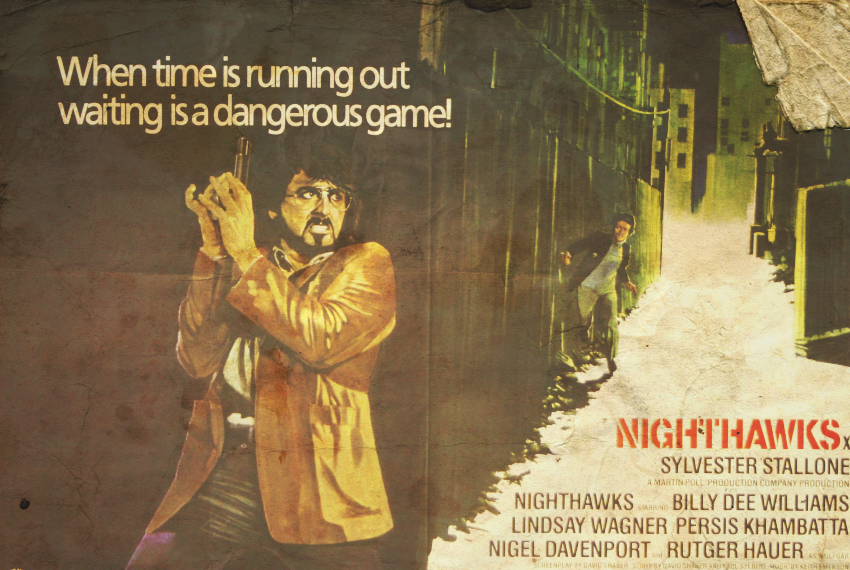
Deke DaSilva (Sylvester Stallone) and Matthew Fox (Billy Dee Williams) are two badass New York City Cops. Wulfgar (Rutger Hauer) is one of the most dangerous terrorists in the world. When it’s suspected that Wulfgar is in New York City, DaSilva and Fox are transferred to an elite anti-terrorist squad, led by the British expert Peter Hartman (Nigel Davenport). Will they be able to find Wulfgar and stop him before it’s too late?
I’m a big fan of NIGHTHAWKS. The performances from Stallone, Williams, and Hauer are all excellent. Hauer is especially good as the terrorist, Wulfgar. He knocks it out of the park. The action is hard hitting at times, and the tension builds nicely throughout the film, leading to its audience pleasing conclusion. Definitely recommended for fans of action movies and the stars!
Five Fast Facts:
Dutch actor Rutger Hauer was a huge star in the Netherlands when NIGHTHAWKS was made. This is his American film debut.
Sylvester Stallone and Rutger Hauer clashed early and often while making NIGHTHAWKS. The first day on the set, Rutger Hauer had to film a violent action scene. While filming the sequence, Hauer was injured when a cable that would yank him to simulate the force of being shot was pulled too hard, straining his back. Afterward, Hauer discovered that the cable was pulled with such force on Sylvester Stallone’s orders. Hauer threatened Stallone that he would “break his balls” if he ever did something like that again. Reportedly, they clashed often on the film from this point forward.
The director of NIGHTHAWKS, Bruce Malmuth, played the ring announcer of the All-Valley karate tournament at the end of THE KARATE KID. I was 12 years old when I saw THE KARATE KID, and I wanted to be the karate kid. It’s one of my favorite movies, leading to a lifetime crush on Elizabeth Shue.
Reportedly, during the exciting subway chase sequence, Rutger Hauer continually outran Stallone, who is known for his competitive streak. This is one of my favorite sequences in the film, and Hauer does look extremely fast.
If you’re looking for a reason to upgrade to the Shout! Factory blu ray…the Universal Pictures widescreen DVD omits the use of “Brown Sugar” by The Rolling Stones and “I’m a Man” by Keith Emerson. The 2016 Blu-ray release from Shout! Factory adds them back.



 Through the Shattered Lens