Horror Film Review: Exorcist II: The Heretic (dir by John Boorman)


Exorcist2poster

The Exorcist is one of the greatest horror films of all time and a personal favorite of mine.  But what about Exorcist II: The Heretic?  Well, it would be a bit of an understatement to say that The Heretic has not quite received the amount of critical acclaim as the first film.  Since it was first released in 1977, The Heretic has been widely considered to be one of the worst sequels of all time.  It’s a film that is often cited as evidence as to why not all successful films need a follow-up.

Myself, I have sat through The Heretic twice.  And yes, it is a pretty bad film but I have to admit that I enjoyed it each time that I saw it.  It’s not a scary film at all.  It’s not a successful horror film.  But, as an unintentional comedy, it’s hilarious.

The Heretic opens four years after the end of The Exorcist.  Father Merrin (Max von Sydow) is dead, having had a heart attack during the first film while performing an exorcism on Regan MacNeil (Linda Blair).  In the years since, some in the Vatican have cast doubt on whether or not Merrin actually performed exorcisms.  It turns out that, contrary to everything that we saw in the first film, Father Merrin was actually something of a rebel.  His teachings are controversial.  For instance, he was convinced that everyone has latent psychic powers and that the demon Pazuzu possesses those who have the potential to be the strongest psychics.  Why?  Because those people have the ability to lead humanity into a shared global consciousness and…

Well, it gets a little bit complicated.  That’s one of the big differences between The Exorcist and Heretic.  The Exorcist kept things relatively simple.  The Heretic drags in a lot of metaphysical argle bargle.

The deceased Father Merrin has been brought up on charges of heresy.  The Cardinal (Paul Henreid, many, many years after Casablanca), assigns Father Lamont (Richard Burton) to investigate the circumstances surrounding Father Merrin’s final exorcism.

The presence of Richard Burton is what elevates Heretic from merely being bad to being so bad that it’s good.  As written, Father Lamont is supposed to be something of a naive idealist, someone who never met Father Merrin but who has been intrigued by his writings.  Reportedly, several youthful actors turned down the role and eventually, production decided to make Lamont an older man and they ended up casting Richard Burton.  Speaking in a shaky rasp and staring at the camera with bloodshot eyes, Burton appears to be at the height of his famous self-loathing in this film.  Burton is so miscast as an idealistic priest that the film becomes fascinating to watch.  Occasionally, the film tries to make us suspect that Lamont himself may be possessed but with Burton snarling his way through the role, how could anyone tell the difference?

Lamont tracks Regan down in New York.  Regan doesn’t remember a thing about the exorcism and appears to be an overly happy teenage actress.  (A good deal of the movie is devoted to her rehearsing a big dance number.)  She is under the care of psychiatrist Gene Tuskin (Louise Fletcher).  Tuskin has a device called the Synchronizer.  When two people are hooked up to it, they can literally see into each other’s minds.  They can share the same memories.  They can … wait a minute.  What the Hell?  The Synchronizer essentially appears to be little more than a blinking light but it can actually allow you to enter into someone else’s mind?  Doesn’t that seem like that should be a big deal?

Well, it’s not.  Everyone pretty much just shrugs and accepts it…

Through the use of the Synchronizer, Reagan, Lamont, and Tuskin get to watch a lot of scenes from the first Exoricst.  It also allows Father Lamont to have visions of Africa and another exorcism, this one involving a young boy named Kokumo.

This leads to one of my favorite parts of the film; Richard Burton wandering around a dusty African market and randomly telling people, “I am looking for Kokumo.”  It turns out that Kukomo has grown up to be a doctor and he’s now played by James Earl Jones, who appears to be amused by his dialogue.  Also showing up in the film’s Africa scenes is Ned Beatty.  Beatty plays a pilot who flies Lamont to Kokumo’s village.  “Have you come here before?” Beatty asks.  “Once … on the wings of a demon,” Lamont replies.

Well, okay then…

The first Exorcist worked largely because William Friedkin directed it as if he was making a documentary.  John Boorman takes the exact opposite approach here, trying to turn a cheap sequel into a metaphysical meditation on good, evil, and nature.  It’s amazingly pretentious and it would actually be rather annoying if not for the fact that Burton doesn’t make the slightest bit of effort to come across as being in any way emotionally or intellectually invested in his over-the-top dialogue.  When you combine Burton’s overwhelming cynicism with Linda Blair’s nearly insane perkiness, Louise Fletcher’s genial confusion, and James Earl Jones’s cheerful humor, the end result is something that simply has to be seen to be believed.

So, yes, The Heretic is as bad as you’ve heard.  But that doesn’t mean you shouldn’t watch it.

Film Review: The Greatest (1977, dir by Tom Gries and Monte Hellman)


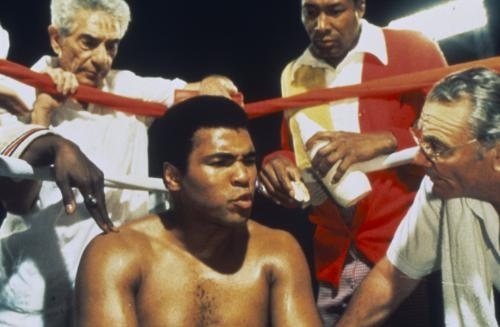
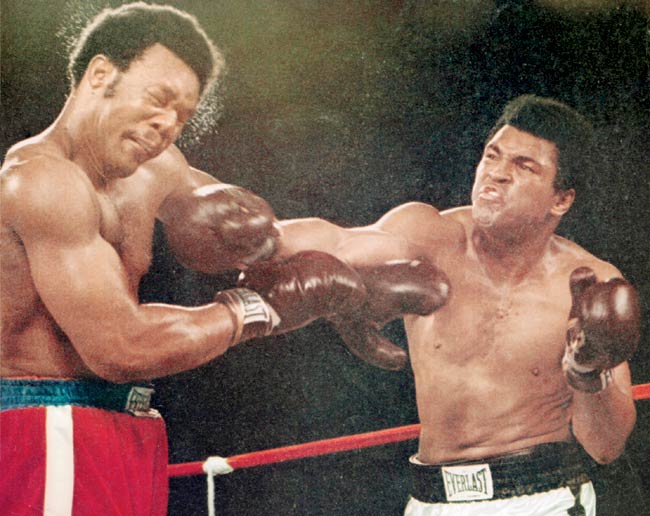
the_greatest_1977_portrait_w858The Greatest opens with 18 year-old Cassius Clay (played by Chip McAllister as a teenager and, as an adult, by Muhammad Ali himself) winning the light heavyweight gold medal at the 1960 Rome Olympics.  Returning home to Kentucky, Clay discovers that not even a gold medal can protect him from racism.  Angered after a restaurant refuses to serve him and his friend, Clay throws his gold medal into the Ohio River.  Under the training of Angelo Dundee (Ernest Borgnine), Clay turns pro and defeats Sonny Liston (Roger E. Mosley) for the heavyweight championship.  Inspired by Malcolm X (James Earl Jones), Clay also joins the Nation of Islam and changes his name to Muhammad Ali.  As heavyweight champion, Ali battles not only his opponents in the ring but racism outside of it.  The Greatest follows Ali as he loses his title for refusing to be drafted and concludes with the famous Rumble in the Jungle, where Ali won the title back from George Foreman.

Sadly, Muhammad Ali has never been the subject of a truly great feature film.  Even Michael Mann’s Ali failed to really capture the mystique that made Ali into such an iconic figure.  The Greatest is interesting because Ali plays himself.  Unfortunately, The Greatest proves that Ali may have been a great showman but he was not a natural actor.  You only have to watch the scene where Ali tries to hold his own with Robert Duvall to see just how stiff an actor Muhammad Ali really was.  Ali’s best scenes are the ones where he is trash talking his opponents or training.  The film opens with Ali jogging while George Benson sings The Greatest Love Of All, a scene that is made all the more poignant when you compare the athletic and confident Muhammad Ali of 1977 with the frail, Parkinson’s stricken Ali of today.

29Muhammad-Ali-1Instead of recreating any of Ali’s legendary fights, The Greatest instead uses actual footage of the matches.  The real life footage is the best part of the film.  After all these years, Ali’s fights against Sonny Liston, Joe Frazier, Ken Norton, and George Foreman remain exciting to watch.  Otherwise, The Greatest is too episodic and low budget to do justice to Muhammad Ali’s story.

If you want to see a truly great film about Ali and his legacy, watch the 1996 documentary When We Were Kings, 2009’s Facing Ali or 2013’s The Trials of Muhammad Ali.  Ali is such an iconic figure that it may be impossible for any feature film to properly do justice to his life and legacy.  These three documentaries come close.

(Director Tom Gries died during the filming of The Greatest.  The movie was completed by Monte Hellman.)

Shattered Politics #22: Dr. Strangelove Or How I Learned To Stop Worrying and Love the Bomb (dir by Stanley Kubrick)


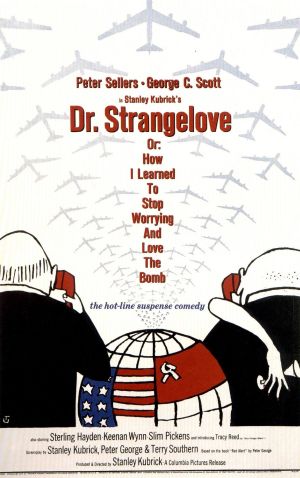
Dr._Strangelove_poster

“Gentlemen!  You can’t fight here!  This is the war room!” — President Merkin Muffley (Peter Sellers) in Dr. Strangelove: Or How I Learned To Stop Worrying And Love the Bomb (1964)

The next time you hear someone bragging about how their favorite politician is an intellectual who always acts calmly and rationally, I would suggest that you remember the example of President Merkin Muffley, one of the many characters who populate the 1964 best picture nominee, Dr. Strangelove or How I Learned To Stop Worrying and Love the Bomb.

As played by Peter Sellers, Merkin Muffley is the epitome of rational political action.  Speaking in a steady (if somewhat muffled) midwestern accent and always struggling to remain calm and dignified, Muffley keeps order in the War Room as the world edges closer and closer to apocalypse.

Just consider, for example, this scene where President Muffley calls the Russian leader (the nicely named Dimitri Kissoff) and explains that a little something silly has happened.

As Muffley explains in the above scene, Gen. Jack D. Ripper (Sterling Hayden) has gone crazy.  Convinced that the Russians have been sapping his precious bodily fluids, Gen. Ripper has ordered a nuclear strike on Russia.  Unfortunately, Russia has built a Doomsday Machine that, should Russia be bombed, will destroy the world.

While Muffley is at fist skeptical about a doomsday machine, his advisor, Dr. Strangelove (also played by Peter Sellers), explains that the doomsday machine not only exists but that it’s actually a pretty good idea.  The wheelchair-bound Dr. Strangelove speaks in a German accent and appears to have lost control over the left side of his body.  At random moments, his left arm shoots up in a Nazi salute.  At other times, his hand tries to strangle him.  Making these surreal moments all the more memorable is the fact that nobody in the War Room seems to notice or question them.

And, while it’s always tempting to dismiss a character like Dr. Strangelove as being an over-the-top caricature, the fact of the matter is that, following the end of World War II, several Nazi scientists ended up working for the U.S. government.  In many ways, the U.S. space program was the creation of a bunch of real-life Dr. Strangeloves.

Of course, President Muffley and Dr. Strangelove aren’t the only roles played by Peter Sellers in this film.  Sellers also plays Lionel Mandrake, a British officer who — as the result of an office exchange program — happens to be at Burpelson Air Force Base at the same time that Gen. Ripper orders the attack on Russia.

As famous as his Sellers’s performances as Dr. Strangelove and President Muffley may be, I actually think Mandrake is his best performance in the film.  In many ways, Mandrake is the audience’s surrogate.  He’s the one who gets to hear Ripper’s rambling explanation for why he launched an attack on Russia.  He’s the one who has to try to convince the hilariously unhelpful Col. Bat Guano (Keenan Wynn) to help him find a quarter so he can call the Pentagon.

(“You’re gonna have to answer to the Coca-Cola company,” Guano says, before shooting open a Coke machine to get change.)

Sellers plays Mandrake as a parody of the traditional, stiff upper lip British army officer.  Not only does that allow some great humor as Mandrake keeps a calm demeanor while listening to Ripper’s increasingly crazed monologue but it also allows Mandrake to be the only sane man in the movie.

(Of course, the whole point of Dr. Strangelove is that the world’s become so insane that one sane man can not make a difference. )

Sellers earned a best actor nomination for playing three different roles and he deserved it but, for me, the two best performances in the film come from Slim Pickens and George C. Scott.

Pickens, of course, is the bomber pilot who ends up riding an atomic bomb like a bull in a rodeo.  As a character, Maj. Kong may be a bit too much of a spot-on stereotype but Pickens brings such sincerity to the role that it doesn’t matter.  Oddly enough, you feel almost happy for him when he rides that bomb to his death.  You know that’s exactly how he would have wanted to go out.

And then there’s George C. Scott, playing the role of Gen. Buck Turgidson.  From the safety of the War Room, Turgidson looks forward to nuclear war and worries when President Muffley invites the Russian ambassador to join them.  (“But he’ll see the big board!” Turgidson exclaims.)  Turgidson is both hilariously stupid and hilariously confident.  Perhaps my favorite Turgidson moment comes when he trips, falls, and stands back up without once losing his paranoid train of thought.

(Though he doesn’t have a big role, James Earl Jones makes his film debut in Dr. Strangelove.  The way he delivers the line “What about Major Kong?” makes me laugh every time.)

50 years after it was first released, Dr. Strangelove remains a comic masterpiece of a nightmare, a film that proves that political points are best made with satire and not sermons.

6 More Film Reviews From 2014: At Middleton, Barefoot, Divergent, Gimme Shelter, The Other Woman, and more!


Let’s continue to get caught up with 6 more reviews of 6 more films that I saw in 2014!

At Middleton (dir by Adam Rodgers)

“Charming, but slight.”  I’ve always liked that term and I think it’s the perfect description for At Middleton, a dramedy that came out in January and did not really get that much attention.  Vera Farmiga is a businesswoman who is touring colleges with her daughter (Taissa Farmiga, who is actually Vera’s younger sister).  Andy Garcia is a surgeon who is doing the same thing with his son.  All four of them end up touring Middleton College at the same time.  While their respective children tour the school, Vera and Andy end up walking around the campus and talking.  And that’s pretty much the entire film!

But you know what?  Vera Farmiga and Andy Garcia are both such good performers and have such a strong chemistry that it doesn’t matter that not much happens.  Or, at the very least, it doesn’t matter was much as you might think it would.

Hence, charming but slight.

http://www.youtube.com/watch?v=i-b_mPVuNOI

Barefoot (dir by Andrew Fleming)

Well, fuck it.

Sorry, I know that’s not the best way to start a review but Barefoot really bothered me.  In Barefoot, Scott Speedman plays a guy who invites Evan Rachel Wood to his brother’s wedding.  The twist is that Wood has spent most of her life in a mental institution.  Originally, Speedman only invites her so that he can trick his father (Treat Williams) into believing that Speedman has finally become a responsible adult.  But, of course, he ends up falling in love with her and Wood’s simple, mentally unbalanced charm brings delight to everyone who meets her.  I wanted to like this film because I love both Scott Speedman and Evan Rachel Wood but, ultimately, it’s all rather condescending and insulting.  Yes, the film may be saying, mental illness is difficult but at least it helped Scott Speedman find love…

On the plus side, the always great J.K. Simmons shows up, playing a psychiatrist.  At no point does he say, “Not my tempo” but he was probably thinking it.

Divergent (dir by Neil Burger)

There’s a lot of good things that can be said about Divergent.  Shailene Woodley is a likable heroine.  The film’s depiction of a dystopian future is well-done. Kate Winslet has fun playing a villain.  Miles Teller and Ansel Elgort are well-cast.  But, ultimately, Divergent suffers from the same problem as The Maze Runner and countless other YA adaptations.  The film never escapes from the shadow of the far superior Hunger Games franchise.  Perhaps, if Divergent had been released first, we’d be referring to the Hunger Games as being a Divergent rip-off.

However, I kind of doubt it.  The Hunger Games works on so many levels.  Divergent is an entertaining adventure film that features a good performance from Shailene Woodley but it’s never anything more than that.  Considering that director Neil Burger previously gave us Interview with the Assassin and Limitless, it’s hard not to be disappointed that there’s not more to Divergent.

Gimme Shelter (dir by Ron Krauss)

Gimme Shelter, which is apparently based on a true story, is about a teenage girl named Apple (Vanessa Hudgens) who flees her abusive, drug addicted mother (Rosario Dawson).  She eventually tracks down her wealthy father (Brendan Fraser), who at first takes Apple in.  However, when he discovers that she’s pregnant, he demands that she get an abortion.  When Apple refuses, he kicks her out of the house.  Apple eventually meets a kindly priest (James Earl Jones) and moves into a shelter that’s run by the tough Kathy (Ann Dowd).

Gimme Shelter came out in January and it was briefly controversial because a lot of critics felt that, by celebrating Apple’s decision not to abort her baby, the movie was pushing an overly pro-life message.  Interestingly enough, a lot of those outraged critics were men and, as I read their angry reviews, it was hard not to feel that they were more concerned with showing off their political bona fides than with reviewing the actual film.  Yes, the film does celebrate Apple’s decision to keep her baby but the film also emphasizes that it was Apple’s decision to make, just as surely as it would have been her decision to make if she had chosen to have an abortion.

To be honest, the worst thing about Gimme Shelter is that it doesn’t take advantage of the fact that it shares its name with a great song by the Rolling Stones.  Otherwise, it’s a well-done (if rather uneven) look at life on the margins.  Yes, the script and the direction are heavy-handed but the film is redeemed by a strong performance from Vanessa Hudgens, who deserves to be known for more than just being “that girl from High School Musical.”

Heaven is For Real (dir by Randall Wallace)

You can tell that Heaven is For Real is supposed to be based on a true story by the fact that the main character is named Todd Burpo.  Todd Burpo is one of those names that’s just so ripe for ridicule that you know he has to be a real person.

Anyway, Heaven Is For Real is based on a book of the same name.  Todd Burpo (Greg Kinnear) is the pastor of a small church in Nebraska.  After Todd’s son, Colton, has a near death experience, he claims to have visited Heaven where he not only met a sister who died before he was born but also had a conversation with Jesus.  As Colton’s story starts to get national attention, Todd struggles to determine whether Colton actually went to Heaven or if he was just having a hallucination.

You can probably guess which side the movie comes down on.

Usually, as a self-described heathen, I watch about zero faith-based movies a year.  For some reason, I ended up watching three over the course of 2014: Left Behind, Rumors of War, and this one.  Heaven is For Real is not as preachy (or terrible) as Left Behind but it’s also not as much fun as Rumors of War.  (Rumors of War, after all, featured Eric Roberts.)  Instead, Heaven Is For Real is probably as close to mainstream as a faith-based movie can get.  I doubt that the film changed anyone’s opinion regarding whether or not heaven is for real but it’s still well-done in a made-for-TV sort of way.

http://www.youtube.com/watch?v=oDcaZ3StTfI

The Other Woman (dir by Nick Cassavetes)

According to my BFF Evelyn, we really liked The Other Woman when we saw it earlier this year.  And, despite how bored I was with the film when I recently tired to rewatch it, we probably did enjoy it that first time.  It’s a girlfriend film, the type of movie that’s enjoyable as long as you’re seeing it for the first time and you’re seeing it with your best girlfriends.  It’s a lot of fun the first time you see it but since the entire film is on the surface, there’s nothing left to discover on repeat viewings.  Instead, you just find yourself very aware of the fact that the film often substitutes easy shock for genuine comedy. (To be honest, I think that — even with the recent missteps of Labor Day and Men, Women, and Children — Jason Reitman could have done wonders with this material.  Nick Cassavetes however…)   Leslie Mann gives a good performance and the scenes where she bonds with Cameron Diaz are a lot of fun but otherwise, it’s the type of film that you enjoy when you see it and then you forget about it.

Quickie Review: Field of Dreams (dir. by Phil Alden Robinson)


“The one constant through all the years, Ray, has been baseball. America has rolled by like an army of steamrollers. It has been erased like a blackboard, rebuilt and erased again. But baseball has marked the time.” — Terence Mann

I have always been a fan of baseball. I would say that baseball has been the one thing which has always remained constant for me throughout the years. Other sports may be flashier, faster and more violent, but baseball I’ve always equated as part of America’s national identity. This is why 1989’s Field Of Dreams by Phil Alden Robinson continues to resonate for me and for legions of baseball fans everywhere.

The film is based off of the W.P. Kinsella’s novel, Shoeless Joe, and tells the story of one Ray Kinsella and his titular field of dreams. It’s a film which sees Ray not just building a baseball field in his field of corn despite financial problems bringing him and his family closer to losing everything, but it also sees him traveling across the country to find a reclusive writer in Terence Mann (J.D. Salinger in the novel). It’s afilm which offers an insight to what makes baseball and the American identity so intertwined as the film finally offers Ray a chance to finally realize that the very baseball field he has built in his cornfield has granted many a second chance to realize their dream. For this film that dream is to be able to play baseball once more and this second chance becomes important to the ghosts of baseball’s past who have fallen from baseball’s grace through a scandal which had them banned from the game they love.

I’ve never been a big Kevin Costner fan, but his work in this film as Ray Kinsella showed me why people saw in him talent as an actor and not just a pretty face up on the screen. His real-life love for baseball shows in his performance as Ray whose own love for baseball becomes a personal journey for redemption and reunion with a father who also shared his love for the sport. The performances by Amy Madigan as Ray’s supportive wife was quite good and allowed the character not to be eclipsed by Costner’s excellent work as Ray. Even James Earl Jones as the writer Terence Mann gives the film a level of gravitas which just added to the film’s intimate yet epic nature. But it’s the breakout performance by Ray Liotta as the ghost of baseball great Shoeless Joe Jackson. Liotta’s screentime was limited to mostly in the latter part of the film, but his presence dominated every moment he was on the screen.

Field of Dreams has been called just a good baseball film by some, but for many people who have seen and loved it see it as more than just a film about baseball. It’s a film that shows Americana at it’s best and most nostalgic. Shows how one sport has become such a positive influence on the relationship between children and their fathers. It’s a film that dares to show genuine affection and love to the idea of letting someone follow their dream despite many outside influences and obstacles trying to get in their way. There’s a reason the film was nominated for an Oscar Best Picture. Even voters who are so used to rewarding films that look at the darker and more depressing side of the human condition could see the inherent quality in a film which looks at the brighter and more hopeful side of the equation.