Happy birthday to me! Yes, I share my birthday with such luminaries as Charlie Chaplin, Christine McIntyre, Peter Ustinov, Henry Mancini, and coach Bill Belichick! Seeing as how we here in Massachusetts have a three-day weekend (Patriot’s Day on Monday), I’ll be pretty busy. But before I step away from the blogosphere for a few days, I thought I’d try to find something to share from the year I was born (yes, I’m THAT old!!).
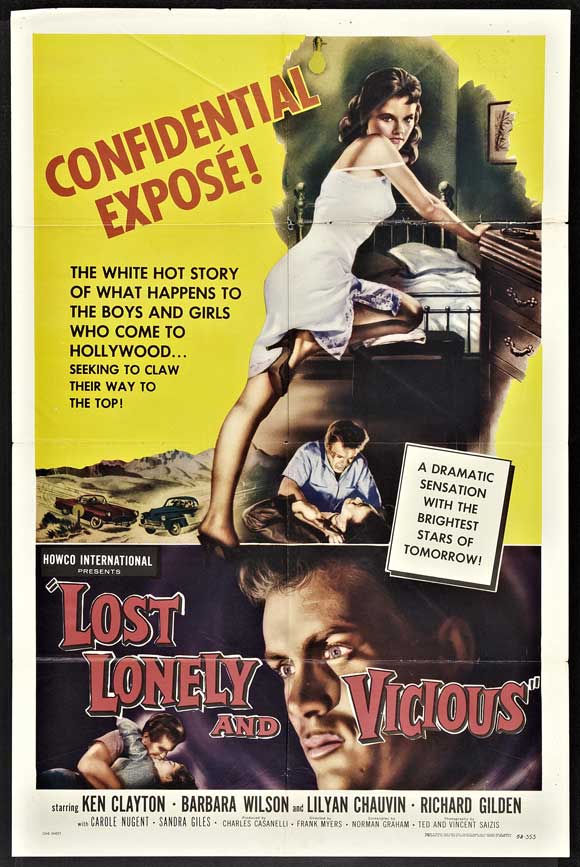
What I stumbled upon was LOST, LONELY, AND VICIOUS, a fictional retelling of the James Dean mystique, right down to the two leads (superficially) resembling Dean and his REBEL WITHOUT A CAUSE co-star, Natalie Wood. It’s the story of Johnny Dennis (initials JD, get it?), a young actor “obsessed with death” on the cusp of stardom. Despite by awful acting and wretched dialogue, I kind of enjoyed it. No accounting for taste, I guess! There aren’t any…
Traditionally, films about teenagers tend to age terribly. The language, the clothes, the attitudes, and even the humor; it’s all usually out-of-date within five years or so. One need only watch something like A Summer Place to both see how dated a film can become and to see how one generation’s idol can appear rather ludicrous to future generations. (And yes, I am talking about Troy Donahue…) What makes Rebel Without A Cause unique is that it’s a movie about teenagers that was released way back in 1955 and yet, nearly 60 years later, it still feels fresh and relatable.
Of course, it helps that the title character is played by James Dean who, to put it lightly, was no Troy Donahue.
Rebel Without A Cause tells the story of three alienated teenagers trying to survive in the suburbs of Los Angeles. (“…and they all came from good homes!” the film’s poster informs us.) Plato (Sal Mineo) is a painfully sensitive 15 year-old who has been abandoned by his parents and is being raised by the family’s maid. (Since this movie was made in 1955, the fact that Plato is gay is obvious but never explicitly stated.) Judy (Natalie Wood) is the girlfriend of Buzz (Corey Allen) and is acting out because she feels that’s the only way she can can get her father to pay attention to her. And then there’s Jim Stark (James Dean), whose family has just moved to Los Angeles and who is constantly in the middle of the fights between his overbearing mother (Ann Doran) and his weak-willed father (Jim Backus).
During Jim’s first day at high school, he not only manages to make an enemy when Buzz spots him attempting to flirt with Judy but he also gets to go on a field trip to the Griffith Observatory, where the students are told that the entire universe is going to end eventually. After the field trip, Buzz challenges Jim to a knife fight. Jim agrees only after the rest of Buzz’s gang (including a young Dennis Hopper) accuse him of being “chicken.” However, after a security guard breaks up the fight, Buzz challenges Jim to a “chicken run.”
(People in the 50s were obsessed with chickens.)
That night, Jim and Buzz both drive stolen cars towards the edge of a cliff. The first driver to jump out of his car loses. Before they start their engines, Buzz smiles and tells Jim, “I like you.” Yay! Jim’s finally made a friend! Uh-oh, Buzz just drove over the cliff and his car exploded! Well, so much for that friendship. Now, with Buzz’s gang swearing revenge and their parents incapable of understand what happened, Jim, Judy, and Plato are on the run. They end up hiding out in an abandoned house and find a brief moment of happiness before the gang and the police show up to ruin everything.
The challenge of reviewing Rebel Without A Cause is trying to find a new way to say what everybody already knows. Rebel Without A Cause is a great film that’s distinguished by Nicholas Ray’s sensitive direction and James Dean’s iconic performance in the lead role. Whenever I see Rebel Without A Cause, I’m always struck by just how much unexpected nuance there is Dean’s interpretation of Jim Stark. We always think of James Dean as being the epitome of cool and I think we tend to forget that, at least in the beginning of the film, Jim is anything but that. Instead, he’s awkward and shy. His attempts to flirt with Judy lead to her calling him “a real yo-yo.” As much as he tried to fit in with the rest of his classmates, he’s a permanent outsider. (Just consider what happens with his infamous “moooo” during the presentation at the observatory.) He has a lot to say but he doesn’t know how to say it and every time that he tries to express what he’s feeling, he’s ignored by adults who don’t have the patience to listen. Dean brings such a raw intensity to these scenes that I always find myself wanting to reach out and hug him and tell him that everything’s going to be okay, even though I know that it’s not. Even today, it’s still easy to see why every teenager in the 50s either wanted to be or to be with Jim Stark.
Also, whenever I watch the film, I’m reminded of how much I relate to the character of Judy. I think that’s because, when I was 16, I might as well have been Judy. Natalie Wood’s performance might not be as showy as James Dean’s but it’s equally effective.
Of course, one reason why Rebel Without A Cause has become iconic is because James Dean died shortly after filming ended. (In fact, some of his scenes had to be redubbed by Dennis Hopper, who reportedly could do an exact imitation of Dean’s voice.) It’s interesting to wonder what would have become of James Dean if he had lived. Would he have continued to be one of our best actors or would he have eventually been forgotten or forced to appear on television? Personally, I like to think that James Dean would have remained a great actor but he would have been too much of an iconoclast to remain in Hollywood. Eventually, in my alternative universe, James Dean moved to Europe and teamed up with Klaus Kinski to star in a series of spaghetti westerns. And they were great.
As for Rebel Without A Cause, it remains a great movie nearly 60 years after it was first made. And really, what more needs to be said?
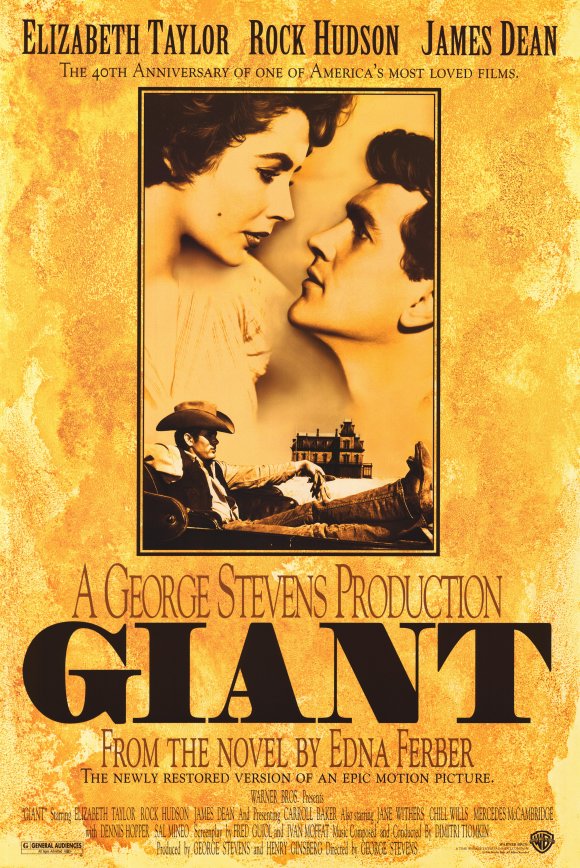
Let’s continue to embrace the melodrama by taking a look at the 1956 best picture nominee, Giant.
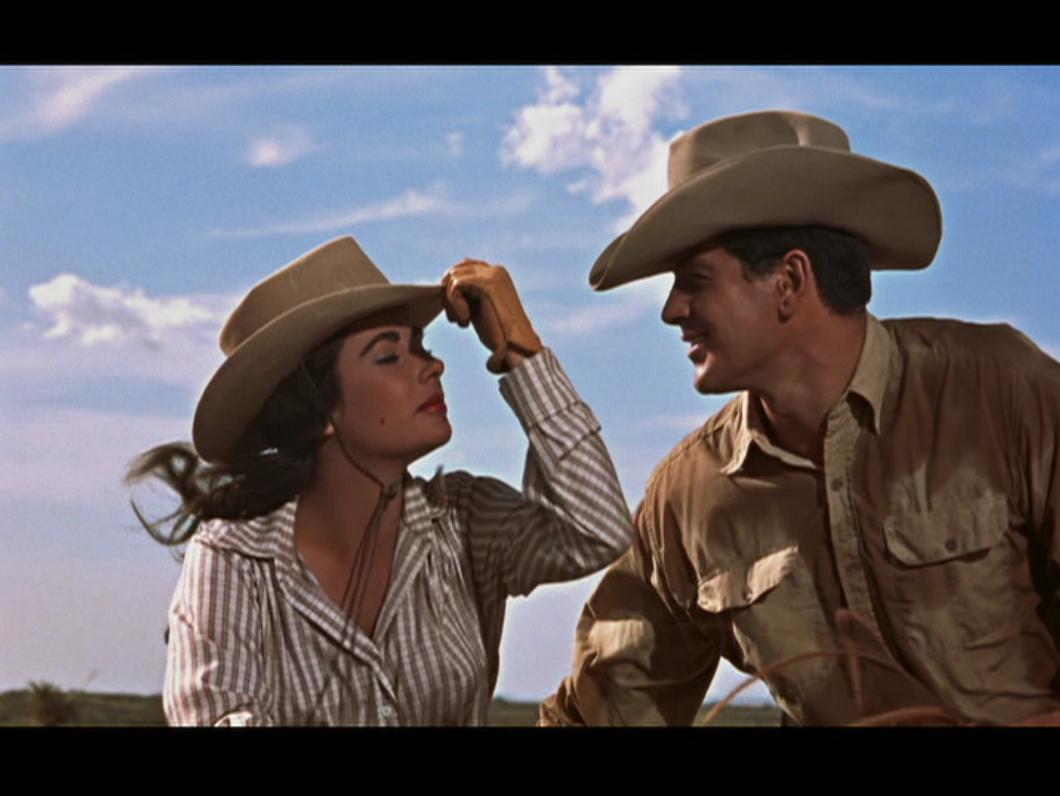
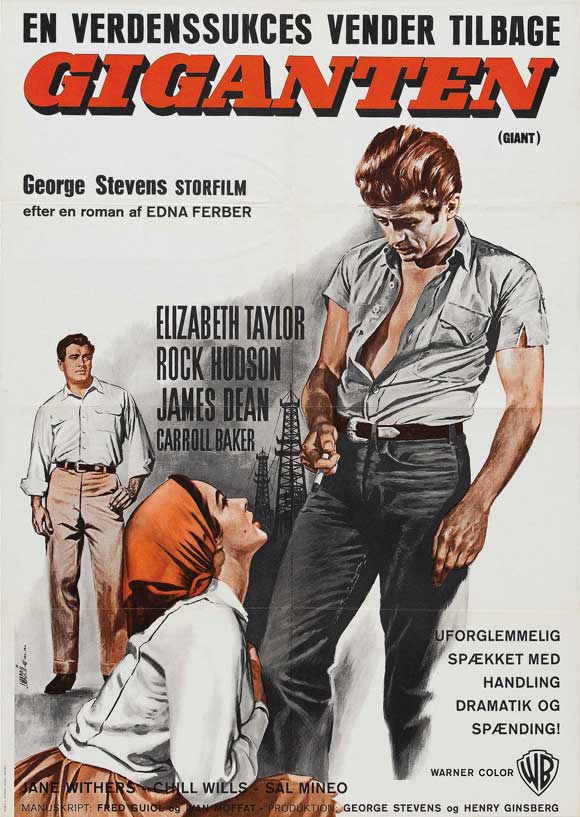
Giant is a film about my home state of Texas. Texas rancher Bick Benedict (Rock Hudson) goes to Maryland to buy a horse and ends up returning to Texas with a bride, socialite Lesley Lynnton (Elizabeth Taylor). At first, Lesley struggles to adapt to the harsh and hot Texas landscape. Bick’s sister, Luz (Mercedes McCambridge) takes an instant dislike to Lesley and Bick is annoyed by Lesley’s concern over the living conditions of the Mexicans that work on Bick’s ranch. It sometimes seems like the only person who appreciates Lesley is Jett Rink (James Dean), an ambitious ranch hand who secretly loves her and who is planning on becoming a rich man. That’s exactly what happens when oil is found on the land around Bick’s ranch. While Bick stubbornly clings to the past, oilman Jett represents both the future of Texas and the nation. Meanwhile, Bick and Lesley’s son (played by a very young Dennis Hopper) challenges his father’s casual bigotry when he falls in love with a Mexican girl.
Giant is appropriately named because it is a huge film. Clocking in at 201 minutes, Giant tells a story that spans several decades and features a big cast that is full of familiar faces, all struggling for their chance to somehow stand out from everyone else around them. Even the film’s wonderful panoramic shots of the empty Texas landscape only serve to remind us of how big the entire film is. To a certain extent, the size of Giant‘s production is to be understood. In the 1950s, Hollywood was having to compete with television and they did this by trying to make every film into a major event. You watch a movie like Giant and you practically hear the old Hollywood moguls shouting at America, “See!? You can’t get that on your precious TV, can you!?”
For those of us watching Giant today, the length is both a blessing and a curse. It’s a curse because the movie really is too damn long. The opening scenes drag and many of them really do feel superfluous. It’s hard not to feel that the real story doesn’t really start until about 90 minutes into the movie. And once the story really does get started, there’s still way too much of it for it all to be crammed into one sitting. Oddly enough, you end up feeling as if this extremely long film is still not telling you everything that you need to know. If Giant were made today, it would probably be a two-part movie on either HBO or Lifetime and it would definitely feature a lot more sex.
However, to be honest, one of the reasons that I did enjoy Giant was because it was as big as it was. I mean, the film is about Texas so of course it should be a little excessive! Everything’s bigger in Texas and that includes our movies. Add to that, Giant may be too long but it uses that length to deals with issues that are still relevant today — oil, immigration, and racial prejudice. Rock Hudson may not have been a great actor but he is at least convincing as he transitions from bigotry to tolerance.
But really, when it comes to Giant, most people are only interested in James Dean. And they definitely should be because Dean gives a great and compelling performance here. Dean brings all of the emotional intensity of the method to material that one would not naturally associate with method acting and the end result is amazing to watch. Giant was released after Dean had been killed in that infamous car wreck. I can only imagine what it must have been like to be sitting in a theater in 1956 and to see this compelling and charismatic actor towering above the world on the big screen while aware, all the time, that his life had already been cut short and he would never been seen in another film.
Even better, Dean’s new style of acting clashes perfectly with Hudson’s old style of acting, making the conflict between Bick and Jett feel all the more real and intense. Much as Bick represents old Texas and Jett represents the new Texas, Hudon and Dean represented the two sides of Hollywood: the celebrity and the artist. Needless to say, Dean wins the battle but, surprisingly, Hudson occasionally manages to hold his own.
I can’t necessarily say that Giant is an essential film. A lot of people are going to be bored by the excessive length. But if you’re a fan of James Dean or if you’re from Texas, Giant is a film that you need to see at least once.
Here’s a blast from the past: In 1954, James Dean and Paul Newman audition for Elia Kazan’s East of Eden. Dean, famously, was cast and earned his first posthumous Oscar nomination. (His second nomination came for his work in Giant.) Dean was 23 here. Newman was 29.