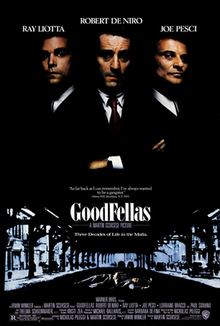
Lisa Marie Reviews An Oscar Nominee: Goodfellas (dir by Martin Scorsese)


First released in 1990 and continuously acclaimed ever since, Goodfellas did not win the Oscar for Best Picture.

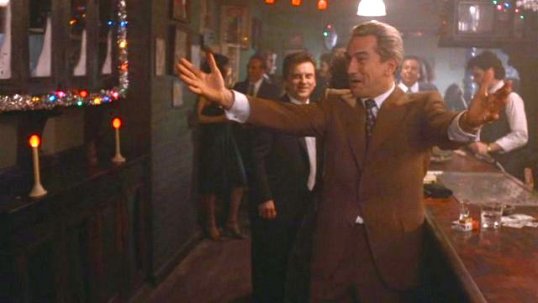
I’m always a bit surprised whenever I remember that.  Goodfellas didn’t win Best Picture?  That just doesn’t seem right.  It’s not the other films nominated that year were bad but Goodfellas was so brilliant that it’s hard to imagine someone actually voting for something else.  Seriously, it’s hard to think of a film that has been more influential than Goodfellas.  Every gangster film with a soundtrack of kitschy tunes from the 6os and 70s owes huge debt to Goodfellas.  Every actor who has ever been cast as a wild and out-of-control psycho gangster owes a debt to Joe Pesci’s performance as Tommy DeVito.  When Ray Liotta passed away two years ago, we all immediately heard him saying, “I always wanted to be a gangster.”  Robert De Niro’s Jimmy Conway remains the epitome of the ruthless gangster.  For many, Paul Sorvino’s neighborhood godfather redefined what it meant to be a crime boss.  Lorraine Bracco made such an impression as Karen Hill that it somehow seemed appropriate that she was one of the first people cast in The Sopranos, a show that itself would probably have not existed if not for Goodfellas.  Frank Sivero, Samuel L. Jackson, Tobin Bell, Debi Mazer, Vincent Gallo, Ileana Douglas, Frank Vincent, Tony Sirico, Michael Imperioli, Tony Darrow, Mike Starr, Chuck Low, all of them can be seen in Goodfellas.  It’s a film that many still consider to be the best of Martin Scorsese’s legendary career.  Who can forget Robert De Niro smoking that cigarette while Sunshine of Your Love blared on the soundtrack?  Who can forget “Maury’s wigs don’t come off!” or “Rossi, you are nothing but whore!?”  Who can forget the cheery Christmas music playing in the background while De Niro’s Jimmy Conway grows more and more paranoid after pulling off the biggest heist of his career?
Plus, it’s a Christmas movie!

And yet, it did not win Best Picture.

Myself, whenever I’m sitting behind a garbage truck in traffic, I immediately start to hear the piano coda from Layla.  For that matter, whenever I see a helicopter in the sky, I flash back to a coke-addled Henry Hill getting paranoid as he tries to pick up his brother from the hospital.  Whenever I see someone walking across the street in the suburbs, I remember the scene where Henry coolly pistol-whips the country club guy and then tells Karen to hide his gun.  I always remember Karen saying that she knows that many of her best friends would have run off as soon as their boyfriend gave them a gun to hide but “it turned me on.”  It would have turned me on as well.  Henry might be a gangster and his friends might be murderers but he doesn’t make any apologies for who he is, unlike everyone else in the world.

But it did not win Best Picture.

How many people have imitated Joe Pesci saying, “How am I funny?”  How many times did Pesci and Frank Vincent have to listen to people telling them to “go home and get your fucking shinebox?”  A lot of people remember the brutality of the scene where Pesci and De Niro team up to attack Vincent’s crude gangster but I always remember the sound of Donavon’s Atlantis playing on the soundtrack.
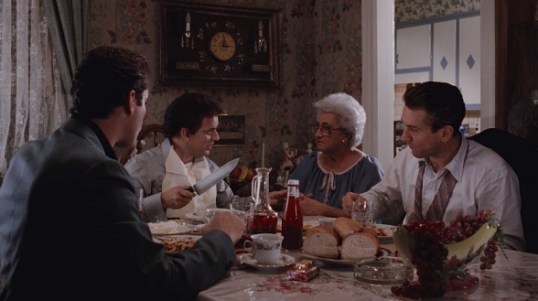
And then there’s Catherine Scorsese, showing up as Tommy’s mom and cooking for everyone while Vincent struggles to escape from the trunk of a car.  “He is content to be a jerk,” Tommy says about Henry Hill.  Just a few hours earlier, Tommy was apologizing to Henry for getting blood on his floor.

Goodfellas is a fast-paced look at organized crime, spanning from the 50s to the early 80s.  Ray Liotta plays Henry Hill, who goes from idolizing gangsters to being a gangster to ultimately fearing his associates after he gets busted for dealing drugs.  It’s a dizzying film, full of so many classic scenes and lines that it feels almost pointless to try to list them all here or to pretend like whoever is reading this review doesn’t remember the scene where the camera pans through the club and we meet the members of the crew.  (“And then there was Pete The Killer….”)  Goodfellas is a film that spend two hours showing us how much fun being a gangster can be and then thirty minutes showing us just how bad it can get when you’re high on coke, the police are after you, and you’ve recently learned that your associates are willing to kill even their oldest friends.  No matter how many times I watch Goodfellas, I always get very anxious towards the end of the film.  With the music pounding and the camera spinning, with Henry looking for helicopters, and with all of his plans going wrong over the course of one day, it’s almost a relief when Bo Dietl points that gun at Henry’s head and yells at him, revealing that Henry has been captured by the cops and not the Gambinos.  Karen desperately running through the house, flushing drugs and hiding a gun in her underwear, always leaves me unsettled.  It’s such a nice house but now, everything is crashing down.

There’s a tendency to compare Goodfellas to The Godfather, as their both films that re-imagine American history and culture through the lens of the gangster genre.  I think they’re both great but I also think that they are ultimately two very different films.  If The Godfather is sweeping and operatic, Goodfellas is the film that reminds us that gangsters also live in the suburbs and go to cookouts and that their wives take care of the kids and watch movies while the FBI searches their home.  If The Godfather is about the bosses, Goodfellas is about the blue collar soldiers.  The Godfather represents what we wish the Mafia was like while Goodfellas represents the reality.
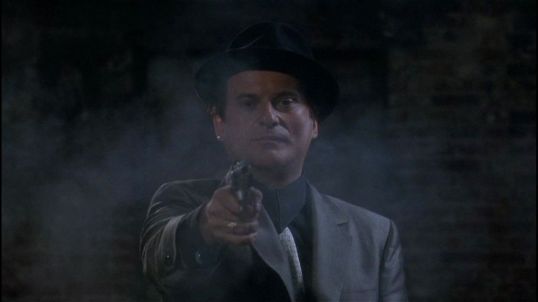
Goodfellas is one of the greatest films ever made but it lost the Best Picture Oscar to Dances With Wolves, a film that left audiences feeling good as opposed to anxious.  To be honest, Martin Scorsese losing Best Director to Kevin Costner feels like an even bigger injustice than Goodfellas losing Best Picture.  One can understand the desire to reward Dances With Wolves, a film that attempts to correct a decades worth of negative stereotypes about Native Americans.  But Scorsese’s direction was so brilliant that it’s truly a shame that he didn’t win and that Lorraine Bracco didn’t win Best Supporting Actress.  It’s also a shame that Ray Liotta wasn’t nominated for playing Henry Hill.  At least Joe Pesci won an Oscar for redefining what it meant to be a gangster.

Goodfellas is proof that the best film doesn’t always win at the Oscars.  But it’s also proof that a great film doesn’t need an Oscar to be remembered.
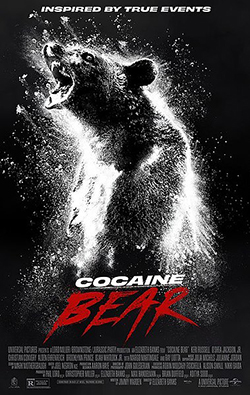
Film Review: Cocaine Bear (dir by Elizabeth Banks)


Cocaine Bear is the story of a duffel bag full of cocaine and the bear that gets into it.  It’s loosely based on a true story.  I say loosely because, in real life, the bear promptly overdosed and died.  In the film, the bear not only survives eating a bag of cocaine but it also subsequently goes on a coke-fueled rampage.

The film opens in 1985, with a series of anti-drug commercials airing on television and a drug smuggler flying high above Georgia.  The smuggler kicks his shipment of cocaine out of the plane, so that it can later be retrieved from the mountains below.  Unfortunately, for him, he also manages to slip and plummets out of the plane to his death.  A day later, in Georgia’s Chattahoochee–Oconee National Forest, two hikers are debating which band they should hire to play for their wedding when they happen to come across a black bear.  The hikers decide to snap a picture of the bear.  The bear, whose face is coved in cocaine, decides to eat the hikers.

Yep, both the bear and her two adorable cubs have discovered the joys of cocaine.  It would probably be best to close down the park until someone can hold an intervention but, unfortunately, more and more people keep showing up.  For instance, there’s a detective named Bob (Isiah Whitlock, Jr.) who is determined to track down the cocaine and use it to finally take down the St. Louis’s drug kingpin, Syd (Ray Liotta, in his final film role).  Syd, meanwhile, has sent his son Eddie (Alden Ehrenreich) and his employee Daveed (O’Shea Jackson, Jr.) to retrieve the drugs.  Daveed is determined to get the job done while Eddie, who is mourning the death of his wife, just wants to leave the family business behind.  Local criminal Stache (Aaron Holliday) wants to deal the drugs himself but instead ends up bonding with Eddie.  Park ranger Liz (Margo Martindale) wants to pursue her crush on animal inspector Peter (Jesse Tyler Ferguson).  Finally, two kids, Dee Dee (Brooklynn Prince) and Henry (Christian Convery) have skipped school and are lost in the park.  Dee Dee’s mother (Keri Russell) is determined to rescue them and then ground them for the rest of their lives.

Yes, there’s a lot of people in this film.  I haven’t even mentioned Stace’s partners-in-crime or the paramedics who pick an inopportune time to show up.  The majority of the people in this film end up getting ripped apart by the bear and, make no mistake about it, the bear is the true heroine of the film.  All of the actors do well with their roles, though I do wish that Liotta could have ended his career playing something other than just another psycho criminal.  Keri Russell, Margo Martindale, Isiah Whitlock, Jr., and Alden Ehrenreich all deserve a lot of credit for bringing their characters to life.  But the bear is the true star here.  The bear kills a lot of people and most of the deaths are pretty bloody but, at the same time, the bear doesn’t really mean any harm.  It just really likes cocaine and the majority of the people who the bear kills are killed precisely because they either got cocaine on their clothes (or face) or they allowed themselves to become a part of the cocaine trade.  The bear ultimately becomes a satirical representation of every anti-drug commercial that has ever aired.  If you’re not worried about overdosing, how do you feel about getting torn apart by a bear?  Not so much fun being a rebel now, is it?

Cocaine Bear is an admittedly dark comedy, one in which almost all of the human characters have at least one bizarre quirk to make them memorable.  Usually, I’m not a huge fan of gory comedies but the humor in Cocaine Bear has an appealingly weird edge to it.  Eddie, Stache, and an annoyed Daveed playing twenty questions while looking for a duffel bag full of drugs is amusing but it becomes hilarious when combined with scenes of the bear joyfully finding more cocaine.  As well, Henry and Dee Dee’s reaction to finding a brick of cocaine is every parent’s nightmare but also one to which everyone should be able to relate and maybe even chuckle at.  I laughed, even as I thought, “OH MY GOD, DON’T DO THAT!”

Finally, in a time when so many movies are full of unnecessary padding, Cocaine Bear deserves a lot of credit for telling its story in 90 quickly placed minutes.  The film doesn’t waste any time getting to the point and it doesn’t overstay its welcome.  A lot of filmmakers could learn a lesson from Cocaine Bear.

The Cocaine Bear trailer has something extra in the Picnic Basket!


Between Slither and Brightburn, I’ve been curious to see what an Elizabeth Banks horror film would look like. Well, it looks like that dream is coming true with next year’s Cocaine Bear. Based on actual events, Cocaine Bear is the tale of a bear who manages to get a hold of some cocaine and goes wild in the forest. One Part Prophecy, one part The Revenant with a pinch of The Edge and a dash of Cujo, and you’ve got what looks like a fun horror comedy.

Cocaine Bear stars Alden Ehrenreich (Solo), Jesse Tyler Ferguson (ABC’s Modern Family), Margo Martindale (Practical Magic, Justified), Isiah Whitlock, Jr. (Da 5 Bloods), both Keri Russell and Matthew Rhys (The Americans), O’Shea Jackson, Jr. (Ingrid Goes West), and Ray Liotta (Smoking Aces) in one of his final roles.

Cocaine Bear opens in theatres next February.

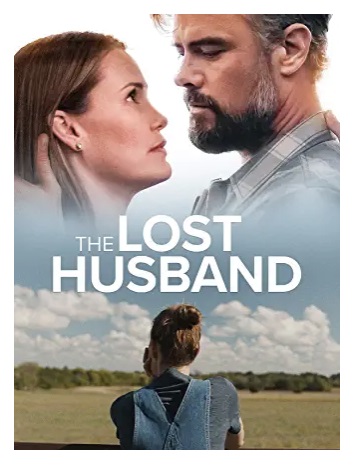
The Films of 2020: The Lost Husband (dir by Vicky Wright)


The Lost Husband tells the story of Libby (Leslie Bibb).

Libby had a good life.  She lived in a big house in the suburbs of Dallas.  She had a handsome and loving husband named Danny (Kevin Alejandro).  She was the proud mother of two wonderful children, Abby (Callie Hope Haverda) and Tank (Roxton Garcia).  But then, one day, there was a car wreck.  Abby was injured and now walks with a limp.  Danny was killed.  And Libby was left a widow and a single mother.

When she loses her home, Libby and the kids try to live with Libby’s chain-smoking mother, Marsha (Sharon Lawrence).  Largely due to the fact that Marsha is a terrible human being who resents her daughter, that doesn’t work out.  Instead, Libby ends up moving out to a farm that’s owned by Aunt Jean (Nora Dunn).

Jean is plain-spoken but far kinder than Marsha.  She lives in a house without a television or a dishwasher.  Amazingly, she does have indoor plumbing.  Still, despite not having many modern luxuries, Jean proves herself to be a far stronger and far more caring person than Marsha ever was.  She not only gives Libby and her children a home but she also encourages Libby to work on the farm….

What?  Well, okay, maybe that doesn’t sound like Jean is doing Libby a favor by making her do physical farm labor but actually she is.  When Libby goes to work, she meets the handsome and single James O’Connor (Josh Duhamel).  James is the farm manager and, of course, he’s got some tragedies of his own that he’s still struggling to deal with.  Though James is at first skeptical as to whether or not Libby is ever going to be able to handle working on a farm, he’s impressed with her determination.  He also bonds with Tank and Abby and even goes as far as to teach Abby how to beat up the local bully….

And right now, you’re probably thinking that this is another silly Nicholas Sparks adaptation, the type of movie that’s perhaps destined to show up on Lifetime in another year or so.  Well, the film may very well play on Lifetime at some point in the near future but there’s still much more to The Lost Husband than just a romance between two troubled souls who work on a Texas farm.  The film is more concerned with Libby’s struggle to come to terms with the loss of her husband than it is with the possibility of her finding a new one.  Yes, James is a great guy and he looks like Josh Duhamel but this is a film that understands that Libby has to take care of herself first.

The Lost Husband is not really a movie that will take you by surprise but it’s still a gentle and sweet-natured film, one that has a good heart and is often sincerely likable.  Leslie Bibb and Josh Duhamel are both believable as two people who are still struggling to recover from their own pain but who still haven’t given up on the idea of finding some sort of happiness.  One thing I liked about the film is that it treated both Libby and James with respect.  Though Libby is not a natural-born farmer, she’s not portrayed as being some sort of spoiled city girl, either.  (In other words, she may not be excited about milking a cow but she still does it without accidentally getting a face full of milk.)  Meanwhile, James may be skeptical about Libby working on the farm but, at the same time, he’s not particularly rude or resentful about it.  Libby and James are both allowed to be adults, which is something of a rare occurrence in films about city girls returning to the farm where they grew up.

The Lost Husband is a nicely done romantic drama.  It’s not a film that’s going to change your life but it will definitely hold your attention if you happen to watch it on a rainy afternoon.

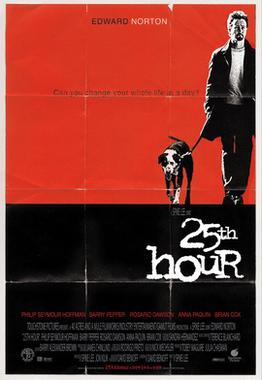
Film Review: 25th Hour (dir by Spike Lee)


(SPOILERS)

First released in 2003, 25th Hour is one of those films that gets better and better with each subsequent viewing.

Monty Brogan (Edward Norton) may have done some very bad things in the past but nearly everyone has benefited.  His childhood friends, a trader named Frank (Barry Pepper) and a teacher named Jacob (Philip Seymour Hoffman), both get to live vicariously through their friend, even if neither one of them is quite willing to admit it.  Monty’s father (Brian Cox) is a retired fireman who now owns a bar that was largely purchased with the money that Monty made from dealing drugs.  Monty’s girlfriend, Naturelle (Rosario Dawson), is “living high” off of the profits of Monty’s drug deals.  For that matter, so is Monty.  Monty has a nice apartment, a loyal dog, and a supportive boss named Uncle Nikolai (Levan Uchaneishvili).

Of course, Monty understands that he’s in the business of destroying lives.  When Monty first met Naturelle, he had just completed a transaction with a well-dressed businessman.  Years later, when Monty is sitting on a bench with his dog, that same man approaches him and begs for more drugs.  The man’s no longer wearing a suit.  Now, he’s apparently homeless and so addicted that he takes it personally when Monty informs him that he’s no longer in the drug-selling business.

Why is Monty no longer selling?  Someone told on Monty.  When the DEA showed up at his apartment, it didn’t take long for them to find the packages that he had hidden in the cushions of the couch.  For all of his swagger and confidence, it would appear that Monty wasn’t quite as clever as he thought he was.  Monty was arrested and subsequently sentenced to seven years in prison.

The majority of 25th Hour takes place during Monty’s final night of freedom, a night that he’s planning on spending it with Frank and Jacob, both of whom could have made the same mistakes that he did but, for whatever reason, they didn’t.  Needless to say, Monty’s got a lot on his mind.  For all of his attempts to hide it, Monty isn’t as tough as he pretends to be.  He knows that it’s not going to be easy for him to do seven years in confinement.  He’s terrified of getting raped in prison and he worries that he’s going to be locked in a holding cell with 200 other criminals.  Both he and his friends know that, even if he does survive, he’ll be a different man when he gets out.  Frank suggests that he and Monty could open a bar when Monty is released but they both know this is an empty promise.  Not only is Monty is scared of the future but he’s haunted by the past.  Is he getting what he deserves?  What if he had made different choices?  Will Nautrelle wait for him or, as some of his associates suggest, is she the one who betrayed him in the first place?

Over the course of the night, both Frank and Jacob are also forced to deal with their feelings towards Monty.  Frank is a Type A personality, the one who spends his day screaming into telephones and who eagerly looks forward to exploiting bad economic news for his own financial gain.  Frank says that Monty is getting what he deserves but, as the film progresses, it becomes obvious that Frank knows that he has more in common with Monty than he wants to admit.  Jacob, on the other hand, is a socially awkward teacher who is struggling to deal with a crush that he’s developed on one of his students (Anna Paquin).  If Frank fears that he’s more like Monty than he wants to admit, Jacob wishes he could be more like him.  At first, it’s hard to imagine that these three men could ever have been close friends but, as soon as you see them together, it all makes sense.

As directed by Spike Lee, one of American cinema’s greatest provocateurs, 25th Hour is more than just the story of one man’s last night of freedom.  Over the course of the film, Monty becomes a symbol of not just New York City but of America itself.  Driven by self-interest, Monty has spent his life ignoring the consequences of his actions and, now that he has no choice but to confront them, it’s too late.  During the film’s most famous scene, Monty stares in a mirror while his reflection rants against every single neighborhood and ethnic group in New York City.  The rant is such a powerful scene that it’s easy to miss the most important point.  Only at the end of the rant does Monty’s reflection admit that he’s as much to blame for his life as any of them.

Oh yes, the Rant.  The Rant is so famous that I was almost tempted to not mention it in this review, just because it doesn’t seem as if there’s much left to be said about it.  Even people who dislike the film seem to be in agreement that the Rant is one of the most powerful and incendiary moments in early 21st century cinema.  The Rant gives us a portrait of a divided and angry society in collapse and it’s a portrait that is probably even more relevant today than it was when the film was first released.  The Rant feels like such a classic Spike Lee moment that it’s surprising to discover that the Rant was included in the script even before Lee was attached to the film.

http://www.youtube.com/watch?v=bLtq4n59Vic

A few things about the Rant:

  1. The film deliberately leaves it ambiguous as to whether or not Monty is actually speaking.  We see the back of his head and his reflection but the movement of his head rarely seems to match the movement of his reflection.  Regardless of whether Monty is actually speaking or just imagining the rant, the scene does make clear that, even on his way to prison, Monty can only truly express himself while alone.  Of course, once he’s locked up, Monty’s not going to be alone for at least seven years.
  2. “Enron!”  I have to admit that, when I recently rewatched film, I laughed when Monty started ranting about Enron.  I can vaguely remember a time when everyone was obsessed with Enron and Halliburton and all that other stuff so I found it funny that I briefly had to struggle to recall just what exactly Enron was.  16 years from now, I wonder if people will watch old movies and TV shows and say, “Why are they all so obsessed with Russia?”

As well-done and brilliantly acted as it may be, the Rant has tended overshadow an even better moment.  It has been said that the key to a successful work of art is a good ending.  As a writer, I can tell you that endings are a hundred times more difficult than beginnings.  Fortunately, 25th Hour has an absolutely brilliant ending.

After having finally convincing Frank to beat him up (in an effort to make himself look tougher once he arrives in prison), Monty is being driven to the prison by his father.  As they leave New York City, Monty takes one final look at the city and it’s citizens enjoying freedom that he’ll never again have.  (This is such a New York City that you can’t help but feel that it’s adding insult to injury that Monty’s going to have to serve his time upstate.)  As he drives, Monty’s father begins to talk…

It’s all about decisions and consequences.  Monty made his decisions years ago.  Over the course of Monty’s last night of freedom, Frank, Jacob, Naturelle, and even Uncle Nikolai made their decisions.  And now, as he drives his son to prison, Monty’s father is forced to make a decision of his own.  There’s so much great acting to be found in 25th Hour but, during that final soliloquy, Brian Cox upstages all of them.  Brian Cox is one of those character actors who seems as if he’s been around forever.  He’s the type of dependable actor who, much like Monty’s father, is often taken for granted.  If nothing else, you have to be thankful for a film like 25th Hour because it gives everyone a chance to be reminded of just how brilliant an actor Brian Cox truly is.

(Here’s a random bit of a Brian Cox trivia.  While everyone knows that, in Manhunter, Brian Cox was the first actor to play Hannibal Lecter, he also played Winton Churchill the same year that Gary Oldman won an Oscar for playing the same role in Darkest Hour.)

25th Hour is not an easy film to watch.  At times, it’s one of the most depressing films ever made.  It’s tempting to say that, as bad as things ultimately turn out for him, you’re glad that Monty has his father and his friends but that’s really not true.  No matter how much his friends care about him or how much Naturelle and his father love him, Monty’s going to prison and his story is simply not going to have a happy ending.

And yet, 25th Hour is one of those films that you can’t look away from and, after you watch it, you simply can’t forget.  Every time I watch 25th Hour, I find new details to appreciate.  With each subsequent viewing, the pungent dialogue becomes even more multi-layered.  With each subsequent viewing, Monty becomes even more of an intriguing and tragic figure.  This is a film that makes you appreciate the brilliance of Edward Norton and mourn the fact that Barry Pepper rarely gets roles as good as his role here.  With each viewing, 25th Hour reminds you of what a great talent we lost when we lost Philip Seymour Hoffman.  It’s film that gets better with each viewing.

Assuming that Monty survived and managed to stay out of trouble, he should be out of prison by now.  Hopefully, wherever he is, he’s doing okay.

A Movie A Day #322: CHiPs (2017, directed by Dax Shepard)


Based on the campy 70s cop show that will live on forever in syndication, CHiPs is about two unlikely partners who, after a rough beginning, work together to catch a cop’s killer and capture a gang of armed robbers.
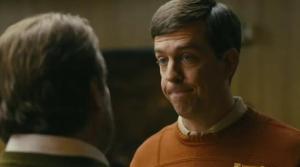

Officer Jon Baker (Dax Shepherd) is a flaky former motocross champion who joins the California Highway Patrol to try to impress his estranged wife (Kristen Bell).  Baker pops painkillers like candy, throws up whenever he enters an unfamiliar house, and has a knee that randomly goes out.  Baker can’t shoot, fight, or think but he sure can ride a bike.

Officer Francis Llewelyn “Ponch” Poncherello (Michael Pena) is actually an FBI agent named Castillo who has been assigned to work undercover to investigate corruption in the CHP.  Ponch is a sex addict who is obsessed with yoga pants and who keeps accidentally shooting his former partner (Adam Brody).

Both Baker and Ponch are given one identifying characteristic.  Baker’s thing is that he always says the wrong thing and then apologizes.  Ponch’s thing is that he always says the wrong thing and then doesn’t apologize.  That is about as deep as things get.

I’m not really sure who this movie is supposed to appeal to.  Michael Pena and Dax Shepard have been good in other productions but they’re both awful here, let down by a script that does not have much to offer beyond tepid bromance and dick jokes.  The humor is too deliberately lowbrow and raunchy to appeal to the people who were fans of the quaintly innocent TV show but it’s also neither meta nor clever enough to appeal to the audience that made hits out of 21 and 22 Jump Street.  I guess the ideal audience for this film would be people who still find gay panic jokes to be hilarious because CHiPs is full of them.  If the last movie you saw was made in 1999 and starred Adam Sandler and David Spade, CHiPs might be right up your alley.

CHiPs is a terrible fucking movie but what really distinguishes it from other terrible movies is the amount of contempt that it seems to have for its source material.  The Jump Street movies might have poked fun at the TV series that inspired them but it was still obvious that the films were being made by fans.  CHiPs can’t even be bothered to use the original’s theme music as anything other than a way to punctuate a few cheap jokes.  Erik Estrada, the original Ponch, does have a cameo but only so he and the new Ponch can talk about eating ass in Spanish.  Otherwise, there is nothing that links the movie to the TV show.  A more accurate title would have been Two Assholes On Motorcycles, except the motorcycles really are not that important to the film.  So, I guess the title would actually just have to be Two Assholes.  That sounds about right to me.

CHiPs proves that not every stupid cop show needs a movie version.  Now, excuse me while I get back to work on my T.J. Hooker spec script…

Lisa Marie Finally Gets Around To Reviewing Cedar Rapids (dir. by Miguel Arteta)


So, in my review of The Beaver, I talked about the annual Hollywood Black List and how the movies that are always listed at the top of the black list usually turn out to be vaguely disappointing.  Well, in that review, I failed to mention that The Beaver was not the only Black List film that I’ve seen (so far) in 2011.  A few months ago, I saw the film that topped last year’s list, Cedar Rapids(The Cedar Rapids screenplay, by the way, was written by Phil Johnston.)

Now, Cedar Rapids (which is scheduled to be released on DVD in June) actually had a pretty good run down in here in Dallas.  Unlike Austin, Dallas is not a film-crazed city and — with only four theaters currently specializing in indie and art films — it’s usually a case of “you snooze, you lose” when it comes to seeing anything out of the mainstream.  We’ll have a few hundred theaters all showing something like Avatar for half a year but a film like James Gunn’s Super will usually sneak in, play in one theater for two weeks, and then just as quickly vanish.

Cedar Rapids, however, stuck around for about a month and a half, playing exclusively at the Dallas Angelika.  It took me a while to actually find the time to go see it (and, perhaps because of the whole Black List thing, I just didn’t feel much enthusiasm for seeing it) and, in fact, I ended up seeing it the last day it played at the Angelika. 

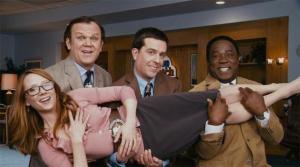
As for why I wanted to see it — well, it had gotten some very positive reviews from critics who traditionally don’t give comedies good reviews so that piqued my interest.  I knew that the film featured three of my favorite character actors — John C. Reilly, Stephen Root, and Thomas Lennon.  The film was also being touted as a comeback for Anne Heche whose autobiography Call Me Crazy was a favorite book of a former roommate of mine.  Finally, I wanted to see the film because it starred Ed Helms, who, at the time, I thought seriously might end up as the new boss on The Office.

Helms, in case you don’t know for some reason, plays Cornell graduate Andy Bernard on The Office.  When he first appeared during the show’s third season, he was portrayed as an incredibly obnoxious preppy with an anger management problem and I loved how Helms so thoroughly threw himself into making Andy just the most annoying human being ever.  Andy was eventually sent to anger management classes and, upon returning, the character has become less obnoxious and just more buffoonish and, in my opinion, a lot less entertaining.  As well, with Jim and Pam now safely married, Andy ended up as the focus of some of the Office’s weakest episodes.  In fact, Andy was the center of so many episodes earlier this season that I found myself wondering if the show’s producers weren’t perhaps trying to see how the audience would react to Ed Helms becoming the new star of the show.  Since I had mixed feelings about that prospect, I felt that maybe Cedar Rapids would provide me with an answer.

In Cedar Rapids, Ed Helms plays Tim Lippe, an almost impossibly innocent insurance agent who is sent by his boss (Stephen Root, who appears to be the go-to guy when you need someone to play a friendly but vaguely threatening manager) to a regional conference in Cedar Rapids, Iowa.  Tim is ordered to conduct himself well, to go out of his way to impress the conference president (Kurtwood Smith), and to win the prestigious “Two Diamonds” Award.  (The award has been won for the company in the past by Helms’ rival at the company who, at the beginning of the film, accidentally kills himself while practicing autoerotic asphyxiation.  The rival is played by Thomas Lennon and I’m kinda sorry that Lennon didn’t have more scenes because seriously, he always makes me smile.)

After saying goodbye to his much older girlfriend (Sigourney Weaver, who is wasted in her cameo), Helms heads off for Cedar Rapids.  This is a big deal for him because he’s the type of movie innocent who has never even been on a plane before.  Helms arrives at Cedar Rapids determined to do the right thing but he soon discovers that he is rooming with Dean Ziegler (John C. Reilly), a loud, crude, and cynical agent who indulges in every vice that Helms has been ordered to avoid.  Needless to say, Helms initially tries to resist being drawn into Reilly’s orbit but soon, he finds himself being corrupted and enjoying it.  Through Reilly, he meets yet another insurance agent (played by Anne Heche) that he soon finds himself falling in lust with.  All this happens, of course, under the disapproving eye of Kurtwood Smith and Helms soon learns just how far he is expected to go to win that Two Diamonds Award…

As it might be obvious from the above description, Cedar Rapids is one of those films that attempts to be both a wild comedy and a poignant coming-of-age drama.  And it succeeds very well at being a comedy and it does pretty good job of being a drama but it never manages to do both at the same time.  The end result is an entertaining but wildly uneven film that never feels like it’s quite as good as it should be. 

The film is at it’s best when it’s just Helms, Reilly, Heche, and Isiah Whitlock, Jr. (playing another insurance agent) hanging out and BSing.  Those scenes ring well and all four of these actors have a real ensemble chemistry together.  You really do end up believing that Reilly, Heche, and Whitlock truly do care about their new friend and you just as strongly believe that Helms really is falling in love with Heche.  These are the best scenes in the movie. 

The film is less effective when it tries to be something more than just an ensemble comedy.  It’s in these scenes — with Kurtwood Smith quoting bible verses and the Two Diamonds Award becoming a metaphor for all sorts of things — that the film gets heavy-handed and a bit boring.  I also have a feeling that these scenes are probably the reason why so many Hollywood readers went nuts of the Cedar Rapids screenplay because these scenes are the least challenging in the film.  These are the scenes that pat you on the back for watching the movie.  Anyone who has ever seen a movie knows that Kurtwood Smith’s character is going to turn out to be a hypocrite because when was the last time that you see a movie in which the guy who talked about Jesus didn’t turn out to be a hypocrite?  Therefore, it’s kinda hard to buy into Helms’s shock when he discovers that Smith isn’t all that he’s cracked up to be.  I mean, I can force myself to buy that the Helms character has never been on a plane before but my God, has he never seen a movie or an episode of Law and Order before either?  Seriously, the character isn’t a Mennonite.  He’s just from the midwest.

In the lead role, Ed Helms is a lot like the movie.  He’s great when he’s just a member of the ensemble but sometimes seems to struggle a bit in the more dramatic scenes.  To a large extent, the problem is that the film goes so out of it’s way to present Helms as being some sort of man-child that it’s hard to take him seriously once he suddenly starts to think for himself.  As I previously stated, the supporting cast is uniformly strong.  Reilly is a drunken, foul-mouthed force of nature while Heche steals every scene that she’s in and, in the end, proves herself to really be the heart and soul of the film.

So, in the end, I guess I would say that Cedar Rapids, as uneven and as frustrating as it occasionally turned out to be, is worth seeing once it comes out on DVD in June.