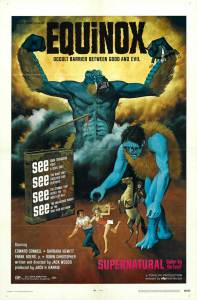
First released in 1970, Equinox is a low-budget film about a bunch of kind of dumb teenagers who find a book and end up getting chased around the woods by a bunch of angry monsters.
Equinox is a fun little movie. The acting may not be the greatest and this is one of those films where everyone always seems to do the stupidest possible thing at the worst possible time but there’s a lot of charm to be found in the monsters. This film is thought, by many, to have inspired the Evil Dead and there are some definite similarities.
There are actually two music videos of Lordi’s Would You Love A Monsterman, one that was released in 2002 and another one from 2006. This is the 2002 video.
This version features a young girl playing with a dirty doll in the woods when Lordi suddenly appears and invites her to join them. They even set her doll on fire but she still decides to join. That is the power of Lordi.
Lordi is a Finnish band, who have been making music since 1992. An earlier version of Would You Love A Monsterman was recorded under the title I Would Do It All For You in 1993. When I Would Do It All For You was turned into Would You Love a Monsterman in 2002, it became Lordi’s first big hit.
Four years after this video was released, Lordi would make history as both the only Finnish and the only “hard rock” act to win the Eurovision song contest with their song, Hard Rock Hallelujah.
During the month of October, we like to share classic episodes of horror-themed television. That was easier to do when we first started doing our annual October horrorthon here at the Shattered Lens because every single episode of the original, black-and-white Twilight Zone was available on YouTube. Sadly, that’s no longer the case. In fact, there is exactly one episode of the original Twilight Zone on YouTube.
Fortunately, that episode is a classic. In 1962’s To Serve Man, an alien (Richard Kiel) comes to Earth and invites people to return to his home planet with him. He leaves behind a book. When everyone learns that the title of the book is To Serve Man, they excitedly decide that the book must be an instruction manual on how to help mankind. The truth, as we learn in the episode’s classic finale, is something a little bit different.
Here’s the episode! Watch it before YouTube yanks it down.
(This episode originally aired on October 2nd, 1962. It was directed by Richard L. Bare from a script by Rod Serling. It was based on a short story by Damon Knight.)
To be honest, it’s a bit of a struggle to say what exactly the 1992 film Hellmaster was actually about but I think it definitely had something to do with the end of the world. John Saxon plays Prof. Jones, a sadistic eugenicist who, in the late 60s, developed a drug that he claimed would — I kid you not — “cure homelessness.” Apparently, the drug would make the homeless so strong that they would be able to build a house or something. Anyway, a reporter (David Emge, best known as the helicopter pilot in the original Dawn of the Dead) discovered what Jones was doing and that the drugs were actually turning the homeless into mind-controlled zombies. Jones responded by murdering the reporter’s wife and then vanishing.
Are you following the story so far?
20 years later, the reporter is having nightmares about the homeless so he decides to start hanging out around the Kant Institute for the Gifted. We’re told that the Kant Institute is a college. There only appears to be one professor and a handful of students, the majority of whom appear to be in their early 30s. I’m not really sure what’s being taught at the school. (The only class we see features two white people debating whether or not Malcolm X hated the homeless.) One of the students, Shelley (Amy Raasch), is apparently clairvoyant and she keeps having visions of the school’s chapel bursting into flames.
Meanwhile, there are shots of an old church bus driving down various deserted roads. “Have a nice day” is written across the cross that hangs on the front of the bus. On top of the bus, someone’s painted a smiley face. The bus itself is occupied by four deformed followers of Prof. Jones. Apparently, they’ve spent the last 20 years driving around the country and killing people. One of them is dressed like a nun and carries several hypodermic needles. They come across a stalled motorist and promptly kill him. The man’s daughter (Sarah Barkoff) escapes and flees to the nearby Kant Institute.
It turns out that the bus is also heading to the Kant Institute! Eventually, Prof. Jones pops up and explains that it took God six days to create the world but Jones believes that it will only take him one night to transform the world into Hell. Why does Jones want to do this? That’s not really clear. Actually, it’s not even clear how showing up at the Kant Institute will even help Jones accomplish that goal.
Anyway, the rest of the movie is basically Shelley and the reporter and a handful of friends attempting to not get transformed into zombies by Prof. Jones. This is easier said than done because, as we quickly discover, everyone in this movie is an idiot.
Hellmaster is one of those low-budget horror films that shouldn’t work and yet somehow, it does. Yes, the plot makes absolutely no sense and, with the exception of genre vets Saxon and Emge, the performances are almost all terrible. But no matter! At its best, the film — which is full of dark hallways and deserted roads and twisty camera angles — achieves a dream-like intensity. The zombies, with their hypodermic needles and their joyful savagery, are genuinely creepy and John Saxon is properly menacing as Prof. Jones. It’s a relentless film, one that leaves you feeling as if anyone can die at any time and, when they do die, it’s often in the most macabre ways possible. A crippled student is beaten to death with his own crutch. Another is doused with acid. And you may be asking yourself, “But why was there a big vat of acid just sitting around?” but oddly, it works within the surreal dream logic of the film. It makes no sense and yet, it happens. If anything, the lack of a coherent plot and the low-budget aesthetic help this film create and maintain its nightmarish atmosphere.
For all of its flaws, Hellmaster is a thousand times more effective than you might expect.
Smalltown reporter Jessie St. Clair (Rachael Leigh Cook) has stumbled across the story of her career. A stripper and a prostitute have been murdered. Before committing the murders, the killer sent each victim a video tape of him stalking her. With the help of her producer, Jane (Annabella Sciorra), and her cameraman, Rob (Kip Pardue), Jessie sets out to try to solve the case but when she receives a videotape that indicates that she might be the next victim, she quits her job and vanishes.
Then, Albert Bodine (Cary Elwes) shows up in town. Albert says that he’s the anchor of the UK’s top true crime show, American Crime, and that he wants to investigate not only the two murders but also Jessie’s disappearance. When both Rob and Jane are suddenly fired by their station, they reluctantly agree to work with Albert. Albert soon proves himself to be so incompetent that his new colleagues start to wonder if he’s actually who he says he is. Meanwhile, another videotape turns up, this one starring Jane.
The tone of American Crime is all over the place and it never seems to be sure if it wants to scare us or if it wants to make us laugh but there are some tense scenes and a good twist ending. American Crime tries to strike a balance between being a horror/thriller and a satire of media sensationalism. It doesn’t always succeed but you really haven’t lived until you’ve seen Cary Elwes play a sleazy tabloid reporter. Imagine an even more hyperactive version of Robert Downey, Jr’s performance in Natural Born Killers and you’ll have some idea of what Cary Elwes does in this movie. Elwes sweats profusely, bulges his eyes, speaks with an extremely affected English accent, and plays with his hair every time he passes a mirror. Everything sets him off, from his camera falling off of its tripod to people questioning his journalistic credibility. Though the movie does feature good roles for underappreciated actresses like Rachael Leigh Cooke and Annabella Sciorra, Elwes is definitely the best thing about and the main reason to watch American Crime.
Hi, everyone! Well, in case you hadn’t noticed, it’s October and we’ve pulled the string here at the Shattered Lens! Welcome to the annual TSL Horrorthon! For the next 31 days, TSL is going to be home to everything that makes October our favorite month of the year!
So, here’s Bela Lugosi in Ed Wood’s Glen or Glenda, performing the opening ceremony of the season:
First published in 1974, Carrie is often cited as being Stephen King’s first novel.
That, of course, isn’t technically true. King had written three novels before Carrie, the majority of which weren’t very good. Carrie is a novel that King says he wrote in a hurry because he was living in a trailer and needed the money. It’s also a novel that King says he had absolutely no faith in because he didn’t feel like he could write from a female perspective. Despite King’s then-low opinion of what he had written, Carrie went on to become his first published novel. Thought the novel wasn’t an immediate success (the hardback edition only sold 13,000 copies), it subsequently became a best seller after it was adapted into Brian DePalma’s 1976 film of the same name.
By now, we all know the story, don’t we? Even if you’ve never read the book or seen any of the film versions, there’s been so many different rip-offs and unofficial remakes of Carrie that I doubt that there’s anyone who doesn’t know the story. Everyone knows that Carrie White was a high school outcast and that her mother was a religious fanatic. We all know what happened the night that Tommy Ross took Carrie White to prom. We all know about the cruel prank that was played on Carrie, about the pig’s blood that was dumped on her right after Tommy and Carrie were crowned king and queen of the prom. And we all know that Carrie’s response was to use her own telekinetic powers to burn down the entire town and to kill the majority of her tormentors.
44 years after it was first published, it’s still interesting to read Carrie. On the one hand, you can definitely see the beginnings of King’s signature style, especially towards the end of the book when Sue Snell comes across a dying Carrie. On the other hand, this book is definitely different from any other King novel. For one thing, it’s only 199 pages long. Living in a trailer and struggling to make ends meet may not have been easy for King but I would say it actually made him a better writer. Carrie contains none of the rambling, self-indulgent filler that’s come to typify much of King’s recent work. One imagines that, if King wrote Carrie today, we’d have to wade through at least 500 pages of people talking about the history of psychic phenomena before the book even got around to Sue asking Tommy to take Carrie to prom. Instead, because King was writing while hungry, there’s a hunger to the book. It doesn’t waste any time.
King structured the novel so that half of it was narrative and half of it was, for lack of a better term, evidence. We get excerpts from police reports, newspaper articles, and books written after the prom disaster. The White Committee offers up their official report. We get to read a little bit of Sue Snell’s book, I Am Sue Snell. I imagine the structure was largely the result of King’s self-confessed insecurity with the book’s subject matter. (For instance, whenever you doubt that Tommy Ross would actually take Carrie to prom, an except from the final report of the White Committee pops up and assures you that he did.) Though borne of insecurity, the structure actually works pretty well. It leaves little doubt that, after Carrie’s prom, the world will never be the same again.
The thing that really struck me while rereading this novel was that Stephen King himself seemed to dislike Carrie White almost as much as her classmates did. King focuses, to an almost uncomfortable degree, on Carrie’s unattractive appearance and, often times, he seems to be keeping his own distance from his main character, as if he was weary about trying to get inside of her head. When Carrie does go on her rampage, she comes across more as an out-of-control monster than someone who has been pushed too far. Our popular conception of Carrie being a tragic victim really has more to do with how Sissy Spacek played her in the original film than in how King wrote about her in his novel.
Instead, the book is far more concerned with Sue Snell and Tommy Ross, who are both portrayed as being everyone’s idealized high school companion. As both a novel and a film, Carrie‘s greatest weakness has always been that the plot hinges on the idea that any teenager, no matter how guilt-ridden, would actually ask their romantic companion to take someone else to prom. The pig’s blood, I believe. The prom, less so.
Carrie has its flaws but, to be honest, I actually think it’s better than some of King’s more recent books. If nothing else, it’s a chance to look into Stephen King’s mind before he became the Stephen King.
Are you scared of snakes? If so, you’re not alone. According to 2001 Gallup Poll, 56% of Americans said they were scared of snakes. By comparison, only 45% of Americans said they were scared of public speaking while 41% said heights. Only 36% said they were scared of spiders and only 7% were frightened by the prospect of going to the doctor.
There are nearly 3,000 different species of snakes in the world and only 25% of them are poisonous. Most snakes are harmless and even the poisonous ones usually won’t strike as long as they’re left alone. But people will always be scared of snakes. The sound of a hiss is enough to send most people into a panic.
Back in the pulp era, snakes used to regularly appear on the covers of magazines and paperbacks, often being held by a cultist or threatening a bound victim. When it comes to pulp art, snakes are never good news. Take a look:
This October, along with with everything else, I want to highlight Italian horror! Today, we start things off with a look at 1988’s Ratman!
Terry (Janet Agren) has come to a Caribbean island, not for a vacation but instead to collect the remains of her sister, Marlis (Eva Grimaldi). Marlis was an up-and-coming model who came to the island with a photographer named Mark (Werner Pochath) and another model named Peggy (Luisa Menon). Marlis had her entire life ahead of her but apparently, someone murdered her on the island and then left her body in an abandoned building where it was eaten by a rat.
Obviously, identifying a dead sibling would be a difficult task for anyone. Fortunately, no sooner has Terry arrived on the island than she runs into Fred (David Warbeck). Fred is a true crime writer, a man who knows the island and who is always ready with a quip or a joke. For reasons that are never quite clear, Fred invites himself to accompany Terry down to the morgue. Why does Terry allow a complete stranger to go with her to identify her sister’s body? Who knows? Maybe it’s because Fred is played by David Warbeck, who was one of the more likable actors to regularly appear in Italian horror films.
It turns out to be a good thing that Fred came along because, when they arrive at the morgue, it turns out that the police don’t actually have Marlis’s body! Instead, they have Peggy’s body. Peggy was murdered while wearing Marlis’s dress, which led to a case of mistaken identity. But, if Marlis isn’t dead, where is she?
Could she and Mark have gone deeper into the jungles of the island, hoping to find the perfect place to take the pictures that will turn Marlis into a superstar? Of course, they have! Unfortunately, what they did not take into account is that the island is also the home of the Ratman!
Who is the Ratman? Well, his name is actually Mousey (Nelson de la Rosa), despite the fact that he doesn’t really act like a mouse. Mousey was created a mad scientist who wanted to see what would happen if he crossed the genes of a monkey and a rat. The end result was a 2’4 sociopath with really sharp teeth and an insatiable urge to kill. The scientist thinks that he’ll win the Nobel Prize for this creation but Mousey seems to be more concerned with killing people. As soon as he gets out of his cage, he goes on a killing spree….
Mostly because of the presence of Nelson de la Rosa (who, until his death in 2016, was the world’s shortest man), Ratman has a cult following. And it must be admitted that de la Rosa makes for a memorable ratman. Unfortunately, he’s not really in the film that much. The majority of the film is made up of filler. For instance, we spend a lot of time watching Mark take pictures. A lot of time is also devoted to Fred and Terry having to deal with the incompetent island police. (The police are convinced that Marlis is dead and are apparently willing to force Terry to look at every dead body on the island to prove it.)
Fortunately, this film also features David Warbeck and, as any fan of Italian horror can tell you, Warbeck was one of those actors who improved any film in which he appeared. Warbeck always approached his roles with a sense of humor and a likable joie de vivre and he’s probably as convincing as anyone could hope to be when appearing in a film like Ratman. Warbeck delivers his lines with just enough of a smile to not only let you know that he’s in on the joke but to also invite you to play along with him.
Reportedly, Ratman was a troubled production and the film’s producer stepped in to take over from the credited director. That perhaps explains why the film itself sometimes feels rather disjointed. There is one undeniably effective sequence, in which a model is stalked by a knife-wielding maniac just to then be attacked by Mousey instead. Otherwise, by the standards of most Italian horror films, it’s a visually bland movie. I would have liked to have seen what someone like Lamberto Bava and Lucio Fulci could have done with Ratman.
Ratman exists in several different version. The version I saw was dubbed into French and it was obvious that a good deal of gore had been cut from the film. (The “official” Italian version has a running time of 82 minutes. The version I saw only ran 76 minutes.) Still, even in an edited form, this film has an undeniable “What did I just see” appeal to it and it’s always worth watching anything that features David Warbeck.
Once upon a time, there were two shows about women who could speak with the dead.
One show ran from 2005 to 2011. It starred a future Oscar winner and, over the course of its run, it was nominated for a bunch of Emmys. It may have never been a huge hit but it received decent ratings and, even more importantly, it was a critically acclaimed. The show claimed to be based on fact and it took a low-key, procedural approach to its stories.
The second show ran from 2005 to 2010 and it starred a multiple Golden Globe nominee and it was never nominated for any major Emmys. (The first season, however, did receive a Teen Choice nomination.) Like the first show, it was never exactly a big hit, though it did have a loyal audience. Whereas the first show was acclaimed by critics, the second show was routinely dismissed. If the first show was subdued and low-key, this second show took the exact opposite approach.
The first show was called Medium.
The second show was called Ghost Whisperer.
I watched both of them and I can tell you that both had their strengths and their weaknesses. Medium was, at time, genuinely creepy and Patricia Arquette gave an admirably serious performance. At the same time, the show was often so serious that it was a bit of a drag to watch. You may have believed that Arquette could talk to the dead but you never really bought into the idea that they would want to talk to her or anyone else on the show. In short, Medium was good but it wasn’t much fun.
Ghost Whisperer, on the other hand…
Listen, I’m not even going to pretend that Ghost Whisperer was a great show. It was a frequently silly and over-the-top show. Jennifer Love Hewitt played Melinda Gordon, who lived in Grandview, New York and who owned an antique shop called — I kid you not — Same As It Never Was Antiques. The dead would come to Melinda because they still had feelings that needed to be resolved on Earth before they could cross over into the afterlife. Sometimes the ghosts were in denial. Sometimes they were rude, violent, and scary. Sometimes they were just mildly quirky. But they always ended up happy that Melinda was able to find a way for them to move on. Over the course of five seasons, the show developed both the quirkiness of the town and the mythology behind the ghosts themselves. We learned about the Watchers and the Shadows and the Shinies and the Book of Changes. We also learned a bit about Melinda’s history. Season 3 ended with Melinda helping her deceased father go into the light and you better believe I cried.
If Medium was an often dour, somber, and deliberately frumpy show, Ghost Whisperer was bright, fun, and unapologetically glamorous. While poor Patricia Arquette always seemed to be carrying the entire weight of the world on her shoulders, Jennifer Love Hewitt always appeared to be having a blast playing Melinda. While she may not have been as good as an actress as Patricia Arquette, Jennifer Love Hewitt always brought just enough natural enthusiasm to the role that she could make even the most hackneyed of dialogue believable. When I looked over some of the reviews of Ghost Whisperer’s first season, the immediate thing that I noticed was that many of the critics (in particular, the male critics) were obsessed with pointing out that Jennifer Love Hewitt was continually dressed and filmed in such a way to emphasize her breasts, as if there’s some sort of crime in being proud of what you have. But for me, as someone who shares the struggle of trying to find cute clothes for big boobs, it was empowering that Melinda didn’t hide her body, her personality, or her beliefs. As played by Hewitt, Melinda was confident, outspoken, and unapologetic. Yes, she dressed a certain way. Yes, she looked a certain way. Yes, she believed that she could help ghosts cross over. And if anyone had a problem with it, so what? Melinda was a role model who never really got her due. If I ever find myself speaking to ghosts, I hope that I handle it half as well as Melinda did.
Ghost Whisperer ended in 2010 and Medium ended in 2011. Medium may have been nominated for more awards but guess which one I’ll always make a point to watch in syndication?


 Through the Shattered Lens