Horror Film Review: Firestarter (dir by Mark L. Lester)


Adapted from Stephen King novel, 1984’s Firestarter is a film about a girl with a very special power.

Back in the day, a bunch of college students needed weed money so they took part in a government experiment.  Half of them were told that they were being given a placebo.  The other half were told that we would be given a low-grade hallucinogen.

Surprise!  The government lied!  It turns out that everyone was given the experimental drug!  Some of the students ended up going crazy.  One unfortunate hippie clawed his eyes out.  Meanwhile, Vicky (Heather Locklear) gained the ability to read minds.  She also fell in love with Andy McGee (David Keith), a goofy fellow who gained the ability to mentally control people’s actions.  They married and had a daughter named Charlie (played by a very young Drew Barrymore).  Charlie, it turns out, can set things on fire!  She’s a firestarter!

Well, of course, the government can’t just leave the McGees out there, controlling minds and setting things on fire.  Soon, the McGees are being pursued by the standard collection of men in dark suits.  Vicky is killed off-screen, leaving Charlie and Andy to try to find some place where they’ll be safe.

Good luck with that!  This is the government that we’re talking about.  The thing with films like this is that the government can do practically anything but it never occurs to them to not all dress in dark suits.  I mean, it just seems like it would be easier for all of these secret agents to operate if they weren’t automatically identifiable as being secret agents.  Anyway, Andy and Charlie are eventually captured and taken to The Farm, a really nice country estate where Andy and Charlie are kept separate from each other and everyone keeps talking about national security.

Running the Farm is Capt. Hollister and we know that he’s a bad guy because he wears a suit and he’s played by Martin Sheen.  Working with Hollister is John Rainbird (George C. Scott), a CIA assassin who kills people with a karate chop across the nose.  When Charlie refuses to show off her firemaking abilities unless she’s allowed to talk to her father, Rainbird disguises himself as a custodial engineer and proceeds to befriend Charlie.  Of course, Rainbird’s plan is to kill Charlie once she’s displayed the extent of her powers….

Stephen King has written that he considers this film to be one of the worst adaptations of one of his novels but, to be honest, I think the movie is actually a bit of an improvement on the source material.  Firestarter is probably the least interesting of Stephen King’s early novels.  Supposedly, Charlie was based on King’s youngest daughter and, reading the book, it’s obvious that everyone’s fear of Charlie is mostly a metaphor for a father trying to figure out how to raise a daughter.  Unfortunately, instead of concentrating on those primal fears, the book gets bogged down in boomer paranoia about MK-ULTRA experiments.

The movie, however, is just silly enough to be kind of charming.  For example, consider the way that Andy grabs his forehead and bugs out his eyes whenever he uses his powers.  Andy’s powers may be slowly killing him but he just looks so goofy whenever he uses them that you just can’t help but be entertained.  And then you’ve got Drew Barrymore sobbing while setting people on fire and George C. Scott growling through all of his dialogue and even Martin Sheen gets a scene where he gets excited and starts jumping up and down.  (And don’t even get me started on Art Carney and Louise Fletcher as the salt-of-the-Earth farmers who try to protect Andy and Charlie….)  Some of the special effects are a bit hokey, as you might expect from a film made in 1984 but occasionally, there’s a good shot of something (or someone) burning up.  It’s all so over-the-top and relentlessly dumb that you can’t help but be entertained.  You can even forgive the fact that basically nothing happens between the first 10 and the last 15 minutes of the movie.

Firestarter‘s silly but I liked it.

Horror on the Lens: Dr. Jekyll and Mr. Hyde (dir by John S. Robertson)


394px-Dr_Jekyll_and_Mr_Hyde_1920_poster

Ever since the birth of film, Robert Louis Stevenson’s Dr. Jekyll and Mr. Hyde has been a popular subject for adaptation.  Not only does the classic story of a good doctor who unleashes his evil instinct via potion serve as a potent metaphor for everything from sexual repression to drug addiction, but the dual role of Dr. Jekyll and Mr. Hyde has provides an excellent opportunity for an actor to show off.

The first film adaptation of Dr. Jekyll and Mr. Hyde is believed to have been made in 1908.  Two more version followed in 1912 and 1913 and then, suddenly, 1920 saw three different film versions.

The best known of the 1920 version is our film for today.  This version is best remembered for John Barrymore’s powerful performance in the title role but it also holds up remarkably well as a work of cinematic horror.

Music Video Of the Day: Creatures by Motionless in White (2011, dir by Stephen Penta)


AGCK!

Today’s music video of the day is this wonderfully creepy video from Motionless in White.  Seriously, there’s always something disturbing about a maniacal grin in a music video.

With the exception of the chorus, this song was composed of lyrics that were sent by fans of the band.  Here’s what the fans came up with:

I fall
This is the end of you
Whispers are their weakness
Their weakness
Everyday I must practice
To fake this smile on my face
It’s all the rain that’s putting me to sleep
I’ll let the blood tell the truth tonight, this is my life’s work
11 tracks is not enough, to tell you how I’ve died inside
And love is lost like words
11 tracks is not enough
In spiders eyes a man becomes a fly
In prolonged silence, we all stand defiled
We fall in line with the atrophy of life
The calm before the storm is a defeating silence
I’ve given my all, to this valley of despair
We are the damned, the cursed and the broken
There’s so much more inside us
We are the lost, the sick and unspoken
There’s so much more inside us
I’m drowning in an ocean of the tears that I’ve cried
I tried to drown my sorrows
Instead they’re all drowning me
I tried to drown my sorrows
Instead they’re all drowning me

Enjoy!

Horror on TV: The Curse of Degrassi (dir by Stefan Brogren)


This is a special episode of my favorite TV show of all, Degrassi!  Originally airing on October 28th, 2008, The Curse of Degrassi features Degrassi’s main mean girl, Holy J Sinclair (Charlotte Arnold), getting possessed by the vengeful spirit of deceased school shooter, Rick Murray (Ephraim Ellis).  Chaos follows!  Fortunately, Spinner (Shane Kippel) is around to save the day.  As any true Degrassi fan can tell you, only Spinner has a chance against the forces of the undead.

What I like about this episode is that, in the best tradition of Degrassi, it goes there.  Holly J does get possessed.  Just about the entire cast end up dying horribly.  Spinner has to battle the undead spirit of Rick Murray and he has to do it without the help of Drake.  And, as far as we know, this episode is canon.  So, yes, Rick Murray’s ghost actually does haunt Degrassi Community School and yes, only Spinner can save us all.

Go Spinner!

Enjoy!

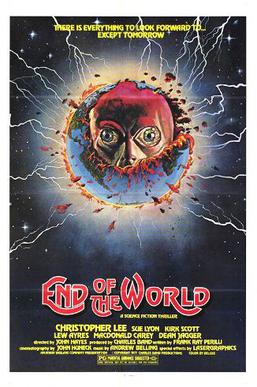
The TSL’s Horror Grindhouse: End of the World (dir by Charles Band)


The 1977 film End of the World has got a great opening scene.  An obviously distraught priest (played by none other than Christopher Lee!) steps into an isolated diner.  He tells the counterman that he needs to use the phone.  The counterman says, “Sure, father.”  And then suddenly, everything in the dinner starts blowing up.  The phone, the coffee, the pinball machine, everything explodes.  The counterman ends up trying to unsuccessfully throw himself through a window.  The priest, looking rather confused, steps outside of the diner and he runs into …. his exact double!  Christopher Lee meets Christopher Lee!

Again, that’s a great opening and it’s really not a surprise that the rest of the film can’t live up to it.  Once the two Christopher Lees disappear into the darkness, the focus of the story shifts to a scientist named Andrew (Kirk Scott) and his wife, Sylvia (Sue Lyon, who years previously played Lolita).  Andrew spends a lot of time sitting in front of a boxy computer and staring at the screen.  He’s picking up strange transmissions from space and he’s trying to translate them.  Andrew goes home.  He and his wife got a party.  Andrew sits in front of the computer a while longer.  Andrew goes home.  Andrew goes to work.  Andrew keeps staring at the computer….

“Wait,” you’re saying at this point, “isn’t this is a Christopher Lee movie?”

Yes, it is.  Christopher Lee is indeed top-billed and he’s hardly in the movie at all.  I’d like to think that, when asked why by an intrepid reporter why he agreed to star in End of the World, Lee laughed and replied, “For the money, of course.”  But, according to Lee’s autobiography, he did the film because he was told that he would be appearing with a cast of distinguished actors like Jose Ferrer, Dean Jagger, and John Carradine.  Now, Dean Jagger does have a small cameo in the film but Ferrer and Carradine are nowhere to be seen.  Either they left the production or someone lied to Sir Christopher!

Anyway, back to the plot.  Eventually, Andrew figures out that the space transmissions are predicting natural disasters.  We don’t actually see any of these disasters because, after all, this is the end of the world on a very low budget.  But we are assured that the disasters are happening.  Andrew and Sylvia discover that the transmissions are coming from a convent in the middle of the desert.  Andrew and Sylvia go to investigate and they discover that the nuns are….

ALIENS!

Now, this is actually a pretty good twist and there are some vaguely humorous scenes of the the nuns working in a space lab.  It turns out that the nuns (and one of the Christopher Lees) are stranded on this planet because their spaceship broke down.  They don’t really like Earth, considering it to be an ugly and polluted place.  They’re planning on ending the world but they need to leave before the whole place blows up.  They demand that Andrew help them fix their transporter and they’re going to hold Sylvia hostage until he does so….

It’s all a bit silly but, as you’re watching the film, you can’t help but wish that it had been even sillier.  I mean, alien nuns and Father Christopher Lee?  That sounds like the makings of a certain type of classic!  But, unfortunately, the film never fully embraces the full potential of its absurdity.  It takes forever for Andrew and Sylvia to actually reach that convent and even the alien nuns become rather passé after a few minutes.  Christopher Lee is fun to watch as always and his character’s irritation with being stuck on Earth was obviously mirrored by Lee’s irritation with being in the film.  And, despite all else, let’s give credit where credit it is due — the title lives up to its promise.  The world may end in a pile of stock footage but an end is an end.

Anyway, this one is pretty much for Christopher Lee completists only.  Watch the opening and then fast forward to the end.

Robotic Vengeance: Steel and Lace (1991, directed by Ernest Farino)


On trial for raping concert pianist Gally Morton (Clare Wren), evil businessman Daniel Emerson (Michael Cerveris) gets four of his sleazy buddies to provide a fake alibi for him.  After Emerson is acquitted, Gally goes to the roof of the courthouse and leaps to her death.
Five years later, Daniel and his four friends have made a fortune by illegally foreclosing on people’s houses.  They may think that they’ve gotten away with their crimes but what they don’t know is that Gally’s brother, Albert (Bruce Davison), has been building a robot version of his sister.  Soon, Robot Gally is killing off all of Emerson’s friends while a courtroom sketch artist named Alison (Stacy Haiduk) and a detective named Dunn (David Naughton) attempt to figure out what’s going on.

A mix of The Terminator and I Spit On Your Grave, Steel and Lace is a classic of its kind.  While the deaths are inventive and, considering who Robot Gally is killing, deserved, what really sets the film apart is the strong cast and the inventive direction.  Director Ernest Farino wastes no time getting down to business and he inventively opens the film by cutting back and forth between Emerson assaulting Gally and the jury acquitting him of the crime that we just saw him commit.  Davison is not in the film as much as you might expect but he still makes an impression as the fanatical Albert and Naughton and Haiduk are likable even if their scenes sometimes feel like padding.  Best of all is Clare Wren, an actress who deserved to be a bigger star and who is convincing both as the fragile Gally and as the vengeance-driven robot.  Robot Gally eventually comes to question whether justice is truly be served by all of the killings and Wren sells it.  Also be sure to keep an eye out for David L. Lander, playing the prerequisite eccentric coronor.  (Has there ever been a movie coroner who wasn’t an eccentric?)  Finally, Brian Backer — who will be forever known for playing nice guy Mark Ratner in Fast Times At Ridgemont High — is effectively cast against type as one of Emerson’s stooges.

Steel and Lace is one of the best low-budget films to come out of the early 90s, a deeply satisfying tale of robotics and vengeance.

Video Game Review: Hamburger Hell (1986, J.P. Jansen)


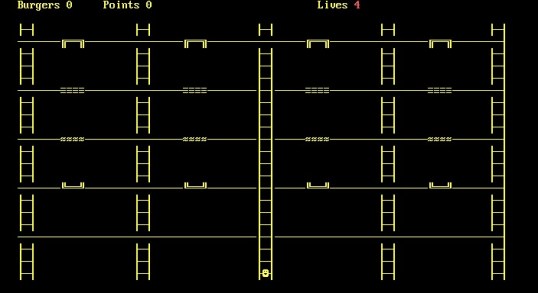
In this game, you are working in a fast food restaurant.  Your goal is to make as many hamburgers as possible.  The more hamburgers you make, the more money the restaurant makes and the more your boss likes you.

Sounds simple, right?

Think again!

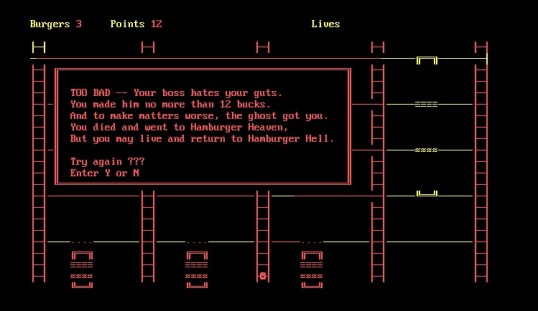
In this restaurant, it’s not just about knowing when to flip the burger.  Instead, you have to climb to the top of a ladder and push each ingredient down a level, one-by-one.  (That’s you, at the bottom of the third ladder.)  Making things extra difficult is that there’s a ghost running up and down the ladders.  The more hamburgers you make, the faster the ghost becomes.  If the ghost touches you, you die.  You come right back to life the first four times.  But after the fourth time, this happens:

This is an intentionally dumb but very addictive game.  You can play it at the Internet Archive.

Eat well and watch out for that ghost!

Horror Scenes That I Love: Jack Meets Lloyd in The Shining


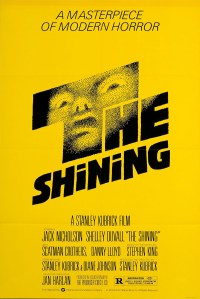
The scene below is, of course, from Stanley Kubrick’s 1980 masterpiece, The Shining.

In this scene, Jack Torrance (Jack Nicholson) stumbles into the Overlook Hotel’s ballroom, still fuming over having been accused of abusing his son.  A recovering alcoholic, Jack sits at the bar and thinks about how he would give up his soul for just one one drink.  And, on cue, Lloyd (Joe Turkel) appears.

As I was watching this scene, it occurred to me that, way back in 1980, there probably was some guy named Lloyd who saw this movie in a theater and was probably totally shocked when Jack suddenly stared straight at him and said, “Hey, Lloyd.”

The brilliance of this scene is that we never actually see Lloyd materialize.  We see him only after Jack has seen him.  So, yes, Lloyd could be a ghost.  But he could also just be a figment of Jack’s imagination.  Jack very well could just be suffering from cabin fever.  Of course, by the end of the movie, we learn the truth.

Everyone always talks about Jack Nicholson’s performance as Jack.  Some people love it and some people hate it.  (I’m in the first camp.)  However, let’s take a minute to appreciate just how totally creepy Joe Turkel is in this scene.  Turkel was a veteran character actor and had appeared in two previous Kubrick films, The Killing and Paths of Glory.  Two years after appearing in The Shining, Turkel played what may be his best-known role, Dr. Eldon Tyrell in Blade Runner.

From Stanley Kubrick’s The Shining, here’s Jack Nicholson and Joe Turkel:

Horror Book Review: Encyclopedia Of Vampire Mythology by Theresa Bane


Now, here’s the interesting thing about vampires:

They’ve been around forever.

Seriously, long before Bram Stoker first put pen to paper, there were legends about vampires.  Of course, they weren’t always called vampires.  In the Middle East, there was talk of the Afrit, which was the soul of a murdered person who would return to the spot of its death and drink the blood of anyone unlucky enough to cross it.  In Macedonia, it was said that certain people who had lived wicked lives and never eaten pork would return to life as a blood-drinking wild boar.  In Iceland, it was the Alfemoe who sucked blood while the ancient Greeks could tell you all about Empusa, who drank blood to maintain a youthful appearance.

Of course, we all know that vampires don’t exist, or at least they don’t exist as supernatural creatures.  Still, it is somewhat amazing that all of these different societies and cultures developed essentially the same myth at roughly the same time, despite not having much contact with each other.  There is just something universal about both the threat and the allure of the vampire.

With all of the different legends out there, it can be difficult to keep your mythological vampires straight.  Fortunately, the Encyclopedia of Vampire Mythology is here to help!  Written by a vampirologist (albeit one who goes out of her way to make sure that we understand that she personally doesn’t believe in them), this encyclopedia has entries for all of the various mythological vampires and their legends.  With the exception of Dracula, this encyclopedia doesn’t include any of the “fictional” vampires from television or film.  If you’re looking for an entry on Angel or Edward Cullen, this is not the place to look.  But what the book does have is entries on the legendary beings who came before the celebrity vampires of today.  It makes for interesting reading and it also serves as a reminder that there’s more to the vampire legend than what we’ve seen in the movies or read in novels.

For both authors and readers of vampire fiction, the Encyclopedia of Vampire Mythology is a valuable resource.