Horror On TV: Tales From The Crypt 3.8 “Easel Kill” (dir by John Harrison)


For tonight’s excursion into televised horror, we have the 8th episode of the 3rd season of HBO’s Tales From The Crypt!

Easel Kill feels a bit like a remake of Color Me Blood Red.  Tim Roth plays a painter who appears to have lost his talent.  Apparently, he has recently stopped drinking and he’s just not that inspired when he’s sober.  (However, he’s just as angry as he’s always been.  He’s the type of neighbor who will push someone off of a fire escape if they’re playing their music too loud.)  Fortunately, once he starts painting with blood, people are suddenly interested in his paintings.

The only problem is getting the blood…

This episode originally aired on July 17th, 1991.

Enjoy!

The TSL’s Daily Horror Grindhouse: Scalps (dir by Fred Olen Ray)


The 1983 film Scalps answers the following question:

What happens when these grad students…

scalps-02

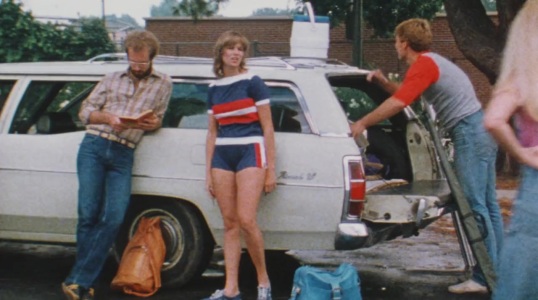
…dig up a sacred Native American burial ground and consider stealing some of the artifacts for themselves?

These grad students right here!

These grad students right here!

Well, they upset this lion…

scalps-1

…and this woman…

scalps-movie-1983-5

…and this guy, as well!

scalps

Needless to say, things don’t end well for anyone involved.

As for why those students were out digging for artifacts in the first place, the blame rests with Prof. Machen.  At first, Machen didn’t go with the students.  He had to take care of stuff back at the university.  When he finally did show up, it was a little bit too late.  Prof. Machen is played by an actor named Kirk Alyn, who was the first actor to play Superman back in the 1940s.

In the picture below, you can tell Prof. Machen is an explorer because of the pith helmet that he’s carrying:

vlcsnap-2014-07-26-09h28m09s26

Scalps is about 80 minutes long.  Most fans of low-budget horror will not be shocked to learn that Scalps is about 60 minutes of filler and 20 minutes of actual action.  Seriously, it takes forever for those grad students to actually reach the site of the dig and then, once they start digging, it seems to take even longer for anything to actually happen.  Occasionally, we get a quick flash forward of someone getting scalped or an insert of either the lion, the witch, or the warrior looking upset.

The grad students themselves are pretty much interchangeable.  As far as the men go, two of them have beards and another likes to drink beer.  As far as the women are concerned, two of them are blonde and one of them is slightly less blonde.  D.J. (Jo-Ann Robinson) is kind of a hippie and she has a bad feeling about everything.

(Stupid hippies!  Bleh!)

What’s odd is that, in the end, the film’s glacial pace actually works to its advantage.  Combined with an 80s synthesizer-of-doom score and some ragged but still effectively desolate shots of the desert, the slow pace actually gives Scalps something of a dream-like feel.  Like a filmed nightmare, the film is suffused with a feeling of impending doom.  Once the killings start, Scalps also makes good use of the slo-mo of doom.  Even the most rudimentary of scenes can be scary when they’re filmed in slow motion.

Scalps has been described as being one of the most censored films in cinematic history.  If you listen to Fred Olen Ray’s director’s commentary (more on that below), you’ll learn that it was largely censored due to the behavior of an unethical producer.  That said, it is a remarkably gory little film.  It may take a while for the blood to start flowing but once it starts, it doesn’t stop.  Admittedly, some of the gore effects worked better than others.  The arrow to the eye didn’t seem authentic.  The scalping, on the other hand, seemed far too authentic.  As for the decapitation …. well, I’d put that somewhere in the middle.

Scalps is something of a historical oddity, because it was one of the first films to be directed by the incredibly prolific Fred Olen Ray.  If you’re lucky enough to find the out-of-print Retromedia DVD, you can listen to a commentary track from Fred.  He’s remarkably honest about the film’s flaws and also discusses how he feels that the film’s producers ruined the film by adding random insert shots and flash forwards.  (“That’s not us doing that!” Fred says during one insert of the lion.)  Fred also points out that he made the mistake of actually shooting some of the night scenes at night.  It’s always interesting listening to a veteran director talk about his first film.  Since they have nothing to lose by openly discussing the mistakes that they made, their commentaries become a sort of a mini-film school.

Scalps is not a lost masterpiece but it is oddly watchable.  Somehow, it manages to be both silly and surprisingly effective at the same time.

210k4rq

Horror Film Review: Son of Dracula (dir by Robert Siodmak)


son_of_dracula_movie_poster

Did you know that Count Dracula had a son?

Well, maybe he did or maybe he didn’t.  It all depends on how you interpret the 1943 film, Son of Dracula.  In Son of Dracula, Lon Chaney, Jr. plays a vampire named Count Alucard.  I get the feeling that it’s supposed to be a shocking moment when it’s pointed out that Alucard is Dracula spelled backwards but, since the movie is called Son of Dracula, I would think that most people would have already figured out the connection.

That said, when Alucard reveals that his true name is Dracula, he seems to be suggesting that he is the original Count Dracula.  And yet the name of the film is Son of Dracula.  At one point, two characters speculate that Alucard is a descendant of the original, just to be corrected by his bride.  “He is Dracula!” she announces.  Then again, she could just be bragging.  If you’re going to marry a Dracula, wouldn’t you rather marry the original than a descendant?

If he is the original Dracula, you do have to wonder why he’s still alive.  Since the film is a part of the Universal Dracula series, you have to wonder how he managed to survive being both staked by Van Helsing and having his body cremated by his daughter in Dracula’s Daughter.  You also can’t help but notice that Alucard doesn’t bear much of a resemblance to Bela Lugosi. nor does he have a European accent.  Instead, Alucard looks a lot like Lon Chaney, Jr.  Chaney does not make for the most convincing vampire.  As an actor, Chaney tended to project a certain “likable but dumb lug” quality that worked well for The Wolf Man and as Lenny in Of Mice and Men but it doesn’t quite work when he’s cast as a suave, Hungarian vampire.

Anyway, Son of Dracula finds Count Alucard in New Orleans at the turn of the century.  He has specifically moved to the Deep South so that he can be with Katherine Caldwell (Louise Allbritton), a young woman who is obsessed with the occult.  Katherine secretly marries Alucard.  When her former boyfriend, Frank (Robert Paige), finds out about the marriage he decides that the best way to handle way things would be to get drunk and shoot the count.  Unfortunately, since the Count is a vampire, the bullet passes through him and kills Katherine instead.

Or does it!?

Probably the most interesting thing about Son of Dracula is that it presents Alucard as being manipulated by a mortal.  Usually, Dracula is the one doing the manipulating but in Son of Dracula, it’s suggested that a clever mortal can manipulate the undead jut as easily.  GO KATHERINE!

Anyway, Son of Dracula is okay.  It has some steamy deep south atmosphere and it’s fun in a campy, Universal sort of way.  It has some historical significance because it was apparently the first film to actually feature a vampire transforming into a bat onscreen.  For the most part, though, it’s a film that will best be appreciated by Universal horror completists.

That said, I kind of like the fact that nobody in the film could figure out that Alucard is Dracula spelled backwards.  That was cute.

4 Shots From Horror History: House of Frankenstein, The Uninvited, House of Dracula, The Picture of Dorian Gray


This October, I’m going to be doing something a little bit different with my contribution to 4 Shots From 4 Films.  I’m going to be taking a little chronological tour of the history of horror cinema, moving from decade to decade.

Today, we continue our look at the 1940s.

4 Shots From 4 Films

House of Frankenstein (1944, dir by Erle C. Kenton)

House of Frankenstein (1944, dir by Erle C. Kenton)

The Uninvited (1944, dir by Lewis Allen)

The Uninvited (1944, dir by Lewis Allen)

House of Dracula (1945, dir by Erle C. Kenton)

House of Dracula (1945, dir by Erle C. Kenton)

The Picture of Dorian Gray (1945, dir by Albert Lewin)

The Picture of Dorian Gray (1945, dir by Albert Lewin)

Horror On the Lens: Bride of the Monster (dir by Ed Wood, Jr.)


Bride_of_the_Monster_(1956_movie_poster)

Today’s horror film on the lens is Edward D. Wood’s 1955 epic, Bride of the Monster.  The film itself doesn’t feature a bride but it does feature a monster, a giant octopus who guards the mansion of the mysterious Dr. Vornoff (Bela Lugosi).  Vornoff and his hulking henchman Lobo (Tor Johnson) have been kidnapping men and using nuclear power to try to create a race of super soldiers.  Or something like that.  The plot has a make-it-up-as-you-go-along feel to it.  That’s actually a huge part of the film’s appeal.

Bride of the Monster is regularly described as being one of the worst films ever made but I think that’s rather unfair.   Appearing in his last speaking role, Lugosi actually gives a pretty good performance, bringing a wounded dignity to the role of Vornoff.  If judged solely against other movies directed by Ed Wood, this is actually one of the best films ever made.

(For a longer review, click here!)

Horror on TV: Tales From The Crypt 3.7 “The Reluctant Vampire” (dir by Stephen Hopkins)


Since I’ve been reviewing so many Dracula films as of late, it seems only appropriate that tonight’s excursion into televised horror should be about a vampire as well!

The Reluctant Vampire was the 7th episode of the 3rd season of HBO’s Tales From The Crypt!  It stars Malcolm McDowell as a vampire who is a little bit too nice for his own good.  Seriously, you can’t go wrong with Malcolm McDowell as a vampire.

The Reluctant Vampire originally aired on July 10th, 1991.

Enjoy!

The TSL’s Daily Horror Grindhouse: Green Room (dir by Jeremy Saulnier)


greenroom5

Jeremy Saulnier’s Green Room is one of the best films of the year but I don’t know if I’m ever going to be able to bring myself to watch it a second time.

Why?

There’s two reasons:

Number one, Green Room is one of the most intense films that I’ve ever seen.  Much like Saulnier’s previous film, Blue Ruin, this is a violent movie that never makes violence look fun.  The violence here is all too real and the pain that the characters feel is all too real as well.  I watched a good deal of Green Room through my fingers, hiding my face behind my hands.  Seriously, I’ve seen some pretty gory movies.  (I’m an unapologetic fan of Italian horror, after all.)  But Green Room still left me shaken.  Occasionally, it even left me gasping for breath.  It’s just that intense.  It’s a film about four people battling for survival and I’m surprised (and a little proud) that I survived all the way to the end.

The other reason is that the film stars Anton Yelchin.  It was one of the final films that he made before his death and he gives such a likable and committed performance that it’s impossible for me to think about the film without getting a little emotional.  Far more than his supporting work in the Star Trek films, Green Room showcased what a good actor Anton Yelchin truly was.  It’s impossible for me to think about Green Room without mourning a talent taken from us far too soon.  And though it might be difficult to watch the film a second time, everyone should watch Green Room at least once.  If you ever wonder why some of us still get emotional when we talk about Anton Yelchin, it’s all there in the movie.

In Green Room, Yelchin plays Pat.  Pat is the bass player for a punk band called the Ain’t Rights.  The Ain’t Rights have been touring the northern part of the country.  It’s a low-budget tour, one that perfectly reflects that anti-corporate politics of the Ain’t Rights.  For them, the tour means crashing with friends, siphoning gasoline, and doing interviews with underground radio stations.  In fact, one interviewer — the rather dorky Tad (David W. Thompson) — arranges for them to do a show at an isolated bar in Oregon.  Tad tells them that the bar attracts a rough crowd but that they’ll be okay because his cousin Daniel (Blue Ruin‘s Macon Blair) works there.

The Ain’t Rights arrive and discover that the club appears to have a clientele that is exclusively made up of Neo-Nazi skinheads.  After some hesitation, the Ain’t Rights take the stage and, for a few brief moments, Saulnier shows them performing in slow motion and those of us in the film’s audience — even someone like me, who would probably otherwise never listen to a band like the Ain’t Rights — are briefly caught up in the joy and excitement of their performance.

Unfortunately, while the band is performing, the Nazis are busy murdering a woman in the green room.  And, after the band walks in on the aftermath of the murder, they soon find themselves marked for death as well.  The band is smart enough to lock themselves in the green room and to take one of the Nazis as a hostage.  However, they know that they can’t stay in that room forever.  At some point, they’re going to have to figure out how to escape from the bar…

Green Room is a harrowing and violent film, one that maintains an almost feverish intensity from start to end.  Making it all the more difficult to watch is that Saulnier keeps the horror rooted in reality.  The Neo-Nazis never turn into cardboard movie slashers.  Instead, they are a very real and disturbing threat.  (It’s interesting to note that occasionally, a Neo-Nazis will express some doubt about killing the band but none of them have the courage to actually refuse any of the orders that they receive.  We often hear that people need to respect authority.  Well, Green Room shows what happens when people blindly respect authority to the extent that they can no longer think for themselves.)  Though the film may be violent, it never celebrates that violence and when one character does get a chunk of arm chopped off, it’s literally one of the most painful images to ever be captured on film.  You like every member of the band so, when they get hurt, you feel their pain as well.  Though Yelchin may be the main character, the other members of the Ain’t Rights — played by Alia Shawkat, Joe Cole, and Callum Turner — all make a good impression as well.  You want them all to escape and dread the realization that not all of them will.

As for the owner of the club, his name is Darcy and he’s played by Patrick Stewart.  At first, it may sound like stunt casting.  Patrick Stewart as a Neo-Nazi?  But interestingly enough, Darcy doesn’t really seem to care about ideology.  Instead, you get the feeling that he realized that there was money to be made by catering to racists so that’s what he decided to do.  When he barks out orders and demands that the members of the band be killed, his main motivation seems to be pure greed.  If the band escapes and reports the murder, he’ll lose his club.  Stewart gives a chilling performance.  When he first appears, you do think, “Hey, it’s Patrick Stewart!”  But, within minutes, you forget who is playing him.  He becomes Darcy and you’re scared to death of him and his followers.

Green Room is an incredibly intense and scary film.  It also features perhaps the best performance of Anton Yelchin’s career.  Green Room stands as a testament to a talent taken too early.

(On a purely personal note: I’m glad that Green Room took place in Oregon.  Too often, movies tend to portray racism as being an exclusively Southern issue, one that somehow magically disappears once you head up north.  It often feels as if people spend so much time talking about racism in other states that they fail to actually look at what’s happening in their own backyard.  It’s easier to laugh at a state like Alabama than to ask why someone like Eric Garner died on the streets of New York City.  Racism is an American issue, and that includes the states both below and above the Mason-Dixon line.)

patrick-stewart

Horror Film Review: Dracula’s Daughter (dir by Lambert Hillyer)


draculas_doughter_original_poster_1936

Did you know that Dracula had a daughter!?

Well, Bram Stoker might disagree but, according to Universal Studios, he did.  Her name was Countess Marya Zaleska and, as played by Gloria Holden, she is the title character in 1936’s Dracula’s Daughter!  Like her father, the Countess was also a vampire.  The film never gets into just how she became a vampire.  Was she born a vampire or, far more disturbingly, was she once a mortal who turned into a vampire by her own father?  The film doesn’t tell us but it does establish early on that she hates being one of the undead.  Unlike her father, she struggles with her urge to drink blood.  When she discovers that Dracula has been staked, she and her servant, Sandor (Irving Pichel), steal the body from the morgue and burn it.  The Countess thinks that this will cure her of her urges.

Sadly, it does no such thing.

So, what’s a reluctant, 20th century vampire to do?  Well, she can always go to a psychiatrist and hope that science can somehow break the curse.  She ends up as a patient of Dr. Jeffrey Garth (Otto Kruger).  By coincidence, Dr. Garth has another famous patient — Dr. Edward Von Helsing.  (That’s right, they changed the “van” to a “von” in Dracula’s Daughter.  Despite the name change, Edward van Sloan returns to play the veteran vampire hunter.)

Von Helsing in on trial, accused of murdering Dracula in the previous film.  Oddly enough, nobody mentions Renfield who, seeing as how we’re told Dracula’s Daughter starts exactly where Dracula left off, would have been found dead in the crypt as well.  Even stranger, no one steps forward to defend Von Helsing.  Dr. Seward, Mina, Johnathan Harker?  Forget about them.  Not a single one is to be found while Von Helsing is accused of murder.

Bastards.

Fortunately, Von Helsing has a defense!  Since Dracula was already dead and had been for 500 years, Von Helsing could not have killed him.  Helping him out with this defense is Dr. Garth…

Meanwhile, the Countess tries to resist the urge to attack every woman that she sees.  She pours her frustrations out into painting.  One night, Sandor brings the Countess a new model, a beautiful young woman named Lil (Nan Grey).  The Countess orders Lil to undress and then, after staring at her, gives into her urges and attacks…

If you’re thinking that there’s a subtext here, that’s because there is.  (In fact, Universal’s tagline for the film was, “Save the women of London from Dracula’s Daughter!”)  Perhaps even more so than in Dracula, Dracula’s Daughter uses vampirism as a metaphor for forbidden sex.  When the Countess stares at Lil and, later, when she prepares to bite the neck of Dr. Garth’s fiancée, she is embodying the hysterical fears of a puritanical society.  When she unsuccessfully seeks a cure for her vampirism, we’re reminded that, in the 1930s, psychiatry classified homosexuality as being a mental illness.  When the Countess struggles with her urge to drink blood, she is a stand-in for everyone who has struggled with their sexuality.

Gloria Holden plays the Countess as being as much a victim as a victimizer.  Whereas Bela Lugosi turned Dracula into the epitome of evil, Gloria Holden gives a performance that is full of ambiguity.  In fact, she at times seems to be so tortured by her vampiric state that, when she finally fully embraces the fact that she’s a vampire, you have to cheer a little.  At least she’s finally being honest with herself!  At least she’s no longer making apologies or allowing society to punish her for being who she is.  Was Countess Zaleska the first reluctant vampire in film history?  I’m not sure but Holden’s performance undoubtedly set the bar by which all other self-loathing vampires should be judged.

Dracula’s Daughter holds up surprisingly well.  It’s definitely one to look for during this Halloween season.

4 Shots From Horror History: Dr. Cyclops, The Wolf Man, Cat People, I Walked With A Zombie


This October, I’m going to be doing something a little bit different with my contribution to 4 Shots From 4 Films.  I’m going to be taking a little chronological tour of the history of horror cinema, moving from decade to decade.

Today, we take a look at the first few years of 1940s.

4 Shots From 4 Films

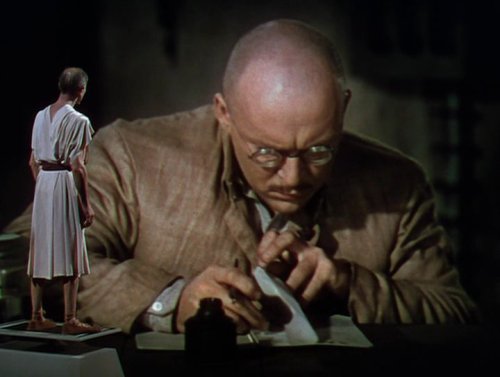
Dr. Cyclops (1940, dir by Ernest B. Schoedsack)

Dr. Cyclops (1940, dir by Ernest B. Schoedsack)

The Wolf Man (1941, dir by George Waggner)

The Wolf Man (1941, dir by George Waggner)

Cat People (1943, dir by Jacques Tourneur)

Cat People (1942, dir by Jacques Tourneur)

I Walked With A Zombie (1943, dir by Jacques Tourneur)

I Walked With A Zombie (1943, dir by Jacques Tourneur)

Horror on the Lens: Children of the Corn (dir by Fritz Kiersch)


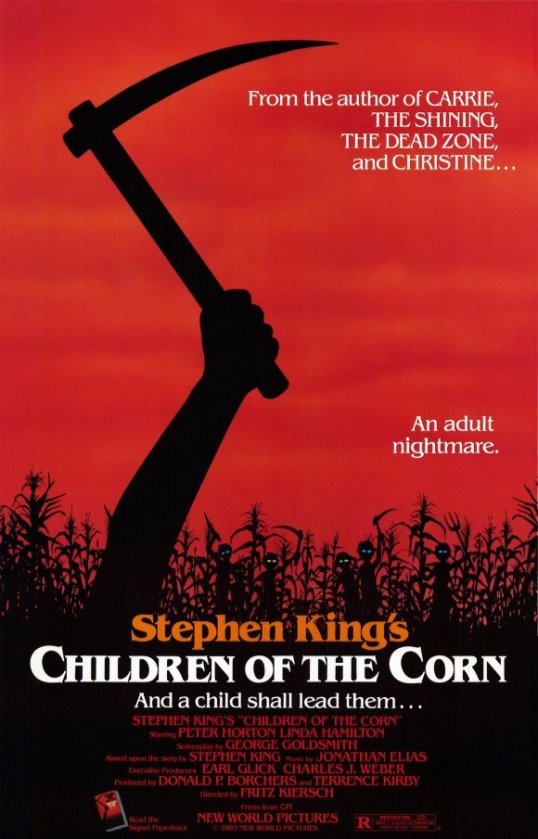
ChildrenoftheCorn

Today’s horror on the lens is the 1984 film that TSL editor-in-chief Arleigh Sandoc has called the worst Stephen King adaptation of all time.  For the record, I tend to agree with that judgment but, for some reason, a lot of people seem to like Children of the Corn.

And I will admit — the kids are creepy.  Especially that little Isaac guy with the shrill voice.  Whenever Isaac starts screaming, “MALACHI!!!!,” — well, it’s like nails on a chalkboard, to be honest.

Anyway, in case you’d forgotten, this is the movie where all the little kids hang out in a cornfield and kill adults.  It attempts to say something about religion but I’m not sure what it’s trying to say.  It’s all kind of silly but, as I said, some people seem to like it.

(Personally, I prefer that old episode of South Park where they keep declaring shenanigans on the carnival, all the cows jump off a cliff, and the visiting yankee tourists end up getting devoured by rats in jail.)

In order to help you decide for yourself whether or not this is a decent film, here is Stephen King’s Children of the Corn!  Enjoy it while you can because you just know that YouTube is going to eventually yank it down for copyright reasons.