The TSL’s Daily Horror Grindhouse: Demons (dir by Lamberto Bava)


demons

“What the Hell happened to Rosemary?”

— Tony The Pimp (Bobby Rhodes) in Demons (1985)

A lot of what you need to know about Demons, an Italian horror film from 1985, can be summed up by the fact that one of the leading characters is named Tony the Pimp.  Demons is a very self-aware film, one that is not only over-the-top and ludicrous but which is cheerfully aware that it’s over-the-top and ludicrous.  Considering that Demons is an apocalyptic film that ends with nearly the entire cast dead, Demons is a surprisingly good-natured horror film.

The film opens in Berlin.  There’s a mysterious man hanging out at a subway station.  He’s wearing a silver half-mask and, from what we can see of his face, he appears to be heavily scarred.  Interestingly enough, the man is played by Michele Soavi.  (Though Soavi is now best remembered as the director of Dellamorte Dellamore, he was an actor and assistant to Dario Argento when Demons was produced.)  The man doesn’t speak.  Instead, he hands out flyers to random people, inviting them to attend the premiere of a new horror film.

The man obviously does a very good because a truly diverse group of characters show up for the premiere.  There’s a wealthy blind man who comes with his assistant.  (The assistant is played by Dario Argento’s oldest daughter, Fiore.)  There’s an older couple who keep shushing everyone in the audience.  There’s Cheryl (Natasha Hovey), who ends up sitting next to the handsome George (Urbano Barberini, who would later co-star in Dario Argento’s Opera).  And, of course, there’s Tony the Pimp (Bobby Rhoades) who shows up wearing a white suit and with two prostitutes.

The film-within-the-film is a horror film that plays out like an homage to every Italian horror film released in the 1980s.  It deals with four teenagers who stumble across the grave of Nostradamus and end up transforming into blood-thirsty demons.  One of the teenagers is played by Michele Soavi, though it’s never clear whether the teenager and the man in the mask are supposed to be the same person.

As they watch the movie, something strange starts to happen in the audience.  One of the prostitutes scratched her face when she put on a prop mask.  When the same mask appears in the movie, the cut on her face starts to throb.  Soon, she is transformed into a … DEMON!

JUST LIKE IN THE MOVIE!

Needless to say, the arrival of a real-life demon leads to a panic in the theater but guess what?  The doors are locked!  There’s no way out!  When Tony the Pimp breaks into the projection booth, he discovers that there’s no projectionist and the movie cannot be stopped!  On top of that, getting scratched by a demon means that you transform into a demon yourself!

In other words — remember the debate about whether or not horror movies can turn their viewers into murderous monsters?  Well, Demons says that they definitely can…

Demons was directed by Lamberto Bava, son of the famous Mario Bava, and it remains one of the most popular Italian horror films of all time.  With a script that was co-written by Dario Argento (who also produced), Demons is a fun and exciting horror film that cheerfully dares you to take it too seriously.  Watching this energetic film, you can tell that Bava was having a lot of fun with the idea that the world could end as a result of watching just one horror movie.

Demons was a huge box office hit so, naturally, there were hundreds of unofficial sequels.  Though Michele Soavi’s The Church was a Demons film in every way but name, the only official sequel was Demons 2.  We’ll look at that film tomorrow.

Horror Film Review: The Invisible Man (dir by James Whale)


the-invisible-man

The 1933 Universal horror film, The Invisible Man, never seems to get as much attention as Frankenstein, Dracula, The Wolf Man, or The Mummy.  Perhaps it’s because the invisible man really isn’t a supernatural monster.  He’s just a scientist who has turned himself invisible and is now going mad as a result.  Or maybe it’s because there have been so many crappy films that have used invisibility as a plot point that the reputation of the original Invisible Man suffers by association.

For whatever reason, The Invisible Man never seems to get spoken about in the same breathless, gleeful manner as some of the other Universal monsters.  But I have to admit that, though I usually can’t stand movies about invisibility, I rather like The Invisible Man.

Based on a novel by H.G. Wells, The Invisible Man opens with a mysterious man (played by Claude Rains) arriving in a small English village.  He checks into a small inn and soon, everyone in the village is scared of him.  It’s not just his haughty attitude or his habit of ranting about his own superiority.  There’s also the fact that he is literally covered, from head to toe, in bandages.  He always wears gloves and dark glasses.  He insists that he’s doing important research and demands to be left alone.

The inn keeper (Forrester Harvey) and his histrionic wife (Una O’Connor) put up with the mysterious man until he falls behind on his rent.  However, once confronted, the mysterious man announces that he’s not going anywhere.  When the police and a mob of villagers arrives, the man starts to laugh like a maniac.  He unwraps the bandages around his head and…

THERE’S NOTHING UNDERNEATH!

Well, there is something there.  It’s just that the man is invisible so no one can see what’s underneath.  It turns out that the man is Dr. Jack Griffin, a chemist who has been missing for several days.  He’s created an invisibility serum but he can’t figure out how to reverse the effects.  Even worse, the serum is driving him insane.  Griffin’s fiancée, Flora (Gloria Stuart), and her father, Dr. Cranley (Henry Travers), are searching for Jack but Jack doesn’t particularly want to be found.  Jack is more interested in exploring how he might be able to use invisibility to conquer the world…

The Invisible Man is historically important because it was the film that brought Claude Rains to Hollywood.  Rains has previously made films in the UK but this was his first American film.  Think of how different film history would have turned out if The Invisible Man had, as originally planned, starred Boris Karloff.  Without Claude Rains coming to America, who would have played Louis in Casablanca?  Who would have played Sen. Paine in Mr. Smith Goes To Washington or Alex Sebastian in Notorious?  Of course, we don’t really see Claude Rains’s face until the very end of The Invisible Man.  Instead, we just hear his voice but what a voice Claude had!  He delivers his dialogue with just the right amount of malicious sarcasm.

I like The Invisible Man.  For modern audiences, it’s not particularly scary.  (Though I do find the idea of being unknowingly followed by an invisible person to be a little unnerving…)  However, unlike a lot of other old horror films, you can watch The Invisible Man and see why it would have been scary to an audience seeing it for the very first time.  In 1933, a time when film was still a relatively new medium and audiences had yet to become jaded by special effects, here was a man unwrapping his bandages to reveal that there was nothing underneath!  That had to have freaked people out!

The Invisible Man was directed by James Whale and the film features the same demented sense of humor that distinguished The Bride of Frankenstein.  The villagers are portrayed as being so hysterical that you can’t help but think that maybe Griffin has a point about being surrounded by fools.  By the time the local constable declares, “What’s all this then?,” you can’t help but start to sympathize with Jack Griffin.

There’s been a lot of  bad invisibility movies made but The Invisible Man is not one of them.  It may not be as well remembered as some of the other Universal horrors but it’s definitely one worth seeing.

4 Shots From Horror History: The Strange Door, The Black Castle, The Maze, House of Wax


This October, I’m going to be doing something a little bit different with my contribution to 4 Shots From 4 Films.  I’m going to be taking a little chronological tour of the history of horror cinema, moving from decade to decade.

Today, we look at the start of the 1950s.

4 Shots From 4 Films

The Strange Door (1951, dir by Joseph Pevney)

The Strange Door (1951, dir by Joseph Pevney)

The Black Castle (1952, dir by Nathan H. Juran)

The Black Castle (1952, dir by Nathan H. Juran)

The Maze (1953, dir by William Cameron Meznies)

The Maze (1953, dir by William Cameron Meznies)

House of Wax (1953, dir by Andre De Toth)

House of Wax (1953, dir by Andre De Toth)

Horror on the Lens: Night of the Ghouls (dir by Edward D. Wood, Jr.)


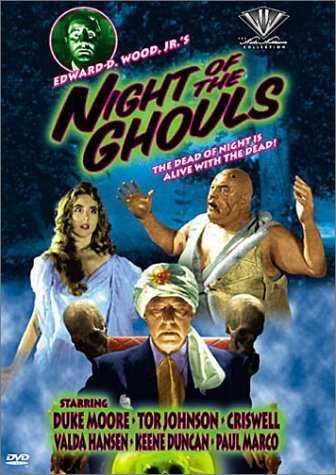
GhoulsdvdToday’s movie is Ed Wood’s sequel to Bride of the Monsters.  In Night of the Ghouls, con man Dr. Alcula (Kenne Duncan) moves into Bela Lugosi’s old mansion and pretends to talk to the dead.  What Alcula doesn’t realize is that the house is actually haunted (by Tor Johnson’s Lobo, among others) and real ghosts don’t appreciate pretend ghosts.

What can you say about a film like of Night of the Ghouls?  It’s an Ed Wood film, with all that suggests.  However, how can you resist a film that starts with Criswell sitting up in his coffin and providing commentary?

The role of Dr. Alcula was originally written for Bela Lugosi.  After Lugosi’s death, veteran actor and longtime Wood friend Kenne Duncan got the role instead.  Also of note, Wood appears twice in this film.  Not only does his picture appear on a wanted poster in the police station but Wood also plays one of the female ghouls.

(See this one when you can because, as I mentioned yesterday, YouTube has been taking down almost all of the Ed Wood films that have been uploaded to the site.)

Horror On TV: Tales From The Crypt 3.10 “Mournin’ Mess” (dir by Manny Coto)


Tonight’s excursion into the world of televised horror is the 10th episode of the 3rd season of HBO’s Tales From The Crypt!

Steven Weber plays an alcoholic reporter who thinks that he has found the story of his career!  Someone is preying on the homeless and our reporter is determined to find out who and why.  (Not because he actually cares about the homeless, of course.  He just needs a big story to save his career.)  However, the reporter quickly discovers that 1) all charities are not charitable and 2) you should always be careful about biting off more than you can chew…

This well-acted episode was directed and written by Manny Coto and it originally aired on July 31st, 1991.

Enjoy!


The TSL’s Daily Horror Grindhouse: Galaxy of Terror (dir by Bruce D. Clark)


galaxy_of_terror

Long before Event Horizon (but, perhaps more importantly, shortly after the original Alien), there was 1981’s Galaxy of Terror!

Produced by Roger Corman and featuring production design and second unit work from James Cameron, Galaxy of Terror tells the story of what happens when, in the future, the crew of the Quest are dispatched to a mysterious planet.  They’re on a rescue mission but what they don’t realize is that they’re heading into a trap!

The crew of the Quest is virtually a who’s who of cult actors.

The youngest member of the crew is Cos.  Cos is scared of everything and, from the minute you see him, you can tell that he’ll probably be the first to die.  Cos is played by Jack Blessing, who subsequently became a very in-demand voice over artist.  You may not recognize the name or the face but you’ve probably heard the voice.

Captain Trainor, who is still troubled by a disastrous mission in the past, is played by Grace Zabriskie, who is rumored to have inspired Bob Dylan’s “Like A Rolling Stone” and who subsequently became a regular member of David Lynch’s stock company.

The fearsome Quuhod is played by one of the patron saints of exploitation filmmaking, the one and only SID HAIG!  Quuhod doesn’t say much but Sid Haig doesn’t have to say much to make an impression.

Technical officer Dameia is played by Taaffe O’Connell.  She suffers through the film’s most infamous and distasteful scenes, in which she’s assaulted by a gigantic space worm.  That scene was apparently insisted upon by Roger Corman and it’s not easy to watch.  At the same time, since the film takes place on a planet that is ruled by pure evil, the scene somehow works.  It’s that scene that tells you that Galaxy of Terror is not going to be your typical B-movie.  That is the scene that says, “This movie is going to give you nightmares!”

Ranger is played by Robert Englund!  That’s right — the original Freddy Krueger himself.  It’s interesting to see Englund in this role because Ranger is actually one of the only likable characters in the film.  It’s strange to see the future Freddy Krueger being menaced by the same type of threats that he unleashed on Elm Street.  But Englund does a good job in the role.  In fact, he does so well that you wonder what would have happened in his career if he hadn’t been forever typecast as the man of your nightmares.

The arrogant and cocky Baelon is played by future director, Zalman King.  It says something about King’s acting career that Galaxy of Terror is not the strangest film that he ever appeared in.

Burned-out Commander Ilvar is played by Bernard Behrens, who is one of those character actors who has a very familiar face.  If you watch any movie from the 80s or 90s that features a weary homicide detective or an unsympathetic bureaucrat, it’s entirely possible that he was played by Bernard Behrens.

Kore, the ship’s cook, is played by Ray Waltson, who is another one of those very familiar character actors.  Over the course of his long career, Waltson appeared in everything from The Apartment to The Sting to Fast Times At Ridgemont High to a countless number of TV shows and TV movies.  Waltson was usually cast in comedic roles so it’s interesting to see him here, playing a role that is very much not comedic.

Alluma, an empath, is played by Erin Moran, who was best known for playing Ron Howard’s bratty sister on the somewhat terrible (but apparently popular and deathless) sitcom, Happy Days.  Moran’s explosive death scene is another reason why Galaxy of Terror has a cult following.

And finally, the “star” of the film is Edward Albert, who plays Cabren.  To return to my earlier comparison to Event Horizon, Edward Albert has the Laurence Fishburne role.

Anyway, our crew is sent on a rescue mission but, when they crash land on the planet Morganthus, they find themselves outside of a desolate pyramid.  They make the mistake of exploring the pyramid and end up being confronted by their greatest fears.  (They also eventually discover that one of their crewmates is a traitor.)  It’s pretty much a typical sci-fi slasher film but it makes an impression because, thematically, it’s just so dark.  The fears that attack the crew members are so ruthless and brutal that they will take even the most jaded of horror fans by surprise.  Galaxy of Terror is relentless and merciless in its effort to scare the audience.

What especially distinguishes Galaxy of Terror is that, despite the obviously low budget, the entire film feels sickeningly real.  A lot of credit for that has to go to James Cameron, who creates a lived-in future that actually feels a lot more plausible than anything to be found in Avatar.

So, if you have the chance, turn off the lights, watch the film in the dark, and prepare for a perfect Halloween nightmare!

6 Trailers From Planet Horror


For this week’s edition of Lisa Marie’s Favorite Grindhouse and Exploitation Film Trailers, we have 6 trailers from Planet Horror!

Planet of the Vampires (1965)

(From director Mario Bava)

Queen of Blood (1966)

Starship Invasions (1977)

Inseminoid (1981)

Galaxy of Terror (1981)

Breeders (1997)

What do you think, Halloween Visitors?

main-laser-beam-cloaking-device-could-save-planet-earth-from-being-annihilated-by-genocidal-aliens

Horror Film Review: Event Horizon (dir by Paul W. S. Anderson)


event_horizon_ver1

Event Horizon, a sci-fi/horror hybrid from 1997, is one of those films that starts out with a series of title cards:

“2015 First permanent colony established on moon.”

Wait … 2015?  How did I miss that?

” 2032 Commercial mining begins on Mars.”

Yay!  Only 16 more years to wait until we’re finally on Mars!

“2040 Deep space research vessel ‘Event Horizon’ launched to explore boundaries of Solar System. She disappears without trace beyond the eighth planet, Neptune. It is the worst space disaster on record.”

Wow, that sucks.  But things happen…

“2047 Now…”

Alright, let’s get this story going!

Seven years after it disappeared, the Event Horizon suddenly sends out a distress signal.  It turns out that it didn’t blow up like everyone assumed.  Instead, it’s still out in space.  The surly crew of the Lewis & Clark is called off of leave and sent on a rescue mission.  (And when I say surly, I do mean sur-ly!  Seriously, nobody on the Lewis & Clark is in a good mood … ever!)  Accompanying the crew is Dr. Weir (Sam Neill), the scientist who designed the Event Horizon.  Captain Miller (Laurence Fishburne) may not be happy about having Dr. Weir on his ship but, then again, Captain Miller always seems to be annoyed about something.

The Event Horizon appears to be deserted.  The walls are covered with blood.  The captain — at least it appears to be the captain — has been crucified and left on display.  Dr. Weir explains that the Event Horizon was designed to create an artificial black hole and it’s possible that the ship went into another dimension and that it may have brought something back with it.  Other crew members speculate that the Event Horizon may have accidentally been transported to Hell.  Either way, it’s not a good thing but, after the Lewis & Clark suffers some damage, the crew find themselves stranded on the Event Horizon.

Soon, the crew members are having hallucinations.  The ship’s doctor (Kathleen Quinlan) sees her son running through the ship.  Captain Miller sees the burning corpse of a friend that he had to abandon during a previous mission.  Another crewman appears to be possessed and attempts to commit suicide by opening up the airlock.  Dr. Weir has visions of his dead wife.  Things get darker and darker.  People die.  Eyes are ripped out of sockets.  A video of the original crew is found and it’s like something out of a painting by Hieronymus Bosch.  Miller wants to blow up the Event Horizon.  Dr. Weir replies, “We are home!”

Agck!

Seriously, Event Horizon is a curious film.  I’ve seen it a few times and I have to admit that it’s never quite as good as I remembered.  If you want to get really technical about it, Event Horizon is a poorly paced film that is overly derivative of the Alien franchise and it features perhaps the worst performance of Laurence Fishburne’s career.

(Yes, even worse than his performance in Contagion…)

But, at the same time, even if I’m always somewhat disappointed with the film, Event Horizon is also a movie that stays with you.  Whatever flaws the film may have, it is genuinely scary and disturbing.  Director Paul W.S. Anderson does a good job of turning that spaceship into the ultimate floating haunted house and, even more importantly, he keeps you off-balance.  This is one of the few horror films where literally anyone can die, regardless of whether they’re top-billed or have an Oscar nomination to their name.  Whatever the evil is that has possessed the Event Horizon, it is ruthlessly and sadistically efficient.

Plus, there’s that video.  If you’ve seen the movie, you know what I’m talking about.  Anderson has complained that the studio made him cut a lot of footage out of the video but what remains is disturbing enough.  Seriously, you’ll never want to hear another Latin phrase after watching Event Horizon.

4 Shots From Horror History: Strangler Of The Swamp, House of Horrors, She-Wolf of London, Scared To Death


This October, I’m going to be doing something a little bit different with my contribution to 4 Shots From 4 Films.  I’m going to be taking a little chronological tour of the history of horror cinema, moving from decade to decade.

Today, we look at the latter half of the 1940s.

4 Shots From 4 Films

Strangler of the Swamp (1946, dir by Frank Wisbar)

Strangler of the Swamp (1946, dir by Frank Wisbar)

House of Horrors (1946, dir by Jean Yarbrough)

House of Horrors (1946, dir by Jean Yarbrough)

She-Wolf of London (1946, dir by Jean Yarbrough)

She-Wolf of London (1946, dir by Jean Yarbrough)

Scared To Death (1947, dir by Christy Cabanne)

Scared To Death (1947, dir by Christy Cabanne)

Horror On The Lens: Plan 9 From Outer Space (dir by Edward D. Wood, Jr.)


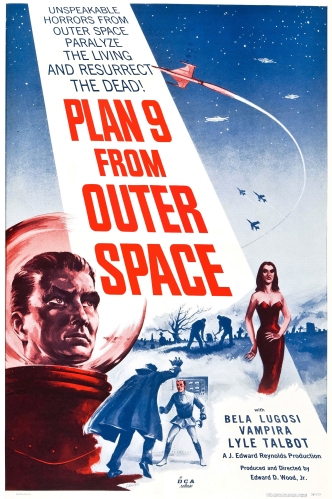
Plan_9_Alternative_posterWatching Ed Wood’s infamous Plan 9 From Outer Space is something of an October tradition here at the Shattered Lens!  And you know how much I love tradition!  (Add to that, I shared Bride of the Monster last night and I’m going to be reviewing at least two sci-fi horror films later today so it just seems appropriate to go ahead and share Plan 9 today!)

Incidentally, I know this film has a reputation for being the worst film ever made.  Personally, I don’t think that it deserves that reputation.  Is it bad?  By traditional standards of quality, I guess it can be argued that Plan 9 From Outer Space is a bad movie.  But it’s also a lot of fun and how can you not smile when you hear Criswell’s opening and closing statements?

Enjoy and be sure to read Gary’s review!

(And also be sure to read Jedadiah Leland’s tribute to Criswell!)

(On another note: Watch this as quickly as you can because, for the first time since we started Horror on the Lens, the films of Ed Wood are being yanked off of YouTube.  Copyright violations, they say.  Personally, I think that’s shameful.  First off, Ed Wood is no longer alive.  Wood had no children and his widow died in 2006, having never remarried.  Whatever money is being made off of his films is not going to support his family.  Wherever he is, I think Ed would be more concerned that people see his films than some faceless corporation make money off of them.)