Hi, everyone! Well, in case you hadn’t noticed, it’s October and we’ve pulled the string here at the Shattered Lens! Welcome to the annual TSL Horrorthon! For the next 31 days, TSL is going to be home to everything that makes October our favorite month of the year!
So, here’s Bela Lugosi in Ed Wood’s Glen or Glenda, performing the opening ceremony of the season:
First published in 1974, Carrie is often cited as being Stephen King’s first novel.
That, of course, isn’t technically true. King had written three novels before Carrie, the majority of which weren’t very good. Carrie is a novel that King says he wrote in a hurry because he was living in a trailer and needed the money. It’s also a novel that King says he had absolutely no faith in because he didn’t feel like he could write from a female perspective. Despite King’s then-low opinion of what he had written, Carrie went on to become his first published novel. Thought the novel wasn’t an immediate success (the hardback edition only sold 13,000 copies), it subsequently became a best seller after it was adapted into Brian DePalma’s 1976 film of the same name.
By now, we all know the story, don’t we? Even if you’ve never read the book or seen any of the film versions, there’s been so many different rip-offs and unofficial remakes of Carrie that I doubt that there’s anyone who doesn’t know the story. Everyone knows that Carrie White was a high school outcast and that her mother was a religious fanatic. We all know what happened the night that Tommy Ross took Carrie White to prom. We all know about the cruel prank that was played on Carrie, about the pig’s blood that was dumped on her right after Tommy and Carrie were crowned king and queen of the prom. And we all know that Carrie’s response was to use her own telekinetic powers to burn down the entire town and to kill the majority of her tormentors.
44 years after it was first published, it’s still interesting to read Carrie. On the one hand, you can definitely see the beginnings of King’s signature style, especially towards the end of the book when Sue Snell comes across a dying Carrie. On the other hand, this book is definitely different from any other King novel. For one thing, it’s only 199 pages long. Living in a trailer and struggling to make ends meet may not have been easy for King but I would say it actually made him a better writer. Carrie contains none of the rambling, self-indulgent filler that’s come to typify much of King’s recent work. One imagines that, if King wrote Carrie today, we’d have to wade through at least 500 pages of people talking about the history of psychic phenomena before the book even got around to Sue asking Tommy to take Carrie to prom. Instead, because King was writing while hungry, there’s a hunger to the book. It doesn’t waste any time.
King structured the novel so that half of it was narrative and half of it was, for lack of a better term, evidence. We get excerpts from police reports, newspaper articles, and books written after the prom disaster. The White Committee offers up their official report. We get to read a little bit of Sue Snell’s book, I Am Sue Snell. I imagine the structure was largely the result of King’s self-confessed insecurity with the book’s subject matter. (For instance, whenever you doubt that Tommy Ross would actually take Carrie to prom, an except from the final report of the White Committee pops up and assures you that he did.) Though borne of insecurity, the structure actually works pretty well. It leaves little doubt that, after Carrie’s prom, the world will never be the same again.
The thing that really struck me while rereading this novel was that Stephen King himself seemed to dislike Carrie White almost as much as her classmates did. King focuses, to an almost uncomfortable degree, on Carrie’s unattractive appearance and, often times, he seems to be keeping his own distance from his main character, as if he was weary about trying to get inside of her head. When Carrie does go on her rampage, she comes across more as an out-of-control monster than someone who has been pushed too far. Our popular conception of Carrie being a tragic victim really has more to do with how Sissy Spacek played her in the original film than in how King wrote about her in his novel.
Instead, the book is far more concerned with Sue Snell and Tommy Ross, who are both portrayed as being everyone’s idealized high school companion. As both a novel and a film, Carrie‘s greatest weakness has always been that the plot hinges on the idea that any teenager, no matter how guilt-ridden, would actually ask their romantic companion to take someone else to prom. The pig’s blood, I believe. The prom, less so.
Carrie has its flaws but, to be honest, I actually think it’s better than some of King’s more recent books. If nothing else, it’s a chance to look into Stephen King’s mind before he became the Stephen King.
Are you scared of snakes? If so, you’re not alone. According to 2001 Gallup Poll, 56% of Americans said they were scared of snakes. By comparison, only 45% of Americans said they were scared of public speaking while 41% said heights. Only 36% said they were scared of spiders and only 7% were frightened by the prospect of going to the doctor.
There are nearly 3,000 different species of snakes in the world and only 25% of them are poisonous. Most snakes are harmless and even the poisonous ones usually won’t strike as long as they’re left alone. But people will always be scared of snakes. The sound of a hiss is enough to send most people into a panic.
Back in the pulp era, snakes used to regularly appear on the covers of magazines and paperbacks, often being held by a cultist or threatening a bound victim. When it comes to pulp art, snakes are never good news. Take a look:
This October, along with with everything else, I want to highlight Italian horror! Today, we start things off with a look at 1988’s Ratman!
Terry (Janet Agren) has come to a Caribbean island, not for a vacation but instead to collect the remains of her sister, Marlis (Eva Grimaldi). Marlis was an up-and-coming model who came to the island with a photographer named Mark (Werner Pochath) and another model named Peggy (Luisa Menon). Marlis had her entire life ahead of her but apparently, someone murdered her on the island and then left her body in an abandoned building where it was eaten by a rat.
Obviously, identifying a dead sibling would be a difficult task for anyone. Fortunately, no sooner has Terry arrived on the island than she runs into Fred (David Warbeck). Fred is a true crime writer, a man who knows the island and who is always ready with a quip or a joke. For reasons that are never quite clear, Fred invites himself to accompany Terry down to the morgue. Why does Terry allow a complete stranger to go with her to identify her sister’s body? Who knows? Maybe it’s because Fred is played by David Warbeck, who was one of the more likable actors to regularly appear in Italian horror films.
It turns out to be a good thing that Fred came along because, when they arrive at the morgue, it turns out that the police don’t actually have Marlis’s body! Instead, they have Peggy’s body. Peggy was murdered while wearing Marlis’s dress, which led to a case of mistaken identity. But, if Marlis isn’t dead, where is she?
Could she and Mark have gone deeper into the jungles of the island, hoping to find the perfect place to take the pictures that will turn Marlis into a superstar? Of course, they have! Unfortunately, what they did not take into account is that the island is also the home of the Ratman!
Who is the Ratman? Well, his name is actually Mousey (Nelson de la Rosa), despite the fact that he doesn’t really act like a mouse. Mousey was created a mad scientist who wanted to see what would happen if he crossed the genes of a monkey and a rat. The end result was a 2’4 sociopath with really sharp teeth and an insatiable urge to kill. The scientist thinks that he’ll win the Nobel Prize for this creation but Mousey seems to be more concerned with killing people. As soon as he gets out of his cage, he goes on a killing spree….
Mostly because of the presence of Nelson de la Rosa (who, until his death in 2016, was the world’s shortest man), Ratman has a cult following. And it must be admitted that de la Rosa makes for a memorable ratman. Unfortunately, he’s not really in the film that much. The majority of the film is made up of filler. For instance, we spend a lot of time watching Mark take pictures. A lot of time is also devoted to Fred and Terry having to deal with the incompetent island police. (The police are convinced that Marlis is dead and are apparently willing to force Terry to look at every dead body on the island to prove it.)
Fortunately, this film also features David Warbeck and, as any fan of Italian horror can tell you, Warbeck was one of those actors who improved any film in which he appeared. Warbeck always approached his roles with a sense of humor and a likable joie de vivre and he’s probably as convincing as anyone could hope to be when appearing in a film like Ratman. Warbeck delivers his lines with just enough of a smile to not only let you know that he’s in on the joke but to also invite you to play along with him.
Reportedly, Ratman was a troubled production and the film’s producer stepped in to take over from the credited director. That perhaps explains why the film itself sometimes feels rather disjointed. There is one undeniably effective sequence, in which a model is stalked by a knife-wielding maniac just to then be attacked by Mousey instead. Otherwise, by the standards of most Italian horror films, it’s a visually bland movie. I would have liked to have seen what someone like Lamberto Bava and Lucio Fulci could have done with Ratman.
Ratman exists in several different version. The version I saw was dubbed into French and it was obvious that a good deal of gore had been cut from the film. (The “official” Italian version has a running time of 82 minutes. The version I saw only ran 76 minutes.) Still, even in an edited form, this film has an undeniable “What did I just see” appeal to it and it’s always worth watching anything that features David Warbeck.
4 Shots From 4 Films is just what it says it is, 4 shots from 4 of our favorite films. As opposed to the reviews and recaps that we usually post, 4 Shots From 4 Films lets the visuals do the talking.
Since I just reviewed 1973’s Don’t Look Now, here are 4 shots from 4 other horror films that were released the same year.
Donald Sutherland and Julie Christie in Don’t Look Now (1973)
I have to admit that I’m actually a bit embarrassed to say that Venice is my favorite city in Italy.
I mean, it’s such a cliché, isn’t it? Tourists always fall in love with Venice, even though the majority of us really don’t know much about the city beyond the canals and the gondolas. I spent a summer in Italy and Venice was definitely the city that had the most American visitors. Sadly, the majority of them didn’t do a very good job representing the U.S. in Europe. I’ll never forget the drunk frat boys who approached me one night, all wearing University of Texas t-shirts. One of them asked, “Are you from Texas?”
“No,” I lied.
“You sound like you’re from Texas!” his friend said.
“No, ah’m not from Texas,” I said, “Sorry, y’all.”
I mean, that’s not something that would have happened in Florence or even Naples! In Rome, handsome men on motor scooters gave me flowers. In Venice, on the other hand, I had to deal with the same assholes that I dealt with back home!
That said, I still fell in love with Venice. And yes, it did happen while riding in a gondola. At that moment, I felt like I was living in a work of art. I can still remember looking over the side of the gondola and watching as a small crab ran across someone’s front porch. That’s when I realize that, by its very existence, Venice proved that anything was possible.
I’ve often heard that Venice is slowly sinking. That Venice has a reputation as being a dying city would probably have come to a surprise to the drunk Americans who were just looking for a girl from Texas that summer. And yet, Venice has always been associated with death. Just consider Thomas Mann’s Death in Venice and the subsequent film adaptation from Luchino Visconti. Consider the controversial Giallo in Venice. And, of course, you can’t forget about the 1973 film, Don’t Look Now.
Oh my God, Don’t Look Now is a creepy movie. It’s probably best known for two things: the lengthy sex scene between Julie Christie and Donald Sutherland (which was apparently quite controversial back in 1973 but which seems rather tame when viewed today) and the film’s shock ending. It’s one of the best and most disturbing endings in the history of horror and I’m not going to spoil it in this review. The first time I saw the movie, the ending caught me totally off guard and gave me nightmares. Admittedly, it’s not hard to give me nightmares but what’s remarkable is that, upon subsequent viewings, the ending is still just as frightening and disturbing. In fact, knowing what’s going to happen makes the film even more chilling.
The film’s story is actually a rather simple one. After their daughter, Christine, accidentally drowns, John (Donald Sutherland) and Laura Baxter (Julie Christie) take a trip to Venice. Though they’re in Venice so that John can restore an ancient church, both John and Laura are mostly trying to escape their grief. Laura meets a blind woman, Heather (Hilary Mason), who claims to not only be a psychic but who also says that she can see Christine in the afterlife. Laura believes Heather and is concerned when Heather says that Christine wants them to leave Venice. John, on the other hand, believes that Heather is a fake.
When the Baxters get a phone call informing them that their son has taken ill, Laura flies back to the UK. Or does she? One day, John spots his wife riding on a boat with Heather and her sister. Has Heather abducted or brainwashed his wife? When John goes to the police, they are as skeptical of him as he was of Heather. In fact, they start to suspect that John may have something to do with a recent rash of murders.
Confused, John searches Venice for his wife but, instead of finding her, he spots a figure in the distance. It appears to be a young child, one who is wearing the same red coat that Christine was wearing when she drowned….
It’s a simple story but it’s told in a very complex fashion. Director Nicolas Roeg is best known for his fragmented narrative style. Roeg often mashes together scenes from the past, present, and future and leaves it up to the viewer to put it all together. (For instance, in Don’t Look Now, scenes of John and Laura making love are intercut with scenes of them getting dressed afterward.) Roeg’s style that can often come across as being pretentious but, in Don’t Look Now, it works perfectly. The audience is kept off-balance and is always aware that that’s more than one possible interpretation for everything that is seen. Is Laura in the UK or is she on a boat in Venice? Is Heather seeing Christine or is she just trying to con a grieving mother? Is John chasing the figure in the red coat or is she actually the one pursuing him? Is John chasing the figure because he believes that she’s his daughter or because he wants to prove, once and for all, that Christine is gone and never coming back? Roeg keeps you guessing.
Death seems to permeate every frame of Don’t Look Now, whether it’s Heather’s cheery descriptions of the afterlife or the sight of a bloated corpse being pulled out of the canal. Even when John is working in the church, he still nearly slips off a scaffolding. While John restores ancient buildings to the vibrant glories of the past, the present seems to grow more and more ominous and menacing. John and Laura may have traveled to Venice to escape their grief but their grief follows them. How they deal with that grief — both as a couple and as individuals — is what determines their fate. For a film that is full of mysteries, none is as enigmatic as Julie Christie’s smile when she’s on the boat.
I’m probably making Don’t Look Now sound like an incredibly grim film and, to a certain extent, it is. After all, early 70s cinema is not known for its happy endings. And yet, as dark and disturbing as this film may be, it’s impossible to look away from. Roeg does a fantastic job capturing both the beauty and the decay of Venice while Donald Sutherland and Julie Christie are so sympathetic as John and Laura that you find yourself rewatching and hoping that somehow, they don’t end up making the same mistakes that they made the last time that you watched.
Don’t Look Now is an essential horror film and one that’s as timeless as the sight of a crab running across someone’s front porch.
Put on your dancing shoes because, in just a few hours, it will be the first day of October!
If things have been a little bit more quiet than usual here at the Shattered Lens Bunker, it’s because we’ve been busy getting ready for our 7th Annual Horrorthon! That’s right, this is the time of year when the Shattered Lens devotes itself to my favorite genre …. horror!
This is my favorite time of year!
This year, among other things, I’ll be showcasing Italian horror! The tricks and the treats begin in just another few hours! So, sit back, have some popcorn, and get ready for the greatest 31 days of the year!
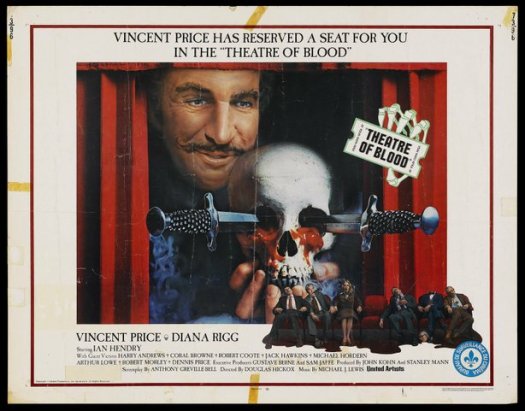
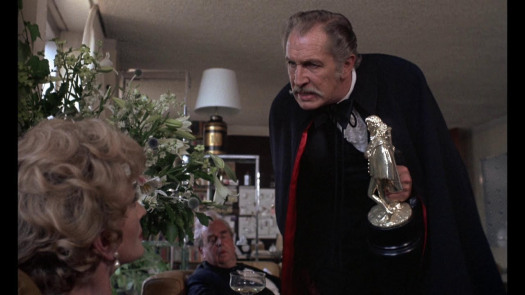
Vincent Price traded in Edgar Allan Poe for William Shakespeare (and American-International for United Artists) in THEATER OF BLOOD, playing an actor’s dream role: Price not only gets to perform the Bard of Avon’s works onscreen, he gets to kill off all his critics! As you would imagine, Price has a field day with the part, serving up deliciously thick slices of ham with relish as he murders an all-star cast of British thespians in this fiendishly ingenious screenplay concocted by Anthony Greville-Bell and directed with style by Douglas Hickox.
Edward Lionheart felt so slighted by both scathing criticism and once again being stiffed at the prestigious Critics’ Circle award, he broke up their little soiree by doing a swan dive into London’s mighty Thames. His body was never found, and everyone assumed they had seen Lionheart’s final performance, but unbeknownst to all he was fished out of the river…
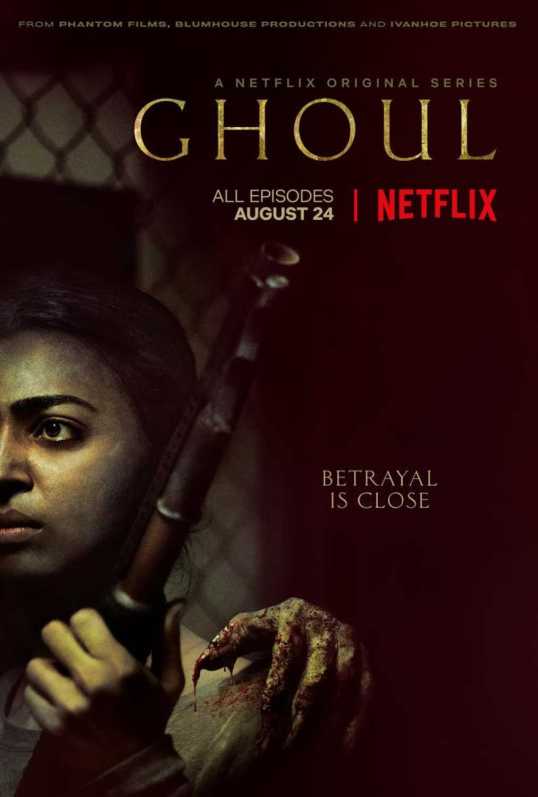
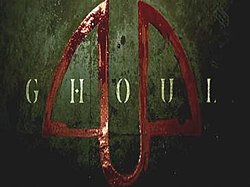
Based in the Arabic folklore of the ghoul, a monster who can eat the flesh of another and take on its likeness. Set in a dystopian future where everything taught against the ruling class is punishable by any means necessary, Nida’s (Apte) father (Zaheer) is captured for just those crimes. Sentenced to a prison where the only possible outcome is death. Years later, Nida, after being recruited by a special force, is sent as a new recruit to that same prison as a guard and interrogator, only to find it has much darker secrets.
Quotes:
“Strike the deal with your blood….. and out of the smokeless fire…. The Ghul will come….”
“The near future. The country has changed. Sectarian violence has reached crisis point. Secret detention centers are established. A military clampdown is in effect.”
“You will not know its presence…. As it takes to your group…. Awake or asleep, The nightmares will begin…”
“Finish the task… Reveal their guilt… Eat their flesh…”
Review:
This, honestly, was one of the most intense, terrifying and horrific TV series I have ever watched. It seriously is not for the faint of heart. However, it also is one of the best written, acted and directed horror series I have seen in a long time. If you get a bit squeamish at intense horror, this might not be the series for you, but if you do love to be scared and on the edge of your seat for two and a half hours, this is the one for you.
Trailer:
Where can you watch?
The three part terrifying series is streaming on Netflix now.
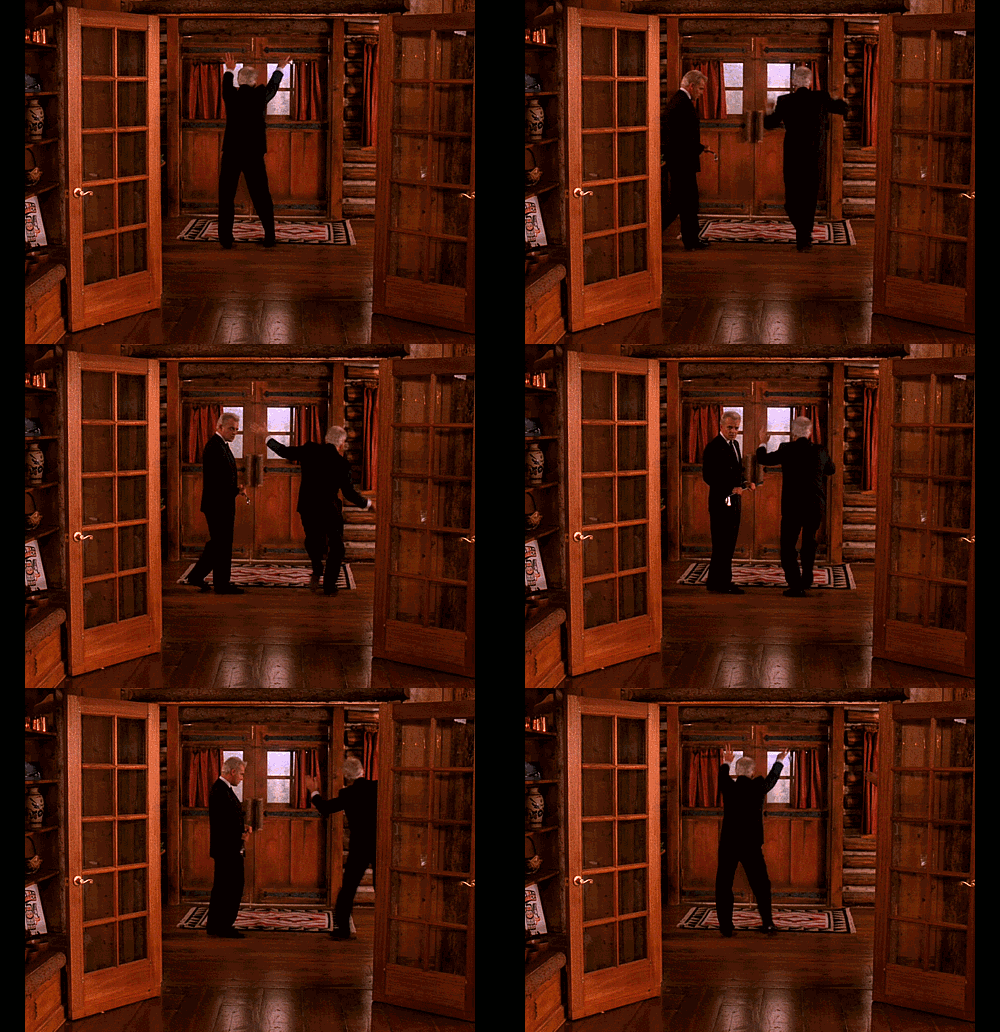
4 Shots From 4 Films is just what it says it is, 4 shots from 4 of our favorite films. As opposed to the reviews and recaps that we usually post, 4 Shots From 4 Films lets the visuals do the talking.
Only one more month to go and it’ll be time for TSL’s annual horrorthon! I’m already working on my October reviews. Here’s four shots from 4 films that I’m planning on reviewing in October!






 Through the Shattered Lens