The TSL’s Horror Grindhouse: Christina’s House (dir by Gavin Wilding)


This 2000 straight-to-video film opens with a shocking and effectively violent scene in which an innocent girl scout is yanked into a dilapidated house and bludgeoned to death.  There’s even a slow-motion shot of crushed cookies falling to the floor.  It’s excessive, tasteless, and so ludicrous that it actually makes you think that Christina’s House could actually be, if nothing else, an enjoyably self-aware exploitation film.

Unfortunately, everything pretty much goes downhill after that scene.  The rest of the film deals with Christina (Allison Lange), a teenage girl with an annoying father named James (John Savage), an annoying brother named Bobby (Lorne Stewart), an annoying boyfriend named Eddy (Brendan Fehr), and an annoying admirer named Howie (Brad Rowe).  That may sound like a lot of annoying people for one person to deal with but Christina actually manages to be even more annoying than all of them.  Absolutely no one in this film comes across as being someone with whom you would want to be trapped in a murder house.

Anyway, Christina’s mom has been institutionalized in a Washington mental hospital so James, has rented out a nearby house.  (Naturally, it’s the same house where that girl scout was previously killed.)  James appears to be almost absurdly overprotective of and strict with Christina but it’s also possible that he might just be an asshole in general.  He’s certainly not happy that she’s dating Eddy, who is the local bad boy and who does stuff like hang out on the roof at night.  James would probably be happier if Christina was dating Howie, who has been hired to help fix up the house.  Howie’s so respectful and such a hard worker.  He’s a man who really knows how to handle a hammer.

Christina, however, has other things on her mind.  For one thing, young women are being murdered and the creepy sheriff (Jerry Wasserman) keeps coming by the house and asking strange questions.  Add to that, Christina sometimes thinks that she can hear someone or something in the attic.  Of course, every time that she tries to investigate, her father comes out of his bedroom and yells at her.

(It could just be that James doesn’t want his daughter spending her nights wandering around in her underwear and searching for a vicious killer, in which case James probably has a point.  Still, he’s kind of a jerk about it.)

Who is the murderer?  Is it Eddie, Bobby, or Howie?  Or could it maybe be James?  What if the sheriff’s somehow involved?  Well, don’t worry!  The identity of the murderer is revealed about an hour into this 90-minute film and it’s exactly who you think it’s going to be.

If not for the extremely odd performance of John Savage, this film would be totally forgettable.  Savage was the film’s “prestige” actor, a performer who previously appeared in films like The Deer Hunter, the third Godfather, Do The Right Thing, and The Thin Red Line before finding himself in Christina’s House.  John Savage attacks the role of James with all of the ferocity of an actor who has gone from co-starring with Robert De Niro and Christopher Walken to playing second fiddle to Allison Lange and Brendan Fehr.  Savage yells every line and glares at his co-stars with the fury of a man on a mission of vengeance.  As a result, both the actor and the character that he’s playing come across as if they’re always just one annoyance away from putting his fist through a wall.  James may be written as an overprotective father but Savage plays him as being a borderline sociopath.  It’s such a totally inappropriate and misjudged performance that it becomes oddly fascinating to watch.  It takes a great actor to give as entertainingly bad a performance as the one given by John Savage in Christina’s House.

With the exception of Savage’s over-the-top theatrics and Jerry Wasserman’s memorably creepy turn, the rest of the cast is largely forgettable.   The problem is that, as written, most of the characters are fairly unlikable and you really don’t care whether they die or not.  When the killer eventually trapped Christina and Bobby in their new home, I found myself more worried about the house than either of them.

Christina’s House is available on YouTube and sometimes, it shows up on late night television.  (I saw it on This TV.)  It’s pretty dumb but if you’re  fan of good actors bellowing in rage, you might want to watch it.

People Are Dumb: Happy Hell Night (1992, directed by Brian Owens)


In 1966, Father Zachary Malius (Charles Cragin), a priest-turned-Satanist, murders a group of frat boys who have broken into his family’s crypt as part of an initiation prank.  After he’s captured by policeman Henry Collins (Sam Rockwell), Malius falls into a catatonic state and is sent to a mental asylum

25 years later, two pledges from the same fraternity break into the asylum so that they can take their picture with Father Malius.  Why?  Because people are dumb.  Of course, as soon as they take their picture, Father Malius wakes up and goes on a rampage.  Armed with a pickax and an endless supply of one-liners that even Freddy Krueger would have turned down, Father Malius heads back to the fraternity.  Also returning to the frat is retired Detective Henry Collins (who is now played by a clearly slumming Darren McGavin).

When I was growing up in the 90s, Happy Hell Night used to be a mainstay on late night HBO.  It’s a typical straight-to-video slasher, distinguished only be a few familiar faces in the cast  and a decently scary murderer.  With his pale skin and his gaunt appearance, Malius looks like Nosferatu in a priest’s collar.  Charles Cragin has a perfect thousand-yard stare for the role.  It’s just too bad that Happy Hell Night was made at the time when every killer had to be a comedian because most of Malius’s one-liners feel out of place for a Satanist who has spent the last 25 years locked away in an asylum.

As for the familiar faces, Happy Hell Night not only features future Oscar winner Sam Rockwell in a small role but also CSI’s Jorja Fox , who shows up just long enough to get hit in the head with a pickax.  When the movie was released, Darren McGavin was the best-known member of the cast.  He has about five minutes of screen time and overacts his death scene like a real pro.


Book Review: 666 by Jay Anson


Published in 1981, 666 is a book that will make you wonder, “How do people not know what 666 means?”

It’s the story of Keith and Jennifer, an attractive young couple who move into a new home and immediately become fascinated by the empty house across the way.  The empty house’s address is 666 Sunset Brooke Lane and no one finds that strange.

Keith decides to explore the house and discovers not only a coin that was minted by the Roman Empire but also a stained glass window that appears to feature someone who looks exactly like him.  Keith does find that strange but it still doesn’t occur to him that there might be a clue to be found in the address.

Jennifer friend, David, decided to rent out 666 Sunset Brooke Lane and immediately starts to have visions of not only Christians being tortured during the reign of Nero but also of a naked Jennifer standing on the house’s front porch.  And yet, David never associates this with the house’s address.

Keith’s brother is a priest (!) who is investigating a local Satanic cult and yet somehow, it never occurs to him to be concerned about 666 Sunset Brooke Lane.

Anyway, it all ends in (tame) sex, violence, and tragedy, as these things often do.  The main lesson that I took away from this book was that you should be concerned if a notorious murder house suddenly appears in your backyard.  It’s a lesson that I won’t forget.

666 was written by Jay Anson, who had previously written a “non-fiction” book called The Amityville Horror666 is a story about four incredibly dumb people, all of whom inspired me to shout, “Why don’t you just leave the damn house!?” more than a few times.  That said, it’s also enjoyably pulpy and the main characters are all so thinly drawn and unlikable that you really don’t mind when they start dying.  Though you’ll be shaking your head at many of the book’s implausibilities, the final chapters are crudely effective and, when it’s time to describe the torture techniques of ancient Rome, Anson goes all out.

Plus, the book has a really cool inside cover!

Italian Horror Spotlight: Hatchet for the Honeymoon (dir by Mario Bava)


“My name is John Harrington. I’m 30 years old. I am a paranoiac.”

So declares John Harrington (Stephen Forsyth) at the start of the 1969’s Hatchet for The Honeymoon.  Along with being a paranoiac, John Harrington is also handsome, charming, and apparently quite successful.  He owns a bridal dress factory in France, a business that he inherited from his mother after her untimely death.  On the outside, everything looks perfect but appearances can often be deceiving.

John’s wife, Mildred (Laura Betti), knows that John is hiding secrets.  She regularly taunts John, reminding him that he’s not only impotent but that he’s also has an unhealthy obsession with his memories of his mother.  John’s mother died when he was very young.  He witnessed her death but he’s repressed the memory of who actually killed her.  John is determined to recover those memories.

So, what does John do?

Does he go to a hypnotist?  Does he dig through old police files and search for clues?  Does he ask someone to analyze his dreams?  That’s what you or I might do but John, you must remember, is a paranoiac.  Somehow, John has realized that, whenever he commits a murder, he remembers just a little bit more about the night his mother died.  So, in order to learn the truth about his mother’s death, John is murdering the models who work at his bridal salon.  Apparently, it’s very important that his victims be wearing a wedding dress when they die….

Okay, now you’re probably already thinking that this sounds like a somewhat bizarre movie.  Well, believe it or not, things are about to get a lot stranger.

After John meets a new model named Helen (Dagmar Lassander), he decided that he doesn’t need Mildred yelling at him anymore.  So, he puts on a wedding veil and murders Mildred.  However, even in death, Mildred won’t leave John alone.  Mildred’s ghost shows up and announces that everyone will be able to see her but John.

So now, John is having to deal with everyone assuming that his wife is with him, even though he can’t see her.  As you might guess, this makes it a bit difficult for John to convince potential victims to come back to the salon with him.

And, from there, it just keeps getting stranger and stranger….

Hatchet For The Honeymoon was written and directed by one of the most important figures in the history of Italian cinema, Mario Bava.  A master technician with a wry and occasionally self-mocking sense of humor, Bava worked in every genre, from peplums to spaghetti westerns to poliziotteschis, but he’s best remembered for his work in the horror genre.  Bava is often credited with having directed the first giallo film and his often-violent thrillers are still influential to this day.

Hatchet For The Honeymoon is often described as being one of Bava’s lesser films but I don’t agree with that judgment.  If nothing else, Hatchet For The Honeymoon is probably one of Bava’s more playful movies.  From the increasingly bizarre twists and turns of the film’s plot to John Harrington’s wonderfully overwrought narration, the entire film has an almost improvisational feel to it.  One gets the feeling that Bava is poking fun at the conventions of the giallo genre.  The usual omnipresent, black glove-wearing killer has been replaced by an impotent wedding dress designer who can’t even escape the ghost of his dead wife.

(Reportedly, Mildred wasn’t originally in the script and was only added because Bava wanted to work with actress Laura Betti.  Perhaps that explains why Mildred often seems to be standing outside of the story, mocking not only John but also the mechanics of the thriller plot.)

As one would expect from a Bava film, Hatchet for the Honeymoon is frequently a visual marvel, a pop art-inspired mix of dark shadows and red blood.  The wedding dresses are to die for and so is the cinematography.  I especially liked the darkly ominous shots of John surrounded by the lifeless mannequins in his salon.  Early on, when we get a shot from John’s point of view, the image is slightly blurred and the angle seem just a bit off, a reminder of John’s twisted impression of the world around him.  When John walks up stairs to the kill his wife, the sound of his movement seems to echo through his ornate but sterile home.

If Stephen Forsyth sometimes seems to be a bit stiff in the role of John, it’s an appropriate reminder that John is an empty shell and all of his feelings and emotions are manufactured.  Laura Betti does a wonderful job nagging him in life and her palpable joy about getting revenge in death is one of the best things about the movie.

Hatchet For The Honeymoon is an exuberantly weird film and definitely one that needs to be seen by anyone seeking to fall in love with Italian horror.

4 Shots From 4 Horrific Family Films: Spider Baby, The Baby, The Texas Chainsaw Massacre, Amityville II: The Possession


4 Shots From 4 Films is just what it says it is, 4 shots from 4 of our favorite films. As opposed to the reviews and recaps that we usually post, 4 Shots From 4 Films lets the visuals do the talking.

Today, we have 4 shots from 4 films that all feature horrific families!

4 Shots From 4 Horrific Family Films

Spider Baby (1964, dir by Jack Hill)

The Baby (1973, dir by Ted Post)

The Texas Chainsaw Massacre (1974, dir by Tobe Hooper)

Amityville II: The Possession (1982, dir by Damiano Damiani)

Horror Film Review: Mom and Dad (dir by Brian Taylor)


Mom and Dad, which was released earlier this year, is the story of many things.

It’s a story of the suburbs, the perfect place to buy a home and raise your family.  Nice lawns, big houses, friendly people, and plenty of buried resentment.  It’s a place that can either represent a new beginning or the death of all of your childhood dreams.  It all depends on how you look at it.  Mom and Dad opens with a suburban mom leaving her newborn in a car that has been strategically parked on the railroad tracks.

Mom and Dad is also the story of a family.  The Ryans may seem like they have it all but one only needs to look at their morning routine to see that things aren’t as perfect as they may appear.  Teenager daughter Carly (Anne Winters) is dating a guy who she knows her parents dislike.  Her younger brother, Josh (Zackary Arthur), is something of a brat.  Carly’s father, Brent (Nicolas Cage), is stuck in a monotonous job while her mother, Kendall (Selma Blair), had to give up her career to raise two children who don’t seem to appreciate her at all.  On top of all that, the grandparents (one of whom is Lance Henriksen) are coming over later for dinner.  The Ryans are a family who spend more time looking at their phones that actually talking to each other.

Mom and Dad is also the story of static.  It’s not just the metaphorical static that makes it difficult for the Carly to understand her parents.  It’s also a very real static, a hissing and popping noise that suddenly comes over radios, pa systems, and televisions and which, for reasons that are never really made clear, fills parents with rage.  When a parent hear the static, they suddenly become obsessed with killing their children.  Kendall’s sister attempts to smother her newborn while a group of new fathers gather in the hospital, shaking with rage as they stare at their babies.  Elsewhere, parents gather outside the high school, waiting for their kids to get out of school so that they can kill them.

As for Carly and Josh, they find themselves locked in their basement while, outside, Brent and Kendall plot their demise.  What makes all of this particularly disturbing (and, at times, darkly humorous) is that it’s not like the parents turn into glass-eyed zombies.  Instead, their personalities remain largely the same, except for the fact that they’re now obsessed with killing their children.  When Brent and Kendall discuss wanting to murder their children, they speak about everyday frustrations.  Brent wants to murder Carly because he caught her hanging out with her boyfriend.  Kendall wants to kill her son and her daughter because she feels like she’s had to give up her entire life just to be their mother.  The static didn’t drive Mom and Dad crazy.  Instead, it just really reminded them that sometimes, children can be a real pain in the ass to deal with.

When it was initially released, the film got a lot of attention for a scene in which an enraged Brent sledgehammers a pool table while singing The Hokey Pokey and yes, it is a classic Nicolas Cage scene.  That Cage goes totally and gloriously over-the-top as Brent shouldn’t come as a shock to anyone.  (For the record, I always enjoy a good Nicolas Cage freakout.)  Even better though is Selma Blair, who is as subtle as Cage is wild.  When Kendall talks about everything that she’s sacrificed to be a stay-at-home mom, it’s a poignant moment.  She may be trying to kill her children but you still feel for her.  Cage is, as usual, entertainingly bizarre but Blair actually gives the film some unexpected depth.

It’s a wild and deeply subversive film and definitely not for everyone.  It also features a wonderful third act twist and one of my favorite endings of the year.  Mom and Dad has its flaws but, for those who like a little satire with their horror, it’s definitely worth seeing.

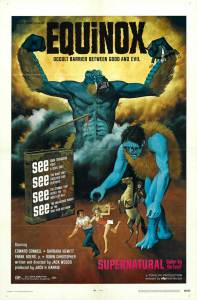
Horror on the Lens: Equinox (dir by Jack Woods and Dennis Muren)


Today’s horror on the lens is a film that Gary reviewed a few years ago.  

First released in 1970, Equinox is a low-budget film about a bunch of kind of dumb teenagers who find a book and end up getting chased around the woods by a bunch of angry monsters.

Equinox is a fun little movie.  The acting may not be the greatest and this is one of those films where everyone always seems to do the stupidest possible thing at the worst possible time but there’s a lot of charm to be found in the monsters.  This film is thought, by many, to have inspired the Evil Dead and there are some definite similarities.

Enjoy!

Horror on TV: The Twilight Zone 3.24 “To Serve Man” (dir by Richard L. Bare)


“It’s a cookbook!”

During the month of October, we like to share classic episodes of horror-themed television.  That was easier to do when we first started doing our annual October horrorthon here at the Shattered Lens because every single episode of the original, black-and-white Twilight Zone was available on YouTube.  Sadly, that’s no longer the case.  In fact, there is exactly one episode of the original Twilight Zone on YouTube.

Fortunately, that episode is a classic.  In 1962’s To Serve Man, an alien (Richard Kiel) comes to Earth and invites people to return to his home planet with him.  He leaves behind a book.  When everyone learns that the title of the book is To Serve Man, they excitedly decide that the book must be an instruction manual on how to help mankind.  The truth, as we learn in the episode’s classic finale, is something a little bit different.

Here’s the episode!  Watch it before YouTube yanks it down.

(This episode originally aired on October 2nd, 1962.  It was directed by Richard L. Bare from a script by Rod Serling.  It was based on a short story by Damon Knight.)

Enjoy!


The TSL’s Horror Grindhouse: Hellmaster (dir by Douglas Schulze)


Welcome to the end of the world.

Or something like that.

To be honest, it’s a bit of a struggle to say what exactly the 1992 film Hellmaster was actually about but I think it definitely had something to do with the end of the world.  John Saxon plays Prof. Jones, a sadistic eugenicist who, in the late 60s, developed a drug that he claimed would — I kid you not — “cure homelessness.”  Apparently, the drug would make the homeless so strong that they would be able to build a house or something.  Anyway, a reporter (David Emge, best known as the helicopter pilot in the original Dawn of the Dead) discovered what Jones was doing and that the drugs were actually turning the homeless into mind-controlled zombies.  Jones responded by murdering the reporter’s wife and then vanishing.

Are you following the story so far?

20 years later, the reporter is having nightmares about the homeless so he decides to start hanging out around the Kant Institute for the Gifted.  We’re told that the Kant Institute is a college.  There only appears to be one professor and a handful of students, the majority of whom appear to be in their early 30s.  I’m not really sure what’s being taught at the school.  (The only class we see features two white people debating whether or not Malcolm X hated the homeless.)  One of the students, Shelley (Amy Raasch), is apparently clairvoyant and she keeps having visions of the school’s chapel bursting into flames.

Meanwhile, there are shots of an old church bus driving down various deserted roads.  “Have a nice day” is written across the cross that hangs on the front of the bus.  On top of the bus, someone’s painted a smiley face.  The bus itself is occupied by four deformed followers of Prof. Jones.  Apparently, they’ve spent the last 20 years driving around the country and killing people.  One of them is dressed like a nun and carries several hypodermic needles.  They come across a stalled motorist and promptly kill him.  The man’s daughter (Sarah Barkoff) escapes and flees to the nearby Kant Institute.

It turns out that the bus is also heading to the Kant Institute!  Eventually, Prof. Jones pops up and explains that it took God six days to create the world but Jones believes that it will only take him one night to transform the world into Hell.  Why does Jones want to do this?  That’s not really clear.  Actually, it’s not even clear how showing up at the Kant Institute will even help Jones accomplish that goal.

Anyway, the rest of the movie is basically Shelley and the reporter and a handful of friends attempting to not get transformed into zombies by Prof. Jones.  This is easier said than done because, as we quickly discover, everyone in this movie is an idiot.

Hellmaster is one of those low-budget horror films that shouldn’t work and yet somehow, it does.  Yes, the plot makes absolutely no sense and, with the exception of genre vets Saxon and Emge, the performances are almost all terrible.  But no matter!  At its best, the film — which is full of dark hallways and deserted roads and twisty camera angles — achieves a dream-like intensity.  The zombies, with their hypodermic needles and their joyful savagery, are genuinely creepy and John Saxon is properly menacing as Prof. Jones.  It’s a relentless film, one that leaves you feeling as if anyone can die at any time and, when they do die, it’s often in the most macabre ways possible.  A crippled student is beaten to death with his own crutch.  Another is doused with acid.  And you may be asking yourself, “But why was there a big vat of acid just sitting around?” but oddly, it works within the surreal dream logic of the film.  It makes no sense and yet, it happens.  If anything, the lack of a coherent plot and the low-budget aesthetic help this film create and maintain its nightmarish atmosphere.

For all of its flaws, Hellmaster is a thousand times more effective than you might expect.

Elwes Unbound: American Crime (2004, directed by Dan Mintz)


Smalltown reporter Jessie St. Clair (Rachael Leigh Cook) has stumbled across the story of her career.  A stripper and a prostitute have been murdered.  Before committing the murders, the killer sent each victim a video tape of him stalking her.  With the help of her producer, Jane (Annabella Sciorra), and her cameraman, Rob (Kip Pardue), Jessie sets out to try to solve the case but when she receives a videotape that indicates that she might be the next victim, she quits her job and vanishes.

Then, Albert Bodine (Cary Elwes) shows up in town.  Albert says that he’s the anchor of the UK’s top true crime show, American Crime, and that he wants to investigate not only the two murders but also Jessie’s disappearance.  When both Rob and Jane are suddenly fired by their station, they reluctantly agree to work with Albert.  Albert soon proves himself to be so incompetent that his new colleagues start to wonder if he’s actually who he says he is.  Meanwhile, another videotape turns up, this one starring Jane.

The tone of American Crime is all over the place and it never seems to be sure if it wants to scare us or if it wants to make us laugh but there are some tense scenes and a good twist ending.  American Crime tries to strike a balance between being a horror/thriller and a satire of media sensationalism.  It doesn’t always succeed but you really haven’t lived until you’ve seen Cary Elwes play a sleazy tabloid reporter.  Imagine an even more hyperactive version of Robert Downey, Jr’s performance in Natural Born Killers and you’ll have some idea of what Cary Elwes does in this movie.  Elwes sweats profusely, bulges his eyes, speaks with an extremely affected English accent, and plays with his hair every time he passes a mirror.  Everything sets him off, from his camera falling off of its tripod to people questioning his journalistic credibility.  Though the movie does feature good roles for underappreciated actresses like Rachael Leigh Cooke and Annabella Sciorra, Elwes is definitely the best thing about and the main reason to watch American Crime.