The TSL’s Horror Grindhouse: Blood for Dracula (dir by Paul Morrissey)


Count Dracula (played by Udo Kier) has a problem.  In order to stay strong and healthy, he needs a constant supply of virgin blood.  (Or, as Kier puts in, “weergen blood.”)  Unfortunately, he lives in 1920s Romania and apparently, there just aren’t many virgins left in Eastern Europe.

However, Dracula’s assistant, Anton (Arno Juerging) has a solution.  Dracula just needs to move to Italy!  After all, Italy is the home of the Vatican and it’s just been taken over by Mussolini and the fascists.  Surely, no one in Italy is having sex!  Dracula should be able to find all the virgins that he needs in Italy!

So, Dracula climbs into his coffin and Anton drives him to Italy.  Once they arrive, they meet an Italian land owner,  Il Marchese di Fiore (played by Italian neorealist director Vittorio De Sica).  The Marchese is convinced that Dracula is a wealthy nobleman and he says that Dracula can marry any of his four daughters.  He assures Dracula that they’re all virgins but Dracula soon discovers that two of them are not.  It turns out that, thanks to the estate’s Marxist handyman, Mario (Joe Dallesandro), it’s getting as difficult to find a virgin in Italy as it was in Romania!

After completing work on Flesh For Frankenstein, director Paul Morrissey and actors Udo Kier, Joe Dallesandro, and Arno Juerging immediately started work on Blood for Dracula.  Though Blood for Dracula never quite matches the excesses of Flesh for Frankenstein, it still taps into the same satiric vein that provided the lifeblood that gave life to Flesh for Frankenstein.  Once again, the sets and costumes are ornate.  Once again, the frequently ludicrous dialogue is delivered with the straightest of faces.  Once again, Udo Kier goes over-the-top as a famous monster.  And, once again, Joe Dallesandro plays his role with a thick and anachronistic New York accent and he looks damn good doing it.

Ironically, one of the differences between Flesh for Frankenstein and Blood for Dracula is that there’s quite a bit less blood in the Dracula film.  Then again, that’s also kind of the point.  Dracula literally can’t find any blood to drink and, as a result, he’s become weak and anemic.  Udo Kier is perhaps the sickliest-looking Dracula in the history of Dracula movies.  By the time that he meets the Marchese’s four daughters, he’s so sick that he literally seems like he might fade away at any second.  As ludicrous as the film sometimes is, you can’t help but sympathize with Dracula.  All he wants is some virgin blood and the communists aren’t even willing to let him have that.  Blood for Dracula is, in its own twisted way, a much more melancholy film than Flesh For Frankenstein.  Or, at least it is until the finale, at which point one character gets violently dismembered but still continues to rant and rave even after losing the majority of their limbs.

When Blood for Dracula was released in 1974, it was originally called Andy Warhol’s Dracula, though Warhol had little to do with the movie beyond allowing his name to be used.  As with Flesh for Frankenstein, Antonio Margheriti was credited in some prints as a co-director, largely so the film could receive financial support from the Italian government.

Sadly, there would be no Andy Warhol’s The Mummy or Andy Warhol’s Wolfman.  One can only imagine what wonders Kier, Dallesandro, and Morrissey could have worked with those.


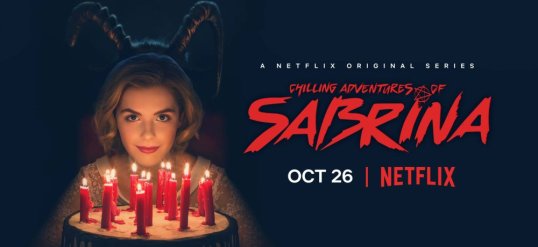
The Chilling Adventures of Sabrina 1.3 “Chapter Three: The Trial of Sabrina Spellman” (dir by Rob Seidenglanz)


(Before reading my review of the third episode of Chilling Adventures of Sabrina, be sure to read Case’s thoughts on the first two episodes!)

Having run out on her Dark Baptism, Sabrina Spellman (Kiernan Shipka) finds herself put on trial.  She’s been accused of breaking her promise, which is one of the worst things of which a witch can be accused  (Especially when that promise was made to Satan.)  Even worse, she’s been informed that, in witch court, you are considered to be guilty until proven innocent.  The prosecution has her signature in the Book of The Beast.  Sabrina has an attorney named Daniel Webster (John Rubinstein).

As soon as I heard the name Daniel Webster, I got excited because I assumed that Sabrina’s attorney was going to turn out to be the great Massachusetts political leader who served 19 years in the U.S. Senate and as Secretary of State under three different U.S. presidents.  (Webster was also the subject of a short story and film called The Devil and Daniel Webster, which is briefly referenced when Sabrina is told that Webster once beat the Devil at his own game.)  But no, it turned out that Sabrina’s lawyer was just a mortal named Daniel Webster, a guilt-ridden man who once sold his soul to the Devil and asked to be made the world’s greatest attorney.  As Webster explains it, he used his powers to win acquittals for the worst of the worst and it wasn’t until one of them murdered his daughter that Webster realized that everything came with a cost.  At first, Webster, who is played with a haunting sadness by Rubinstein, refuses to take on Sabrina’s case but then he changes his mind.  Of course, this leads to Madam Satan assuming the form of Webster’s dead daughter and trying to manipulate him into dropping the case.

Speaking of manipulation, Harvey (Ross Lynch) is being manipulated by his abusive father to abandon art and work in the mines.  As Harvey explained to Sabrina, he once saw a creature of unbelievable evil living underground.  Ross Lynch gave an especially good performance in this episode and he and Shipka have an amazing chemistry, as displayed in a scene in which Harvey rather sweetly checked to see if Sabrina had the Spellman “family birthmark.”

That “family birthmark” is one of the key plot points of The Trial of Sabrina Spellman.  With her attorney demanding that Sabrina, as a half-human, be tried by human law, Father Blackwood (Richard Coyle) suggests that if Sabrina wants to be tried as a human then perhaps she should be forced to endure the degradation that humans have forced on witches over the years.  Perhaps, he suggests, she should be tossed in a lake and she can judged by whether or not she floats.  Or perhaps, she should be forced to strip naked so that she can be inspected for a witch’s mark.  And, at that moment, Sabrina is every woman who has ever had her words or his wishes casually dismissed or who has ever been told that the burden of proof is on her and her alone.  Sabrina is told that she  can either be humiliated and degraded as a part of the mortal world or she can be a witch and essentially lose all of her freedom.  For much of this episode, it appears that there is no middle ground.

Meanwhile, in the moral world, Rosalind (Jaz Walker) fights against school censorship and reveals that she’s losing her eyesight.  Rosalind’s bravery inspires Sabrina but it also inspires Ms. Wardwell (who, of course, is actually Madam Satan).  Ms. Wardwell announces the formation of a secret book society, which will allow her to continue to manipulate Sabrina.

Toward the end of the The Trial of Sabrina Spellman, Aunt Zelda (played by Miranda Otto) announced, “Praise Satan!  I’m young again!” and again, I was reminded that I was no longer watching Melissa Joan Hart and Beth Broderick in Sabrina, The Teenage Witch.  That’s not bad thing, of course.  When I was growing up, I loved Sabrina, The Teenage Witch and now that I’m an adult, I’m enjoying Chilling Adventures of Sabrina.  Kiernan Shipka, Mirando Otto, and Lucy Davis are all perfectly cast and Richard Coyle and Michelle Gomez are wonderfully hissable villains.

Up next is Episode 4, which is called Witch Academy.  Look for my review either later tonight or tomorrow!

Horror on TV: Kolchak 1.16 “Demon In Lace” (dir by Don Weis)


Tonight, on Kolchak….

Young college students are dying of heart attacks and Carl Kolchak is on the case!  Could it be just a coincidence?  Could it be drugs?  Could it be anything other than a Sumerian demon?  Well, if you know Kolchak, you already know the answer to that question!

This episode originally aired on February 7th, 1975.

Enjoy!

Italian Horror Showcase: Il mostro di Frankenstein (dir by Eugenio Testa)


Sadly, there are some films that I will probably never get to see and this is one of them.

There’s a lot of reasons that films become lost.  Some films have been purposefully destroyed.  Some have been merely forgotten.  Unfortunately, it took several decades for people to understand that films could also be art.  Back during the silent era, I imagine people would have laughed at the idea that someone in 2018 would have any interest in watching a film that was made in 1920.

1920 was the year that a German-Italian production company produced Il mostro di Frankenstein.  It was one of the first film adaptations of Mary Shelley’s classic monster.  (It wasn’t the first, of course.  Thomas Edison produced his version of Frankenstein in 1910 and there may have even been earlier versions.)  It was a silent film.  It reportedly starred the hulking Umberto Guarracino as Frankenstein’s Monster while the Baron was played by a former circus performer name Luciano Albertini.  (Albertini also produced the film.)  The completed film reportedly ran afoul Italy’s then-stringent censorship laws and so much footage was cut that the final version only ran 39 minutes.

Il mostro di Frankenstein is considered to be a lost film, one that is now remembered for being one of the few Italian horror films released before the 1950s.  (As a genre, horror was frowned upon by both the Vatican and Mussolini, which meant the while the genre thrived across the world, Italian horror spent several decades moribund.)  In fact, I’ve read that Il mostro di Frankenstein was the last horror film to be produced in Italy until Riccardo Freda’s I Vampiri was released in 1957.  I can’t say for sure whether that’s true or not but it makes for a good story.

Sadly, I’ll probably never see Il mostro di Frankenstein.  But, hey — if anyone in your family ever worked in the Italian film industry, why don’t you go up to your attic and take a look?  If it’s in your basement, get it out.  And if you find it in a storage locker, don’t throw it away because you’ve got a piece of history that many of us would like to see.

Until that happens, we only have this one screenshot to let us know that there was once a silent Italian film about Frankenstein and his monster.

Horror Film Review: Mary Shelley’s Frankenstein (dir by Kenneth Branagh)


Oh my God, this is an exhausting movie.

Directed by and starring Kenneth Branagh, the 1994 film Mary Shelley’s Frankenstein sticks pretty closely to the plot (if not the tone) of Mary Shelley’s original novel.  What that means is that this movie includes a lot of the good stuff that often seems to get left out of other Frankenstein adaptations.  For instance, we learn more about the life of Victor Frankenstein (Kenneth Branagh) before he created his monster.  We find out about his family and his troubled romance with Elizabeth (Helena Bonham-Carter).  Victor’s good friend Henry Clerval (Tom Hulce) is included and so is Professor Waldman (John Cleese) and Captain Robert Walton (Aidan Quinn).

It also means that we get to watch as the Monster (Robert De Niro) flees into the wilderness and later befriends a kindly blind man (Richard Briers).  The Monster, as always, is happy until mankind interferes and treats him unfairly.  The Monster learns to speak and, after it learns to read, it discovers who created it and it sets out for revenge.  We watch as everyone that Victor Frankenstein cares about dies, all as a result of his desire to play God.

And yet, while you have to respect the fact that Branagh tried to stay (more or less) true to the plot of the original novel, Mary Shelley’s Frankenstein is a bit of a chore to sit through.  A huge part of the problem is that Kenneth Branagh cast himself to play Victor Frankenstein.  In the book, Victor is a rather sickly character and his desire to create life is probably as much inspired by his own poor health and the death of the people close to him.  In the film, Branagh plays Victor as being almost a Byronic figure, with the camera emphasizing his flowing hair and his muscular physique.  Even when Victor does push himself to the point of death in his research, you never really believe it because Branagh the director isn’t willing to let Branagh the actor look weak or malnourished.  However, turning Victor into an alpha male also turns him into a jerk.  Unlike say Colin Clive or Peter Cushing in The Curse of Dracula, you never find yourself sympathizing with Kenneth Branagh’s Victor.

And then you have Robert De Niro as the Monster.  Now, really, I imagine that — in 1994 — the idea of De Niro playing the Monster seemed like an obvious one.  I mean, the Monster is a great role and De Niro’s one of the greatest actors who ever lived so if anyone could find a new and interesting way to play Frankenstein’s Creation, it would have to be De Niro, right?

But no.  First off, De Niro may be a great actor but it’s hard to accept the idea that a monster created in Germany would speak with a New York accent.  Even under tons of makeup, De Niro does an okay job of projecting the Monster’s rage but, unlike Karloff or Christopher Lee, De Niro never seems to really connect with the character.  You never forget that you’re watching a heavily made-up Robert De Niro.  De Niro often seems to be rather detached from what’s happening on screen.

Branagh’s directs in a manner that can only be called operatic, which turns out to be a mistake.  The story is already dramatic enough without Branagh spinning the camera around every few moments.  There’s not a subtle moment to be found in the film but unfortunately, Frankenstein is a story that needs just a little bit of subtlety.  It all gets to be a bit overwhelming and, by the time the Monster is literally ripping a heart out of a body, you’re just like, “Enough already!”

It’s just a really tiring movie.

Death From Above: Beaks: The Movie (1987, directed by Rene Cardona, Jr.)


The birds are pissed off.  A hang glider gets pecked to death while flying through the sky.   A chicken farmer is devoured. A professional hunter loses an eye to a bird and then has to use the remaining one to watch as the birds savagely attack his granddaughter’s birthday party.  A family on vacation is forced to run for cover as their attacked by pigeons and doves.  From South America to Spain to Puerto Rico, the birds are organizing and they are attacking.  Can journalist Vanessa (Michelle Johnson) and her cameraman Peter (Christopher Atkins) figure out why the birds are attacking or are they destined to become the latest victims of the avian terror?

This may sound like the Hitchcock film but Beaks was directed by Mexico’s Rene Cardona, Jr. and that makes all the difference.  Following in the footsteps of his father, Cardona was the king of Mexican B-movies.  There was no idea strange enough or plot stupid enough that Rene Cardona, Jr. couldn’t take it and turn it into a really bad movie.  Even by his standards, Beaks is bad as pigeons and doves are tossed at screaming actors.  Why are the birds attacking?  Caronda shows us a polluted lake as if to say, “Any questions?”  In the end, the birds attack until they suddenly don’t anymore but don’t get too cocky because there are other animals out there that are looking mighty disgruntled.

For some reason, in the late 80s and early 90s, Christopher Atkins had a very busy career in bad movies.  Seeing the Atkins name in the cast was usually a good sign that it was time to change the channel.  In Beaks, he gets the best line when he says, “These birds know what they’re doing!”  The film’s second best line goes to another actor, Gabriele Tinti, who says, “Fucking bird, flapping everywhere.”

If Hitchcock made The Birds with less skill but more gore and gratuitous nudity, the end result would still be better than Beaks.

Horror Scenes That I Love: Dr. Frankenstein and The Monster Dance In Young Frankenstein


Earlier today, my sister shared with us a look at Frankenstein through the ages. 

It seems only appropriate to follow that up with a look at the doctor and his creation putting on the ritz.

From 1974’s Young Frankenstein….

4 Shots From 4 Dario Argento Films: Profondo Rosso, Suspiria, Inferno, Tenebrae


4 Shots From 4 Films is just what it says it is, 4 shots from 4 of our favorite films. As opposed to the reviews and recaps that we usually post, 4 Shots From 4 Films lets the visuals do the talking.

I can’t let this October pass without paying tribute to one of my favorite directors.  It’s time for….

4 Shots From 4 Dario Argento Films

Profondo Rosso (1975, dir by Dario Argento)

Suspiria (1977, dir by Dario Argento)

Inferno (1980, dir by Dario Argento)

Tenebrae (1982, dir by Dario Argento)

Horror On The Lens: I Was A Teenage Werewolf (dir by Gene Fowler, Jr.)


1957’s I Was A Teenage Werewolf combines two genres that were very popular in the late 50s.

On the one hand, it’s a film about a teenage rebel.  Tony Rivers (Michael Landon) is a teenager that means well but he keeps losing his temper.  If he can’t learn to control his anger, he could very well be looking at a life behind bars.

On the other hand, it’s also a horror film.  When Tony visits a hypnotist (Whit Bissell), the end result is Tony turning into a werewolf and going on a rampage, all while still wearing his letterman jacket.

All in all, this is a pretty fun little movie.  You can check out my review of it by clicking here.

And you can watch the movie below!