Lisa Goes Back To College: Getting Straight (dir by Richard Rush)


Am I too young to start feeling nostalgic for the past?

It’s been 6 years since I graduated from the University of North Texas and, as much as I enjoy officially being an adult and all that good stuff, I have to admit that there’s a part of me that misses being in college.  Even though I know that I will be returning to school to work on my master’s, there’s a part of me that really regrets that I’ll never again get to be an undergrad with the rest of my life in front of me.

Fortunately, I review movies so, whenever I start to feel nostalgic for the past, I can just watch and review a movie.  Last week, I was missing college.  So, I watched a few films about college.  The first film that I watched was from 1970 and it was called Getting Straight.
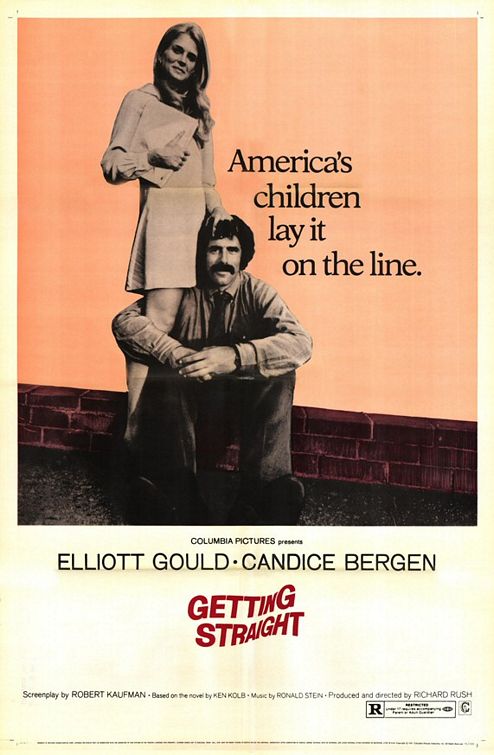
Getting Straight

One of the first things that you notice while watching Getting Straight is that director Richard Rush apparently made the decision to film nearly the entire movie in extreme close-ups.  When Nick, a spaced-out hippie played by Robert F. Lyons, steps into a room and starts laughing, the camera zooms in so close that you can practically see down the back of his throat.  When Jan (played by a very young Candice Bergen) breaks down into tears after getting beaten up at a political demonstration, the camera so obsessively lingers over her tear-stained face that the viewer is left with little choice but to consider just how terrible a performance Bergen is actually giving.  When Harrison Ford shows up in an early role, the camera zooms into his face, as if to force us to say, “Hey, that’s Harrison Ford!”  Meanwhile, the star of the film, Elliott Gould, is in almost every scene and, thanks to Rush’s love of extreme close-ups, it’s hard not to focus on the fact that his thick sideburns and his walrus mustache looks like they are threatening to devour his entire face.

Elliott Gould plays Harry Bailey, a grad student at an unnamed California university.  In his undergraduate days, Harry was a political activist who, we’re told, marched for civil right as Selma.  Then he served in Viet Nam and not as some conscientious objector either (though that would have made sense, considering his political beliefs).  No, Harry saw combat.  And, while doing all of that, Harry also somehow found time to be in Paris during the 1968 student strike.  However, Harry is now back in America and all he wants to do is get his master’s in education so that he can teach the underprivileged.

Along with his prominent facial hair and his colorful past, the main thing that you notice about Harry is that he yells.  A lot.
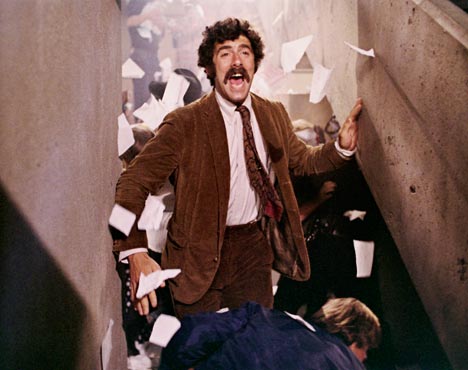
Elliot Gould in Getting StraightHarry yells because his professors expect him to show up for classes that he doesn’t care about.  When those same out-of-touch professors expect Harry to take a test that he doesn’t consider to be important, he gets his friend Nick to take it for him.  Nick, being an idiot, signs his name to the test but then marks it out and writes down Harry’s name instead.

Harry yells because a bunch of student activists expect him to join their protests.  Harry tells them that they’re shallow and the only reason they care about politics is because “protests are sexy.”  Despite his condescending attitude, the rest of the student body continues to look up to Harry.  I imagine it has something to do with the hypnotic power of his mustache.

Harry yells because a professor suggests that F. Scott Fitzgerald might be gay.  Harry also says that Arizona is the best state of the union because it has the lowest occurrence of homosexuality.  If nothing else, all of this serves to remind us that this film was made in 1970.

Mostly, however, Harry just yells at his girlfriend, Jan.  Jan lies about being pregnant and Harry yells.  Jan says that she’s thinking about getting married.  Harry yells that she is a “dumb broad.”  Jan says she’s on her period.  Harry yells that she’s lying and that he’ll be over later that night.  Harry yells when Jan breaks up with him.  Harry yells when Jan introduces him to her new boyfriend, despite the fact that Harry has been screwing — in extreme close-up — every other undergrad on campus.  Harry yells at her that she might as well just be a “man with a hole.”

In other words, Harry is a self-righteous jerk.  Harry is a misogynist.  Harry is a hypocrite.  Harry is an asshole.  And yet — probably because this film was made in 1970 — Harry is also supposed to be the film’s hero.  Harry is supposed to be the character that we sympathize with and, indeed, every other character in the film is totally charmed by Harry and his behavior.  Even poor abused Jan continues to come to Harry, despite the fact that her next door neighbor is Harrison Ford!

Harrison Ford in Getting Straight

Harrison Ford in Getting Straight

Yes, there are many very valid criticisms to be made about Getting Straight.  Harry is unlikable.  Candice Bergen gives an amazingly bad performance.  Richard Rush’s direction shows an overdependence on close-ups and rack focus shots, techniques that he uses so frequently that they eventually lose all meaning but instead simply come across as being nervous tics.  Like so many of the counter cultural films of the early 70s, Getting Straight is an excruciatingly sexist film.  That’s one thing that the films of both the counter-culture and the establishment had in common, a deep disdain and fear of women in general.  Harry may claim that the student protestors are only into politics because they want to get laid but it’s hard to see how he’s any better.  The middle stretch of Getting Straight could have just as easily have been called Harry Must Get Laid.

However, Getting Straight does get one thing right.  It perfectly captures the atmosphere of college.  From the pompous and out-of-touch professors to the creepy old grad students (that would be Harry) to the portentous seriousness of the student activists, Getting Straight captures all of that perfectly.  As such, Getting Straight might not really work as a dramatic film but it’s definitely worthwhile as a record of a specific time and place.  Much of what today seems annoying about a film like Getting Straight is really nothing more than a recording of what was once considered to be culturally acceptable.

Getting Straight is a portrait of 1970 that makes me glad that I was born in 1985.

And you can watch it below!
44 Days of Paranoia #36: The Fugitive (dir by Andrew Davis)


For our latest entry in the 44 Days of Paranoia, let’s take a look at the 1993 best picture nominee, The Fugitive.

We’re all familiar with the saying, “You just had to be there.”  We usually hear it as an excuse that’s uttered when a storyteller realizes that his audience isn’t as fascinated by his tale as he is.  It’s a way of assuring us that we would also be fascinated if only we had been present when the story actually took place.

I think the same holds true of a lot of movies.  You simply had to be there when the film was originally released to theaters, before it’s impact could be diluted by repetition and imitation, to understand why that movie was successful or why certain critics continue to speak so fondly of it.

Case in point: The Fugitive.

Based on an old television series, The Fugitive was a huge hit when it was first released in 1993.  It was critically acclaimed, it featured an Oscar-winning supporting performance from Tommy Lee Jones, and the film itself was even nominated for best picture of the year.  The Fugitive is still regularly cited as being one of the best action movies ever made.

And yet, last month, when I watched The Fugitive for the first time, I was left distinctly underwhelmed.

The film opens with Chicago surgeon Richard Kimble (Harrison Ford) arriving home and discovers that his wife has been murdered by a one-armed man (Andreas Katsulas).  Kimble struggles with the assailant but the man still manages to escape into the night.  The police don’t believe Kimble’s story and he ends up being arrested and subsequently convicted of his wife’s murder.  It was at this point that I shouted out, “What about DNA!?” but then I remembered that this film was probably made before DNA became a regular part of the criminal justice system.  You just had to be there…

While Kimble is being transported to death row, a fight breaks out that causes the prison bus to crash and gives Kimble a chance to escape.  Kimble is now a fugitive, trying to track down the one-armed man and clear his name.  Pursuing him is the charismatic and rather manic U.S. Marshal Sam Gerard (Tommy Lee Jones).

Every review that I’ve ever read about The Fugitive always praises two scenes.  One is the bus crash that gives Kimble his opportunity to escape.  The other is the scene where Gerard first catches up to Kimble.  Standing at the edge of a storm drain, Kimble says that he’s innocent.  Gerard calmly  replies, “I don’t care.”  Kimble then proceeds to jump over the edge and into the raging waters below.  Realistically, the fall really should have killed him but, if it had, there would be no movie.

Those two scenes are genuinely exciting and well-done.  Unfortunately, the rest of the film isn’t quite as memorable.  Kimble spends the rest of the movie running around Chicago while Gerard chases after him.  It’s all shot well enough and Tommy Lee Jones is a lot of fun to watch (the film comes to life in the scenes where Gerard interacts with the other members of his team) but, at the same time, it all feels rather predictable.  For all the scenes of Ford looking intense and running through the city, I was more excited about the chance to say, “Hey, isn’t that Julianne Moore!?” when she showed up as a sympathetic doctor.

Worst of all, the solution to the film’s mystery literally comes out of nowhere.  However, that solution does feature a Big Evil Corporation which, if nothing else, qualifies The Fugitive for inclusion in the 44 Days of Paranoia.

Watching The Fugitive, I could see how the film had influenced other action films and I think that was a large reason why the film didn’t work for me.  What was once undoubtedly seen as being thrilling and surprising now seemed rather mundane and predictable.

That’s why I imagine that, in the case of The Fugitive, you just had to be there.

Other Entries In The 44 Days of Paranoia 

  1. Clonus
  2. Executive Action
  3. Winter Kills
  4. Interview With The Assassin
  5. The Trial of Lee Harvey Oswald
  6. JFK
  7. Beyond The Doors
  8. Three Days of the Condor
  9. They Saved Hitler’s Brain
  10. The Intruder
  11. Police, Adjective
  12. Burn After Reading
  13. Quiz Show
  14. Flying Blind
  15. God Told Me To
  16. Wag the Dog
  17. Cheaters
  18. Scream and Scream Again
  19. Capricorn One
  20. Seven Days In May
  21. Broken City
  22. Suddenly
  23. Pickup on South Street
  24. The Informer
  25. Chinatown
  26. Compliance
  27. The Lives of Others
  28. The Departed
  29. A Face In The Crowd
  30. Nixon
  31. The Hunger Games: Catching Fire
  32. The Purge
  33. The Stepford Wives
  34. Saboteur
  35. A Dark Truth

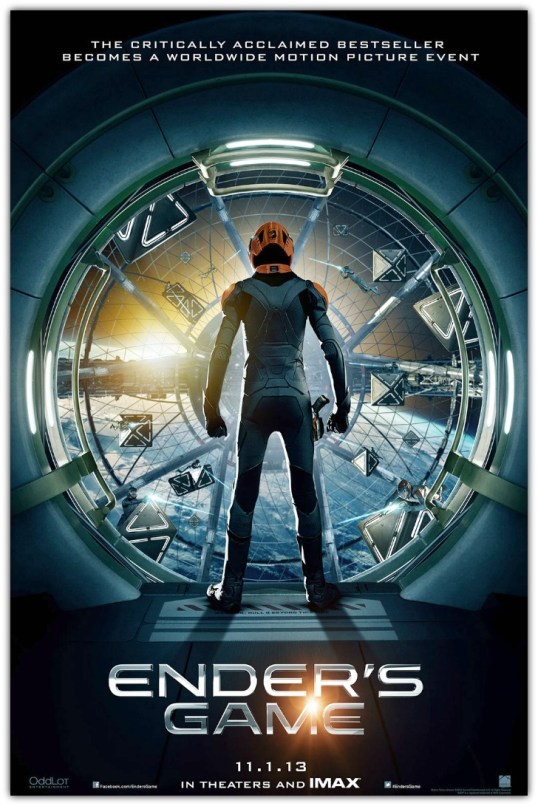
Trailer: Ender’s Game


EndersGame

It’s finally going to happen. A film adaptation of Orson Scott Card’s sci-fi novel Ender’s Game is going to be on the bigscreen. This was a property that was often talked about becoming a film, but years upon years of talk never amounted to much other than fan casting and never getting past the concept stage.

I knew that the film adaptation had gotten the greenlight over a year ago, but I just assumed that something will derail it once again and leave Ender’s Game as another case of film vaporware. The fact that there’s now a trailer released by Summit Entertainment means that the film will come out. Now whether the film adaptation satisfies the book’s legion of fans and still entertain those who never read a word of Card’s novels still to be determined.

Ender’s Game is set for a November 1, 2013 release date.

A Quickie With Lisa Marie: The Conversation (dir. by Francis Ford Coppola)


As a result of my continuing effort to see every single film ever nominated for best picture, I’ve been lucky enough to both discover and rediscover a handful of excellent films that, for whatever reason, have ended up forgotten and neglected in the years since they scored their nominations.  One of the more recent of these films was Francis Ford Coppola’s masterpiece of a paranoia, the 1974 Best Picture nominee The Conversation.*

The Conversation tells the story of Harry Caul (played by Gene Hackman), a surveillance expert who, along with his colleague Stan (played by the great John Cazale), is hired by a businessman (Robert Duvall) to bug a conversation between Duvall’s much younger wife (played by Cindy Williams) and a man who might be her lover (played by Fredric Forrest).  Harry, we quickly discover, is a man who values his privacy and who manages to find a balance between his unsavory job and his devout religious faith by maintaining an impenetrable shield of detachment from the rest of humanity.  He is a man who hides from the world inside of his apartment, only allowing himself to show the slightest hint of emotion when playing his saxophone.  In one of the film’s best scenes, Harry finds himself awkwardly socializing with a far more sleazy acquaintance (played by Alan Garfield, one of the great character actors of the 70s) and it becomes apparent that Harry may be the best in the business but he’s still the ultimate outsider.

However, Harry is forced to confront the contradictions of his own lifestyle when he listens to the conversation between Forrest and Williams and believes that he might have found evidence that both Forrest and Williams are in fear for their lives.  With Duvall’s operatives demanding the surveillance tapes, Harry Caul soon finds himself becoming more and more paranoid and unstable as he finds it more and more difficult to justify his detachment.  Harry finds himself obsessively listening to the conversation over and over again, going over every possible nuance and emphasis to try to figure out what’s actually being said.  Of course, by the end of the film, it’s obvious to both Harry and the audience that nothing is as simple as it sounds. 

Compared to the Godfather films and Apocalypse Now, the Conversation is a surprisingly low-key and rather muted film.  A lot of this is because, as opposed to the Corleones and Martin Sheen’s Captain Willard, Gene Hackman’s Harry Caul is a complete and total introvert, a man who makes his living by observing a world that he refuses to be a part of.  Though the film works quite well as a thriller, it works best when viewed as a sympathetic character study of a paranoid and anti-social human being.  Hackman full inhabits the role, bringing Harry — with all of his frustrating contradictions and conflicted actions — to oddly vibrant life.  The film ultimately serves as a sad-eyed look at how a good person can justify doing bad things and how the inevitable consequences of those bad things can only be delayed for so long.

On a final note, an impossibly young Harrison Ford shows up here as Duvall’s sinister assistant.  He plays the role with just the right amount of prissy arrogance and he has a great scene where he asks Harry is he wants to try a homemade cookie.  “They’re good,” Ford assures him.

So is The Conversation.

—–

* Of course, another Coppola film — The Godfather, Part II — beat the Conversation for best picture.  However, The Conversation did win the Palme D’Or at Cannes that year.  It was a good year to be Francis Ford Coppola.

The Most Meh Film of 2011: Cowboys and Aliens (dir. by Jon Favreau)


For about a year now, I’ve been seeing the trailer for Cowboys and Aliens before every single film I’ve gone to see.  And now, finally, the Jon Favreau’s latest film has been released.  I saw it on Friday afternoon with my friend Evelyn and our reaction to it can be summed up in one word:

Meh.

Seriously, this might not be the worst film of 2011 so far (not as long as Priest, The Conspirator, The Beaver, and Sanctum continue to exist in our reality) but it’s definitely one of the most meh films of all time.  Cowboys and Aliens epitomizes everything that we mean when we say “meh.”  It’s not exactly terrible but it’s not good either.  What it is, ultimately, is very forgettable. 

This is one of those films where everything just seems to be a little bit off-track.  It’s like a car that technically runs but the whole time you’re inside of it, you know that there’s a chance the engine’s going to explode and you’re going to be stranded in Oak Cliff* with a dying cell phone.  You’re just happy that it gets you to your destination so you can get out of the car, not because you actually enjoyed the trip.

If you want to get into specifics, I’d point out that:

1) Daniel Craig isn’t all that believable as a notorious gunslinger.

2) Harrison Ford looks annoyed to be there.

3) The cast is full of excellent character actors — like Sam Rockwell — who essentially get to do nothing.

4) The aliens basically look like leftovers from Skyline andBattle L.A. 

5) The action sequences are pretty boring (there’s not one moment that makes you gasp and go, “Wow!”) and are so badly edited that it’s difficult to keep track of who is shooting at who. 

6) For the first quarter of the film, we’re watching a bad western and then, suddenly, we’re watching a boring, uninspired science fiction action film. 

7) A major plot point essentially centers on Daniel Craig (with the aid of some helpful Indians, of course) going on a “spirit quest.”  Seriously, filmmakers today use spirit quests and sweat lodges in much the same way that filmmakers of the 60s used garish acid trips.  It’s all an excuse for a bunch of zoom lenses and bright color filters.

8 ) Finally, and this is most fatal of the film’s flaws, it just takes all of this so seriously.  There’s not even a scene of a brave gunslinger shouting, “Draw, you four-armed bastard!” at an alien.  Seriously, this should have been a fun film.  Instead, it’s just another overproduced, forgettable establishment film.

Jon Favreau is a likable enough actor (even if he does seem to be fated to spend his career competing for roles with Kevin James) and he’s made some likable films (Elf, Iron Man, Zathura)  but Cowboys and Aliens could have been made by just about anyone.  It’s a film that feels like it was put together on an assembly line.  Originally, me and Evelyn swore that, if Cowboys and Aliens sucked, we were going to react by running down to the front of the theater and entertaining everyone by doing the Timewarp.  However, by the time it became apparent just how meh this film was, neither one of us really felt like creating a little sexy civil disobedience.  Quite frankly, we just wanted it to end so we could move on to the next film.

—————

*Oak Cliff, for all you Yankees out there, is a neighborhood of Dallas.  I used to live there but I was only a few months old at the time and I still wouldn’t want to end up stranded out there.


Cowboys & Aliens: Trailer 2


Last night saw the release of the latest (most likely the final) trailer for Jon Favreau’s sci-fi and western mash-up called Cowboys & Aliens.

There’s some new scenes shown in this latest trailer some of which were first shown earlier this month at WonderCon 2011. There’s less of the comedic aspect shown in the past trailers. The usage of Audioslave’s “Show Me How To Live” was a nice touch.

There’s not much else to say other than the film sold me fully at WonderCon 2011 so this latest trailer is just icing on the cake. With three more months to go before it finally sees it’s release there’s going to be a lot of hype surrounding this film and it better live up to it.

Cowboys & Aliens is still set for a July 29, 2011 release.

Cowboys & Aliens (Super Bowl TV Spot)


Super Bowl XLV hasn’t even started and the very first summer blockbuster tv spot has already been released by its producers. While it still hasn’t premiered on tv it has already aired on the internet as Jon Favreau and crew continues to build up the hype the film got from its panel at 2010’s San Diego Comic-Con.

The tv spot that will air during the game is only half a minute long, but during that small time frame we see a lot more action with clear glimpses of the alien machines/spacecrafts that will be doing some abducting and probing in the Old West.

If this film end ups being as fun as the original Men In Black then I’m there. But part of me fears that it could turn out to be something like Wild, Wild West which would definitely make it a major fail. Here’s to hoping it’s more like the former and not the latter when it comes out on July 29, 2011.

Cowboys & Aliens Teaser Trailer


Who would’ve thought that a comic book named Cowboys & Aliens will end up being one of the most anticipated tentpole films for the Summer of 2011. It’s a fun little book from Platinum Studios created by Scott Mitchell Rosenberg and written by Fred Van Lente and Andrew Foley with the artwork done by one Luciano Lima. The premise of the comic book is literally about cowboys and aliens. With the latter attempting to enslave humanity during the 1870’s and starting with the Wild West. In their plans for world conquest are a band of cowboys and Indians who band together despite their many conflicts and issues to combat a shared and greater threat.

The film was announced prior to the release of Favreau’s Iron Man 2 and was a surprising one. Many insiders thought he was a shoo-in to helm the planned Avengers film for Marvel, but instead he chose this project instead.

To say that Cowboys & Aliens steamrolled into production with so many heavyweights behind it would be an understatement. Favreau was already in the director’s chair and producing the project behind the scenes were giants of the industry like Steven Spielberg, Brian Grazer and Ron Howard. The cast roped in for the film was also quite impressive with Daniel Craig taking on the lead role with Olivia Wilde, Harrison Ford, Clancy Brown, Keith Carridine, Walton Goggins and Paul Dano supporting Craig.

The very first teaser trailer has been released and could be seen above. While the trailer only shows only a little bit it does confirm that it will have cowboys and, from the brief glancing images, aliens. Cowboys & Aliens has a tentative release date of July 29, 2011 and joins other comic book-based films for that summer like Thor, Captain America and Green Lantern.

It will be interesting to see if Favreau keeps the bulk of the books storyline in the film or will he just loosely base the story on the books. One thing for sure, he and his crew have a tall order to try and tell this story and do it well enough that it stands out amongst the many comic book blockbusters and sequels set to appear in the same season. This film could be a real fun, action-adventure or it could easily turn into the second coming of Wild, Wild West. Here’s to hoping it’s the former and not the latter.