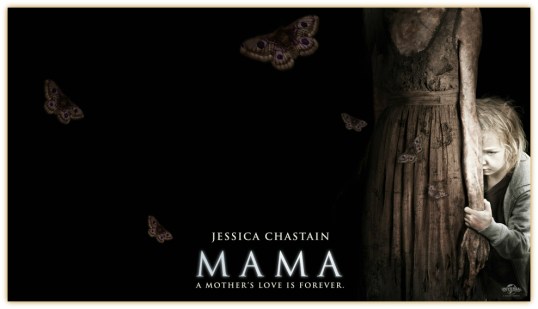
This weekend sees the release of the Guillermo Del Toro produced horror film Mama. It’s the full feature length film from a short film of the same name by Argentinean filmmaker Andres Muschietti who also directs the full film.
I’m pretty jaded when it comes to horror films purporting to scare the hell out of people, but after seeing this short I could easily believe why Guillermo Del Toro jumped at the chance to produce the feature length adaptation and put the short film’s director back in the chair to the the adaptation. It’s a short film that’s barely 3-minutes long and it’s a wonderful exercise in setting the appropriate mood and atmosphere before the money shot when we finally see the titular character of “Mama”.
Anyone who lives in a home with a second floor and stairs leading up it will definitely need to see this short film to get an idea of what to expect when they finally see Mama in the theaters.
I think Guillermo Del Toro’s upcoming giant robots vs giant monsters summer film will either fail to live up to the hype it’s been gathering since the very first teasers and images were released or the film will blow people’s minds away. This looks to be a film that will not brook any middle-of-the-road reaction. Some will either love it and some will absolutely hate it. Already there’s people who have been dismissing it as nothing but a jumped-up-Michael Bay rip (like that’s even possible) or dismissing it just because it’s a summer blockbuster, special-effects heavy film and not a barely-funded, arthouse, indie foreign film about the meaning of life, existence and the ennui that befalls all.
I, for one, am hyping this film up to beyond what’s safe to hype a film up for (yeah that doesn’t make sense but still deal with it). I’ve been a fan of Del Toro since I first caught his imaginative and inventive take on the vampire myth with Cronos. While he’s earned geek cred for his genre projects he is also once of the few filmmakers who have also gained the respect of the arthouse indie crowd with such films as The Devil’s Backbone and Pan’s Labyrinth.
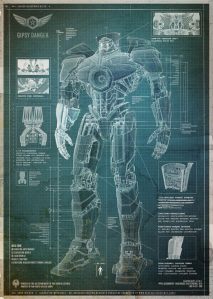
Enough gushing over the man. It’s all about the new trailer which premiered at this year’s CES over in Las Vegas. One wouldn’t think of CES as a place to premiere new footage about a summe rblockbuster, but as one can spy in this newest trailer it looks like Qualcomm paid some cash to get itself named in the film even if it’s just in the background. Also, just to show just how awesome this film will be there are also the design blueprints of five of the giant Jaegers that we’ve caught glimpses of in the trailer.
It’s hard to believe that’s it’s been 11 years since Peter Jackson released The Lord of the Rings: The Fellowship of the Ring on the masses in 2001. There were much trepidation from Tolkien fans that Jackson (who had been known mostly for low-budget splatter horror-comedies) wouldn’t be able to handle the monumental task of adapting what many consider the greatest novel ever written in the 20th century. Tolkien’s epic fantasy became the standard by which fnatasy epics would be compared to for decades to come and still do. To say that Jackson succeeded in this epic task would be an understatement. TheLord of the Rings trilogy would hoard awards from 2001 to 2003 and also box-office receipts to make any dwarf-lord green with envy.
It’s now 2012 and we finally have the release of Jackson’s next trip into Middle-Earth as he adapts another of Tolkien’s beloved novels. This time he tackles The Hobbit which for some Tolkien fans remains their favorite of the author’s works. It’s a novel that might not have the epic scope and breadth of The Lord of the Rings, but what it lacks in that department it more than makes up in being a fun, adventure tale of a curious hobbit named Bilbo Baggins, a wizard named Gandalf the Grey and a fellowship of twelve dwarfs led by one Thorin Oakenshield of Erebor.
The Hobbit was originally written as a children’s book, but in later years Tolkien would retcon some parts of the novel to better fit with his magnum opus in The Lord of the Rings.It’s this revised version of that children’s story that Peter Jackson, Fran Walsh, Philippa Boyens and Guillermo Del Toro would adapt for the big-screen. Initially a two-film set that would tell the story of Bilbo and his merry band of adventurers, but it has since been expanded to become a trilogy as Jackson and his writers take a page out of Tolkien’s bag of tricks and try to tie-in this latest trilogy to the Lord of the Rings which precedes it by a over a decade.
The first film in this new trilogy is called The Hobbit: An Unexpected Journey and we begin by returning to sometime before the beginning of the first trilogy’s first film. We see the aged Bilbo reminiscing of his adventures 60 years hence and deciding to put it to pen and paper as a sort of memoir of that adventure to reclaim the lost dwarf-hold of Erebor. It’s in this opening that we get to see Frodo once more (played once again by Elijah Wood who doesn’t seem to have aged) prior to him taking up the One Ring.
Bilbo recounts to Frodo the realm of Erebor deep inside the Lonely Mountain east of the Shire to Frodo and how it’s wealth in silver, mithril, gold and precious gems became well-known throughout Middle-Earth. Yet, as Bilbo warns, it’s the very sickness of avarice by Erebor’s Thror the King which seals the dwarf-hold’s doom. We learn that hoards of wealth does more than light up the dwarf king’s eyes with greed but also brings the attention of one of the very last dragon’s in Middle-Earth. The arrival of Smaug to Erebor signals the death of not just that dwarf realm, but the surrounding human town of Dale. The surviving dwarfs of Erebor flee in a massive diaspora towards any safe haven willing to take them in. What was once a proud and powerful realm has now been sundered and it’s afterwards that we get to the meat of the film’s story.
Martin Freeman as a younger Bilbo Baggins was more than just great casting but one which the film needed if one was to believe that this young Bilbo would grow old to be the Ian Holm one fans of the first trilogy have come to know well. His performance as Bilbo Baggins of Bag End becomes the anchor from which the rest of the company would revolve around. When we first meet Freeman as Bilbo he’s not the adventurer that he would become, but a hobbit that’s respectable and one not for doing anything foolish like going on adventures. Yet, his lot in life changes as Gandalf maneuvers the situation so that he becomes embroiled in the quest by Thorin Oakenshield (played by Richard Armitage) to retake his ancestral lands of Erebor and it’s massive wealth from Smaug who has taken it for his lair.
While many would think that a film called The Hobbit would focus on Bilbo I thought the way the film unfolded that this story was all about the dwarfs with extra focus on the single-minded Thorin who comes off initially as both condescending, superior and dismissive of poor old Bilbo. The film never fails to show how much Thorin thinks so less of Bilbo yet throughout the film’s two and a half and more running time we see cracks in Thorin’s ice-cold demeanor towards the young hobbit. By film’s end we see just how wrong Thorin has been of Bilbo’s worth and it makes for one of the film’s more emotional scenes when Thorin realizes this as well.
The Hobbit: An Unexpected Journey is not just about a brooding dwarf prince and his motley band of dwarfs getting into one trouble after the next once they’ve left the Shire with Bilbo. The film also brings on a parallel storyline which tries to lay down the foundation that would tie this new trilogy with the first one. It’s the storyline of the Great Necromancer that Gandalf and a fellow wizard, Radagast the Brown, suspect might be the Great Enemy returned. We learn soon enough during the White Council in Rivendell (attended by Gandalf, Galadriel, Elrond and Saruman the White) that this so-called Necromancer might be Sauron looking to regain his former strength and gather an army to him.
It’s this second storyline that get’s sandwiched within the Thorin Oakenshield Fellowship quest that comes off a bit awkward in the film’s overall narrative flow. Where the film is all about fun adventuring and camaraderie when the dwarfs and Bilbo are on the screen, when they’re not and the film tries to tell us about Sauron’s eventual return the film slows down. These scenes are not uninteresting. On it’s own these sequences bring back the epic tone of the original trilogy and brings it into this film, but it’s that very grandiose theme that seems out of place in what is simply a “men on a mission” story.
Fortunately, we don’t spend too much time dwelling on this side-story. The final third of the film is all about Thorin and company needing to escape from one goblin lair and orc ambush to another. The last 45 minutes or so flies back swiftly after a very uneven first two hours that would make more than a few theater-goers look at their watch. The wait is worth it as we see that Jackson hasn’t forgotten how to choreograph and stage fantasy action scenes. While the use of CGI might be more evident this time around than the previous three films they’re still small compared to other blockbuster films of it’s type. It’s still all about WETA practical effects, make-up and costumes that combine to create a world that’s become familiar yet still have a sense of newness to them as we see new areas of Middle-Earth only mentioned in brief passing in the original trilogy.
The Hobbit: An Unexpected Journey is a wonderful return to the world of Middle-Earth. It is not without it’s missteps and flaws, but it also gets saved by some great performances from the ensemble cast which makes up the dwarfs. The aerial shots of the New Zealand’s eclectic geography shows just how much cinematographer Andrew Lesnie has become such a major component of making Middle-Earth come alive. Even the return of Howard Shore as the film’s composer was a welcome that brought more than a few smiles.
There’s no way of talking about The Hobbit without bringing up the stylistic gamble Peter Jackson has taken in filming this film and the rest of the trilogy in 48fps instead of the traditional 24fps (frames per second) that filmmakers have been using for almost a hundred years now. It’s an aesthetic choice that gives the film a overly realistic look akin to watching a stage production live. Everything looks too perfect and the High-Frame Rate (HFR) takes away some of the cinematic look which many have grown up seeing every time they watch a film. This new filming style works in certain areas like wide shots of the outdoor scenes. Whether it’s the emerald green rolling hills of the Shire to the snowcapped Alpine peaks of the Misty Mountains, these scenes in HFR came out beautiful. It’s when the film switches over to a much more enclosed and personal space within rooms and halls that we get the unusual “soap opera” look some have complained about. It takes a bit of getting used to, but some make the adjustment quickly enough while others may never make the adjustment.
Yet, it is when the film shows a CGI-created sequence that the HFR fails. While the doubling of the frame rate during filming has made the 3D in the film come off smoothly it did make some of the CG-effects come off as too video game-like. A sequence earlier in the film where we see a flashback of Thorin and the dwarfs of Erebor trying to retake another fallen dwarf hold in Moria (Khazadum in dwarfish) looks like a cinematic cutscene as a dwarf army charges and battles it out with an orc and goblin force which had taken Moria as it’s own.
All the scenes where HFR fails to come off as believable turn out better when The Hobbit was seen in traditional 24fps. I actually think that downscaling the film from it’s original HFR to a more traditional film frame speed of 24fps gave the film an even more magical look than the original trilogy. Jackson and his team of filmmakers have two more films to release and hopefully take some of the criticism this first film has received about HFR that they tweak and work on making the new style much more believable instead of taking the audience out of the film’s narrative.
The Hobbit: An Unexpected Journey doesn’t come off as grandiose as the original trilogy and for some that might come as a disappointment. Yet, as an adventure film it more than does it’s job to fully entertain it’s audience while, at the same, time reminding it’s audience how much this film and this trilogy will lead into The Lord of the Rings. I recommend that people just see the film and decide on their own whether it’s a worthy addition to the Middle-Earth saga as seen through the eyes of Peter Jackson. I, for one, think it is and with two more films left we shall see whether Jackson’s return to Middle-Earth has been a triumphant one or not.
I think I may have just found my No. 1 most-anticipated film of 2013. It’s a no-brainer really considering my taste in pure, surefire entertainment. Let’s go through the check-list shall we….
Summer blockbuster: CHECK
Guillermo Del Toro directing: CHECK
Live-Action Mecha goodness: CHECK
Kaiju roaring and fighting: CHECK
Giant Mecha fighting and rocket punching: CHECK
GLaDOS doing voice-over work: CHECK and CHECK.
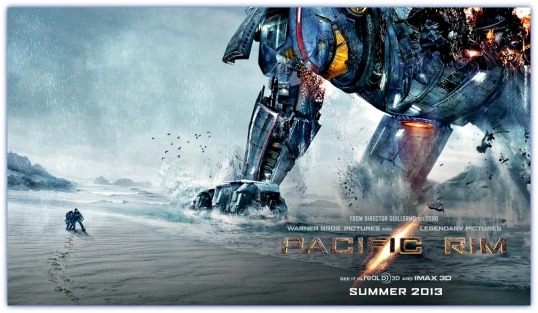
Guillermo Del Toro has been the champion of genre fans and even though the multitude of projects he gets his name attached to never even make it past the concept stage when they do he always goes full-bore, balls-to-the-wall and damn the torpedo forward with his vision. It looks like Pacific Rim he gets to give his fans and those who just want some crack-a-lacka, eyes-going-to-bleed action a chance to watch his vision of giant robots fighting giant monster for the fate of the planet. This film brings me back to my days as a youngling staring wide-eyed in front of the TV watching such classic anime as Mazinger Z and Voltron.
It helps to have GLaDOS providing the voice of the giant “Jaeger” mechas and current badass Jax Teller aka Charlie Hunnam be one of the two main Jaeger pilots. We even get to see Idris Elba acting in hia natural voice. This looks to be a film that just wants to give and give and give. It’s a giver.
Pacific Rim punches everyone in the groin and we’ll love it for doing so on July 12, 2013.
Guillermo Del Toro’s 2013 summer blockbuster film Pacific Rim is already becoming one of the film genre fans are eagerly awaiting to see and we’re still a at least 7 months away from it’s premiere.
Pacific Rim is as simple a story as one can find nowadays. Set in a future devastated by an apocalyptic war involving hundred-foot tall monsters rising out of the sea (called kaiju in the film), Pacific Rim is a giant robot vs. giant monsters film. It harkens back to the classic Godzilla and kaiju films of the 60’s and 70’s. With Guillermo Del Toro on board as the film’s director the film already has the geek cred to bring in Comic-Con crowd. The question now is whether the rest of the film-going masses will flock to see Jaegers (what the giant robots humanity uses are called) duke it out with Kaiju on a devastated Earth.
We get what looks like the first viral video marketing set-up for the film. It shows snippets of a news report of San Francisco being attacked by one of these Kaiju. The video looks to be inspired by Cloverfield from a few years back. Near the end of the video we get to see quick glimpses of the dead Kaiju sprawled atop the deck of an aircraft carrier looking like a 1000-foot land shark. Whatever it is that is in San Francisco it seems like its catnip to giant monsters.
Pacific Rim stars Idris Elba, Charlie Hunnam, Rinko Kikuchi, Charlie Day and Ron Perlman and set for a July 12, 2013 release date.
It just a littleunder 3 months before Peter Jackson takes us back to Middle-Earth with the first of three films that will make up The Hobbittrilogy.
There’s not much else to say other than this latest trailer for The Hobbit: An Unexpected Journeyjust continues to whet the appetite for all things Middle-Earth. It’s much more action-packed with some nice new scenes instead of just rehashing what was in the original teaser trailer from year ago.
Enough words. Just watch the trailer below and decide for yourself whether another trip to Middle-Earth (before all the War of the Ring brouhaha of the first trilogy) is worth your monies.
The Hobbit: An Unexpected Journeypremieres worldwide on December 14, 2012.
While Christopher Nolan’s The Dark Knight Rises is the most anticipated summer blockbuster for this upcoming 2012 then it would be safe to say that the most anticipated film for 2012 for some would be Peter Jackson’s The Hobbit: An Unexpected Journey.
This is a film that has been years in the making and even more years in development hell as the rights to J.R.R. Tolkien’s novel, The Hobbit, was entangled through many different studios. Once those entanglements were finally resolved and the film set to be put into production the film suffered more setbacks as budget and script rewrites kept things from starting. The original filmmaker picked to helm this two-part prequel, Guillermo Del Toro, had to back out after years of delays though he still remains as producer and his ideas and conceptual art and design has become the foundation for the film.
The film finally got the greenlight to start filming once Peter Jackson stopped searching for Del Toro’s replacement and took on the role as director once again. While Del Toro was a great choice I think most fans of the original trilogy were glad that Jackson decided to just take up the director’s chair once more. Who else knew the world of Middle-Earth on film better than the man who made what was called the unfilmable novel into the new millenium’s iconic film trilogy.
Like the production of the Lord of the Rings trilogy, Jackson and his geniuses at WETA have been pretty good with showing fans progress made on the films through video blogs released by Jackson himself. With just a year left to go before part one of this two-part prequel premieres we finally have the first official teaser trailer to the film and I must say that it’s great. Even from just snippets shown in the teaser one could see some of Del Toro’s more darker concepts and influence in the film’s look and tone. But then some of it also comes from Jackson himself whose early background as a filmmaker was all about dark, macabre subjects and themes.
The Hobbit: An Unexpected Journey is set for a December 14, 2012 release.
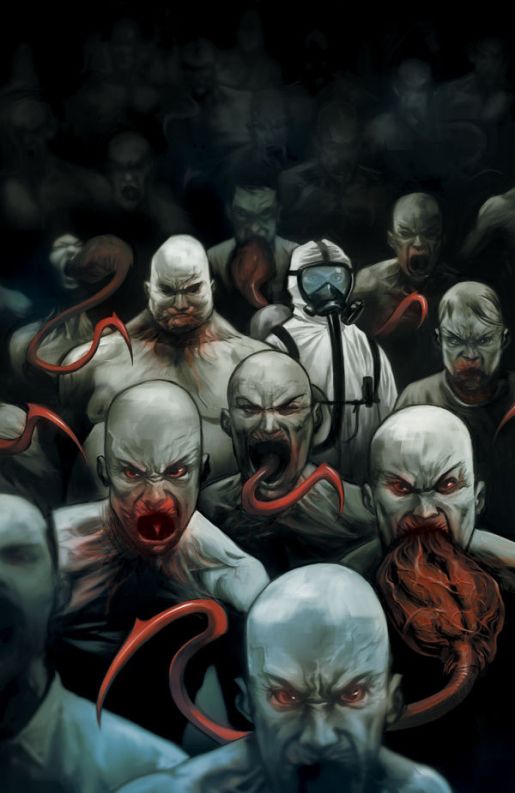
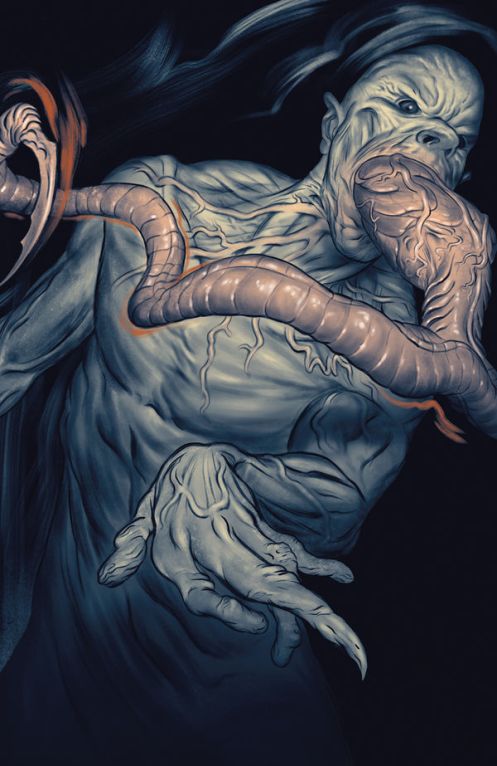
The vampires of The Strain appear to be the next step of the Reapers, Del Toro introduced in Blade II. These creatures far removed from the handsome angst filled vampires of True Blood, Twilight, etc and more in the line with the apex predators that caused nightmares.
Below is the breakdown of the hemophagic corpses (via the wiki page) Vampire Biology
The vector for vampirism is a capillary worm, which, once introduced into the human host’s bloodstream (either through a vampire’s feeding or direct invasion by the worm through a wound or orifice), introduces an incurable and fast-acting virus. By manipulating the host’s genes, the virus causes a human to undergo numerous radical physical changes.
Vampire Physicality
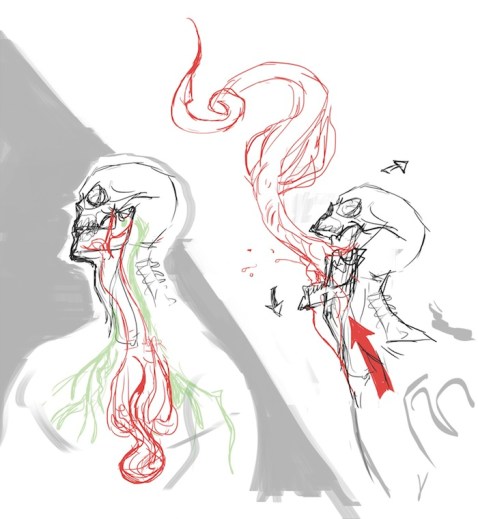
The first and most distinct vampire adaptation is the development of a long, retractile proboscis beneath the host’s tongue, which is able to extend up to six feet from the mouth. This “stinger” is both the vampire’s feeding and reproductive mechanism, shooting forth to latch onto human prey’s throat or thigh, both draining the victim’s blood for nutrition and infecting the human with capillary worms. The vampire’s jaw is set at a lower hinge than a human, the mouth gaping like a snake’s when the stinger is deployed. As the structure of the stinger is actually modified tissue from the human lungs and throat, vampires are incapable of physical speech.
A vampire’s physical appearance is governed mainly by the host body shedding those human traits that are obsolete to its new life cycle. Hair and fingernails are gradually lost, while the external nose and ears atrophy, leaving a fully matured vampire’s skin as smooth and featureless as marble. The vampire’s complexion is extremely pale between feedings, but appears a flushed red after a recent blood-meal. Eye coloration is a black pupil surrounded by a red sclera, with a white nictitating membrane sliding across for protection. The middle fingers of both hands grow and strengthen, and a thick talon develops in place of the lost fingernail. As vampire reproduction is achieved through viral infection of hosts and not through any sexual mechanism, the human genitalia also atrophy, leaving a mature vampire with no discernible gender.
The digestive and circulatory systems of a vampire are simplified and fused, the vampire’s interior organs most resembling a series of connected sacs. Nutrition from a blood feeding is transported throughout this system via a thick, viscous white fluid that forms the vampire equivalent of blood. The capillary worms are present in this fluid, swimming throughout the circulatory system and often visible beneath the vampire’s thin skin. Like rodents, a vampire is unable to vomit, its suction-based digestive process functioning only one way. All bodily waste is excreted from a single rectal orifice in the form of a pungent ammonia-based spray; a vampire will excrete for the entire duration of a feeding, purging old food as it consumes new blood.
The vampire’s body temperature runs extremely high, at 120 degrees Fahrenheit, and a human is able to feel their ambient heat from several feet away.
Many of the physical changes from human to vampire occur gradually following the initial worm infection, and are accompanied by great pain. A newly “turned” human will lie in a state of suspended animation for an entire day, rising the next night as a nascent vampire. The stinger is present for the vampire’s first foray, in order to facilitate feeding, but other traits (hairlessness, talons on the mid-digit, lack of distinct internal organs) will develop within the first seven nights following infection. The vampire’s mental state will also be confused at first, and its movements will be clumsy and awkward. As it matures, however, the vampire will become supremely agile, able to leap great distances and climb sheer surfaces with the aid of its talons. Full maturity, physically and mentally, occurs within the first thirty nights.
In spite of the vampire’s morbid biology stripping legend of most of its romance, the most famously admired trait of the undead remains intact: immortality. Unless slain by violence or sunlight, a vampire’s parasitic body structure will neither fade nor weaken with the passage of time, giving them an effectively endless “life”-span. Even in those cases where the host body is damaged beyond repair, a vampire of sufficient power can transfer their consciousness (via a torrential capillary worm transfer) from one human form to another.
Vampire Senses
The sensory apparatus of the vampire is highly adapted for their nocturnal life cycle. Color vision is replaced with the ability to sense heat signatures, and the world is perceived in a monochrome brightened by sources of warmth (such as human prey). Hearing is greatly enhanced, in spite of the loss of external ears.
The vampires’ greatest sensory asset, however, is the “hive mind” that all new vampires share with the Ancient that propagated them. Each vampire, through some undefined telepathic link, is able to send and receive thought and sensory information to and from their Ancient progenitor. In this manner, the Ancient vampires direct the actions of their individual spawn through mental communication, regardless of distance. Perhaps akin to its radiation shielding properties, the element lead has the effect of blocking this mental connection.
In spite of their biological inability to speak, vampires can communicate with humans through telepathy, transmitting thoughts directly into a person’s internal monologue. Those vampires seeking to pose as human can train themselves to move their lips in a pantomime of speech, but the actual communication is still via thought-transference.
An Ancient vampire is also able to use this telepathic ability as a weapon; known as the “murmur”, this mental shock-wave has the ability to completely overwhelm the minds of surrounding human beings, rendering them unconscious.
Vampires also experience an overwhelming compulsion to infect family members and those they cared about as humans (their “dear ones”). They possess a unique ability to locate such targets, this sense being likened to a pigeon’s homing instinct.
Vampire Weaknesses
Many of the traditional vampire “weaknesses” of common folklore remain effective, although their potency is explained in terms of specific effects on vampire biology.
Sunlight is the vampire’s ultimate destroyer, specifically ultraviolet light in the UVC range. This is due to the germicidal properties of the wavelength, as it breaks down the virus-laden tissues of the vampire’s body. A localized source of UVC light, such as a fluorescent lamp, can be used to repel a vampire, much as a burning torch can repel an animal. Complete exposure, either to direct sunlight or a powerful UVC source, will result in complete desiccation of the vampire’s body, leaving behind nothing but ashes.
Silver, whether in the form of a metal weapon or even a fine chemical mist, can also wound or kill a vampire. Much like sunlight, this is due to the disinfecting properties of the element damaging the vampire’s viral biology. While conventional weapons (lead bullets, steel blades) can cause physical damage, they will not repel a vampire. Silver causes vampires both debilitating pain and a certain amount of fear, and binding a vampire in silver will completely incapacitate them.
Severing the spinal column through any method is another effective way to destroy a vampire. While the vampire’s simplified internal organ structure makes them difficult to harm with attacks to the body, decapitation will result in the vampire’s death.
Although there appears to be no biological imperative behind it, vampires cannot cross running water. This is alluded to as having something to do with the origin of the Ancients, but no further explanation is given. This aversion to water can be overcome, however, if the vampire is assisted (or “invited”) by a human.
Traditional religious protections against vampires, such as a crucifix or holy water, display no practical effect. The prevalence of this lore is explained as having been the product of Bram Stoker’s “fevered Irish imagination”.
Garlic, another common folk defense, has no noticeable use in repelling vampires.
Silver-backed mirrors, while they will not harm a vampire, will reveal their presence. While vampires do indeed cast a reflection, it is blurred and distorted, akin to an image vibrating at an impossible speed. Modern chrome-backed mirrors, however, will not have this effect, and the vampire will appear normally in such a looking-glass.
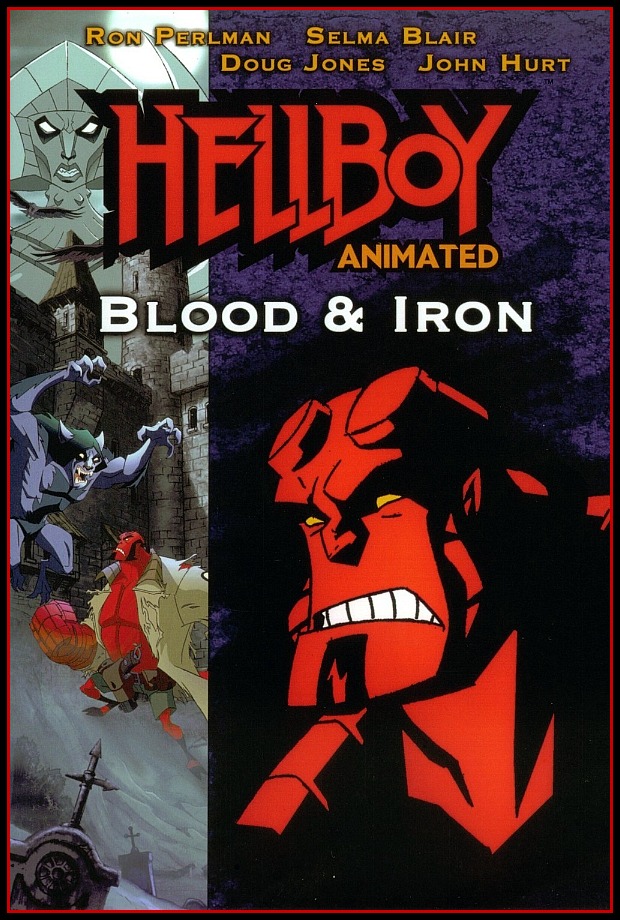
Guillermo Del Toro will forever be one of the heroes of comic book fans everywhere due to his bringing Mike Mignola’s Hellboy comic book franchise from the printed page to the silver screen. He first brought the Big Red Guy with the 2004 film adaptation of the same name. The film was a modest success and brought the titular character to a whole new group of fans. In 2008, Del Toro came out with the bigger and more epic sequel, Hellboy II: The Golden Army. What some fans of the character sometimes forget or didn’t even realize was that in-between these two films were two direct-to-dvd releases of the animated variety. The first to come out was Hellboy: Sword of Storms in 2006. While I enjoyed that animated film it would be the follow-up dvd release, Hellboy: Blood and Iron which truly captured the essence of the comic books even moreso than the two live-action films.
Hellboy: Blood and Iron would combine parallel storylines about Hellboy and his surrogate father’s, Trevor Bruttenholm, encounter with one Erzsebet Ondrushko also known in occult circles as Elizabeth Bathory the Blood Countess. According to the film, Erzsebet would bathe in the blood of innocent, young girls. The film also makes Erzsebet a follower and disciple of the Mediterranean goddess of witchcraft and sorcery, Hecate.
One storyline would play out in reverse chronological order and take place in 1939 as a much younger Trevor Bruttenholm travels to Eastern Europe to investigate a series of murders that locals have attributed to the return of the Blood Countess. The other storyline moves to the present as Hellboy and his teammates from the B.P.R.D. (Bureau for Paranormal Research and Defense) investigate the supposed hauntings of the estate of a wealthy businessman. This would be an estate that would be the center piece of a sort of haunted amusement park with the Blood Countess and the legends surrounding her as the main attraction.
Hellboy: Blood and Iron does a great job of mixing action, horror and the occult without one or the other overshadowing the rest. The film takes some of it’s ideas from Mike Mignola’s (creator of the Hellboy franchise) Hellboy graphic novel, Wake the Devil, and screenwriter Kevin Hopps does a good job of taking those ideas and creating something new yet similar as well. The film also benefited from the return of the cast of the live-action Hellboy films to voice their respective characters in this animated film. There’s Ron Perlman in his gruff and sardonic best as the title character. Selma Blair returns to voice Hellboy’s closest friend in the redheaded pyrokine Liz Sherman with Doug Jones and John Hurt rounding it out as Abe Sapien and Trevor Bruttenholm.
The animation is not the highest level but for a direct-to-dvd affair it more than holds up and really captures the look and feel of the comic books it was based on. Yet, while an animated film this one wouldn’t be appropriate for little kids to watch. For a “cartoon” it’s quite violent with themes of witchcraft, vampirism and blood sacrifice prevalent from beginning to end. It’s actually quite scary in certain sections especially whenever the resurrected Erzsebet appeared. I don’t think most animated films ever involved a sequence of a tub full of fresh, hot blood waiting to be used as bathwater.
For those willing to learn more and understand the appeal of the Hellboy comic books to legions of fans this animated film was a good example. Hellboy: Blood and Iron was great from beginning to end especially how it interwove not just the vampiric and pagan legends surrounding Erzebet Ondrushko, but also little tidbits of information and character development which added to the backstory of not just Hellboy but those closest to him. Plus, this animated film had two character’s whose names were variants of the name Lisa.
In 2008, Dreamworks Animation released what many had thought was one of their animated films. Some even went so far as to consider it on the same level as many of the Pixar animated offerings. This was high praise indeed and the praises from critics was awarded by public acclaim as Kung Fu Panda became an instant classic for Dreamworks Animation. It wasn’t a huge surprise that a sequel was quickly greenlit by the studio and now three years has passed and that sequel has finally come out. Kung Fu Panda 2 does one of those rare feats in film-making where it surpasses it’s original predecessor in all things. This was a sequel that was able to take what made the first one so fun and thrilling and build on it without losing the charm that made it so beloved in the first place.
Kung Fu Panda 2 brings back the Dragon Warrior Po (Jack Black returning in the role of the big fat panda) as he continues to live his dream of having become the Dragon Warrior and fighting evil, bandits and criminals with his fellow kung fu masters, the Furious Five. Instead of the film highlighting Po’s size as a detriment and keeping him a buffoonish character like in the beginning of the first film this sequel actually makes him an equal of his heroes, if not, surpassing them. This is a refreshing change since the writers could’ve easily banked on Po as a character who bungled and stumbled his way through most of the film.
This film was a continuation of Po’s journey as a hero which the first film was just the first step. Despite being a kung fu master in his own right his culture becomes threatened by a villain even more devious than the first film’s Tai Lung. Lord Shen (voiced by Gary Oldman) is the mad peacock heir to Gongmen City who has found an ultimate weapon through fireworks that he plans to defeat kung fu and conquer all of China. Kung fu is everything to Po and he journeys with the Furious Five to confront Lord Shen and stop his plans before it’s too late.
It’s during this journey that Po learns more about his true past and where he truly comes from. The sequences where Po’s adopted goose father tells of Po’s past was some of the best animations Dreamworks has done and I’d say surpasses some of Pixar’s own work. After seeing this film I’m sure many kids and some adults would want themselves their very own baby panda. Who would’ve thought that baby pandas sounded like human babies when they cried. It’s knowing his past that Po must now learn to find his inner peace if he’s to ever go beyond just being a kung fu master.
Kung Fu Panda 2 was actually quite a dark film in places as themes of genocide, destructive march of technology against nature, difficulties of adopted children finding their true origins and many others. That’s not to say that this sequel wasn’t fun to watch. The action took the kung fu fight scenes from the first film to a whole new level, but without turning it into all flash and no substance. It’s during some of the thrilling fight sequences that we see Po truly become part of the Furious Five and even affection from some of it’s members. It would be interesting to see how a third film would explore the growing relationship between Po and certain striped-feline.
The story gets a much needed infusion of creative help from one Guillermo Del Toro who served as creative producer. His inclusion in the film’s development was probably why the film had a much darker and serious tone in addition to the charm it continued from the first film. If there was anyone in Hollywood who knows how to further develop a character through a Campbellian hero’s journey then it’s Del Toro. If Dreamworks Animation is able to keep Del Toro on hand to further treat their other projects then it will be quite a coup for the studio.
The animation in this film is a step above the first film and anything Dreamworks Animation has ever done. With each passing year and release it looks like Dreamworks Animation has been able to come to the same level of animated work Pixar has set with their own projects. While I’m sure there’s no animosity between animators fo the two houses there probably is some sort of friendly rivalry which helps push both studios to improve on their animation work. All this means is that the public wins out in the end as we’re treated to better animated features from both Dreamworks and Pixar. It’s a good thing that Dreamworks Animation has also improved their storytelling with each new film that they’re not being called the weaker films when compared to Pixar’s latest.
In the end, Kung Fu Panda 2 more than lives up to it’s predecessor and actually surpasses it in every way. This sequel’s animation and use of stereoscopic 3D was some of the best in CG animation to date. It had a story that continued to explore and build the characters from the first film that they’ve gone beyond simple, basic animated characters but fully realized and complex individuals. Even the ending scene in the film which definitely sets-up a third film doesn’t seem tacked on but looks like something that would further continue Po’s hero’s journey. Sequels and milking of a franchise usually don’t sit well with serious film fans, but this franchise seems to be doing it correctly and using each new film to further an epic tale. Here’s to hoping we see Po and his Furious Five friends back for more in the coming years.