Review: A Dog Called Vengeance (dir. by Antonio Isasi)


I’ve always felt that a truly good movie should inspire the viewer to seek to confess something about themselves.  So here’s my confession.  When I was a toddler, I was mauled by a stray dog.  I don’t remember it, of course but I still have the small scars on my left arm as proof.  As a result, I’m scared of dogs and I always have been.  I jump when I hear one barking and the sound of one growling can easily set off a panic attack.  Whenever I see one nearby, regardless of whether it’s on a leash or not, my heart starts to race.  

For that reason, I suppose it was inevitable that a movie like the 1976 Spanish production A Dog Called Vengeance would get to me.

The film opens in an unnamed South American country.  Political prisoner Jason Miller escapes from a jungle prison.  As he flees, Miller runs into a tracker and the tracker’s dog, a German Shepard named King.  Miller kills the tracker and then continues to run.  King, after a few rather sad scenes in which he tries to revive his dead master, gives chase.

And that, in short, is pretty much the entire 108-minute film.  Miller runs and King chases.  Whenever Miller thinks that he’s safe (whether he’s taking a bath in a river or making love to a woman who has agreed to hide him), that relentless dog shows up and tries to kill him.   I have to admit that this movie did little to alleviate my fear of dogs because King is truly viscous.  The scenes were attacks both Miller and other assorted humans left me cringing and I don’t think it’s just a coincidence that Miller looks to be truly scared during some of the attack scenes.  King easily dominates the 1st half of this movie.

The 2nd half of the movie feels like a totally different movie from the first.  Jason Miller, having reached the city, is reunited with his comrades in the revolution.  Whereas the first half of the movie was almost wordless, the movie suddenly become a lot more talky as Miller and his associated debate the merits and morality of revolution.  Personally, I prefer the second half if just because a nice element of moral ambiguity is introduced here as it becomes pretty obvious that the “revolutionaries” are just as corrupt as the country’s dictator.  In the city, Miller finds himself still being pursued by his enemies but now his friends want him dead as well.  And, of course, that dog shows up again as well…

Anatonio Isasi’s direction is, for the most part, strong and Jason Miller (best known as Father Karras in the Exorcist) gives a good, low-key performance as the film’s lead.  But, of course, the real star of the movie is that damn dog and, despite not being a doglover, I have to admit that it did a pretty good job.  Not only did I believe that dog wanted to kill Miller but I believed that he easily could as well.  However, at the same time, it hard not to feel a little bit of admiration for King.  He was just so compellingly relentless in his pursuit.  It’s probably one of best unacknowledged canine performances in film history.

A Dog Called Vengeance is the epitome of the type of flawed yet oddly compelling film that could only have been made outside of the Hollywood system.  By refusing to shy away from showing either the full savagery of the dog’s attacks or in man’s response to those attacks, director Isasi manages to craft a political allegory that also works as a simple thriller.  By refusing to paint either Miller or the dog in purely black-and-white terms, he introduces a moral ambiguity that most Hollywood studios would never have the guts to even attempt.  Tellingly, the most shocking and disturbing scene in the film is not one of King’s many attacks on Miller.  Instead, it’s a scene in which our paranoid “hero” guns down an innocent dog while its 10 year-old owner watches in horror.

Unfortunately, A Dog Called Vengeance isn’t an easy film to find.  I saw it as part of the Grindhouse 2 DVD compilation and the transfer — taken straight from a VHS release — was terrible with frequently blurry images and terrible sound.  To a certain extent, this did give an authentic “grindhouse” feel to the experience of watching the movie but it doesn’t change the fact that it took a while to get used to just how bad the movie looked.  Luckily, the transfer seemed to improve as the film went on and, by the end of the movie, was no longer an issue.

Review: The Black Waters Of Echo’s Pond (dir. by Gabriel Bolongna)


I’m going to start this review with a disclaimer.  Yesterday, I nearly died trying to see this movie.  As I was driving to the theater, I nearly collided with another car.  One of us (okay, it me) wasn’t paying attention and ran a stop sign.  We handled the near accident with the usual mix of car horns and profanity and, my heart still racing, I drove on to the theater and saw The Black Waters of Echo’s Pond.

As a result of my near death experience, I sat through this movie with one thought in my head: was seeing it worth losing my life?  While there are some movies (Suspiria, Beyond the Darkness, Zombi 2, and the Living Dead Girl, for example) that I would happily sacrifice a few years in order to see on the big screen, Black Waters is not one of them.

The film actually starts out well with a 9-minute prologue.  An archeological expedition in Turkey discovers an ancient tomb.  Inside the tomb, they find a map that is somehow linked to the Greek God Pan.  For nine minutes, we’re treated to clunky exposition (“Why, it’s what we’ve been here looking for!”  “Professor, do you mean that it’s the ancient map of Pan’s Arcadia?”  “Yes, the same Pan who was the Greek God of fertility and…”) and it seems like this movie might actually turn out to be a fun, cheerfully stupid take on the old Mummy movies that Hammer Studios released in the late 60s.

No such luck.  All the members of the expedition are promptly killed off-screen.  We jump forward to the “present day” and the entire movie quickly goes downhill.

In the present day, nine college friends get together to spend a weekend in an isolated mansion on an even more isolated island.  Why they would want to do this is never really addressed nor do you ever believe that any of the characters have a shared history or would actually be friends if not for the fact that the film demands it.  While there are some talented actors in the cast, they have absolutely no chemistry when they’re on screen together.  Since the rest of the film is pretty much dependent upon us believing that these people are all old friends, this lack of chemistry pretty much dooms the entire movie. 

(Add to that, the men in this group all appear to be having the worst bad hair day in recorded history.)
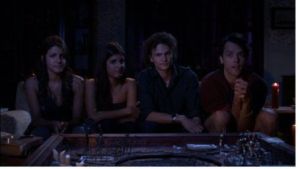
Once they’re in the mansion, the power promptly dies.  While attempting to find a fuse box, one of the friends instead discovers a board game.  Our group proceeds to play the game and soon, they’re seeing visions of murder, illicit sexual activity, and a big-horned demon.  However, none of them find this to be all that curious because they are 1) stoned and 2) incredibly stupid.

As I watched them play this cursed Jumanji death game, I found myself wondering if nobody in this film had ever seen a horror movie before.  Surely, if they had, they would realize that getting together in an isolated location, joking about sex, smoking weed, and then playing with the mysterious game that was previously walled up in the cellar is a good way to guarantee that you’re not going to be alive in the morning. 

To a certain extent, you have to be willing accept a lot of stupidity on the part of the characters in a horror film.  After all, we all know that our poor victims are always going to end up running up a flight of stairs in order to escape the killer (as opposed to going out the front door) and we forgive them for that because we know that if their actions were logical, then there would not be a movie.  However, the victims of the Black Waters of Echo’s Pond simply require us to forgive too much. 

Anyway, the game quickly starts to get weird as everyone draws cards that require them to answer increasingly personal questions.  Old resentments boil up to the surface.  One guy admits to wanting to have sex with both his girlfriend and her sister while the token responsible girl finds herself compelled to flirt with the token slut.  All of this goes on until finally, one member of the group snaps and, while everyone else is busy getting it on, proceeds to cut his best friend in half with a chainsaw.  (And no, nobody in the house hears the screams or the chainsaw because, as I mentioned earlier, they’re all incredibly stupid.)
Once that first murder is committed, everyone is soon trying to kill everyone else.  In this regard the film is remarkably similar to Mario Bava’s classic Bay of Blood (a.k.a. Twitch of the Death Nerve).  However, the constant carnage in the Bava film worked because Bava made it clear that his many murderers were all working independently from each other with just their own greed to motivate them.  Whereas in Black Waters, it is made clear from the start that everyone has been possessed by Pan.  In short, the murders have nothing to do with the people being killed or those who do the killing.  And while the murders are nicely brutal and bloody (I hate bloodless horror films), they don’t have any meaning beyond the mechanics of the film.

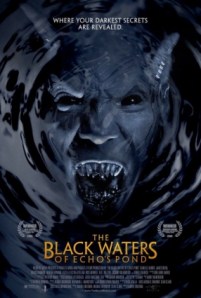
Pan (or at least I assume that its meant to Pan because it looks more like a Minotaur than anything else) shows up fairly early in the movie and he is an impressive creature with a goat’s head that features glowing eyes and long, dirty talons at the end of his fingers.  Still, I think it was a mistake on the part of the filmmaker’s to reveal him as early (and as often) as the film does.  Once Pan shows up, the movie loses all of its mystery.  We now know, for sure, that all the ensuing mayhem is the result of Pan’s supernatural malevolence.  By revealing Pan as early as it does, the film sacrifices whatever chance it may have had to be truly scary.  Instead Pan, just becomes another faceless killer and the movie, which has been advertised as a “psychological thriller,” loses its edge.

Outside of Pan, the cast is largely forgettable and they’re certainly not helped by how unlikable the majority of the characters are.  A few members of the cast do occasionally manage to offer up a few good (or, at least, memorable) moments but their efforts are sabotaged by some of the most leaden dialogue I’ve ever heard.  (It’s not a good sign that the film feels like it was dubbed into English even though it’s not.) 

The Babysitter twins from the Planet Terror segment of Grindhouse show up for instance and, even though their characters are wildly inconsistent, they both bring a lot of energy to their roles.  Incidentally, one of them gets the worst the line of the dialogue in the entire film when she says, “Shakespeare is Shakespeare!  B-movies are porn!”

Robert Patrick plays Pete, the grizzled old-timer who gets to do the whole “Some people say the killer is still out there…” thing.  It’s not much of a role but Patrick has fun with it.

Speaking of horror film tropes, Mircea Monroe plays Veronique, the token slut.  From the minute she shows up on-screen, you know she’s doomed because she’s flirtatious, openly bisexual, and likes to show off her boobs.  (Come to think of it, if I ever find myself in a slasher film, I am fucked!)  It’s a thankless role but Monroe does her best with it and actually give Veronique a personality that goes beyond the puritan stereotype of the slasher film slut.  Her best scene is her last.  The look of mournful resignation on her face make her final fate rather sad and suggests the type of film that Black Waters could have been.

The two nominal leads are played Danielle Harris and James Duval and they both occasionally manage to transcend the shallowness of their roles.  Harris, of course, is a horror film veteran who could play her role in her sleep.  To her credit, she doesn’t.  James Duval is best known for playing Frank the Bunny in Donnie Darko.  Here, he plays ne’er-do-well Rick.  If for no other reason, the movie is worth seeing just for the way Duval delivers the line “Shit!  We’re fucked!”  It’s a line that he repeats several times and he says it with just the right combination of genuine frustration and stoner pathos.

In many ways, Black Waters On Echo’s Pond feels a lot like one Lucio Fulci’s post-Manhattan Baby efforts.  You have no doubt that the movie was made by talented people and you keep wanting it to be better than it actually is.  You find yourself clinging onto the few isolated moments that are actually effective and hoping that maybe they’ll carry you to the light at the end of the tunnel.  Unfortunately, by the end of the movie, you realize that the light was actually the train that’s just bisected you because you were too stupid to jump off the tracks.

Ultimately, the main problem with The Black Waters of Echo’s Pond is that it just is not a scary movie.  I can usually forgive a lot from a horror movie as long as there’s a handful of shocking “jump” moments.  Unfortunately, Black Waters doesn’t feature a single one.  While the gore effects are occasionally impressive, it takes more than blood to make a horror movie.  All the material was there for this to be a fun little B-movie (and not a porno, regardless of what that Babysitter Twin claims) but it just doesn’t happen.

I recently posted some of my feelings about this film over on a message board.  I quickly received a reply from a gentleman who disagreed with me.  He informed me that not only did I not have the slightest idea how difficult it is to make a movie but by criticizing this film, I was failing to support “independent film.”  “Why don’t you just go spend more of your money on Avatar again?” he asked.  Well, for the record, I hated Avatar and I do support independent film.  Just because this movie was made outside of the studios, that doesn’t make it a good film.  If you want to see a good, independent horror and/or fantasy film, go track down Baghead or Primer.  Leave the Black Waters of Echo’s Pond undisturbed.

My Top Ten Books About The Movies


I love movies and I love books so I guess it would stand to reason that I love books about movies the most of all.  (I also love movies about books but there are far fewer of those, unfortunately.)  Below are my personal favorites.  I’m not necessarily saying that these are the ten greatest film books ever written.  I’m just saying that they’re the ones that I’m always happy to know are waiting for me at home.

10) Soon To Be A Major Motion Picture by Theodore Gershuny — This is one of the great finds of mine my life.  I found this in a used bookstore and I bought it mostly because it only cost a dollar. Only later did I discover that I had found one of the greatest nonfiction books about the shooting of a movie ever written!  Gershuny was present during the filming of a movie called Rosebud in the early 70s.   I’ve never seen Rosebud but, as Gershuny admits, it was a critical disaster that managed to lose a ton of money.  The book provides a fascinating wealth of backstage gossip as well as memorable portraits of director Otto Preminger and actors Robert Mitchum (who was originally cast in the lead role), Peter O’Toole (who took over after Mitchum walked off the set), and Isabelle Huppert.   If nothing else, this book should be read for the scene where O’Toole beats up critic Kenneth Tynan.

9) Suspects by David Thomson — A study of American cinema noir   disguised as a novel, Suspects imagines what would happen if George Bailey from It’s a Wonderful Life fell in love with Laura from the movie of the same name.  Well, apparently it would lead to Sunset Boulevard’s Norma Desmond having an affair with Chinatown’s Noah Cross and to one of George’s sons, sensitive little Travis, getting a job in New York City as a Taxi Driver.  And that’s just a small sampling of what happens in this glorious mindfuck of a novel.

8 ) Profondo Argento by Alan Jones — Long-time fan Alan Jones examines each of Dario Argento’s films (even Argento’s obscure historical comedy The Five Days of Milan) and proceeds to celebrate and (in many cases) defend Argento’s career.  Jones also interviews and profiles several of Argento’s most frequent collaborators — Daria Nicolodi, Asia and Fiore Argento, Simon Boswell, Claudio Simonetti, Keith Emerson, George Romero, Lamberto Bava, Michele Soavi, and many others.  Jones’ sympathetic yet humorous profile of Luigi Cozzi is priceless.

7)  Spaghetti Nightmares by Luca Palmerini — Spaghetti Nightmares is a collection of interviews conducted with such Italian filmmakers as Dario Argento, Ruggero Deodato, Umberto Lenzi, Lucio Fulci, and others.  Among the non-Italians interviewed are Tom Savini (who, as always, comes across as appealingly  unhinged) and David Warbeck.  (Sadly, both Warbeck and Fulci would die shortly after being interviewed.)  What makes this interesting is that, for once, Argento, Fulci, et al. are actually being interviewed by a fellow countryman as opposed to an American accompanied by a translator.  As such, the subsequent interviews turn out to be some of the most revealing on record.

6) Sleazoid Express by Bill Landis and Michelle Clifford — Landis and Clifford’s book is both a history and a defense of the old grindhouse theaters of New York City.  Along with describing, in loving and memorable detail, some of New York’s most infamous grindhouses, they also write about some of the more popular movies to play at each theater.  Along the way, they also offer up revealing profiles of such legendary figures as David Hess and Mike and Roberta Findley.  Reading this book truly made me mourn the fact that if I ever did find myself in New York City, I won’t be able to hit the old grindhouse circuit.

5) Beyond Terror: The Films of Lucio Fulci by Stephen Thrower — Fulci has always been a terribly underrated director and, indeed, it’s easy to understand because, in many ways, he made movies with the specific aim of alienating and outraging his audience.  It requires a brave soul to take Fulci on his own terms and fortunately, Stephen Thrower appears to be one.  Along with the expected chapters on Fulci’s Beyond Trilogy and on Zombi 2, Thrower also devotes a lot of space to Fulci’s lesser known works.  Did you know, for instance, that before he became the godfather of gore, Fulci specialized in making comedies?  Or that he also directed two very popular adaptations of White Fang?  Thrower also examines Fulci’s often forgotten westerns as well as his postapocalyptic sci-fi films.  And, best of all, Thrower offers up a defense of the infamous New York Ripper that, when I read it, actually forced me to consider that oft-maligned film in a new light.  That said, Thrower does admit to being as confused by Manhattan Baby as everyone else.

4) Immoral Tales by Cathal Tohill and Pete Toombs — Tohill and Toombs offer an overview of European “shock” cinema and some of the genre’s better known masters.  The book contains perhaps the best critical examination of the work of Jean Rollin ever written.  The authors also examine the work of Jesus Franco and several others.  This is a great book that reminds us that the Italians aren’t the only ones who can make a great exploitation film.

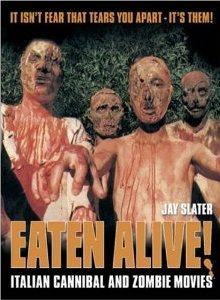
3) Eaten Alive by Jay Slater — This book offers an overview of the Italian film industry’s legendary cannibal and zombie boom.  Along with reviewing every Italian movie to feature even the slightest hint of cannibalism or the living dead (this is one of the few books on Italian cinema that discusses both Pasolini and Lucio Fulci as equals), Eaten Alive also features some very revealing interviews with such iconic figures as Catriona MacColl, Ian McCullough, and especially Giovanni Lombardo Radice.  Radice, in fact, also contributes a memorable “guest” review of one of the movies featured in the book.  (“What a piece of shit!” the review begins.)  Memorable reviews are also contributed by Troma film founder Lloyd Kaufman who brilliantly (and correctly) argues that Cannibal Holocaust is one of the greatest films ever made and Ramsey Campbell who hilariously destroys Umberto Lenzi’s infamous Nightmare City.

2) The Book of the Dead by Jamie Russell — If, like all good people, you love zombies then you simply must do whatever it takes to own a copy of this book.  Starting with such early masterpieces as White Zombie and I Walked With A Zombie, Russell proceeds to cover every subsequent zombie film up through George Romero’s Land of the Dead.  Russell offers up some of the best commentaries ever written on Romero’s Dead films, Fuci’s Beyond Trilogy, Rollin’s Living Dead Girl, and Spain’s Blind Dead films.   The pièce de résistance, however, is an appendix where Russell describes and reviews literally ever zombie film ever made.

1)  All The Colors Of the Dark by Tim Lucas  — This is it.  This is the Holy Grail of All Film Books.  If you’ve ever asked yourself if any book is worth paying close to 300 dollars, now you have your answer.  This one is.  Tim Lucas offers up the most complete biography of director Mario Bava ever written.  In fact, this may be the most complete biography of any director ever written!  Lucas examines not only Bava’s life but also every single movie that Bava was ever in any way connected to, whether as a director or as a cameraman or as the guy in charge of the special effects.  This is 1,128 pages all devoted to nothing but the movies.  This is the type of book that makes me thankful to be alive and I owe a huge debt of gratitude to Tim Lucas for writing it.

LisaMarieBowman: Welcome!


I am pleased to announce the arrival of a new contributor to the site. The lovely and smart LisaMarieBowman. Her love for foreign films and especially grindhouse films of the 70’s and 80’s match my own thus she’s automatically one of the coolest people on this planet. She’ll be posting her thoughts on foreign films and other things entertainment which catches her fancy.

So, for the regular visitors to the site plesse make her feel welcome and wish her good luck.

Review: Welcome Home, Brother Charles (dir. by Jaama Fanaka)


Recently, I decided to try to track down and watch every single movie featured in Synapse’s 42nd Street Forever DVD collection.  Some of these movies have been unexpectedly brilliant and quite a few have been the exact opposite.  But none have been quite as wonderfully odd as a low-budget blaxploitation film entitled Welcome Home, Brother Charles.  If ever I have to explain who I am, I’ll do so by stating that I hated Avatar but I loved Welcome Home, Brother Charles.

The plot of Welcome Home, Brother Charles is almost simplicity itself.  Charles (played by Marlo Monte) is a small-time criminal who is struggling to get by in the Los Angeles ghetto.  At the start of the movie, Charles is arrested by two, white policemen.  While making the arrest, the more racist of the two cops attempts to castrate Charles (or as Charles later puts it, “damn near cuts off my manhood”).  Unfortunately, this is America in the 1970s and that can only mean that Charles is destined to go to prison while the racist cop is proclaimed a hero. 

After doing the “man’s time,” Charles is released from prison and finds himself back out on the mean streets of L.A.  However, things have changed.  His former best friend has now set himself up as the local godfather and is none too happy to see Charles wandering around.  Even worse, Charles discovers that the man who “damn near cut off (his) manhood” is still being proclaimed a hero.  Charles responds the way anyone would.  He seeks revenge against his enemies by 1) seducing their wives and 2) strangling those who have betrayed him with his penis.

Yes, that’s right.  Charles goes into prison as a small-time criminal but he comes out as some sort of X-rated super hero.  Not only can he seduce women simply by kissing them but he can now mentally turn his penis into a boa constrictor.  Add to this, director Jaama Fanaka doesn’t shy away from showing us Charles’ penis stretching across the screen and strangling his enemies.  When you consider that this feat was accomplished without CGI, you can only conclude that either Fanaka is a very talented director or that Marlo Monte was a very lucky man.

Whether it’s Charles constantly lamenting the fact that he nearly lost his “manhood” or then using that manhood to kill his enemies, Welcome Home Brother Charles is a penis-obsessed film. 

(Strangely enough, that word is never actually uttered in the film.  Nor do we hear any other of the common terms for the male organ.  Instead, we just hear the term “manhood” a few hundred times.) 

What was especially odd was that the film took an almost nonchalant attitude towards the scenes involving Charles and his magic penis.  At no point are we offered any explanation of just how exactly Charles acquired this power.  Nobody seems to be all that shocked by it.  You would think at least one of his victims would, at some point, say, “Oh, c’mon, you’re not seriously going to strangle me with your penis, are you?” 

I found myself wondering if perhaps this was actually a common thing, maybe one of those guy things that I, as a result of gender, simply do not know about.  After I watched the movie, I called up my friend Jeff and I asked him, “If you concentrate really hard, can you use your penis to pick things up and maybe strangle people?”

He was quiet for a few minutes before saying, “Uhmm…sure.” 

What’s even stranger than the sight of grown men being strangled by a gigantic penis is that director Fanaka appears to be taking this story very seriously.  There’s little deliberate humor in the movie and the actors all play their roles with an admirable seriousness.  In the lead role, Monte is probably as a convincing as anyone could be while using their penis to strangle another human being.

The thing about this movie is that when Welcome Home, Brother Charles works, it truly does work.  Charles’ time in prison is represented by a series of grim, black-and-white stills that roll over a soundtrack composed of horrific screams.  This montage is surprisingly disturbing and, in a manner of minutes, let’s us know the Hell that Charles goes through as a convict.  When, after being released from prison, Charles visits his old neighborhood, Fanaka gives us a much more joyful montage of Monte interacting with the people living there.  Directed in a cinema verite style, there’s a lively energy to these scenes that actually adds a rather tragic dimension to the rest of Charles’ story. 

These are the type of scenes (along, of course, with the sight of Charles strangling people with his penis) that would never appear in a mainstream film.  The prison scenes would have been filled with stereotypical predatory homosexuals and shanks-in-the-shower scenes that would have served as traditional crowd pleasers but would have carried absolutely no emotional impact.  As for the montage of Charles in his old neighborhood, forget about it.  That sequence would have hit the cutting room floor, sentenced to maybe show up as a DVD extra if that.  If nothing else, this movie shows why the grindhouses were necessary and how much we’ve lost with their decline.

Like many grindhouse films, Welcome Home, Brother Charles was released under several different titles.  It’s been released on DVD under the title Soul VengeanceIf you’re the type of DVD snob who likes to show off by talking about “transfers,” the transfer here is a bit grainy but quite honestly, this is a movie that needs to be grainy.  For best viewing experience, invite several homeless drug addicts over to hang out as you watch the movie and turn your living room into your own private grindhouse.

The Daily Grindhouse: The New York Ripper (dir. by Lucio Fulci)


I’ve decided to share my love of grindhouse films by posting periodical daily grindhouse choices. To inaugurate this new feature I’ve chosen a favorite early 80’s grindhouse flick straight from the mind of the maestro himself, Lucio Fulci.

The New York Ripper is one of Fulci’s contribution to the Italian cinema genre of gialli films. Giallo (gialli – plural) films have a colorful, no pun intended, history in Italian filmmaking and it’s Golden Age last from the 70’s all through the mid-80’s when the public’s appetite for them started to wane. This  Lucio Fulci entry into the giallo genre was not his first but it was one of his most infamous one’s for the fact that many people thought it’s depiction of women and their deaths on-screen was labeled as extremely misogynistic and cruel. The New York Ripper wasn’t even one of the better films in Fulci body of work, but the label of misogynism and having been banned from many countries or being shown only as a X-rated feature film brought it attention and made it a staple in the so-called “grindhouse” cinemas that were prevalent in the 70’s and 80’s.

The film liberally lifts its ideas from the famous “Jack the Ripper” true-crime investigation and transplants it, where else, but New York City. The killings were brutal to the point that I understood the outrage many had over them. What made this film a favorite of mine is not the controversy revolving over calls of misogynism or the near-pornographic scenes of violence, but the killer himself. As you shall see in the attached trailer for the film the duck voice and quacking you will hear is not a joke added into the trailer but part of the film’s titular character’s personality.

Yes, ladies and gents…Donald Duck is the New York Ripper!