In 1978’s Death Drug, Philip Michael Thomas plays Jesse Thomas.
Jesse is a plumber with a dream. He wants to be a songwriter, a musician, and most of all, a star. His girlfriend and eventual wife, Carolyn (Vernee Watson-Johnson), stands by him as he sends his music off to record companies and waits for word. When he’s finally given a recording contract, no one is happier for him than Carolyn. Certainly, Jesse’s own father doesn’t seem to care much about his son’s success. “I have no son,” he says, even after Jesse wins a Grammy.
(To be fair, they’ll give just about anyone a Grammy.)
Unfortunately, with success comes temptation. While celebrating at a local club, Jesse is approached by a drug dealer (Frankie Crocker) who gives Jesse a cigarette that is laced with Whack. Whack, as those of us who have seen Disco Godfather can tell you, is PCP. Remember Disco Godfather‘s cry of “We’ve got to attack the whack?” Well, Jesse allows himself to become a victim of whack attack. It starts out simply enough, with a moving painting. Then, before you know it, Jesse’s hairbrush is turning into a hungry alligator and Jesse starts to become convinced that everyone is plotting against him. Even a trip to the grocery store goes wrong as Jesse spots spiders in the produce and zombies in the aisles! Jesse freaks out. He runs outside. He…. well, no spoilers for me. But let’s remember the words of Rudy Ray Moore in Disco Godfather. Put your weight on it! Yes, indeed. Put your weight on it, Jesse.
This is one of those anti-drug films that was probably best enjoyed by people who viewed it while high. It’s a rather short film, which means that Jesse goes from being a hard-working plumber-turned-musician to a ranting and raving maniac in record time. Philip Michael Thomas throws himself into the role, especially the ranting and raving part. I’ve been binging Miami Vice so seeing the usually collected and cool Thomas screaming in terror at things that aren’t there was an interesting experience. Because the film was so short, there’s some filler that’s awkwardly tacked on, presumably to bring the movie up to feature length. We get a news report about a man who went crazy from PCP-usage and had to be taken down by the cops. We get a report about Jesse Thomas’s musical career that features a much-older looking Philip Michael Thomas performing a song that’s more from the 80s than the 70s. (That was inserted into the film when it was re-released in 1985, at the height of Thomas’s Miami Vice success.) There’s a lengthy news report at the end that, hilariously, has a moment where the reporter apologizes for “technical difficulties” that were probably included just to get the movie past the 70-minute mark.
As I mentioned, this film was re-released in 1985. Philip Michael Thomas filmed a special introduction for the film, in which he played pool in his Hollywood mansion and told the viewer that, out of all the roles he had played (“cops, kings….”), none of them meant as much to him as his performance as Jesse Thomas. Philip Michael Thomas is the epitome of 80s cool in that introduction and in a short scene that appears after the end credits. Don’t worry, folks, the film is telling us. Jesse Thomas may have fallen victim to the whack but Philip is still over here putting some weight on it.
In the end, it’s all fairly silly but it does make a nice companion piece to Don Johnson’s Heartbeat. If you’re a success, you really owe it to yourself to have a vanity project. It’s what the people want.
1998’s Soldier starts off with a brilliant seven-minute sequence. We watch as, over the course of 17 years, a child named Todd is raised and trained to be the ultimate soldier. From a young age, he’s learning how to fight. He’s learning discipline. He’s learning to follow orders without question. We follow him as he goes on to fight in conflict after conflict. The name of each conflict in which he fights is tattooed on his muscular arms. Finally, a title card appears that informs us that Todd (now played by Kurt Russell) is “Between wars.”
Captain Church (Gary Busey) insists that Todd and his fellow soldiers are the greatest fighting force in the galaxy. The autocratic Colonel Merkum (Jason Isaacs) disagrees, claiming that his genetically-engineered soldiers are superior and that Todd is now obsolete. After a savage training exercise that leaves Todd unconscious, Merkum orders that Todd be dumped on an abandoned planet.
Of course, it turns out that the planet in question is not actually abandoned. Instead, it’s home to a group of colonists who crash-landed on the planet years ago and who now live a life that is devoid of conflict. When Todd approaches the colony, he is cautiously welcomed. Todd, who rarely speaks, is extremely strong and quick and that pays off when he’s able to save Jimmy (Michael Chiklis) from being pulled into a thrasher. However, Todd is also haunted by PTSD and he’s been bred to fight and that leaves the other colonists cautious about him. Despite the efforts of Mace (Sean Pertwee) and his wife Sandra (Connie Nielsen), the other colonists vote to exile Todd from their colony.
Meanwhile, Merkum and his “superior” soldiers are heading towards the planet, eager to execute the colonists as a part of a training exercise. Todd will have to use all of his training to defeat Merkum’s super soldier, Caine 607 (Jason Scott Lee), and help the colonists reach their final destination.
One of the more interesting things about Soldier is that it apparently takes place in the same cinematic universe as Blade Runner. The wreckage of one of Blade Runner‘s flying cars is spotted on the planet and Todd is shown to have fought in some of the same battle that Roy Batty claimed to have witnessed in Ridley Scott’s classic film. For that matter, Ridley Scott himself has said that Blade Runner also takes place in the same cinematic universe as Alien and some people insist that Predator is a part of the universe as well. That’s a rich heritage for Soldier, which is essentially a dumb but entertaining B-movie.
I liked Soldier, almost despite myself. It’s a silly film and there are certain scenes, mostly dealing with day-to-day life in colony, that feel a bit draggy. But I enjoyed Kurt Russell’s performance as the ultimate super soldier. Russell has very little dialogue in the film and his character is bit stunted emotionally but it doesn’t matter. Ultimately, Russell’s natural charisma carries the day and his fight with Caine 607 is genuinely exciting. As usual, Jason Isaacs makes for a wonderfully hissable villain and even Gary Busey gives what is, for him, a rather restrained and ultimately credible performance. As is so often the case with the work of director Paul W.S. Anderson, the film is a cartoon but it’s an entertaining cartoon.
Yes, the 1976 film Dixie Dynamite is supposedly set in Georgia but it’s hard not to notice that all of the hills and mountains in the background look like they’re from California. The story features two sisters, Dixie (Jane Anne Johnston) and Patsy (Kathy McHaley), who go into the moonshine business after their father drives his car off a cliff. Their father was the best moonshiner in the business and they aim to carry on his legacy, despite the efforts of Sheriff Marsh (Christopher George) and banker Charlie White (R.G. Armstrong). Blowing up their stills and threatening to auction off their land isn’t going to stop these two from doing whatever it is exactly that they’re doing in this film. Eventually, the sisters steal a bunch of dynamite and start blowing stuff up. Normally, I’d say “Woo hoo!” but this film even makes random explosions seem as boring as the 4th of July in Canada.
Warren Oates plays Mack, a motocross champion who occasionally helps the daughter’s out. At least, I think he’s helping them. To be honest, it’s not always easy to tell what Mack’s purpose actually is in this story. He tends to show up randomly, usually after all the action has ended. He’s kind of a useless friend, to be honest. Warren Oates brings his rough-hewn charm to the roll and you’re usually glad to see him, if just because the actresses playing the sisters are genuinely lousy, but you’re never quite sure what he’s doing there. Watching the film, one gets the feeling that Oates just dropped by the set whenever he felt like it and filmed a scene or two.
It’s really not that crazy of a possibility. Actor Steve McQueen makes a cameo appearance in this film, riding a motorcycle and challenging Oates. McQueen didn’t make many films in the 70s. Let’s consider some of the films that he turned down: The Great Gatsby, Jaws, Apocalypse Now, The Driver, The French Connection, Sorcerer, and Hard Times. None of those films appealed to McQueen but he was still willing to show up for a day’s worth of shooting on Dixie Dynamite. Of course, McQueen does go uncredited.
This is an odd film, full of slow spots that not even actors like Warren Oates, Christopher George, and R.G. Armstrong can make up for. Director Lee Frost was best-known for his softcore exploitation films and Dixie Dynamite is full of odd transitions and jump cuts, leading me to suspect that the film was originally meant to be a lot more like a typical Frost film before it was decided to go in a PG-direction as well.
Perhaps the oddest part of the film is that the daughter’s final scheme to get revenge on the sheriff and the banker involves stealing two dead bodies from the local morgue. The bodies are made up and dressed to look like Dixie and Patsy so that the sisters can fake their own death. I can understand that and even give them credit for hatching a clever plan. But I still find it weird that the film never really explains how the bodies were stolen or why they were in the morgue in the first place. What are the chances that Patsy and Dixie would head down to the morgue and find two look-alikes?
The film features dynamite, Warren Oates, and corpse-stealing but it’s still incredibly dull. That’s just weird.
The 1980’s saw the what film enthusiasts saw as the death of the grindhouse experience. Major cities had begun to clean up their skid rows and the $1 all-day matinee theaters were closing down left and right. By the late 80’s gone were the buckets of stale popcorn, watered down sodas, carpets so sticky that one didn’t even want to think was made them that way and, of course, the sketchy individuals who always seemed to in every showing no matter the time.
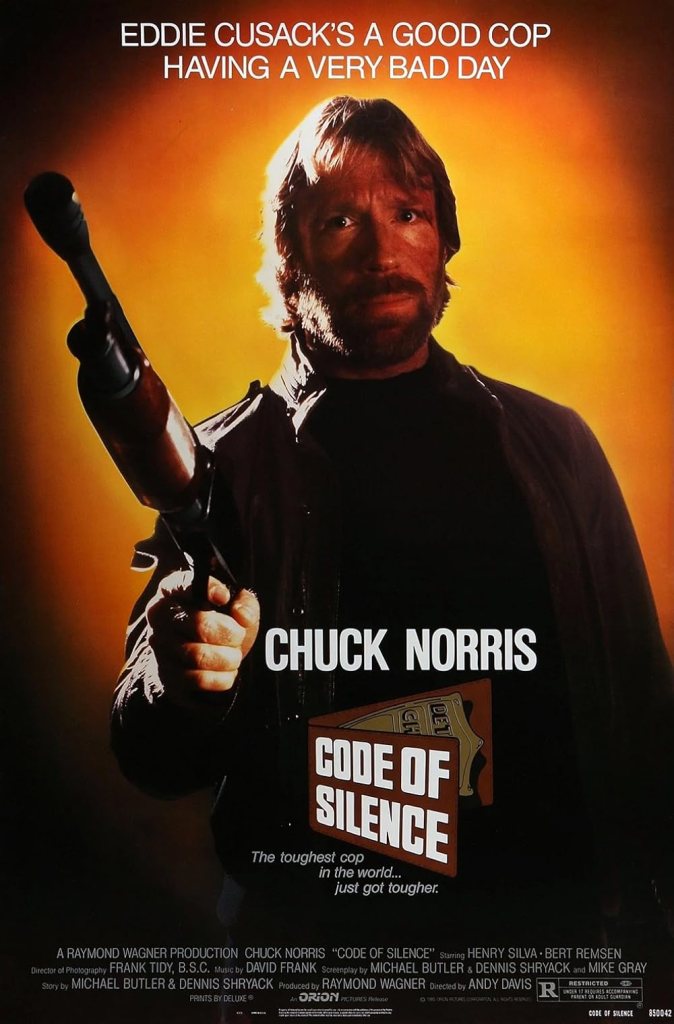
Yet, the grindhouse never truly left the cinema, but became a bit more “mainstream” under the many independent studios that came about during the early 80’s. You had Cannon, Carolco, United Film and Orion to name a few. It was with Orion that we get the latest guilty pleasure of mine and that was the one really good film that Chuck Norris ever made: Code of Silence.
Chuck Norris was the Jason Statham and Scott Adkins of the 1980’s action scene. He was cranking out action flicks almost on a yearly basis trying to cash in on not just the Bruce Lee martial arts phase, but also the action hero phase that was beginning to be dominated by Schwarzenneger and Stallone. While Norris never reached the heights of those two action stars, his list of action films from the 80’s and into the early 90’s were decent and, dare I say, very workmanlike.
Code of Silence was the one film that had a decent story of the lone good cop that has to fight not just the criminals but also the corrupt cops and system that allows crime to run rampart. Norris as Sgt. Eddie Cusack of the Chicago PD has become the template for the loner hero cop who ends up not just fighting the mob (of differently nationalities) but also a corrupt partner and, they always have one or two, a couple of retired cops who help him but also die in the process.
Norris doesn’t lean heavily on the martials arts of his previous action films. Code of Silence was the film that helped transition him to the gunplay of the action flicks that the public couldn’t get enough of. While the film could and never truly escape it’s grindhouse influence it was very good enough both in characters, plot and direction (director Andrew Davis would later film later classics with The Fugitive and Under Siege).
The film really gets its grindhouse bonafides with the addition of Henry Silva as the main antagonist. Silva would make a career out of being the villain in many 80’s action flicks and in Code of Silence he steals the limelight with his over the top performance as Colombian drug trafficker Luis Camacho. Where Jack Palance got more praise for being the preeminent villain and tough guy of from the 70’s and 80’s, I do believe that Silva was the more sinister of the pair when it came to their performance.
Code of Silence shows that Chuck Norris can carry a film with minimal dialogue and on the power of his silent, seething stares. He was never one for quippy one-liners and Code of Silence is all the better because of it.
I was a bit shocked to discover that I’ve neve actually sat down and written up a real review of 1979’s Mad Max for this site. Considering how much I like this film and all the scenes and shots that I’ve share from Mad Max, you would think that I would have at least written about why I like this violent but intriguing film so much. Today is George Miller’s birthday so let’s talk about the film that launched his career.
Mad Max is often described as being a post-apocalypse film but that’s not quite true. It does take place in a “near future,” one in which there seems to be noticeably less people around. The roads of Australia are dominated by crazed punks who have taken their obsession with their cars and motorcycles to the extreme. (Director George Miller trained as a doctor and has said that this film was partially inspired by the auto crash victims who were brought into the emergency room on a nightly basis.) Civilization is on the verge of collapsing but it is still hanging on by a thread. For every Night Rider (Vincent Gil), ranting as he crashes into people, and for every psycho gang leader like Toecutter (Hugh Keays-Byrne), there are people just trying to survive day-to-day. The nightly news is still televised though the news is always so bad that no one seems to pay it much mind anymore. There are still cops, like Max Rockatansky (Mel Gibson) and Goose Rains (Steve Bisley), who patrol the roads in their cars and who do whatever is necessary to chase down the people who appear to be destined to inherit a world that they very much want to destroy. Society still exists but it’s obviously on its last legs and the attempts to maintain some sort of normalcy — laws, news, vacation homes, sexy saxophone playing — can’t hide the fact that the world is coming to a violent end. Max tries to deny that reality until, finally, he has no choice but to accept both the new world and his place in it.
Whenever I watch Mad Max, I’m always surprised by the fact that Mel Gibson almost seems like a supporting character for the majority of the movie. When the movie starts, Max is tightly wound and in control and he doesn’t show much emotion while he’s on the job. The flamboyant and always joking Goose seems like a much more likable protagonist. He’s the guy that the viewer wants to spend time with and, when he ends up getting burned nearly to death by Toecutter and Toecutter’s protegee, Johnny the Boy (Tim Burns, cast as one of the most loathsome characters ever to appear in a film), it’s a shocking moment. Goose had so much life to him. The attention then shifts to Max’s wife, Jessie (Joanne Samuel). When she finds herself being menaced by Toecutter and his gang, it’s alarming because she’s both a mother and she’s eventually isolated from both her family and from Max. We don’t want to see anything bad happen to Jessie. When something bad does happen, we’re more than ready for Max to step up and get some vengeance. And that’s exactly what Max does. One of the film’s most iconic images features Max not even flinching at the sound of an explosion in the distance. He’s gotten his vengeance but at the price of his soul. And, even as the film comes to an end, it’s obvious that nothing can be done to stop society’s collapse. Max has accepted what neither Goose nor Jessie could. There is no safety or society in the new world. There is only the road and the battle to control the remains of the world.
What makes Mad Max such a thrilling film? A lot of it has to do with the stuntwork, which remains truly spectacular to this day. Made in the era before CGI, Mad Max features real cars that are being driven by real people who put themselves into real danger to capture some of the most stunning crashes captured on film. As well, the cast truly brings their characters to life. Tim Burns makes Johnny the Boy into a truly hateful character, one who manages to somehow be both whiny and dangerous at the same time. Joanne Samuel and Steve Bisley are sympathetic as Jessie and Goose. And then you’ve got Mel Gibson, young and on the verge of the superstardom that people now tend to pretend never happened, showing the intensity that would become his trademark as the increasingly unhinged Max. (I love Tom Hardy but, as good as he was in Mad Max: Fury Road, he never came close to capturing the soul-shattering intensity of Gibson’s thousand-yard stare,)
That said, I think the main reason why Mad Max continues to resonate is because it all feels so plausible. One looks at the world of Mad Max and it’s very easy to imagine finding yourself there. Unlike other apocalypse films that often seem to be taking place in an entirely different universe, Mad Max feels like it could be playing out just a few miles away from the closet motorway. For all of the spectacular stunts and flamboyant characters, Mad Max is a film that continues to feel very real. For that, George Miller deserves a lot of credit. Mad Max is a true classic of grindhouse filmmaking, featuring a story that feels more powerful with each passing year.
Some of the most inventive action films have been coming out of Southeast Asia these past 20 or so years. It was led by the very entertaining and brutal actions films headlined by martial artist turned action star Tony Jaa from Thailand then followed up by Indonesian action star Iko Uwais from The Raid series by Welsh director Gareth Edwards.
In 2018, Netflix bought the distribution rights for an Indonesian action thriller from director Timo Tjahjanto that starred the aforementioned Iko Uwais, Joe Taslim, Julie Estelle and a who’s who of Indonesia’s acting scene. At first glance, The Night Comes for Us looked to cash-in o the popularity of Gareth Edwards’ The Raid series, but one would be both mistaken and remiss to think such a thing.
The Night Comes for Us looked at Edwards’ The Raid duology and thought to itself that the action wasn’t brutal and visceral enough so decided to rectify that missed opportunity. Timo Tjahjanto took what he learned from his past work on horror films and decided to add some of those visual storytelling techniques to an action film that one would either have a hard time to sit through while viewing or just gobble with up with glee.
Guilty pleasure doesn’t mean the film has to be cheaply made or seen as being bad it’s good type of thing. I always thought that its something that one enjoyed despite knowing that there’s many out there who would look at someone askance for enjoying such a low-brow affair. The Night Comes for Us is both visually stunning in its production yet still has that low-down, grungy feel to it that harkens back to the hey day of grindhouse films of the 70’s and early 80’s. The only thing missing from this film was film grain imperfections such as film scratches and flaws to give it that 42nd street, NYC movie theater circa 1970’s experience (stale, days old popcorn and sticky floors included).
This film has it all and it has it in such abundance that one might just forgive Timo Tjahjanto for overdoing things when it came to the brutal violence that in years past would’ve earned it the dreaded XXX thus endearing it to the grindhouse crowd. The film actually opens up and ends in one of the few calm and introspective scenes with everything else in-between just straight up violence both hand-to-hand and gun variety. The Night Comes for Us is the film version of that saying “it woke up and chose violence.”
Joe Taslim headlines the film and he gives such a visceral and unhinged performance that one would be forgiven for mistaking his character as the villain if seeing the film in the middle after missing the beginning. Iko Uwais usually plays the reluctant hero in his previous films, but gets to let loose in a more antagonist role that more than matches Taslim when the two finally square off each other. The other stand-out performance to highlight would be Julie Estelle as The Operator who can throw down just as extreme as the men and, in fact, her fight scenes are pretty much the most brutal in the whole film and that is saying a lot.
So yeah, The Night Comes for Us, go see it and be horrified and/or amazed in equal measure. I guarantee that even if you hate the experience you won’t say that it was ever boring or bland.
First released in 1989, Casablanca Express takes place during World War II.
The three leaders of the Allied nations — Franklin D. Roosevelt, Joseph Stalin, and Winston Churchill — are scheduled to meet in Casablanca to plan the Allied strategy for the next phase of the war. Churchill insists that he will take a train from Algiers to Casablanca, despite the danger that might put him in. Even though everyone advises him against it, Churchill is determined. He makes it clear that he will be traveling by train.
When Major Valmore (Jean Sorel), Colonel Bats (Donald Pleasence), and Maj. Gen. Williams (Glenn Ford) learn that the Germans are aware that Churchill will be on the train and that they will be sending their own intelligence agents to try to kidnap or even assassinate him, they assign three intelligence agents to travel with Churchill. The agents are Alan Cooper (Jason Connery), Captain Franchetti (Francesco Quinn), and Lt. Lorna Fisher (Jinny Steffan) and they are under orders to do whatever is necessary to protect Churchill’s life. Unfortunately, Cooper gets so busy chasing after a French double agent that he misses the train’s departure time. When Otto van Tiblis (Manfred Lehmann) makes his move to take over the train, it falls to Franchetti and Lorna to stop him. Despite their best efforts, they fail. Now, it appears that Churchill’s only hope is that Cooper will not only be able to reach the train but also defeat the army of Germans who have taken it over.
Directed by Sergio Martino, Casablanca Express is an Italian film that owes quite a bit to the legacy of writers like Ian Fleming and Jack Higgins. The plot to capture Churchill owes more than a bit to The Eagles Has Landed, right down to one of the film’s final twists and Donald Pleasence making a cameo appearance as an authority figure. Alan Cooper is a combination of James Bond and Indiana Jones. He’s just as comfortable in a suit and tie as he is riding a camel across the desert. Sergio Martino was one of the best directors of Italian genre films. He dabbled in everything, from giallo films to Hercules films to crime films to cannibal films to action films like this one. As a filmmaker, he was efficient and quick to get to the point. The action in Casablanca Express moves quickly. In fact, it moves so quickly that the audience often doesn’t have time to consider all of the plot holes. Martino knows better than to worry about authenticity. That’s not the type of film that Casablanca Express is.
The film stars Jason Connery and Francesco Quinn, the sons of Sean Connery and Anthony Quinn. They are both adequate in their roles, even though neither one of them has quite the screen presence of their famous fathers. Jason Connery is handsome and he looks good in a suit and Francesco Quinn looks good throwing a punch. That’s all that’s really required of them. Personally, my favorite character was Lorna Fisher, who fought the Nazis by distracting them with her legs. That would be my strategy as well so I’m glad to see that it worked here.
CasablancaExpress was made at a time when the Italian film industry was going through a down period. Hence, the budget is low and the film can sometimes seem a bit rushed. But, all in all, it’s an entertaining B-action movie.
In the early 70s, Sal Watts, the owner a popular chain of Oakland clothing stores, took a look at the “blaxploitation” films coming out of Hollywood and thought to himself, “I can do better.”
For two years, Watts worked on his film. Originally titled Black Agent Lucky King, the film took place in Oakland and an unnamed Middle Eastern country. When the evil Prince Hassan (Richard Scarro) overthrows the king and takes over the country’s oil fields, Manny King (played by “Little Jamie” Watts) is among the Americans who escape from the country. Accompanying him is Princess Oneeba (Claudia Russo), who I guess is supposed to be Hassan’s sister, though it’s never really made clear in the film.
Who is Solomon King? He’s a businessman. He’s a social activist. He’s a former Green Beret and a semi-retried agent of the CIA. All the women love him. All the men envy him. He’s the coolest guy in Oakland and everyone assumes that he’s the perfect person to keep Oneeba safe. Solomon and Oneeba fall in love. They talk walks along the beach. Oneeba is amazed that you can hear the ocean when you hold a shell up to your ear. The entire time, a man with a high-powered rifle is following Oneeba. Finally, when Oneeba steps out onto the balcony of Solomon’s penthouse, the sniper take his shot. Oneeba falls in slow motion. Solomon holds her as she dies and then, he tries to cry. In this scene, we’re reminded that crying on cue is not as easy as it looks and that Sal Watts was definitely not a trained actor.
Solomon is out for revenge. He wants to take down Prince Hassan and return the king to his throne. He also wants to get back the oil wells that Hassan stole from him and his family. (The film makes it sound like everyone owns an oil well.) The CIA suggests that Solomon should get some of his Green Beret pals together and overthrow Prince Hasan. Sure, why not? I mean, look how well that thinking worked when the CIA and the Mafia tried to invade Cuba!
Eventually, Solomon puts together an army and invades the unnamed Middle Eastern country. Even though the country is supposed to be in the Middle East, it’s hard not to notice that it looks a lot like Oakland. Solomon gets his revenge but nothing can bring Oneeba back to life….
Solomon King was long-considered to be a lost film. A few years ago, a damaged print was discovered and the film was partially resorted. (The original film reportedly ran close to two hours. The restoration clocks in at 85 minutes.) Solomon King is definitely a work of outsider art. What Sal Watts lacked in experience and ability, he tried to make up for with determination. There are a few genuinely well-done shots of Solomon driving his car. (As befits the coolest guy in Oakland, he’s even got a phone in his car!) The soundtrack features an appealing mix of jazz and funk. And there are a few politically-charged lines of dialogue that suggest that Sal Watts had more on his mind than just making another action film. That said, Solomon King is also, even in its shortened version, a rather slow-paced and difficult-to-follow film. The acting is terrible and the fight scenes are haphazardly edited in a way that’s meant to keep you from noticing that no one in the film is actually hitting anyone but which actually has the opposite effect. My favorite moment was when there was a close-up of Solomon kicking out his leg and then an abrupt jump cut of someone falling backwards, trying to look as if they had been kicked. It was so unconvincing that it was actually kind of charming.
Solomon King is proof that anyone can make a film but making a good one is significantly more difficult.
First off, we’ve got the trailer for Head, starring the Monkees! This film was co-written by Jack Nicholson.
2. The Great Rock and Roll Swindle (1980)
In the first film that Julien Temple made about the history of the Sex Pistols, Malcolm McLaren presents himself as being the genius behind the group and tries to keep viewers from noticing that Johnny Rotten refused to have anything to do with the film.
3.Stunt Rock (1978)
I know next to nothing about this film but it was directed by Brian Trenchard-Smith and that’s often a good sign.
4, Sgt. Pepper’s Lonely Hearts Club Band (1978)
Featuring Donald Pleasence singing the longest version of I Want You ever recorded!
5. The Decline of Western Civilization (1981)
From director Penelope Spheeris comes the ultimate documentary about 1980s Los Angeles punk rock.
6. The Decline of Western Civilization Part 2: The Metal Years (1988)
Caligula is a film with a long and storied history. In the mid-1970s, Penthouse publisher Bob Guccione wanted to follow the lead of his rival, Hugh Hefner, and get into the movie business. His plan was to make an explicit adult film with high production values, one that could be sold as a mainstream feature film. He decided that the infamously decadent Roman Emperor Caligula would be the subject of his film. In order to give the project some gravitas, he accepted scripts from both Lina Wertmuller and Gore Vidal. Ultimately, he chose to go with Vidal’s script because Vidal’s name had more cultural cachet than Wertmuller’s. It certainly wasn’t because he liked Vidal’s script, which Vidal later said featured a lot of gay sex but only one scene of heterosexual coupling.
With the promise that Caligula would be a classy production that would push the boundaries of cinematic sex without actually being pornographic, Guccione was able to bring together a truly impressive cast of actors. Malcolm McDowell agreed to play Caligula. Helen Mirren was cast as Caligula’s wife, Caesonia. John Gielgud took on the role of Nerva the philosopher while Peter O’Toole was cast as the diseased Emperor Tiberius. Guccione offered directing duties to John Huston and Lina Wertmuller. In the end, no matter how much money he was willing to spend or how distinguished a cast he had assembled, Guccione could not find a prominent, mainstream director who was willing to work with him. Guccione ended up hiring a director he knew little about, an Italian arthouse filmmaker named Tinto Brass.
Brass proceeded to rewrite Vidal’s script. Brass’s version of the film featured more sex and less politics. Guccione was happy about that until he discovered that Brass’s plan was to direct the sex scenes to be grotesque and disturbing. To his horror, Guccione discovered that Brass was essentially parodying the type of film that Guccione wanted him to direct. Even when Guccione insisted that the latest “Penthouse pets” be cast in the film, Brass tried to keep them in the background. As Guccione’s demands grew, Brass responded by refusing to emphasize the ornate and very expensive sets that Guccione had paid to have created. A working ship was built but Brass reportedly chose to put it in a small warehouse so that there would never be room to get a full shot of it. Guccione responded by taking the film away in post-production and inserting several hardcore sex scenes, which upset the members of the cast who did not sign on to appear in a pornographic film.
As for the film itself, it must be said that Caligula is probably one of the most historically accurate portrayals of ancient Rome. The city was said to be a mix of dirty streets and ornate palaces and Caligula certainly captured the mix of beauty and sordid decadence that was the Roman Empire. The film’s plot actually sticks very closely to what was written about Caligula by Roman historians like Suetonius. Helen Mirren and Malcolm McDowell both give strong performances, even if McDowell later claimed the film ruined his career by typecasting him as a perverse villain. Peter O’Toole is memorably grotesque as Tiberius. Exploitation vets John Steiner and Teresa Ann Savoy also make an impression in their roles and one gets the feeling that they both understood what type of film they were appearing in, even if the bigger names in the cast did not. There are moments of shocking grandeur and visual beauty to be found in Caligula and also moments of such total ugliness that they are difficult to watch. In many ways, Caligula is what Guccione wanted. It’s a big, expensive film that tests boundaries and features explicit sex.
But, Good God, is it ever boring! Seriously, the scene where Caligula visits Tiberius in Capri goes on forever. Despite McDowell’s strong performance, Caligula is not a particularly compelling character. He becomes emperor and then he goes mad. For over two hours, Caligula does one terrible thing after another and there’s only so long that you can watch it before you just want someone to hurry up and kill him. The film suggests that Caligula was rebelling against the Roman establishment but, in the end, who cares? He kills his friends. He has sex with his sister. In the film’s most disturbing scene, he rapes a bride and then fists the groom. It just goes on and on and it gets old pretty quickly.
Still, there’s always been a lot of debate over whether or not it would be possible to make Caligula into a good film. Bob Guccione claimed that he saved the film. Tinto Brass disagreed and his director’s cut, which takes out Guccione’s hardcore inserts, is considerably better-paced than the Guccione version but the nonstop ugliness still gets rather boring.
That brings us to the latest version of Caligula, the Ultimate Cut. Assembled without the input of Tinto Brass or the deceased Bob Guccione, Caligula: The Ultimate Cut played at Cannes in 2023 and was given a limited release by Drafthouse Films in 2024. It was largely assembled out of unused footage and alternate takes. I’ve read that not a single fame from the original version of Caligula is in The Ultimate Cut but I don’t think that’s quite true. (The scene with the giant beheading machine appears to be the same footage that appeared in the original version.) Caligula: The Ultimate Cut removes all of Guccione’s hardcore footage but it also downplays a lot of Brass’s directorial flourishes as well. Instead, The Ultimate Cut is said to much more closely follow Gore Vidal’s vision of the film.
Is the Ultimate Cut any good? It definitely looks better than the previous version of Caligula. The restoration makes Rome into a very colorful city. There’s a bit more humor to McDowell’s performance in the Ultimate Cut. While his version of Caligula still becomes a monster (and the wedding rape is still included in the film), he starts out as a clown whose mission is to humiliate the Roman establishment in much the same way that Tiberius used to humiliate him. In The Ultimate Cut, Caligula is much more of an anarchist. At the same time, the Ultimate Cut features a bit less of John Steiner as the duplicitous Longinus and that’s a shame because Steiner’s performance was one of the best in the original version. As well, Helen Mirren’s performance is stronger in the original version than in The Ultimate Cut. The alternate takes that were used in The Ultimate Cut often seem to favor McDowell over Mirren.
That said, The Ultimate Cut is still a bit of an endurance test. Caligula’s meeting with Tiberius still goes on forever and the nonstop evil of his reign still gets a bit dull after a while. It turns out that Caligula the Anarchist is no more compelling than Caligula the Madman. Brass and even Guccione may have had a point with the original version of Caligula. Caligula is a film that requires a truly sordid and shameless sensibility to be interesting.
In the end, it’s hard not to feel that all of this could have been avoided if Gemellus had been named emperor.



 Through the Shattered Lens