(Hi everyone! Usually, my sister — the Dazzling Erin Nicole — tracks down and selects the images that we feature in our Artwork of the Day feature. However, Erin is taking the week off — and November 24th is not only the day after Thanksgiving but her birthday as well!, so be sure to wish her a happy one! — so, for the next few days, I’ll be selecting our artwork of the day! — Lisa Marie)
Look at those bricks fly!
Listen, I really can’t tell you a thing about whether or not Pay or Die is a good movie or not. All I know is that the film was released in 1979, it was rated R, and this was the poster. It’s a tremendously effective poster, though. I don’t know if it’s a fair representation of what happens in the movie, of course. But I hope it is. I hope there’s at least one scene featuring two men and a woman kicking the Hell out of a brick wall.
Posters like this are actually a huge reason why I enjoy researching grindhouse films. Just looking at it is enough to inspire you to create your own movie in your head. Why are they kicking through the wall? Why are they even working together? Why is the movie called Pay or Die? Do they own someone money? Does someone owe them money? Maybe they’re kicking through the wall of a bank. The possibilities are endless!
I will say this, though. If I ever did use my bare hands to smash through a brick wall, I’d probably try to make sure that my boobs were a little better protected when I did it. Seriously, I imagine breaking through a wall, especially one made of bricks, is not as safe as they make it look in the movies. Considering all of the kicking that appears to be involved, I would also probably not wear open-toed sandals while doing it either. That just seems like common sense to me.
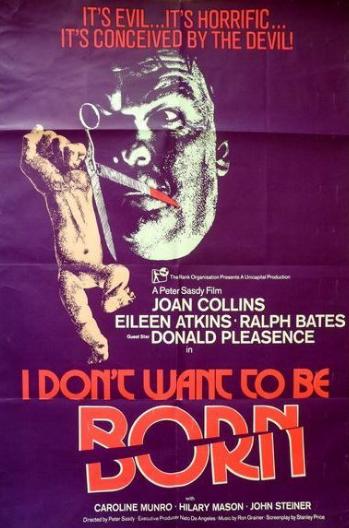
Now, admittedly, that dialogue is never heard in the 1975 British horror film, I Don’t Want To Be Born. However, if I had heard that particularly exchange in this film, I would not have been surprised. That’s just the type of movie that I Don’t Want To Be Born is. It’s a thoroughly ludicrous, totally ridiculous movie and what makes it all the more memorable is that it doesn’t seem to realize how silly it all is. This is a batshit crazy movie that tells its story in the most serious way possible. This damn film is almost somber, it’s so serious.
Lucy (played by Joan Collins) is a stripper who performs her act with a perverted dwarf named Hercules (George Claydon). When Hercules tries to force himself on Lucy, he is tossed out of the club by Tommy (who is played by John Steiner, a good actor who somehow always turned up in movies like this one.) After she and Tommy make love, Lucy is confronted by Hercules who curses her, telling her that she will have a baby “as big as I am small and possessed by the devil himself!”
Oh, Hercules, you weirdo.
9 months later, Lucy’s life has somehow completely changed. She’s no longer a dancer. Now, she’s married to a rich Italian named Gino (played by Ralph Bates, speaking in a bizarre accent). When Lucy has her baby, it’s a long and difficult delivery. The baby is huge! Not only is he huge, but he also has a bad temper and unnaturally sharp nails. The first time that Lucy holds him, he attacks her. Whenever the baby is introduced to anyone new, he responds by biting them. When Tommy drops by to take a look at the baby that might be his son, he ends up with a bloody nose!
But that’s not all this baby can do! Anytime he’s left alone in a room, the room ends up getting destroyed. Eventually, he apparently figures out how to climb trees and how efficiently slip a noose around the neck of anyone who walks underneath him. And don’t think that you can escape this baby simply because you’re taller and faster. One unfortunate person is decapitated, even though he’s standing at the time. How did the baby reach his neck? Who knows?
Does this baby need an exorcism? Lucy’s sister-in-law, Sister Albana (Eileen Atkins), certainly believes that it does! As Lucy thinks about whether the baby’s behavior is in any way odd, she glances over at the baby and — OH MY GOD! The baby has Hercules’s face!
And it just keeps going from there. Again, I feel the need to repeat that this film is meant to be taken very seriously. The script may be full of awkward and clichéd dialogue but most of the cast attempts to act the Hell out of it. Speaking of the cast, there’s a lot of familiar horror people in this one. Along with John Steiner, there’s also Caroline Munro and Donald Pleasence. Those three give performances that somehow manage to remain credible, perhaps because they had the experience necessary to understand what type of movie they were in. But the rest of the cast … you feel bad for them because they’re just trying so hard.
It’s a terrible movie but it’s so weird that I have to recommend that everyone see it once. If for nothing else, see it for the scene where Hercules responds to an attempt to exorcise the baby by swaying drunkenly on the stage. It’s weird and it’s hard for mere words to do it justice.
“No wonder this baby didn’t want to be born!”
That line is also nowhere to be found in this movie. It’d be nice if it was, though.
Well, it turns out that there’s a sequel and it’s on YouTube! Both films were directed by Jim Wynorski and featured pretty much the same cast, despite the fact that a few of them were playing new characters. It was released under several different titles. Hard To Die is the one that I’m going with for this review. However, the film was also known as Tower of Terror, which makes sense when you consider that the majority of the film takes place in a hi-rise office building. It was also apparently released in some places as Sorority House Massacre III, despite the fact that there’s no sorority house in the movie.
Actually, it’s debatable whether or not Hard To Die is actually a sequel. It’s true that Orville Ketchum (Peter Spellos) does make another appearance. In the first movie, Orville was the creepy neighbor. In Hard To Die, he’s the janitor at the office building. Orville tells the exact same story, with the exact same flashbacks, that he told in Sorority House Massacre II. (Those flashbacks, of course, were lifted from a totally unrelated movie called Slumber Party Massacre. There were apparently a lot of massacres in the 80s and 90s.) The evil spirit of Hockstadder returns as well, though this time he comes flying out of a box that was accidentally delivered to the office building as opposed to a Ouija board. And, of course, there’s an abundance of lingerie, awkward dialogue, and cheap gore effects. (At one point, a bucket of fake blood is literally splashed on a wall.) However, Hard To Die also tells almost exactly the same story of Sorority House Massacre II. There are so few differences that I’m actually more tempted to say that Hard To Die is a remake of Sorority House Massacre II than a sequel. The only problem with that theory is whether or not a second movie can be considered remake when the first movie literally came out the exact same year.
(One of the reasons that I love my work here at the TSL is that it allows me to obsess over minutia like this.)
Anyway, the main difference between Hard To Die and Sorority House Massacre III is that there’s no sorority house in Hard To Die. Instead, Hard To Die takes place in a lingerie shop that just happens to be located on the 7th floor of a skyscraper. The hard-working employees are spending the weekend doing inventory but it’s not going to well. For one thing, the sprinklers accidentally go off so everyone decides to take off their wet clothes, put on skimpy lingerie, and order pizza. Personally, I probably would have waited for the pizza to arrive before getting naked but then again, I’ve never worked retail or dated a pizza deliveryman.
The pizza does eventually arrive but no one gets to eat it because the deliveryperson gets set on fire and ends up falling several floors to her death. That’s a waste of good pizza, which is kind of depressing. Meanwhile, Orville keeps trying to warn everyone about Hockstadder but, instead, he keeps getting beaten up. The end credits of Hard To Die promised that the next film would be called Orville In Orbit. Apparently, it was never made but I do hope that Orville got a vacation after all of this.
Anyway, Hard To Die is an extremely silly movie but it’s just so sincere in its silliness that it feels somewhat churlish to be too critical of it. If I had to choose whether to be in Sorority House Massacre II or Hard To Die, I would probably pick Hard To Die because, at least in that movie, I’d get to shoot a machine gun. Hard To Die is so blatantly and unapologetically over the top that you can’t help but be amused by it all.
I’ve enjoyed reviving this feature for October. I’m not totally sure if I’ll continue it because, as I said way back at the start of the month, there are only so many trailers on YouTube and I don’t want to spend too much time repeating myself. We’ll see!
These are trailers for 6 of my favorite horror films:
Lisa and the Devil (1973)
From the great director, Mario Bava. This film is like a cinematic dream. Plus, the main character is named Lisa!
Some movies just force the viewer to ask, “What would you do?”
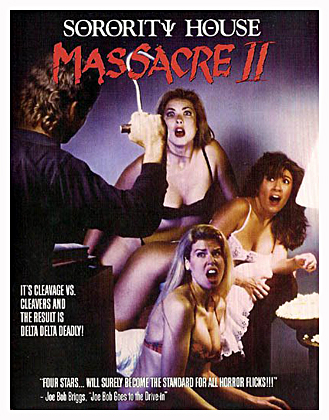
I mean, just consider what it would be like to be in the scenario that’s presented to us in the 1990 film, Sorority House Massacre II. You’re a college student. You’ve got your entire future ahead of you. The president of your sorority has just purchased a new sorority house and she wants you and three others to spend the weekend helping her fix the place up.
You arrive at the house and you discover that it’s literally on the verge of collapsing. There’s no electricity. There’s no telephone. (And remember, this is back when people just used landlines.) There’s no hot water. Soon after arriving, you’re informed that there’s two reasons why the house was being sold at such a cheap price.
First off, there’s the neighbor. He’s a creepy, kinda pervy-looking guy named Orville Ketchum. When Orville comes over to meet his new neighbors, he announces that he has the keys to the basement. He reaches into his pants to retrieve them. Ewwww!
Secondly, it turns out that the house isn’t just any deserted house. It’s the old Hockstadder Place! Years ago, Mr. Hockstadder killed his daughters before dying. Orville witnessed the whole thing. As he tells the story, you might notice that the flashbacks are lifted from a film called Slumber Party Massacre, despite the fact that you’re starring in Sorority House Massacre II.
Despite all of that, you still enter the house. A storm is rolling in and, whenever you look out the window, you see the same lightning stock footage that has appeared in a countless number of cheap horror movies.
When you and your friends decide to explore the basement, you find a Ouija board. You know that Ouija boards can be dangerous but everyone else wants to run upstairs and use it. Someone suggests that maybe the board can be used to contact the spirit of Hockstadder. After all, according to Orville, Hockstadder swore that his murderous spirit would never leave the house and would possess anyone who tried to move in.
At this point, you have two options.
Do you say, “Okay, obviously, it’s not a good idea to contact the spirit of a murderer — especially one that said he would possess anyone who tries to contact him — so I’m going to go ahead and leave now?”
or
Do you light some candles, strip down to your underwear in front of a bunch of open windows (despite the fact that weird old Orville is right across the street), sit on a filthy floor, and try to communicate with the spirit of a homicidal maniac?
The smart option would be the first one so, of course, the characters in Sorority House Massacre II do the exact opposite. Then again, nobody in Sorority House Massacre II appears to be that smart. For one thing, they’re all in their 30s and they have yet to graduate college. Trust me, I wish I could have stayed in college forever but, at some point, you really do have to either graduate or drop out. Tuition’s not cheap.
Anyway, Sorority House Massacre II is one of those movies that just amuses me to death. There’s absolutely nothing subtle about it. It’s such a blatant exploitation film that you can’t help but admire it for not pretending to be something that it isn’t. (At the same time, it’s rather tame when compared to the movies that we’re used to today. Whenever someone is killed, obviously fake blood is squirted on a wall.) This may be a stupid movie but it’s very sincere in its stupidity and there’s something to be said for that.
Add to that, Peter Spellos is memorably weird as Orville. The way he delivers his lines makes Orville into the neighbor that everyone would dread having next door. In the end, though, it’s a good thing that Orville was there.
Finally, there is one surprisingly effective moment. The movie starts with the “final girl” huddled in a dark room, begging the unseen killer to remember who they are. The movie then flashes back to that morning, with the girls standing in front of the house. The abrupt cut from darkness to the bright and sunny morning is surprisingly effective and feels almost dream-like. Though one gets the feeling it was probably unintentional, it’s still works far better than you’d expect.
So, in honor of Val’s commitment to her craft, I decided that today’s six trailers would be for six movies that Val either watched or mentioned in her review of The Evil Eye! Unfortunately, it turns out that not all of those movies have trailers on YouTube. And I already shared the trailer for Mario Bava’s The Girl Who Knew Too Much (a.k.a. Evil Eye) last week.
Let’s see what I did find!
Bruka, Queen of Evil (1973)
I could not find a trailer for Queen of Evil. However, when I did a search for “Queen of Evil Trailer,” one of the trailers that came up was for Bruka, Queen of Evil. I’ve never heard of this film before but it looks like something some of our readers would like.
2. Manhattan Baby (1982)
However, YouTube did have a trailer for Lucio Fulci’s Manhattan Baby, which was also known as Evil Eye. Actually, Evil Eye was probably a better title for it. I’m one of the few people willing to defend this film and even I’m unsure just what exactly Manhattan Baby is supposed to mean.
3. The Green Inferno (1988)
Val’s search for information about The Evil Eye led her to Bloody-Disgusting.com, which featured an infamous review of The Green Inferno. Here’s the trailer for 1988’s Green Inferno, which should not be mistaken for Eli Roth’s Green Inferno.
While two sorority pledges painted his face and then posed for selfies with his unconscious body, Brandon choked to death on his own vomit. The pledges were named Corey (Sarah Booth) and Elaina (Kimberly-Sue Murray) and when they were put on trial for manslaughter, they claimed that it was just a prank gone wrong and that the other members of the sorority put them up to it. Of course, no one was willing to back up their stories. Instead, the president of the sorority, Jacqueline Gill (Katherine Barrell), just went on television and said that she hoped the two would ask God for forgiveness. Corey and Elaina were convicted and sent to prison.
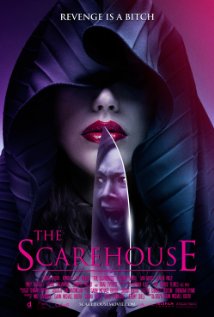
Two years later, Corey and Elaina have been released and now they’re looking for revenge. However, a simple revenge will not do. Elaina is an engineering genius and Corey … well, Corey’s just really angry. They’ve set up an elaborate haunted house and they’ve sent a private invite to each member of the sorority…
Two girls seeking revenge for a sorority prank gone wrong sound like either the set up for a Lifetime movie or the world’s worst Lime-a-rita commercial. (“So, this happened: we thought we were going to a haunted house but then it turned out we were actually being invited to our violent doom. Yep, it was a Lime-a-rita night.”) However, The Scarehouse is neither. Instead, it’s a rather grisly horror film with a streak of extremely dark humor.
But is it any good?
Let’s start with what works. Both Sarah Booth and Kimberly-Sue Murray give very good performances as the two girls. Even when the script lets them down, Booth and Murray keep the movie from dying. The film actually does some interesting things with the two characters. It keeps us guessing about which one of them is really the driving force behind the whole revenge plot. No sooner do you think that you’ve figured out their power dynamic then something will happen or words will said that force you to reconsider what you previously assumed.
Though I had a hard time believing that such an elaborate death trap could have been designed by just two people, the haunted house was a memorable and creepy location. It was full of atmosphere and the promise of doom. If I ever found myself in there, I’d probably be scared.
Finally, you always have to admire a horror film that doesn’t shy away from pursuing things to their darkest conclusion. Once one enters the Scarehouse, there is no escape and everyone’s worst nature will be exposed. There is no exit and Hell is other people.
At the same time, I’ve grown tired of movies that feature lengthy scenes of people being tortured. After nearly two decades of Saw films and Hostel rip-offs, whatever shock value those scenes may have once had are gone. The tortures in The Scarehouse are elaborate and sadistic and thoroughly unpleasant to sit through. A girl with an eating disorder has her corset tightened until she literally splits in half. A forced pillow fight leads to corrosive chemicals eating away at flesh. Some of it is clever but, far too often, these scenes go on too long. There’s only so long you can spend watching someone being tortured until you mentally check out.
As well, The Scarehouse uses a nonlinear time line. In between the scenes of Corey and Elaina getting their revenge, we see flashbacks to the prank that led to death of Brandon. But, since we already know what happened because it’s all Corey and Elaina ever talk about, there’s not really anything new to be discovered in the flashbacks.
Obviously, my feelings about The Scarehouse are mixed. I was pretty dismissive immediately after I watched it but the movie has definitely stuck with me. It has its flaws but it also has two memorable and frightening performances. Watch at your own discretion.
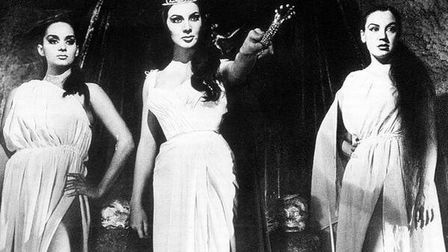
If a group of vampires are determined to ruin your night, what should you do? Well, according to the classic Mexican film Santo vs. las Mujeres Vampiro, your first move should be to call a wrestler.
Today’s horror on the lens is the 1995 Italian film, Cruel Jaws!
As you’ll quickly notice, though the actors speak in English, there are also Japanese subtitles. That’s because the film was barely released in the United States, for legal reasons. (Cruel Jaws is full of footage lifted from better-known shark films.) However, it was very popular in Japan.
Hell of the Living Dead, a 1980 Italian zombie film, is a movie known by many different names. Some of these names are more memorable than others.
For instance, it’s known as Virus, which isn’t a very good name. It’s kind of boring. Plus, a virus could lead to anything. Sure, a virus could turn someone into a zombie but it could also just mean a week in bed. Plus, there’s already a thousand movies called Virus.
Night of the Zombies is a bit more specific, though still rather generic. Just about every Italian horror film that came out in 1980 was about zombies and most of them took place at night.
Island of the Living Dead, at the very least, let’s you know where the majority of the movie takes place. That said, it’s kind of a dishonest title. The island isn’t just occupied by the living dead. There’s also a primitive tribe, the members of which pop up occasionally to throw spears at a group of soldiers and a journalist.
I absolutely love the title Zombie Creeping Flesh. Seriously, I don’t know why they bothered to come up with so many alternate titles when they already had Zombie Creeping Flesh.
However, this film is best known as Hell of the Living Dead and, actually, I guess that’s a pretty good title. I mean, it’s totally and completely over the top. Add to that the title almost feels like a challenge being specifically issued to the fans of George Romero’s zombie films. It’s as if the film is saying, “If you can’t handle the Night or the Dawn, the Hell is absolutely going to kill you!”
Anyway, this is an extremely low-budget film from director Bruno Mettei and screenwriter Claudio Fragasso. The team of Mattei/Fragasso were famous for producing some of the most ludicrously silly horror films to ever come out of Italy. (Outside of his collaboration with Mattei, Fragasso is best known for directing Troll 2.) A typical Mattei/Fragasso film is entertaining without being particularly good. They were never ones to allow a thing like a lack of money to stand in the way of their narrative ambitions.
For instance, in Hell of the Living Dead, there’s one isolated scene that’s supposed to take place at the United Nations. The scene appears to have been filmed in a lecture hall at a small university. One delegate angrily declares that he is sick of everyone exploiting his zombie-occupied country. Someone else suggests that maybe they should take a break until tomorrow. It’s an incredibly inauthentic scene that adds nothing to the story but that didn’t keep the team of Mattei and Fragasso from including it in the film. They were determined to have a UN scene and they weren’t going to let a lack of money or access stop them.
Anyway, the majority of the film deals with a zombie outbreak on a small tropical island. The island is almost exclusively made up of stock footage. A typical scene will feature a character like journalist Lia (played by Margit Evelyn Newtown) standing in the middle of the frame. She looks to the right and we get some grainy stock footage of a bat or something similar. She looks to her left and we get some faded stock footage of a tiger.
As I mentioned previously, the island also has primitive natives. Whenever you hear the drums in the distance, it’s important to toss off your shirt, paint your face, and start jogging. Otherwise, you might get killed. You know how that goes.
And then there’s the zombies, of course. The zombies get an origin story, something to do with an accident at top secret chemical plant. At the start of the film, a rat attacks a scientist. I’m assuming the rat was carrying the virus but it’s just as possible that Mattei just decided to throw in a random rat attack. (His best film was literally just 90 minutes of rat attacks.) Regardless, the zombie effects actually aren’t that bad but the problem is that whenever the zombies show up, they have to compete with all of the stock footage. When the zombies aren’t dealing with animal footage that was originally shot for a mondo film, they keep busy by eating nearly everyone that they meet. A group of soldiers have been sent to take care of the zombies but since none of them are particularly bright, they don’t have much luck.
Hell of the Living Dead has a reputation for being one of the worst zombie films ever made. I don’t know if I would go that far. It’s watchable in a “what the Hell did I just see?” sort of way. And in the end, isn’t that kind of the point of a film like this?