The 1972 presidential campaign was a strange one.
Today, it’s best-remembered for the fact that Richard Nixon carried 49 states and won 60.7% of the popular vote. Nixon’s victory came after the Democratic nominee, George McGovern, dropped his running mate, Thomas Eagleton, from the ticket after it was revealed that Eagleton had undergone electroshock treatment for depression. McGovern was also, at that point, one of the most liberal candidates to ever be nominated by a major political party. Much as with the earlier Barry Goldwater campaign, many of McGovern’s campaign volunteers and aides went on to have long careers in politics but their enthusiasm did not translate into votes for McGovern. Today, Nixon’s victory is seen as being such a foregone conclusion that people still wonder why a group of campaign operatives and White House aides even felt like they needed to break into the Watergate hotel to win.
1972 was a bit before my time but, if you look at the number of candidates who ran for the Democratic nomination, it’s obvious that, despite how thing ultimately turned out, quite a few people originally thought Nixon was vulnerable in 1972. Over 20 Democratic office holders competed for the right to run against Nixon. Sen. Edmund Muskie was the early favorite but, in the end, George McGovern won the nomination as the result of a largely grassroots effort. McGovern became the first Democrat to win the nomination through the primary system as opposed to making deals with political and labor bosses. McGovern’s campaign was fueled by opposition to the Vietnam War and an earnest idealism that got on the nerves of just about everyone outside of the campaign. One of McGovern’s rivals, Sen. Henry Jackson, said that McGovern was the candidate of “abortion, amnesty, and acid.”
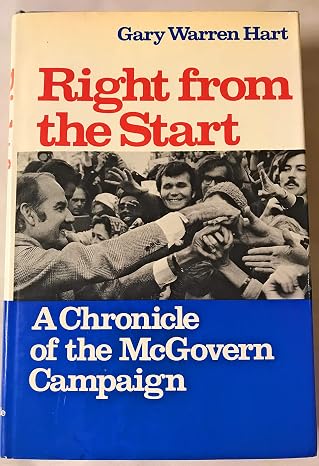
McGovern’s campaign manager was a Colorado lawyer named Gary Hart. Hart would later be elected to the U.S. Senate and would twice run for president himself. (Hugh Jackman played Hart in the rather forgettable film, The Front Runner.) However, before Hart first ran for the Senate, he took the time to write a book about the McGovern campaign. That book was called Right From The Start. I ordered a used copy off of Amazon about ten years ago. It cost me about twenty dollars. If I ordered the book today, it would only cost me $16.00.
The book is an interesting historical document. Hart writes about the day-to-day operations of the McGovern campaign. He does a very good job of showing how McGovern came from behind to win the Democratic nomination. Hart writes about how the campaign recruited people who were new to politics but who were passionate about the issues. He writes about how Morris Dees (yes, the Southern Poverty Law Center guy) spearheaded the campaign’s fundraising. He writes about the day that Governor George Wallace was shot in Maryland. He shows how a group of committed activists were able to bypass the party bosses and win their candidate the nomination. Where Hart struggles is with explaining why McGovern lost the general election. Hart puts a lot of the blame on Thomas Eagleton and perhaps that’s justified. But McGovern still lost 49 states. To me, that would indicate there were even bigger problems then picking a bad running mate. But, because Hart was on the same side of McGovern, it’s perhaps understandable that he would struggle to admit that the electorate simply didn’t respond to what McGovern was selling.
(Ironically, in 1984, Hart and McGovern would both run for the Democratic presidential nomination.)
The chapter where Hart discusses the process that led to Thomas Eagleton becoming, albeit temporarily, McGovern’s running mate is the book’s highlight. As Hart explains it, he and the rest of McGovern’s aides had been so busy winning McGovern the nomination that none of them had really bothered to consider who McGovern should run with. McGovern had his own preferences but they all declined to join the ticket. A bunch of exhausted men ended up sitting around and tossing out names like CBS anchorman Walter Cronkite and Boston Mayor Kevin White. Someone suggested that, since the convention was being held in Miami, the second spot should go to New Orleans Mayor Moon Landrieu just so the next day’s paper would read “MOON OVER MIAMI.” In the end, Thomas Eagleton was picked not because anyone feels strongly about him but instead because he was the only one that nobody felt any passion about whatsoever. He was serviceable and inoffensive and, when he was asked if there was anything in his past that might embarrass the campaign, he replied that they’re wasn’t. A few weeks later, Eagleton’s psychiatric history was leaked to the press and the McGovern campaign imploded. Maybe they should have just asked Cronkite.
Right From The Start is an compulsively readable and interesting campaign memoir, perfect for history nerds like you and me.

