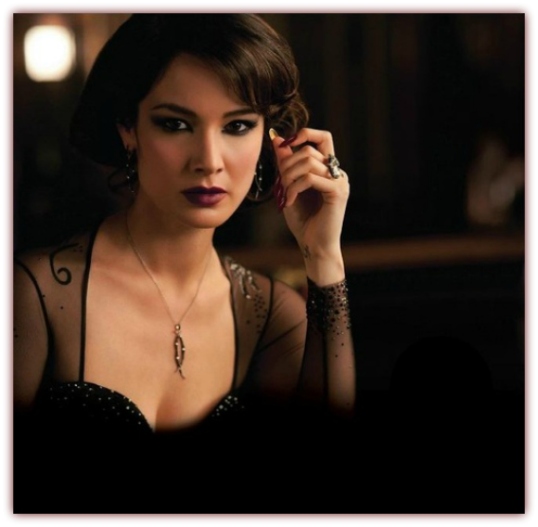
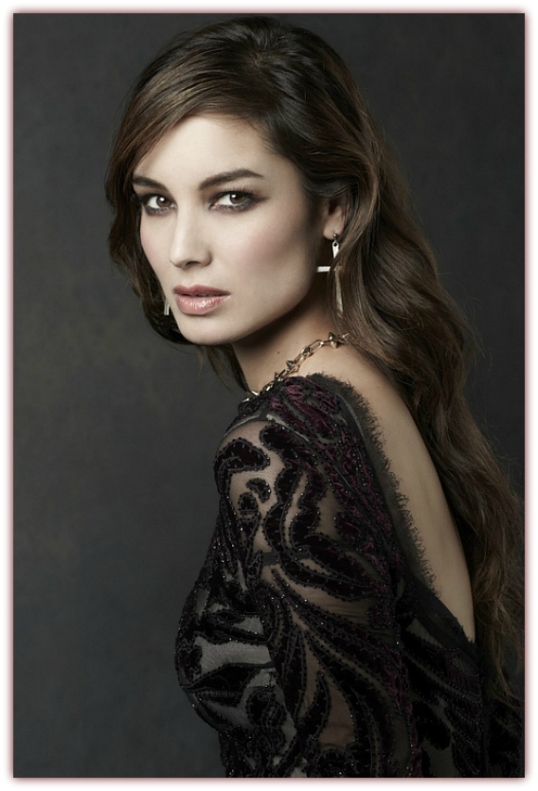
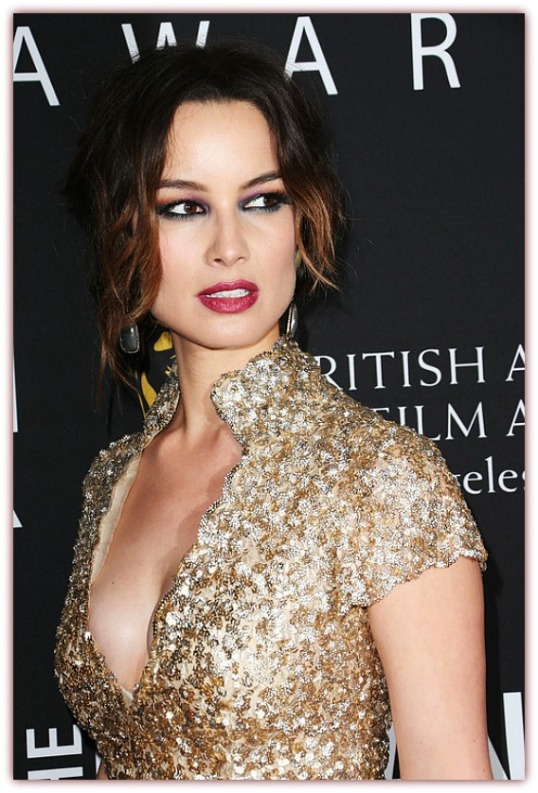
The latest “Hottie of the Day” comes courtesy of the latest Bond Girl and making her appearance on the latest James Bond film: Skyfall.
Bérénice Marlohe is a French actress of French, Khmer and Chinese heritage. It’s a powerful combination that truly makes her one of the most exotic Bond Girls (Kissy Suzuki doesn’t count). Prior to landing the role of the femme fatale Bond Girl, Ms. Marlohe spent much of her acting career in small roles for French tv. The disadvantage of her exotic looks which kept her from getting roles outside of TV has now made her an almost perfect choice to play Severine. I think she has more than earned her spot in many “best of…” lists for Bond Girls with not just her looks but her acting skills as well.
“When the dead come for you, there’s no place left to run.”
Most zombie films tend to be average at best, often falling into outright mediocrity. Because this subgenre is relatively easy to create, many aspiring filmmakers believe they can produce the next standout hit with just an HD camera, a modest budget, and a cast drawn from friends and family. Naturally, this formula has led most zombie movies to occupy the low end of the horror genre in terms of quality. However, every so often, a truly exceptional film emerges. Edgar Wright’s Shaun of the Dead became an instant classic by blending horror with comedy, and Zack Snyder’s remake of Romero’s Dawn of the Dead delivered intense, action-packed thrills.
The 2009 French horror film La Horde—directed by Benjamin Rocher and Yannick Dahan—leans toward Snyder’s style. It strips away societal commentary, opting instead for raw action and relentless gore. This might suggest a mindless movie, but La Horde proves to be as engaging and nihilistic as Snyder’s film, perhaps even more so by its conclusion.
The directors spare no time on exposition, diving straight into the plot. The story follows a group of French police officers—most likely narcotics agents—who plan to take revenge on a Nigerian crime lord responsible for killing one of their own. Their chosen battlefield is a dilapidated high-rise apartment complex in a crime-infested district of Paris. However, their operation quickly unravels when the ambush goes disastrously wrong. What begins as a gritty crime thriller transforms abruptly into an apocalyptic battle for survival, as the police and rival gang members are forced to join forces against a sudden zombie outbreak sweeping through Paris and possibly beyond.
Once the zombies arrive, the film shifts into high gear. The action and gore come fast and furious, skillfully choreographed and unflinching. Secondary characters are swiftly dispatched, leaving only the most capable to fight their way through a tenement overrun by fast, aggressive zombies akin to those in Snyder’s Dawn of the Dead or Boyle’s 28 Days Later. Though some purists might balk at sprinting zombies, they fit perfectly with the film’s frantic pace. Notably, the film does not attempt to explain the outbreak’s origin, leaving audiences as disoriented as the characters, glimpsing only fragmented news reports for context.
The remainder of the film is an intense descent through the building, with the survivors battling floor by floor in search of an exit and safety at a nearby military base. Choosing characters familiar with violence—cops, criminals, and a hardened local survivor—grounds their fierce will to survive in realism. Even the lone resident they encounter brings useful skills born from a violent past.
While La Horde does not offer complex character development, its finely tuned action scenes keep the audience fully engaged, masking the story’s simplicity. By the film’s end, viewers are likely to forgive any flaws, having been thoroughly entertained. A few characters, such as the composed officer Oussme (Jean-Pierre Martins) and the crime lord Markudi (Eriq Ebouaney), achieve extra depth, but most are archetypes serving the survival narrative. Still, this works well given the film’s focus on high-stakes survival.
Though La Horde never secured a major U.S. release, it gained attention on the international genre festival circuit starting in 2010. While it may primarily appeal to zombie and horror aficionados, it also offers plenty for action fans. Its brutal, relentless energy earns it a strong recommendation as an exhilarating experience from start to finish.
Sometimes, I feel that there are only two types of people in the world. There’s the minority who appreciate the dreamlike atmosphere and sensual obsessions that dominate the vampire films of French director (and genius) Jean Rollin.
And then there’s the majority who don’t. We refer to this majority as being “the idiots.”
As for me, Jean Rollin is one of my favorite directors. I’ve previously reviewed his low-budget masterpiece, Night of the Hunted, on this site. I hope, in the future, to review even more of his films.
For now, I’d just like to share a scene from one of his later films, the hauntingly beautiful and elegiac Two Orphan Vampires.
Rollin is a director best known for spending the past five decades making films in which he continually and obsessively returns to a few key themes: the importance of memory, a nostalgia for the innocence of youth mixed with the knowledge that youthful innocence could also be destructive, a fascination with the beach, an obvious love of architecture (Rollin films old castles the way that an American director might film an action sequence), and — most notoriously — the use of two female protagonists who are usually portrayed as possessing a very strong, sister-like bond even though it’s rare that they actually are blood-related.
A good deal of Rollin’s current following comes from men who feel that there’s an erotic element to Rollin’s portrayal of female friendship. And to an extent, they’re right. But to an even greater extent, it doesn’t matter. Regardless of why the relationships between Rollin’s protagonists exists, the important thing is that they are portrayed as sharing an unbreakable bond. Whether they’re linked by lust, friendship, or just memory, Rollin’s women are bonded by a very true, very real love and that’s what makes his movies special to me.
This is what the scene below is all about. The two orphan vampires of the title are two teenage sisters. During the day, they are blind but when the sun goes down, they can not only see but they become vampires as well. Two Orphan Vampires is a surprisingly sad and haunting look at their attempts to survive in a world that has no place for them. In the scene below, after failing in several attempts to get the blood they need to continue to live, each sister resorts to drinking the blood of the other. To me, every thing that Rollin had directed before was leading up to this scene.
(This scene is also prototypical Rollin in that the budget is obviously low, the actors are more than adequate but, at the same time, are obviously not professionals, and the English dubbing is poorly done. And yet the scene itself — especially when seen in the larger context of both the entire film and Rollin’s movies as a whole — is actually more sincere and memorable than the majority of what is produced by the mainstream. In short, this is pure Rollin in that you either get it or you don’t.)
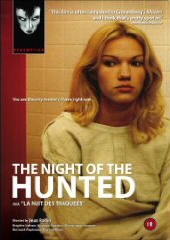
When, at that age of 22, I first saw Jean Rollin’s Night of the Hunted, I cried as much as the first time I saw Titanic at the age of 12. In both cases, the tears were inspired by a “doomed” love story. The main difference between the two films is that I don’t cry over Titanic anymore. But Night of Hunted still brings me to tears every time I see it.
The film opens with the image of a terrified young woman (Brigitte Lahaie) running through a dark forest until she eventually reaches a highway. She’s picked up by a young man (Vincent Gardere) who, being a guy, proceeds to take her back to his apartment in Paris. She confesses that she can’t remember who she is, why she was running, or even being picked up by the young man in the first place. Saying that she needs some sort of memory to fill the emptiness, she proceeds to make love to Gardere. Gardere, being a guy, doesn’t object.
However, he does make the mistake of later leaving Lahaie alone in the apartment afterwards. As soon as Gardere leaves, Lahaie forgets ever meeting him and why she’s even in the apartment in the first place. Even as she tries to figure out what’s going on, the apartment is visited by a doctor who tells Lahaie that she is his patient and that she needs to go with him to a “clinic” where he can treat her. No longer remembering her encounter with Gardere, Lahaie agrees.
Needless to say, the “clinic” turns out to be what Lahie was so desperately trying to escape just a few hours before. We learn that Lahie is merely one of several hundred people who, months earlier, were exposed to a biological warfare experiment gone wrong. Now, as a result, her brain is slowly dying one cell at a time. The clinic is actually a government-run prison where she and her fellow victims have been sent to be forgotten about and to eventually die. Lahie finds herself surrounded by men and women who, as they slowly lose everything that made them unique, revert back to their most primal instincts. While Gardere tries to find her, Lahie struggles to survive just one final night in both the clinic and in the prison of her own fading mind.
Director Jean Rollin is best known for his sexually-themed vampire films but the Night of the Hunted is not as huge a departure for him as it may first seem. One of Rollin’s reoccurring themes is the importance of our memories, no matter how idealized they may sometimes be and this theme is present in every frame of Night of the Hunted.
The lead role is played by Rollin’s frequent muse and collaborator, Brigitte Lahaie. Because the majority of Lahaie’s career has been spent making adult films, she’s never gotten the due she deserves as an actress. Playing a difficult role here, Lahaie is the movie’s greatest strength. She brings a real sincerity and empathy to her role and its impossible to imagine this movie working without her. If nothing else, this movie is a wonderful display of Lahaie’s often underrated talent.
Rollin made the film for very little money and used a cast made up almost entirely of nonprofessionals and French adult film veterans. So, yes the film does sometimes have a grainy look and the editing is definitely jagged. When the characters shoot at each other, it is obvious that they’re firing toy cap guns. To me, however, this works in the film’s favor. The raw quality of the film perfectly mirrors that constant fear and confusion that Lahaie and her fellow prisoners live in. No, the film is not technically perfect but a flawed masterpiece is preferable to uninspired technical perfection any day.
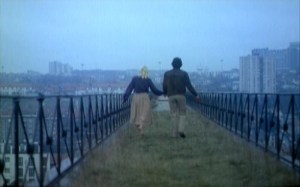
Despite working with a miniscule budget, Rollin captures some haunting images in this film. Never has Paris looked as desolate as in this movie. One of Rollin’s trademarks has always been his own fascination with architecture and, as a result, the cold skyscraper where Lahaie is held prisoner almost becomes a character itself. I’ve always considered Jean Rollin to be horror cinema’s equivalent to Jean-Luc Godard and, with its images of a sterile city run by passionless autocrats, Night of the Hunted brings to mind Godard’s Alphaville.
The film’s most haunting image comes at the end and it is this image that brings tears to my eyes every time. Whatever flaws the film may have, Night of the Hunted has one of the best final shots in the history of cinema. Even if everything preceeding it had been worthless, this movie would be worth sitting through just for the stark beauty of the final shot. Night of the Hunted ends on a note that manages to be darkly sad and inspiringly romantic at the same time. It’s an ending that makes Night of the Hunted one of the most romantic films of all time.
Night of the Hunted was released in 1980 and, like the majority of Rollin’s films, was never released in the States. Redemption, however, has released it on DVD (which is how I first saw it in 2008.) While the transfer is undeniably rough, that actually gives the movie a documentary-like quality that works in its favor. The film is in French with English subtitles. As is so often the case with subtitles, a lot of the film’s nuance is sacrificed in translation. Fortunately, the combination of Rollin’s visual sense and Lahaie’s lead performance more than makes up for it.






 Through the Shattered Lens