The Blues Brothers! They’re on a mission from God.
Jake (John Belushi) and Elwood Blues (Dan Aykroyd) are two Chicago orphans who love the blues and committing crime. After Jake is paroled from Joliet Prison, he’s picked up by Elwood in an old police car. Elwood traded the original Bluesmobile for a microphone. Jake understands, even if he still doesn’t like being seen in a police car. When they visit the orphanage where they were raised, Sister Mary Stigmata (Kathleen Freeman) beats them with a ruler and tells them that the orphanage is going to close if she can’t pay a $5,000 tax bill. Jake and Elwood set out to reform their band, raise $5,000, and save the orphanage. Jake and Elwood may be two career criminals who never take off their dark glasses but they’re on a mission from God.
Along the way to putting the band together and raising $5,000, Jake and Elwood meet characters played by everyone from James Brown to Ray Charles to Aretha Franklin. You never know when a big production number might break out. Jake and Elwood also step on a few toes. Soon, the Blues Brothers being chased by the police, the national guard, Jake’s parole officer (John Candy), Charles Napier’s country-western band, and a group of Illinois Nazis (led by Henry Gibson). There’s also a mysterious woman (Carrie Fisher) who wants to kill them. She has an impressive array of weapons but terrible aim.
The Blues Brothers was the first comedy to be based on a Saturday Night Live bit. Unlike most other SNL movies, The Blue Brothers develops its plot far beyond what was originally seen on television. Jake and Elwood get a full backstory and they also get personalities that go beyond the black suits and the dark eyewear. The Blues Brothers features Belushi at his most energetic but it’s also one of the few films to actually know what to do with Dan Aykroyd’s eccentric screen presence. If Belushi’s Jake is all about earthly pleasures, Aykroyd’s Elwood almost seems like a visitor for another world. Aykroyd’s performance of the Rawhide theme song is one of the film’s highlight.
The Blues Brothers has its share of funny lines and its famous for the amount of pointless destruction that it manages to fit into its storyline (with the “unnecessary violence” being authorized by the Chicago police to stop the Blues Brothers) but it’s also as surprisingly sincere tribute to the blues. It’s a movie that can balance Ray Charles shooting at a shoplifter and a massively destructive car chase in a suburban mall with Cab Calloway playfully performing Minnie the Moocher and Aretha Franklin bringing down the house (or diner, as the case may be). The movie can feature both a jump over an open drawbridge and Steven Spielberg as the clerk at the tax office. It’s one of the strangest comedies ever made and it features all the excesses that would bring an end to 70s Hollywood but when Jake and Elwood say they’re on a mission from God, you believe them.
“The family is truly desperate. And when people get desperate, the knives come out.” — Benoit Blanc
After shaking up galaxies far, far away with Star Wars: The Last Jedi, Rian Johnson returned to solid ground in 2019 with Knives Out, a film so self-assured and inventive it practically felt like a director catching his breath while reminding the world what made him exciting in the first place. It was his first movie after that polarizing Star Wars entry, and he used the opportunity not to go bigger, but smarter—to take something intimate, character-driven, and refreshingly old-school and make it gleam again. Knives Out landed as a kind of palate cleanser for both him and the audience: a modern mystery that leaned into genre nostalgia while reinventing it with sharp humor and social bite. The result wasn’t just a change of pace—it was a confident display of craft from a filmmaker unbothered by his critics, operating with absolute control over every frame, every line, and every perfectly timed smirk.
The setup couldn’t be more classic: a wealthy family patriarch, Harlan Thrombey, turns up dead after his 85th birthday, leaving behind a tangled household of suspects, secrets, and strained smiles. His death looks like suicide, but something isn’t right. Enter Benoit Blanc, a Southern gentleman detective hired anonymously to snoop through the wreckage of lies and grievances. The scenario drips with vintage whodunit flavor, but Johnson’s genius lies in retooling that familiarity into something electrifyingly modern. The Thrombeys aren’t just eccentric millionaires—they’re avatars of American entitlement, each convinced of their own superiority while quietly dependent on the man they pretend to revere. By building his mystery around a clan that mirrors contemporary divisions of money, politics, and self-deception, Johnson injects wit and purpose into the genre without ever losing the fun of the game.
Jamie Lee Curtis plays the confident matriarch Linda, Michael Shannon the resentful son Walt, Toni Collette the spiritual grifter Joni, and Don Johnson the smirking son-in-law Richard—all of them playing heightened but recognizable shades of selfishness. Their sniping exchanges during the first act are among the film’s best sequences, packed with fast banter, political jabs, and casual hypocrisy. Johnson directs these moments like a verbal tennis match, letting personalities bounce and clash until the family’s shiny façade cracks enough for true frustrations to spill out. It’s sharp, funny, and chaotic, showing early on that no one in the Thrombey family is as self-made or self-aware as they claim to be.
Amid that colorful ensemble, the performance that most stunned audiences came from Chris Evans as Ransom Drysdale, Harlan’s playboy grandson and the family’s unapologetic black sheep. Coming off years of playing Marvel’s resolutely noble Steve Rogers, Evans dives into Ransom with visible glee, turning him into a figure of charm and mystery whose motives are never quite clear. He’s magnetic from the moment he appears—witty, cynical, a little dangerous—and Johnson clearly relishes using Evans’s clean-cut image to toy with expectations. Ransom strides into the story radiating confidence, but there’s a guarded, almost predatory intelligence behind his grin. His scenes crackle because the audience can’t quite decide where to place him: is he the rare Thrombey who sees through the family hypocrisy, or is he spinning his own kind of manipulation? That tension between self-awareness and deceit gives his every line an edge. Watching Evans in this role feels like a release for him and a thrill for viewers, a testament to both his range and Johnson’s intuitive casting.
Opposite that moral uncertainty stands Ana de Armas’s Marta Cabrera, Harlan’s kind and soft-spoken nurse who suddenly finds herself at the heart of the story. Marta grounds the entire film emotionally, her decency cutting through the Thrombeys’ arrogance like sunlight in a dusty room. She’s the migrant caretaker who everyone claims to love while casually condescending to, a detail Johnson uses to expose how often politeness masks prejudice. Marta’s inability to lie without vomiting, played initially for laughs, gradually becomes symbolic—a kind of moral honesty that makes her unique in a house ruled by deception. De Armas brings layered vulnerability to the role, balancing fear, guilt, and compassion with natural ease. Through her, Johnson turns the whodunit into something more human and emotionally resonant. She isn’t just a witness or a suspect; she’s the beating heart around which all the greed, paranoia, and privilege revolve.
Then there’s Daniel Craig’s Benoit Blanc, whose arrival shifts the film into another gear entirely. His Southern drawl—equal parts poetic and perplexing—sets the tone for what becomes one of Craig’s most playful performances. After years of portraying the stoic James Bond, he’s clearly having the time of his life as a detective who investigates with both intellect and intuition. Blanc operates less like a hard-nosed cop and more like a philosopher; he believes that solving a crime means understanding human weakness as much as evidence. His famous “donut hole” speech perfectly captures the balance Johnson strikes between earnestness and absurdity. Blanc may revel in his own melodrama, but he also brings heart to chaos, observing people’s contradictions without losing his sense of wonder. The result is a detective who’s less about revelation and more about revelation’s moral cost.
Visually, Knives Out belongs to a rare category of films that are so meticulously crafted they could be paused at any frame and still look compelling. Johnson and cinematographer Steve Yedlin transform Harlan’s mansion into a breathing character—an architectural echo chamber of secrets. The walls are lined with strange trinkets, elaborate paintings, and heavy mahogany furniture that suggest old money’s suffocating weight. There’s something both cozy and claustrophobic about the space, which mirrors the tension between family warmth and poisonous resentment. The camera glides through it with purpose, lingering on small details that gain meaning later, and the autumn-colored palette—deep reds, browns, and golds—wraps everything in an inviting melancholy. It’s as much a visual experience as it is a narrative one, and few modern mysteries feel as tactile.
Johnson’s writing keeps that sense of precision. The plot unfolds like clockwork, but the mechanics never feel mechanical. Instead, he keeps viewers off-balance by blending humor with genuine suspense. Instead of relying entirely on high-stakes twists, Johnson builds tension through empathy, giving us access to characters’ doubts and stakes rather than just their clues. The result is a mystery that keeps the audience guessing in emotional and moral dimensions, not just logical ones. Every revelation says as much about character as it does about the crime.
Underneath the quick humor and ornate mystery structure, Knives Out doubles as a satire of class and entitlement. Johnson sketches the Thrombeys as people who talk endlessly about fairness, morality, and self-reliance yet collapse into panic when their material comfort is threatened. Through them, he captures a peculiar American irony: the people most obsessed with earning their status are often those most insulated from real struggle. When the family gathers to argue over wealth and loyalty, Johnson doesn’t need to exaggerate—they expose themselves with every smug phrase and self-justified rant. It’s social commentary that’s biting but never heavy-handed because it plays out through personality instead of sermon.
Nathan Johnson’s score carries the story forward with playful precision, shifting from tension to whimsy in sync with the characters’ shifting loyalties. There’s something almost dance-like about the film’s rhythm: scenes of laughter can spiral into confession, and interrogations can dissolve into comedy without losing a beat. The editing supports that agility, cutting crisply between overlapping dialogue and close-ups that reveal just enough expression to keep us alert. Johnson’s sense of pacing feels theatrical in the best way—it’s about timing and tone rather than spectacle.
As with many of Rian Johnson’s works, contradiction fuels the story’s appeal. Knives Out is cynical about human greed but oddly hopeful about individual decency. It mocks arrogance but rewards empathy. Even when it toys with genre clichés, it does so out of affection, not scorn. Johnson clearly understands that mystery storytelling is as much about character and morality as deduction, and he uses humor and chaos as tools to explore who people become under pressure. The movie’s sophistication lies in how effortless it feels—its layers unfold smoothly, but the craft behind them is razor sharp.
The film’s ending closes with a visual that redefines power without needing words. After a story filled with deceit, pretension, and the scramble to control a legacy, it concludes on an image that says everything about perspective—who actually holds the moral high ground and how quietly dignity can win. Like the rest of the movie, it’s both playful and pointed, leaving you smiling while still turning the characters’ behavior over in your mind.
Looking back, Knives Out stands as a defining moment in Rian Johnson’s career. After the spectacle and dialogue storms of The Last Jedi, this lean, ensemble-driven mystery reaffirmed his strengths as a writer-director who thrives on structure, rhythm, and human contradictions. It’s a film that takes as much pleasure in observation as revelation, brimming with sly humor and performances that sparkle across the moral spectrum. Anchored by Ana de Armas’s poignant sincerity, Daniel Craig’s eccentric brilliance, and Chris Evans’s unpredictable charisma, it became one of the most purely enjoyable movies of its time. Witty without pretense, political without lecturing, and perfectly balanced between cynicism and heart, Knives Out remains proof that the old whodunit can still cut deep—and that Rian Johnson’s sharpest weapon is still his storytelling.
Since we’ve been talking a lot about the original Little Shop of Horrors today, it’s only appropriate to share a scene from the remake for today’s scene of the day.
From 1986’s Little Shop of Horrors, here is Steve Martin performing Dentist! Because there’s nothing scarier than going to the dentist, right?
As Christmas approaches, Mortimer (Don Ameche) and Randolph Duke (Ralph Bellamy) make a bet to determine whether it’s nature or nurture that shapes someone’s future. The fabulously wealthy owners of Duke & Duke Commodity Brokers, the brothers casually frame their director, Louis Winthrope III (Dan Aykroyd), for everything from dealing drugs to sealing money to cheating on his girlfriend (Kirstin Holby). After Louis is kicked out of both his job and his mansion, the Dukes hire a street hustler named Billy Ray Valentine (Eddie Murphy) to take his place. Earlier Winthrope tried to get Valentine arrested for approaching him in the street. Now, Valentine is living in Winthrope’s mansion, with Winthrope’s butler and Winthrope’s job.
While Winthrope tries to survive on the streets with the help of a outwardly cynical but secretly kind-hearted prostitute named Ophelia (Jamie Lee Curtis, in her first non-horror starring role), Billy Ray surprises everyone by using his street smarts to become a successful, suit-wearing businessman. The Dukes, of course, have no intention of keep Billy Ray Valentine on as their director. Not only are the Dukes snobs but they’re racists as well. Once their one dollar bet has been settled, they start planning to put Billy Ray back out on the streets with Winthrope.
Trading Places was Eddie Murphy’s follow-up to 48 Hrs and he again showed himself to be a natural star while playing the type of role that could have been played by Dan Ayrkroyd’s partner, John Belushi, if not for Belushi’s early death. (Jim Belushi has a cameo as a party guest.) Murphy gets to show off a talent for physical comedy and Trading Places is one of the few films to really take advantage of Dan Aykryod’s talents as both a comedian and actor. Winthrope goes from being a coddled executive to being as streetwise as Valentine. This is probably Aykroyd’s best performance and he and Eddie Murphy make for a good team.
But the real stars of the film are four actors who weren’t really thought of as being comedic actors, Denholm Elliott, Don Ameche, Ralph Bellamy, and especially Jamie Lee Curtis. Ophelia is a much edgier character than the “final girls” that Curtis was playing in horror films and Curtis steals almost every scene that she’s in. Ameche and Bellamy are great villains and it’s fun to watch them get their comeuppance. What screwball comedy would be complete without a sarcastic butler? Denholm Elliot fills the role of Coleman perfectly.
Trading Places was a box office success when it was released and it’s now seen as being one of the new Christmas classics, a film for the adults to enjoy while the kids watch Rudolph and Frosty. I think the movie ends up going overboard towards the end with the gorilla and Dan Aykroyd wearing blackface but, for the most part part, it’s still a very funny and clever movie.
Since we’ve been talking a lot about the original Little Shop of Horrors today, I thought I would only be appropriate to share a scene from the remake for today’s scene of the day.
From 1986’s Little Shop of Horrors, here is Steve Martin performing Dentist! Because there’s nothing scarier than going to the dentist, right?
(Yes, I nearly picked Mean Green Mother From Outer Space but …. I don’t know. It bothers me that the film remake changes the dark ending of both the original film and the stage production.)
4 Shots From 4 Films is just what it says it is, 4 shots from 4 of our favorite films. As opposed to the reviews and recaps that we usually post, 4 Shots From 4 Films is all about letting the visuals do the talking.
We’ve reviewed a lot of science fiction and we’ve got a lot more left to go. (Keep an eye out for my reviews of Starcrash and The Humanoid over the upcoming few days.) However, from the beginning, this month has always been centered around Star Wars. You may have heard that there’s a little movie called Star Wars: The Force Awakens and it’s opening this week. Apparently, a few people are excited about it. Since we love reviewing little known art films here at the Shattered Lens, we decided why not review all of the previous Star Wars films during the week leading up to the release of The Force Awakens? Jeff (a.k.a. the blogger known asJedadiah Leland) started us off by reviewing The Phantom Menace.Then Alexandre Rothier took a look at Attack of the Clones, followed by Jeff’s look at Revenge of the Sith.Leonard Wilson was the next to step up to the plate, reviewing both A New Hope and The Empire Strike Back.
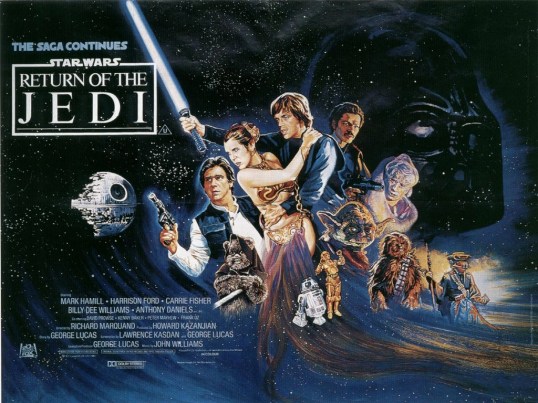
And now, it’s my turn to add my thoughts to this project. It’s time to review the 1983 film, Return of the Jedi. And I have to admit that, when I first thought about what I wanted to say in this review, I was totally intimidated. Unlike my fellow writers here at the Shattered Lens, I’m hardly an expert when it comes to Star Wars. Don’t get me wrong — I know the basics. I know that Darth Vader is Luke’s father. I know that Han Solo flies the Millennium Falcon and that Princess Leia is in love with him. I know there’s an evil Empire and I know that there are rebels. I’m not a virgin when it comes to Star Wars but, at the same time, I’m definitely not as experienced (with Star Wars) as most of my friends and fellow movie bloggers.
“Dang, Lisa, get over it!”
So, late this afternoon, when I sat down to watch Return of the Jedi, it was with more than a little trepidation. My obvious panic and welling tears convinced Jeff to watch the movie with me and I was happy for that. He loves Star Wars so I knew he could explain to me what was going on.
Finally, we watched Return of the Jedi and I discovered that I was panicking over nothing. Return of the Jedi may be the third part of trilogy and I may not be an expert on the films that came before it. But, even with all that in mind, Return of the Jedi is not a difficult film to figure out. As opposed to the finales of Harry Potter, The Hobbit, and The Hunger Games, Return of the Jedi keeps things simple. A good guy has been kidnapped by a bad guy. The other good guys come to the rescue and then go to another planet so that they can fight an even bigger bad guy. It’s not complicated.
As I watched Return of the Jedi and realized that I was having absolutely no problem following the film’s plot, I also realized that the Star Wars films are such a huge part of our culture that, regardless of how many of them we’ve actually sat through, everyone has absorbed them by osmosis. Bits and pieces of it are everywhere, showing up in everything from TV sitcoms to political commentary. (Remember how everyone used to compare Dick Cheney to Darth Vader?) The Star Wars franchise is almost biblical in that respect. At the same time, the fact that everyone knows about these movies makes them a little difficult to review. You don’t so much watch a Star Wars film as you join in a universal experience. As a reviewer, you definitely find yourself wondering what you can add to a conversation that everyone else has already had.
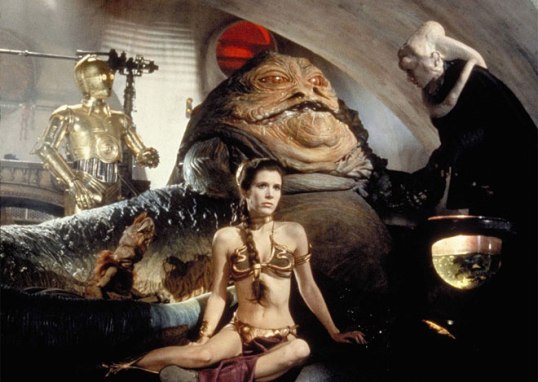
As a stand alone movie, Return of the Jedi is actually three separate films mixed together. The first film deals with Luke Skywalker (Mark Hamill) showing up at Jabba the Hutt’s palace and rescuing Han Solo (Harrison Ford), Princess Leia (Carrie Fisher), Chewbacca (Peter Mayhew), and two robots from being tossed into a creature called the Sarlacc, which is basically a giant vagina out in the middle of the desert. The second film deals with the rebels teaming up with a bunch of teddy bears and fighting the Empire on a jungle planet. And the third film features Luke and Darth Vader (body of David Prowse, voice of James Earl Jones, face of either Sebastian Shaw and Hayden Christensen, depending on which version of the film you’re watching) dealing with their family issues while the Emperor (Ian McDiarmid) cackles in the background. Some parts of the film work better than others. The end result is entertaining but definitely uneven.
Jedi‘s heart belongs to that third film, the one dealing with Luke and Darth Vader. I’ve read some pretty negative online comments about Mark Hamill’s performance in New Hope and Empire Strikes Back but, in Return of the Jedi, he brings an almost haunted intensity to the role of Luke. In theory, it’s easy to be snarky about all the talk about the “Dark Side of the Force,” but, when you look in Hamill’s eyes, you totally understand what everyone’s going on about. You see the fire and the anger but, even more importantly, you see the struggle between good and evil. There’s a very poignant sadness to the scenes where he and his father prepare to meet the Emperor.
And speaking of the Emperor, he is pure nightmare fuel! AGCK!
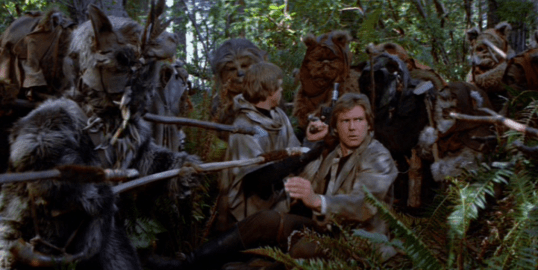
As for the other two films to found within Return of the Jedi, the jungles of Endor didn’t do much for me. Don’t get me wrong. I thought the action scenes were handled well and, unlike apparently everyone else in the world, I was not annoyed by the inclusion of the Ewoks, the killer teddy bears who helped to the Rebels to take down the Empire. I thought the Ewoks were cute and I actually got pretty upset when one of them was killed in battle. If I had been alive when Return of the Jedi had been released, I probably would have wanted a stuffed Ewok and, I imagine, that was the main reason they were included in the film. (I also imagine that’s the main reason why a lot of people can’t stand them.)
So, no, the Ewoks did not bother me. What did bother me was that under-construction Death Star floating out in the middle of space. It bothered me because I really couldn’t imagine any reason why — after the first Death Star was apparently such a colossal failure — the Empire would insist on trying to do the exact same thing all over again. This, along with the fact that they were rather easily defeated by a bunch of teddy bears, leads me to wonder whether the effectiveness of the Empire was just a little overrated. I mean, the Emperor was scary but otherwise, everyone involved with the Empire was pretty incompetent.
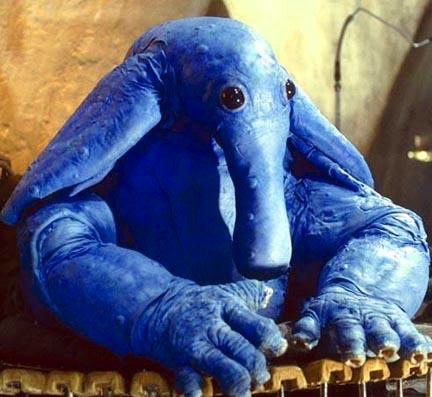
Far more impressive, as far as villains go, was Jabba the Hut. In fact, Jabba and his decadent entourage were so memorable and colorful and evil and icky that they pretty much overshadowed almost everything else in the film. I mean, Jabba even had a blue elephant playing music for him! And I know that I’m supposed to be critical of the film for putting Leia in that gold bikini but you know what? Leia may have been forced to wear a gold bikini but she never gave up her dignity or her defiance. And when it came time to take out Jabba, Leia used the tools of her oppression to do so, strangling him with his own chains. In that one scene, Leia proved herself to be a true rebel.
There’s a lot that’s good about Return of the Jedi but, as I said earlier, it’s definitely an uneven film. Richard Marquand’s direction is perhaps the epitome of workmanlike. It’s efficient and it’s dependable and there’s absolutely nothing surprising or particularly challenging about it.
It’s interesting to note that, before Richard Marquand was selected as director, the job was offered to both David Lynch and David Cronenberg, two directors who are all about surprising and challenging the audience. What would David Lynch’s Return of the Jedi been like? Well, here’s one possibility:
As for David Cronenberg’s Return of the Jedi, it might have looked something like this:
For better or worse, the world got Richard Marquand’s Return of the Jedi, which I imagine was pretty close to what George Lucas wanted the film to be.
As I sit here finishing up this review and wondering just why exactly I was so intimidated earlier (seriously, this turned out to be one the easiest reviews that I’ve ever written), I estimate that 75% of the people that I know are currently sitting in a theater and watching The Force Awakens. Keep an eye out for Arleigh’s review in the next few days!
And in closing, here’s that blue elephant that I mentioned earlier. Dance!
The year 2005 was a dark time to be a fan of Star Wars.
The first two parts of the highly anticipated prequel trilogy had been released and had left fans feeling as if millions of voices had cried out in terror and suddenly been silenced. No sooner had fans started to recover from the trauma of The Phantom Menace then Attack of the Clones was unleashed and they were stunned to learn that a movie could be even more pointless than The Phantom Menace.
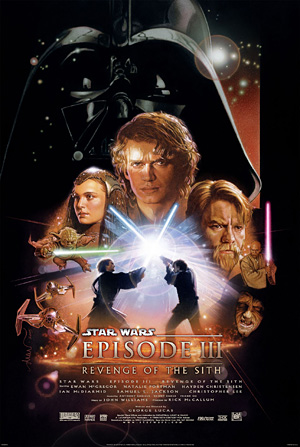
The summer of 2005 promised the release of Star Wars Episode III: The Revenge of the Sith. Fans were excited because they knew that Anakin Skywalker would finally be transformed into Darth Vader but they also knew that he would still be played by Hayden Christensen. Many of us who went to see the movie on its opening weekend did so with low expectations and mixed feelings.
“WAR!” the opening title crawl of Revenge of the Sith declared, as if it was trying to reassure those of us in the audience that it would not be another boring Star Wars prequel. There was nothing in the crawl about taxation or trade routes. Instead, it was all about how the Galactic Republic was at war with separatists and how Chancellor Palpatine was being held prisoner by General Grievous. After an exciting battle on Grievous’s flagship, Anakin not only rescued Palpatine but also decapitated Christopher Lee’s Count Dooku, despite the fact that Dooku had surrendered and was unarmed. That’s when those of us watching knew that Revenge of the Sith was not going to be like the other two prequels. Revenge of the Sith was going to be darker and edgier and not just for kids. A headless Count Dooku action figure would not be sold at your local toy store.
Looking back, it is easy to forget how relieved many of us were that Revenge of the Sith was not terrible. After the bitter disappointment of the first two prequels, we were happy that Jar Jar Binks only appeared during one shot towards the end of the film and he did not speak. We were happy that Ewan McGregor and Natalie Portman both finally got to give performances that justified casting actors of their caliber as Obi-Wan and Amidala. We were happy that, since Anakin and Amidala were secretly married between Attack of the Clones and Revenge of the Sith, we did not have to sit through any more scenes of them falling in love. Many of us had found Hayden Christensen’s performance to be petulant in Attack of the Clones and, intentionally or not, Revenge of the Sith seemed to validate our suspicions by having both Yoda and Mace Windu say the same thing about Anakin. After the embarrassment of Phantom Menace and Attack of the Clones, this was a prequel that we felt we could get behind.
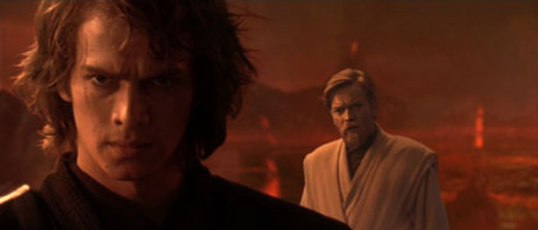
And we were really happy with the climatic battle between Obi-Wan and Anakin. After Anakin had gone over to the dark side, he and Obi-Wan dueled on a volcanic planet. “You were supposed to be the chosen one!” Obi-Wan shouted after chopping off Anakin’s legs. After being left to die by Obi-Wan, Anakin was rescued by Emperor Palpatine. It was only after being encased in that famous black armor that Palpatine told the new Darth Vader that Amidala had died. Darth Vader’s “Nooooooooo!” would go down in history.
At the end of the film, Jimmy Smits was seen giving an infant Luke to Owen and Beru Lars and Darth Vader and the Emperor were seen standing on the bridge of an imperial ship and looking out at the skeleton of the Death Star. For the first time since the prequels were first released, some of us applauded at the end of a Star Wars film.
When, ten years later, I rewatched Revenge of the Sith for the first time in a long while, my immediate impression was that it was nowhere close to being as good as I remembered. Without a doubt, it was still the best of the prequels but how much was that really saying? Of all the prequels, it came the closest to capturing the sense of awe and excitement that made the original trilogy (even Return of the Jedi) so entertaining but, at the same time, it still had many of the same flaws that afflicted Phantom Menace and Attack of the Clones. Hayden Christensen was as stiff and inexpressive as ever, as was George Lucas’s dialogue. (When Obi-Wan tells Anakin that Palpatine is evil, Anakin actually replies, “From my point of view, the Jedis are evil!” He shouts this in the middle of a light saber duel.) Even the movie’s most shocking moment, when Anakin murdered a group of children, was no longer effective because everyone in the movie insisted on calling the children “younglings.”
Throughout the entire prequel ordeal, George Lucas would insist that it was necessary to see all three of the prequels to really understand the story he was trying to tell and how it fit in with the original trilogy. However, of all the prequels, Revenge of the Sith is the only one that feels as if it adds anything to what we had already learned from watching the original trilogy. Nor is there anything to be gained from having seen the first two prequels before watching Revenge of the Sith for the first time. The main accomplishment of Revenge of the Sith was to prove that The Phantom Menace and Attack of the Clones were entirely unnecessary. (Revenge of the Sith actually works better if you have never seen Phantom Menace because there is no way that the Anakin played by Jake Lloyd could have grown up to be the Anakin played by Hayden Christensen.)
Why, when we originally watched Revenge of the Sith, did so many of us think that it was so much better than it actually was?
In the year 2005, we were just happy to have a Star Wars film that did not totally suck.
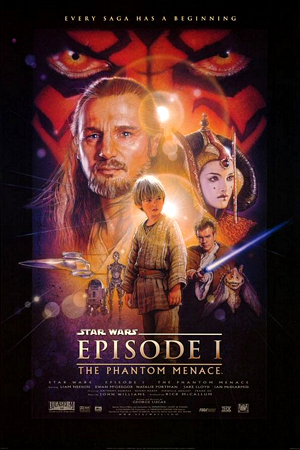
The time was May of 1999. The place was a movie theater in Baltimore, Maryland. The theater was packed with people waiting to see the most anticipated film of their lifetime. The film was The Phantom Menace, the first prequel to the original Star Wars trilogy. For two years, the people in the audience had followed every detail of the film’s production. Some of them had gone to showings of Meet Joe Black and Wing Commander, just so they could see the first trailers for the film.
Sitting out in that audience was one 16 year-old boy who, a few nights earlier, had been standing outside a Target at midnight so that he could be one of the first to buy Phantom Menace merchandise. He bought two Jar Jar Binks action figures because, even before Phantom Menace opened, he suspected Jar Jar would be the most controversial character.
When the lights went down, the audience cheered. At the start of every trailer, someone in the dark theater shouted, “I bent my Wookie!” The audience laughed the first two times. By the fifth time, there were only a few pity titters.
Finally, it was time! The first few notes of John Williams’s Star Wars theme echoed through the theater. Again, the audience cheered as the familiar title crawl appeared on-screen.
The 16 year-old read the opening crawl and he started to get worried. What was all this talk about taxation? Trade routes? Trade Federation? Blockades? It seemed more appropriate for Star Trek or even Dune. Except for the mention of Jedis at the end of the crawl, it did not sound much like Star Wars.
Things started to look up as soon as Liam Neeson and Ewan McGregor made their first appearance as Qui-Gon and Obi-Wan. Obi-Wan’s first line was, “I have a bad feeling about this.” A few people in the audience clapped. “I bent my Wookie!” a familiar voice shouted. Nobody laughed.
When a hologram of Darth Sidious appeared and told the Trade Federation goons to kill Qui-Gon and Obi-Wan, everyone in the audience knew that Darth Sidious was Palaptine, the future Emperor, and the excitement was palpable. When Qui-Gon and Obi-Wan fought off the battle droids and escaped to the besieged planet of Naboo, the audience started to relax. Maybe this wouldn’t be as bad as the critics were saying.
Then Qui-Gon and Obi-Wan met Jar Jar Binks and the whole movie went to shit.
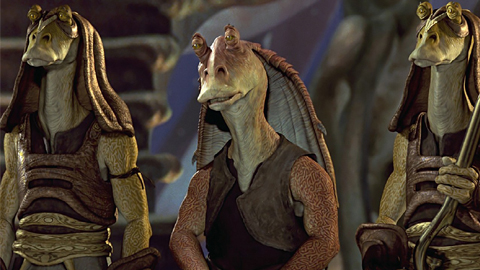
In the months leading up to the release of The Phantom Menace, everyone had heard about Jar Jar Binks and how he was a totally computer-generated character. Jar Jar Binks was the future of movie technology and, from the minute he first appeared, the future was fucking terrifying. Jar Jar was a Gungun, an amphibious creature who was characterized as being clumsy and cowardly. He shrieked in a high-pitched voice and spoke in an indescribable dialect. As much as the audience tried, there was no way to avoid or ignore Jar Jar Binks. He was not in the entire movie but he was at the center of every scene in which he did appear.
As Jar Jar led Obi-Wan and Qui-Gon to the underwater city of the Gunguns, a voice in the dark theater shouted out, “I bent my Wookie!”
“Shut the fuck up!” the 16 year-old snapped back.
The 16 year-old was not sure if anyone heard him but the voice was silent for the rest of the movie.
Sorry, Ralph.
No sooner had the audience recovered from their introduction to Jar Jar then they met young Anakin Skywalker. Anakin’s story was the whole reason that The Phantom Menace had been made. The audience knew that the prequels would show how Anakin Skywalker would grow up to the greatest and most evil badass in the universe, Darth Vader. But in Phantom Menace, he was just a 9 year-old slave on the planet of Tatooine, conceived by immaculate conception. Even before Phantom Menace was released, the word was out that Jake Lloyd, the child cast as young Anakin, was not exactly the best actor in the world. But even though they had been forewarned, the audience was not prepared for just how terrible little Jake Lloyd was in the role. There was no darkness to Jake Lloyd’s cutesy performance. There was no sadness or toughness. Jake Lloyd came across like the type of hyperactive child who would end up in the ensemble of a Christmas play, breaking character and waving to his parents during the Crucifixion. Not only could the audience not see him growing up to be Darth Vader but they could not imagine him as a slave living on an inhospitable desert planet.
Qui-Gon, Obi-Wan, Jar Jar, Queen Padme (Keira Knightley), and Padme’s handmaid, Amidala (Natalie Portman) were stranded on Tatooine when they first met Anakin. Qui-Gon felt that Anakin was “the chosen one,” who would bring balance to the force. It was hard for the audience to believe him when they heard Anakin shout, “Yippe!”
For that 16 year-old who had stayed up past midnight to buy two Jar Jar Binks action figures, that “yippe” was the final straw. He had watched the original Star Wars trilogy on VHS tapes. He had gone to the re-releases. He loved Star Wars and he wanted to love The Phantom Menace. Instead, he felt so let down by the film that he could barely look at the screen.
The 16 year-old wondered why C3PO and R2D2 were in the film. Phantom Menace revealed that they were built by the future Darth Vader. R2D2 would even help Anakin in the film’s final battle. It made no sense. The 16 year-old wondered if anyone else in the audience was as confused as he was. He wondered why, if he could see that this made no sense, George Lucas could not understand the same thing.
Anakin won a pod race and was allowed to leave Tatooine. The film’s action was moved to the Coruscant, a planet that was covered with one huge city. Samuel L. Jackson appeared as Mace Windu and, when he stared out at the audience, he seemed to be saying, “I fucking dare you to yell anything about bending your motherfucking Wookie!” There were scenes set in the galactic senate, presumably to appease everyone who wanted a meticulously detailed portrait of how a galactic Republic would be governed. Padme turned out to be a fake and Amidala was revealed as the real queen. There was a final battle between the forces of the Republic and the Trade Federation. Qui-Gon was killed in a duel with the evil Darth Maul (Ray Park) but Obi-Wan promised to train Anakin in the ways of the Jedi. Palpatine promised that he would be watching Anakin’s development.
And, of course, there was this:
For many in the audience who truly loved the original trilogy and who had spent the past two years scouring every corner of the Internet in search of news about The Phantom Menace, the midi-chlorians was the point that they give up on the movie. The Force added a hint of mysticism to the original trilogy. Because it was so mysterious and its origins so deliberately obscure, fans of Star Wars could imagine that The Force was inside of them as well as Luke and Darth Vader. “May the force be with you,” was more than just a catch phrase to those fans. It was a reminder that, even in a galaxy far far away, there was still mystery and faith. When Qui-Gon talked about midi-chlorians, fans realized that not only did they understand the appeal of Star Wars better than George Lucas but George Lucas did not even care why they loved his film. For those fans, the midi-chlorians not only ruined The Phantom Menace but cheapened the original trilogy as well. The Force was no longer special or mystical. Anakin might as well have just been bitten by a radioactive spider.
For the 16 year-old, it was somehow even worse that, before asking about the Force, Anakin apologized to Qui-Gon for causing so much trouble. Sitting out in the theater, he knew that the boy who would grow up to be Darth Vader would never yell “yippie!” and he would never apologize for causing any trouble.
At the end of the movie, the audience did not know how to react. The 16 year-old talked to his friends as they filed out of the theater. Everyone was in a state of denial. They knew that they had seen something very disappointing but, after all the excitement leading up to the release of The Phantom Menace, they did not want to admit how disappointed they really were with the actual movie. They talked about what did work. They talked about the pod race, which had been fun. They talked about the exciting light saber duel between Qui-Gon, Obi-Wan, and Darth Maul. Being teenage boys, they also talked about Natalie Portman and Keira Knightley.
They tried not to talk about Jar Jar Binks, beyond agreeing that he sucked. They tried not to talk about Jake Lloyd as Anakin. It was too painful to know that Star Wars had been reduced to Jar Jar Binks and Jake Lloyd. They did make fun of the “I bent my Wookie” guy. In the face of grave disillusionment, it was all that the 16 year-old and his friends could do.
Today, enough time has passed that it is easier to laugh about Jar Jar Binks and The Phantom Menace. Though the initial trauma may have faded into memory, it all came rushing back to me as soon as Lisa asked me if I would be willing to review The Phantom Menace for this site. I cautiously agreed and hoped that, since I already knew what I was getting myself into, The Phantom Menace would not be as disappointing the second time around.
It was a strange experience rewatching The Phantom Menace. While I remembered how bad the movie was, I’d forgotten how equally boring it was. Jar Jar Binks was even more annoying than I remembered and Jake Lloyd was even worse. Of the film’s best scenes, the pod race went on too long and the duel with Darth Maul was too short. For such a badass villain, Darth Maul was underused for much of the film, as if George Lucas did not understand that the kids he claimed to have made the film for would be far more interested in the dynamic Darth Maul than the histrionic Jar Jar Binks.
Emphasizing Jar Jar Binks over Darth Maul made as much sense as emphasizing the Ewoks at the expense of Boba Fett.
Worst of all, the entire movie felt even more pointless the second time around. When the prequels were first released, George Lucas always said that all three of them should be viewed in the context of the larger story that they were telling. But what do we really learn from The Phantom Menace or any of the prequels? Did anyone really want to know about how trade was regulated before the Empire? Did we really need to know the exact details of how Anakin became a Jedi? Watching The Phantom Menace, the answer is no.
I was especially surprised by how bad the CGI looked. When The Phantom Menace was first released, the CGI was often the only thing that was critically praised. Critics may have hated Jar Jar Binks as a character but they all agreed that it was impressive that a major character had been created by a computer. It is easy to forget just how big a deal was made about The Phantom Menace‘s special effects. At the time, we had yet to take it for granted that an entire movie could be made on a computer.
But seen today, the CGI not only seems cartoonish but, like the midi-chlorians, it feels like a betrayal of everything that made the original Star Wars special. The universe of New Hope and Empire Strikes Back felt lived in. It was imperfect and real. It was a universe where even the most fearsome storm trooper could accidentally bump his head on a doorway.
But the CGI-created universe of The Phantom Menace was too slick and too perfect. There was no chance for spontaneity or anything unexpected. The universe of the original Star Wars trilogy was one in which you could imagine living but the universe of The Phantom Menace seemed only to exist in the computers at Lucasfilm. With The Phantom Menace, George Lucas seemed to be reminding those who loved his films that the Star Wars universe belonged to him and him alone. Our imagination was no longer necessary.
As for that 16 year-old who first saw The Phantom Menace in that Baltimore theater, I still have those Jar Jar Binks action figures. I keep one of them on my desk at work and I enjoy the strange looks that it gets. If you push down its arms, Jar Jar sticks out his tongue.
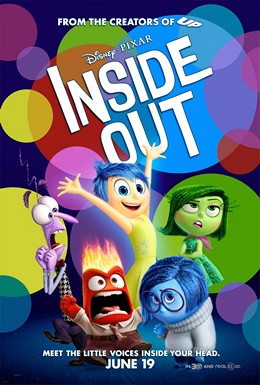
Inside Out is the latest brilliant film from Pixar’s Pete Docter and it will remind you why you fell in love with Pixar in the first place.
There are no talking cars or lovable monsters in Inside Out. Instead, it’s the story of a very normal 12 year-old girl named Riley (voiced by Kaitlyn Dias). Or rather, it’s the story of what goes on in her head. For most of the movie, Riley deals with experiences to which we can all relate: she moves to a new city, she struggles to relate to her well-meaning parents (voiced by Kyle MacLachlan and Diane Lane), and she tries to fit in at a new school. Inside Out is a film about the small moments of life and how they all add up to create a bigger picture.
What sets Inside Out apart is the way that it tells its deceptively simple story. Inside Out takes place almost entirely inside of Riley’s brain. And it turns out that her mind is gigantic wonderland, one that is so big and complex that not even the characters who live there quite understand how it all works. Bing Bong (Richard Kind), a pink half-elephant, half-cat, half-dolphin creature, spends his time wandering through the halls of memory and mournfully thinking back to when he was Riley’s imaginary friend. Whenever Riley goes to sleep, the actors and directors at Dream Productions film a different nightly movie. Meanwhile, Imagination Land is a fun place to visit but not a good place in which to live and past childhood traumass — like a gigantic stalk of broccoli and a terrifying birthday clown — are locked away deep in Riley’s subconscious, where they are guarded by officious policemen. Zigzagging through this mental landscape is the literal Train of Thought.
And then, above it all, there’s Headquarters. This is where five different emotions take turns “steering” Riley through life. Fear (Bill Hader) is always nervous but, at the same time, keeps Riley safe. Disgust (Mindy Kaling) prevents Riley from eating broccoli and hanging out with the wrong crowd. Sadness, meanwhile, hasn’t had much to do over the past 12 years and, as a result, she spends most of her time standing in a corner and feeling … well, sad. Sadness is voiced by Phyllis Smith, best known for playing Meredith on The Office. Smith proves herself here to be a strong and empathetic voice artist.
Their unquestioned leader is Joy (Amy Poehler). As befits her name and job, Joy is always positive, always upbeat, and always optimistic. For 12 years, Joy has been in charge of steering Riley’s life but that all changes when Riley and her family move to San Francisco. Suddenly, Joy finds it more difficult to keep Riley permanently happy. Memories that were formerly color-coded yellow for happy start to turn blue.
When both Joy and Sadness are accidentally expelled from the Headquarters, it’s up to the three remaining emotions to try to keep Riley well-balanced until they can return. However, the journey back up to the Headquarters is a long and dangerous one, full of some of the most imaginative (and metaphorical) imagery in Pixar’s history. Joy and Sadness will have to work together to make it.
And really, that’s what makes Inside Out so special. It’s the rare family film that acknowledges that allowing ourselves to feel sad is often as important as being happy.
Inside Out is a brilliant coming-of-age story and one of the best films of the year. It’s a film that will make you laugh and cry and will remind you of why you fell in love with Pixar in the first place. Kids will love the humor and adults … well, adults will probably be trying to hold back the tears.
 The Blues Brothers! They’re on a mission from God.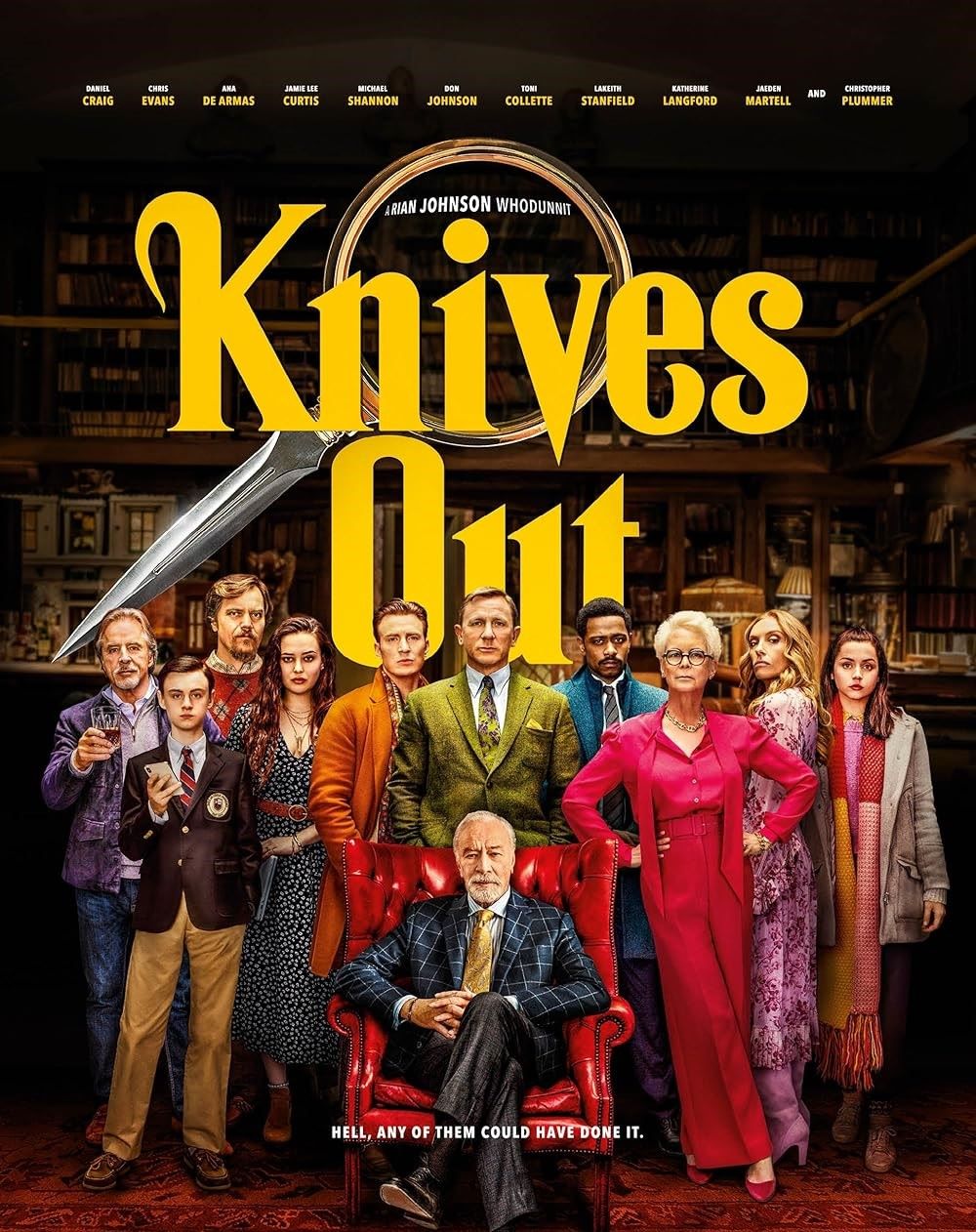




 The year 2005 was a dark time to be a fan of Star Wars.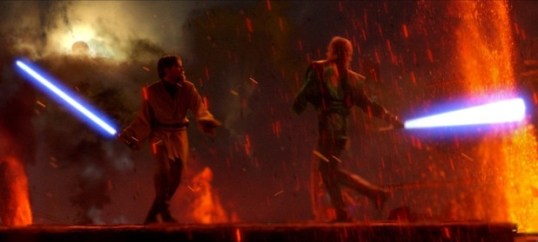
 A long time ago in a galaxy far, far away…

 Through the Shattered Lens