“Now is the time to choose! Die and be free of pain, or live and fight your sorrow!” — Auron
While Final Fantasy VI is still my personal favorite game in the entire Final Fantasy series, Final Fantasy X is the entry that reached me most directly on an emotional level. VI remains the peak of the pixel-art era for me: a sprawling, tragic, beautifully varied masterpiece whose cast, music, and broken world are impossible to separate from what the franchise means to me. But X feels more intimate. Its story of Tidus, Yuna, and a society trapped in a cycle of grief and sacrifice hits with a particular sadness because it takes the time to let its characters live inside that pain. In that sense, Final Fantasy Xis the high point of the series’ 3D era in much the same way Final Fantasy VI represents the high point of its 2D era—not necessarily my number-one favorite overall, but perhaps the most emotionally affecting game in the franchise.
That distinction matters because Final Fantasy X was not merely a graphical leap. It was a game that used its new presentation to deepen the things Final Fantasy had always done best. The move to fully three-dimensional environments, voiced dialogue, and cinematic camera work could have pushed the series toward empty spectacle, but X uses those tools to make its people and places feel more immediate. It was also a major mechanical departure, replacing Active Time Battle with the Conditional Turn-Based system and conventional leveling with the Sphere Grid. Even now, it feels like a near-perfect midpoint between the intimate pacing of classic turn-based JRPGs and the larger dramatic ambitions the series pursued in later generations.
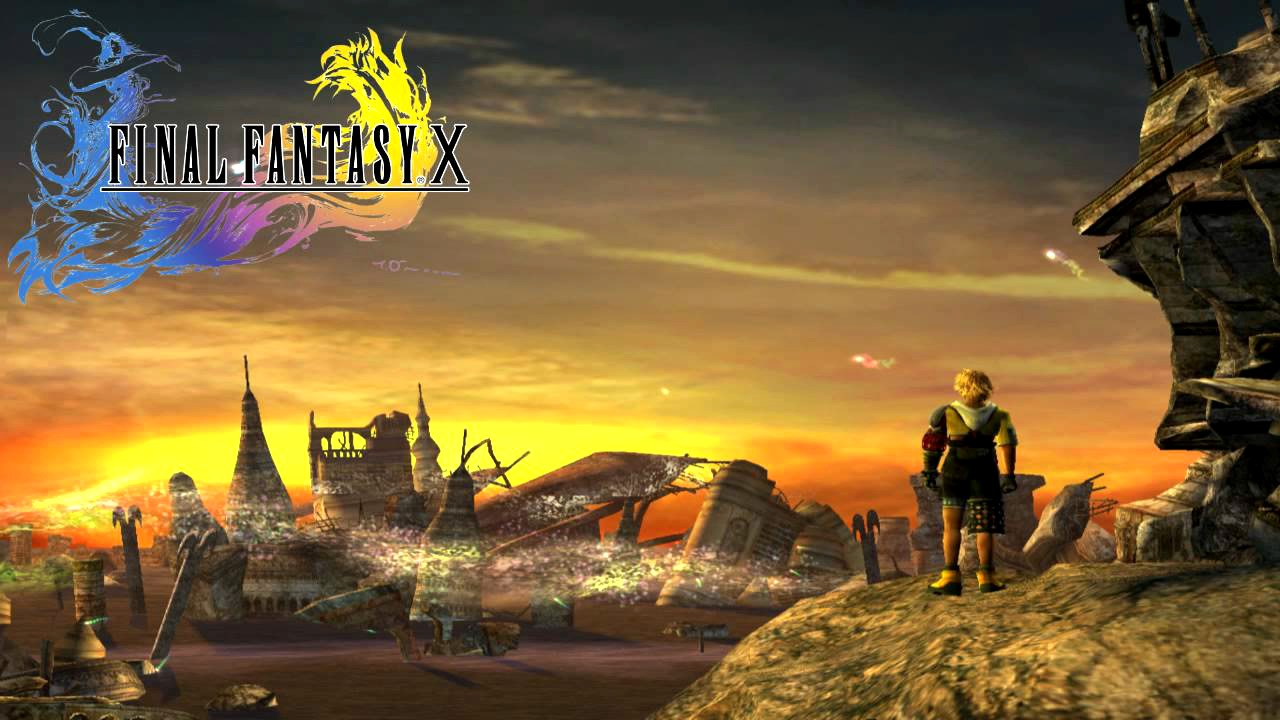
The game opens with one of the strongest introductions in the entire series. Tidus, a cocky Blitzball star from the futuristic city of Zanarkand, is suddenly pulled into chaos when the massive entity called Sin attacks. He wakes up in Spira, a world that considers his home a myth from a thousand years ago. This makes Tidus a useful protagonist because he is just as confused as the player. He asks why everyone fears Sin, why technology is considered dangerous, and why people willingly accept a religious system built around loss. The initial premise is deceptively simple: Tidus joins Yuna, a summoner, and her guardians on a pilgrimage to defeat Sin. But every new location and revelation complicates the purpose of that journey.
Tidus can be obnoxious at first, and that is not necessarily a flaw. He is immature, defensive, loud, and permanently irritated by the shadow cast by his famous father, Jecht. Yet he is also emotionally transparent in a way many RPG heroes are not. He is frightened, lonely, jealous, and desperate to believe he can return to the life he lost. His character arc works because the game lets him grow out of that narrow perspective. He begins by wanting to save himself, then slowly realizes that everyone around him has been surviving a kind of pain he never understood. Even the infamous laughing scene makes more sense in context: it is two people forcing themselves to laugh because admitting how sad they are would be even harder. Tidus is messy, but that is why he feels human.
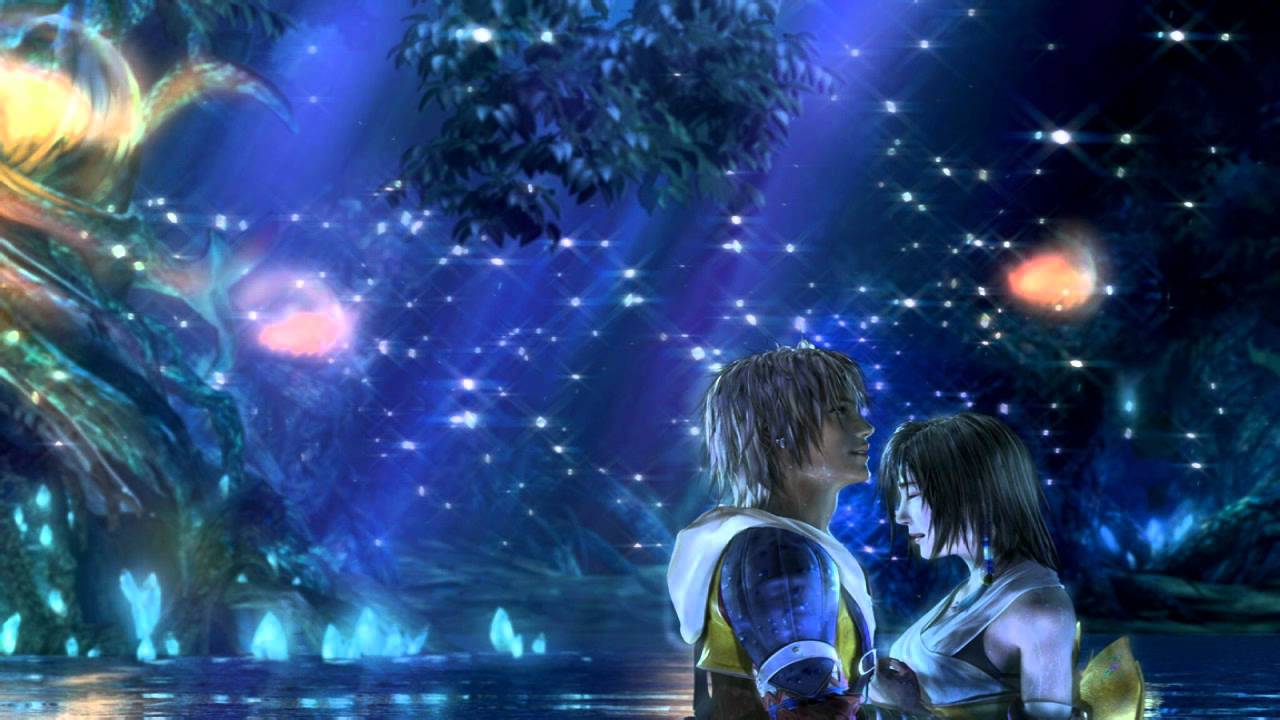
Yuna is the true heart of Final Fantasy X. At first, she appears reserved, gentle, and almost impossibly composed, but that calmness is a defense. She has been raised to accept an obligation that asks her to carry the hopes of Spira, and the game gradually exposes the brutal cost of that role. Her story is about realizing that kindness does not require obedience, and that faith does not have to mean accepting cruelty forever. Yuna is never reduced to being simply Tidus’s romantic interest. Their relationship matters because he sees her as a person before he fully understands what the world expects her to give up. That dynamic makes their romance feel earned rather than imposed.
Their relationship is one of the best in the series because it is built through ordinary moments as much as grand ones. They talk, joke, tease one another, share awkward silences, and slowly become the one person each can speak honestly with. The romance is not there to distract from the larger plot; it gives the story its emotional center. The question is never only whether Spira can be saved from Sin. It becomes whether Tidus and Yuna are allowed to imagine a life that is not defined by sacrifice. That is why the later turns of the story hurt as much as they do. Final Fantasy X understands that a world-saving quest becomes meaningful when the people involved have something personal they are fighting to keep.
The rest of the party helps make Spira feel like a lived-in place rather than a backdrop for Tidus and Yuna. Auron is the cool, stoic guardian archetype, but his guarded nature hides regret and responsibility. Wakka can be frustrating because he begins with deeply ingrained prejudices and unquestioned religious beliefs, but his growth works precisely because the game does not pretend he starts out enlightened. Lulu has some of the sharpest dialogue and a quietly emotional connection to the group. Kimahri is sparse with words, but his loyalty and history of exile make his presence meaningful. Rikku brings skepticism, humor, and a much-needed challenge to the assumptions that most of Spira has normalized. Together, they feel like a genuine group of travelers linked by old wounds, conflicting loyalties, and a growing sense that they cannot continue following the same path.
Spira is one of the series’ finest worlds because it is colorful, beautiful, and deeply sad all at once. Its beaches, temples, forests, ruined cities, and moonlit roads give it a warmer visual character than the industrial settings of several earlier entries, but that warmth never becomes carefree. Sin hangs over everything. The clash between the high-tech Zanarkand of Tidus’s memories and Spira’s restrictive religious society creates the game’s central tension. Technology is not simply treated as good or bad; it is tangled up with historical guilt, fear, and the power to decide who is allowed to define sin. The game is critical of religious institutions without being cynical about faith itself, which gives its world more depth than a simple rebellion narrative.
The music is inseparable from the story’s impact. Composed primarily by Nobuo Uematsu, Masashi Hamauzu, and Junya Nakano, the soundtrack understands that a melody can tell the player how to feel before the plot explains why. “To Zanarkand” is one of the defining pieces of Final Fantasy music: lonely, fragile piano notes that announce immediately that this is going to be a sad story. “Besaid Island” is warmer and lighter, creating a brief sense of peace before the pilgrimage’s true weight becomes clear. “The Hymn of the Fayth” may be even more important because it functions as an in-world sacred song, with its emotional meaning changing as the player learns more about Spira.
Other tracks turn scenes into permanent memories. “Otherworld” makes the opening Blitzball sequence feel thrilling and chaotic. “Suteki da ne” is openly romantic, but it earns its emotion because the game has patiently developed Tidus and Yuna’s connection. “A Fleeting Dream” and “Someday the Dream Will End” are quietly devastating, allowing sadness to settle rather than demanding tears from the player. Even the battle themes have a strong sense of momentum and atmosphere. Later games in the series have excellent soundtracks—some arguably have individual tracks that stand alongside anything here—but Final Fantasy X may be the strongest at integrating its music with its storytelling. Certain melodies do not just remind you of scenes; they make you feel the scenes again.
Its biggest mechanical innovation is the Sphere Grid. Instead of receiving traditional level-ups with automatic stat increases, characters earn AP after battles, gain Sphere Levels, and use those levels to travel across a huge board of connected nodes. Each node can grant a stat boost, a spell, a special technique, or a passive ability, but it must be activated with the appropriate sphere item. The result is a leveling system that feels visual and physical. You do not merely watch Strength or Magic rise in a menu. You plot a route, move through it, unlock a node, and decide where that character should grow next.
The early game gives every party member a distinct route. Tidus moves toward speed and time-based support magic, Yuna develops white magic and summoning tools, Lulu gains increasingly powerful black magic, Auron builds physical strength and defensive enemy-breaking abilities, and Rikku develops utility skills. That structure works because the battle system expects the player to rotate the party depending on enemy weaknesses. Tidus handles fast and airborne enemies, Auron crushes armored foes, Lulu punishes elemental weaknesses, and Yuna’s Aeons can change the entire rhythm of a difficult battle. The Sphere Grid makes those roles feel natural rather than arbitrary.
Later, the system becomes much freer. Key Spheres open locked paths, and special movement spheres can move a character into another person’s section of the Grid. You can turn Yuna into a formidable physical attacker, give Tidus high-level magic, or make Auron a surprisingly effective support character. The Standard Grid keeps everyone on more clearly defined routes, while the Expert Grid begins characters closer together and allows more experimentation earlier. It is one of the series’ most elegant systems because it gives newcomers direction without depriving experienced players of freedom. It also fits the story’s themes: Spira is filled with people assigned roles by faith, family, history, and fear, while the Sphere Grid lets the player decide whether to stay on the expected route or become something different.
Subsequent Final Fantasy games have surpassed Final Fantasy X visually. Final Fantasy XII offers massive environments and political scale, Final Fantasy XIII has some of the most striking art direction in the franchise, and Final Fantasy XV, Final Fantasy XVI, and the Final Fantasy VII Remake project achieve cinematic visual detail impossible on the PlayStation 2. Yet bigger worlds and more advanced graphics have not consistently produced better storytelling, stronger music integration, or more satisfying character progression. Later games often have tremendous individual strengths, but they can also feel more fragmented: mechanically uncertain, overly dependent on lore, or less focused in their party dynamics.
That is why Final Fantasy X still stands so tall. Like Final Fantasy VI, it feels like a point where the series’ best ideas aligned. Its story is emotional without becoming hollow spectacle, its soundtrack is embedded in the player’s memory, and the Sphere Grid makes progression feel like an active creative choice. It can be linear, very sincere, and occasionally a little corny, but those are parts of its personality rather than weaknesses that ruin it. Final Fantasy VI will always be my favorite, but Final Fantasy X is the one that hurts the most—and that is exactly why it remains the bar that later 3D Final Fantasy games still struggle to reach.