The TSL’s Daily Horror Grindhouse: Road Games (dir by Abner Pastoll)


Road Games is an odd film.  On the one hand, it’s such a slow-moving film that there’s really not a whole lot of plot to describe.  On the other hand, what little plot that does exist all hinges on a big twist that I really can’t reveal.  Considering how offended some people get when I reveal the end of a Lifetime film on this site, I can only imagine the reaction if I spoiled this film.

Jack (Andrew Simpson) is a depressed British guy who is stranded in France.  He’s been hitchhiking across the country, hoping to make his way to Calais so that he can catch a ferry back to the UK.  Oddly, he’s traveling with no bags.  When we first meet Jack, he’s frustrated because nobody is willing to stop and pick him up.

Jack does eventually meet another hitchhiker, Veronique (Josephine de la Baume).  Despite the fact that Jack speaks little French and Veronique speaks little English, they have an immediate chemistry.  Veronique even lets Jack know why nobody wants to pick him up.  Apparently, there’s a serial killer in the area!

Shortly afterwards, a car actually does stop.  The owner of the car, Grizard (Frederic Pierrot), offers them a ride.  Jack quickly gets in the car but Veronique is weary of the rough-spoken Grizard and only reluctantly gets in the back seat.  They drive.  Grizard asks way too many personal questions.  He stops to pick a dead rabbit off of the road.  He gets mad when Jack tries to turn on the radio.  He also mentions that, because of a strike that neither Jack nor Veronique had heard about, there are no ferries from Calais.  He offers to let Jack and Veronique stay at his home for the night.  Though Veronique is reluctant, Jack readily agrees.

Grizard’s wife is Mary (Barbara Crampton).  Grizard insists that Mary is British but Mary tells Jack that she’s actually from the States.  Veronique doesn’t trust either Grizard or Mary but Jack says that they’re probably just lonely.  Veronique is offended that she and Jack are given separate rooms.  Jack replies that they’re probably just old-fashioned…

And that’s all I can tell you about the plot!  There’s a really big twist and it’s actually fairly clever.  But, my God, it takes forever to get there.  Road Games is a very slow film.  I know some of that was to build up suspense and the film is certainly not a failure but it’s still hard not to feel that Road Games was basically a terrifically effective 20-minute short film that was unnecessarily padded out to 95 minutes.

Road Games did the festival circuit in 2015 and got a release earlier this year.  It’s currently on Netflix and I guess I would give it a partial recommendation, especially if you’re a fan of the horror road genre.  There was a lot I did like about the movie: the cinematography is gorgeous and the original score is evocative of the best of giallo.   The acting is okay, though Barbara Crampton is really the only stand-out in the cast. Throughout the film, the characters speak in a combination of French and English and Road Games makes good use of the language barrier to keep us off-balance.  (How much is Jack understanding? we constantly wonder.)  But the film itself is just so slow!  I’ll be curious to see what director Abner Pastoll does next.  I just hope his next film has a steadier pace.

166490-l-lo


Horror On The Lens: Son of Frankenstein (dir by Rowland V. Lee)


son_of_frankenstein_movie_poster

For those who might have a hard time keeping their Universal monster films straight, 1939’s Son of Frankenstein is the third Frankenstein film, following the original and Bride of Frankenstein.  It’s the first one to have been directed by someone other than James Whale.  It’s the one that features the one-armed policeman.  It’s the one that features Bela Lugosi as a vengeful grave robber named Ygor.  It’s also the final film in which Boris Karloff would play the monster.

And, on top of all that, it’s also a pretty good movie, one that holds up as both a sequel and stand-alone work!

Son of Frankenstein opens decades after the end of Bride of Frankenstein.  (How many decades is open for debate.  I’ve read that the film is supposed to be taking place in 1901 but there’s a scene featuring a 1930s-style car.  Let’s just compromise and say that the film is taking place in 1901 but someone in the village owns a time machine.  I think that’s the most logical solution.)  Henry Frankenstein is long dead, but his name continues to strike fear in the heart of Germans everywhere.  Someone has even tagged his crypt with: “Heinrich von Frankenstein: Maker of Monsters.”

Needless to say, everyone in the old village is a little uneasy when Henry’s son, Wolf von Frankenstein (Basil Rathbone) shows up at the castle.  In fact, they’re so uneasy that the local constable, Krogh (Lionel Atwill), pays Wolf and his family a visit.  Krogh explains that, when he was a child, the Monster ripped his arm out “by the roots.”  AGCK!

(That said, that really doesn’t sound like the Frankenstein Monster that we all know and love, does it?  I suspect there’s more to the story than Krogh is letting on…)

Wolf explains that he has no plans to bring the Monster back to life.  He then sets out to do just that.  Wolf wants to redeem Henry’s reputation and the only way to do that is to prove that Henry was not misguided in his quest to play God.  Helping Wolf out is Ygor (Bela Lugosi).  Ygor is a former blacksmith who was due to be hanged but, because of a malfunction with the gallows, he just ended up with a disfigured neck.

It turns out that Ygor happens to know where the Monster’s body is being hidden.  When Wolf brings the Monster back to life, he quickly discovers that Ygor’s motives weren’t quite as altruistic as Wolf originally assumed.  It turns out that Ygor wants revenge on the jury that sentenced him to death and now, he can use the Monster to get that revenge.

As for the Monster, he no longer speaks.  Instead, he just angrily grunts and he kills.  Whatever kindness he developed during the previous film was obviously blown up with Elsa Lanchester at the end of Bride of Frankenstein.  On the one hand, it’s fun to see Karloff as the monster.  On the other hand, it’s impossible not to regret that he doesn’t get to do much other than stumble around, grunt, and strangle people.  There are only two scenes where Karloff gets to show any real emotion and, in both cases, he does such a great job that you can’t help but regret that the monster is such a one-dimensional character in Son of Frankenstein.

But no matter!  Regardless of how the film uses (or misuses) the Monster, it’s still an entertaining 1930s monster film.  Basil Rathbone does a great job as the imperious but ultimately kindly Wolf von Frankenstein.  And Bela Lugosi’s natural theatricality makes him the perfect choice for Ygor.  To be honest, I actually think Lugosi does a better job as Ygor than he did as Dracula.  I know that’s blasphemy to some but watch the two films side-by-side.  Lugosi is clearly more invested in the role of Ygor.  Considering that Lugosi reportedly felt that he was mistreated in Hollywood, it’s tempting to wonder if some of his own anger informed his performance as the perennially mistreated and bitter Ygor.

Son of Frankenstein closed out the Karloff Frankenstein trilogy.  When Frankenstein’s Monster made his next appearance, he would be played by the same actor who later took over the role of Dracula from Lugosi, Lon Chaney, Jr.

(And interestingly enough, Lugosi would subsequently take over the role of the Monster from Chaney.  But that’ll have to wait for a future review…)

4 Shots From Horror History: Night of the Demon, Curse of Frankenstein, Horror of Dracula, The Mummy


This October, I’m going to be doing something a little bit different with my contribution to 4 Shots From 4 Films.  I’m going to be taking a little chronological tour of the history of horror cinema, moving from decade to decade.

Today, we reach the end of the 50s and the rise of British horror.

4 Shots From 4 Films

Night of the Demon (1957, dir by Jacques Tourneur)

Night of the Demon (1957, dir by Jacques Tourneur)

The Curse of Frankenstein (1957, dir by Terence Fisher)

The Curse of Frankenstein (1957, dir by Terence Fisher)

 Horror of Dracula (1958, dir by Terence Fisher)

Horror of Dracula (1958, dir by Terence Fisher)

The Mummy (1959, dir by Terence Fisher)

The Mummy (1959, dir by Terence Fisher)

Horror on the Lens: 13 Ghosts (dir by William Castle)


Since I reviewed the remake yesterday, today’s Horror on the Lens is the 1960 original, William Castle’s 13 Ghosts!

Now, William Castle was famous for his gimmicks.  For instance, theaters showing The Tingler were wired to give electrical shocks to random patrons.  He had a special gimmick for 13 Ghosts, a film about a house haunted by ghosts that you can only see while wearing special goggles.  Since I’m a lazy film blogger, I’m going to quote the film’s Wikipedia article on this particular gimmick:

“For 13 Ghosts, audience members were given a choice: the “brave” ones could watch the movie and see the ghosts, while the apprehensive among them would be able to opt out of the horror and watch without the stress of having to see the ghosts. The choice came via the special viewer, supposedly “left by Dr. Zorba.”

In the theatres, most scenes were black and white, but scenes involving ghosts were shown in a “process” dubbed Illusion-O: the filmed elements of the actors and the sets — everything except the ghosts — had a blue filter applied to the footage, while the ghost elements had a red filter and were superimposed over the frame. Audiences received viewers with red and blue cellophane filters. Unlike early 3D glasses where one eye is red and the other is cyan or blue, the Illusion-O viewer required people to look through a single color with both eyes. Choosing to look through the red filter intensified the images of the ghosts, while the blue filter “removed” them. Despite Castle’s claims to the contrary, not many heart failures or nervous breakdowns were averted by the Illusion-O process; although the blue filter did screen out the ghostly images, the ghosts were visible with the naked eye, without the red filter.”

Personally, if I had been alive in 1960, I totally would have watched the whole movie through the red filter.  Go ghosts go!

Anyway, 13 Ghosts is actually a lot of fun in a low-budget, 1960s drive-in sort of way.  Watch it below and, as always, enjoy!


The TSL’s Daily Horror Grindhouse: Demons 2 (dir by Lamberto Bava)


demons-2-2

1985’s Demons was such a success that it only took one year for it to be followed by a sequel.  Like the first film, Demons 2 was directed by Lamberto Bava and produced by Dario Argento.  (Once again, Argento is also credited with co-writing the script.)  Bobby Rhodes appears in both films, though he plays two different characters.  And again, it’s the same basic plot: watching a movie leads to an outbreak of a plague that transforms a group of people into a pack of murderous demons.

And yet, despite all the similarities, Demons 2 is a hundred times better than the first Demons.  And I say that as someone who really likes the first film.  There simply is no comparison between the two.  If Demons was a nonstop thrill ride, Demons 2 is a filmed nightmare.

Demons 2 takes place in a high-rise apartment building.  In the style of any good disaster movie, the first part of the film introduces us to the tenants and gives us just enough information so that we’ll be able to remember who is who.

For instance, in one apartment, we have George (David Knight) and his pregnant wife, Hannah (Nancy Brilli).  In another, we have a woman (Anita Bartolucci) who obsessively dotes on her dog.  Down the hall, ten year-old Ingrid Haller (Asia Argento, making her film debut) watches TV while her parents eat dinner.  In the basement, a gym instructor named Hank (Bobby Rhodes) shouts encouragement at a group of body builders.

And finally, in another apartment, a teenage girl named Sally (Coralina Cataldi Tassoni) sits in her bedroom and cries.  It’s her birthday but her parents are out for the night.  Meanwhile, her friends are gathered in the living room and wondering if Sally is ever going to come out of her room.  Sally is upset because her boyfriend didn’t come to the party.  Poor Sally.

In her sadness, Sally has turned on her TV but she’s barely watching.  And what’s on TV that night?  A horror movie, one that tells the same story as the one we saw in the first Demons and the one that we will eventually see again in Demons 2 (and also in Michele Soavi’s The Church).  A group of teenagers come across a dead demon.  When one of them accidentally gets splashed by the demon’s blood, he is transformed into a demon himself…

(If this sound familiar, that’s perhaps because the same idea was later used in 28 Days Later, a film that owns a not insignificant debt to both of the Demons films and Umberto Lenzi’s Nightmare City.)

Suddenly, the movie demon stops and seems to be staring straight at the unseen camera.  He starts to approach it, until his twisted face fills the entire TV screen…

Suddenly, the demon bursts out of the TV and infects Sally.  Sally finally leaves her bedroom and proceeds to attack everyone at her party, spreading the infection.  Meanwhile, acidic demon bile eats through the floor and drips into the apartments below, infecting everyone that it touches…

demons-2

And I do mean everyone!  If there’s anything that truly separates the Demons films from so many other horror films, it’s that literally anyone can be infected.  It doesn’t matter if you’re likable or if you’re funny or if you’re played by a familiar actor.  If you get infected, you’re going to turn into a demon.  Usually, when you watch a horror film, you can sure that children and pregnant women will automatically be safe.  Demons 2 wastes little time in letting you know that this isn’t the case as far as this film is concerned.

Demons was pretty much distinguished by nonstop action.  In Demons 2, director Lamberto Bava devoted more time to atmosphere and characterization.  As a result, Demons 2 features characters that we actually care about and  some truly haunting images, everything from Sally’s friends moving, in slow motion, down a dark hallway to Asia Argento watching as her parents are literally ripped into pieces in front of her.  If Demons was defined by its relentless heavy metal soundtrack, Demons 2 is defined by the ambient but haunting new wave music that plays through the majority of the film.  Demons was an action-horror film.  Demons 2 is a nightmare from which you cannot awake.

If you have the opportunity, I would say to watch both of the Demons films.  But if you have to choose only one to watch, go with Demons 2.

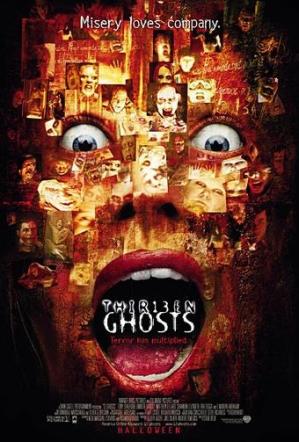
Horror Film Review: Thirteen Ghosts (dir by Steve Beck)


thir13en_ghosts_poster

Thirteen Ghosts!  

Oh my God, this 2001 haunted house movie scared the Hell out of my when I was way too young to know any better.  Seriously, it would come on HBO late at night and I would secretly watch it with the sound turned down and just the visuals would freak me out.

That lawyer getting chopped in half by the glass doors?  AGCK!

That ghost staring at Shannon Elizabeth?  AGCK!

That other ghost attacking Shannon Elizabeth?  AGCK!

All of the ghosts suddenly appearing and then just as quickly disappearing?  AGCK!

MATTHEW LILLARD!?  DOUBLE AGCK!

Seriously, I had nightmares about those ghosts!

For this month’s horrorthon, I decided to rewatch Thirteen Ghosts and … well, first of all, I was reminded by the DVD that apparently, the name of the film is not Thirteen Ghosts.  Instead, the proper name is Thir13een Ghosts, which is really kind of annoying because it’s not like that “13” even vaguely resembles a “T”.  I’m not even sure how exactly you would pronounce Thir13een.  Wasn’t one of the robots in the last Star Wars film named Thir13een?  Just looking at the title makes me think about that episode of South Park where Cartman went into the future and had a robot dog named K-10 (and a cat named Kit-9 and a bird named Kok-A-3!)

So, no offense meant to anyone who was involved in the naming of the film, but I’m going to keep calling it Thirteen Ghosts!

Anyway, I decided to rewatch Thirteen Ghosts because I remembered it as being the scariest film ever made and … wow, it really did not stand up to the test of time.  I mean, don’t get me wrong.  The ghosts were still kind of scary and I guess that Tony Shalhoub did the best that he could do with the material.  But the movie itself…oh my God.

Seeing as how I’m contractually obligated to come up with at least 500 words about Thirteen Ghosts, let’s talk about the plot, shall we?  Tony Shalhoub is Arthur.  Arthur’s a widower who has two children, Kathy (Shannon Elizabeth) and Bobby (Alec Roberts).  For some reason, Kathy is obsessed with sink fixtures.  Bobby, meanwhile, is your typical bratty kid.  Arthur is like way poor and about to lose his house.  Despite this, he continues to employ a housekeeper named Maggie (Rah Digga).  HEY, ARTHUR, THERE’S NO POINT IN HAVING A HOUSEKEEPER IF YOU CAN’T AFFORD YOUR FREAKING HOUSE!

Anyway…

Fortunately, Arthur is informed that his uncle, a legendary ghost hunter named Cyrus (F. Murray Abraham) has died and, as a result, Arthur has inherited his mansion!  YAY!  PROBLEM SOLVED!  Of course, the mansion is kind of weird.  The walls are covered with Latin phrases and it’s all glass.  “I do not do windows,” Maggie says.  Ha ha ha.

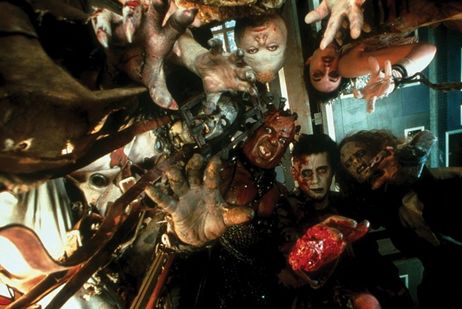
Well, it turns out that the entire house is full of murderous ghosts.  (Of course, you can’t see them unless you put on special glasses.)  We occasionally get glimpses of the ghosts and this is where Thirteen Ghosts actually triumphs.  The ghosts actually are really freaky looking and they’ve all got enjoyably weird backstories.  That’s a good thing.

What isn’t a good thing is that, in order for the ghosts to get free and wreck some havoc, everyone in the house is required to act like a total idiot.  Hence, we get Shannon Elizabeth staring at herself in a mirror for literally four minutes, just so one ghost can sneak up behind her.  We get Bobby and Maggie constantly running off.  We also get Embeth Davidtz as a “spirit liberator” and Matthew Lillard as a psychic.

Does Matthew Lillard give a good performance in Thirteen Ghosts?  It’s hard to say.  He definitely gives a performance that could only be given by Matthew Lillard.  There’s a few scenes where you do wish someone on set had told him to calm down but, on the whole, you can count me in the pro-Lillard camp.  It’s a silly film and it needs someone willing to give a silly performance.

There are a few parts of Thirteen Ghosts that have stood up well.  The ghosts, the production design, the scene with the lawyer.  But ultimately, the movie fails because you really don’t care about Arthur or his family or his housekeeper.  In these type of films, the main characters either have to be likable or they have to be so unlikable that you don’t mind seeing them get terrorized.  But bland just will not get the job done!

Since I love lists, here’s my ranking of the ghosts, from least to most frightening:

  1. The Withered Lover — I can’t talk too much about her without it counting as a spoiler but she’s the only ghosts that isn’t malicious and therefore, she’s not frightening.
  2. The Bound Woman — A hanging woman wearing a prom dress.  Who cares?
  3. The Torso — The torso is a legless torso that has to drag itself around by its hands.  The torso is kinda freaky but it’s hard to be scared of something that doesn’t have legs.
  4. The Pilgrimess — The Pilgrimess was accused of witchcraft in the 17th Century.  She’s kind of scary but she’s also still in the stocks so she’s not quite as threatening as she could be.
  5. The Great Child and
  6. the Dire Mother — AGCK!  The Dire Mother is a tiny woman who is always feeding her giant son, the Great Child!  Creepy!
  7. The Torn Prince — The Torn Prince always freaks me out.  Not only is he massively disfigured as the result of a car crash but he also carries a baseball bat.  AGCK!
  8. The First Born Son — The first born son is a kid who has an arrow sticking out his head.  He whispers that he wants to play.  AGCK!  Children are creepy.
  9. The Angry Princess — The Angry Princess is a total rip-off of the bathtub ghost from The Shining but she still scares the Hell out of me.  AGCK!
  10. The Hammer — AGCK!  He’s a former blacksmith, covered in spikes and featuring a hammer in place of his left hand.
  11. The Juggernaut — Oh my God, this guys is scary and evil-looking!  We’re told that he killed 9 people when he was alive and 31 people as a ghost.  DOUBLE AGCK!
  12. The Jackal — OH MY GOD!  The Jackal gave me nightmares when I was younger and he’s still the scariest of the ghosts!  He’s the one who has a cage on his head.  The scene where he attacks Shannon Elizabeth is pure nightmare fuel!  TRIPLE AGCK!

Anyway, the movie’s not as scary as I remembered but those ghosts are still Agck-worthy.

2001ghosts


Horror On The Lens: Revenge of the Creature (dir by Jack Arnold)


For today’s horror on the lens, we present to you 1956’s Revenge of the Creature!

Revenge of the Creature was the first sequel to The Creature From The Black Lagoon.  It turns out that the Gil-Man didn’t actually die at the end of the last film.  Instead, he’s alive, he’s been captured, and he’s now being displayed in an aquarium.

Now, I’m going to be honest: Revenge of the Creature is not as a good as The Creature From The Black Lagoon.  But it’s still kind of fun in a silly 1950s monster movie sort of way.  And, if you keep your eyes open, you might spot a very young Clint Eastwood, playing a lab technician and sporting a truly impressive head of hair.

Enjoy!


Film Review: The Girl On The Train (dir by Tate Taylor)


the-girl-on-the-train

Before I get around to talking about The Girl On The Train, I’m going to tell you a little story about myself.

A few years ago, I used to make a point of riding the DART train.  (DART stands for Dallas Area Rapid Transit.  Large sections of Upstream Color were filmed on a DART train.)  Every weekend, instead of driving out to the Dallas Angelika or the Dallas Museum of Art and contributing to climate change or whatever it was that I was supposedly doing whenever I drove my car, I would hop on the train.  It was a little inconvenient but I was saving the world.  Or something.

It was about a 30 minute ride from my local DART Station to downtown Dallas and I have to admit that I actually used to enjoy it.  I would always look out the window and watch as Dallas passed by.  I got to know all of the buildings and houses on the route pretty well.  Thanks to riding the DART train, I discovered that there’s a house on Forrest Lane that’s been boarded up for five years and counting.  Near Spring Creek, there’s a two-story house that I wouldn’t mind owning.  It’s a two-story glass house and it has a really nice deck that looks out over the creek.  I would always look at those houses and, in my mind, I would make up lurid stories about the people who lived there.  For a while, it was great fun.

(Unfortunately, it eventually stopped being fun but that’s a story that will have to wait for whenever I finally get around to reviewing Ms. 45…)

As I watched The Girl On The Train, I started to think about those times on the DART train.  And the more I thought about it, the more I realized that every story that I came up with while sitting on my DART train was a hundred times more interesting than anything that happened in The Girl On The Train.

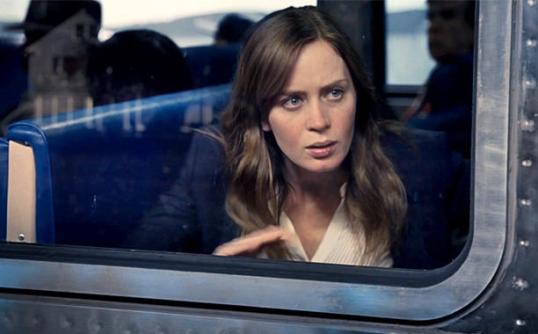
Emily Blunt stars as Rachel Watson.  Rachel is an alcoholic.  She got divorced from Tom (Justin Theroux) after she discovered that Tom was having an affair with their real estate agent, Anna Boyd (Rebecca Ferguson).  Tom and Anna are now married and have a baby.  Rachel, meanwhile, is a blackout drunk who has been unemployed for a year.  She spends her time on a train, drinking and ride back and forth between Connecticut and New York.

Every night, the train stops near Rachel’s old house.  Rachel looks out the window and she stares at her former home.  Occasionally, she sees Tom and Anna celebrating their new life.  Rachel also finds herself obsessing on the house next door.  Megan Hipwell (Haley Bennett) lives at the house and works as Tom and Anna’s nanny.  As Rachel discovers from looking out the train’s window, Megan is cheating on her husband with a mysterious, bearded man (Edgar Ramirez).

(Rachel has a really good view from her window seat.  Admittedly, I’m notoriously near-sighted so I might not be the best judge, but I could never actually see what was happening inside any of the houses that I stared at.  Rachel, however, must have super vision.  Maybe she was Supergirl before she turned into an alcoholic.  Who knows?)

One day, a drunk-off-her-ass Rachel forces her way off of the train and stumbles towards her former home.  She thinks that she sees Anna jogging and chases after her.  “Whore!” Rachel yells before passing out.  When Rachel regains consciousness, she can’t remember anything that happened.  But she has vague memories of being involved in some sort of struggle…

Eventually, Rachel learns that Megan is missing and presumed murdered.  Even worse, Rachel is the number one suspect.  The main detective (who is somewhat inevitably played by Allison Janney) suspects that Rachel mistook Megan for Anna.  It turns out that Rachel has a history of erratic behavior.  She even tried to kidnap Tom and Anna’s baby!  Seriously, lock Rachel up!

Trying to figure out what happened and clear her name, Rachel approaches Megan’s husband, Scott (Luke Evans) and pretends to be a friend of Megan’s.  It turns out that Scott was an abusive husband.  Soon, he’s both confiding in Rachel and encouraging her to start drinking again.  Rachel starts spending more and more time with Scott and it becomes obvious that she’s trying to live the life that she once imagined that Megan and Scott had.  There’s an interesting subtext to both Rachel’s obsession with Megan and her attempt to start a new relationship with Scott but it’s never really explored.  Instead, it’s brought up and then abandoned a few scenes later.

In fact, as a film, The Girl On The Train never really explores anything.  (It only grudgingly hints at the complexity of the book on which it was based.)  As opposed to similar films like Gone Girl or Denis Villeneuve’s Prisoners, there’s not much depth or insight to The Girl On The Train.  I’ve read some reviews that have complained that The Girl On The Train is “melodramatic” or “trashy,” but, if that were the case, it would at least be a fun movie to watch.  This is one of those films that thinks it’s a lot deeper than it actually is.

The Girl On The Train was probably doomed as soon as Tate Taylor was hired to direct it.  Taylor previously directed both The Help and a musical biopic called Get On Up.  Tate Taylor is one of those directors who goes out of his way not to challenge his audience (The Help is one of the most positive films about systemic racism that I’ve ever seen) but The Girl On The Train needed a director with more of a subversive edge.  The Girl On The Train needed a director who would embrace the film’s pulpy sensibility as opposed to one who would go out of his way to sand away the story’s rough edges and create an inoffensive and bland product that would be perfect for mass consumption.

And then you’ve got the film’s cast, which is full of talented performers who all seem to be uniquely uninspired by the material that they have to work with.  Emily Blunt did such good work in Looper and Sicario so why is she so boring here?  Why does Justin Theroux seem to be eagerly awaiting the end of the movie?  Why are both Haley Bennett and Rebecca Ferguson reduced to playing characters who feel as if they’ve sprung out of a misogynist’s daydream?  What is Edgar Ramirez even doing in the movie?  Or Lisa Kudrow?  Or Laura Prepon?  Why is it that every world-weary female authority figure has to be played by Allison Janney?  Why?  Why?  Why!?

So, I have to admit that I was a bit disappointed with The Girl On The Train.  I think I would have been more entertained if I had just hopped on the DART train and let my imagination do the rest of the work.

The TSL’s Daily Horror Grindhouse: Demons (dir by Lamberto Bava)


demons

“What the Hell happened to Rosemary?”

— Tony The Pimp (Bobby Rhodes) in Demons (1985)

A lot of what you need to know about Demons, an Italian horror film from 1985, can be summed up by the fact that one of the leading characters is named Tony the Pimp.  Demons is a very self-aware film, one that is not only over-the-top and ludicrous but which is cheerfully aware that it’s over-the-top and ludicrous.  Considering that Demons is an apocalyptic film that ends with nearly the entire cast dead, Demons is a surprisingly good-natured horror film.

The film opens in Berlin.  There’s a mysterious man hanging out at a subway station.  He’s wearing a silver half-mask and, from what we can see of his face, he appears to be heavily scarred.  Interestingly enough, the man is played by Michele Soavi.  (Though Soavi is now best remembered as the director of Dellamorte Dellamore, he was an actor and assistant to Dario Argento when Demons was produced.)  The man doesn’t speak.  Instead, he hands out flyers to random people, inviting them to attend the premiere of a new horror film.

The man obviously does a very good because a truly diverse group of characters show up for the premiere.  There’s a wealthy blind man who comes with his assistant.  (The assistant is played by Dario Argento’s oldest daughter, Fiore.)  There’s an older couple who keep shushing everyone in the audience.  There’s Cheryl (Natasha Hovey), who ends up sitting next to the handsome George (Urbano Barberini, who would later co-star in Dario Argento’s Opera).  And, of course, there’s Tony the Pimp (Bobby Rhoades) who shows up wearing a white suit and with two prostitutes.

The film-within-the-film is a horror film that plays out like an homage to every Italian horror film released in the 1980s.  It deals with four teenagers who stumble across the grave of Nostradamus and end up transforming into blood-thirsty demons.  One of the teenagers is played by Michele Soavi, though it’s never clear whether the teenager and the man in the mask are supposed to be the same person.

As they watch the movie, something strange starts to happen in the audience.  One of the prostitutes scratched her face when she put on a prop mask.  When the same mask appears in the movie, the cut on her face starts to throb.  Soon, she is transformed into a … DEMON!

JUST LIKE IN THE MOVIE!

Needless to say, the arrival of a real-life demon leads to a panic in the theater but guess what?  The doors are locked!  There’s no way out!  When Tony the Pimp breaks into the projection booth, he discovers that there’s no projectionist and the movie cannot be stopped!  On top of that, getting scratched by a demon means that you transform into a demon yourself!

In other words — remember the debate about whether or not horror movies can turn their viewers into murderous monsters?  Well, Demons says that they definitely can…

Demons was directed by Lamberto Bava, son of the famous Mario Bava, and it remains one of the most popular Italian horror films of all time.  With a script that was co-written by Dario Argento (who also produced), Demons is a fun and exciting horror film that cheerfully dares you to take it too seriously.  Watching this energetic film, you can tell that Bava was having a lot of fun with the idea that the world could end as a result of watching just one horror movie.

Demons was a huge box office hit so, naturally, there were hundreds of unofficial sequels.  Though Michele Soavi’s The Church was a Demons film in every way but name, the only official sequel was Demons 2.  We’ll look at that film tomorrow.

Horror Film Review: The Invisible Man (dir by James Whale)


the-invisible-man

The 1933 Universal horror film, The Invisible Man, never seems to get as much attention as Frankenstein, Dracula, The Wolf Man, or The Mummy.  Perhaps it’s because the invisible man really isn’t a supernatural monster.  He’s just a scientist who has turned himself invisible and is now going mad as a result.  Or maybe it’s because there have been so many crappy films that have used invisibility as a plot point that the reputation of the original Invisible Man suffers by association.

For whatever reason, The Invisible Man never seems to get spoken about in the same breathless, gleeful manner as some of the other Universal monsters.  But I have to admit that, though I usually can’t stand movies about invisibility, I rather like The Invisible Man.

Based on a novel by H.G. Wells, The Invisible Man opens with a mysterious man (played by Claude Rains) arriving in a small English village.  He checks into a small inn and soon, everyone in the village is scared of him.  It’s not just his haughty attitude or his habit of ranting about his own superiority.  There’s also the fact that he is literally covered, from head to toe, in bandages.  He always wears gloves and dark glasses.  He insists that he’s doing important research and demands to be left alone.

The inn keeper (Forrester Harvey) and his histrionic wife (Una O’Connor) put up with the mysterious man until he falls behind on his rent.  However, once confronted, the mysterious man announces that he’s not going anywhere.  When the police and a mob of villagers arrives, the man starts to laugh like a maniac.  He unwraps the bandages around his head and…

THERE’S NOTHING UNDERNEATH!

Well, there is something there.  It’s just that the man is invisible so no one can see what’s underneath.  It turns out that the man is Dr. Jack Griffin, a chemist who has been missing for several days.  He’s created an invisibility serum but he can’t figure out how to reverse the effects.  Even worse, the serum is driving him insane.  Griffin’s fiancée, Flora (Gloria Stuart), and her father, Dr. Cranley (Henry Travers), are searching for Jack but Jack doesn’t particularly want to be found.  Jack is more interested in exploring how he might be able to use invisibility to conquer the world…

The Invisible Man is historically important because it was the film that brought Claude Rains to Hollywood.  Rains has previously made films in the UK but this was his first American film.  Think of how different film history would have turned out if The Invisible Man had, as originally planned, starred Boris Karloff.  Without Claude Rains coming to America, who would have played Louis in Casablanca?  Who would have played Sen. Paine in Mr. Smith Goes To Washington or Alex Sebastian in Notorious?  Of course, we don’t really see Claude Rains’s face until the very end of The Invisible Man.  Instead, we just hear his voice but what a voice Claude had!  He delivers his dialogue with just the right amount of malicious sarcasm.

I like The Invisible Man.  For modern audiences, it’s not particularly scary.  (Though I do find the idea of being unknowingly followed by an invisible person to be a little unnerving…)  However, unlike a lot of other old horror films, you can watch The Invisible Man and see why it would have been scary to an audience seeing it for the very first time.  In 1933, a time when film was still a relatively new medium and audiences had yet to become jaded by special effects, here was a man unwrapping his bandages to reveal that there was nothing underneath!  That had to have freaked people out!

The Invisible Man was directed by James Whale and the film features the same demented sense of humor that distinguished The Bride of Frankenstein.  The villagers are portrayed as being so hysterical that you can’t help but think that maybe Griffin has a point about being surrounded by fools.  By the time the local constable declares, “What’s all this then?,” you can’t help but start to sympathize with Jack Griffin.

There’s been a lot of  bad invisibility movies made but The Invisible Man is not one of them.  It may not be as well remembered as some of the other Universal horrors but it’s definitely one worth seeing.