Cleaning Out The DVR: And Now For Something Completely Different (dir by Ian MacNaughton and Terry Gilliam)


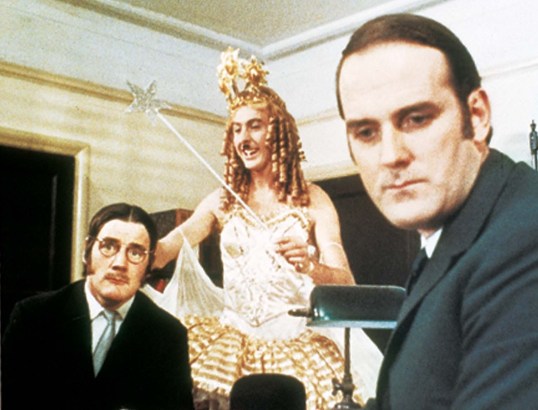
A tall, dark-haired British man sits behind a desk that is rather oddly sitting in the middle of a field.  He wears a dark suit and he looks quite serious as he says, “And now, for something completely different….”

Cut to a short film about a man with a tape recorder up his nose, followed by another short film about man who has a tape recorder up his brother’s nose.

A Hungarian man tries to buy cigarettes while using an inaccurate English phrasebook.  The publisher of the phrasebook is later brought before the court.

Poor old Arthur Pewty goes to marriage counseling and can only watch impotently as the counselor seduces his wife.  Having filed to stand up for himself, Pewty is crushed by 16-ton weight.

A self-defense instructor teaches his students how to defend themselves when they are attacked by a man with a banana.

A loquacious man in a pub says “nude nudge” and “wink wink” until his drinking companion is finally forced to slam down his drink.

A man who sees double recruits a mountaineer to climb the two peaks of Mt. Kilimanjaro.  Hopefully, they’ll be able to find last year’s expedition, which was planning on building a bridge between the two peaks.

There’s bizarre, almost Dadaist animation, featuring classic works of art interacting with cartoonish cut-outs.

Uncle Sam appears to explain how communism is like tooth decay.  A toothpase commercial explains how taking care of your teeth is like racing a car.  A motor oil company shows how it can destroy darkness and grim.

A prince dies of cancer but the spot on his face flourishes until it falls in love and moves into a housing development.

A man tries to return a dead pigeon.  The store clerk insists the pigeon is merely stunned and then sings about wanting to be a lumberjack.

A general complains that things have gotten much too silly.

The narrator appears randomly, announcing, “And now for something completely different….”

Okay, okay, you get the idea.  First released in 1971, And Now For Something Completely Different was the first film to be made featuring all of the members of Monty Python’s Flying Circus.  It was their initial attempt to break into the American market, a collection of surreal sketches that they had previously performed on television for the BBC.  Unfortunately, at the time, no one in America really knew who Monty Python was and the film failed at the box office, to the extent that many in the UK advised against Monty Python even allowing their program to later air on PBS because it was felt that Americans just wouldn’t get it.  Of course, Americans did eventually get it.  The show remains popular to this very day.  Countless Americans are convinced that they can speak in a perfectly convincing British accent, as long as they’re quoting a line from Monty Python.  The previous 4th of July, when the town band played John Philip Sousa’s Liberty Bell, I saw hundreds of people stamping down their feet at the end of it.  As for And Now For Something Completely Different, it was re-released in 1974 and became a bit of a cult favorite in the States.

That said, the members of Monty Python were never particularly happy with the film.  They were convinced to make the film by Victor Lownes, who was the head of Playboy’s UK operation.  Lownes, however, alienated the members of the group by trying to exert control over the material.  He particularly objected to the character of Ken Shabby, a perv who probably had a stash of sticky Playboys back at this flat.  Lownes also put up very little money for the production, meaning that the Pythons had to resort to shooting the film, without an audience, in a deserted factory.  Apparently, even the deliberately cheap-looking special effects of the television show were considered to be too expensive to recreate for the film.  Michael Palin and Terry Jones both later complained that the film itself was series of scenes featuring people telling jokes while sitting behind desks.

Of course, Lownes’s biggest sin was trying to insinuate that he was somehow the Seventh Python.  (One can only imagine how many people were guilty of the sin over the years.  Claiming to be the Seventh Python was probably a bit like claiming to be the Fifth Beatle.)  When Terry Gilliam was animating the film’s opening credits, the names of the cast were shown in blocks of stone.  Lownes insisted that his name by listed the same way.  Gilliam reluctantly acquiesced but then redid the names of the Pythons so that they were no longer in stone.  Fortunately, Victor Lownes would not involved in the subsequent Python films.

All that said, there’s no denying that And Now For Something Completely Different is a funny movie.  I mean, it’s Monty Python.  It’s John Cleese, Michael Palin, Graham Chapman, Eric Idle, Terry Jones and Terry Gilliam, all youthful and at the heights of their considerable comedic talents.  Even if all of the sketches are familiar from the show, they’re still funny and it’s impossible not to enjoy discovering the way that the movie threads them together.  (Combining the Lumberjack song with the dead parrot sketch worked out brilliantly.  “What about my bloody parrot!?” Cleese is heard to shout as Palin walks through the forests of British Columbia.)  Personally, my favorite Python is Eric Idle but I also love any sketch that involves Michael Palin getting on John Cleese’s nerves.  Everyone knows the dead parrot sketch, of course.  But I also like the vocational guidance counselor sketch.  It’s hard not to get caught up in Palin’s excitement as he discusses his lion tamer’s hat.  Almost as wonderful as Palin’s turn as Herbert Anchovy, accountant was Michael Palin’s turn as the smarmy host of Blackmail.  Actually, maybe Michael Palin is my favorite Python.  I guess it’s a tie between him and Eric.

And Now For Something Different has been on my DVR for quite some time.  I’ve watched it several times.  I’m not planning on deleting it any time soon.

Film Review: Lost Horizon (dir by Charles Jarrott)


“Friends forever.  It’s a nice idea.”

With those words, the late Casey Kasem closed out the infamous “Rockumentary” episode of Saved By The Bell.  In this episode, Zack Morris fell asleep in his garage while waiting for his high school friends to arrive for band rehearsal.  While he was asleep, he dreamt about becoming a superstar as the result of Zack Attack’s hit song, Friends Forever.  Later, of course, Zack was led astray by a publicist who tried to sell him as being a “male Madonna.”  Zack didn’t care about the fame.  He was more concerned that the music and the lights at his concert were so excessive that the audience couldn’t even hear his lyrics.  Because, seriously, when you’re coming up with banger lyrics like “We’ll be friends forever/yes we will,” you want to make sure that they can clearly be heard.

It’s easy to make fun of the band and the show but that doesn’t make Casey Kasem’s words any less true.  Friends forever.  It is a nice idea.  It’s also a totally unrealistic and implausible idea.  People grow apart.  People develop new interests.  People move to different towns.  Sometimes, people just decided that they need to take a little break from the same old thing.  Instead of demanding that people remain friends forever, it would perhaps be more realistic to encourage people to enjoy and treasure the time that they have in the present.  But, to be honest, entertainment is not about that type of reality.  No one wants to hear, “Be friends until you get bored.”  Instead, they want to hear “Friends forever!”  It’s a simple idea and the simple ideas are the ones that usually bring us the most comfort.

Take the idea behind Shangri-La, for instance.  Shangri-La was a utopia that was hidden away in the Himalayas.  It was a place where there was no war, no greed, and everyone was in nearly perfect health.  It was a place where it was common for people to live to be well over a hundred years old.  It’s a place where people literally can be friends forever.  And while the place does have one very big drawback — i.e., once you decide to stay there, you can’t return to the outside world for even so much as a brief visit — it’s still easy to see why this idealized existence would appeal to many people.

The lamasery of Shangri-La was first introduced in a 1933 novel called Lost Horizon.  Written by James Hilton, Lost Horizon told the story of a group of westerners who, fleeing from a political uprising in India, find themselves in Shangri-La.  That the novel’s portrayal of a peaceful utopia hidden away from the “modern world” proved to be popular should not come as a surprise.  In 1933, the world was still recovering from the Great War.  Much of Europe was still in ruins, both economically and physically.  The combination of the First World War and the Spanish Flu pandemic had shaken everyone’s faith in the future.  Even as a group of idealistic activists, industrialists, and politicians tried to make war illegal, Mussolini seized power in Italy.  Spain was on the verge of civil war.  In Germany, a fanatical anti-Semite named Adolf Hitler had managed to move from being a fringe politician to being named chancellor.  The U.S. was suffering from the Great Depression.  Even the UK was so mired in political turmoil that it was no longer a reliable bulwark against chaos.  To the readers who were having to deal with all of that on a daily basis, the idea of Shangri-La was an inviting one.

(One of those readers was Franklin D. Roosevelt, who named his presidential retreat Shangri-La.  Years later, Dwight Eisenhower would rename Shangri-La after his son and it’s remained Camp David ever since.)

Not surprisingly, the book’s success led to it being adapted for the movies.  Frank Capra took the first crack at it, release his film version in 1937.  At the time, Capra’s adaptation was the most expensive film to have ever come out of Hollywood.  (It cost $1.6 million dollars!)  It also underperformed at the box office, nearly bankrupting Colombia Pictures.  Even though the film itself was nominated for Best Picture of the year, it still took five years for the film to earn back its cost.  Because Colombia edited the film to shorten its lengthy running time, Capra sued the studio and the end result was that everyone involved lost a good deal of money.  Considering all of the bad luck that befell the first production, one might wonder why Hollywood would even risk making a second version of the film.  And indeed, it would be several decades before any major studio attempted to bring Hilton’s novel back to the screen, despite the fact that the idea behind Shangri-La was probably looking more attractive with each crisis-filled day.

Ross Hunter

In 1973, producer Ross Hunter was sleeping on a mountain of cash.  Well, perhaps he wasn’t but a look at some of the films that he had produced would definitely suggest that he could have if he had so chosen.  Hunter started his career producing melodramas that starred Rock Hudson and were often directed by Douglas Sirk.  He was the type of producer who understood that importance of glitz and glamour, especially with the film industry facing a new competitor named television.  In the 60s, he made films that were totally out-of-touch with the turmoil of the decade but which still appealed to middle-aged viewers who wanted an escape from the hippies and the assassins.  In 1970, he scored his biggest hit of all time when he produced Airport.  As dull as that film seems to us today, it was the biggest hit of 1970 and it also gave birth to the disaster genre.  (It was also the only Ross Hunter production to be nominated for Best Picture.)

It was after the success of Airport that Ross Hunter decided to produce a remake of Lost Horizon.  Following the approach that he used in Airport he gathered an all-star cast.  In fact, George Kennedy appeared in both Airport and Lost Horizon!  Joining Kennedy were Oscar nominees Sally Kellerman, John Gielgud, Charles Boyer, Peter Finch, and Liv Ullmann.  Michael York, fresh off of Cabaret, and Olivia Hussey, who was best-known for playing Juliet in the wildly successful 1968 version of Romeo and Juliet, were cast as rebellious lovers who tried to escape the paradise of Shangri-La.  Larry Kramer, the future playwright and political activist, was hired to write the script.  Charles Jarrott, who specialized in big, glossy films and who had been nominated for Best Director for his work on Anne of a Thousand Days, was brought in to direct.  And Burt Bacharach was enlisted to write the song because, on top of being a literary adaptation with an all-star cast, Lost Horizon was also going to be a musical.

What could go wrong?

What indeed.

The 1973 version of Lost Horizon opens with an endless aerial view of the Himalayas.  In the background, singers sing about peace and love.  “There’s a lost horizon/waiting to be found/where the sound of guns/don’t pound in your ears/anymore,” the singers repeat several times, as if to hammer home the fact that the audience is not about to get Burt Bacharach at his best.

When the opening credits finally end, we find ourselves at an airport.  A very non-musical protest has broken out.  The characters in the film describe it as a revolution but instead, it just looks like a bunch of confused extras standing on a landing strip.  When it comes to an epic film like this, it’s always a good idea to see what the extras are doing.  In a good film, the extras will actually be a part of the world onscreen and you won’t even think of them as being a crowd of paid performers.  In a bad film, like this one, they’ll all stand around in a perfectly organized group and they’ll all do the exact the same thing at the same time, like shaking their fists at a plane.

Despite all of the “drama” at the airport, one airplane does manage to take off.  On the plane are the Conways, diplomat Richard (Peter Finch) and his younger brother, George (Michael York, whose blond prettiness suggests that there’s not a chance he could share any DNA with the much more rough-hewn Peter Finch).  There’s also a Newsweek photographer named Sally Hughes (Sally Kellerman), who pops pills and who suffers from a pronounced case of ennui.  She describes her job as “taking pictures of the headless so that people with heads can look at them in magazines while getting their hair done.”  (Damn, Newsweek apparently used to be  really messed up publication!)  Sam Cornelius (George Kennedy) is an engineer and an embezzler.  And finally, there’s Harry Lovett (Bobby Van), who introduces himself to everyone as being “Harry Lovett, the comedian.”  Harry was playing an USO show when the revolution broke out and apparently, he was abandoned in the country because his act was so bad.  Is the film suggesting that, in 1973, the United States would actually abandon a citizen in a dangerous, war-torn country?  I hope someone impeaches that President Nixon!

Our heroes may think that they’re escaping to freedom but it turns out that the plane is actually being hijacked!  One thing leads to another and eventually, as happens in all good musicals, the plane cashes in a remote area of the Himalayas.  At first, it seems like our heroes are done for but, fortunately, they’re discovered by Chang (the very British John Gielgud) and a group of Shangri-La monks.  Chang leads the party through the snowy mountains and eventually, they arrive at what appears to be a Disney resort but what we’re told is actually Shangri-La, a tropical paradise that sits in the middle of one of the most dangerous places on Earth!

Shangri-La has something for everyone:

Sally gets off drugs and discovers a library that, oddly enough, has every book ever written even though no one knows where Shangri-La is, none of the inhabitants can leave the area without running the risk of rapidly again, and Amazon wasn’t a thing in 1973.

Sam discovers a gold mine but, realizing that money doesn’t matter, he instead uses his engineering skills to help out the farmers of Shangri-La.  It really didn’t appear that the farmers of Shangri-La needed any help but whatever, I guess.  As long as Sam is happy.

Harry Lovett becomes a big star as the children of Shangri-La love his comedy.  Children are well-known for their lack of taste when it comes to comedy.

Richard not only falls in love with the local teacher (Ingmar Bergman’s muse, Liv Ullman) but he also meets the High Lama (the very French Charles Boyer).  It turns out that the High Lama is finally going to die and that he’s determined that Richard is the man who is destined to take over Shangri-Law, despite the fact that Richard has only recently arrived and isn’t even a Buddhist.

In fact, almost everyone is so happy that they start to sing and dance!  It takes 50 minutes for the film to reach its first big musical number.  Unfortunately, there’s a reason why most successful film musicals open with a big number instead of holding off on it.  It’s important to, early on, get the audience used to the idea that they’re watching a film set in a world where it’s perfectly common for people to break out into song.  From West Side Story to La La Land, good musicals have understood the importance of bringing the audience in early.  Lost Horizon waits until everyone has gotten used to the film being a somewhat rudimentary adventure/disaster film before suddenly springing the singing and the dancing on everyone.  It’s a bit jarring.  It wouldn’t matter, of course, if the songs were any good but again, this was not Burt Bacharach’s finest moment.

Unfortunately, one member of the group doesn’t want to stay in Shangri-La and dance and sing.  George Conway does not want to be friends forever.  Instead, he’s fallen in love with the local librarian, Maria (Olivia Hussey).  Maria dreams of seeing New York and London.  George is determined to grant her wish, despite being told that Maria is nearly as old as John Gielgud and will start to age as soon as she leaves Shangri-La.  Richard feels an obligation to accompany his brother.  Needless to say, things don’t go well.  (As Michael York would later put it himself, “There is noooo sanctuary….”)  Will Richard be able to find his way back to Shangri-La?

“Let’s not go to Camelot, ’tis a silly place,” King Arthur famously declared in Monty Python and the Holy Grail.  Lost Horizon suffers the opposite problem.  While Lost Horizon’s Shangri-La is occasionally a silly place, it’s usually just an incredibly boring place.  One can’t help but feel that Maria has a point, regardless how much time Sally spends singing about her hatred of the New York night life.  The film’s downfall is that it argues for Shangri-La being viewed an ideal without making Shangri-La into any place that you would want to visit.  Add in the anemic songs and the confused performances and Charles Jarrot’s inability to maintain any sort of compelling pace and you have a film that’s too dull to really even qualify as a fun bad film.  It’s just bad.

That said, much like friends forever, Shangri-La is a nice idea.

8 Shots From 8 Films You Should Watch In 2022


4 Or More Shots From 4 Or More Films is just what it says it is, 4 shots from 4 of our favorite films. As opposed to the reviews and recaps that we usually post, 4 Shots From 4 Films lets the visuals do the talking!

Today is the start of a new year and it’s also a day to start thinking about which film you’re going to discover over the course of the next 12 months!  Below are my suggestions for 8 films that, if you haven’t already watched them, you should definitely make time to watch before 2023 rolls around!

8 Shots From 8 Film For 2022

It (1927, dir by Clarence Badger, DP: H. Kinley Martin)

The Rules of Game (1939, dir by Jean Renoir, DP: Jean Bachelet)

Portrait of Jennie (1948, dir by William Dieterle, DP; Joseph H. August)

Chappaqua (1966, dir by Conrad Rooks, DP: Etienne Becker, Robert Frank, and Eugene Schufftan)

An American Hippie in Israel (1972, dir by Amos Sefer, DP: Ya’ackov Kallach)

Strange Behavior (1981, dir by Micahel Laughlin, DP: Louis Horvath)

The Two Orphan Vampires (1997, dir by Jean Rollin, DP: Norbert Marfaing-Sintes)

A Field in England (2013, dir by Ben Wheatley, DP: Laurie Rose)

6 Classic Trailers For January 1st, 2022


Well, it’s the first day of a new year and that means that it’ time for me to bring back a feature that was once quite popular on this site, Lisa Marie’s Favorite Grindhouse and Exploitation Film Trailers.  This is where I just share six trailers, sometimes all dealing with the same thing and sometimes not.  Unfortunately, because there’s only so many trailers available on YouTube, you’ll probably see a few trailers listed more than once.  It can’t be helped but no matter!  Trailers are fun and hopefully, watching a few of them will be an enjoyable way for you to start your day or your week or whatever.  I certainly enjoy them!

Since it’s the start of a new year and I already shared a music video for The Hustle, I figured I would continue that disco theme now.  Below are 6 trailers that will hopefully leave you dancing!

  1. Thank God It’s Friday (1978)

Considering that this film won an Oscar and was released by a major studio and featured both Jeff Goldblum and future Oscar nominee Debra Winger in the cast, it may seem odd to include this trailer in a feature about exploitation film previews.  But seriously, just watch the movie!  Yes, Last Dance is great but otherwise, this movie is pure drive-in gold.

2. Skatetown USA (1979)

“The greatest story ever rolled!”  Check out Patrick Swayze, playing a bad guy.  Swayze made his film debut here and, when he became a star, he actually tired to buy the rights to the film to keep anyone from ever seeing it again.  Honestly, though, it’s not that bad.  The music’s good.  Some of the routines are fun.  Swayze smolders with intensity.  Put on your skates and dance!

3. Roller Boogie (1979)

At the same time that Patrick Swayze was dominating Skatetown USA, Linda Blair was teaching a nation how to roll, dance, and love.

4. Disco Godfather (1979)

Of course, the disco wasn’t always a safe place.  Even in the 70s, it was a dangerous world out there.  Fortunately, Rudy Ray Moore was around to keep the peace and prevent the dancers from getting hooked on PCP.  “Put your weight on it, put your weight on it, put your weight on it!”

5. Can’t Stop The Music (1980)

You can’t stop the music …. no matter how much you try!  This was an attempt at a Village People movie.  It apparently didn’t really go very well.  I’ve never actually seen the film, though I suppose I’ll have to watch it someday.

6. Xanadu (1980)

Heh …. on YouTube, this is listed as being “A Gene Kelly movie.”  Yeah, Gene Kelly is one of the stars but I still don’t know if I’d necessarily call this “A Gene Kelly movie,” in the same way that I might use the label for Singin’ In The Rain or An American In ParisXanadu was one of the last of the big disco movies and it’ll live forever, though perhaps not in the way that it was originally intended to.

Scene That I Love: A New Year In Cuba From The Godfather, Part II


Happy New Year!

Well, the clock has now struck midnight on the West Coast and that officially means that it is 2022 in the United States!  It’s a new year, which means that we have another chance to get things right or, at the very least, not repeat the mistakes of the previous year.

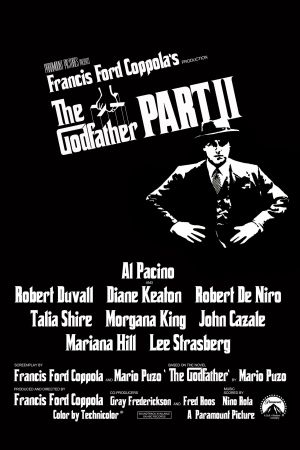
I’m looking forward to 2022 for a number of reasons.  We’ve got a lot planned here at Through the Shattered Lens.  So, what better way to start things off than by sharing a scene that I love from one of the greatest and most important films of all time, 1974’s The Godfather Part II?

The scene below takes place on New Year’s Eve.  The scene starts in 1958 and it ends in 1959.  Michael Corleone (Al Pacino) and his brother Fredo (John Cazale) are in Havana at the invitation of Hyman Roth (Lee Strasberg).  Roth know that Cuba could be a gold mine for the American mob but Michael, from the start, realizes that the country’s corrupt government is on the verge of collapse.  Tragically, it’s also in Havana that Michael realizes that Fredo betrayed him to his enemies.

On December 31st, 1958, as the corrupt and wealthy celebrate a new year in Havana, the communist rebels ride into the city.  While the President of Cuba prepares to announce that he will be fleeing the country, Michael confronts his brother and tells him that he knows the truth.  Later, as they both attempt to flee the country, Michael and Fredo see each other on the streets.  Fredo runs from Michael, refusing his offer to help.  Though Fredo would eventually return to the family, the film’s ending revealed Fredo’s first instinct was the correct one.

Much of the scene below is based on fact.  The Cuban government did fall on New Year’s Eve and Fidel Castro and his rebels did triumphantly ride into Havana on January 1st.  Before Castro came to power, the Mafia did have a major stake in Cuba and reportedly quite a few mobsters were in Havana when Castro took over.  Meyer Lansky (on whom the film’s Hyman Roth was based) was one of the many mob officials who were rumored to have caught the last flight off of the island.  Seeking to be the only mob boss in his country, Castro did force the Mafia out of Cuba, which led to an alliance between organized crime and the CIA to try to overthrow Castro.  At the time that The Godfather Part II was released, the details of the CIA and the Mafia’s attempts to assassinate Castro were just starting to be revealed to the public.  As powerful as the scene below is today, it probably resonated even more with audiences in 1974.  In 1974, this was all still recent history and it undoubtedly brought to mind the still-fresh national trauma of the assassination of the Kennedy brothers.

Beyond the historical significance of the scene below, it also features brilliant work from two actors who will forever be linked together, Al Pacino and the late John Cazale.  Cazale and Pacino first met while they were both working off-Broadway, years before Mario Puzo even started writing the novel that would become The Godfather.  They were close friends and, along with co-starring in The Godfather films, they also played bank-robbing partners in Dog Day Afternoon.  Tragically, John Cazale died of cancer at the age of 42.  He only appeared in five films, every one of which was nominated for Best Picture and one could argue that the Academy’s failure to nominate Cazale for either Dog Day Afternoon or Godfather Part II is one of the most unforgivable oversights in Oscar history.

That said, it’s a new year.  Save the arguing for later.  Here’s a scene that I love:

Lisa Marie’s Oscar Predictions for December


Well, the year’s nearly over and that means that it is time for me to post my final Oscar predictions for 2021.  The race has gotten much clearer with the start of the precursor season.  The critics love The Power of the Dog.  However, it’s perhaps a bit too early to declare it the front runner.  I want to see how things go with the Guilds in January before I bestow that title on any film.

A few thoughts:

There are ten Best Picture nominees this year so we won’t have any of that, “Here’s a random number of nominees” crap.  In theory, that should open the door for some unconventional nominees that might have missed the cut-off in previous years.  Again, I said, “In theory.”  They tried this 10 nominee thing before and it didn’t really lead to the results that a lot of people were expecting.

Still, I’m going to swing out on a web and predict a Best Picture nomination for Spider-Man: No Way Home.  It’s got Disney and Sony behind it.  It’s making a ton of money despite not playing in China.  It’ the film that’s currently giving the industry hope that there’s a future outside of the streaming sites.  Plus, after the nominations of Black Panther and Joker, it might be time to give the whole “They’ll never nominate a comic book movie!” argument a rest.  

I’m also going to predict a Best Picture nomination for Drive My Car, which has been getting a lot of attention from the critics.  

The critics also loved West Side Story but now, it’s probably best known for being a bust at the box office.  I still think the movie will be nominated but I don’t think it’ll win.  And I think it’s a lot less likely that Rita Moreno will pick up a nomination.  People seem to have moved on from the movie.  Again, this could all change once the Guilds start announcing their nominations.

The critics are split on Don’t Look Up.  I personally think it’s one of the worst films of 2021.  But the film will be nominated for much the same reason that The Big Short and Vice were nominated.  There’s a lot of Academy members who agree with McKay’s politics.  And the people who do like Don’t Look Up really, really like it.  And I also think there’s probably enough people annoyed with Elon Musk that Mark Rylance will sneak into the supporting actor race.

Belfast has not been dominating the early part of awards season but I think it will come on strong once the Guilds start announce their nominations.

Anywya, these are just my guesses, for better or worse.  To see how my thinking has evolved,  check out my predictions for March and April and May and June and July and August and September and October and November!

Best Picture

Belfast

CODA

Don’t Look Up

Drive My Car

Dune

King Richard

Licorice Pizza

The Power of the Dog

Spider-Man: No Way Home

West Side Story

Best Director

Paul Thomas Anderson for Licorice Pizza

Kenneth Branagh for Belfast

Jane Campion for The Power of the Dog

Ryusuke Hamaguchi for Drive My Car

Denis Villeneueve for Dune

Best Actor

Benedict Cumberbatch in The Power of the Dog

Peter Dinklage in Cyrano

Andrew Gardield for tick….tick….BOOM!

Will Smith in King Richard

Denzel Washington in The Tragedy of MacBeth

Best Actress

Jessica Chastain in The Eyes of Tammy Faye

Lady Gaga in House of Gucci

Alana Haim in Licorice Pizza

Kristen Stewart in Spencer

Rachel Zegler in West Side Story

Best Supporting Actor

Bradley Cooper in Licorice Pizza

Ciaran Hinds in Belfast

Troy Kostur in CODA

Mark Rylance in Don’t Look Up

Kodi Smit-McPhee in The Power of the Dog

Best Supporting Actress

Ariana DeBose in West Side Story

Ann Dowd in Mass

Kirsten Dunst in The Power of the Dog

Aunjanue Ellis in King Richard

Marlee Matlin in CODA


Catching Up With The Films of 2021: After We Fell (dir by Castille Landon)


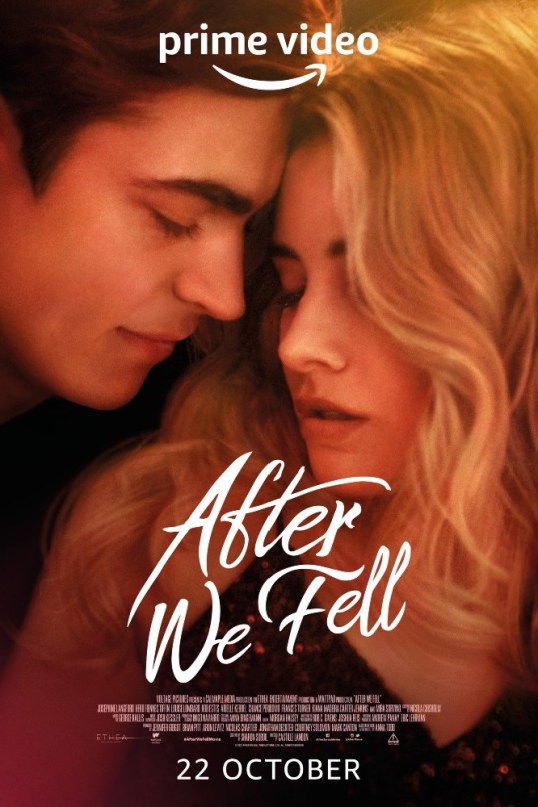
After We Fell continues the story of Tessa and Hardin, the world’s most boring couple.

If you’ve seen After and After We Collided, you know the story of Tessa (Josephine Langford) and Hardin (Hero Fiennes-Tiffin).  You know that Tessa has an alcoholic father and that she met and fell in love with Hardin during her first semester of college.  You know that Hardin is a British bad boy with a lot of really lame tattoos but he also really likes The Great Gatsby.  Hardin’s from a wealthy family and he’s a recovering alcoholic.  Hardin may come across like a sullen jerk but that’s just because no one but Tessa understands who he truly is.  Blah blah blah.

Hardin and Tessa spent the first two movies having a bunch of boring relationship problems and that’s pretty much what they spend the third movie doing, as well.  There’s a lot of tastefully filmed sex scenes but no one’s going to mistake these films for Fifty Shades of Grey.  Whenever Hardin and Tessa have sex in After We Collided, there’s a close-up of Hardin grabbing a condom.  The one time that Hardin doesn’t grab a condom, it leads to one of the film’s few plot developments.  It’s the rule of Chekhov’s Condom.  If a condom is used in the first act, a condom will not be used in the second act, and there will be consequences in the third act.

There’s not really much of a plot to this one.  Tessa takes a job in Seattle.  Hardin doesn’t want her to go to Seattle.  Tessa’s drunk dad shows up.  Hardin bonds with the drunk dad.  Hardin’s mother gets married so the film’s action moves to London.

When Hardin and Tessa visit his mom, Hardin’s mom says, “I set your bed up, Hardin.”

“I was expecting to stay on the floor,” Hardin replies.

OH, SHUT THE FUG UP, HARDIN!  JUST SAY THANK YOU FOR ONCE!

The After films wouldn’t be so bad if Hardin wasn’t such an annoying douchebag.  And it would help is Tessa actually had a personality that went beyond her relationship with Hardin.  They’re a boring couple.  Whatever chemistry Fiennes-Tiffin and Langford had in the first two films is totally missing in After We Fell.  When they have phone sex, you feel bad for whoever at the NSA is having to transcribe their conversation.  They have no interests outside of each other and listening to middlebrow music.  Hardin continually fears that Tessa is going to leave him but Tessa wouldn’t exist if she wasn’t half of a couple and neither would Hardin.  They’re not individuals.  They have no personality outside of worrying about each other, fighting with each other, and talking about each other.  One gets the feeling that they are the couple that everyone tries to avoid at a party.  “Don’t get stuck in a corner with those two unless you’re ready to spend the entire night listening to the story about that time Hardin was reading The Great Gatsby in the student union….”

The film ends with the promise of “To be continued.”  I’m looking forward to After The Divorce.

Here Are The 2021 Nominations of The North Carolina Film Critics Association!


The North Carolina Film Critics Association will be announcing their winners on January 5th!

Here are their nominees:

BEST NARRATIVE FILM
Drive My Car
Dune
The French Dispatch
The Green Knight
Licorice Pizza
Mass
Pig
The Power of the Dog
West Side Story
The Worst Person in the World

BEST DOCUMENTARY FILM
Flee
The Sparks Brothers
Summer of Soul
Val
The Velvet Underground

BEST ANIMATED FILM
Encanto
Flee
Luca
The Mitchells vs. The Machines
Raya and the Last Dragon

BEST FOREIGN LANGUAGE FILM
Drive My Car
A Hero
Riders of Justice
Titane
The Worst Person in the World

BEST DIRECTOR
David Lowery – The Green Knight
Denis Villeneuve – Dune
Jane Campion – The Power of the Dog
Paul Thomas Anderson – Licorice Pizza
Steven Spielberg – West Side Story

BEST CINEMATOGRAPHY
Dune
Nightmare Alley
The Power of the Dog
The Tragedy of Macbeth
West Side Story

BEST ACTOR
Andrew Garfield – tick, tick… BOOM!
Benedict Cumberbatch – The Power of the Dog
Dev Patel – The Green Knight
Nicolas Cage – Pig
Will Smith – King Richard

BEST SUPPORTING ACTOR
Alex Wolff – Pig
Jason Isaacs – Mass
Jeffrey Wright – The French Dispatch
Kodi Smit-McPhee – The Power of the Dog
Woody Norman – C’mon C’mon

BEST ACTRESS
Alana Haim – Licorice Pizza
Jessica Chastain – The Eyes of Tammy Faye
Kristen Stewart – Spencer
Olivia Colman – The Lost Daughter
Renate Reinsve – The Worst Person in the World

BEST SUPPORTING ACTRESS
Aunjanue Ellis – King Richard
Ann Dowd – Mass
Ariana DeBose – West Side Story
Kirsten Dunst – The Power of the Dog
Ruth Negga – Passing

BEST VOCAL PERFORMANCE IN ANIMATION OR MIXED MEDIA
Abbi Jacobson – The Mitchells vs. The Machines
Danny McBride – The Mitchells vs. The Machines
Jacob Tremblay – Luca
Kelly Marie Tran – Raya and the Last Dragon
Stephanie Beatriz – Encanto

BEST ACTING ENSEMBLE
Dune
The French Dispatch
Licorice Pizza
Mass
The Power of the Dog

BEST ORIGINAL SCREENPLAY
C’mon C’mon
The French Dispatch
Licorice Pizza
Mass
Pig

BEST ADAPTED SCREENPLAY
Drive My Car
Dune
The Green Knight
Passing
The Power of the Dog

BEST EDITING
Dune
The French Dispatch
The Last Duel
The Power of the Dog
West Side Story

BEST SPECIAL EFFECTS
Dune
The Green Knight
The Matrix Resurrections
Spider-Man: No Way Home
The Suicide Squad

BEST STUNT COORDINATION
Black Widow
The Matrix Resurrections
No Time To Die
Shang Chi and the Legend of the Ten Rings
Spider-Man: No Way Home

BEST COSTUME DESIGN
Cruella
Dune
Last Night in Soho
Nightmare Alley
Spencer

BEST HAIR & MAKE-UP
Cruella
Dune
The Eyes of Tammy Faye
House of Gucci
Nightmare Alley

BEST PRODUCTION DESIGN
Dune
The French Dispatch
The Green Knight
Nightmare Alley
West Side Story

BEST SCORE
Don’t Look Up
Dune
No Time To Die
The Power of the Dog
Spencer

BEST ORIGINAL SONG
Every Letter – Cyrano
Guns Go Bang – The Harder They Fall
Just Look Up – Don’t Look Up
No Time To Die – No Time To Die
So May We Start – Annette

BEST SOUND DESIGN
Dune
Nightmare Alley
No Time To Die
tick, tick… BOOM!
West Side Story

BEST DIRECTORIAL DEBUT
Fran Kranz – Mass
Lin-Manuel Miranda – tick, tick… BOOM!
Maggie Gyllenhaal – The Lost Daughter
Michael Sarnoski – Pig
Rebecca Hall – Passing

BEST BREAKTHROUGH PERFORMANCE
Alana Haim – Licorice Pizza
Cooper Hoffman – Licorice Pizza
Emilia Jones – CODA
Woody Norman – C’mon C’mon
Rachel Zegler – West Side Story

KEN HANKE MEMORIAL TAR HEEL AWARD
Anthony Mackie (Falcon and the Winter Soldier; Synchronic; Outside the Wire; The Woman in the Window) – Studied at the University of North Carolina School of the Arts
Ariana DeBose (West Side Story; Schmigadoon) – From Raleigh, North Carolina
Brian Tyree Henry (Eternals; The Woman in the Window; Godzilla vs. Kong) – From Fayetteville, North Carolina
Jonathan Majors (The Harder They Fall, Loki) – Studied at the University of North Carolina School of the Arts
Stephen McKinley Henderson (Dune; Bruised) – Studied at the University of North Carolina School of the Arts

Catching-Up With The Films of 2021: Fear and Loathing in Aspen (dir by Bobby Kennedy IIII)


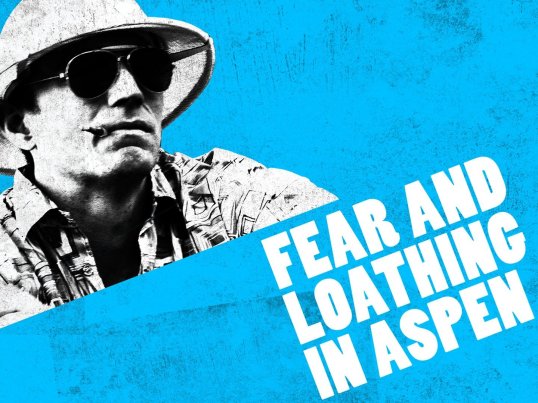
The year is 1970 and big business has all the power in Aspen, Colorado.  The landscape is being bulldozed to make room for time-shares.  The once pristine ground is being covered in asphalt.  The rich are using Aspen as their own personal playground while the hippies, drawn to the town by the beautiful landscape, are regularly used as scapegoats for every problem that the town encounters.

A struggling journalist named Hunter S. Thompson (Jay Bulger) wants to change that.  When Thompson first declares that he will be running a third party, “freak power” campaign for Sheriff of Pitkin County, his main concern is getting paid to write about it and perhaps becoming a regular contributor to Rolling Stone Magazine.  But, as the campaign starts to grow and Thompson finds success in motivating the hippies to actually register to vote, he starts to realize that he could actually win this thing.  Despite the efforts of Aspen’s mayor (Cheryl Hines, the stepmother of the film’s director), “freak power” is on the verge of turning the establishment upside down.

Fear and Loathing in Aspen is based on the true story of Thompson’s campaign.  Thompson did not win but he did go on to write Fear and Loathing in Las Vegas and to cover the 1972 presidential election for Rolling Stone.  Thompson was an iconoclast, a writer who as open about his love for drugs as he was for his love of guns.  He committed suicide in 2005.  If he were still with us, one imagines that he would probably love Bernie while hating Trump, Biden, and Twitter.  There have been a few, generally uneven attempts to bring Thompson and his writing to cinematic life, the most famous probably being Terry Gilliam’s adaptation of Fear and Loathing in Las Vegas, starring Johnny Depp as Thompson.

Fear and Loathing Aspen stars Jay Bulger as Thompson and it should be said that Bulger does a good job in the role.  While he doesn’t quite have the movie star charisma of Johnny Depp, he is believable as a sincere prankster, as someone who is genuinely torn between whether or not to burn it all down or to try to make people’s lives better by participating in the system.  Unfortunately, the rest of the film doesn’t really rise up to the level of Bulger’s performance.  Cheryl Hines, Laird Macinstosh, and Paul Morgan all give such cartoonishly evil performances as Thompson’s political opponents that it makes Steve Carell’s performance as Donald Rumsfeld in Vice look nuanced and intelligent by comparison.  The film’s director tends to rely a bit too much on obvious tricks, like split screens and shaky hand-held footage.  It gets distracting.

The director, by the way, is Bobby Kennedy III, the son of Robert F. Kennedy, Jr.  There’s some irony to be found in a film about outsiders being directed by a member of the Kennedy family, particularly the son of someone who would probably just be another Facebook conspiracy troll if not for the circumstances of his birth.  Fear and Loathing in Aspen may tell the story of an outsiders revolt but it doesn’t feel authentic.  With the exception of a few scenes, it feels like counterculture cosplay.