So, the long-delayed “found footage” horror film Apollo 18 was finally released at the beginning of this month and critics, both mainstream and not-so-mainstream, have been having a collective orgy in expressing their hated for the film. It currently has a “rotten” rating over on Rotten Tomatoes. Roger Ebert — a man who gave the god-awful remake of Straw Dogs a positive review (“better than the original!”) — didn’t care much for it. Over at Hitfix.com, the appropriately named Drew McWeeny practically popped a blood vessel expressing his hatred of the film. (McWeeny followed this up by giving Shark Night 3-D a positive review.) The toadsuckers at AwardsDaily.com haven’t even acknowledged that Apollo 18 exists. (Then again, the folks in charge of that movie site have lately been more obsessed with Barack Obama’s reelection chances than with film.) Yes, everyone’s been busy hating on Apollo 18 but you know what?
I kind of enjoyed it.
As the film’s trailer makes pretty obvious, Apollo 18 is the latest example of the mockumentary horror film. At the start of the film, we get a title card telling us that the film has been edited together from long-classified footage of a secret NASA mission to the moon. At the end of the film, we get another title card inviting us to visit a web site that, presumably, will have more information about how this footage was discovered. The found footage shows us two pleasantly bland astronauts who, once they’ve landed on the moon, find themselves being stalked by some sort of shadowy creature that always seems to be hanging out just slightly out of camera range.
As many critics pointed out, this film’s plot — once you get pass the novelty of where it takes place — is pretty much standard as far as “found footage” horror movies are concerned and yes, Apollo 18 would never have been made if not for the success of Paranormal Activity. However, I still enjoyed Apollo 18 because — unlike the Paranormal Activity films — Apollo 18 is truly an homage to the Grindhouse heart that beats within the whole found footage genre. Whether it’s the gimmicky nature of the film’s storyline or even the attempt to recreate both the Space program and the moon for next to no money, Apollo 18 is a film that belongs in a double feature with some other critically reviled but fun horror film. Much like Ruggero Deodato did with Cannibal Holocaust, director Gonalo Lopez-Gallego artfully uses scratched and overexposed film stock to create the feeling that we actually are watching footage that somebody just happened to come across out in the middle of the desert. The film’s plot is predictable and there’s not a lot of jump-out-of-your-seat scares but, like many good grindhouse films, Apollo 18 does create a palpable feeling of doom that doesn’t let up until the end credits. Even the film’s tongue-in-cheek claims to being factual are, in the end, rather likable.
Apollo 18 may not be a great film but it’s certainly doesn’t deserve the amount of hatred that it’s received. It’s an occasionally enjoyable film that was made by people who, at the very least, seem to understand why the old films of the grindhouse era are still being watched and rediscovered today.
It’s probably a bit too early to answer that question. After all, we’ve still got 3 months left to go in the year and Roland Emmerich’s take on Shakespeare (a.k.a. Anonymous) hasn’t been released yet. So, no, Rod Lurie’s remake of Straw Dogs cannot be called the worst film of 2011 yet. Instead, it’s just the worst film so far.
Straw Dogs is a remake of the 1971 Sam Peckinpah film. In the Peckinpah film, David Sumner (played by Dustin Hoffman) is a pacifist who, upon moving to the childhood home of his wife Amy (Susan George), is repeatedly harassed by the locals until he finally takes his very brutal revenge. It’s a flawed and uneven film that still carries quite a punch. I wouldn’t say I’ve ever enjoyed watching Peckinpah’s Straw Dogs but it’s undeniably powerful film. As for the remake, Peckinpah has been replaced with Rod Lurie, Hoffman by James Marsden, and Susan George’s controversial character is now played by Kate Bosworth. None of these changes are for the better.
Lurie’s version of Straw Dogs almost slavishly follows the plot of the original. He’s made just a few changes and none of those changes are for the better. The most obvious change is that, while the first Straw Dogs took place in rural England, Lurie’s version takes place in Mississippi. It’s pretty easy to guess Lurie’s logic here. Lurie, after all, previously created the television show Commander-in-Chief in which President Geena Davis heroically struggled to save the nation from fundamentalists with Southern drawls. Lurie’s vision of Mississippi is some sort of Blue State nightmare where everyone drives a pickup truck, goes to church, cheers at football games, and makes supportive comments regarding the War in Iraq. In the original Straw Dogs, David Sumner is a truly a stranger in a strange land, an American who doesn’t realize just how out-of-place he is in rural England. In the remake, David Sumner is just a guy on vacation from the West Coast. He really has no excuse for being quite as dense as he is when it comes to not pissing off the locals. By changing the locale, Rod Lurie essentially just makes his film into yet another example of Yankee paranoia. This wouldn’t be such a problem except that Lurie seems to be taking it all so seriously. He really seems to feel that he’s making a legitimate contribution to the whole Red State/Blue State divide. Watching the film, I had to wonder if Rod Lurie truly believed that it’s impossible to get a cell phone signal in Mississippi.
The other big difference is that in Lurie’s version, David Sumner is no longer a mathematician. Instead, he’s now a Hollywood screenwriter who is apparently working on an epic screenplay about the Battle of Stalingrad. (“I figured out a way to get Khrushchev in on the action!” he says at one point.) To be honest, David’s screenplay sounds kinda boring and it’s hard not to sympathize with the “hillbilly rednecks,” (as David calls them) who ask him why anybody would want to watch his movie. (The rednecks also ask him if he thinks that God had anything do with the Battle of Stalingrad. Speaking as a nonbeliever, I have to say that this film was almost hilariously paranoid about any sort of religious belief.) Part of the power of the first Straw Dogs came from the fact that David was an academic. He was a man whose life was about theory and that made it all the more shocking to see him explode into action. It also explained his non-existent social skills, because he was, after all, the product of a very insular, intellectual existence. However, in the remake, David just becomes a condescending jerk who’s working on a screenplay for a film that most viewers would have little interest in actually sitting through. (Add to that, it was hard not to feel that this new David was just Rod Lurie’s Mary Sue.)
David is in Mississippi because it’s the childhood home of his wife, Amy. The character of Amy is problematic in both versions of Straw Dogs but, to be honest, I found her character to be even more illogical and insulting in Lurie’s remake. In the original Straw Dogs, Amy is portrayed as an idiot who flirts with every man she sees, taunts her husband to the point of violence, and (by that film’s logic) puts herself in a situation that leads to her rape. The character is, in many ways, an insulting stereotype but at least she’s a consistent insulting stereotype. The remake’s Amy is presented as being a considerably stronger character. She doesn’t openly flirt with the local rednecks, she and her husband are a lot more obnoxiously lovey dovey, and (as opposed to in the first film), it’s never suggested that she actually enjoys being raped. Kudos to Lurie for trying to make her a stronger character. Yet, at the same time, the remake’s Amy still does a lot of the same illogical things as the original Amy. The original Amy at least had the excuse of being an idiot. The remake’s Amy just comes across as being an inconsistent, poorly-concieved character. Eventually, it becomes obvious that director Lurie wasn’t trying to make Amy into a stronger character as much as he was just trying to be politically correct. (Another thing that the two Amys have in common is that neither one of them wears a bra. It made sense in the original film because the original Amy was presented as being something of a wannabe flower child. In the remake, it just comes across as Lurie’s dirty boy excuse to get a peek at Kate Bosworth’s nipples. Seriously, who goes jogging without a sports bra?)
Anyway, the remake follows the path of the original. David and Amy return to Amy’s home village where they meet Amy’s ex-boyfriend Charlie Venner (played by an amazingly hot and sexy Alexander Skarsgard). David hires Charlie and his redneck buddies to repair the roof of an old barn. Charlie, who is obviously still attracted to Amy, spends the entire first part of the movie subtly humiliating David and basically being a bully. Somebody strangles Amy’s cat. Amy says it was Charlie and his friends. David replies, “I can’t just accuse them.” Eventually, David is taken on a deer hunt by Charlie’s friends and while he’s gone, Charlie and his buddy Chris rape Amy.
(In the original it was a snipe hunt and the sight of Dustin Hoffman searching for a nonexistent creature while his wife is being raped was quite disturbing and perfectly symbolized his character’s impotence. In the remake, David is once again left alone in the woods but this time, he shoots and kills a deer and, unfortunately, James Marsden isn’t a good enough actor to let us know what that means.)
Amy never tells David that she was raped, nor does she go to the authorities. (This makes a sick sense in the original. In the remake, it just seems like an effort by Rod Lurie to degrade a previously strong woman.) The next night, David ends up sheltering the local sex pervert in his house while Charlie and his drunken friends attempt to break in. This leads to David revealing that, as opposed to being “a coward,” he’s actually as vicious a killer as everyone else in the film.
In the original version, this was a disturbing revelation if just because Sam Peckinpah emphasized not so much the killing as the fact that, as the siege progresses, David begins to enjoy the killing more and more. Once Peckinpah’s David has given into the reality that he too is an animal, you realize that it’ll be impossible for him to return to being the essentially decent man that he was before. In the original, you start out cheering David’s revenge but soon, you just want it to stop. Much like the originalTexas Chainsaw Massacre, the film is so thematically nightmarish that you end up thinking you’ve seen a lot more blood than you actually have. It sticks with you.
However, since Lurie’s remake is a film devoid of nuance or subtlety, the sudden explosion of violence on David’s part is neither surprising nor all that exciting. And since James Marsden is no Dustin Hoffman (to put it lightly), you don’t see any change in David once the violence begins. He’s not a man turning into an animal as much as he’s just a 90210 reject with a scowl on his face. He kills a lot of men but he looks oh so pretty doing it and Amy cheers him on every step of the way. (In the original, Amy was terrified of her husband’s new side. I would be too.) Since Lurie isn’t a good enough director to generate a sincere emotional response to seeing David turn into a killer, he instead lingers over all the blood and gore like a pervert struggling to catch his breath while secretly looking at a snuff website. In short, the original Straw Dogs condemned violence by pretending to celebrate it. The remake celebrates it by pretending to condemn.
Okay, you may be saying, so it’s not a great film. But is it really the worst of 2011 so far? After all, Alexander Skarsgard gives a charismatic, bad boy performance and James Woods has a few good scenes as a venomous former football coach. And director Lurie, while he may be incapable of keeping the action moving at a steady pace, does manage to make Mississippi look pretty. That’s all true but I still say that Straw Dogs is the worst movie of the year so far. Why?
Because it’s not only a remake of a film that didn’t need to be remade but it’s also a remake that was apparently made by people who don’t have a clue about what made the original an important film to begin with. It’s a film that’s gloriously unaware of its own tawdriness, a sordid mess that can’t even have fun with the possibilities inherent in being a sordid mess. Arrogantly, director Lurie invited you to compare his film to Sam Peckinpah’s by not just ripping off the film’s story (as countless other enjoyable films have done) but by claiming the title as well. It’s a film that represents Hollywood at its worst and for me, that’s why it’s earned the title of worst film of 2011 so far.
(One positive note: Perhaps this terrible, insulting remake will encourage someone to track down the original Straw Dogs and see how this story was meant to be told.)
Both Leonard and Arleigh have already written detailed (and positive) reviews of Contagion so I’m going to keep my review short and simple.
I say this with the greatest amount of respect for my fellow reviewers and to all of our readers who are probably going to vehemently disagree with me:
Contagion sucked.
Big time.
With this film, director Stephen Soderbergh takes material that is ripe for exploitation and histrionics and he presents it in a very clinical, low-key fashion and the result is a draggy film that takes itself way too seriously. Seriously, if you’re going to end the world, have some fun with it.
Soderbergh assembles an impressive cast and then he pretty much just strands them out in the middle of nowhere. I appreciate the fact that the director and the cast are trying to keep things rooted in reality but oh my God, the reality here is so boring. Most of the cast does an okay job but Jennifer Ehle, who plays one of the scientists looking for a cure, gives such an annoyingly mannered performance that watching her was like listening to some little kid running around in squeaky shoes. Seriously, if I had to hear one more artfully placed stammer from her, I was going to scream.
Finally, this is yet another film where the villain is a blogger. I mean, he’s even English, that’s how evil Jude Law’s blogger is. I mean, I’m sorry that all the old folks out there are so threatened by the Internet but this blogger-as-villain trend is just petty.
With its all-star cast and its pretensions towards being an “important film,” Contagion should have been a fun, tawdry little romp. It should have been like a 21st Century Airport or Towering Inferno. Kate Winslet and Laurence Fishburne should have been having an adulterous affair. 2nd-rate television actors should have been dropping like flies. There should have been melodramatic music and dialogue like, “Excuse me, did you say the nurse was conducting the operation?”
I am happy to say that it’s a beautiful day today. After dealing with a record number of 100 degree days that slowly plodded along without so much as a breeze or a cloud in the sky, I am happy to say that, as I type this, the temperature outside is 84 degrees, the sky is gray with storm clouds, and, here at Le manoir d’Bowman, we’ve got the windows open and we’re loving the breeze. To me, it seems like a perfect time for 6 more of Lisa Marie’s Favorite Grindhouse and Exploitation Trailers.
From acclaimed director John Boorman comes … whatever this is. For the longest time, I assumed that this film starred Sean Connery as someone named Zardoz but having watched the trailer, I now see that Connery played Zed. That makes sense. With that pony tail and red diaper, Connery looks more like a Zed than a Zardoz here. I like the flying head, just because I keep imagining that after the head dropped off all those guns, Connery shouted, “Give me more, Head!”
Now, this is a trailer that could have used a big floating head. The Norseman appears to be yet another oddly ambitious, very low-budget film from the John Boorman of Texarkana, Charles B. Pierce.
Pierce was also responsible for The Evictors. “It’s happening again…” Much as the trailer for the Norseman featured the co-star of Eaten Alive, Mel Ferrer, the trailer features the star of Suspiria, Jessica Harper.
Grindhouse and exploitation films loved to exploit Yankee paranoia, which helps to explain films like Tick…Tick…Tick. (It also helps to explain — but throughly fails to justify — the latest remake of Straw Dogs.)
This film co-stars the legendary Sonny Chiba. I can’t watch this trailer too many times because I know it’ll inspire me to show off my karate moves. Last time I did that, I ended up with a sprained ankle.
This is one of those public domain films that seems to show up in every other Mill Creek Box Set. It’s a guilty pleasure of mine and the trailer is all tacky goodness. Plus, Erika Blanc’s in it. (And the title has allowed me to have a lot of fun at my friend Evelyn’s expense.)
Before he was hired to direct Zombi 2, Lucio Fulci directed this spaghetti western. Not surprisingly, it’s one of the darkest, most cynical westerns ever made.
Nine years before Four of the Apocalypse, Fulci directed another western, this one with Franco Nero. Have I mentioned the things I would let Franco Nero do to me if I could get my hands on a time machine? Mmmmm….Franco Nero.
As part of my continuing effort to get caught up on reviewing all of the movies that I’ve seen so far this year, allow me to offer up 6 very quick reviews of 6 very different documentaries that I’ve recently seen. Two of these documentaries — Buck and Senna — are still playing in theaters. The other four — American, Exporting Raymond, The Greatest Movie Ever Sold, ResurrectDead— are all available On Demand and on DVD and Blu-ray.
1) American: The Bill Hicks Story(dir. by Matt Harlock and Paul Thomas)
This heartfelt documentary about the life of the late comedian Bill Hick and it shows why his defiantly anarchistic humor is even more relevent today as it was during his heyday. Here, his story is told through the use of cut-and-paste animation and it’s surprisingly poignant. I didn’t know a thing about Bill Hicks before I saw this film but I was crying by the end of it.
2) Buck (dir. by Cindy Meehl)
Buck is a portrait of both the real-life horse whisperer Buck Brannaman and the various ranchers and horse owners who come to his various “clinics.” The documentary covers Brannaman’s own abusive childhood and shows how he managed to turn the worst circumstances into something good. The film works best when it just allows the charismatic Buck to talk about his life and his beliefs. It’s less succesful when Hollywood phony Robert Redford pops up to talk about his feelings towards Buck.
3) Exporting Raymond (dir. by Phillip Rosenthal)
This is an interesting documentary in that it manages to be both entertaining and annoying at the same time. Phillip Rosenthal was the creator of one of the most oddly durable sitcoms of all time, Everybody Loves Raymond. In this documentary, which was directed by Rosenthal, we watch as he goes to Russia and deals with the resulting culture clash as he tries to adapt Raymond for Russian television. If you’re like me and you’re fascinated by all the behind-the-scenes production aspects of television and film, then you’ll find a lot to enjoy in this documentary. Unfortunately, Rosenthal himself is a bit too self-satisfied and, often times, he comes across like an almost stereotypical “ugly American.” There’s something annoying about watching a wealthy, American television producer going over to a country that’s perpetually on the verge of self-destruction and then bitching about how ugly all the buildings look.
4) The Greatest Movie Ever Sold (dir. by Morgan Spurlock)
In The Greatest Move Ever Sold, Morgan Spurlock sets out to make the “Iron Man of documentaries,” a documentary that is completely and totally funded by product placement. The documentary itself becomes about Spurlock’s attempts to find the corporate sponsors needed to make his documentary and the results are often hilarious and the film does succeed in getting you to think about how we are constantly bombarded with advertisements. At the same time, this is also a good example of a “Who cares?” documentary. Spurlock shows us how advertising works but he never really convinces us that it’s as big a problem as old toadsuckers like Ralph Nader and Noam Chomsky seem to think. In many ways, Morgan Spurlock is a more likable version of Michael Moore in that he primarily makes documentaries for people who already agree with him.
5) Resurrect Dead: The Mystery of the Toynbee Tiles (dir by John Foy)
This is a fascinating documentary about the mysterious Toynbee Tiles. The Toynbee Tiles are, to quote Wikipedia, “messages of mysterious origin found embedded in asphalt of streets in about two dozen major cities in the United States and four South American capitals.” That message is:
TOYNBEE IDEA
IN Kubrick’s 2001
RESURRECT DEAD
ON PLANET JUPITER.
These tiles first appeared in the 1990s and they’ve remained a perplexing unsolved mystery. Nobody’s sure what the mysterious message means, who wrote the message, or even how the tiles were embedded into the asphalt. This documentary is about not only the mysterious tiles but also the men who have, over the years, become obsessed with them and how that obsession has gone on to effect their own perception of reality. The movie even offers up a plausible theory of who is responsible for the tiles. Seriously, this is one of the most fascinating documentaries that I’ve ever seen.
6) Senna (dir. by Asif Kapadia)
Senna tells the life story of Ayrton Senna, a Brazilian formula one racer who was the world champion for three years before his own tragic death during a race. I have to admit that I don’t know much about Formula One racing and, as a result, I had some trouble following Senna. But Senna, seen in archival footage, is a charismatic and sometimes enigmatic figure and the racing footage is both exciting and, occasionally, frightening.
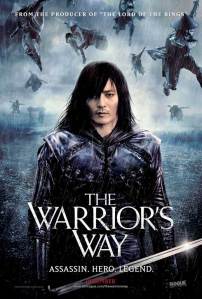
I’ll admit that I didn’t give The Warrior’s Way that much thought when we picked it up from the rental store the other day. At first glance, it didn’t seem to have much of an identity to it. Was it trying to be something serious like a House of Flying Daggers or something more humorous like Kung Fu Hustle? I guess one could say that it’s really a little of both and although the movie may be a little too strange for it’s own good, it was really worth going through the first hour or so just to get to the last 30 minutes. The film really picks up steam from there going forward.
In the film, Yang (Jang Dong Gun) becomes the Greatest Swordsman in the World after defeating the original Greatest Swordsman ever. After doing so, he’s given an order to kill a family by his clan. Managing to kill everyone but a young baby named April, Yang decides to let it live and to take care of it, giving the movie a Lone Wolf and Cub / Shogun Assassin feel.
And basically, what the film boils down to is Yang trying to leave behind the life he had in order to protect the baby he’s found. He finds himself in a Wild West town and meets a number of individuals who help him hide his identity. In return, he helps them gain the courage to find themselves. Kate Bosworth’s character, Lynne, is a knife thrower with a bit of talent, but without any focus. Geoffrey Rush is something of a drunkard, but in watching what Yang is doing in the town, he sets aside his drinking ways in place of sniper rifle. Both actors are okay in their roles, but I found myself wondering why they went with these, honestly.
One of the standouts of this film (if one could say there’s a standout, because the movie really could be better than what it was) was Danny Houston. Despite some of the bad movies he’s been in (X-Men Origins: Wolverine instantly comes to mind), he carries his characters with this really weird style – his voice has this sense of authority, much like a Liev Schreiber – his villain is the classic evil cowboy, which normally would do him a lot of justice. Here, he does okay in his scenes, but doesn’t really have a whole lot to work with.
Yang is also being pursued by his former master, Saddest Flute, named after the sound one’s throat makes when it’s cut. Saddest Flute and his ninjas manage to make their way to the town, which culminates in a really cool battle which is one part Rango, one part Ninja Scroll and even a little like Samurai Jack. And all of that really needs to be seen, all 25 to 30 minutes of it, even if it happens to be just as a clip.
Overall, The Warrior’s Way is the kind of movie you end up watching if you’re planning to take a nap on a Sunday afternoon or if you really like cinema of this type. It’s not worth taking the whole ride for, but it ends with such a bang that one may not consider it a total loss.
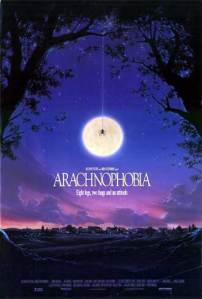
When I was a kid, my grandmother used to keep this clear shower curtain of a large black web, complete with a big red spider on it. It scared me so bad that I was actually more willing to brave the darkness of the basement bathroom than to have to deal with that monstrosity in the well-lit one. Between that, my brother’s EC comics and the original “The Fly” with Vincent Price, it’s how I developed Arachnophobia. It’s a fight or flight reflex that occurs when anything spider related appears. It seems fitting that as I’m writing this from a location that’s full of Black Widows, Arachnophobia is the topic for this review.
Arachnophobia marked the first directing attempt by Frank Marshall, long time producer of many of Steven Spielberg’s films. The film turned out to be a success when released, and manages to feature one the greatest Human vs. Tarantula battles ever filmed.
Although the film has some horror elements, it’s kind of hard to classify Arachnophobia as an actual horror film, despite the deaths that are in the film. There are some humorous moments (particularly from John Goodman), and the scares don’t come too often. For anyone who’s bothered by spiders, though, there are a number of jumpy moments that occur without being excessively gory. The story is a little misleading. It starts in Venezuela, South America, where a deadly tarantula manages to sneak its way on board a trip back to California. You’d think that from here, the Tarantula would end up finding another Tarantula, and thus pull a Kingdom of the Spiders with a whole town full of spiders. The writers, however, end up making a mistake in having a Tarantula mate with a common house spider, thus breeding dozens of other smaller spiders.
That’s like a Tiger trying to mate with a house cat. I’m not exactly sure if that’s even possible, but I’m getting off track. This actually ends up helping the story because now the town has to deal with all of these smaller spiders that are easy to hide around. I always considered that to be pretty effective.
Jeff Daniels character, Dr. Ross Jennings suffers from Arachnophobia in the worst way. Moving to the town of Canaima with his family, he trades the big city for a more relaxed, rural setting. Of course, it’s a happy ideal situation until various deaths start happening around town. Eventually, he and the authorities come to realize just how bad things really are. John Goodman’s character was an interesting touch as a funny exterminator, but really wasn’t used as much as he could have in this film. Then again, when he does tend to steal the scenes he’s in. Arachnophobia has a number of other supporting actors, but the film mainly belongs to Daniels, Goodman and the the spiders.
Chris Walas, who won an Oscar for his effects and make up work in The Fly helped to create some of the more mechanical spiders and close-ups when necessary. While you can tell where you’re dealing with real tarantulas and their synthetic counterparts, he did a great job in getting the fear factor out there, especially during the final standoff of the film. Without giving much away, the last 20 minutes of the movie are brilliant in that the final battle is much more than the simple “find it and squash it” scenario from Kingdom of the Spiders. It’s almost a violent chess match.
Arachnophobia is a treat. It may not be the best film about spiders in general, but if you do suffer from the condition or know someone who does, it definitely worth seeing, just to jump and squirm now and then. It’s much better than knowing there are real Black Widows to contend with.
As I was writing up my review of Shark Night 3D, I found myself thinking about Soul Surfer, another film that came out earlier this year and also featured a character losing an arm to a shark. Oddly enough, both Shark Night and Soul Surfer feature supporting performances from former American Idol contestants. (Carrie Underwood has a small supporting role in Soul Surfer.) Beyond that, however, the two films couldn’t be any more different.
Soul Surfer is based on the true story of Bethany Hamilton, a surfer who, back in 2003, lost her arm to a shark. I can still remember when this happened because, despite the fact that I live in one of the most land-locked parts of the country, it really, really freaked me out. I have a morbid fear of somehow losing a limb whether by shark attack, car accident, or Jigsaw Killer. (I guess, in my case, car accident would be the most likely possibility.) I couldn’t help but look at the endless footage of a seemingly cheerful Hamilton being interviewed without wondering how I would react if the same thing happened to me. Would I be able to stay as positive as Hamilton? I hope I could but, to be honest, I probably wouldn’t.
That’s one reason why I avoided seeing Soul Surfer when it was first released to theaters and instead only saw it once it showed up On Demand and I was looking for a movie to watch before bedtime. Once I actually saw it, I was surprised to discover that Soul Surfer is an effective (if predictable) film that is occasionally even touching.
The film opens with some truly beautiful scenes set in Hawaii and rather quickly establishes Bethany Hamilton (played here by AnnaSophia Robb) as a normal teenage girl who just happens to be a very talented surfer. Hamilton loses her arm about thirty minutes in and the rest of the film is devoted to her struggle to come to terms with both the loss of her arm and her newfound fame. The film ends with Hamilton’s triumphant return to competetive surfing and, in its undeniably sincere and old-fashioned way, it makes for an undeniably touching moment. Robb is likable as Hamilton though the film’s true heart and soul is provided by Dennis Quaid and Helen Hunt. They play Hamilton’s parents and both of them prove they are capable of making even the most mawkish of lines effective.
Soul Surfer was popular with audiences but got slammed by critics who complained that the film was 1) predictable and 2) far too manipulative. I would say that these critics are missing the point and their criticism has more to do with their own need to show off their cynical credentials than anything they may have actually seen on-screen.
Yes, Soul Surfer is emotionally manipulative and yes, the film is predictable but so what?
The important thing is that the film works.
That’s a lot more than you can say for the much more cynical Shark Night 3D.
If nothing else, the new film Shark Night 3D has an appropriate title. The movie takes place over the course of one night, there are a few sharks, and it’s all presented in 3D. If only the rest of the film worked as well.
Basically, the film is about this college student named Sara (played by Sara Paxton) who invites all of her college friends to Louisiana for the weekend and basically gets them all killed. Among Sara’s friends are geeky-but-cute Nick (Dustin Milligan), geeky-but-not-so-cute Gordon (Joel David Moore, who was also in Avatar), token black guy Malik (Sinqua Walls), Malik’s girlfriend Maya (Alyssa Diaz), Beth (American Idol runner-up Katherine McPhee) who we know is doomed because she has both tattoos and big boobs, and Blake (Chris Zylka), who possesses no personality but he does have a really nice ass. Seriously. Unfortunately, Sara forgets to tell them that her psycho ex-boyfriend Dennis (Chris Carmack) is waiting for her, along with his redneck buddy Red (Josh Leonard).
There’s also a lot of sharks swimming around this lake and, since this is a 3D movie, these sharks are capable of jumping out of the water like dolphins and snatching people out of boats and off of docks. Seriously, these are some talented sharks. Malik gets his arm bitten off and it’s pretty much all downhill from there. Malik is talented too because, even after he gets his arm bitten off, he’s still capable of grabbing a harpoon and standing out in the middle of the lake, bleeding as he taunts the sharks. Now, as ludicrous as this sounds, it’s probably the film’s best moment. It’s certainly one of the only truly grindhouse moments in this film. At the very least, it suggests a self-awareness that is lacking from the rest of the film.
Shark Night 3D sucks. There, I said it. I feel a little bad about saying that because, obviously, you can’t judge Shark Night 3D by the same standard that you would judge a film like 8 1/2 or The Rules of the Game. As I watched the end credits roll, I wondered if maybe I was being too hard on this film. After all, a lot of the dialogue was so bad that the intention behind it had to have been satiric? Right? Was I just being unfair? So, mentally, I compared Shark Night 3D to last year’s Piranha 3D and I quickly realized that I wasn’t being unfair. Shark Night 3D sucks.
The cast is uniformly bland, the plot is silly without ever being enjoyable, and — worst of all — the sharks are boring. Remember how the killer fish in Piranha 3D managed to be both ludicrous and scary? Remember how they each seemed to have their own little diabolic personality? It made you root for the piranhas and, as a result, you didn’t mind the fact that they were eating cardboard characters. However, the sharks in Shark Night just look like CGI sharks. Remember how the piranhas were literally everywhere in Piranha 3D? In Shark Night, the sharks just pop up randomly whenever the film’s engine starts to run out of gas.
I think the ultimate verdict I can pass on Shark Night is this: I am usually a total aquaphobe. Seriously, I can’t swim. I don’t do boats. I don’t do water parks. When my family went to Hawaii, I spent a lot of time walking on the beach in my bikini but you better believe I ran like the wind whenever I saw the tide coming for me. Over Labor Day weekend, I spent a while wading in the shallow end of my uncle’s pool and my family was literally amazed that I didn’t freak out. So was I, for that matter. (Yay me!)
And yet, as I watched Shark Night — which was all about people going into the water and dying terrible deaths — not once did I cover my eyes.