Live Tweet Alert: Join #ScarySocial for Waxwork!


As some of our regular readers undoubtedly know, I am involved in a few weekly live tweets on twitter.  I host #FridayNightFlix every Friday, I co-host #ScarySocial on Saturday, and I am one of the five hosts of #MondayActionMovie!  Every week, we get together.  We watch a movie.  We tweet our way through it.

Tonight, at 9 pm et, Deanna Dawn will be hosting #ScarySocial!  The movie?  1988’s Waxwork!  

If you want to join us this Saturday, just hop onto twitter, start the movie at 9 pm et, and use the #ScarySocial hashtag!  It’s a friendly group and welcoming of newcomers so don’t be shy.

The film is available on Prime and Tubi!

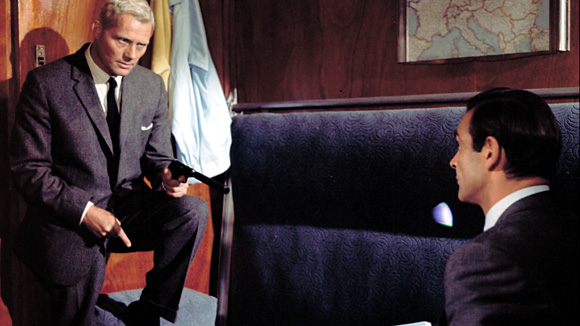
Film Review: The Eagle Has Landed (dir by John Sturges)


The 1976 film, The Eagle Has Landed, takes place during World War II.

The year is 1943 and, with the war turning against Germany, Heinrich Himmler (Donald Pleasence, in a chilling turn) orders Colonel Max Radl (Robert Duvall) to come up with a plan to kidnap Winston Churchill.  When Radl learns that Churchill is scheduled to visit a small, coastal British village, he recruits a cynical member of the IRA, Liam Devlin (Donald Sutherland), to travel to the village and make contact with a Nazi sleeper agent, Joanna Grey (Jean Marsh).  While Devlin sets up the operation in Britain and falls in love with Molly Prior (Jenny Agutter), Radl recruits disillusioned Colonel Kurt Steiner (Michael Caine) to lead the mission to kidnap Churchill.

At first the village is welcoming to Steiner and his men, who are disguised as being Polish paratroopers.  However, it doesn’t take long for the plan to fall apart.  Soon, Steiner and his men are holding the villagers hostage in a church while battling a group of American soldiers led by the incompetent Colonel Clarence Pitts (Larry Hagman) and Captain Harry Clark (Treat Williams).  Meanwhile, in Germany, Radl learns that Hitler did not actually authorize the mission to kidnap Churchill and that he has been set up as the scapegoat in case the mission fails.

The Eagle Has Landed can seem like a bit of an odd film.  For a film that was released in the same year as Network, All The President’s Men, and Taxi Driver, The Eagle Has Landed feels rather old-fashioned and almost quaint in its storytelling.  This was the final film to be directed by John Sturges, a director who started his career in the 1940s and whose best-known films included The Magnificent Seven and The Great Escape.  Sturges’s direction is efficient but not at all flashy.  (It’s a film that feel like its very much a product of the mid-60s as opposed to the mid-70s.)  The story plays out at a deliberate pace, one that leaves no doubt that the film was based on a novel.  In fact, it sometimes feels as if the film itself should have chapter headings.  The film holds your interest but it’s hard not to feel that a film that should have been an epic action film has instead been turned into something far less ambitious.

Sturges works with an ensemble cast, with no one member of the cast really dominating over the other.  (I guess if the film has a main character, it would be Donald Sutherland’s Liam Devlin but, for all the time that’s devoted to him, he actually doesn’t do that much once the action starts.)  The cast is full of good actors, though a few of them are miscast.  Neither Michael Caine nor Robert Duvall make much of attempt to sound German.  As a member of the IRA, Donald Sutherland sounds as Canadian as ever.  Fortunately, Caine, Duvall, and Sutherland are all strong-enough actors that they can make an impression even with somewhat distracting accents.  Treat Williams is a bit bland as the heroic American but Larry Hagman generates a few chuckles as Williams’s amazingly dumb commanding officer.  The important thing is that ensemble is strong enough to hold the viewer’s attention.

The Eagle Has Landed is an old-fashioned but still entertaining film.  The actors are fun to watch, the action scenes are fairly exciting, and it ends with a clever twist, one that was apparently historically accurate.  It’s a well-done historical melodrama, even if it’s never quite as epic as it aspires to be.

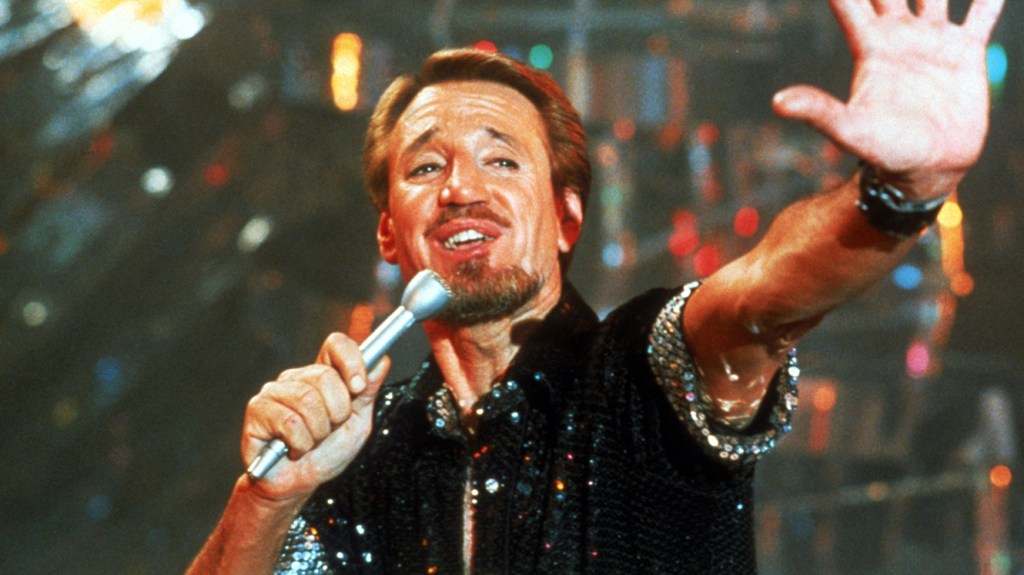
Song of the Day: Nothing Ever Happens On Mars from Waiting For Guffman


Today’s song of the day could probably double for a scene that I love but that’s okay.  I’ve always loved the Nothing Ever Happens On Mars song from Waiting to Guffman.

(Mars?  “Where’s that!?”)

It’s such a marvelous scene.  Yes, it captures the absurdity of regional theater but it also captures the underlying sweetness of it as well.  We may laugh but it’s still hard not to be touched by how much the members of the audience love it.

And, in the contest of the show, it’s a nice reminder that we’re not that different.  Martians get bored with their hometown as well!

Scenes That I Love: Catherine O’Hara and Fred Willard in Waiting for Guffman


When I heard that the actress Catherine O’Hara had passed away, I immediately thought of Waiting For Guffman.

I know that a lot of people immediately thought of Schitt’s Creek.  And I imagine that a lot of people thought of her as the desperate mother in Home Alone.  And definitely, there are a lot of people on twitter who are posting clips of her work on SCTV right now.  But I’m a theater nerd and, when you’re a theater nerd, Waiting for Guffman pretty much feels likes watching your life on film.

The entire cast of Waiting for Guffman is brilliant.  It’s definitely the most emotionally satisfying of all of Christopher Guest’s mockumentaries.  But I’ll have a special place in my heart for Catherine O’Hara and Fred Willard as the community theater superstars.  Today’s scene that I love features O’Hara and Willard giving the audition of a lifetime in Waiting For Guffman.

Live Tweet Alert: Join #FridayNightFlix for Double Impact!


As some of our regular readers undoubtedly know, I am involved in a few weekly watch parties.  On Twitter, I host #FridayNightFlix every Friday and I co-host #ScarySocial on Saturday.  On Mastodon, I am one of the five hosts of #MondayActionMovie!  Every week, we get together.  We watch a movie.  We tweet our way through it.

Tonight, at 10 pm et, I will be hosting #FridayNightFlix!  The movie?  1991’s Double Impact!

If you want to join us this Friday, just hop onto twitter, find Double Impact on Prime, start the movie at 10 pm et, and use the #FridayNightFlix hashtag!  I’ll be there happily tweeting.  It’s a friendly group and welcoming of newcomers so don’t be shy.

See you there!

Brad reviews THE GHOST AND MR. CHICKEN (1966), starring Don Knotts.


I love Don Knotts. I’m one of those people who have watched every episode of THE ANDY GRIFFITH SHOW (1960-1968) multiple times. And while it’s true that there are good episodes in the last three seasons, the series was at its best when Sheriff Andy Taylor and his sidekick Barney Fife were serving the townsfolk of Mayberry, North Carolina during the first five seasons. In Barney Fife, Don Knotts created one of the best characters in television history, earning five Emmy Awards in the process. When Don Knotts left the series at the height of its popularity, the first movie he made was THE GHOST AND MR. CHICKEN!  

In THE GHOST AND MR. CHICKEN, Knotts plays Luther Heggs, a meek typesetter at a small-town newspaper in Rachel, Kansas, who dreams of being a serious reporter but is treated like a joke by nearly everyone around him. When the town prepares for the 20-year anniversary of an unsolved murder at the supposedly haunted Simmons Mansion, Luther unexpectedly gets a chance to prove himself. He volunteers to spend the night alone in the mansion to see if it really is haunted. As you might expect, Luther is scared out of his mind as he hears banging on the walls, discovers secret passageways, and observes blood-stained organs playing themselves. The night culminates with Luther seeing a portrait of poor Mrs. Simmons with gardening shears piercing her throat! By surviving the night, and then telling the truth about what he experienced, Luther just may uncover a real crime being committed behind all of this “supernatural” activity!

Since Don Knotts left THE ANDY GRIFFITH SHOW to pursue a movie career, I’m glad to report that his decision to star in THE GHOST AND MR. CHICKEN was a really good choice. His performance is a masterpiece of physical comedy. Sure, Knotts trembles, shakes and delivers his lines in his awkward, nervous way for a lot of laughs, but he also provides a vulnerability that really makes you root for him. Knotts knew how to play lovable losers in a way that shows a quiet decency. He may actually be scared, and he may seem like a real pushover, but he also finds the courage to do the right thing even when it’s not easy. This was true for Barney Fife, and it’s also true for Luther Heggs in THE GHOST AND MR. CHICKEN.

Aside from Don Knotts, THE GHOST AND MR. CHICKEN has a solid supporting cast! Joan Staley is very beautiful as Luther’s love interest, Alma. Staley was a Playboy Playmate in 1958, so I can definitely see why Luther is in love. I like the fact that her Alma is more than just a pretty face. Rather, she’s one of the few people who sees Luther as more than a joke, which makes her even more appealing. Meanwhile, Luther’s newsroom boss (Dick Sargent) and office rival (Skip Homeier) never miss an opportunity to be condescending. The director Alan Rafkin directed 27 episodes of THE ANDY GRIFFITH SHOW, so he definitely knows how to get the best comedy out of Knotts and the rest of his cast. He also keeps the tone light, with the haunted house set pieces playing out like gentle, kid-friendly chills rather than anything truly scary. The blood-stained organ / garden shears sequence in the mansion is especially effective, with Don Knotts perfectly walking the line between raging fear and slapstick comedy. Signaling that there was a big audience for Don Knotts in the movies, THE GHOST AND MR. CHICKEN proved to be a box office hit, taking the number one spot during its first week of release, and grossing about eight times its budget!  

Ultimately, THE GHOST AND MR. CHICKEN endures because it understands the special qualities of its star. Don Knotts is funny, and he’s also human. He may be scared out of his mind, but he also has decency and an ability to find courage when he must. In that way, it’s a comfort movie, a should-be Halloween staple, and finally, a reminder that sometimes the bravest person in the room is the one who can’t quit shaking.  

Film Review: Fort Apache, The Bronx (dir by Daniel Petrie)


Welcome to Fort Apache, The Bronx.

Shot on location, the 1981 film of the same name takes place in one of the toughest police precincts in New York City.  The film opens with a prostitute (Pam Grier) walking up to a police car in the middle of the night and promptly gunning down the two cops inside.  (The scene emphasis on the blood splattering in the squad car makes it all the more disturbing and frightening.)  As soon as the cops are dead, people come out of the shadows and immediately start going through their pockets, collecting everything that they can.

Why were the cops killed?  There is no real motive, beyond Grier’s prostitute being high on drugs and enjoying the kill.  Indeed, we know from the start that Grier is the killer but the cops investigating the case continually ignore her, despite the fact that she’s always wandering around in the background.  (Grier is perfectly frightening in the nearly silent role.)  The new captain of the precinct, a by-the-book type named Dennis Connolly (Ed Asner), assumes that the killing must have been an organized assassination and he is soon ordering his cops to arrest and interrogate almost anyone that they see.  If someone jaywalks, Connolly wants them in the back of a squad car so that they can be interrogated.  He offers to give the men two weeks of extra vacation time for every lead that they find.  When veteran detective John Joseph Vincent Murphy III (Paul Newman) says that the reward is going to do more damage than good, Connolly dismisses his concerns.  Connolly is convinced that he knows how to run the precinct.  He views the people who live in the Bronx as being enemies who have to be tamed and controlled.  Murphy, who comes from a long line of cops, believes in working with the community as opposed to going strictly by the book.

It’s an episodic film, following Murphy and his partner, Corelli (Ken Wahl), as they try to keep the peace in a neighborhood full of empty lots, abandoned buildings, and horrific poverty.  (The film is all the more effective for having actually been shot on location.  Looking at the scenery in which everyone is living and working, it’s easy to understand why tempers get so easily frayed.)  Corelli is ambitious.  Murphy is cynical.  When Murphy meets a nurse (Rachel Ticotin), it seems like love at first sight.  They’re both survivors of the toughest city in America.  But the nurse has a secret of her own.  There’s a lot of stories that are told in Fort Apache, The Bronx but few of them have a happy ending.

It’s an effective film, though the structure is occasionally a bit too loose and the generic “cop music” on the soundtrack sometimes makes it seem as if the viewer is watching a cop show on one of the nostalgia channels.  The film works because it allows the Bronx itself to be as important a character as the cops played by Newman, Asner, and Wahl.  There’s a grittiness to the film that overcomes even the occasional melodramatic moment.  In the end, the film suggests that, while cops come and go, the precinct will always remain the same.  Killing two drug dealers just allows two more to move in.  Reporting on a bad cop, like the one played in the film by Danny Aiello, will only lead to the ostracization of a good cop.  To the film’s credit, neither Newman nor Asner are portrayed as being totally correct or totally wrong in their different approaches to police work.  Newman is correct about Asner’s heavy-handed tactics creating mistrust and resentment in the community.  Asner, however, has a point when he says that a cop killer cannot be allowed to go unpunished.

Paul Newman gives a great performance as Murphy, a role that a lesser actor would have turned into a cliche.  Murphy is the latest in a long line of cops and he’s on the verge of abandoning the family business.  Newman does a good job of portraying not only Murphy’s burnout but also how his affair with the nurse briefly inspires him to believe that he still might actually be able to make a difference in the world.  The film ends on an ambiguous note, one that leaves you with the impression that Murphy couldn’t stop being a cop if he tried.  The job may be burning him out but it’s still the only thing he knows.

Fort Apache, The Bronx is not an easy movie to find.  Though it did well at the box office (and reportedly inspired shows like Hill Street Blues and NYPD Blue), the film was also controversial because of the way the Bronx was portrayed.  While it’s not currently streaming or even available to rent on any of the major sites, I did find a good, age-restricted upload on YouTube.  Look for it before someone takes it down.

Film Review: Winning (dir by James Goldstone)


In 1969’s Winning, Paul Newman plays a race car driver.

That’s certainly not a surprise.  Newman was very much a fan of racing and owned a few race cars himself.  In Winning, he looks totally comfortable and believable behind the wheel.  There’s not a moment that you look at Paul Newman and think to yourself that he couldn’t be exactly who he’s playing, a very successful and very ambitious race car driver.  At its best, the film is a visual love letter to the sport of racing and the thrill of driving fast.  When Newman is on that track, Winning is an exciting film.

Unfortunately, Winning doesn’t spend nearly enough time on the track.  Instead, we spend way too much time examining the bad marriage of Frank (Paul Newman) and Elora Capua (Joanne Woodward).  Frank meets Eulora at a car rental place, where she’s working behind the counter.  After a whirlwind romance, they get married and Frank becomes a stepfather to Elora’s annoyingly sensitive son, Charley (Richard Thomas).  (The film doesn’t necessarily mean for Charley to be annoying but he most definitely is.)  Still, Frank remains obsessed with winning.  He remains so obsessed with winning that Elora has an affair with Lou Erding (Robert Wagner), another race car driver.  With his marriage in shambles, Frank throws himself into preparing for the Indianapolis 500.

Winning is very much a film of the late 60s.  There’s really not much of a story so the film tries to get by on frequent jump cuts, intentionally skewed camera angles, and frequent montages.  It’s one of those American films that desperately wants to be mistaken for the type of movies that were coming out of Europe at the time.  I tried to count all of the jump cuts during the first few minutes of the film and I quickly gave up.  While there’s nothing wrong with a good jump cut, the frequent cuts in Winning feel more like an affectation than anything else.  Basically, someone in production said, “The kids like jump cuts so toss them in whether they’re necessary or not.”  The film’s attempt to be arty only further serve to remind us that there’s very little actually going on.

Paul Newman had charisma to burn and, in Winning, he looks like he’s enjoying himself whenever he’s behind the wheel.  The marriage of Newman and Woodward was one of Hollywood’s great love stories but that doesn’t come across in the marriage for Frank and Elora.  A lot of that is because there’s really not much that can be said about who Elora.  She’s a blank.  Paul Newman had the screen presence and the cool confidence to get away with playing an underwritten character.  Woodward, however, can’t overcome the shallow script.  (Though Robert Wagner was nowhere near as good an actor as either Newman or Woodward, he has the right look for the role and his stiff line delivery actually works well for the character.  For whatever reason, Wagner often seemed to do his best work in Paul Newman films.)

Really, I shouldn’t be surprised that Winning turned out to be stylish but empty.  The film was directed by James Goldstone, who also directed the painfully portentous Sidney Poitier-as-Jesus film, Brother John.  Eventually, Goldstone straightened up and gave us enjoyably bad films like Rollercoaster and When Time Ran Out.  Newman is in When Time Ran Out as well.  Just as with Winning, he’s the best thing in the movie.  That’s one of the benefits of being one of the great actors.  Even when they’re appearing in a less-than-impressive film, you just can’t stop watching them.


Film Review: Hud (dir by Martin Ritt)


In 1963’s Hud, Paul Newman plays a monster named Hud.

Hud Bannon is the son of rancher Homer Bannon (Melvyn Douglas).  Hud lives in a small Texas town, where he’s known for his pink Cadillac, his heavy-drinking, and his womanizing.  When we first meet him, he’s leaving the home of a married woman and narrowly escaping the rage of her husband.  Throughout the film, he mentions that he’s heading into town to meet “Mrs.” So-and-So.  Hud’s father fears that Hud might be incapable of caring about anyone but himself.  Hud’s nephew, Lonnie (Brandon deWilde), at first looks up to Hud but, over the course of the film, he comes to see his uncle for who he truly is.  Though Hud is quick to defend Homer from others, he himself views Homer with contempt and even plots to have the old man declared incompetent so that he can take over the ranch.  His flirtation with the family housekeeper, Alma (Patricia Neal), soon crosses the line into something much more dangerous.  Hud is charming and handsome in the way that only a 30-something Paul Newman could be.  But he’s also a complete monster.

In Hud, Newman gave one of his best performances and director Martin Ritt and cinematographer James Wong Howe captured some haunting images of the most barren parts of the Texas panhandle.  Howe’s black-and-white imagery not only captures the harsh landscape but also the harsh outlook of the people who live there.  Hud’s ruthless personality as is much a product of the demands of the land as his own narcissism.  The characters in Hud live in a land that doesn’t allow sentimentality.  It’s a land that’s allowed Hud to become the monster that he is.

At least, that’s the way that Paul Newman saw Hud.  That was also the way that the film’s director, Martin Ritt, viewed Hud.  They viewed him as being about as villainous and unlikable as a character could be but, to Newman’s surprise, audiences actually walked out of the film embracing the character and making excuses for him.  Newman was shocked to learn that teenagers were putting posters of him as Hud on their walls.

Why did viewers embrace Hud?

Some of it is due to the fact that Brandon deWilde gives a remarkably bland performance as Lonny.  We first see Hud through Lonny’s eyes and we are meant to share Lonny’s growing disillusionment with his uncle.  But Lonny comes across as being such an empty-headed character that it’s hard to really get emotionally invested in his coming-of-age.  When Hud eventually dismisses Lonny and his concerns, Lonny really can’t defend himself because there’s not much going on inside of Lonny.  On the other hand, Paul Newman gives such a charismatic performance as Hud that we find ourselves continually making excuses for his bad behavior.  When he talks about how he was raised and his difficult relationship with his father, we have sympathy for him even though we know we shouldn’t.  The viewer makes excuses for Hud because that’s what we tend to do when it comes to charismatic bad boys who don’t follow the rules.

Indeed, Hud is proof of the power of charisma and screen presence.  As a character, Hud does some truly terrible things and yet, because he’s Paul Newman, we want to forgive him.  We want to try to figure out why someone who is so handsome and so charismatic would also be so angry.  Lonny may be the “good” character but Hud is the one who we want to get to know.  When Lonny flips through a paperback to read the sex scenes, he comes across as being creepy.  When a drunk Hud flirts with a woman who he has just met, we ask ourselves what we would do if Hud ever tried that with us.  The truth is that we all know what we would do.  That’s what makes Hud both a dangerous and an intriguing character.

In the end, Hud is an excellent film that features Paul Newman at his best and which uses the downfall of Homer’s ranch as a metaphor for a changing American society.  Though Hud was  not nominated for Best Picture, it was nominated for almost everything else.  Melvyn Douglas and Patricia Neal won acting Oscars.  James Wong Howe’s cinematography was also honored.  Paul Newman was nominated and perhaps would have won if not for the fact that Sidney Poitier was nominated for playing the exact opposite of Hud in Lilies of the FieldHud was meant to be a picture about Lonny discovering his uncle was a monster.  Instead, the film became about Hud’s refusal to compromise.  It turns out that people like good-looking rebels who do what they want.

Even if viewers missed the point, Hud was one of the best films of the early 60s and Paul Newman’s powerful performance continues to intrigue.


Film Review: Paris Blues (dir by Martin Ritt)


1961’s Paris Blues tells the story of four Americans in Paris.

Ram (Paul Newman) and Eddie (Sidney Poitier) are expatriate jazz musicians.  Ram has come to Paris to try to find success as a musician.  He’s a little cocky.  He’s a little arrogant.  However, he’s talented and he believes enough in his talent that he takes it a little bit personally when he’s told that he should just focus on being a composer instead.  Eddie is Ram’s best friend and someone who has no interest in ever returning to America.  In America, he’s judged by the color of his skin.  In Paris, no one cares that he’s black.  In Paris, they just care about his talent.

Lillian (Joanne Woodward) and Connie (Diahann Carroll) are best friends who are spending two weeks in Paris.  They love jazz and eventually, Lillian comes to love Ram while Connie comes to love Eddie.  Connie tries to convince Eddie to marry her and come back to America with her but Eddie tells her that “the struggle” in America is not “my struggle.”  Ram also finds himself torn over whether he should stay in Paris or return to America with Lillian.  In the end, one man leaves and one man stays.  It’s not really much of a surprise who does what.

Paris Blues was directed by Martin Ritt, a director who had been blacklisted during the 50s and whose career was revived by several films that he made with Paul Newman.  (Newman and Joanne Woodward first met on the set of Ritt’s The Long Hot Summer.)  Ritt was one of those reliably liberal directors who made message films that dealt with political issues but were never quite radical.  Paris Blues features a lot of talk about the civil rights movement and it makes an attempt to be honest about why two Americans would chose to live in a different country.  And yet, as was so often the case with Martin Ritt’s films, the film presents itself as being far more daring than it actually is.  Yes, Ram initially hits on Connie but he loses interest once he sees Lillian.  Though the film is based on a novel that featured an interracial relationship, there’s never really any doubt that, in the film, Ram is going to end up with Lillian and Eddie is going to end up with Connie.  And while the film makes it clear that Ram and Lillian sleep together within hours of first meeting each other, the relationship between Connie and Eddie is romantic but chaste.  Paris Blues may be a mature film for 1961 but it’s still definitely a film of 1961.

That said, the music’s great (Louis Armstrong shows up to jam with Ram and Eddie) and Newman and Woodward’s chemistry is off the charts.  Ram is like a lot of the characters that Paul Newman played in the 50s and 60s.  He can be self-centered and he can be petulant and he can be self-destructive.  But he’s never less than honest and the fact that he refuses to compromise or give into self-doubt makes him very appealing.  While Poitier struggles with a script that refuses to allow him too much personality (he’s affably pleasant, even when he’s explaining why he doesn’t want to live in America), Newman dominates the film in the role of an artist determined to share his vision.

Paris Blues is never the masterpiece that it tries to be but Paul Newman makes it more than worth watching.