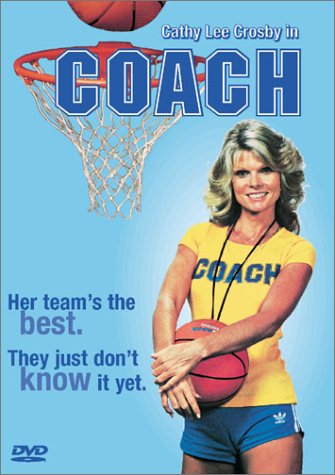
Just from watching the trailer above, you probably think that the 1978 film Coach is just your standard high school sports film. And, in many ways, it is. But, since it was made in the 70s, things still get a little bit weird. Before proceeding, I should probably point out that Coach (like the similar The Teacher) was produced by Crown International Pictures. But you probably already guessed that.
An exclusive California high school has a problem. The boy’s basketball team is having a terrible season. The most powerful man in town, F.R. Granger (Keenan Wynn), demands a change! (You can tell that Granger is powerful because he goes by his initials.) After ordering the hapless basketball coach to resign, Granger and the school board hire Randy Rawlings to replace him. Oddly enough, they don’t actually interview Randy for the job or attempt to meet Randy ahead of time. They just know that Randy is a former Olympian and are overjoyed when Randy accepts the job.
On Randy’s first day on the job, everyone is shocked to discover that Randy Rawlings is — GASP — a woman! Now, I’ll admit that this film is a little bit before my time and the world was probably a lot different back in the 70s but, as an Olympic medalist, wouldn’t Randy be a bit of a celebrity? And would anyone as obsessed with winning as F.R. Granger actually hire a coach sight unseen? Anyway, F.R. is none too happy to discover that Randy (Cathy Lee Crosby) is a woman and tries to fire her on the spot. Sorry, F.R. — can’t be done. As Randy points out, F.R. needs cause to fire her.
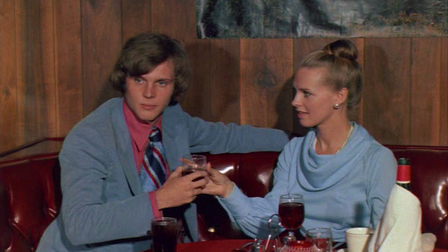
After forcing them to all take a cold shower and then coaching them to a few victories, Randy wins over the team. She also starts sleeping with one of her players (played by a very young and handsome Michael Biehn) and this is where the movie gets weird. I kept expecting this affair to be discovered and used by F.R. as an excuse to fire Randy. Because, after all, why would any film feature a rather creepy subplot about a teacher sleeping with a student unless it was somehow going to pay off in the end? But instead, the affair just sort of happens and never really ties back into the main plot of whether or not Randy will be able to coach the team to having a winning season.
Now, I know you’re probably thinking to yourself, “What would the great Russian writer Anton Chekhov think about this?” Well, here’s an exact quote from Mr. Chekhov:
“Remove everything that has no relevance to the story. If you say in the first chapter that there is a rifle hanging on the wall, in the second or third chapter it absolutely must go off. If it’s not going to be fired, it shouldn’t be hanging there.”
In other words, Coach was definitely not written by Anton Chekhov.
Anton Chekhov ponders the narrative failings of Coach
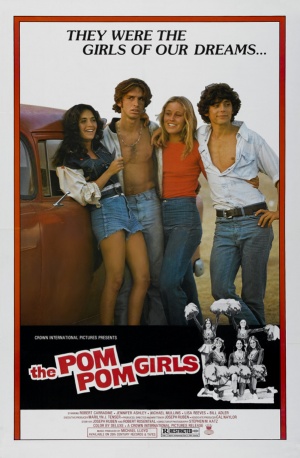
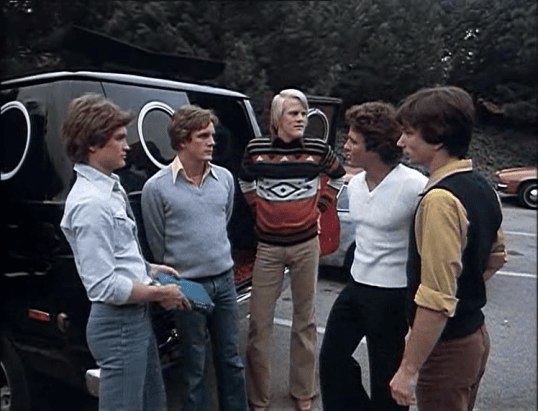
The Pom Pom Girls was released in 1976, the same year as Massacre at Central High. It also features two actors who made quite an impression in Central High — Robert Carradine and Rainbeaux Smith. However, that is where the similarities end because, whereas Central High was a political allegory disguised as an exploitation film, The Pom Pom Girls is an almost prototypical 70s teen comedy. Whereas Central High was all about subtext, The Pom Pom Girls has no subtext. Try to look between the lines of The Pom Pom Girls and all you’ll find is blank space. And, finally, while Central High remains a difficult film to see, I’ve lost track of how many of my Mill Creek box sets include The Pom Pom Girls.
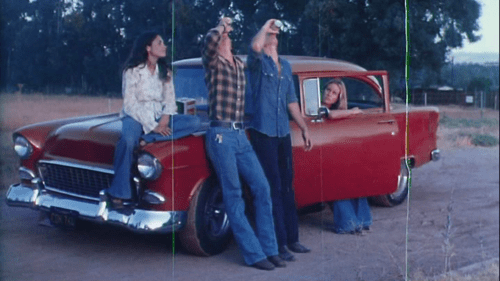
The Pom Pom Girls is about … well, close to nothing. Johnnie (Robert Carradine) and Jesse (Michael Mullins) are students at Rosewood High School in California. Because the film was made in 1976, they spend most of their time driving around in a van and listening to MOR radio stations. Johnnie and Jesse are also star football players, which is one of the odd things about the film because, while Carradine is genuinely likeable and Mullins makes for a plausible sullen high school student, neither one of them comes across as if they could be football players. The big game comes up against rival Hardin High, so there’s a prank war that involves a little more nudity than the ones on Saved By The Bell ever did. Johnnie and Jesse also have girlfriends, both of whom are cheerleaders. Jesse cheats on his girlfriend but apparently, the audience is supposed to sympathize with him because she refused to go to the beach with him. Johnnie, meanwhile, has a leather jacket-wearing nemesis named Duane (Bill Adler), who is upset because Johnnie is dating his ex. As often happens, it all ends with a recreation of the famous “chicken run” from Rebel Without A Cause. We watch a car explode from three different angles. In order to leave you with some suspense, I will not mention whether anyone was in the car.
You’re welcome.
And a fun time was by all…
One of the strange things about The Pom Pom Girls is that while the two main characters and their girlfriends are all presented as being rebels, they’re also presented as being the most popular kids in school. Johnnie and Jesse are the captains of the football team. They’re dating the captains of the cheerleading squad. Despite the movie’s attempts to convince us otherwise, these people are not rebels fighting the establishment. Instead, they are the establishment. This is actually something that The Pom Pom Girls has in common with Richard Linklater’s far superior Dazed and Confused. The difference, however, is that Dazed and Confused actually calls its character out on the hypocricy of their posturing while The Pom Pom Girls just tries to have the best of both worlds. Johnnie is both a star football player and the class clown who breaks the rules. Jesse is both a great team player and an angry individualist. I guess that’s the 70s for you.
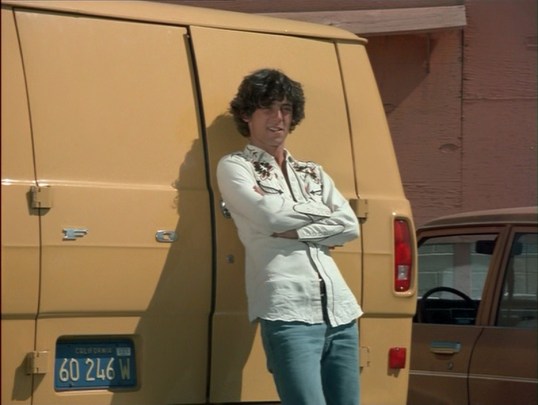
He owns a van. It has shag carpeting and a strobe light.
Back in high school, I was often asked to try out for cheerleading but I never did. For one thing, I didn’t see why I should have to try out when they could have just easily approached me and said, “Hi, will you please be the new head cheerleader?” Even beyond that, I couldn’t stand the idea of always having to be happy. And, perhaps most importantly, my sister was already a cheerleader and I wanted to establish my own thing. However, I still made Erin watch The Pom Pom Girls with me and I asked her if the film was a realistic portrait of high school cheerleading. In response, she rolled her eyes which I believe was her way of saying no.
But, even if it isn’t exactly Bring It On,The Pom Pom Girls still does have some worth as a time capsule of the clothing, attitudes, and vans of the 70s. To be honest, that’s probably the only thing of value that The Pom Pom Girls has to offer because, otherwise, it’s basically a film about a likable guy who spends all of his time hanging out with a guy who will literally not stop whining about being a football player and how nobody is willing to go to the beach with him.
Incidentally, The Pom Pom Girls was released by Crown International Pictures. Much like the company’s previous film, The Young Graduates, the main message here appears to be that the 70s kind of sucked.
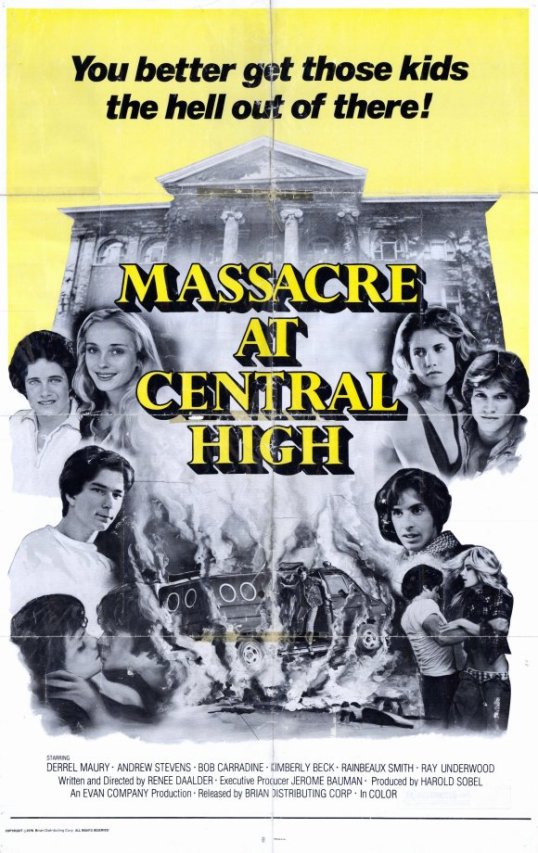
With a title like Massacre at Central High, you probably think that this 1976 film is a low-budget slasher film. However, you’re totally wrong. Instead of being a low-budget slasher film, Massacre at Central High is a low-budget political allegory and it’s a pretty good one at that. It’s also not exactly an easy film to see (I had to watch it off of a scratchy, old VHS tape), which is unfortunate because it’s probably one of the best exploitation films of the 1970s.
Massacre at Central High takes place at a high school in Southern California. The first thing that you notice about Central High is that there aren’t any adults around. The students don’t ever appear to go to class. Instead, they spend their time roaming the halls. The school is run by four wealthy jocks who enforce order, repress independent thought, and spend most of their time hanging out in an exclusive lounge. Of the four ruling jocks, Mark (Andrew Stevens) is the most sensitive, an overall nice guy who doesn’t approve of the excesses of the others but, at the same time, isn’t willing to stand up to them either.
The Ruling Clique
As for the other students, they spend their time being alternatively harassed and cared for by the jocks. They’re told, of course, that everything is for their own good and that their survival depends on the survival of Central High. Spoony (Robert Carradine) is caught and punished for spraying political graffiti on the lockers. Oscar (Jeffrey Winner) is regularly bullied by the jocks on account of his weight. School librarian Arthur (Dennis Kort) is attacked for being an intellectual. When Rodney (Rex Steven Sikes) makes the mistake of parking his car in one of the jock’s space, they react by stealing and wrecking his car.
Things start to change when track star David (Derrel Maury) transfers to Central High. David is an old friend of Mark’s and, at first, Mark attempts to get him to join the ruling clique. However, David is disgusted by the other jocks and starts to stand up for the oppressed students. The jocks (with the exception of Mark) respond by lowering a car down on David’s leg, crushing it.
No longer able to run track and now moving with a permanent limp, David refuses to tell anyone the truth about how he injured his leg. Instead, he returns to school and gets his revenge, methodically murdering all of the jocks except for Mark. Mark and his girlfriend Theresa (Kimberly Beck) now find themselves transformed into societal pariahs within the halls of Central High. Meanwhile, the formerly oppressed students step up to fill the power vacuum and, to David’s disgust, they quickly turn out to be just as bad as their now deceased oppressors.
David Is Disappointed
Now realizing that most revolutions are waged by the lower class against the upper class for the sole benefit of the middle class and that there’s absolutely no way to bring any real change to Central High, David instead makes plans to destroy the entire high school…
Surreal and dream-like, Massacre at Central High is a potent allegory that takes the concept of absolute power corrupting absolutely to its logical extreme. It’s a film that celebrates revolution while, at the same time, asking, “What’s the point?” It’s a film that looks at politics, society, and culture and actually has the courage to suggest that it might be better just to give up on all of it. Featuring excellent performances from Maury, Beck, and Stevens and wonderfully off-center direction from Rene Daalder, Massacre at Central High is not an easy film to track down but it’s definitely one worth seeing.
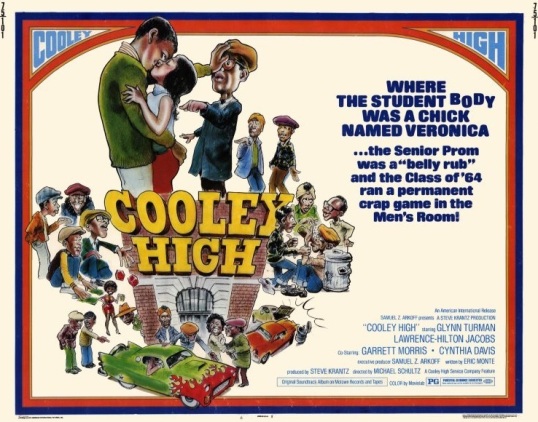
For our next entry in Back to School, we take a look at a film that is often referred to as being a “black American Graffiti,” 1975’s Cooley High.
Cooley High follows the adventures of two lifelong friends who are both seniors at Edwin G. Cooley Vocational High School in Chicago, Illinois. The charismatic Cochise (Lawrence Hilton-Jacobs) is a popular and friendly basketball star. Meanwhile, Preach (Glynn Turman) is an aspiring writer who, despite his obvious intelligence, is also one of the worst students at the school. Preach divides his time between skipping school, gambling, and writing poetry. Alone among their friends, Cochise and Preach both seem to have a chance to escape from life in the projects. At the start of the film, Cochise has just received a scholarship to play basketball in college. As for Preach, he’s the eternal optimist. He knows he’s going to make it, even if he doesn’t seem to be quite sure how he’s going to do it.
For the first half of the film, Cooley High is largely a plotless collection of vignettes featuring Cochise, Preach, and their friends skipping school, chasing girls, getting into minor trouble, and trying to avoid major trouble. The emphasis is on comedy but, unlike a lot of high school comedies from the 70s and 80s, the humor grows organically from the characters. Facing a future that’s likely to be dominated by prejudice, poverty, and limited opportunity, what can the students of Cooley High do other than laugh? The second half of the film takes a far more dramatic turn, with Preach and Cochise accused of both stealing a car and snitching on the actual thieves in order to get out of jail. The film’s downbeat conclusion may be predictable but it’s effective all the same.
One reason why I wanted to review Cooley High is because a few months ago, while I was trying to find something to watch on TV, I came across an episode of a show called Unsung Hollywood. The title of the episode was “The Story of Cooley High” and it told the story of how and why this film was made. It was actually pretty interesting to watch, as it featured interviews with screenwriter Eric Monte (who based the character of Preach on himself), director Michael Schultz (who directed a lot of memorable films in the 70s — including Sgt. Pepper’s Lonely Hearts Club Band — but has never quite gotten the recognition that he deserves), and the film’s two stars. Even more interesting, however, were the interviews with the local Chicago residents who essentially played themselves during the filming of Cooley High. Some of them had fond memories of appearing in the film while others were upset that the film’s box office success didn’t open up any new opportunities for them. Most haunting of all was the fate of an amateur local named Norman Gibson. After giving a genuinely good performance as a petty criminal who comes to a violent end in Cooley High, Gibson was murdered a year after the film was released.
As I mentioned before, Cooley High is often compared to American Graffiti and the two films do have some things in common, like the period setting and a great soundtrack. Ultimately, though, Cooley High can stand on its own.
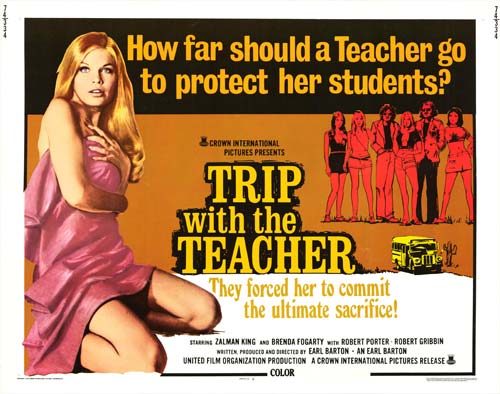
First released in 1975 and subsequently included in a few hundred DVD box sets, Trip With The Teacher is yet another strange film from Crown International Pictures.
The film opens with a school bus driving through the California desert. On board the bus is Miss Tenny (Brenda Fogarty) and four teenage girls. One thing that I immediately noticed is that director Earl Barton — perhaps realizing that none of the girls had really been given any sort of individual personality — took the time to make sure each of the girls was color-coded so that the audience could keep them straight. One is dressed in all blue, another in all green, and then another is wearing an unfortunate canary yellow. Meanwhile, Julie (Cathy Worthington) is obviously meant to be the main girl because she’s allowed to wear not one but two colors — yellow and white. When we first meet this group, we’re told that they’re on a field trip to see some Navajo ruins but, later on in the film, Julie says that they’re on a camping trip that has nothing to do with school beyond the presence of their teacher. But the important thing is that they’re on a bus in the middle of the desert. (The bus, by the way, is being driven by Marvin, who is played by an actor named Jack Driscoll and who might as well have “doomed” tattooed on his forehead.)
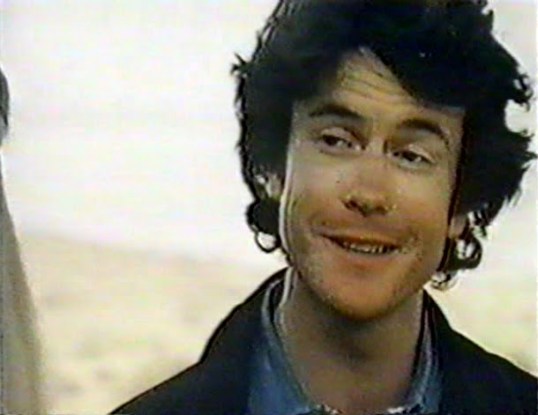
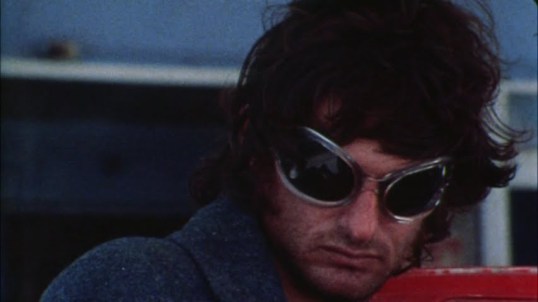
Also in the desert are two motorcycle-riding brothers — goofy Pete (Robert Porter), who has a big mustache and seems like a nice guy up until he starts trying to kill people, and Al (Zalman King), who is surly, wears weird sunglasses, and suffers from narcolepsy. When Pete gets a flat tire out in the middle of the desert, he’s helped out by a passing motorcyclist named Jay (Robert Gribbin). (Al sleeps through the entire encounter.) Jay, who is oddly friendly and talkative, decides that he’ll ride along with these two strangers.
I’ve seen Trip With The Teacher a few times and I have to say that I have never really been able to figure out what’s supposed to be going on with Jay. He’s the film’s nominal hero but Robert Gribbin plays him as being such a talkative and outwardly friendly character that my natural impulse is to distrust him. Maybe I’ve seen too many films where the good Samaritan always turns out to be a psycho but Jay is simply too good to be true.
‘
The Way Too Friendly Jay
Briefly, this suspicion seems to be confirmed when Jay, Pete, and Al come riding up on the school bus and Jay sees Julie through a window. Julie smiles and waves at Jay and I don’t blame her because I probably would have done the same thing, because Jay is cute, motorcycles are sexy, and you have to do something to pass the time while you’re being driven through the desert. But then 30-something Jay smiles and starts to wave back at 16 year-old Julie and mouths something like, “Come over here!” before flashing a huge grin and the scene gets undeniably creepy.
(The creep factor is not lessened by Jay later telling Pete, “Gee, that Julie is a really cute girl.”)
Anyway, when the school bus eventually breaks down, the three motorcyclists stop to “help.” In this case, helps means that Pete and Al use their motorcycles to tow the bus to a remote desert cabin. After a fight that leaves Marvin dead, Pete and Al decide to take the teacher, the girls, and Jay hostage until they can figure out what to do….
Now, I said earlier that Trip With The Teacher is weird and, believe it or not, it’s not just because of Jay. In the role of Al, future director Zalman King gives one of the oddest cinematic performances that I have ever seen. King alternates between underplaying and overacting, randomly going from mumbling to such an extent that you can barely understand him to literally yelling out every single line. It’s a performance that is so strange that it transcends such mundane concepts as good or bad. Single-handedly, Zalman King creates a reason for people to actually sit through Trip With The Teacher.
Zalman King in Trip With The Teacher
The other odd thing about Trip With The Teacher is that, despite all of the bad things that happen on screen, the film features some oddly cheerful music. The film’s theme song is played over the end credits, which juxtaposes the music with scenes from the movie. It’s an odd experience, watching all of these tense scenes play out while listening to that cheerful music.
And you can watch those end credits below! (This, needless to say, is where the spoiler warning comes into effect.) In order to get the full effect, be sure to stick with the credits all the way until the music stops playing.
(A quick warning: Though Trip With The Teacher is actually pretty mild as far as 70s grindhouse and drive-in films are concerned, the end credits still feature a few images that some may find disturbing — especially if you haven’t actually seen the film. Once you’ve actually sat through the film and can put everything in context, it’s pretty much impossible to take any of it seriously.)
So, you knew when I started this series of Back to School reviews that I would eventually end up reviewing a horror film or two. Whether it’s because they were written and directed by people still bitter over being teenage outcasts or because they were produced by people who were smart enough to realize that a lot of horror fans are still students, several horror films have been set in the world in high school.
Take, for instance, the 1974 film, Horror High.
Horror High tells the story of Vernon Potts (Pat Cardi), who is the smartest student at his high school. However, it’s debatable how much of an accomplishment that is because, in this low-budget film, it appears that there’s only 6 or 8 students at the school. Regardless, Vernon’s combination of intelligence, acne, and social awkwardness have come together to make him the school outcast. Not only do Vernon’s fellow classmates make fun of him but the janitor threatens to kill him, the football coach orders him to help the team cheat, and his English teacher destroys Vernon’s biology homework. Vernon’s only friend is a guinea pig named Mr. Mumps. Vernon eventually gives Mr. Mumps an experimental serum that turns Mr. Mumps into a murderous monster. Unfortunately, the janitor subsequently kills the guinea pig but, in the process, he also forces Vernon to drink the serum, which leads to Vernon occasionally turning into a monster himself. On the bright side, Vernon does eventually get to date the girl he has a crush on, largely because she’s single now that Monster Vernon has killed her boyfriend…
Horror High is one of those low-budget films that is so extremely odd that it can’t help but have an oddly dreamlike power to it. This is one of those cases where the total lack of narrative logic actually works to the film’s advantage. Pat Cardi makes for a believable outcast and everyone else in the cast is properly despicable. As ludicrous as the plot may be, the film itself is full of a palpable atmosphere of dread and doom. I’ve seen a lot of bad high schools in a lot of low-budget horror films but it’s hard for me to think of one that was quite as nightmarish as the one in Horror High.
Incidentally, Horror High was filmed in my home state of Texas, in the wonderful city of Irving!
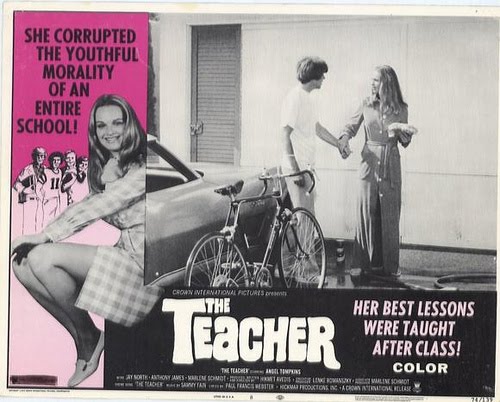
“She Corrupted The Youthful Morality of an Entire School!” the tagline for the 1974 film The Teacher screams out.
Uhmmm, no.
In fact, that’s probably one of the most deceptive taglines in the history of film advertising. However, we shouldn’t be surprised that it was used. Like The Young Graduates, The Teacher was produced by Crown International Pictures. Crown International was all about getting people to buy tickets and they probably figured that more people would pay to see a movie about a teacher corrupting “an entire school” than they would for a film about a 28 year-old teacher having an affair with one (and only one) 18 year-old who has recently graduated high school.
The relationship is between Diane (Angel Tompkins) and Sean (Jay North). Diane lives next door to Sean’s family. She’s married to a man who spends most of his time on the road, racing motorcycles and only occasionally calling his wife. Diane is a teacher but we only briefly see her standing outside of the local high school. While Sean admits that he has always had a crush on her and, at the start of the movie, even spies on her while she’s sunbathing, it’s never made clear whether or not Sean was ever actually in any of her classes. In fact, the only thing controversial about their eventual relationship is that there’s a 10 year age difference between them. But that really doesn’t seem to bother anyone, with the exception of two old women who happen to see Diane and Sean out on a date.
Teacher and Not A Student
That, of course, doesn’t mean that Diane doesn’t have anything to teach Sean. As the film’s theme song tells us, “Every boy needs a teacher, to help show him the way…”
But here’s the thing. Considering how tawdry one would naturally expect a film like The Teacher to be, it’s actually treats Diane and Sean’s relationship with a lot of sensitivity. Tompkins and North have a lot of chemistry together and both of them give natural and believable performances. In many ways, this film is a sincere attempt to explore an unlikely relationship. I’ve always felt that in almost every 70s exploitation film, there’s an art film waiting to break out. That’s certainly the case with The Teacher.
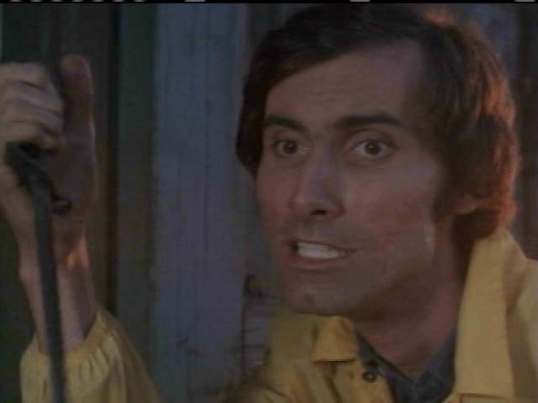
However, The Teacher isn’t just about Diane “teaching” Sean. It’s also about a guy named Ralph, who also happens to be obsessed with Diane. (When, at the start of the film, Sean is spying on Diane, little does he suspect that Ralph is spying on him.) We know Ralph is a bit off because he’s always talking to himself, he drives a hearse, and he’s played by Anthony James. You may not recognize his name but if you’re a fan of 70s and 80s exploitation cinema, you know who Anthony James is. He’s one of those very intense, very creepy-looking character actors who would always show up playing psychos and evil henchmen.
Anthony James
Ralph is not only obsessed with Diane but he also blames Sean for the death of his younger brother. It seems that Sean and Ralph’s brother were spying on Diane when, somehow, Ralph’s brother ended up falling to his death. (If you get the feeling that literally every male in this film appears to spend the majority of his time watching Diane — well, you’re right.) Ralph wants vengeance and, in his defense, Sean never really does seem to be that upset about the death of his best friend.
Because this film was made in the 70s, it all leads to surprisingly somber ending that will probably inspire you to reconsider any belief you may have in a benevolent God.
I have to admit that, out of all the Crown International films that I’ve recently watched, The Teacher was a favorite of mine. Watching the film — with its constantly shifting tone and it’s mix of arthouse pretension and grindhouse melodrama — is an odd experience that epitomizes everything that I love about old exploitation films.
Thank you, Crown International, for always being you.
Well, this is certainly intimidating. I know I’ve said this many time before but it deserves to be repeated: it’s often a hundred times more difficult to review a great film than it is to review a merely mediocre one. When a film fails, it’s usually easy to say why. The acting was bad. The directing was uninspired. The plot didn’t make any sense. Or maybe the film has been so overpraised that you, as a reviewer, are almost obligated to be tougher on it than you would be with any other film. However, it’s never as easy to put into words just what exactlyit is that makes a movie great.
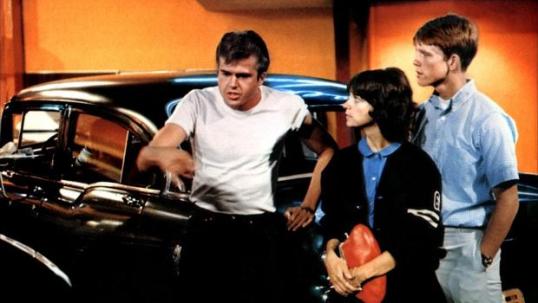
Take the 1973 Best Picture nominee American Graffiti for instance. I could tell you that this is a very well-acted film and that it features an ensemble of very likable performers, many of whom subsequently went on to become stars and celebrated character actors. Then again, you can say the same thing about countless other films.
I could say that director George Lucas does such a good job putting this film together that it’s hard to believe that he’s the same man who would later be responsible for all three of the Star Wars prequels. Then again, I could also say the same thing about how odd it is that the same man who directed the entertaining Final Destination 5was also responsible for the far less enthralling Into The Storm.
I could tell you that the film serves as a valuable time capsule in that not only does it feature a loving recreation of small town America in the early 60s but that it’s also a chance to see what Richard Dreyfuss, Ron Howard, and Charles Martin Smith all looked like when they still had hair. But then again, I also praised The Young Graduates for being a time capsule as well.
Let’s face it — it’s difficult to define the intangible qualities that make a film great. Often times, it’s a case of simply knowing it when you see it. I’ve seen American Graffiti a few times. The last time I saw it was at a special Sunday showing at the Alamo Drafthouse. And, on that early Sunday afternoon, the theater was packed with people who had paid for the chance to see the 40 year-old film on the big screen. I’m 28 years old and it’s significant that, while the majority of the audience was older than me, there were quite a few people who were younger. American Graffiti is one of those films that obviously spoke to audiences when it was first released and continues to speak to audiences today.
As I mentioned in my review of Rebel Without A Cause, films about teens tend to age quickly and, often times, one generation’s masterpiece will turn out to be a later generation’s joke. When a film like Rebel or American Graffiti survives the test of time, it’s because the film has managed to capture a universal truth about what it means to be young and to have your entire life ahead of you.
American Graffiti takes place over the course of one long night in Modesto, California in 1962. The film follows several different characters, the majority of whom have just graduated from high school. What these characters all have in common is that one phase of their life has ended and a new one is about to begin. Over the course of that one night, all of them are forced to say goodbye to their past identities and, in some instances, are forced to face their future.
For instance, there’s Curt (an amazingly young Richard Dreyfuss), a neurotic intellectual who spends the night trying to decide whether or not he actually wants to leave for college in the morning. Complicating Curt’s decision is a mysterious blonde who mouths “I love you” at him before driving away. While searching for her, Curt finds himself unwillingly recruited into the Pharoahs, a somewhat ludicrous small town gang that’s led by Joe (played, in hilariously clueless fashion, by Bo Hopkins.) Curt, incidentally, is my favorite character in the film. He’s just adorable, which admittedly is not a reaction that one often has to Richard Dreyfuss.
(Curt is also featured in one of my favorite scenes, in which he smokes a cigarette with a lecherous teacher named Mr. Wolf.)
Curt’s sister (Cindy Williams) is dating Steve Bolander (Ron Howard). Steve is the former class president and, unlike Curt, he’s very excited about leaving home. Ron Howard gives such a likable performance that it actually takes a few viewing to realize just how big of a jerk Steve really is.
And then there Terry (Charles Martin Smith) who wears big glasses and has bad skin. Terry gets to spend the night driving around in Steve’s car and manages to pick up a girl named Debbie (Candy Clark). For Terry, this is his night to actually be somebody and what makes it all the more poignant is just how obvious it is that Terry will probably never get another chance. Though he may not realize it, those of us watching understand that this is literally going to the be the best night of Terry’s life.
(Incidentally, much like Ron Howard, Charles Martin Smith would go on to become a film director and gave the world the amazingly sweet Dolphin Tale.)
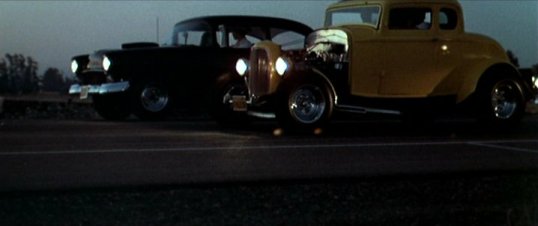
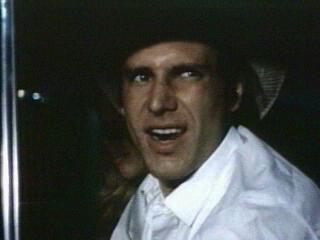
And finally, there’s John Milner (Paul Le Mat). John is a little older than the other main characters. He spends most of his time in his car, driving around and getting challenged to race. He’s the epitome of late 50s/early 60s cool, with an attitude and a look that he obviously borrowed from James Dean and Marlon Brando. Over the course of the night, he is forced to deal with a bratty 13 year-old stowaway (MacKenzie Phillips) and a mysterious challenger named Bob Falfa (played by a youngish Harrison Ford, who wears a cowboy hat and speaks with a country twang).
The film follows these characters through the night and then, at the end of it, we get the famous epilogue where we discover that all of the male characters have pretty much ended up exactly how we thought they would. In some cases, that’s a good thing. And in other cases, it’s not. It’s a good ending that’s kept from being great by the fact that none of the film’s female characters rate so much as even a mention.
So, what else can be said about American Graffiti?
If you’re a teen who lives in North Texas, then today was your first day back to school. In honor of this event, I’ve been doing a special series of Back to School reviews: 76 reviews in 8 days, all dealing with either high school or being a teenager. Today, we continue this series by taking a look at The Ringer, a clever 1972 film about drugs, music, and nose rings!
Over the course of 20 minutes, The Ringer tells several different stories. A girl shoots up heroin and then reacts with disturbing passivity as blood starts to run down her arm in close-up. A group of ad execs discuss the best way to convince teenagers to buy “ringers,” huge nose rings that will let people know what they believe in. (While the whole idea behind the ringers is a play on the idea of people being “led by the nose,” it also accurately predicted future fashion and how many educational films can you say that about?) A group of music executives discuss the best way to market a new band, agreeing that the best strategy would be to make it appear as if the band isn’t being sold while it actually is. (One of them suggests that they shouldn’t have chairs at any of the band’s shows, in order to make the band seem unpretentious and seriously, we all know that would totally work…) And finally, there’s the group of drug dealers who strategize about the best way to sell pills to teenagers…
Now, I have to admit that I have a weakness for old educational films but that’s largely because they tend to be so silly. The Ringer is unique in that it’s actually a very clever and well-done film that deftly uses satire (as opposed to the heavy-handed messaging that we usually tend to associate with educational films) to make its point. As opposed to many other anti-drug films of the period, The Ringer doesn’t spend any time telling horror stories about what people may or may not do while under the influence but instead, it ridicules and attacks those that get rich off of other people’s addictions.
The Ringer is also interesting because it was the directorial debut of filmmaker Jeff Lieberman, who brought a similar mix of satire and drama to such classic films as Blue Sunshine, Squirm, and Just Before Dawn! If you keep an eye out, you can spot him playing one of the drug dealers!
Monday is the first day of school down here in Dallas so it seems only appropriate that this latest entry in our Back to School series should be a look at one of those most quintessential Texas films ever made, the 1971 best picture nominee, The Last Picture Show.
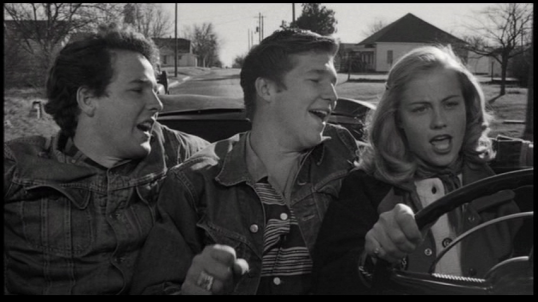
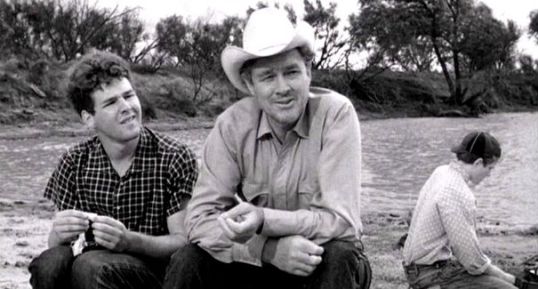
Directed by Peter Bogdanovich and based on a novel by Larry McMurtry, The Last Picture Show takes place in 1951 and tells the story of two high school seniors, best friends Sonny Crawford (Timothy Bottoms) and Duane Jackson (Jeff Bridges, reminding us once again why everbody loves him). Sonny and Duane live in the rural town of Anarene, Texas. With little to look forward to in the future, beyond perhaps getting a job working in the oil fields, Sonny and Duane are both intent on enjoying their final year of high school. Sometimes, that means driving down to Mexico for the weekend. Sometimes, it means going to the only theater in town and seeing a movie. Most of the time, however, it means hanging out in a pool hall owned by the strict but fatherly Sam (Oscar winner Ben Johnson). Often times they are accompanied by the intellectually disabled Billy (Sam Bottoms), who responds to everything with a blank smile and spends most of his spare time wandering around with a broom, futilely trying to sweep the dusty streets.
The charismatic and impetuous Sonny is dating the beautiful and self-centered Jacy Farrow (Cybil Shepherd), who is the daughter of the wealthiest woman in town. Jacy knows that her cynical mother (Ellen Burstyn) is having an affair with an oil worker named Abilene (Clu Gulager) but she’s more concerned with her own future. Even though she’s dating Sonny, Jacy still accepts an invitation from the awkward Lester Marlow (played by a memorably goofy Randy Quaid) to attend a naked indoor pool party. At the party, she meets Bobby Sheen (Gary Brockette), who is rich and will be able to provide her with the future that Duane never will. However, Bobby tells Jacy that he isn’t interested in her because she’s a virgin. If nothing else, this gives Jacy a reason to stay with Duane, at least until after they have sex.
Meanwhile, the far more sensitive Sonny ends up having an affair with Ruth Popper (Cloris Leachman, who won an Oscar for her performance in this film), the wife of the high school football coach. It appears that Sonny truly cares about Ruth but then he finds himself being tempted by none other than his best friend’s girlfriend…
At heart, The Last Picture Show really is basically a small town soap opera, a Texas version of Peyton Place.The difference between the two films — beyond the fact that The Last Picture Show just happens to be a 1oo times better than Peyton Place — is that The Last Picture Show doesn’t take place in a beautiful, idealized small town. Instead, the town ofAnarene is a believably bleak location, one that will be familiar to anyone who, like me, grew up in the American southwest. A good deal of the success of The Last Picture Show is due to the fact that it was actually filmed on location in Archer City, Texas.
(Nothing annoys me more than when I see the mountains of California in the background of a movie that’s supposed to be taking place in North Texas. We don’t have mountains up here. For the most part, we don’t even have hills. The land is flat. You can see forever, if you know where to look.)
Of course, you can’t talk about The Last Picture Show without talking about Robert Surtees’s stunning black-and-white cinematography. Not only does the black-and-white remind us that this is a film about a fading way of life but it drives home the fact that Sonny and Duane don’t have much to look forward to. Growing up in Anarene means they are destined for lives without color or excitement. In the end, can you really blame them for occasionally acting before they think?
Ultimately, the success of The Last Picture Show is due to a lot of things. This was Peter Bogdanovich’s second film as a director and he did such an excellent job here that he’s basically spent the rest of his career trying to live up to this one film. (That said, Bodganovich also left his wife for Cybill Shepherd — despite the fact that his wife was the one who suggested that he make this film and cast Cybill in the first place! Don’t worry though — Polly Platt got her revenge by having a far more successful career than her ex-husband and she even produced Say Anything, a film that we will soon be looking at.) The screenplay, by McMurtry and Bogdanovich, is full of sharp dialogue and memorable characters. As for the performers, this is probably one of the best acted films ever made. Jeff Bridges and Timothy Bottoms play off each other well, Cybill Shepherd is the epitome of casual destructiveness, and Ben Johnson is brilliantly cast as the film’s moral center. My favorite performance comes from Ellen Burstyn, who delivers every line with just the right combination of contempt and ennui.
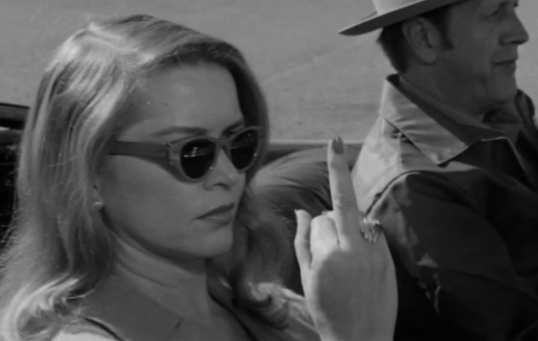
Ellen Burstyn in The Last Picture Show
If you’re a Texan, The Last Picture Show is one of those films that you simply have to see. And if you don’t enjoy it and if you don’t relate to at least a few of the characters (I related to Jacy, though I like to think that I’m a lot nicer in the way I treat people), then you’re not a real Texan.