Insomnia File #69: Candy (dir by Christian Marquand)


What’s an Insomnia File? You know how some times you just can’t get any sleep and, at about three in the morning, you’ll find yourself watching whatever you can find on cable or streaming? This feature is all about those insomnia-inspired discoveries!

If you find yourself having trouble getting to sleep tonight, you can always pass the time by watching the 1968 film, Candy.  It’s currently on Tubi.

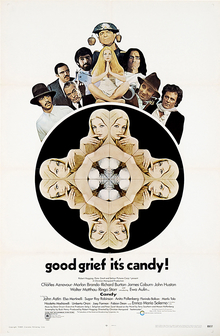
Based on a satirical novel by Terry Southern and Mason Hoffenberg, Candy follows Candy Christian (Ewa Aulin), a naive teenager from middle America as she has a number of increasingly surreal adventures, the majority of which end with her getting sexually assaulted by one of the film’s special guest stars.  It’s very much a film of the 60s, in that it’s anti-establishment without actually seeming to know who the establishment is.  It opens with a lengthy sequence that appears to be taking place in outer space.  It ends with an extended sequence of Candy walking amongst the film’s cast and a bunch of random hippies.  Director Christian Marquand appears as himself, directing the film.  Yep, this is one of those films where the director and the film crew show up and you’re supposed to be say, “Far out, I didn’t realize I was watching a movie, man.”

The whole thing is a bit of a misfire.  The novel was meant to be smut that satirized smut.  The film isn’t really clever enough to work on any sort of real satirical level.  As was the case with a lot of studio-made “psychedelic” films in the 60s, everything is a bit too obvious and overdone.  Casting the Swedish Ewa Aulin as a character who was meant to represent middle America was just one of the film’s missteps.  Based on The Graduate, Mike Nichols probably could have made a clever film out of Candy.  The French Christian Marquand, a protegee of Roger Vadim’s, can not because he refuses to get out of the film’s way.  It’s all jump cuts, flashy cinematography, and attempts to poke fun at American culture by someone who obviously knew nothing about America beyond the jokes told in Paris.

That said, the main reason that anyone would watch this film would be for the collection of guest stars who all show up and try to take advantage of Candy.  Richard Burton plays an alcoholic poet named MacPhisto and his appearance goes on for far too long.  (Burton, not surprisingly, appears to actually be drunk for the majority of his scenes.)  Ringo Star — yes, Ringo Starr — plays a Mexican gardener who assaults Candy after getting turned on by the sight of MacPhisto humping a mannequin.  When Emmanuel’s sisters try to attack Candy, she and her parents escape on a military plane that is commanded by Walter Matthau.  Landing in New York, Candy’s brain-damaged father (John Astin) is operated on by a brilliant doctor (James Coburn) who later seduces Candy after she faints at a cocktail party.  Candy’s uncle (John Astin, again) also tries to seduce Candy, leading to Candy getting lost in New York, meeting a hunchback (Charles Aznavour), and then eventually ending up with a guru (Marlon Brando).  Candy’s adventures climax with a particularly sick joke that requires a bit more skill to pull off than this film can afford.

If you’re wondering how all of these famous people ended up in this movie, you have Brando to thank (or blame).  Christian Marquand was Brando’s best friend and Marlon even named his son after him.  After Brando agreed to appear in the film, the rest of the actors followed.  Brando, Burton, and Coburn received a share of the film’s profits and Coburn later said that his entire post-1968 lifestyle was pretty much paid for by Candy.  That seems appropriate as, out of all the guest stars, Coburn i the only one who actually gives an interesting performance.  Burton is too drunk, Matthau is too embarrassed, Starr is too amateurish, and Brando is too self-amused to really be interesting in the film.  Coburn, however, seems to be having a blast, playing his doctor as being a medical cult leader.

Candy is very much a film of 1968.  It has some value as a cultural relic.  Ultimately, it’s main interest is as an example of how the studios tried (and failed) to latch onto the counterculture zeitgeist.
Previous Insomnia Files:

  1. Story of Mankind
  2. Stag
  3. Love Is A Gun
  4. Nina Takes A Lover
  5. Black Ice
  6. Frogs For Snakes
  7. Fair Game
  8. From The Hip
  9. Born Killers
  10. Eye For An Eye
  11. Summer Catch
  12. Beyond the Law
  13. Spring Broke
  14. Promise
  15. George Wallace
  16. Kill The Messenger
  17. The Suburbans
  18. Only The Strong
  19. Great Expectations
  20. Casual Sex?
  21. Truth
  22. Insomina
  23. Death Do Us Part
  24. A Star is Born
  25. The Winning Season
  26. Rabbit Run
  27. Remember My Name
  28. The Arrangement
  29. Day of the Animals
  30. Still of The Night
  31. Arsenal
  32. Smooth Talk
  33. The Comedian
  34. The Minus Man
  35. Donnie Brasco
  36. Punchline
  37. Evita
  38. Six: The Mark Unleashed
  39. Disclosure
  40. The Spanish Prisoner
  41. Elektra
  42. Revenge
  43. Legend
  44. Cat Run
  45. The Pyramid
  46. Enter the Ninja
  47. Downhill
  48. Malice
  49. Mystery Date
  50. Zola
  51. Ira & Abby
  52. The Next Karate Kid
  53. A Nightmare on Drug Street
  54. Jud
  55. FTA
  56. Exterminators of the Year 3000
  57. Boris Karloff: The Man Behind The Monster
  58. The Haunting of Helen Walker
  59. True Spirit
  60. Project Kill
  61. Replica
  62. Rollergator
  63. Hillbillys In A Haunted House
  64. Once Upon A Midnight Scary
  65. Girl Lost
  66. Ghosts Can’t Do It
  67. Heist
  68. Mind, Body & Soul

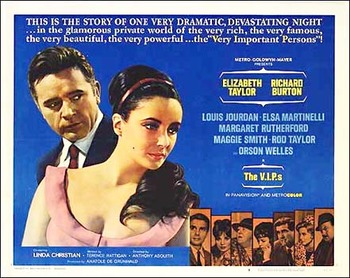
Cleaning Out The DVR: The V.I.P.s (dir by Anthony Asquith)


The 1963 film, The V.I.P.s, is about a group of very important people who have all shown at Heathrow Airport at the same time, all in an effort to get the Hell out of England.  They’ve all got their own individual reasons for wanting to leave the country but the important thing is that they all want to leave.  Unfortunately, a fog has rolled onto the runway and the plane can’t take off.  Because this film was made in 1963, all the passengers are allowed to leave the plane and wait, overnight, in a hotel.

Among the Very Important People:

Flamboyant film producer Max Buda (Orson Welles, playing a version of himself) needs to leave London before he receives a gigantic tax bill.  Accompanying him is his latest discovery, Gloria Gritti (Elsa Martinelli).  Max is the type who does things like barging into the plane’s cockpit and demanding to know why the pilots aren’t willing to risk crashing the plane.  That may sound self-centered on Max’s part but Welles is such a charmer that you forgive him.  Add to that, he’s trying to avoid paying taxes and that’s something that I can definitely get behind.

The Duchess of Brighton (Margaret Rutherford) is an eccentric but impoverished noblewoman who is going to lose her home if she doesn’t fly to Florida and take on a somewhat demeaning job.  The Duchess is the type who struggles to find room in the overhead compartment for her ludicrous oversized hatbox.  She’s never really been out in the real world before.  Margaret Rutherford won an Oscar for her performance, which is occasionally amusing but never particularly subtle.  (Have you seen Airport?  Rutherford has the Helen Hayes role, basically.)

Lee Mangrum (Rod Taylor) is a businessman who is on the verge of losing his business.  Miss Mead (Maggie Smith) is his secretary.  Miss Mead is secretly in love with Lee, who somehow hasn’t noticed.  We’re supposed to sympathize with Lee but he’s so incredibly clueless that it’s hard not to feel that Miss Mead could do better.

Finally, we have Frances Andros (Elizabeth Taylor).  Frances is one of the most popular film stars in the world.  She’s married to Paul Andros (Richard Burton), who is very wealthy and who, like most Burton characters, is also very moody.  Frances has decided to leave Paul and go to America with her lover, Marc Champselle (Louis Jourdan).  However, the fog gives Paul a chance to come to the airport and try to talk Frances out of leaving him.

Make no mistake about it, Liz Taylor and Burton are the main attraction here.  Welles, Rod Taylor, Rutherford, and Smith all get plenty of scenes but it’s obvious that the people behind The V.I.P.s understood that most of the audience would be there to watch Liz and Burton acting opposite each other.  This was, I think, the first film that they made together after falling in love on the set of Cleopatra.  Due to Cleopatra’s legendarily difficult production, it was released around the same time as The V.I.P.s, despite going into production years before the latter film.  Audiences could go watch Liz and Dick fall in love in Cleopatra and then head over to a different theater and watch the two of them fight in The V.I.Ps.  Elizabeth Taylor may be playing Frances Andros and Richard Burton may be playing Paul Andros but they really might as well be playing themselves.

The V.I.P.s is a big and glossy film, the type of movie that the Hollywood studios used to make as their way of saying, “See!  You won’t get this on TV!”  It’s frequently silly but it’s also undeniably watchable.  While Burton and Taylor’s later films tended to feature the two of them at their worst, they’re both actually really good in The V.I.P.s and the scenes where they argue have an emotional heft to them that, with the exception of Who’s Afraid of Virginia Woof?, wasn’t found in their other films.  For once, you watch the film and you really do hope that Liz and Dick will work things out and stay together.  The V.I.P.s may be dated (just try to chase someone through an airport or get off a delayed flight now) but it’s still entertaining.

Sci-Fi Film Review: The 10th Victim (dir by Elio Petri)


10th Victim

Before The Hunger Games…

Before The Purge

There was The 10th Victim!

This Italian film from 1965 takes place in a future that is a lot like our present.  After years of war and senseless violence, the world is finally at “peace.”  Wars are avoided by allowing people to take part in the Big Hunt.  When you join the Hunt, you’re agreeing to take part in 10 rounds of competition.  For five rounds, you’re the hunter.  For the other five rounds, you’re the hunted.  Survive all 10 rounds and your reward will be money and retirement.  So far, only 15 contestants have managed to survive.

If you’re being hunted, you get a letter informing you that you are now being hunted.  The only way to win is to kill the person who has been assigned to hunt you.  Unfortunately, you’re not told who is hunting you and, if you accidentally kill someone who is not hunting you, you’ll be sent to prison for 30 years.  And, of course, the whole time you’re trying to avoid getting killed, others are being hunted around you.  World peace means that there are constant gun battles in the streets, all of which are calmly observed by a rather apathetic populace.  It’s a violent world but it’s legal violence so it doesn’t really concern anyone beyond the people that are getting killed.

(At one point, an announcement is heard while a hunter guns down his target: “Live dangerously but obey the law…live dangerously but obey the law…”)

Coverage of the Big Hunt is the world’s most popular television show and, as a result, legalized murder has become big business.  Companies regularly sponsor hunters and turn their kills into elaborate commercials for their products.

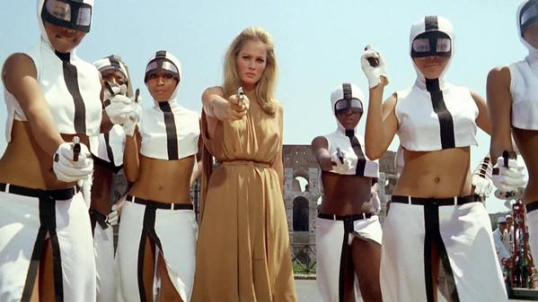
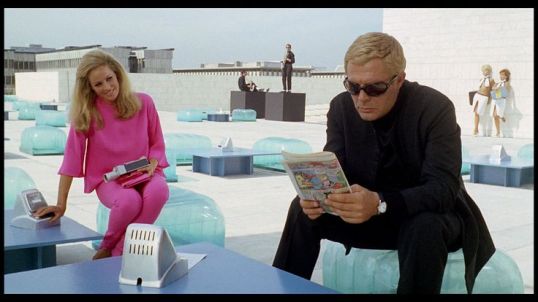
When we first meet Caroline Meredith (Ursula Andress), she is using a literal bullet bra to shoot a man dead.  Caroline is sponsored by Ming Tea and, when she is assigned to hunt Marcello Pollitti (Marcello Mastroianni), the company flies her out to Italy.  In order to make Marcello’s death as cinematic and commercial as possible, Ming Tea and Caroline decide to lure him to Rome’s Temple of Venus.  The Ming Tea dancers are flown in, a choreographer starts working on their routine, and Caroline tracks down Marcello.

Tenth Victim

Marcello has just found out that he’s being hunted and he’s more than a little depressed.  He’s also paranoid and when Caroline first approaches him, Marcello suspects that she’s his hunter and not, as she claims, a journalist.  However, because of the legal penalty for killing a non-hunter, Marcello cannot kill Caroline until he’s sure that she wants to kill him.  Meanwhile, Caroline cannot kill Marcello until they’re at the Temple of Venus, in front of the cameras and the dancers.

And, of course, there’s also the fact that, as they get to know each other, Caroline and Marcello start to fall in love.  When Caroline observes Marcello conducting a bizarre religious ceremony (he’s the head of a cult of sun worshippers), she is so touched that she starts to cry.  Or does she?  Are her tears just a ploy to keep Marcello from suspecting that she wants to kill him?  We’re never quite sure.

If you didn’t already know that The 10th Victim was made in 1965, you would guess it after just a few minutes.  This is one of those hyperstylized works of pop art that, for many people, define 60s cinema.  How you react to the film will depend on how much tolerance you have for its nonstop style.  Speaking as someone who happens to love over-the-top pop art, I enjoyed it but I could imagine other viewers ripping out their hair at the sound of the film’s peppy theme song.

But, if you’re patient, you will eventually discover that, underneath the film’s excesses, it’s actually a rather clever satire of media, politics, culture, religion, and just about everything else that deserves to be satirized.  Marcello Mastroianni and Ursula Andress are both a lot of fun and, in the end, the whole thing works as both a surprisingly accurate prophecy of today’s world and as a time capsule of the 1960s.

Plus, I loved the bullet bra.  I need to get one of those.

It’s a dangerous world, after all.

http://www.youtube.com/watch?v=uiJ6oghRqKY