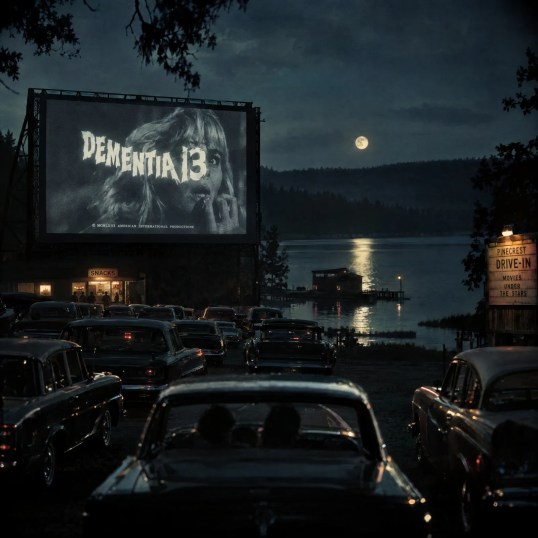
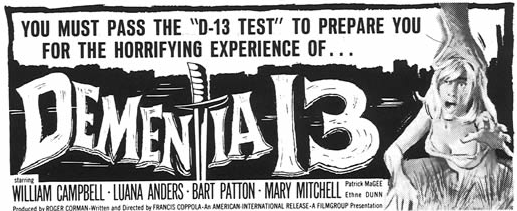
1963’s Dementia13 is a significant film for another reasons.
For one, it’s the mainstream feature film debut of Francis Ford Coppola. (Coppola has said that he directed two softcore films before Dementia13 but they’ve been lost to history.) Both Coppola’s screenplay and his direction were heavily influenced by the early giallo films that were coming out of Italy. One could argue that this is the first American film to pay homage to Mario Bava.
Dementia13 is also the first film on which Coppola ever went overbudget. This film is literally the start of an era.
Coppola himself has been critical of Dementia13. Producer Roger Corman was not happy with the first cut of the film and added a few scenes that took away from Coppola’s pacing. That said, it’s still an atmospheric and creepy forerunner to the American slasher film. The scene in which Launa Anders goes for a swim has been duplicated in numerous other films and it’s still effective in the way that it chops away at the audience’s sense of security. It certainly freaks me out. Of course, I’m not much of a swimmer. I’m a good drowner, though.
In 1974’s The Mutations, Donald Pleasence stars as Professor Nolter. A genetic scientist, Nolter is convinced that plants are the greatest examples of evolution. During the classes he teaches at the local university, Nolter raves about the wonders of the Venus flytrap. Is there anything better than a plant specifically developed to eat bugs? When we see Nolter’s students listening to him, the majority of them appear kind of bored with the whole thing. Only Brian Redford (Brad Harris) is really that interested in anything Nolter has to say.
What no one knows is that Nolter has been conducting experiments of his own. Nolter has hired the deformed Lynch (Tom Baker) to abduct young women and eventually young men so that Nolter can try to speed up their evolution by injecting them with plant DNA… or something. To be honest, I’m not totally sure what Nolter was doing in that laboratory, and I kind of suspect the same was true for the screenwriter. What I can say for sure is that there were a lot of close-ups of the hypodermic needle Nolter was holding in his hand. Unfortunately, all of Nolter’s experiments have failed, and his victims have been transformed into strange creatures. One girl becomes a lizard woman. One guy is turned into a crab-like plant monster.
Fortunately for Nolter, Lynch owns a carnival, and Nolter’s victims just become the latest attractions. Lynch was himself once a carnival “freak.” He was known as “the ugliest man in the world,” and he’s never recovered from the shame and the trauma of being taunted for years. Nolter has promised to cure Lynch of his disfigurement in return for Lynch continuing to abduct new subjects for him. However, when a group of Nolter’s students come to suspect that a classmate has been transformed into a reptile, everything starts to come crashing down.
The Mutations is an odd film. On the one hand, the carnival setting and Donald Pleasence’s mad scientist definitely feel like they could have been lifted from any number of old, black-and-white horror films. At the same time, the nudity, the gore, and the clear implication that Lynch is a pervert, along with everything else, clearly establish that this film was made in the ’70s. Indeed, there’s a scene in which some students talk about dropping acid that practically seems to be shouting, “See? This film is modern and hip!” The film works best when it pays homage to the older films that inspired it. As always, Donald Pleasence seems as if he was born to play an obsessive and quite mad scientist. Tom Baker is brutish as Lynch, but he also communicates the pain that Lynch carries in his heart. (Baker especially deserves credit for managing to give such an expressive performance despite acting underneath a ton of makeup.) Michael Dunn also gives a good performance as the sympathetic leader of the freaks. Unfortunately, the college students are never as interesting. Our heroes are duds. Luckily, the villains are entertaining.
This film was directed by cinematographer Jack Cardiff and, not surprisingly, it looks great. This was Cardiff’s final film as a director. After this film, he returned to working as a cinematographer. One of his last credits was for Rambo: First Blood Part II. No matter what you may think of that film, it looks good! The same can be said of The Mutations.
1963’s Dementia13 is a significant film for another reasons.
For one, it’s the mainstream feature film debut of Francis Ford Coppola. (Coppola has said that he directed two softcore films before Dementia13 but they’ve been lost to history.) Both Coppola’s screenplay and his direction were heavily influenced by the early giallo films that were coming out of Italy. One could argue that this is the first American film to pay homage to Mario Bava.
Dementia13 is also the first film on which Coppola ever went overbudget. This film is literally the start of an era.
Coppola himself has been critical of Dementia13. Producer Roger Corman was not happy with the first cut of the film and added a few scenes that took away from Coppola’s pacing. That said, it’s still an atmospheric and creepy forerunner to the American slasher film. The scene in which Launa Anders goes for a swim has been duplicated in numerous other films and it’s still effective in the way that it chops away at the audience’s sense of security. It certainly freaks me out. Of course, I’m not much of a swimmer. I’m a good drowner, though.
(I originally shared this film back in 2011, 2019, 2022, and 2023 — can you believe we’ve been doing this for that long? — but the YouTube upload keeps getting taken down! So, I’m resharing it today!)
For today’s excursion into the world of public domain horror, I offer up the film debut of Francis Ford Coppola. Before Coppola directed the Godfather and Apocalypse Now, he directed a low-budget, black-and-white thriller that was called Dementia 13. In a possible sign of things to come, producer Roger Corman and Coppola ended up disagreeing on the film’s final cut and Corman reportedly brought in director Jack Hill to film and, in some cases, re-film additional scenes.
Regardless of whether the credit should go to Coppola, Corman, or Hill, Dementia 13 is a brutally effective little film that is full of moody photography and which clearly served as an influence on the slasher films that would follow it in the future. Speaking of influence, Dementia 13 itself is obviously influenced by the Italian giallo films that, in 1963, were just now starting to make their way into the drive-ins and grindhouses of America.
Speaking of giallo films, keep an eye out for Patrick Magee, who gave a memorable performance in Lucio Fulci’s The Black Cat. Luana Anders, who plays the duplicitous wife in this film, showed up in just about every other exploitation film made in the 60s and yes, the scene where she’s swimming freaks me out to no end. Other films featuring Luana Anders include Night Tide and Easy Rider, in which she played one of the hippies who unsuccessfully enticed Peter Fonda and Dennis Hopper to stay at the commune.
As for Francis Ford Coppola, well, he’s gone on to have quite a career, hasn’t he? It’s been quite a journey from Dementia 13 to Megalopolis!