Horror Film Review: The Killer Must Kill Again (dir by Luigi Cozzi)


In this twisty Italian thriller from 1975, George Hilton plays one of his signature roles.  Hilton is cast as Giorgio Mainardi, a handsome and superficially charming man who is actually a soulless cad.  Giorgio is a womanizer who is unhappily married to Norma (Tere Valazquez).  Giorgio doesn’t love Norma but he does love her money and he’s eager to get his hands on it.

One night, after an argument with Norma, Giorgio goes for a late night drive so that he can call his mistress from an isolated phone booth.  While Giorgio is making the call, he witnesses another man pushing his car into the nearby harbor.  The man, who is simply identified as the Killer (Antoine Saint-John), is a serial rapist and murderer whose latest victim was in the car.  Giorgio approaches the man and the two strike up an unlikely partnership.  Giorgio agrees not to go to the police about what he saw if the Killer agrees to kill Norma for him.

A few days later, while Giorgio is at a party, the Killer drives out to Giorgio and Norma’s house.  He breaks into the house and strangles Norma.  He then places the body in the trunk of his car.  The Killer goes back in the house to make sure that he hasn’t left anything behind.  When he comes back outside, his car is gone.  Realizing that his car has been stolen, with Norma’s body in the trunk, The Killer steals someone else’s car.  Of course, in doing so, he sets off a car alarm and the police are called.  By the time Giorgio returns home, both the Killer and the car are gone but the police are waiting for him with the news that Norma has apparently become the latest victim of Rome’s kidnapping epidemic!

(At the time this movie was made, Italy’s terroristic Red Brigades were regularly kidnapping anyone who was considered to be wealthy.)

The Killer’s car has been stolen by Luca (Alessio Orano) and his girlfriend, Laura (Cristina Galbo), who are driving to the beach.  Of course, what they don’t know is that there’s a dead body in the trunk and that the Killer is tracking their every move.  When they reach the beach, Laura soon finds herself fighting for her life when the Killer manages to track her and Luca down.

The Killer Must Kill Again starts out as a Hitchcock-inspired giallo, with the super-sleazy Giorgio hiring the Killer to kill his wife and apparently assuming that he’ll be able to outsmart anyone who investigates the case.  However, once the Killer starts following Luca and Laura, it becomes a thriller with the Killer stalking the two clueless car thieves.  Fortunately, director Luigi Cozzi is able to pull off the massive shift in tone without the story falling apart.  Cozzi delivers a genuinely suspenseful film, one that will keep you guessing until the final moment.  In much the same way that Brian De Palma was often criticized for his obvious love of Hitchcock, Cozzi has often been unfairly dismissed as just being an disciple of Dario Argento’s.  But, with The Killer Must Kill Again, Cozzi brings his own unique spin to the giallo genre and shows himself to be a much stronger director than he was often given credit for being.

One final note: The Killer Must Kill Again features one of the scariest psycho killers that you’re ever likely to see.  Antoine Saint-John is chilling as the nameless Killer.  Later, he would give another excellent performance when he played the doomed painter in Lucio Fulci’s The Beyond.
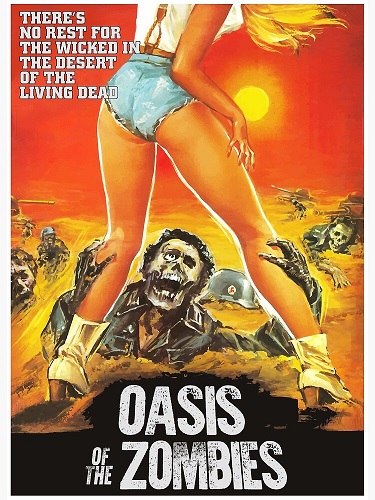
 

Horror Film Review: Oasis of the Zombies (dir by Jesus Franco)


1982’s Oasis of the Zombies opens with two girls in a jeep who just happen to be driving through the middle of a desert in Africa.  When they come across an oasis, they decided to stop so that they can walk around and allow the camera to focus on their rear ends as they explore the area while wearing short shorts.  Unfortunately, it turns out that they’re not very good when it comes observing details because they totally miss the skulls and the pieces of metal that have been decorated with swastikas.  One girl thinks that the oasis is creepy.  The other wants to keep exploring.  Decayed hands suddenly rise out of the ground and attack both of them.

(Oddly enough, the girls reminded me of myself and my BFF, Evelyn.  I called Evelyn after I watched the movie and we both agreed that getting attacked by desert zombies is definitely something that will probably happen to us in the near future.)

After the two girls are zombied, the film cuts to an old man named Captain Blabert (Javier Maiza) telling another man named Kurt Meitzell (either Henri Lambert or Eduardo Fajardo, depending on which version of the film you see) about a shipment of Nazi gold that, for the past few decades, has been sitting in the middle of an oasis in the desert.  Kurt kills Blabert and then heads off with his wife (Myriam Landson or Lina Romay, again depending on which version of the film you see) to track down the gold.

We then cut to London, where college student Robert Blabert (Manuel Gelin) receives not only a message informing him of the death of his father, Captain Blabert, but also a journal that leads to several flashbacks of Captain Blabert serving in Africa during World War II and getting involved with the Nazis and a sheik.

Eventually, Robert and several of his friends end up going to Morocco, where they randomly meet two filmmakers and everyone decides to head into the desert to search for the oasis and the gold.  Fortunately, the oasis and the gold are both easy to find.  However, the oasis is still defended by the Nazis who were assigned to transport the gold.  Of course, the Nazis are all zombies now!

Oasis of the Zombies is a Jesus Franco film and, like many of his later films, it’s more than a little disjointed.  The film’s scenes don’t always seem to follow any sort of conventional narrative logic.  Instead, the scenes often feel as if they’ve been randomly assembled and the end result is a low-budget zombie film that plays out like a fragmented dream, one that seems to feature more stock footage than actual plot.  Franco himself frequently seems as if he’s having trouble concentrating on just what exactly Oasis of the Zombies is supposed to be about.  Random zoom shots are mixed in with shots of a spider building its web and, more than once, the action comes to a stop so the film can turn into an extended travelogue.  As was so often the case with Franco’s later films, some of the shots are striking.  There’s a shot of a man standing on a roof announcing the call to prayer that achieves a surreal grandeur and, as bad as the zombie makeup is, the shots of the living dead silhouetted in the desert are effective.  But for every effective shot, there’s shots of people looking straight at the camera.  Franco was director who could both frame a memorable shot and also be remarkably sloppy.  As such, his aesthetic transcends conventional definitions of good and bad.  Viewers either get him and his semi-improvised excursions into existential horror or they don’t.

Myself, I thought there were enough good shots in Oasis of the Zombies to make it worth watching.  Certainly, it’s not comparable to Franco’s better films, like The Awful Dr. Orlof or Faceless.  But it’s also not quite as bad as its online reputation might suggest.  The zombies relentlessly emerging in the desert are creepy and, in its better moments, the film does capture the feeling of being stranded in the middle of nowhere.  One could argue that the film actually does have a deeper meaning, with the Nazi zombies representing the fact that, for all of its defeats, the hate that fueled the Nazis is still alive and still dangerous.  In the end, it’s a zombie flick, featuring less than impressive zombie makeup and some adequate gore and it’s undoubtedly a Jess Franco film.  There’s no mistaking Franco’s vision for anyone else’s.

Finally, there are two versions of the film.  The French-language version features Henri Lambert and Myriam Landson as Kurt and his wife.  The Spanish-language version features Franco regulars Eduardo Fajardo and Lina Romay as the couple.  Other than the scenes with Kurt, the two versions of Oasis of the Zombies are pretty much the same.  As far as I know, the French-language version is the only one that is available in the States.  That’s the one that I watched for this review.

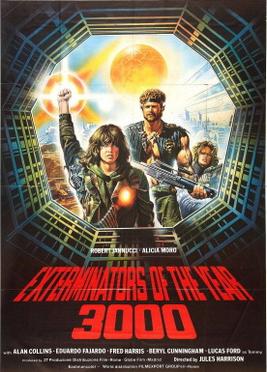
Insomnia File #56: Exterminators of the Year 3000 (dir by Giuliano Carmineo)


What’s an Insomnia File? You know how some times you just can’t get any sleep and, at about three in the morning, you’ll find yourself watching whatever you can find on cable or Netflix? This feature is all about those insomnia-inspired discoveries!

If you’re having trouble getting to sleep tonight, you might want to try going to over to YouTube and doing a search for a 1983 Italian film called Exterminators of the Year 3000.  It won’t cure your insomnia.  In fact, it’s such a peculiar film that it will probably keep you awake for the rest of the night.  However, you will be having fun.  Seriously, if you can’t sleep, you might as well have fun.

The film’s plot will be familiar to anyone who has seen The Road Warrior or Mad Max: Fury Road.  Due to a series of nuclear wars, society has collapsed.  The world is an arid wasteland.  Some survivors live in tiny communities.  Others drive motorcycles across the desert and prey on anyone that they can find.  Water is the most valuable commodity in this world.  The second most important thing to have is a good car.  Your car can be the difference between life and death.

Fortunately, Alien (Robert Iannucci) has a good car.  Unfortunately, Alien keeps losing it.  Alien is a wasteland drifter who spends half of the film looking for his car and the other half of the film helping a kid named Tommy (Luca Venantini) search for water for his community.  Tommy has a bionic arm.  When he’s captured by a group of evil bikers led by Crazy Bull (Fred Harris), his bionic arm gets ripped off.  In one of the strangest scenes that I’ve ever seen, Alien use duct tape to reattach the arm.  If that’s not odd enough, it also appears that he accidentally attached the arm upside down.

That’s just one of the many weird details that sets Exterminators of the Year 3000 apart from all of the other Italian Mad Max rip-offs.  There’s also the fact that Alien eventually and somewhat randomly runs into his ex-girlfriend, who looks like a model and, for some reason, is named Trash (Alicia Moro).  Alien and Trash agree to help Tommy but, the entire time, Alien keeps casually suggesting that maybe they should just abandon Tommy and take all the water for themselves.  This isn’t one of those things where Alien is just pretending to be a cynic, either.  The film leaves little doubt that Alien would have no problem just abandoning Tommy and taking the water for himself.  Even if Trash can convince Alien not to sell out the kid, they’re still going to have to fight a group of people who are all dressed like the Black Knight from Monty Python and the Holy Grail.  While Alien and Trash travel to get the water, Tommy gets a new arm that’s so strong that he can literally throw a piece of metal into someone’s forehead even while standing a few yards away.  Tommy also has a gerbil, which is not only cute but, in something of a rarity for an Italian exploitation film from the 80s, manages to survive the entire film.  (Seriously, I instinctively cringe whenever I see a cute animal in an Italian film from the 80s because I’ve seen enough of them to know what’s probably going to end up happening.)

Of course, Crazy Bull and his bikers continually show up and cause trouble.  Fred Harris gives such an enjoyably over-the-top performance that not even the usual bad dubbing can hurt it.  For whatever reason, Crazy Bull refers to his gang as the Mothergrabbers.  How can you not love a film that featured the main villain shouting, “Into battle, my merry band of Mothergrabbers!?”

Exterminators of the Year 3000 is a fun movie.  The action moves quickly.  There are lot of explosions.  The villains all snarl with panache.  There are plenty of slow motion shots of cars crashing.  And there’s enough odd moments to keep things interesting.  The film even ends with a sudden miracle.  How could anyone resist?  This is Italian exploitation as it most entertaining.

Previous Insomnia Files:

  1. Story of Mankind
  2. Stag
  3. Love Is A Gun
  4. Nina Takes A Lover
  5. Black Ice
  6. Frogs For Snakes
  7. Fair Game
  8. From The Hip
  9. Born Killers
  10. Eye For An Eye
  11. Summer Catch
  12. Beyond the Law
  13. Spring Broke
  14. Promise
  15. George Wallace
  16. Kill The Messenger
  17. The Suburbans
  18. Only The Strong
  19. Great Expectations
  20. Casual Sex?
  21. Truth
  22. Insomina
  23. Death Do Us Part
  24. A Star is Born
  25. The Winning Season
  26. Rabbit Run
  27. Remember My Name
  28. The Arrangement
  29. Day of the Animals
  30. Still of The Night
  31. Arsenal
  32. Smooth Talk
  33. The Comedian
  34. The Minus Man
  35. Donnie Brasco
  36. Punchline
  37. Evita
  38. Six: The Mark Unleashed
  39. Disclosure
  40. The Spanish Prisoner
  41. Elektra
  42. Revenge
  43. Legend
  44. Cat Run
  45. The Pyramid
  46. Enter the Ninja
  47. Downhill
  48. Malice
  49. Mystery Date
  50. Zola
  51. Ira & Abby
  52. The Next Karate Kid
  53. A Nightmare on Drug Street
  54. Jud
  55. FTA

International Horror Film Review: Lisa and the Devil (dir by Mario Bava)


Originally filmed in 1972 and tragically not seen the way it was intended to be seen until years after Mario Bava’s death, Lisa and the Devil tells the story of Lisa (Elke Sommer), a tourist who is visiting the city of Toledo, Spain with a friend.  From the first minute we see Lisa walking through the streets of the city, something seems to be off.  The city seems strangely deserted.  The streets themselves seem menacing, in much the same way that streets of Vienna did in The Third Man.

Lisa leaves her tour group and goes in a store.  A menacing, bald man (Telly Savalas) gives Lisa a strange look as he buys a dummy.  The man resembles a portrait of the devil that Lisa saw earlier.  Running from the shop, Lisa runs into another man (Espartaco Santoni) who appears to be following her.  The man appears to fall to hi death but, despite that, the man will return later.  People have a way of returning in Lisa and the Devil.

Lisa’s tour group appears to have vanished.  She eventually runs into a seemingly friendly couple (Sylvia Koscina and Eduardo Fajardo) who, along with their driver (Gabriee Tinti), agree to take Lisa back to her hotel.  But instead, they somehow end up outside of a dilapidated, mannequin-filled mansion.  When the car breaks down, the group is invited to spend the night by the Countess (Alida Valli, who also appeared in The Third Man), who lives in the mansion with her strange but handsome son, Maximilian (Alessio Oriano).  Maximilian is still mourning his ex-girlfriend, Elena.  Elena, we’re told, bore a striking resemblance to Lisa.

However, it turns out that the Countess and Maximilian are not alone in the mansion.  Also living in the house is the Countess’s second husband, Carlos, who just happens to be the same man that was following Lisa in the city!  And finally, there’s the butler, Leandro, who is the same man who Lisa earlier saw in the shop!

Lisa and the Devil is one of my favorite Italian horror films.  Yes, some of that is because I shared the same name as the movie’s main character and I love it when people say my name a lot.  But I would love this film even if Elke Sommer was playing someone named Annalise or Tiffany.  Mario Bava said that this film, or at least his version of the film, was one of his most personal works and the entire movie does feel like a puzzle that only one person could possibly solve.  In the movie, only Leandro seems to full understand what’s happening in both the city and the house.  In real life, it’s likely that only Mario Bava understood everything that happened in the film.  The film mixes a giallo mystery (because people do soon start to die the mansion) with a surreal exploration of memory, regret, sin, and guilt.  The movie plays out like a waking dream, leaving us to wonder just who exactly Lisa truly is and who the Devil of the title might be.  It’s easy to spot the Devil.  It’s less easy to spot which parts of the film are meant to be reality and which parts might simply be happening in Lisa’s mind.

Unfortunately, the film’s producer had no idea what to do with Bava’s surreal masterpiece.  The few people who saw the film were baffled.  The Italian censors demanded massive cut for both sex and violence and, as a result, Lisa and the Devil was one of the few Bava films not to get a theatrical release in his native country.  It apparently did play in South Korea and Spain, though the Spanish version did not feature Bava’s original, mind-twister of an ending.

Even worse, for the film’s American release, the film’s producer requested that Bava add some exorcism scenes so that the film could take advantage of the popularity of The Exorcist.  By now realizing that his preferred version of the film would probably never be seen, Bava agreed.  With the help of his son, Lamberto, Mario Bava shot several scenes featuring Elke Sommer acting possessed while a priest played by Robert Alda tried to exorcise the demon.  The original Lisa and the Devil footage was presented as being scenes from the dimension Lisa’s soul had been sent to while the demon controlled her body.  The film was retitled House of Exorcism in Amercia.  And here’s the thing — House of Exorcism is hardly a bad movie.  Bava is Bava, afterall.  Sommer does a convincing job acting possessed and the mix of new and old footage is edited together fairly well.  But it’s still not the film that Bava set out to make.

Sadly, Bava’s original version of Lisa and the Devil would not get a proper video release until decades after his death.  It’s not always an easy film to follow.  I’ve seen it several times and there are still things about it that I still don’t fully understand.  It’s a surreal masterpiece, one that is perhaps not meant to be fully understood and the type of dream-film that shows why Bava is one of the few directors that David Lynch has regularly cited as being an influence on his own work.  Lisa and the Devil is a trip through a world dominated by dark and disturbing things and it’s one of the best Italian horror films to come out of the 70s.  Thankfully, it can now be seen the way that Bava intended.


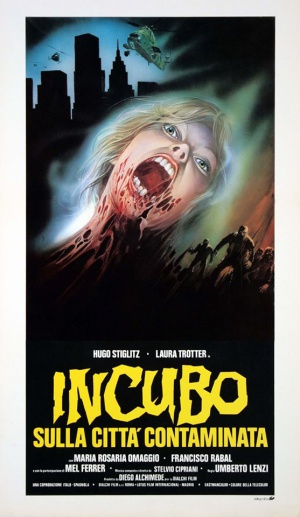
The TSL’s Daily Horror Grindhouse: Nightmare City (dir by Umberto Lenzi)


incubo-sulla-citta-contaminata

Since Case just reviewed 28 Days Later, this seems like the perfect time to say a few words about the 1980 Italian horror film, Nightmare City!  Though Nightmare City has never been as critically acclaimed or as popular with audiences, it is regularly cited as probably being one of the main inspirations for 28 Days Later.

Now, don’t get me wrong.  I can’t say for sure whether it was an influence or not.  I listened to the entire Danny Boyle/Alex Garland commentary track on my DVD of 28 Days Later and neither of them ever mentioned Nightmare City.  As well, there are some pretty big differences between Nightmare City and 28 Days Later.  For one thing, 28 Days Later is a hyperkinetic Danny Boyle film whereas Nightmare City is obviously an Umberto Lenzi film, filled with over the top gore, gratuitous nudity, and nonstop violence.  For that matter, the Infected in 28 Days Later still look human whereas all of the infected humans in Nightmare City are covered with what appears to be burned oatmeal.  (I’m going to guess that it’s meant to be radiation scarring.)

And yet, despite all of that, it’s impossible to watch Nightmare City without thinking about 28 Days Later and vice versa.  Both Nightmare City and 28 Days Later are commonly mislabeled as being zombie films, despite the fact that both of them are about people who have been driven mad by a military accident/experiment.  Where you really see the influence that Nightmare City had on 28 Days Later is in the scenes in which various “infected” humans run through the streets, savagely attacking and killing anyone that they come across.  For all the attention that was given to 28 Days Later‘s “fast zombies,” Nightmare City got there first.  Call them human, call them infected, or call them zombies, the monsters in Nightmare City are relentless, unstoppable, and blood thirsty.  Whatever flaws the movie may have, Nightmare City‘s zombies truly do belong in a nightmare.

(Except for that one scene in which a zombie extra is seen to be kicking a soccer ball while a dog chases after him but you have to look closely to notice…)

But before I say too much more about Nightmare City, I’m going to ask you to watch this tribute to the hero of Nightmare City, journalist Dean Miller:

Dean Miller was played by Spanish actor Hugo Stiglitz.  (If that name sounds familiar, it may be because Quentin Tarantino named a character after him in Inglourious Basterds.)  To be honest, the first time I ever saw Nightmare City, I thought that Stiglitz’s performance was one of the worst in the history of horror cinema.  No matter how violent or bloody the film gets, Stiglitz rarely seems to react.  He might occasionally arch an eyebrow.  But, for the most part, he doesn’t seem to care.  But, after subsequent viewings, I’ve come to respect the fact that, while everyone else in the film was overacting, Siglitz distinguished himself by refusing to act at all.

Nightmare City is a relentless and nonstop film.  It starts out with Dean Miller being sent down to the local airport.  His job is to cover the arrival of a scientist who has been assigned to investigate a recent nuclear accident.  From the minute that the plane lands and a horde of hatchet-wielding zombies stream out onto the tarmac, Nightmare City is nonstop mayhem.

And, quite frankly, a lot of it doesn’t make much sense.  At one point, the zombies enter a television studio and attack what appears to be the most boring dance show in the world and, as bloody and borderline disgusting as the action got, I still couldn’t get over how boring the dance show was before the zombies showed up.  The other thing that struck me about that scene was that nobody at the television studio seemed to be that upset about a bunch of radiation-scarred zombies literally massacring hundreds of people on camera.  Dean may have arched an eyebrow but even he didn’t seem that concerned.

(Fortunately, Dean manages to escape by grabbing a TV and throwing it at the zombies.  Apparently, televisions explode if you throw them, even if they’re not plugged in at the time.)

Then the zombies attack a hospital and it’s the hospital attack that always disturbs me.  There’s a scene where a nurse comes across a zombie raiding a blood bank and he shakes his head almost apologetically.  Oddly, almost all of the doctors turn out to be self-defense experts.  One elderly doctor even throws a scalpel at a zombie with all the skill of an Agent of SHIELD (or perhaps even …. HYDRA!)

Meanwhile, the military is supposed to be doing something but I’m not sure what.  We get a lot of scenes of a general (played by Lenzi regular Mel Ferrer) staring down at a model of the city but he doesn’t ever actually seem to do anything.  His assistant, meanwhile, is worried about his sculptor girlfriend being at home alone.  He should be since there are two zombies in the basement, though we’re never quite sure how they got there without anyone else in the house noticing.

And the mayhem continues.  There’s a zombie priest.  There’s a zombie attack at an amusement park.  There’s many scenes of Hugh Stiglitz staring off in the distance.  At one point, his girlfriend falls off a roller coaster and we are briefly amazed at the sight of an obviously fake dummy crashing to the pavement below.  But fear not because … it’s all a dream!

That’s right, Dean Miller wakes up in bed!

OH MY GOD, LISA, YOU JUST SPOILED THE MOVIE!

No, I didn’t.  Believe it or not, the movie’s nowhere close to being over yet…..

Nightmare City is a hard film to review because, while it might not be good in any traditional sense, it’s also very much a one-of-a-kind movie.  This is one of those relentless and shameless exploitation films that works despite itself.  It’s preposterous, it’s silly, it’s often offensive, and yet it’s never less than watchable.  If you’re into Italian horror, you have to see this film.  If you’re into zombie cinema, you have to see this film.  (If you’re not into either, you probably stopped reading this review a while ago.)

And, while you watch it, I dare you not think about 28 Days Later

(This trailer is NSFW so watch at your own risk…)

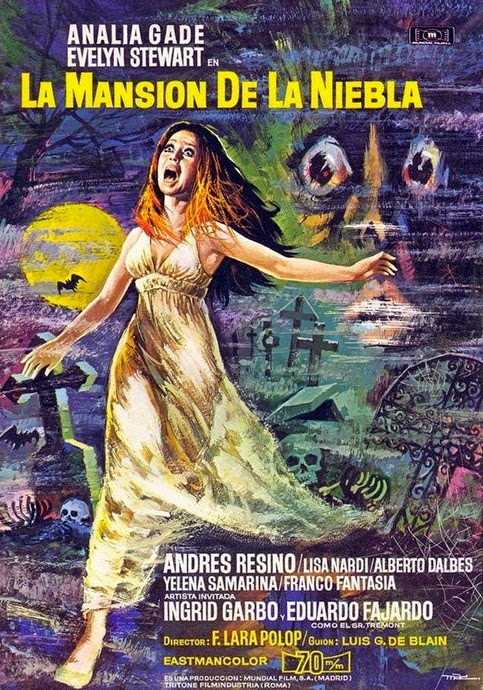
The Daily Horror Grindhouse: Murder Mansion (dir by Francisco Lara Polop)


Maniac Mansion Title

1972’s Murder Mansion (which is also known as Maniac Mansion) is an enjoyable Italian/Spanish co-production.  It’s been included in a few dozen Mill Creek box sets and it’s usually advertised as being a zombie film.  While I don’t want to give too much away about the film’s twisty plot, I do feel obligated to let our readers know that it is most definitely NOT a zombie film.  Instead, it’s an old-fashioned gothic giallo.

Murder Mansion opens with various people separately traveling across the countryside.  A few minutes is devoted to allowing us to get to know them and we quickly discover that they are all familiar giallo types.  There’s the cold businessman, the lecherous man with the beard and the driving gloves, and, of course, the free-spirited young lovers who have just met.  There’s also the emotionally unstable, Elsa (Analia Gade).

When a huge fog rolls in, Elsa is the first of the travelers to find herself stranded outside of a foreboding mansion.  She thinks she sees two shadowy figures in the fog — a woman and a hulking man dressed like a chauffeur — pursuing her.  As she runs through the fog, she runs into the young lovers, who are also similarly stranded.  They decide to seek refuge inside the mansion and … guess what?  It turns out that all the other travelers have decided to seek refuge there as well!

Well, it turns out that the mansion is looked after by a housekeeper named Martha (Ida Galli, a.k.a. Evelin Stewart).  Martha explains that the former owner of the mansion was killed years ago in an automobile accident, along with her chauffeur.  (Hmmm….)  Martha also goes on to explain that the village around the mansion is deserted because the villagers became convinced that the woman and her chauffeur were vampires.  Martha then invites everyone to spend the night.

As everyone prepares to turn in for the night, they can’t help but notice a few strange things.  First off, why is every bedroom decorated with a disturbing painting?  And why does the painting of the former, now deceased, owner of the house look so much like Martha?

As you probably already guessed, a mysterious figure soon starts to prowl around the house, killing the travelers one-by-one.  Meanwhile, Elsa continues to have her nervous breakdown and soon starts to have flashbacks to some unspeakable acts that were committed by her father…

Murder Mansion is an enjoyable little giallo, one that is full of creepy atmosphere, twisty plot developments, and memorably strange characters.  It’s actually a lot of fun to watch as our heroes creep around the mansion and try to put together all of the clues.  (It made me want to go out and solve mysteries!)  As far as blood, gore, and nudity are concerned, Murder Mansion is actually remarkably tame by the standards of Italian (and, for that matter, Spanish) thrillers, which makes it an appropriate introduction to the genre for people who may not have previously seen a lot of giallo films.

(Trust me.  I tried to introduce my aunt to giallo by showing her Mario Bava’s Bay of Blood and she made me stop the movie after the double impalement.  If I had been smart, I would have started with Murder Mansion and then worked my way up.)

All in all, Murder Mansion is a lot of fun and great Halloween treat!