It would be twenty years before those space-faring hunters, the Predators, would return to the big screen. Sure, they appeared in the two Aliens vs. Predator films of the early 2000s, but I don’t count those as part of the Predator franchise—mostly because they weren’t the headliners. Plus, those two mash-up films were all kinds of awful.
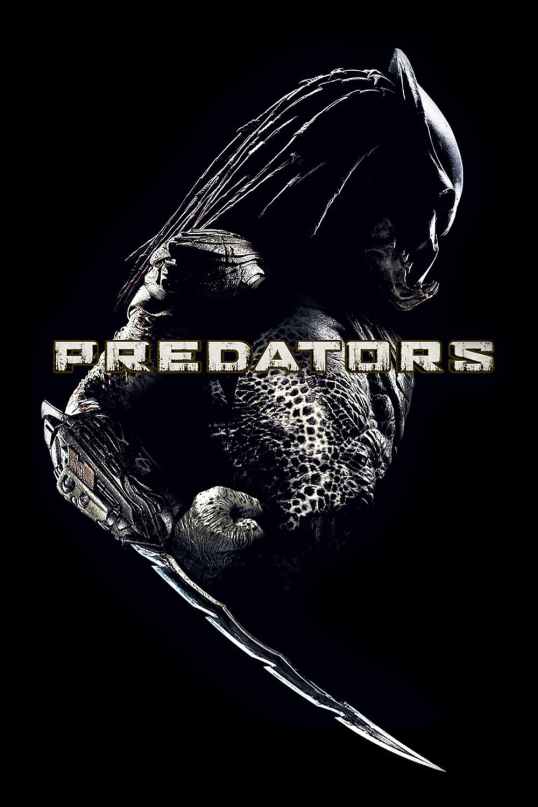
2010’s Predators, directed by Nimród Antal and produced by Robert Rodriguez, set out to breathe new life into the sci-fi action franchise that the two AvP entries had drained of excitement. From the early 1990s until this film’s release, the Predator mythology had steadily expanded through novels, comics, and games, creating a world as rich as any in science fiction. Longtime fans came to understand the Predators’ culture, mindset, and technology.
For some, that world-building stripped away the mystery that made the Predator such an iconic monster. Others felt it helped establish consistent rules, allowing future stories to build on a solid foundation instead of endlessly one-upping what came before.
Predators embraced this expanded lore while adding a new wrinkle: the introduction of the so-called “Super Predators,” bigger, faster, and meaner than the classic hunters we’d seen over the decades. Another new element placed the story on an unnamed planet serving as an extraterrestrial game preserve, where Predators could hunt their chosen prey on familiar ground.
This setup lent a new dimension to the narrative. The humans being hunted had nowhere to run, and whatever advantage they might have enjoyed on Earth vanished instantly. They were now being hunted on Predator turf—a cruel inversion of game hunting, like a safari where the prey has no chance against its well-equipped pursuers.
Despite these new additions to the lore, the film mostly works as an action-thriller. We get the requisite band of misfits, murderers, and killers—the worst humanity has to offer, but the best at what they do. They range from black-ops mercenaries and elite snipers to cartel enforcers and even a serial killer.
Leading this reluctant ensemble is the enigmatic Royce, played by Oscar-winner Adrien Brody, who surprisingly pulls off the wiry, cold-hearted black-ops soldier. The film hinges on his performance. He’s not a team player, nor is he likable—he fits the antihero mold perfectly, willing to sacrifice anyone if it means surviving another hour. Yet he understands that his best chance lies in keeping others alive, if only as tools for his own survival. He’s the audience surrogate, the one who rolls his eyes as everyone else makes one bad decision after another.
Antal’s action direction recalls the McTiernan era. He favors long, sweeping takes that clearly define the geography of each battle—a quality too rare in modern action cinema, where quick cuts and shaky edits often stand in for real dynamism. Where the film falters is in its reliance on exposition-heavy dialogue. After nearly every action set piece, the momentum stalls as characters explain what’s happening. Laurence Fishburne even appears in a role that exists purely to deliver exposition.
Now, about those Super Predators: they’re an intriguing trio who expand the series’ creature variety, though at the cost of making the classic Predator seem almost obsolete. There’s the Tracker, who uses alien hunting dogs to flush out prey; the Falconer, who employs a cybernetic drone that feels straight out of the Marvel Cinematic Universe; and the Berserker, the biggest and most brutal of the three, relying on raw power rather than skill or strategy.
They look fantastic but slightly diminish the menace of the original Predator design. Against this new breed, the traditional hunters seem almost helpless.
Still, Predators stands several notches above what audiences got from the two AvP movies. Despite an exposition-heavy script and a bold but polarizing decision to downplay the classic Predator’s threat, Antal’s entry injects enough adrenaline and fresh lore to reenergize the series. It’s unfortunate that the AvP films’ lingering stench colored its reception, but over time, more fans have come to appreciate Predators for what it is: a fun, muscular, and engaging slice of sci-fi action.
Timur Bekmambetov is one filmmaker that can never be said to hold things back visually on any of his films. He has a style that can be called a combination of the Wachowski Brothers and Zack Snyder. Now one can read that and just groan. The Wachowskis and Snyder are not what one would call the paragon of the filmmaking community. What they do tend to do are create pop-friendly and consumer-friendly films. Whether thse films are of high quality is another thing altogether.
Bekmambetov is an interesting filmmaker from Kazakhstan (who could easily pass for what we imagine Genghis Khan to look like if he was still alive) whose brand of action films tend to focus on all style with little to no substance. For some audiences this just means dumb, brainless fare that has no reason to be paid to see, but I tend to think these same people who shout loudest about how these type of films are dumbing down it’s audiences secretly watch them like crack addicts once they’re on cable. Bekmambetov’s latest film, Abraham Lincoln: Vampire Hunter, definitely follows his unique action and storytelling template he’s established with past films as Nightwatch, Daywatchand Wanted.
The film lives and dies on the simple conceit that one of the United States’ greatest Presidents was also vampire hunter of some skill. We see how an encounter with the vampire which led to the death of Abe’s mother (who had died of the condition known at the time as milk sickness) propels him through the intervening years to plot revenge on the same vampire. It’s during a failed attempt at revenge that he’s noticed by one Henry Sturgess (played by Dominic Cooper) who sees another potential vampire hunter in the young man (adult Lincoln played by one Benjamin Walker who could easily pass for a very young Liam Neeson). We get the usual training montage where Sturgess teaches Abe the finer points in vampire hunting and killing. It’s only proper that Abe would end up picking the rail-splitting axe he’s more comfortable in using than the more practical firearms.
Abraham Lincoln: Vampire Hunteris almost a straight adaptation of Seth Grahame-Smith’s novel of the same name. Some minor subplots are discarded to keep the film moving in the one path the filmmakers and screenwriter (Grahame-Smith himself) decided to concentrate on. It’s this one thing that really pushes the film into a level that would win an audience to it’s cause or lose them altogether. This thing I speak of is the idea that slavery was due to the vampires who have set themselves as the so-called shadow aristocracy of the South and needed a ready source of food to keep themselves hidden from the humans. Yes, slavery was started and made into a near industrial level by vampires. This in turn moves Lincoln to move beyond just vengeance on the vampires who have affected his life from such an early age and instead go towards abolishing slavery from the country as a way to destroy the vampires once and for all.
These are heady ideas that doesn’t seem to fit well with historical facts and figures. Yet, the film does a good enough job of keeping things serious with just the right amount of over-the-top action sequences that Bekmambetov has become well-known for. One such action sequence involves Lincoln and a vampire having a chase scene involving a huge horse stampede. They fight in and amongst the stampeding equines and then on and above them. It’s a sequence that’s equal parts exciting and ludicrous that one just has to either sit back and enjoy it or stand up and walk out. Which is the film in a nutshell. One either goes all-in on the film’s story or folds mentally.
This is not to say that the film has no flaws. It has some glaring flaws that threatened to push the film over the edge of being a fun action flick into all-out dreck. For starters the vampires themselves made for good villains, but Rufus Sewell as the leader of the American vampires (who happens to call himself Adam) looked bored with the whole proceedings. There were brief moments when the charm that we expect from vampire leaders show, but it’s far and few between. Most of the time Sewell looks to be just standing in a particular scene looking bored. The rest of his clan of vampires are no better though Marton Csokas asBart, one of Adam’s lieutenants and main supplier of slaves, did such an over-the-top performance that one wouldn’t be surprised to catch a glimpses of scenery stuck between his teeth.
It’s really the performance by Benjamin Walker in the title role that keeps the film afloat. He has a commanding presence on the screen and he’s able to be convincing as Lincoln both as a young man and then as the elder statesman (some very good old man make-up effects that put the elder Peter Weyland make-up in Prometheus to shame). Mary Elizabeth Winstead as Mary Todd Lincoln also does a good job in what could’ve been a thankless role, but she didn’t look out of place in this peculiar period piece.
The action sequences themselves were choreographed well even though Bekmambetov was still relying a lot of his own brand of slo-mo to accentuate the cool kills Lincoln makes with his silver-coated axe. After awhile this gimmick began to get repetitious, but then again one shouldn’t be surprised to see such a thing over-used in a Bekmambetov film. If one has seen his three previous films then they should know what to expect. Yet, even this doesn’t detract from what this film ultimately turned out to be and that’s just plain fun despite lacking in the acting in certain roles and the sensational, some would say tasteless, use of the Civil War and slavery to tell a story about a vampire-killing President.
Abraham Lincoln: Vampire Hunterwill not make filmmakers like Christopher Nolan, Lars Von Trier and Michael Haneke quake in their shoes. It’s not a film that was made to win awards (though I can see it being nominated for best fight sequence in the MTV Movie Awards). What this film does seem to succeed enough in doing is be a fun and exciting film that rises above it’s source material on the strength of it’s lead and the action created by it’s filmmaker. For a genre film it certainly did a better job of mashing together disparate ideas than last year’s Cowboys & Aliens. Maybe if this film is enough of a success we’ll finally get some movement in the planned film adaptation of Seth Grahame-Smith’s other literary classic mash-up: Pride and Prejudice and Zombies. One can only hope.
If my memory serves me correctly the year of 2010 ended up becoming the year of the Action Team Flicks. Arriving first was the comic book film adaptation, The Losers, which didn’t do so well. Coming out last was the Stallone testosterone action vehicle, The Expendables, which did much better though it lacked somewhat in the grindhouse it was promising. Smack dab in the middle of these two was the film adaptation of the classic 80’s action tv series of the same name, The A-Team, which in the end I thought was the best of the three Action Team Flicks of 2010.
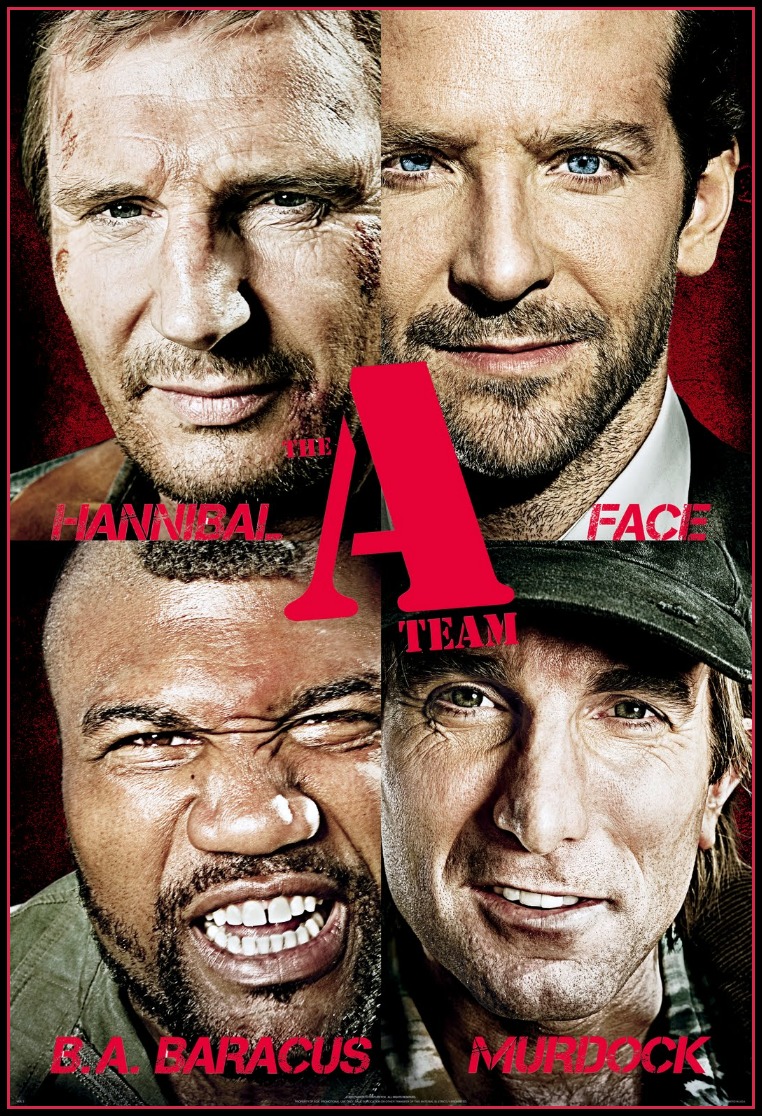
The A-Team was a film project that once had Mel Gibson attached to it right up to Bruce Willis, but delays upon delays pared back what would’ve been a mega-budgeted action blockbuster into something in the bargain basement (for a summer film). It starred Liam Neeson in the iconic role of Col. John “Hannibal” Smith made famous in the 80’s by George Peppard. Surrounding him would be Bradley Cooper as Templeton “Face” Peck, Sharlto Copley as H.M. “Howlin’ Mad” Murdock and veteran MMA fighter Quinton “Rampage” Jackson as B.A. Baracus. Holding court over this A-Team was filmmaker Joe Carnahan working with a script he, Skip Woods and Brian Bloom (who also had a role as the amoral, sociopathic mercenary Pike).
The film took what was great and fun about the original tv series and gives it a 21st-century upgrade. To say that the film’s plot was secondary to watching the cast having fun on the screen would be an understatement. The story dealt with Smith and his team being accused of a crime they didn’t commit and must now escape from a military prison to find out who set them up and clear their name. It’s straight out of the tv series’ basic premise which managed to last a full on four seasons. Fortunately, Carnahan and his writers only had to make this premise last just a little over two hours. While some may think that two hours would be too long for this film it actually moved quite fast for something that went beyond the two hour mark.
Right from the beginning the cast looked to have been having the time of their lives. Neeson was Hannibal through and through while the other actors making up the rest of the team managed to imbue these well-known characters with their own brand of craziness, absurdity and panache. Just like the other two Action Team flicks of 2010 this film also had it’s share of scene-chewing villains in the form of Patrick Wilson as a duplicitous CIA agent and Brian Bloom as the sociopathic leader of a private military company at odds with Smith and his team. It’s these two groups who end up trying to outguess and outmanuever each other to get that final upper hand. Each encounter between these two groups just got more ridiculous with each passing event.
If one ever wondered if one could fly a tank while it was in freefall then this film answers that question. The climactic showdown at the LA shipyard at night has some of the most over-the-top action of the last couple years that wasn’t a scifi-actioner. Laws of physics doesn’t apply in The A-Team and the film revels in that notion as if telling the audience to either get onboard and enjoy the ride or get off and go on the Toad ride instead.
It’s a shame that The A-Team didn’t do as well in the box-office as some would’ve hoped because the film does set things up for further adventures for Neeson and his crew. What Carnahan ended up making won’t be breaking down the doors to the awards committee, but he did deliver on paying homage to the original tv series while adding his own brand of crazy to a film that had just the right amount of fun, ludicrous action to make it the best of 2010’s Action Team Flicks.
If there’s one type of genre film I always will end up watching (sometimes to my regret if they turn out to be awful) it will be the apocalyptic-themed film. It doesn’t matter if the apocalypse about to hammer down on the planet in the film is nuclear war, some cosmic event, zombies, the Rapture, etc. As long as the world is in the brink of snuffing out I will watch it.
To find out last year that Steven Soderbergh was going to make his next big project just such an apocalyptic film was exciting. He was to take the worldwide, multi-subplot storyline and a huge cast like he did with Traffic and substitute an lethal pandemic virus for the drug war. It’s cast was to include Matt Damon, Marion Cotillard, Kate Winslet, Gwyneth Paltrow, Laurence Fishburne, John Hawkes and Jude Law to name a few. The film was going to be filmed around the world to truly give it that international feel to it.
Contagion will have a release date of September 16, 2011 and if any film really could benefit from a really great viral marketing it would be this.
The name Matthew Vaughn should be familiar with comic book fans everywhere. In 2005, Vaughn was introduced as the director to replace Bryan SInger for the third film in the X-Men franchise. The news was met with some cautious optimism. This was a filmmaker who had quite the loyal and growing following for his work on Stardust and Layer Cake. Months after he was picked my 20th Century Fox news came down that he was backing out of the project due to personal reasons and the film scrambled for a replacement which ended up being Brett Ratner. History was made that day as the beginning of the franchise’s decline began and steep plummet which recently reached it’s nadir with 2009’s Wolverine: Origins.
It’s has now been five years since X-Men: The Last Stand made it to the big-screen and now we have a new film in the franchise. X-Men: First Class has a familiar name behind the director’s seat and it looks like Matthew Vaughn stayed this time around (after directing a smaller superhero film in Kick-Ass for 2010) to craft what could become the best film in the X-Men/Wolverine film franchise. This film is a prequel/reboot of sorts (more on that later) and brings a fresh set of eyes and take on the origin story of this franchise.
X-Men: Last Stand actually begins the film exactly how the first X-Men film began with the 1944 World War II concentration camp setting where a young Erik Lensherr (later to become Magneto) finally manifests his power over magnetic fields as he watches his parents torn from his side. The first film ended that sequence once Erik was knocked out, but this time around it continues with a mysterious man named Schmidt (aka Sebastian Shaw and played with James Bond villainous-flair by Kevin Bacon) taking great interest in Erik and his ability which Erik could only use during bouts of pain and anger. The film continues this slight change in the series’ origins by switching over to Westchester County and into the expansive home of a young Charles Xavier who finds a certain young, blue-skinned shapeshifter named Raven who he invites to stay and become his friend once he realized he wasn’t the only one who was different and with abilities.
These two sequences continue to move the film forward as the we see these two “leaders in the making” adults and trying to find their place in the world of the free-swinging lifestyle and the Cold War culture of the 1960’s. Charles Xavier (played like a well-meaning cad and good-natured naivete about the world by James McAvoy) is a student working on his doctorate in Oxford on genetic theories while his “sister” Raven (Jennifer Lawrence) accompanies him. This is a Xavier who still hasn’t found the patient benevelonce of Patrick Stewart’s Professor X and uses his considerable telepathic abilities to help him pick up on beautiful coeds instead. It’s during such a scene where we see Raven show just a hint of jealousy as Xavier tries his lines and moves on a beautiful British lass. It would seem Raven’s feelings for her ‘brother” may go beyond sibling affection though Xavier doesn’t see her as anything other than a sister for him to protect.
Erik Lensherr’s time as an adult was shown as having become a life of obsession over his treatment at the hands of the Nazi’s and those of Schmidt’s as he travels the world in search of escaped Nazi war criminals. Erik takes him throughout South America as he finds the trail of Nazis hiding out in that region since the end of the war. We see this adult Erik hardened by his anger and single-minded need for revenge on Schmidt and those he worked for. He’s not above using his abilities to kill in order to get the information he requires and there’s a hint of satisfaction when he does kill those he sees as responsible for his tragic upbringing with his magnetic abilities. These two adult sequences continues the film’s theme of the ideological difference between Xavier and Erik being formed through nature and nurture as their lives moved down diverging paths from an early beginning until it convergence for a small, brief period around the time of the Cuban Missile Crisis.
The film’s second act begins with Moira McTaggart (Rose Byrne), now a covert CIA Agent, investigating a certain Col. Hendry who she suspects as having betrayed the nation to the Soviets, but instead finds out that the true nature of Hendry’s associations were much more insidious and dangerous. The iconic Hellfire Club of the comics finally make their appearance with Schmidt who actually happens to be Sebastian Shaw (whose powers grant him the ability to absorb all kinetic energy which he uses to keep himself young and can release with explosive results), Emma Frost (January Jones) who’s a telepath with the ability to turn body in a sort of diamond-form, Riptide who can create tornado-like abilities and finally the demonic-looking Azazel whose ability to teleport might give people not well-versed in the “X-Men Universe” a clue as to one-half of parents who may be responsible for Nightcrawler in the second film.
X-Men: First Class spends much of this second act like it was Ocean’s 11 as Xavier and Erik get recruited by the CIA to find other mutants and create their own mutant team to counter Sebastian Shaw’s Hellfire Club and his goal of initiating World War III between the US and the USSR and thus destroy all of humanity and leave the planet for the mutants to rule over. Yeah, it is this part of the film’s plot which may strain the suspension of disbelief for some audiences who never grew up reading the comics, but it shouldn’t. Ian Fleming’s James Bond series used scenarios just as ludicrous with villains just as Machiavellian in the form of SPECTRE so X-Men: First Class and it’s world domination plans shouldn’t be too farfetched to fans of that British superspy and his adventures.
This middle section of the film is where X-Men: First Class actually begins to lag after a strong first act. I don’t know if the sequences of the new recruits training, bonding and learning how to use their powers could’ve been written to move much faster without losing some of the character building scenes. From how this second act played it seemed to look like scenes were actually cut out to try and keep the film from being too long (it’s final cut being just a tad over two hours already upon release), but I wouldn’t be surprised if the DVD/Blu-Ray release actually has a director’s or uncut version that actually expands this middle section to really give life to it instead of having it play out like a perfunctory training montage with a dash of character beats.
The film hits it’s action-film stride with the third and final act as Xavier and Erik’s team of young mutants must now use their abilities to stop Shaw and his Hellfire Club and at the same time prevent World War III from beginning and not freaking out the humans who are still unaware of their existence as a whole. It’s this third section which we see too much of it in the trailers and tv spots that one might say we’ve seen it all before we even see the film as a whole, but it still kept back a lot from those ads to make the whole final twenty minutes of the film thrilling and action-packed.
All of this could just mean that X-Men: First Class was just your run-of-the-mill superhero action film that we get on a yearly basis come summertime, but it’s a testament to Matthew Vaughn’s direction and the strength of the script by Vaughn, longtime collaborator Jane Goldman and Thor scribes Ashley Edward Miller and Zack Stentz that the film goes beyond being just an action film with all it’s sturm und drang coupled with fancy special effects. The previous films in the series always explored important cultural and moral themes that’s always been the bread-and-butter of the X-Men stories in the comic books. We just don’t see the film explore the ideological difference between Xavier’s peaceful co-existence between humans and mutants alike, but also we get more detail on why Magneto finally comes to the conclusion that war between humans and mutants was an inevitability and why his stance doesn’t fall under the aegis of being evil, but something that anyone could understand and even support whether one was human or mutant.
The story also doesn’t just pay lip-service to the idea of how mutants view themselves and how even within the mutant community there’s a visible rift between those whose abilities are invisible to the general population and those whose abilities and genetic mutation physically manifest themselves in such ways that to many might not look to appealing. This idea really gets a major exploration in the subplot involving Raven (soon to be Mystique), Hank McCoy and, to a certain degree, Xavier and Erik. We see how those like Xavier whose abilities don’t show in a physical manner have a sort of “don’t ask, don’t show” about those like Raven when it comes to their power when in public.
Raven (played beautifully by Jennifer Lawrence) is caught between Xavier who wants her to remain incognito so as not to shock the world too soon in realizing that mutants exists and that of Erik who sees Raven’s original blue-skinned form as beauty and perfection and how she should never hide who she truly is. This tug and pull between her two mentors makes for a convincing subplot in how Raven comes to the conclusion which would take her to the side of Magneto in later films, but also highlight how the two sides in later films have so much intertwining bonds of friendship and relationship that seeing them against each other becomes a tragedy on its own. Civil wars are not just a thing of humans but those who sees themselves apart from them.
The great performances by most of the leads add to the film’s strength. McAvoy and Fassbender, at first, look to be unconvincing in terms of their appearance as the younger versions of Patrick Stewart and Ian McKellen, respectively. This becomes a non-issue once they’ve established themselves through their performances which gives new layers to the personalities of Professor X and Magneto. Many people always saw these two as the comic book version of Martin Luther King, Jr and Malcolm X, but that’s an oversimplification. The film and the performances by McAvoy and Fassbender digs deeper into both their characters’ motivations and ideologies and how their past experiences and upbringing couple with their time together as brothers-in-arms and friends show more about these two than just being mutant-proxies of MLK and Malcolm X. The other young mutants do an adequate enough job that they don’t seem lost in the film. Nicholas Hoult as the young Hank McCoy and how he plays off Lawrence’s Raven during their little subplot in the film is one stand-out that I hope gets explore even more in any follow-up sequel.
There’s a nice burgeoning young love chemistry between him and Lawrence as Beast and Raven that doesn’t seem too tacked on to create a the prerequisite love couple in any film. Their common trait of having physical mutations and how they seem to both feel apart even from their fellow mutants develop their characters in ways the previous films in the series never did. They never want to rid themselves of their mutant powers. They just want to look normal and still keep their abilities. It’s a having your cake and eat it too mentality that has some surprising results for both Raven and Hank.
X-Men: First Class has had some fans of the series put in a very difficult situation. The film definitely is a prequel to the previous films, but it also does a major time in rewriting continuity in the series. I was one of those fans and thought it would ruin the film in the context of the franchise. I’m surprised that in the end I didn’t really care and actually hope that this film actually is a reboot of the franchise. I see this film and forget the previous three as being part of it. This film was just too good and fun in it the end for continuity issues to become the major flaw that sinks it. I liken this film as similar to Christopher Nolan rebooting the Batman film franchise. That film honored the contributions to the character, but went on it’s own way to tell that character’s tale. I see Vaughn doing the same with this film. He has done something which many thought was a near-impossible task and that’s make the X-Men franchise relevant once more in a pop-culture landscape that seems to have left the franchise behind after the disastrous Wolverine: Origins of 2009.
This film delivered on the ideas that made the comic books so beloved by millions of fans for almost a half-century. It made great use of the 1960’s time and setting to tell a story of these characters beginnings as heroes and villains (though the latter shouldn’t be seen as them being truly just evil bad guys). Even the inclusion of real-world historical event like the Cuban Missile Crisis was a nice touch which gave the film a foundation in realism. Again, this film played off like a superhero, Marvel version of an Iam Fleming James Bond story. For those who are huge fans of the previous films there’s even two brief cameos of those films two favorite characters that appear in this film. They don’t come off as cheesy and unnecessary and actually come off as great additions. I won’t mention who these cameos were but the audience’s reaction to them was very vocal and very positive. I say the same should be said for X-Men: First Class as a film that resuscitates the franchise.


 Through the Shattered Lens