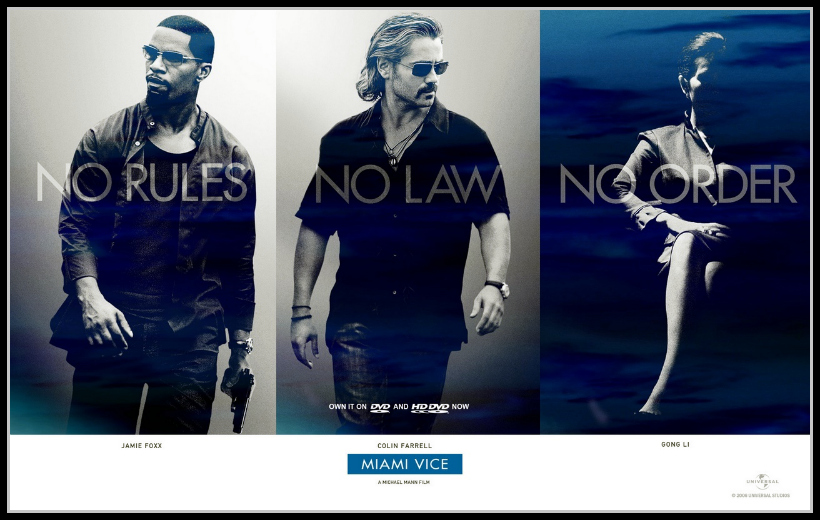
Review: Miami Vice (dir. by Michael Mann)


Michael Mann has always been in the forefront of experimenting and trying out new film techniques and styles to tell his stories. 2003’s Collateral was a veritable masterpiece of directing of a modern, urban noir. He even made Tom Cruise very believable as a sociopathic character. In 2006, Michael Mann followed up Collateral with another trip down the darkside of the law and crime. Taking a concept he made into a cultural phenomenon during the mid 80’s, Mann reinvents the show Miami Vice from the pastel colors, hedonistic and over-the-top drug-culture Miami of the 1980’s to a more down, dirty and shadowy world of the new millenium where extremes by both the cops and the criminals rule the seedy, forgotten side of the city.

Michael Mann’s films have always dealt with the extremes in its characters. Whether its James Caan’s thief character Frank in Thief, the dueling detective and thief of Al Pacino and Robert DeNiro in Heat, up to Foxx and Cruise’s taxi driver and assassin in the aforementioned Collateral. They all have had one thing in common. They’re individuals dedicated to their chosen craft. Professional in all respect and so focused to doing their job right that they’ve crossed the line to obsession. It is this obsession and how it governs everything they do which almost makes it into their own personal form of drug.

This theme continues in Mann’s film reboot of his TV series Miami Vice. The characters remain the same. There’s still the two main characters of Vice Detectives Sonny Crockett and Ricardo Tubbs. This time around these titular characters were played by Colin Farrell (in a look that echoes Gregg Allman more than Don Johnson) and Jamie Foxx. From the first moment the first scene suddenly appears all the way through to the final fade to black in the end of the film, the audience was thrust immediately into the meat of the action. Mann dispenses with the need for any sort of opening credits. In fact, the title of the film doesn’t appear until the end of the film and the same goes for the names of all involved. I thought this was a nice touch. It gave the film a stronger realism throughout.

The film’s story was a mixture of past classic episodes rolled into one two-hour long film with the episode “Smuggler’s Blues” being the main influence on the story. The glamour and glitz that were so prevalent in the original series does show up in the film, but it’s not used too much that it turned the characters of Crockett, Tubbs and the rest of the cast into caricatures. The glamour seems more of a thin veneer to hide the danger inherent in all the parties involved. These people were all dangerous from the cops to the criminals. There’s a lot of the so-called “gray areas” between what makes a cop and what makes a criminal. Mann’s always been great in blurring those lines and in showing that people on either side of the line have much more in common than they realize.

Miami Vice‘s story doesn’t leave much for back story exposition for the main leads. Michael Mann takes the minimalist approach and just introduces the characters right from the beginning with nothing to explain who they were outside of the roles they played — whether they were law-enforcement or drug dealers. The script allows for little personal backstory and instead lets the actors’ performance show just what moves, motivates and inspires these characters. Again, Jamie Foxx steals the film from his more glamorous co-star in Colin Farrell. Farrell did a fine job in making Crockett the high-risk taking and intense half of the partnership, but Foxx’s no-nonsense, focused intensity as Tubbs was the highlight performance throughout the film.

The rest of the cast do a fine job in the their roles. From Gong Li as Isabella, the drug-lord’s moll who also double’s as his organization’s brains behind the finances to Luis Tosar as the mastermind drug kingping Arcángel de Jesús Montoya. Tosar as Montoya also does a standout performance, but was in the screen for too less a time. Two other players in the film I have to make mention of were John Ortiz as Jose Yero who was Montoya’s machiavellian spymaster and Tom Towles in a small, but scary role as the leader of the Aryan Brotherhood gang hired by Yero to be his Miami enforcers. Both actors were great in their supporting role and more than held their own against their more celebrated cast mates.

This film wouldn’t be much of a police crime drama if it was all talk and no action. The action in Miami Vice comes fast and tight. Each scene was played out with a tightness and intensity which prepped the audience to the point that the violence that suddenly arrives was almost a release. Everyone knew what was coming and when the violence and action do arrive it goes in hard and fast with no use of quick edits, slow-motion sequences or fancy camera angles and tricks like most action films. Instead Michael Mann continues his theme of going for realism even in these pivotal moments in the film.

The shootouts doesn’t have the feel of artificiality. The gunshots inflicted on the people in the film were brutal, violent and quick. The camera doesn’t linger on the dead and wounded. These scenes must’ve taken only a few minutes of the film’s running time, but they were minutes that were executed with Swiss-like precision. The final showdown at an empty lot near the Miami docks was organized chaos with the scene easy to follow yet still keeping a sense of anarchy to give the whole sequence a real sense of “in the now”.

The look of the film was where Mann’s signature could be seen from beginning to end. He started using digital cameras heavily in Collateral. His decision to use digital cameras for that film also was due to a story mostly set at night. The use of digital allowed him to capture the deepest black to off-set the grays and blues of Los Angeles at night. Mann does the same for Miami Vice, but he does Collateral one better by using digital cameras from beginning to end. Digital lent abit of graininess to some scenes, but it really wasn’t as distracting as some reviewers would have you believe. In fact, it made Miami Vice seem like a tale straight out of COPS or one of those reality police shows.

Michael Mann stretches the limits of what his mind and technology could accomplish when working in concert. Mann’s direction and overall work in Miami Vice could only be described as being as focused and obsessive over the smallest detail as the characters in his films. This is a filmmaker who seem to want nothing but perfection in each scene shot.

With Miami Vice, Michael Mann has done the unthinkable and actually made a film adaptation of a TV show look like an art-film posing as a tight police drama. Everyone who have given the film a less than stellar review seem to have done so because Mann didn’t use the 80’s imagery and sensibilities from the original show. There were no pastel designer clothes and homes. There was no pet alligator and little friendly banter and joking around. Mann goes the other way and keeps the mood deadly serious. This was very apropo since the two leads led mortally dangerous lives as undercover agents who could die at the slightest mistake. The fun and jokes of the original series would’ve broken the mood and feel of this film. I, for one, am glad Mann went this route and not paid homage to the original series. This some saw as a major flaw, but I saw it as the main advantage in keeping Miami Vice from becoming a self-referential film bordering on camp.

Miami Vice was a finished product thats smart, stylish, and innovative crime drama. This was a film that people would either love despite some of the flaws, or one people would hate due to not being like the original TV series. Those who decide to skip watching Miami Vice because of the latter would miss a great film from one of this generation’s best directors. Those who do give this version of Miami Vice a chance would be rewarded with a great tale of cops and criminals and the obsession they have in their set roles.
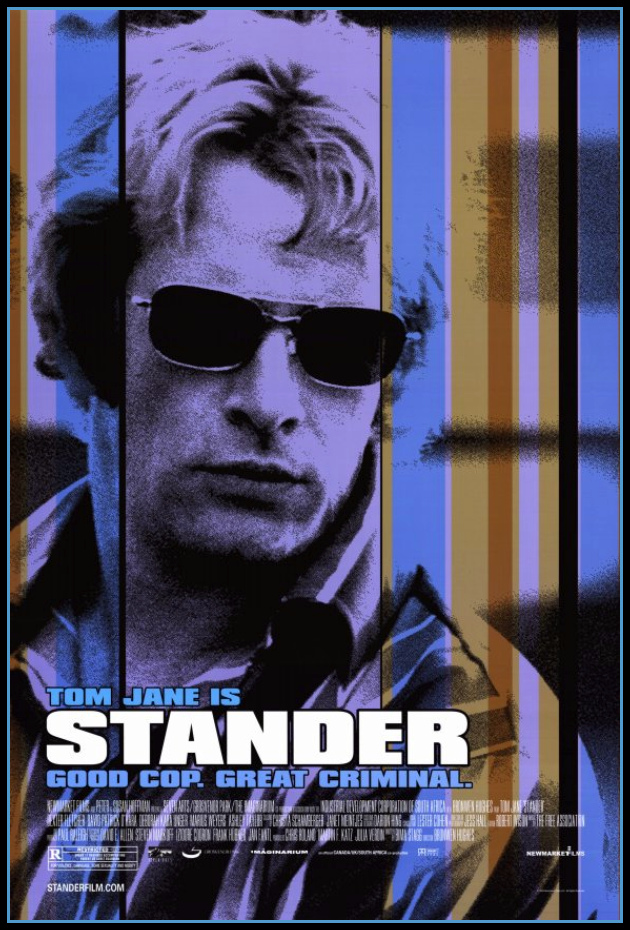
Quickie Review: Stander (dir. by Bronwen Hughes)


Stander was a very good film about the real-life exploits of Andre Stander, Lee McCall and Allan Heyl who were known collectively as The Stander Gang. The Stander Gang was well-known for their daring and reckless bank robberies in their homeland of South Africa. The film stars Thomas Jane (The Punisher, The Mist) as the title character with Dexter Fletcher (Band of Brothers and Lock, Stock and Two Smoking Barrels) and David Patrick O’Hara (Braveheart, Doomsday) rounding out the rest of the Stander Gang.

The film starts off introducing Andre Stander as a highly decorated member of the South African Police Force in the late 1970’s and the beginning of the anti-apartheid movement. It shows Andre Stander’s growing disgust and disenchantment in his government’s racist apartheid policies and his own role in enforcing it. After a violent and brutal break-up of an anti-apartheid protest gathering where Stander kills a protestor, the film begins to move into meat of the story. Stander’s disenchantment with the government causes him to commit bank robberis in audacious fashion as a way to rebel and defy the very state he has sworn to protect and serve.

The scenes where Stander commits these bank robberies were shot well and showed just how daring Andre Stander really was in his exploits. There’s even a sequence where he returns to the scene of his most recent crime to investigate the robbery. A robbery he just committed just hours before during his lunchtime. These scenes and the later ones when he’s joined by two other bank robbers shows Tom Jane at his finest. I think many would be hard-pressed not to think Jane’s performance as a South African, accent and all, wasn’t authentic. His charisma ruled throughout the film and was mostly evident through the many bank robbing sequences. He truly gave Andre Stander the air of a Robin Hood character who, despite his criminal acts, became a sort of folk antihero.

The second half of the film details the exploits of Stander after his incarceration for his bank robberies while a captain of the South African Police Force. It’s here that we meet the rest of Stander’s Gang as he recruits fellow inmate and outlaws Lee McCall and Allan Heyl. Even the way Stander engineers his escape from the work-prison he has been sent to shows his daring in thumbing his nose at the state and the police he used to be a part of. Dexter Fletcher was very good as the twitchy and less stable Lee McCall whose nerves begin to fray the bolder and bolder the gangs bank robberies become. David Patrick O’Hara was also good as the very professional bank robber Allan Heyl. Heyl didn’t have the charisma that Stander had, but he was the rock which kept the robberies from spiraling out of their control. It was great to see O’Hara in another strong role. Some might recognize him as the scene-stealing Stephen, the Irish rebel who joins William Wallace’s fight against the English during Mel Gibson’s Braveheart.

The rest of the film was pretty much one bank robbery after the other with the Stander Gang always one step ahead of the police task force put together to capture them. In a twist of fate, the task force was headed by Stander’s former friend in the police force Cor Van Deverter whose intimate knowledge of Stander’s tactics and thought-processes helps in slowly closing the noose around the gang. There’s abit of a repetition in the robberies and the getaways, but they serve an important purpose of slowly building up the Stander Gang’s folk hero status amongst the population. It also showed the effect it had on some of the members of the gang. As popular and infamous the gang had become they were still outlaws who knew that sooner or later their luck would run out and they’d either be put back into prison or killed outright. For some it was the latter and for others the former.

Throughout the film, one could sense that some of the motivations behind Andre Stander’s actions as a bank robber was to assuage his guilt over the sanctioned acts of brutality he had to perform to protect the apartheid government of his nation. The film and the story being told was almost a full-length film of Stander’s attempt to make up for his past transgressions. And what better way to do this than use the system of the state against itself. He himself points out that a white man could get away with anything when most of the policemen in the city were called away to deal with an emergency regarding the black majority population. Stander realizes this to be true and his second career as a bank robber was born. The film only hints at him being a very good policeman, but the majority of the film shows just how much better he was as a criminal.

The film was expertly directed by Bronwen Hughes and as said earlier had strong performances from all the main leads in the film. The story rarely slowed down to the point that the story lost its direction. Every scene always led to the next part of the story being told until the very bitter end. Stander was a very good film anchored by a fine performance from Thomas Jane. The film showed a brief glimpse into South Africa’s apartheid past and how one individual’s decision to defy the state led to a brief, but daring life of a modern-day Robin Hood.

Falling Skies (Official Trailer)


It looks like while vampires and zombies may be battling it out as the “monster of the moment” the past couple of years there’s an oldie quietly sneaking up behind them to try and take up the general public’s attention.

The first shot was a little film from South Africa called District 9. I think more than a few people saw that little film. Then last year we had a film from two special-effects brothers called Skyline. That particular shot wasn’t as good as the previous title mentioned. In fact, it was godawful though not without it’s perverse entertainment value one gets from watching a very awful film that still manages to entertain (though probably not in the way it’s creators intended to).

In less than a couple of months a film called Battle: Los Angeles will hit the bigscreen and will hopefully be a tad better than the similar plotted Skyline. This one has another South African directing it so that may be a good thing.

Coming this June is a tv series that also follows a similar theme of “alien invasion” with the DreamWorks Television series Falling Skies from producer Steven Spielberg and screeenwriter Robert Rodat. The show will premiere on TNT and stars Noah Wylie, Moon Bloodgood, Will Patton and Dale Dye. From what brief snippets of information that has been released about it the show looks to be similar in tone to Spielberg’s own War of the Worlds where it’s about the human armed resistance trying to retake their cities and the planet back from the alien invaders.

It definitely seems to be a very ambitious show and one that hopefully has a much leaner and efficient take on the alien invasion story than the current remake of V: The Series on ABC. That one had many hoping for a sci-fi to make a great return to network tv and instead we got aliens meets True Blood.

Here’s to hoping Falling Skies doesn’t have aliens wanting to have sex with humans and instead aliens just wanting to kill and/or eat humans instead. I think that would make for a much better show.


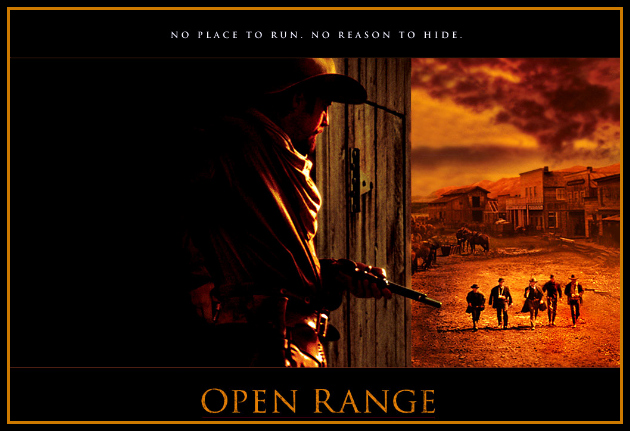
Review: Open Range (dir. by Kevin Costner)


2003 marked a sort of a small comeback for Kevin Costner both as a director and as an actor. The work in question was the very well-done Western, Open Range. Open Range was a moderately budgeted film which has more in common with Costner’s first directorial work, Dances with Wolves than his last big-budget flop, The Postman.

The film was an adaptation of the Lauran Paine novel, The Open Range Men, and it captures much of the themes found in the novel. This was probably due to the fact that screenwriter Craig Storper didn’t deviate from the novel’s basic story. There were no superfluous action sequences and gunfights to ratchet up the action. Everything about Open Range was about the gradual and inevitable final confrontation between the “free-grazers” and the “barbed-wire” men. The free-grazers were played by Kevin Costner and Robert Duvall as Charles Waite and Boss Spearman, respectively. On the other side of the conflict was Michael Gambon playing Denton Baxter, the ruthless land-baron whose attempt to keep the free-grazers from grazing on his land also hides another agenda. Caught in-between these two strong-willed groups were the people in the town Baxter pretty much controls through his “town marshal” (played with fake bravado by James Russo) and the herd helpers under Boss Spearman’s employ.

The theme of freedom to roam the open country versus the rights of a landowner echoes throughout the film. Set in the latter end of the 19th-century, Open Range shows the clash of the more natural ways of the Old West slowly eroding to be replaced by the more industrial, monopolistic practices that became prevalent during the 1880’s, also known in US History as the Gilded Age. Even the personalities of the conflicting characters mirror this theme as the free-grazers only want to use the land as it has been used for years upon years and thats sharing between all men of the West. The land-baron has other ideas in mind and everything boils down to him owning everything around him, even if it means using ruthless tactics to gather even more property.

Open Range also has a bit of modernism in its subplot of Charley Waite’s growing attraction to the sister of the town doctor and the same sister’s well-rounded characterization. It’s not often that a traditional Western shows women in a very positive light instead of the usual submissive and stay-at-home characters of Western’s past. This could also be attributed to the wonderful, underrated performance by Annette Bening who plays Sue Barlow, the doctor’s sister and Charley Waite’s love interest. Bening doesn’t play Sue as the traditional Western female. She also doesn’t go overboard and turn Sue into a 20th-century feminist. She instead plays the character as someone who knows her place in the world, but also one who is strong-willed and willing to stand for what is right.

Open Range was a wonderful throwback to what made such modern Westerns like Unforgiven and Tombstone such a success both for traditionalists and new fans. Kevin Costner’s direction was very low-key. Allowing the story to tell itself at its own pace until the final confrontation. The final gunfight in the end gets a lot of well-earned attention from critics and fans. The entire sequence takes at least 10-15 minutes from start to finish. The fight itself was done in a realistic fashion. There was no sharpshooter dead-eyes in this film, but individuals who had skill but still missed. It was a fight where it wasn’t who was the fastest, but who was the calmest under fire. There’s also a suddenness to the brutality in the final gunfight that demystifies the old-style Western shootouts of past. Some complained that the film was very slow and took too long to get to the “good stuff”, but I actually thought the gradual pacing of most of the film’s length gave the final confrontation even more impact. Costner seem to have learned the lesson all good directors know: less means more.

Open Range won’t go down as a great piece of film making. It surely won’t go down as one of the best in history. What Open Range did accomplish was putting the Western back to its epic and majestic roots, but at the same time keeping the intimacy of a character-driven story. In time, Open Range would probably go down as one of the underrated gems of the last decade and find a place next to its closest comparison, Unforgiven, as one of the best Westerns of the new era.

A Quickie With Lisa Marie: Wall Street (dir. by Oliver Stone)


Yesterday, me and my friend Jeff were planning on seeing Wall Street: Money Never Sleeps.  However, there was one problem — I’d never seen the original Wall Street.  Though I owned the movie on DVD, I’d never actually bothered to sit down to watch it.  Don’t get me wrong, I knew that this was the movie that won Michael Douglas an Oscar.  I knew that Douglas played a character named Gordon Gekko who, at one point in the film, delivered the line, “Greed is good.”  Who hasn’t seen that clip?

So, yesterday, before leaving to see the sequel (which I’ll be reviewing in the near future), I sat down and watched the original. I discovered that there’s a reason why everyone remembers Gordon Gekko’s little “Greed is good” speech.  It’s literally the only memorable part of the entire movie.

Wall Street tells the tale of Bud Fox (Charlie Sheen), a young stock broker who becomes a protegé to an intense and amoral businessman named Gordon Gekko (Michael Douglas).   Gekko specializes in taking over other companies and putting people out of work.  He wants to take over an airline that employs Bud’s father.  Bud’s father is played by Martin Sheen and he’s such a self-righteous, judgmental, blue-collar asshole that you find yourself hoping that Gekko does put him out of work.  Anyway, Bud engages in insider trading (which is apparently a crime though I’m not sure as the film seems to assume that everyone already understands how the stock market works) yet then finds his conscience awakened when Gekko’s greed threatens his dad’s job.  Yes, this is yet another one of those laughably masculine films in which an overage boy has to pick a father figure.  

I guess we’re supposed to care about whether or not he picks the right father but seriously, Bud Fox is such a dull character and Charlie Sheen is so miscast that I found myself wondering when the film’s real hero was going to show up.  I had some hope when James Spader popped up in a supporting role but no, the lead character here is Bud Fox and he’s played by Charlie Sheen.

Not surprisingly, this is pretty much a male-dominated film.  There’s only two notable female characters in the film.  Darryl Hannah plays a ditz and Sean Young plays a bitch and neither one gets a chance to even have fun with the stereotypes.  However, we all know that this film is really just about Gordon Gekko plunking his twanger over money and Bud Fox jackin’ the beanstalk to Gekko.

However, once you see Michael Douglas’s performance as Gordon Gekko, it’s a bit easier to understand why he causes Bud to walk Willie the One-Eyed Wonder Worm.  Douglas truly is amazing in this role.  In fact, Douglas is so charismatic in the role that it actually hurts the movie.  It’s hard to take much pleasure in listening to Martin Sheen talk about how much he loves his union when you realize that all he’s doing is taking up time that could have been devoted to Michael Douglas fucking over poor people.  I don’t know if a bad film can ever be truly redeemed by just one good performance but Douglas definitely makes Wall Street — with all of its awkward moralizing and sexist (and sexual) confusion — worth seeing.

As little as I thought of Wall Street, I still found myself excited about seeing the sequel.  Why?  Because I knew Michael Douglas was coming back and Martin Sheen wasn’t.  Perhaps, I thought, this sequel will simply focus on Gekko being an over-the-top, charming viper instead of forcing us to sit through a repeat of the first film’s heavy-handed moralizing and simplistic political posturing.  Of course, I was wrong but that’s another review for another day.

Oh, one last note: Oliver Stone’s direction is far better than his script.  I once read an old review from Pauline Kael in which she said that Oliver Stone directed “as if someone held a gun to his head and shouted, ‘Go!'”  and this is certainly the case with Wall Street.  That said, I still find it hard to stay interested in any scene that features stock brokers screaming at each other and tossing around little bits of paper.  Seriously, how does the Stock Market work?  Whenever I see any footage from the New York stock exchange, it just looks incredibly silly.

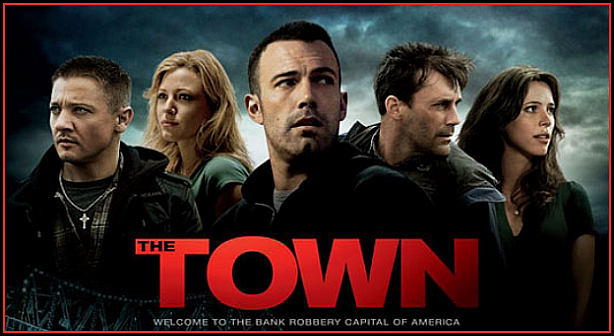
Quickie Review: The Town (dir. by Ben Affleck)


If someone just five years ago told me that Ben Affleck would turn out to be a director whose work has been some of the better crime drama/thrillers of the past decade then I would declare shenanigans on that individual. Ben Affleck might have won an Oscar for helping write the screenplay for Good Will Hunting, but his career since could be labeled as being one of a joke (Gigli) interspersed with huge paycheck projects (Armageddon) that showed his range as an actor.

This is not to say that Affleck has no talent in front of the camera. I just believe that early in his career after winning his Oscar he got fooled into thinking that everything else since would be Easy Street paved in gold (financially and critically). To say that it hasn’t turned out to be that way (though he did make a ton of money) would be an understatement. But one thing happened while Affleck’s acting career was heading nowhere but down. He got behind the camera as a director and his very first time directing a feature-length film he would make one of 2007’s best films. I speak of his film adaptation of the Dennis Lehane crime drama, Gone Baby Gone. He didn’t just direct the life out of that film, but he also the screenplay with the help of Aaron Stockard.

The two of the them would collaborate once again on Affleck’s latest Boston-based crime drama, The Town. He wrote the screenplay and directed the film and pulled in some wonderful performances from an ensemble cast which included Jeremy Renner, Jon Hamm, Rebecca Hall, Blake Lively, Titus Welliver and Pete Postlethwaite. Fellow site writer Lisa Marie already reviewed the film in detail and her review pretty much put down into words exactly what I thought of the film. I will say that I would swerve slightly away from what she considered some of the flaws in the film.

The Town was adapted from Chuck Hogan’s novel, Prince of Thieves. I would consider the screenplay and dialogue as a major strength of the film. While at times it did seemed to follow the step-by-step and by-the-numbers heist thriller story the screenplay itself didn’t ring false. I liken this film to another heist film which shared some themes and similarities. Michael Mann’s Heat also dealt with the cops-and-robbers foundation. Where Mann’s film had a much larger and epic scope to its storytelling it still boiled down to two groups of determined men playing a dangerous game of cat-and-mouse. The women in both film were written just enough that they had distinct personalities, but in the end they were motivations for the men in the film.

Affleck shows that he doesn’t just know how to direct, but continues is reputation as being one very good screenwriter. One just has to be reminded that he is now 3-for-3 when it comes to screenplays he has written which have turned out to be great ones. While he doesn’t have the same flair for words as Tarantino or Mamet when it comes to the screenplay. What he does well was to create an efficient script which flowed from scene to scene. Tarantino’s screenplays are great, but at times he does allow himself to overindulge his inner-film geek and create dialogue that might be Sorkin-like in execution. What I mean is that as great as the dialogue sound there’s no way people really spoke like this to each other. Affleck’s screenplay for The Town felt very natural and even with Jon Hamm’s less than great performance the film had a natural and genuine sound to it’s dialogue.

That’s one flaw pointed out by Lisa Marie that I would disagree with her on. The other two I can see her point, but it bothered me none. Though if I ever took on a life of crime I would hope I find someone just like Rebecca Hall’s Claire. Now there’s a woman who stands by her man no matter what.

I think in the long run this film might just be seen as one of the best of 2010 and some critics have already dubbed it so. While it’s prospects come awards season time is still up in the air I wouldn’t be surprised if it ends up nabbing one of the ten Best Picture nominations when the Oscar nominations get announced. It would be well-deserved and would just prove that Affleck’s career in the film industry might just be hitting its stride. Who would’ve thought it would be as a writer-director and not as an actor.

Cronenberg and Mortensen line up for another Eastern Promises


2007’s Eastern Promises was a film well-received by both critics and the public alike. People loved it because it was David Cronenberg dipping his artistic toe into the pulp crime genre of mob films. Some loved it because it had Viggo Mortensen in what could be his best role to date. For some the film ended just when it really got interesting. The scene in the end with Mortensen’s Nikolai Luzhin sitting alone finally reaching his ultimate goal and an unanswered question of where his loyalties truly lie now.

It’s has now been reported by Deadline Hollywood that producer Paul Webster has lined up both David Cronenberg and Viggo Mortensen for a sequel with Mortensen reprising his Russian mobster Nikolai Luzhin. Plans to have the film to start filming later this winter using a screenplay by Steven Knight (also wrote the first film) may hinge on whether Cronenberg and Mortensen can finish their current project together. This current project, their third together as a creative team, is the Sigmund Freud film The Taking Cure.

No matter how this project develops in the coming months one of the questions fans of the first film will be asking is whether Vincent Cassel will return as well to reprise his role from the first film. Not to mention Naomi Watts and Armin Mueller-Stahl. There’s also the question of how Cronenberg will top the original film’s now famous Turkish Bath House fight scene that’s now considered one of the best, if not THE BEST, fight sequence ever put on film. Or will he even try.

In the end, this is just great news. From all the talk The Taking Cure looks to continue the success the Cronenberg-Mortensen duo have had and this sequel to Eastern Promises may just keep that success going.

Source: Deadline Hollywood

Review: Eastern Promises (dir. by David Cronenberg)


You can’t always be in control.” — Nikolai Luzhin

In 2005 Canadian filmmaker David Cronenberg brought to the silver screen a film that was both a taut, smart crime-thriller and also a well-done film treatise on the nature of violence and how it changes not just witness’ perception of an individual but about themselves as well. The film also introduced what might be the newest creative pairing that could be on par as other pairings like Scorsese-DeNiro and Burton-Depp. The pairing I speak of is that of Cronenberg and his growing repertoire with actor Viggo Mortensen. They scored a critical hit with A History of Violence and in 2007 they collaborate in another crime-drama that more than lives up to their initial collaboration. Eastern Promises is a taut and meticulous drama which brings new eyes and a different approach to the mob film genre made famous by Coppola and Scorsese.

The film begins innocently enough with a very pregnant teenage Russian girl named Tatiana entering a neighborhood store. While Cronenberg chose to open up A History of Violence nary any musical cues and backgrounds to create a sense of naturalism and plant a seed of unease in the audience of what’s to come, he does the opposite with Eastern Promises by allowing long-time collaborator Howard Shore to score this opening scene with a haunting violin solo. Even right from the start Cronenberg’s propensity to use a sudden image of violence to shock the audience works well to set the tone for the film. It is not the usual filmgoing experience to see a young girl, looking lost and afraid of her surroundings, suddenly and bloodily starts to give birth in the middle of a store. It is from the diary entries of this young girl where we get glimpses of the true meaning of the film’s title and sets up the clues and tidbits that Cronenberg gradually fills in as the film progresses and the main characters investigate the girl’s death and the full contents of her diary.

We’re quickly introduced to Anna Khitrova (played with touching compassion and a certain naivete by Naomi Watts), midwife at the London hospital where Tatiana dies from bloodloss due to childbirth. Having had experienced her own personal tragedy regarding a past pregnancy Anna takes it upon herself to find the next of kin or, at the very least, close friends who might know Tatiana and thus claim the child and care for her. It was finding Tatiana’s diary and the business card tucked within amongst the young girl’s meager possessions which gives Anna a starting point for her investigation and search.

It is during this search into Tatiana’s life that Anna encounters Nikolai Luzhin (Viggo Mortensen at his most chameleonic), the personal driver of one Semyon (as played by Armin Mueller-Stahl). Semyon charms Anna with his old world grandfatherly persona yet both the audience and Anna feels something off, even sinister beneath the charm and twinkling eyes. Semyon is not just the owner of the Trans-Siberian, a Russian restaurant, but a boss in the vory v zakone also known as the Russian Mafia. It is through Nikolai that we see the underbelly of Tatiana’s life before her death.

It is during the second half of the film that the film takes a clear turn into Cronenberg territory. With all the players in play Eastern Promises starts to peel the layers on all the characters. Just like in A History of Violence every character in this unofficial follow-up to that film go on through the film living dual-lives. Even Anna’s seeming naivete, in regards to the danger she faces in Semyon and his unstable son Kirill, shows a modicum of world-weariness born out of personal tragedy and those she sees on a daily basis when working as a midwife in the hospital.

Cronenberg doesn’t just try to tell a crime drama about the mob and the subculture they live and die in but he adds his own personal stylistic and metaphorical touches on the mob film conventions. While in the past he has taken on the immutability of the body and the physical nature of man in his later years he has moved on to the amorphous nature of man’s very nature as both a civilized and reasoned animal to the primal being which lurks within each. Eastern Promises delves into this metaphysical topic by showing the natures of both Nikolai and Semyon. Both of whom, at first glance, inhabiting a particular stereotype but soon showing the opposite as the audience gets to know them. Even the twists in the story in the middle section and close to the end doesn’t seem like cheap plot tricks but a logical and almost mathematical conclusion to the very themes Cronenberg has been exploring right from the beginning.

The performances by the cast was top-notch from top to bottom. David Cronenberg’s always has had a reputation for being an actor’s director. His willingness to allow his actors to not just play the part but find ways to become their characters makes his films some of the more well-acted one’s of the last quarter-century. From Watts’ own touching performance as the moral center of the film in Anna to Cassel’s unstable and coward of a bully in Kirill the work put on by the actors adds a level of gravitas to a story that has it’s roots in pulp crime stories and not the high-brow tales prestige films like Eastern Promises has been compared to. But the two stand-out work comes from Viggo Mortensen as the enigmatic Nikolai and Armin Mueller-Stahl as Russian mob boss Semyon. Where Watt’s performance was subtle and Cassel’s literally scene-chewing both Mortensen and Mueller-Stahl bring forth nuanced performances full of life and complexities that makes both characters stand out above a cast already doing great work.

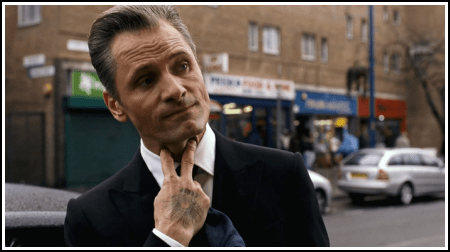
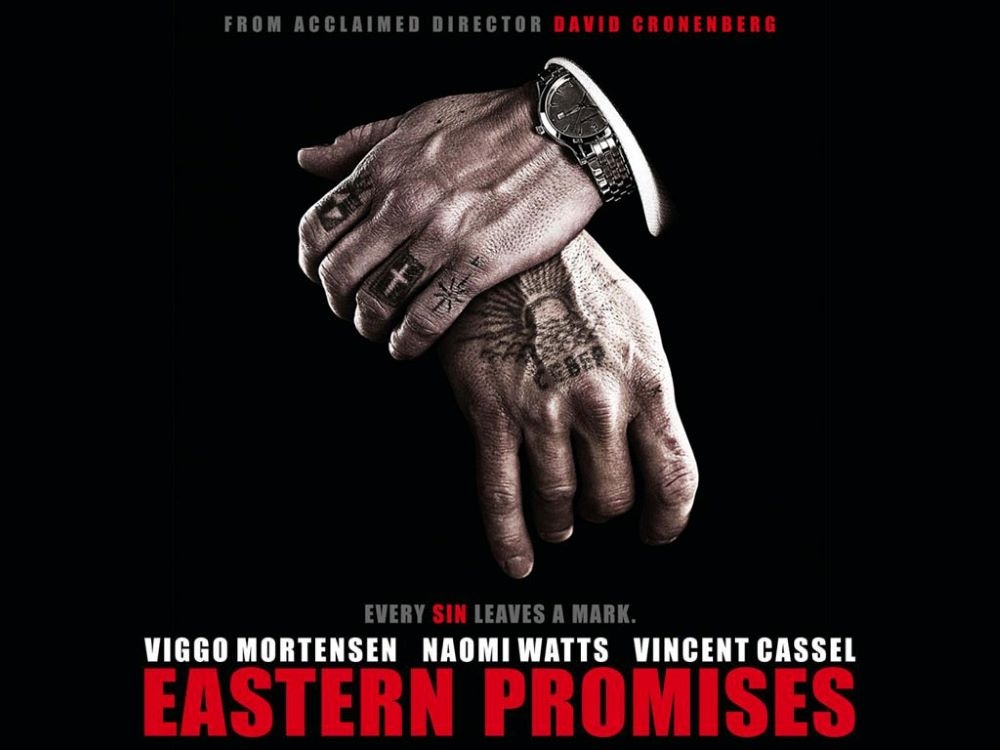
Mortensen’s work as Nikolai actually surpasses his previous Cronenberg-directed role in Tom Stalls of A History of Violence. Viggo has always been quite the Method actor and really loses himself in every role he takes on, but it took him being paired up with Cronenberg for critics and cineastes to finally realize how great an actor he really has become in the last decade. His Nikolai oozes a charisma from the moment he enters the film. He makes Nikolai not just a thug with a brain and a semblance of compassion beneath the rough surface. Mortensen literally becomes Nikolai right down to the very tattoos which tells his character’s criminal past in ink. One could not help but be mesmerized by Mortensen’s work in this film that it was easy to forget that he was playing a part and not actually living that life. To say that Mortensen may have found his creative soulmate in Cronenberg would be quite the understatement and with more projects in the future linking the two together it wouldn’t be a surprise if the two in conjuction finally get the critical awards that has eluded both.

While A History of Violence showed that Cronenberg could work beyond the genre and esoteric genres of his part works, it is with Eastern Promises that we see him move towards a more mainstream type of work. Yet despite a work more accessible than before he still was able to add his own style of storytelling and explore themes usually not seen in crime dramas and mob films. It is this ability to marry the violent pulp with the intellectual high-brow which makes Eastern Promises a delight for both the general filmgoer and the arthouse cineaste. Time will only tell if the successful streak by the duo of Cronenberg-Mortensen continues as the two continue to work together in the years to come.

Aronofsky and Jolie looking to team up


It appears that Darren Aronofsky and Angelina Jolie are being reported as having plans to work together in the near future. Aronofsky has just completed initial filming on his latest, Black Swan, and is now looking to try and adapt the Ron Rash novel, Serena, with Angelina Jolie in the title role.

The project will be using a script adapted from the novel by Chris Kyle (wrote several of Kathryn Bigelow’s past work). The story is set in Depression-era 1929 and involves husband and wife George and Serena Pemberton heading down to North Carolina from Boston to try and make their fortune in timber. The title character of Serena adapts wells to the backwoods country as well as any of the locals and timbermen and in pursuit of creating their timber empire pushes the husband into further acts of cruelty to realize their dream. It is a the height of their power and growing empire that Serena realizes she cannot bear children. This revelation causes her to set out on a plan to murder the son her husband had outside their marriage. The rest of the film becomes a struggle between Serena and the “son” and of betrayal as Serena begins to suspect her husband trying to portect and save his illegitimate family.

Serena looks to have some similar themes as Paul Anderson’s There Will Be Blood and with what could be a small budget despite the period piece setting, Aronofsky may have another classic in the works to add to his body of work. All of this hinges on Aronofsky and Jolie finding financing for the project. Here’s to hoping that their search is not too long and production begins soon enough that Jolie doesn’t back out to work on another film.

Source: THR

Review: The Book of Eli (dir. by The Hughes Brothers)


In 2001 the Hughes Brothers released their film adaptation of the celebrated and very dense graphic novel From Hell. A graphic novel meticulously researched and every detail reconstructed to tell the tale of Jack the Ripper and his killing spree in the London slum of Whitechapel during the turn of the 19th-century into the 20th. It was a film fans of the graphic novel have been waiting for years since it was initially announced. When it was finally released in 2001 the reception and reaction from both critics and audiences were a resounding thumbs down. The Hughes Brothers first major film outside of their comfort zone of the urban setting was seen as a colossal failure and for almost a decade they seemed to have put themselves into a self-imposed exile from Hollywood. It’s now 2010 and with a cas consisting of Denzel Washington and Gary Oldman on opposite sides it looks like the Hughes Brothers have returned from their exile with a very good post-apocalyptic Western called The Book of Eli.

I call The Book of Eli a post-apocalyptic Western because it’s what the film reminded me most of. The setting may be all ashen gray with the world and the environment decades into what the cast can only describe as “the flash” which ended everything. But with all that the film still felt like a throwback to the Westerns of Sergio Leone with equal parts Akira Kurosawa samurai epics. Taking cue from the screenplay by Gary Whitta, the Hughes Brothers set up the rules of the film from the very first frames. We see a world still raining ash even thirty years since a war (hinted as being caused and fought between the major religions of the world). It is a world where cats have become not just the source of food but also oil for chapped lips. If one bought into the world being presented in the very first ten minutes of the film then the rest the remaining hour and forty minutes would be easy going.

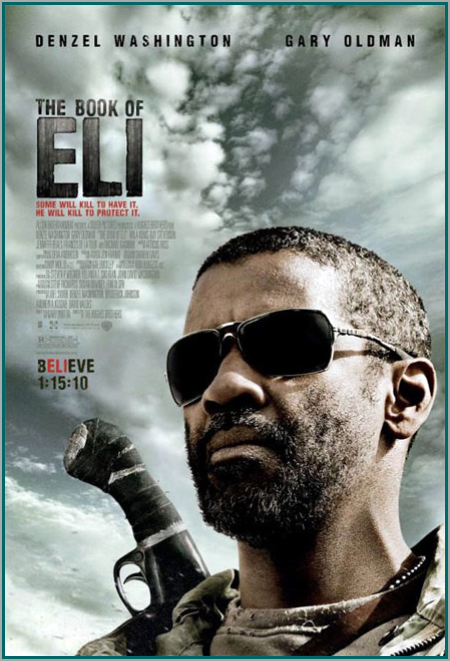
The very first twenty minutes of the film was pretty much free of dialogue as we see the No-Name walker (played by Denzel Washington) survive a day on the road inside an abandoned homestead with only an ancient iPod and the titular book to keep him company. When we finally hear his character speak it is in hushed tones, almost a whisper as if his time of wandering the blasted landscape in solitude has made speaking out loud something almost forgotten. In fact, throughout most of the film Denzel’s character rarely speaks and when he does it doesn’t bode well for those trying to keep him from the path he had been set on for the past thirty years since after “the flash.” It’s during these “encounters” when his character must protect himself that the Hughes Brothers show their unique style in how to film an action scene.

The action scenes owe much of their smooth, precise and deadly ballet to the work of stunt coordinator Jeff Imada and his team of stunt men and women. There’s none of the fast cut and edits to make an action scene seem more chaotic than it really is. Each brutal fight sequence from the hand-to-hand combat to the shootouts are shot with a wide lens to give the audience a clear view of every move, decision and attack made through the fight.  When the camera does move from combatant to combatant it flows from one to another without missing a beat. I will also say that the violence in these fights are quite sudden and brutal. Limbs and heads are cut off with ease that it takes several beats before the audience even realizes what has happened. While the film does have it’s share of action sequences the Hughes Brothers actually seem to hold themselves back from putting in more to keep the fast-pace moving. Instead they use these sudden burst of violence to break whatever monotony may set in during scenes of dialogue.

It is during these downtime from the action that the meat of the story shows itself. The book being protected by Washington’s character may seem to look like a MacGuffin from the onset as he tries to stay on path to deliver it somewhere West. It’s during his brief stop in an unnamed town that we find out just exactly what the book really is. It is also in this part of the film where the audience meets the opposite of Washington’s character in the Carnegie, the town’s dictatorial mayor played by Gary Oldman channeling his inner Stansfield from his time more than a decade ago on the film Leon: The Professional. There really is no one better right now when it comes to playing a villain with some sophistication to go with an equal amount of sociopathic tendencies. Oldman’s Carnegie gets most of the lines in the film and it’s from his lines of dialogue that we learn not just why but also the motivations for his need to have the book in Washington’s possession.

This section of the film where some explaining of the motivations from both leads bring up some interesting ideas about the nature of faith and religion and how both ideas which seem to share a common ground could also be so different from each other. While the ideas of faith and religion gets screen time there’s not much heavy-handed preaching to alienate the audience. Whitta’s script (with some extensive doctoring from a few individuals) gives the audience enough explanation without forcefeeding them. The film leaves it up to the individual viewer to make up their minds about what had been brought up. I do think that the script and the how the two leads in the film were drawn up left little gray area to be explored. We clearly see Washington’s character as the good guy trying to preserve civilization and society as the Good Book teaches while Oldman’s Carnegie wants to use the power of said Book to cement his power and hold over his town and beyond. There definitely could have been room for some more work on the script to actually complicate the two characters’ motivations where both could be seen as correct in what they want done. Instead there’s no delineation as to who is good and who is bad. It is only through Oldman’s performance that the character of Carnegie escapes becoming a one-note villain.

The rest of the cast perform ably enough but still just left to become plot device characters to help move the story forward. It was good to see Jennifer Beals in another major motion picture. The same goes to Ray Stevenson of HBO’s Rome. While their roles were quite small compared to the two leads they still did quite well with what they had to work with. I was surprised to see Tom Waits make an appearance as the town’s Mr. Fixit man and it was a delight to see. Even the small roles played by Michael Gambon and Frances de la Tour didn’t disappoint. Many in the audience, including myself, reacted quite positively to their slightly demented, but funny elder couple. Their time on-screen was brief but they sure made great use of the time they were given.

The one misstep that almost broke the film for me was the miscasting of Mila Kunis in the role of Solara. While I can understand why she looked quite clean in a town and world where everyone’s hygiene was really not a priority she just looked too clean. It seemed like she just stepped out of a Beverly Hills, 90201 remake by way of The Road Warrior. While her performance was good it still paled when compared to the rest of the principals she interacted with. When we finally see what happens to her in the end of the film there’s no reaction of rousing claps, but instead I could hear snickers and more than a few laughs.

While the story was quite good, albeit with some flaws, the film really stands out with its art direction and the work of DP Don Burgess. With the latter, The Book of Eli was given a very washed out looked of browns and greys. There was barely much any color outside of those two that the film, at times, took on a black & white quality in its visual tone. Burgess and the Hughes Brothers’ decision to use the Red HD-camera allowed the team to create a world that’s been turned on its head. This decision also allowed the filmmakers to combine live-action with the matte paintings to show the blasted landscape in the background. But not everything about the look of the film was perfect and/or well-done. At times some of the scenes clearly looked like they were filmed in front of a green-screen. Maybe it was a deliberate choice but one that, at times, became too distracting.

In the end, while not a perfect film, the Hughes Brothers’ The Book of Eli was a very good take on the current spate of post-apocalyptic films. While Hillcoat’s The Road was a depressing and agonizingly morbid take on the same subject, the Hughes Brothers were able to convey the same sentiments with their film but giving enough of a glimmer of hope. The ending doesn’t mean that society is saved by any means, but it does show that the chance for rebuilding is there if given the chance. So, whatever director hell the brothers have been relegated to for most of the last decade this film surely has brought them back from exile. While all was still not forgiven for their work on From Hell they’ve at least gotten back into the good graces of the film-going public and, hopefully, they’ve got more work to come.