Welcome to New York in the 1970s! While the intellectuals flock to the latest Woody Allen movie and the wealthy throw radical chic parties in Manhattan and disturbed young men drive taxis at night and pray for a real flood to clear away all the vermin, most of the city’s citizens are just trying to make it through the day. For many of them, that means spending an hour or two riding the subway. In some ways, the subway is the great equalizer. The minute that you sit down on a filthy train car, it doesn’t matter how old you are or how you vote or the color of your skin. All that matter is finding a way to avoid making eye contact with anyone else.
Four men, all wearing obvious disguised, board the downtown Pelham 1-2-3 train. They all look suspicious but, this being New York, no one wants to make eye contact. Everyone just wants to reach their next stop. The men — who are known as Mr. Blue (Robert Shaw), Mr. Green (Martin Balsam), Mr. Grey (Hector Elizondo), and Mr. Brown (Earl Hindman) — have other plans. Revealing that they’re armed, they take the 18 passengers of the first car hostage. Their leader, Mr. Blue, has a simple demand. He wants a million dollars to be delivered to the car within an hour. If the money’s late, he will kill one hostage every minute, until he receives what he wants.
While the cold-stricken mayor (Lee Wallace) tries to figure out how to 1) raise a million dollars and 2) handle the situation without losing any potential votes in his reelection campaign, Lt. Zach Garber (Walter Matthau) communicates with Mr. Blue via radio. With Mr. Blue underground and Zach above ground, the two of them establish a cautious rapport. Robert Shaw plays Blue as being efficient, polite, but ruthless while Walter Matthau plays Garber with his usual rumpled but intelligent style. As embodied by Matthau, Garber is New York City in human form while Shaw is perfectly cast as the outsider who, for at least an hour or two, has managed to bring the city to its knees.
Even though the original The Taking of Pelham One Two Three is often described as being a Walter Matthau film or a Robert Shaw film, the film’s main character actually is the city of New York City. The film portrays the city as being chaotic, angry, and unpredictable but, at the same time, also resilient and strong. Yes, Garber may spend a lot of time bickering with his co-workers but, in the end, he and Lt. Rico Patrone (Jerry Stiller, another great New York figure) work together to do what has to be done to resolve the situation. For all the time that’s spent on how Mr. Blue and his compatriots take that train hostage, just as much time is spent focusing on how the police, the politicians, and the Transit Authority react to what’s happened. Not having any firsthand knowledge of the New York subway system (beyond being told not to use it when I was in NYC a few years ago), I can’t say whether or not the film is realistic but what’s important is that it feels realistic. Even though the film is full of familiar character actors, it still seems as if you’re just watching a bunch of New Yorkers having a very long day. Though guns are fired and there is a runway train, The Taking of Pelham One Two Three takes a refreshingly low-key approach to its story. There’s no huge action set pieces. The film’s classic final shot hinges not on Garber’s marksmanship but instead on his ability to remember the small details.
The Taking of Pelham One Two Three is one of my favorite heist movies. It’s well-acted. It’s got an interesting plot. It’s got a few moments of unexpected humor. Robert Shaw is a great (and, at times, almost compelling) villain while Walter Matthau and Jerry Stiller make for a great detective team. The great Martin Balsam also turns in a wonderful turn and, even though he’s playing a bad guy, it’s hard not to sympathize him. You need only see his apartment to understand why exactly he felt the city of New York owed him more than it had given him. Best of all, The Taking of Pelham One Two Tree is a tribute to a great American city. The Taking of Pelham One Two Three celebrates New York City in all of its rude, messy, and brilliant glory.

 The year is 1963. The month is November. The city is Dallas. The President of the United States, John F. Kennedy, is coming to visit and two very different men have very different reactions. An eccentric and lonely strip club owner, Jack Ruby (Michael Lerner), worries about an anti-Kennedy ad that has just appeared in the Dallas Morning News. Another loner, a strange man named Lee Harvey Oswald (Frederic Forrest), is busy making plans of his own. When Kennedy is assassinated, history brings Ruby and Oswald together in a way that a shattered nation will never forget.
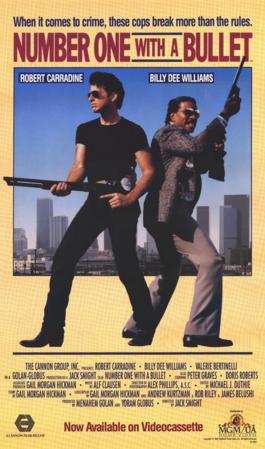 Number One With A Bullet is the story of two cops. Nick Barzack (Robert Carradine) is so crazy that the all criminals have nicknamed “Beserk.” (Who says criminals aren’t clever?) Nick’s partner, Frank Hazeltine (Billy Dee Williams) is so smooth that jazz starts to play whenever he steps into a room. Nick keeps a motorcycle in his living room, wants to get back together with his wife (Valerie Bertinelli), and has an overprotective mother (Doris Roberts). Hazeltine is Billy Dee Williams so all he has to worry about is being the coolest man on Earth. Their captain (Peter Graves!) may want them to do things by the book but Nick and Hazeltine are willing to throw the book out if it means taking down DaCosta, a so-called respectable citizen who they think is actually the city’s biggest drug lord.
