Scenes I Love: Al Pacino and Diane Keaton in The Godfather


Today’s scene that I love comes from my favorite film of all time, 1972’s The Godfather

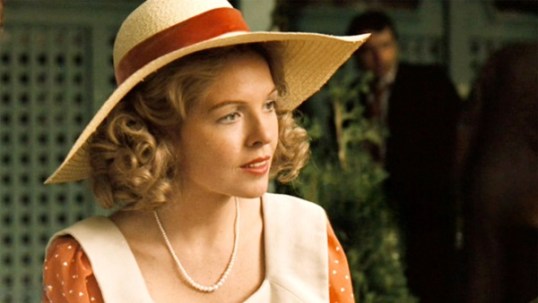
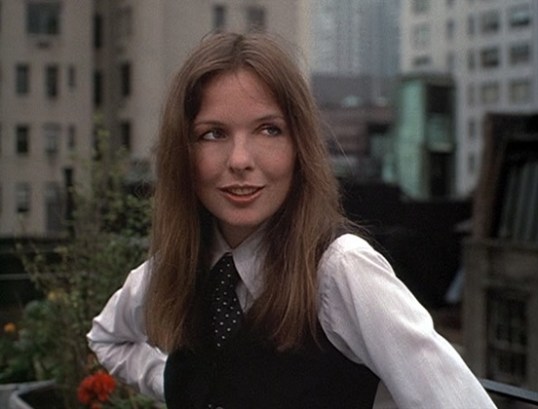
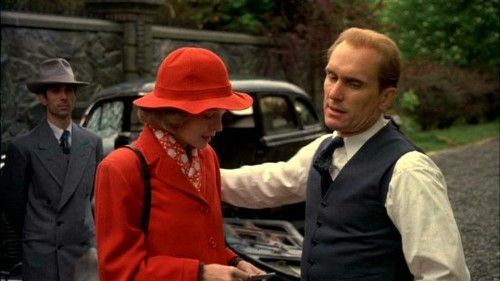
In this scene, Kay Adams (Diane Keaton) has moved on and is working as a teacher.  Suddenly, Michael Corleone (Al Pacino) shows up.  He’s been back from Sicily for a year and he’s working with his father.  Michael promises her that the Corleone family is getting out of the rackets.  We, of course, know that is never going to happen.

October True Crime: Looking for Mr. Goodbar (dir by Richard Brooks)


In 1977’s Looking for Mr. Goodbar, Diane Keaton plays Theresa Dunn.

A neurotic and single woman who has never emotionally recovered from her childhood struggle with scoliosis, Theresa is trying to find herself in the wild and promiscuous world of the 1970s.  After losing her virginity to a condescending college professor (Alan Feinstein), Diane goes on to have relationships with a needy social worker (William Atherton) and an hyperactive petty criminal (Richard Gere).  During the day, she teaches deaf children and she’s good at her job.  She even manages to win over the distrustful brother (Levar Burton) of one of her students.  At night, she hits the bars.  She buys drugs from the neighborhood dealer (Julius Harris).  She tries to read the book that she always carries with her.  (Some nights, it’s The Godfather and other nights, it’s something else.)  She picks up strange men and takes them to her roach-infested apartment.  One of those men, Gary (Tom Berenger), turns out to both be a bit insecure about his masculinity and also totally insane….

Looking for Mr. Goodbar is an adaptation of a novel that was inspired by the real-life murder of a New York school teacher named Roseann Quinn.  The book was best seller and, just as he had with a previous best-selling true crime novel, director Richard Brooks bought the rights and both wrote and directed the film.  Diane Keaton, who at that point was best-known for playing Kay Adams in The Godfather and for appearing in Woody Allen’s comedies, took on the demanding role of Theresa and, whatever one may think of the film itself, it can’t be denied that Keaton gives a brave performance as the self-destructive Theresa.  In fact, I would say it’s one of Keaton’s best performances, outside of her work with Woody Allen and The Godfather Part II.  If she had been played by a lesser actress, Roseann could have been unbearable.  As played by Diane Keaton, though, she’s everyone’s best friend who just need some time to find herself.  The viewer worries about her and wants to protect her as soon as they see her, making her ultimate fate all the more tragic.

As for film itself, I’ve watched Looking For Mr. Goodbar a few times and I’m always a little bit surprised by how bad the movie actually is.  The film actually gets off to a strong start.  The scenes between Theresa and the professor make for a sensitive portrait of a repressed young woman finally getting in touch with her sexuality and, in the process, discovering that she deserves better than the man she’s with.  But once Theresa moves into her apartment and starts hitting the bars at night, the film takes on a hectoring and moralistic tone that leaves the viewer feeling as if the film is blaming Theresa for the tragedy that’s waiting for her at the end of the story.  Diane Keaton and Tuesday Weld (who plays her sister) both give excellent performances but everyone else in the film either does too much or too little.  This is especially true of Richard Gere, who is very hyperactive but still strangely insubstantial in his role.  (Whenever Richard Gere appears on screen, one gets the feeling that they could just walk right through him.)  A scene where Gere jumps around the apartment is meant to be disturbing but it’s more likely to inspire laughter than chills.

It’s an overly long film and the moments in which Theresa has dark, sexually-charged fantasies are never quite as powerful as the film obviously meant for them to be.  (Brian Dennehy makes his film debut as a doctor who kisses Theresa’s breast during one of her fantasies.)  As opposed to the empathy that he brought to In Cold Blood, one gets the feeling that director Richard Brooks didn’t like anyone in this movie and that he was more interested in Theresa as a cautionary tale than as a human being.  With this film, Brooks seemed to be standing athwart the Sexual Revolution and shouting, “Stop!”  That said, the film’s final moments are genuinely disturbing and difficult to watch.  It’s the one moment where Brooks’s lack of subtlety pays off.  Those last minutes are about as horrific as anything you could expect to see.

As for Roseann Quinn, her killer was eventually arrested.  John Wayne Wilson hung himself in prison, 5 months after murdering her.

Diane Keaton, RIP


I’m so sad to hear the Diane Keaton has passed away.  She was 79 years old.

A great actress, she was also one of the few performers who seemed to be as genuine off-screen as she was on-screen.  She brought Kay Adams to life in The Godfather, adding a certain edge that wasn’t present in the novel or the script.  She starred in Woody Allen’s best films.  She lent her voice to Finding Dory.  She won an Oscar for Annie Hall and was nominated for a few other films as well.  In 1996’s Marvin’s Room, she easily stole the film from showy performers like Meryl Streep and Leonardo DiCaprio and earned perhaps her most deserved Oscar nomination.    At a time of generic faces and publicist-written statements, she was refreshingly real.

Diane Keaton, RIP.  She will be missed.


Lisa Marie Reviews An Oscar Nominee: Reds (dir by Warren Beatty)


In the 1981 film Reds, Warren Beatty plays Jack Reed, the radical journalist who, at the turn of the century, wrote one of the first non-fiction books about Russia’s communist revolution and then went on to work as a propagandist for the communists before becoming disillusioned with the new Russian government and then promptly dying at the age of 32.

Diane Keaton plays Louise Bryant, the feminist writer who became Reed’s lover and eventually his wife.  Louise found fame as one of the first female war correspondents but then she also found infamy when she was called before a Congressional committee and accused of being a subversive.

Jack Nicholson plays Eugene O’Neill, the playwright who was a friend of both Reed and Bryant’s and who had a brief affair with Bryant while Reed was off covering labor strikes and the 1916 Democratic Convention.

Lastly, Maureen Stapleton plays Emma Goldman, the anarchist leader who was kicked out of the country after one of her stupid little dumbass followers assassinated President McKinley.  (Seriously, don’t get me started on that little jerk Leon Czolgosz.)

Together …. well, I was going to say that they solve crimes but that joke is perhaps a bit too flippant for a review of RedsReds is a big serious film about the left-wing activists at the turn of the century, one in which the characters move from one labor riot to another and generally live the life of wealthy bohemians.  Reed spends the film promoting communism, just to be terribly disillusioned when the communists actually come to power in Russia.  For a history nerd like me, the film is interesting.  For those who are not quite as obsessed with history, the film is extremely long and the scenes of Reed and Bryant’s domestic dramas often feel a bit predictable, especially when they’re taking place against such a large international tableaux.  At its best, the film is almost a Rorschach test for how the viewer feels about political and labor activists.  Do you look at Jack Reed and Louise Bryant and see two inspiring warriors for the cause or do you see two wealthy people playing at being revolutionaries?

Reds was a film that Warren Beatty spent close to 20 years trying to make, despite the fact that the heads of the Hollywood studios all told him that audiences would never show up for an epic film about a bunch of wealthy communists.  (The heads of the studio turned out to be correct, as the film was critically acclaimed but hardly a success at the box office.)  It was only after the success of the 1978, Beatty-directed best picture nominee Heaven Can Wait that Beatty was finally able to get financing for his dream project.  He ended up directing, producing, and writing the film himself and he cast his friend Jack Nicholson as O’Neill and his then-romantic partner Diane Keaton as Louise Bryant.  (Gene Hackman, Beatty’s Bonnie and Clyde co-star, shows up briefly as one of Reed’s editors.)  One left-wing generation’s tribute to an early left-wing generation, Reds is fully a Warren Beatty production and, for his efforts, Beatty was honored with the Oscar for Best Director.  That said, the Reds lost the award for Best Picture to another historical epic, Chariots of Fire.  Chariots of Fire featured no communists and did quite well at the box office.

The film is good but a bit uneven, especially towards the end when we suddenly get scenes of Louise Bryant trudging through Finland as she attempts to make it to Russia to be reunited with Reed.  The film actually works best when it features interviews with people who were actual contemporaries of Reed and Bryant and who share their own memoires of the time.  In fact, the interviews work almost too well.  The “witnesses,” as the film refers to them, paint such a vivid picture of the Reed, Bryant, and turn of the century America that Beatty’s attempt to cinematically recreate history often can’t compete.  One can’t help but feel that Beatty perhaps should have just made a documentary instead of a narrative film.

(Interestingly enough, many of the witnesses were people who were sympathetic to Reed’s politics in at the start of the century but then moved much more to the right as the years passed.  Reed’s friend and college roommate, Hamilton Fish, went on to become a prominent Republican congressman and a prominent critics of FDR.)

That said, Jack Nicholson gives a fantastic performance as Eugene O’Neill, adding some much needed cynicism to the film’s portrayal of Reed and Bryant’s idealism.  Keaton and Beatty sometime both seem to be struggling to escape their own well-worn personas as Bryant and Reed but Beatty does really sell Reed’s eventually disillusionment with Russia and the scene where he finally tells off his Russian handler made me want to cheer.  Fans of great character acting will want to keep an eye out for everyone from Paul Sorvino to William Daniels to Edward Herrmann to M. Emmet Walsh and IanWolfe, all popping up in small roles.

Reds is not a perfect film but, as a lover of history, I enjoyed it.


Song of the Day: The Godfather by Nino Rota


Today, the Shattered Lens wishes a happy birthday to both Robert Duvall and Diane Keaton!

Along with being two of America’s best actors, Duvall and Keaton also co-starred in the first two Godfather films.  They didn’t share many scenes in the second film (though there was at least one Duvall/Keaton scene that was filmed but not included in the final film) but, in the first film, they have a memorable moment in which Keaton (as Kay) asks Duvall’s Tom Hagen to send a letter to Michael in Sicily.  Hagen politely refuses.  When Kay notices a car that has obviously been bombed, Tom replies with bland good cheer, “Oh, that was an accident.  Luckily, no one was hurt!”

In honor of these two amazing performers and my favorite movie of all time, today’s song of the day is Nino Rota’s theme from The Godfather.
TV Review: Night Gallery 1.2 “Room With A View/The Little Black Bag/The Nature of the Enemy”


The second episode of Night Gallery originally aired on December 23rd, 1970 and it featured three stories, two of which were written by Rod Serling.  Serling, himself, introduced all three of the stories by inviting us to look at the paintings that may or may not have been inspired from them.

Room With A View (dir by Jerrold Freedman, written by Hal Dresner)

When a cranky, bed-bound man (Joseph Wiseman) discovers this his wife (Angel Tompkins) is cheating on him, he comes up with an elaborate scheme to get revenge.  It all hinges on his somewhat nervous nurse (Diane Keaton), who has no idea that she’s being manipulated.

This short segment is well-done but it doesn’t really feel like it belongs on an episode of Night Gallery.  There’s no elements of horror or science fiction to be found in this story.  Instead, it’s just about a manipulative man seeking revenge on his wife.  It’s actually easy to imagine this segment as being a flashback on a Monk-style detective show.  You just need a detective saying, “I finally figured out how you did it!”

For most viewers, probably the most interesting thing about this segment will be the presence of a young Diane Keaton, playing the nurse and laughing nervously at her patient’s rather intrusive questions.

The Little Black Bag (dir by Jeannot Szwarc, written by Rod Serling)

In the 30th Century, a careless accident at a time travel station sends a black medical bag into the past.  It arrives in 1971, where it’s discovered by two homeless gentlemen.  One of the men is a disgraced former doctor named William Fall (Burgess Meredith).  The other, Hepplewhite (Chill Wills), has no medical experience but he does have a greedy spirit.  Fall wants to use the bag to do good,  Hepplewhite wants to use the bag to make money.  Meanwhile, in the future, poor put-upon Gillings (George Furth) is just trying to figure out what to do about the missing bag.

The Little Black Bag is this episode’s high point, featuring good performances from Meredith, Wills, and Furth and also ending with properly macabre twist.  This is another Rod Serling story about how terrible, at heart, most people are but Jeannot Szwarc’s direction is fast-paced and he never allows things to get too heavy-handed.

The Nature of the Enemy (dir by Allen Reisner, written by Rod Serling)

NASA’s latest expedition to the Moon has run into trouble.  The astronauts have discovered that there is something living on the lunar surface.  On Earth, the director of NASA (Joseph Campanella) tries to keep everyone calm while also figuring out the nature of the enemy.

This segment has an intriguing premise but it’s let down by a so-so execution.  Like a lot of less-than-effective Night Gallery segments, this one features a story that doesn’t so much conclude as it just stops after a somewhat weak punchline.

So, the second episode of Night Gallery was not an improvement on the first and it was nowhere close to matching the pilot.  Watching this episode, it was hard not to feel that the show had a few growing pains.  Did it want to be a horror anthology or a collection of short skits?  The 2nd episode reveals a show that was still trying to find it’s voice.

Previous Night Gallery Reviews:

  1. The Pilot
  2. The Dead Man/The Housekeeper


TV Review: Twin Peaks 2.15 “Slaves and Masters” (dir by Diane Keaton)


“Get a life, punk!”

— Albert Rosenfield (Miguel Ferrer) in Twin Peaks 2.15 “Slaves and Masters”

Well, it had to happen some time.

We have reached the “Slave and Masters” episode of Twin Peaks.  Judging from what I’ve read online, most fans seem feel that this episoode was the worst in the show’s history.  Myself, I don’t know whether it is or isn’t.  I’m writing this introduction before watching the episode.  I guess I’ll know soon enough.

Interestingly enough, this episode was directed by actress Diane Keaton.  When I first saw Keaton’s name listed as director, I assumes that she must have been a fan of the show and that she lobbied for the chance to direct an episode.  However, according to Relections: An Oral History of Twin Peaks by Brad Dukes, the opposite was true.  While the cast all liked and respected Keaton as a director, there was also a feeling that she didn’t seem to actually know much about the show.  Considering that the show had suffered a severe ratings decline during the 2nd season, it seems probable that Keaton was hired to direct in an attempt to generate some new interest in the once hot show.

If that was the plan, it didn’t work.  Apparently, the ratings for this episode were so low that Twin Peaks was put on hiatus a week after it aired.  It was only due to a letter-writing campaign that ABC decided to air the last six episodes of the season.  In short, it can be argued that this episode was truly the beginning of the end for Twin Peaks‘s original network run.

So, with all that in mind, let’s take a look at the 23rd episode of Twin Peaks, “Slaves and Masters.”

As always, we begin with the haunting opening credits and Angelo Badalamenti’s lushly romantic (yet ominously threatening) score.  The mood has been set.  We have returned to the world of Twin Peaks.

After the credits, we immediately cut to a close-up of a chess board.  In slow motion, the camera glides over all of the pieces.  The Queen, The pawns, the King, the Bishop, the little horsey guy.  (I don’t know much about chess, sorry.)

Suddenly, we’re no longer looking at chess pieces.  Instead, the camera is panning up the legs of Evelyn Marsh (Annette McCarthy), who is dressed in black and even wearing a black veil and — OH MY GOD, HAS THIS STORYLINE NOT BEEN RESOLVED YET!?  Seriously, when people talk about Season 2 not being as inspired as Season 1, they’re talking about this half-assed film noir rip-off that James (James Marshall) rode into after he hopped on his motorcycle and left Twin Peaks.  From the minute that Evelyn first showed up, I knew exactly what was going to happen with her, James, and her husband.  Much like the whole Audrey kidnapping subplot, the Evelyn Marsh subplot should not have lasted any longer than an episode and a half.  Instead, it’s still going on!

Anyway, the cops are talking to Evelyn and Malcolm (Nicholas Love) about how someone might have killed her husband.  Malcolm is quick to blame James but Evelyn seems a little bit more conflicted about it.  There is a funny moment when Malcolm says that James was hired to fix the Jaguar and the cop can’t figure out how to spell Jaguar.  That made me laugh but, otherwise, this whole scene felt predictable and unnecessary.

Meanwhile, at Wallie’s Bar, a dozen cops are sitting at the bar, smoking cigars and listening to opera music.  (Weird image is weird but it’s just weirdness for the sake of weirdness.)  James and Donna (Lara Flynn Boyle) are in a corner of the bar.  Donna says that they need to get help but James is all like, “I don’t need nobody!”  He says that Malcolm framed him and that he just needs to talk to Evelyn.

Donna goes to call Ed but ends up having to talk to Nadine instead.  Though we only hear Donna’s side of the conversation, it sounds like Nadine is talking about her new boyfriend.  If her new boyfriend is Mike (Gary Hershberger) than that means that Nadine is now dating Donna’s ex and yet, Donna seems to be remarkably okay with that.

Back at the Sheriff’s station, Harry (Michael Ontkean) and Cooper (Kyle MacLachlan) are interrogating Bobby (Dana Ashbrook) and Shelly (Madchen Amick).  Bobby wants to know why Harry and Cooper aren’t making more of an effort to track down Leo.  Cooper asks Bobby about the night that the mill burned down.  Bobby lies and says that Hank Jennings shot Leo.

Harry says that he’ll have some deputies watch the house.  Bobby claims that he’s all the protection that Shelly needs.  (For some reason, Bobby is acting like a methhead in this scene.)  When Bobby and Shelly leave, they pass Albert Rosenfield (Miguel Ferrer), who takes one look at Bobby and shouts, “Get a life, punk!”

(We love you, Albert!)

After giving Harry an out-of-character bear hug (but that’s okay because I like it when dudes hug it out), Albert explains that he’s been sent to Twin Peaks by Gordon Cole.  He has brought with him a picture of Windom Earle, in which Windom looks like an extra in a 1930s gangster movie.  He also brings the news that Windom has been mailing different pieces of clothing to police agencies across the country.

Windom has mailed:

1. A white veil

2. A garter

3. A pair of white slippers

4. A peal necklace

5. A wedding dress

Oh my God, I said as Albert listed the items, Windom Earle is marrying Pippa Middleton!

Cooper says that the clothing belonged to Windom’s dead wife (and Cooper’s ex-lover), Caroline.  Albert says that Windom is definitely making his move and then says that Cooper looks good in the muted earth tones of a flannel shirt.  That was nice of Albert.

Meanwhile, in his cabin, Windom Earle (Kenneth Welsh) plays a flute while Leo (Eric Da Re) lies on the floor.  (I have to be honest that these cabin scenes between Windom and Leo made me think about Peter Boyle burning down Gene Hackman’s hut in Young Frankenstein.)  Once Leo wakes up, Windom — who was previously described as having a mind like a diamond, cold and precise — starts acting like a Satanic little wood sprite.  He jumps around the cabin.  He says a lot of evil quips.  He beats Leo with a flute and then reveals that he’s placed a collar around Leo’s neck.  Windom can electrocute Leo whenever he feels like it.  Windom forces Leo to eat gruel while Windom pretends to be a kitty cat.  “Purrrr,” he says.

(Windom’s a genius so why is he acting like a sadistic towel manager?)

We cut to Ed (Everett McGill) laying in bed with Norma (Peggy Lipton) and talking about how it’s been twenty years since they first fell in love.  They agree that it’s sucked not being together.  Suddenly, they hear Nadine (Wendy Robie) arriving home.  Norma starts to leave but Ed says, “No, no.  We may as well talk to her now.”  Sure, Ed — have this conversation with Nadine while you and Norma are laying in bed in your underwear.  That’ll really avoid any hurt feelings.

Suddenly, Nadine rips the bedroom door off of its hinges.  She comes into the room, carrying a wrestling trophy, and then jumps into bed with Ed and Norma.  Nadine apologizes for beating up Hank and then says that she knows about the two of them.  Nadine says it’s okay because she’s in love with Mike now.

Cut to the Martell house, where Harry and Cooper are talking to Josie (Joan Chen) about what happened to her in Seattle.  Josie says she doesn’t know who killed Jonathan.  Harry begs Josie to tell him the truth.  Out of nowhere, a surprisingly cheerful Cooper announces, “I think I’ll get another cup of Joe!”

(Somewhere, Joe Biden looks up and says, “Oh my God, they’re talking about me in an old episode of Twin Peaks!”  No, Joe, they’re not.  Sorry.  Maybe later.)

While Cooper’s getting more coffee, Pete (Jack Nance) stumbles in.  He has picked up the dry cleaning and can barely see above all of the clothes that he’s holding.  He and Cooper do that thing where, instead of being smart and putting the clothes somewhere first, they stand around and attempt to have a conversation, despite the fact that Pete is about fall over backwards.  When the phone rings, Pete gives the clothes to Cooper and now its Cooper’s turn to struggle to remain standing.  Eventually, Cooper puts the clothes on a chair (was that so hard!?) and then picks one thread off of a jacket.

Speaking of Josie, the phone call was for her.  It turns out that the call is from Thomas Eckhardt (David Warner) and he is wondering if he and Josie could get together.  Thomas reveals that he is responsible for Jonathan’s death.

After hanging up the phone, Thomas and his assistant, Jones (Brenda Strong), stare at a black trunk.

Meanwhile, Ben Horne (Richard Beymer) is apparently still convinced that he’s a Civil War general because he’s talking to Dr. Jacoby (Russ Tamblyn) about Stonewall Jackson.  Much like all that stuff with Evelyn Marsh, this is a plotline that should have been resolved after an episode and a half.  Instead, it’s been dragged out way past the point of being amusing.  The Ben-Goes-Crazy storyline is the epitome of how Season 2 abandoned surrealism in favor of just being weird for the sake of being weird.

It turns out that Ben and Jacoby have an audience.  Audrey (Sherilyn Fenn) and Jerry (David Patrick Kelly) are listening.  Johnny Horne (Robert Bauer) is rocking back and forth while wearing a Native American headdress.  And there’s a few members of the Hotel Staff, who have been transformed into some sort of marching band.

While Ben rants in his really crummy Southern accent, Jerry and Audrey leave the office.  Audrey is worried about her father but Jerry seems to be fairly indifferent.  (Needless to say, this goes against everything that we’ve previously seen about Jerry and his relationship with Ben.)  Audrey points out that, conveniently enough, she is set to inherit the entire Horne business empire if anything happens to Ben and that Jerry better do what she says or she’ll cut him off.

Audrey returns to Ben’s office, where Dr. Jacoby looks perplexed.  Audrey walks up to him and says she wants her father to turn back to normal. Jacoby says that he’s got it all taken care of.  Bobby shows up, dressed like a Confederate soldier.  Ben sings Dixie.  Can this storyline just end, please!?

Meanwhile, at Walli’s, Evelyn is still dressed in black.  Though the bar appears to be closed (there are chairs on the tables and everything), Evelyn is drinking.  Suddenly, Donna walks up to her.  Why is Donna still there?  How much school can you miss in Twin Peaks?  Why are Evelyn and Donna both hanging out in a bar that appears to be closed?

Suddenly, the bartender wanders by, lingering just long enough for Evelyn to order Donna a drink, “one that has a little umbrella in it.”  Okay, is this bar closed or open?  If it’s open, why are the tables covered in chairs?  This stuff is confusing, especially for a non-drinker like me.

Anyway, Donna gets mad when Evelyn says that she won’t help James.  Evelyn explains that life is crap.  (Her words.)  Suddenly, Malcolm (Nicholas Love) shows up and tells Evelyn to go home.  He then threatens Donna and Donna reacts by yelling and then crying.

Back at the station, Albert reveals that the thread that Cooper found was from the carpet outside of Cooper’s hotel room.  Apparently, this proves that it was Josie who shot Cooper at the end of Season 1.  Bad Josie!

After swearing Albert to secrecy, Cooper heads to Harry’s office, where Harry is playing darts.  Harry tells Cooper that the dead vagrant has been identified as being Eric Powell, a former member of the Merchant Marines.

“Powell was Caroline’s maiden name!” Cooper says.

Cooper says that this is all a big chess game to Windom.  Harry says that, if Cooper needs a chess expert, they have one of the best right in town.  And his name is Pete Martell!

At the diner, Pete shows of his mad chess skills by playing and winning four games at once.  Cooper is impressed and invites Pete to help him play Windom’s chess game.  Pete better be good because, every time that Cooper loses a piece, Windom is going to kill an innocent person.

Shelly walks into the diner and asks Norma if she needs any help.  Norma hires her back.  Then Harry shows up and says that he needs to talk to Norma.  They slip into the kitchen where Harry explains that Hank is going away for a long time.  Norma’s okay with that but I’m not.  Hank may be a sociopath but he’s hella charming.

That night, Thomas shows up at the Martell house, where he is greeted by Catherine (Piper Laurie).  Thomas appears to be slightly surprised by the sight of Josie in her maid’s uniform.  Thomas and Catherine drink wine, eat dinner, and discuss art and killing.  It quickly becomes apparent that Thomas has shown up to take Josie and that Catherine is more than willing to allow him to do that, for a price.

Meanwhile, at the Marsh house, Evelyn is stunned when James shows up in the living room and demands to know why Evelyn killed her husband and attempted to frame him.  James says that it was hella lame to manipulate him with everything that he’s been going through.  Evelyn confesses to everything.  She says that she set James up.  She says she did it for the money and also just because she felt like doing it.

Suddenly, Malcolm barges into the room and knocks James out.  Malcolm says that they can now kill James and claim that it was self-defense.   And you know what?  He has a point.  Bye, James.

Meanwhile, Ben and the gang recreate another Civil War battle.  This whole Civil War subplot is so freaking stupid that I don’t even feel like talking about it anymore.  While pretending to be General U.S. Grant, Dr. Jacoby announces that he’s surrendering.  Having won the Civil War, Ben proceeds to faint.  When he wakes up, Ben says that he had the strangest dream about being a general during the Civil War.  He even does the whole “And you were there …. and you … and you!” thing.  Anyway, Ben appears to be back to normal.

At the cabin, Windom is putting on a disguise.  He continues to torment Leo with the electroshock collar.

At the Marsh mansion, James is still unconscious on the floor while Malcolm and Evelyn look down on him.  Donna watches from outside the window.  When Malcolm repeats that they can kill James and make it look like self-defense, Donna runs into the living room and screams, “NO!”

As Evelyn watches Donna cry over a motionless James, she stands up.  Uh-oh, she’s got a gun.  Evelyn shoots Malcolm and then says that she’ll frame Malcolm for her husband’s death though I don’t think it’ll be that difficult a frame-up because Malcolm is actually guilty.

At the Great Northern, Cooper walks down a hallway and stops in front of an elevator.  He looks at a picture of Caroline that he has in his wallet.  As he does this, a poorly disguised Windom Earle steps off the elevator.  Windom goes to the front desk an drops off a note for Audrey.  (Oh, goddamnit, is this going to be the start of yet another Audrey-gets-kidnapped storyline?)  He also notices several postcards that all feature owls.  “Owls,” he says.

Cooper arrives back at his room.  He finds a white mask on his bed.  Windom Earle has been there and he’s left a taunting message.  The episode ends with Windom’s line: “It’s your move.”

Agck!

As for this episode, it definitely felt a bit off.  The main problem is that it focused on two largely uninteresting subplots — Evelyn Marsh and the Civil War — and portrayed Windom Earle as so cartoonishly evil that it’s hard to believe that he could also be the villainous mastermind that Cooper’s spent the last few episodes describing.  It was a weak episode but at least it finished off the whole Evelyn Marsh thing.

Always look on the bright side of life.

Previous Entries in The TSL’s Look At Twin Peaks:

  1. Twin Peaks: In the Beginning by Jedadiah Leland
  2. TV Review: Twin Peaks 1.1 — The Pilot (dir by David Lynch) by Lisa Marie Bowman
  3. TV Review: Twin Peaks 1.2 — Traces To Nowhere (directed by Duwayne Dunham) by Jedadiah Leland
  4. TV Review: Twin Peaks 1.3 — Zen, or the Skill To Catch A Killer (dir by David Lynch) by Lisa Marie Bowman
  5. TV Review: Twin Peaks 1.4 “Rest in Pain” (dir by Tina Rathbone) by Leonard Wilson
  6. TV Review: Twin Peaks 1.5 “The One-Armed Man” (directed by Tim Hunter) by Jedadiah Leland
  7. TV Review: Twin Peaks 1.6 “Cooper’s Dreams” (directed by Lesli Linka Glatter) by Lisa Marie Bowman
  8. TV Review: Twin Peaks 1.7 “Realization Time” (directed by Caleb Deschanel) by Lisa Marie Bowman
  9. TV Review: Twin Peaks 1.8 “The Last Evening” (directed by Mark Frost) by Leonard Wilson
  10. TV Review: Twin Peaks 2.1 “May the Giant Be With You” (dir by David Lynch) by Leonard Wilson
  11. TV Review: Twin Peaks 2.2 “Coma” (directed by David Lynch) by Jedadiah Leland
  12. TV Review: Twin Peaks 2.3 “The Man Behind The Glass” (directed by Lesli Linka Glatter) by Jedadiah Leland
  13. TV Review: Twin Peaks 2.4 “Laura’s Secret Diary” (dir by Todd Holland) by Lisa Marie Bowman
  14. TV Review: Twin Peaks 2.5 “The Orchid’s Curse” (dir by Graeme Clifford) by Lisa Marie Bowman
  15. TV Review: Twin Peaks 2.6 “Demons” (dir by Lesli Linka Glatter) by Leonard Wilson
  16. TV Review: Twin Peaks 2.7 “Lonely Souls” (directed by David Lynch) by Jedadiah Leland
  17. TV Review: Twin Peaks 2.8 “Drive With A Dead Girl” (dir by Caleb Deschanel) by Lisa Marie Bowman
  18. TV Review: Twin Peaks 2.9 “Arbitrary Law” (dir by Tim Hunter) by Lisa Marie Bowman
  19. TV Review: Twin Peaks 2.10 “Dispute Between Brothers” (directed by Tina Rathbone) by Jedadiah Leland
  20. TV Review: Twin Peaks 2.11 “Masked Ball” (directed by Duwayne Dunham) by Leonard Wilson
  21. TV Review: Twin Peaks 2.12 “The Black Widow” (directed by Caleb Deschanel) by Leonard Wilson
  22. TV Review: Twin Peaks 2.13 “Checkmate” (directed by Todd Holland) by Jedadiah Leland
  23. TV Review: Twin Peaks 2.14 “Double Play” (directed by Uli Edel) by Jedadiah Leland


Strange Days Indeed: Woody Allen’s SLEEPER (United Artists 1973)


gary loggins's avatarcracked rear viewer

(I’m posting a bit earlier than usual so I can head up to the Mecca of baseball, Fenway Park! Go Red Sox!!)

Full disclosure: I lost interest in Woody Allen around the time he decided to become a “serious” filmmaker beginning with INTERIORS. Sure, I thought ZELIG and PURPLE ROSE OF CAIRO were funny, and A MIDSUMMER’S NIGHTS SEX COMEDY had its moments. But for me, the years 1969-1977 were Woody’s most creative period, spanning from the absurd TAKE THE MONEY AND RUN to the Oscar-winning ANNIE HALL. Landing right about midway in that timeline stands his brilliant sci-fi satire SLEEPER, which owes more to Chaplin and Keaton than Asimov and Arthur C. Clarke.

The fun begins when Miles Monroe (Allen) is woken from his cryogenic sleep in the year 2173. Two hundred years earlier, Miles had been the proprietor of the Happy Carrot Health Food store, and went in for minor surgery on…

View original post 588 more words

Lisa Reviews An Oscar Winner: Annie Hall (dir by Woody Allen)


anniehallposterYou take a risk when you review a Woody Allen film, even an acknowledged, Best Picture-winning classic like 1977’s Annie Hall.  Do you address the accusations that have been made about him?  Do you ignore them and hope that they won’t be the Elephant in the Room, stomping through your review?  Do you try to justify reviewing (or, in some cases, even watching) Allen’s film?  Or do you just let the work speak for itself?

I love Annie Hall.  Quite frankly, I like a lot of Woody Allen’s films, even though I understand why his work is an acquired taste for quite a few other people.  I’ll address the elephant in the room in a paragraph or two but you know what?  I watched Annie Hall last night and I want to mention a few reasons why I enjoy this film.

First off, Annie Hall features one of Christopher Walken’s first (and best) performances.  He only has a few lines but he makes quite an impression.  He plays Duane, the brother of Annie Hall (Diane Keaton).  When Annie’s boyfriend, Alvy Singer (Woody Allen), is visiting the Hall family, Duane invites Alvy into his bedroom and tells him that, whenever he’s driving, he fantasizes about intentionally swerving into incoming traffoc.  In the very next scene, Duane is driving an oblivious Annie and a terrified Alvy to the airport.  It’s a wonderfully funny moment.  (If you keep your eyes open, you’ll notice that Annie’s apartment is full of pictures of Duane and his thousand yard stare.)

Secondly, this film also features an early role for Jeff Goldblum.  He only has one line — “I forgot my mantra” but my God, he does amazing things with that line.

Third, when Alvy and his agent, Rob (Tony Roberts), are driving through Los Angeles, they pass a theater.  According to the marquee, the theater is showing House of Exorcism, a Mario Bava film.  That’s right: Italian horror in a Woody Allen film.  How glorious is that?

Fourth, Annie Hall is an extremely dated film.  It was made in 1977 and, as to be expected about a film directed and written by a stand up comedian, it’s full of references that were probably hilariously on target then but rather obscure now.  As well, like almost all Woody Allen films, it’s a very New York film.  Alvy is an intellectual, left-wing Jew who suspects that everyone he sees is an anti-Semite and who is dating an aspiring actress and singer who hails from middle America.  (During the scene where Alvy meets her family, he immediately pegs Grammy Hall as a “classic Jew hater.”)  The film is very much told from Alvy’s point of view, which means jokes about New York periodicals and a flashback to an Adlai Stevenson rally.  That being said, I’m a Texas girl who was born long after Annie Hall was first released and I still enjoy the film because it’s a film that captures some universal truths about human relationships.

The first time I watched Annie Hall, I was 17 and I saw a lot of myself in Annie.  While I wouldn’t be caught dead wearing some of her outfits, I knew what it was like to be insecure.  I knew what it was like to be nervous.  I know what it was like to worry about being smart enough.  And, like Annie, I eventually learned that independence was the key to happiness.  Annie Hall has stood the test of time because both Annie and Alvy are relatable while still remaining wonderfully unique and neurotic individuals.

(If ever a film has been a ode to the joy of being neurotic, it’s Annie Hall.)

Fifth, I love the scene where Alvy asks a random couple of the street how they make their relationship work.  “I’m totally shallow and have no original thoughts,” the woman replies.  “And I’m the exact same way,” her husband cheerfully adds.

Sixth, I’m going to assume that Paul Simon was primarily playing himself.

Seventh, there are just so many great scenes.  Like when Alvy deals with a rude cop by ripping up his license.  And then, there’s that lobster scene.  And that moment when Alvy comes over to Annie’s apartment to kill a “spider the size of a buick.”  (Judging by the number of times Alvy has to hit the spider with that tennis racket, I assume buick’s are pretty big.)  There’s the two scenes of Annie singing, one when she’s still insecure and can’t compete with the sound of plates smashing around here and the other when she’s developed the confidence to dominate and control both the stage and the audience.  There’s the scenes where Alvy breaks the fourth wall and get advise from random people on the streets of New York.  And what about when Annie starts laughing while telling the horrible story of how her uncle died at the post office?  Or what about when Alvy tries to avoid having sex with his first wife by discussing the JFK assassination?  Or when we literally see Annie mentally check out of making love to Alvy?  Or how about the split-screen therapy sessions?  Or the sudden moment when Annie and Alvy become cartoon characters?  Or the scene with the pretentious blowhard at the movies?

(As a Southern girl, I have to admit that it’s always strange to me to hear Alvy and Annie talking about “waiting on line” at the movies.  Down here, we say “in line,” which makes a lot more sense.  Since a line is just a crowd of people standing in a certain order, saying that you’re “on line,” is the same as saying your standing on someone’s head.  You get in a crowd, not on them.  Whenever I hear someone from up north talking about “waiting on line,” I assume they must be bidding for something on Ebay.)

I like Annie Hall and I always will.  As for the accusations against Woody Allen, they don’t keep me from enjoying his better films because:

  1. I’ve always been a big believer that art can and should be judged separately from the artist.
  2. Having read what both sides have said about Woody Allen and the accusations that have been made against him, I don’t think he did it.

Obviously, some are going to disagree with me on both those points.  So be it.  Everyone has to make their own choice.  For me, though, what’s important is that Annie Hall is a film that I’ve loved since the first time I saw it and I’ll continue to love it.