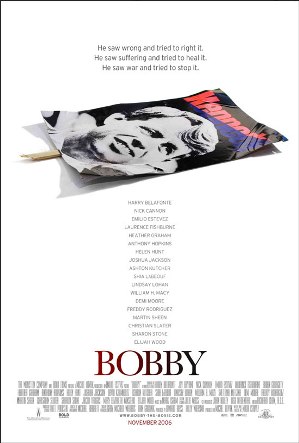
Shattered Politics #80: Bobby (dir by Emilio Estevez)


Bobby_poster

A few years ago, I was on twitter when I came across someone who had just watched The Breakfast Club.  

“Whatever happened to Emilio Estevez?” she asked.

Being the know-it-all, obsessive film fan that I am, I tweeted back, “He’s a director.”

Of course, I could not leave well enough along.  I had to send another tweet, “He directed a movie called Bobby that got nominated for bunch of Golden Globes.”

“Was it any good?” she wrote back.

“Never seen it,” I wrote back, suddenly feeling very embarrassed because, if there’s anything I hate, it’s admitting that there’s a film that I haven’t seen.

However, Shattered Politics gave me an excuse to finally sit down and watch Bobby.  So now, I can now say that I have watched this 2006 film and … eh.

Listen, I have to admit that I really hate giving a film like Bobby a lukewarm review because it’s not like Bobby is a bad film.  It really isn’t.  As a director, Emilio Estevez is a bit heavy-handed but he’s not without talent.  He’s good with actors.  Bobby actually features good performances from both Lindsay Lohan and Shia LaBeouf!  So, give Estevez that.

And Bobby is a film that Estevez spent seven years making.  It’s a film that he largely made with his own money.  Bobby is obviously a passion project for Estevez and that passion does come through.  (That’s actually one of the reasons why the film often feels so heavy-handed.)

But, with all that in mind, Bobby never really develops a strong enough narrative to make Estevez’s passion dramatically compelling.  The film takes place on the day of the 1968 Democratic California Presidential Primary.  That’s the day that Robert F. Kennedy won the primary and was then shot by Sirhan Sirhan in the kitchen of the Ambassador Hotel.  However, it never seems to know what it wants to say about Kennedy or his death, beyond the fact that Estevez seems to like him.

(Incidentally, it’s always interesting, to me, that Dallas is still expected to apologize every day for the death of JFK but Los Angeles has never had to apologize for the death of his brother.)

Estevez follows an ensemble of 22 characters as they go about their day at and around the Ambassador Hotel.  As often happens with ensemble pieces, some of these characters are more interesting than others.

For instance, Anthony Hopkins plays a courtly and retired doorman who sits in the lobby and plays chess with his friend Nelson (Harry Belafonte).  It adds little to the film’s story but both Hopkins and Belafonte appear to enjoy acting opposite each other and so, they’re fun to watch.

Lindsay Lohan plays a woman who marries a recently enlisted soldier (Elijah Wood), the hope being that his marital status will keep him out of Vietnam.  The problem with this story is that it’s so compelling that it feels unfair that it has to share space with all the other stories.

Christian Slater plays Darrell, who runs the kitchen and who spends most of the movie talking down to the kitchen staff, the majority of whom are Hispanic.  Darrell is disliked by the hotel’s manager (William H. Macy) who is cheating on his wife (Sharon Stone).

And then, you’ve got two campaign aides (Shia LaBeouf and Brian Geraghty) who end up dropping acid with a drug dealer played by Ashton Kutcher.  Unfortunately, Estevez tries to visualize their trip and it brings the film’s action to a halt.

Estevez himself shows up, playing the husband of an alcoholic singer (Demi Moore).  And Estevez’s father, Martin Sheen, gets to play a wealthy supporter of Kennedy’s.  Sheen’s wife is played by Helen Hunt.  She gets to ask her husband whether she reminds him more of Jackie or of Ethel.

(Actually, Martin Sheen and Helen Hunt are cute together.  Much as with Lohan and Wood, you wish that more time had been devoted to them and their relationship.)

And there are other stories as well.  In fact, there’s far too many stories going on in Bobby.  It may seem strange for a girl who is trying to review 94 films in three weeks to say this but Emilio Estevez really tries to cram too much into Bobby.

At the same time, too much ambition is better none.  Bobby may have been a misfire but at least it’s a respectable misfire.

Embracing the Melodrama #42: Indecent Proposal (dir by Adrian Lyne)


This one is just dumb.

First released in 1993 and something of a perennial on AMC, Indecent Proposal tells the story of David (Woody Harrelson) and Diane (Demi Moore), two kids who meet in high school, get married, and end up living what, in Hollywood, passes for an average, middle class lifestyle — which is to say, Diane is a successful real estate broker, David is an architect, and they’re in the process of building their dream house on the beach.  (Just like everyone else you know, right?)  However, the economy goes bad, David loses his job, and they find themselves deep in debt.

Desperately, they decide to take a gamble.  Literally.  They go to Las Vegas and, at first, it seems like everything’s going to be alright.  David has a run of luck and makes a lot of money.  They make so much money that David and Diane end up having sex on top of it.  Now, I have to admit, if I ever won $25,000 dollars in Vegas, I would probably spread it on a bed and roll around naked on it as well.  But only if it was paper money.  Coins would probably be uncomfortable and I’d hate to end up with a hundred little impressions of George Washington’s profile running up and down my body.

But anyway, David and Diane make the mistake of sticking around in Vegas for a second day and they end up losing all of the money that they previously won and you better believe that when the chips are pulled away, Diane is shown trying grab them in slow motion while going, “Noooooo!”  Soon, David and Diane are sitting in an all-night diner and trying to figure out what to do next.  A waitress overhears them and sadly shakes her head.  Obviously, she’s seen a lot of movies about Las Vegas.

Anyway, this movie is too dumb to waste this many words on its plot so let’s just get to the point.  David and Diane meets John Gage (Robert Redford), a millionaire who offers to give David a million dollars in exchange for having one (and only one) commitment-free night with Diane.  David and Diane agree and then spend the rest of the movie agonizing over their decision.  Eventually, this leads to Diane and David splitting up, John Gage reentering the picture and proving himself to be not such a bad guy, and David eventually buying a hippo.

It’s all really dumb.

Anyway, I was planning on making quite a few points about this set-up but, quite frankly, this film is so dumb that I’m getting annoyed just writing this review.  So, instead of breaking this all down scene-by-scene, I’m just going to point out a few things and then move on to better melodramas.

1) Every character in the movie has a scene where they eventually ask what we (the viewing audience) would do if we were in a similar situation.  “Would you have sex for a million dollars?”  Well, let’s see.  Basically, the deal seems to be that you have safe, non-kinky, missionary position sex with a millionaire who you will never have to see again after you get paid.  And you’re getting a million dollars in return.  Would I do it?  OF COURSE, I’D DO IT!  It’s a million dollars, it’s just one night, and it’s not like you’re being asked to fuck Vladimer Putin or something.  If the film wanted to create a true moral dilemma, they should have cast someone other than Robert Redford as John Gage and they should have had Gage propose something more than just one night.  If Gage had been played by an unappealing actor (or perhaps if the film were made today with Redford looking as craggly as he did in Capt. America or All Is Lost) or if it had been a million dollars for Diane to serve as a member of Gage’s harem for a year, the film would have been far different and perhaps not any better but at least all of the subsequent angst would have made sense.

2) What really annoyed me is that, after Diane returns from her night with Gage, neither she nor her husband ever cash that million dollar check.  If you’re going to agree to the stupid deal, at least take advantage of it.

3) Finally, why would you accept a check for something like that?  Did Gage write, “For letting me fuck your wife” in the memo line?  Why not get paid in cash so, at the very least, you don’t have to deal with IRS?

Seriously, this movie is just dumb.

Original Cinema Quad Poster - Movie Film Posters


8 Quickies With Lisa Marie: 13 Assassins, Bunraku, The Double Hour, Jig, Meek’s Cutoff, Of Gods and Men, One Day, and There Be Dragons


As part of my continuing effort to offer up a review of every 2011 release that I’ve seen so far this year, here’s 8 more quickie reviews of some of the films that I’ve seen over the past year.

1) 13 Assassins (dir. by Takashi Miike)

The 13 Assassins are a group of samurai who are gathered together to assassinate a sociopathic nobleman in 19th Century Japan.  As directed by Takashi Miike, this is a visually stunning film full of nonstop, brutal action and Miike powerfully contrasts the old school honor of the 13 Assassins with the soulless evil of their target. 

2) Bunraku (dir. by Guy Moshe)

There are some films that simply have to be seen to believed and Bunraku is one of those films.  In the aftermath of a global war, guns have been outlawed but this attempt at social engineering has just resulted in greater societal collapse.  Nicola (Ron Perlman) is the most powerful man on the East Coast but he lives life in paranoid seclusion and instead sends out nine assassins to enforce his will (his main assassin being Killer No. 2, played by a super stylish Kevin McKidd).  Two strangers ( a drifter played by Josh Hartnett and a samurai played by Gackt) arrive in town and, with the help of a bartender played by Woody Harrelson, they team up to destroy the nine assassins and ultimately Nicola himself.  Bunraku, which comes complete with an ominous narrator and sets that look like they belong in a Lars Von Trier film, is a glorious and fast-paced triumph of style over substance, an exciting and fun celebration of the grindhouse films of the past.  With the exception of a miscast Demi Moore (playing Perlman’s mistress), the film is very well-acted but it’s completely stolen and dominated by Kevin McKidd, who can poke me with his sword any time he wants.

3) The Double Hour (dir. by Giuseppe Capotondi)

It took The Double Hour about two years to make it over here from Italy and when it did finally play in American arthouse theaters, it really didn’t get as much attention as it deserved.  That’s a shame because the Double Hour is a pretty entertaining mystery-thriller that’s full of twists and turns and which features an excellent performance by Kseniya Rappoport as an enigmatic hotel maid.  It hasn’t been released on region 1 DVD or blu-ray yet but apparently, there’s some interest in doing an American remake which will probably suck.

4) Jig (dir. by Sue Bourne)

Jig is a documentary that follows several competitors at the 40th Irish Dancing World Championships held in Glasgow in 2010.  I always try to be honest about my personal biases and I have to admit that one reason why I absolutely loved this film is because I not only love to dance but I love Irish stepdancing in specific and, as much as I love ballet, stepdance will always hold a special place in my heart.  I’m not quite sure how to put it into words other then to say that it just makes me incredibly happy as both a participant and a  watcher.  For me, Jig captured that joy as well as showing just how much dedication and sacrifice it takes to truly become proficient at it.  This film — much like Black Swan — made me dance.

5) Meek’s Cutoff (dir. by Kelly Reichardt)

I’ll never forget going to the Cinemark West Plano and seeing Meek’s Cutoff last May.  The theater was nearly deserted except for me, Jeff, an elderly couple, and two women who were, in their appearance and manner, almost stereotypically upper middle class suburban.  As the film’s frustratingly ambiguous conclusion played out on-screen and the end credits started to roll, one of the women angrily exclaimed, “WHAT!?  Well, that won’t win any Academy Awards!”  In many ways, Meek’s Cutoff is a frustrating film.  Based on a true story, it follows a group of 19th century settlers as they try to cross the Oregon Trail while following a guide (Bruce Greenwood) who might be totally incompetent.  Plotwise, not much happens: the settlers kidnap an Indian and demand that he lead them to water, Michelle Williams plays a settler who doubts that any of the men in the party know what they’re doing, and everyone continues to keep moving in search of … something.  The film is, at times, really frustrating and I think it’s been overrated by most critics but, at the same time, it remains an oddly fascinating meditation on life and fate.  Add to that, both Greenwood and Williams give good performances and the film’s cinematography is hauntingly beautiful and desolate at the same time.

6) Of Gods and Men(dir. by Xavier Beauvois)

Of Gods and Men is a quietly powerful and visually stunning French film that’s based on the true story of 7 Trappist monks who were kidnapped from their monastery and murdered by muslim rebels during the Algerian Civil War.  The film imagines the final days of the monks and attempts to answer the question of why they didn’t flee their monastery when they had the opportunity to do so, but instead remained and chose to accept their fate as martyrs.  This meditative film also features excellent performances from Lambert Wilson and Michael Lonsdale and avoids the trap of both easy idealization and easy villainy. 

7) One Day (dir. by Lone Scherfig)

This is another one of those films that was dismissed by almost every critic except for Roger Ebert and you know what?  For once, I’m going to agree with Roger.  I absolutely loved One Day and I think that all the haters out there need to take a chance on romance and stop coasting on the easy cynicism.  One Day follows the love affair of a writer (Anne Hathaway) and a TV personality (Jim Sturgess), visiting them repeatedly on the same day over the course of 20 years.  The film starts with them as college students having a wonderfully awkward one night stand and it ends with Sturgess and their son walking up a beautiful green hill and it made me cry and cry.  Hathaway and Sturgess have a wonderful chemistry together and the film also features some good supporting performances from Patricia Clarkson (as Sturgess’ dying mother) and Rafe Spall (bringing humanity to the thankless role of being the “other guy.”) This is one of the most deliriously romantic films that I’ve ever seen and I loved it.  So there.

8 ) There Be Dragons (dir. by Roland Joffe)

There Be Dragons came out in May and it didn’t get much respect from the critics.  I’ve also read that it was considered to be a box office failure, which is odd because I seem to remember that it was actually in theaters for quite some time.  Anyway, There Be Dragons is an oddly old-fashioned war epic that attempts to mix the fictional story of a Spanish revolutionary (played by Wes Bentley) with an admiring biopic of the founder of Orpus Dei, St. Josemarie Escriva (played by Charlie Cox).  The two stories never really seem mix and instead, they just coexist uncomfortably beside each other.  It doesn’t help that Wes Bentley gives one of the worst performance of 2011.  On the plus side, Charlie Cox gives a good and believable performance as Escriva and the film looks great.  The film is so sincere in its desire to make the world a better place that its hard not to regret that it doesn’t succeed.