13 For 13: Cellar Dwellar (dir by John Carl Buechler)


1987’s Cellar Dweller opens with Jeffrey Combs playing an artist.

Sitting in his art studio (located in the cellar of his home), Combs draws a picture of a monster and he adds a few Lovecraftian occult symbols and — uh oh! — the monster comes to life and start to destroy everything that Combs holds dear.  Combs discovers that he can stop the monster by setting his drawings on fire but, in the process, Combs also destroys himself.

This ten minute prologue features Jeffrey Combs at his best, bringing his neurotic Re-Animator energy to the role of the artist who discovers just how dangerous an active imagination can be.  One reason why Combs is a horror icon is that he can win your sympathy even while playing a character who does some objectively stupid and terrible things.  Unfortunately, once the prologue is over, so is Jeffrey Combs’s role in the film.  He may be first-billed but he doesn’t appear after the opening credits.

The film jumps forward to 1987.  Cartoonist Whitney Taylor (Debrah Farentino) is the latest artist to take residence at Mrs. Briggs’s Institute For The Arts, which just happens to be in the same house that was once home to Jeffrey Combs’s artist.  Mrs. Briggs (Yvonne DeCarlo) is a noted critic of modern art.  In fact, Whitney and Mrs. Briggs disagree so vehemently about art that you really do wonder why Whitney would apply to the Institute in the first place.

There’s a few artists at the Institute.  Norman (Vince Edwards) is a tough guy writer.  Philip (Brian Robbins) is a bad boy artist.  Amanda (Pamela Bellwood) is a former rival of Whitney’s and the two still hate each other.  (Whitney seems to rub a lot of people the wrong way.)  Best of all, there’s a performance artist named …. LISA!
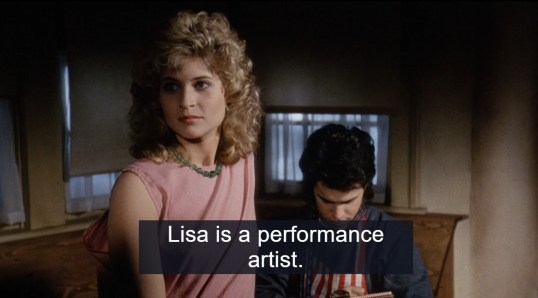
Lisa is played by Miranda Wilson.

Frustrated with Amanda, Whitney gives into her worst instincts and draws a cartoon the features a monster killing her rival.  Uh-oh.  Soon, the monster has reemerged from the cellar and Amanda has disappeared.  One-by-one, the other residents are picked off and their deaths appear in Whitney’s cartoons.  The monster claims that he dwells wherever there is imagination but Whitney is convinced she’s figure out a way to destroy him and bring everyone back.  Has she?  You’ll have to watch the film to find out!

Produced by Charles Band’s Empire Pictures, Cellar Dweller is an enjoyably macabre little tale.  It’s only 77 minutes long and the fast pace makes the film feel like an extended episode of a horror anthology series.  The monster and the plot feel like they could have been lifted from a 50s horror comic and the other artist are all memorably eccentric.  The cast appears to be having a ball.  It’s a fun treat for horror fans like you and me.

Cellar Dweller was directed by special effects specialist John Carl Buechler and he does a good job with the monster.  It’s both intimidating and kind of goofy at the same time.  A year after Cellar Dweller, Buechler directed his best known film, Friday the 13th Part VII — The New Blood.  That film too was likably goofy.
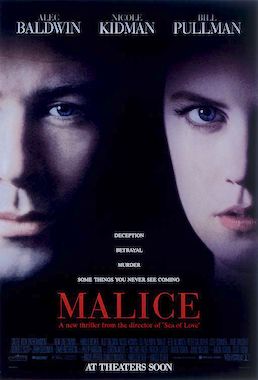
Insomnia File #48: Malice (dir by Harold Becker)


What’s an Insomnia File? You know how some times you just can’t get any sleep and, at about three in the morning, you’ll find yourself watching whatever you can find on cable or Netflix? This feature is all about those insomnia-inspired discoveries!

If you were having trouble getting to sleep last night around 12 midnight, you could have turned over to the Cinemax and watched the 1993 thriller, Malice.  And then you could have spent the next few hours trying to figure out what you just watched.

Seriously, there’s a lot going on in Malice.  The screenplay is credited to Aaron Sorkin and Scott Frank and while it has enough overly arch dialogue and untrustworthy women to plainly identify it as being a product of Sorkin’s imagination, it’s also filled with a mini-series worth of incidents and subplots and random characters.  This is also one of those films where no one can simply answer a question with a “yes” or a “no.”  Instead, it’s one of those movies where everyone gets a monologue, giving the proceedings a rather theatrical feel.  It’s the type of thing that David Mamet could have pulled off.  (Check out The Spanish Prisoner for proof.)  Harold Becker, however, was a far more conventionally-minded director and he often seems to be at a loss with what to do with all of the film’s Sorkinisms (and, to be fair, Frankisms as well).

The film starts out as a thriller, with a serial rapist stalking a college campus and Prof. Andy Safian (Bill Pullman) becoming an unlikely suspect.  Then it turns into a domestic drama as Andy and his wife, Tracy (Nicole Kidman), talk about starting a family.  Then Andy meets a brilliant surgeon named Jed Hill (Alec Baldwin) and the film turns into a roommate from Hell story after Jed moves in with them.  Then it becomes a medical drama after a mistake by Dr. Hill leaves Tracy unable to have children.  Then it returns briefly to the campus rapist story before then turning into a modern-day noir as Andy discovers that Tracy has secrets of her own.  (Whenever one watches a film written by Aaron Sorkin, you can practically hear him whispering, “Women are not to be trusted….” in the background.)  Even as you try to keep up with the plot, you find yourself distracted by all of the cameos.   George C. Scott glowers as Jed’s mentor.  Anne Bancroft acts the Hell out of her role as a drunken con artist.  Peter Gallagher is the lawyer you distrust because he’s Peter Gallagher.  Tobin Bell shows up as a handyman.  Gwynneth Paltrow, in one of her first roles, plays dead convincingly

It’s a big and busy and messy film and it too often mistakes being complicated for being clever.  Bill Pullman is a likable hero but you have to be willing to overlook that the script requires him to do some truly stupid things.  Nicole Kidman is always well-cast as a femme fatale but again, the script often lets her down.

Surprisingly enough, it’s Alec Baldwin who comes out of the film unscathed.  Watching Baldwin in this film, it’s hard to believe that he’s the same actor who has since become something of a bloated self-parody.  Yes, he’s playing an arrogant character (which is pretty much his trademark) but, in Malice, he actually brings a hint of subtlety and wit to his performance.  Baldwin does very little bellowing in the film, despite playing a role that one would think would naturally appeal to all of his bellowing instincts.  Malice is a mess but it’s nice to see the type of actor that Alec Baldwin once was.

Previous Insomnia Files:

  1. Story of Mankind
  2. Stag
  3. Love Is A Gun
  4. Nina Takes A Lover
  5. Black Ice
  6. Frogs For Snakes
  7. Fair Game
  8. From The Hip
  9. Born Killers
  10. Eye For An Eye
  11. Summer Catch
  12. Beyond the Law
  13. Spring Broke
  14. Promise
  15. George Wallace
  16. Kill The Messenger
  17. The Suburbans
  18. Only The Strong
  19. Great Expectations
  20. Casual Sex?
  21. Truth
  22. Insomina
  23. Death Do Us Part
  24. A Star is Born
  25. The Winning Season
  26. Rabbit Run
  27. Remember My Name
  28. The Arrangement
  29. Day of the Animals
  30. Still of The Night
  31. Arsenal
  32. Smooth Talk
  33. The Comedian
  34. The Minus Man
  35. Donnie Brasco
  36. Punchline
  37. Evita
  38. Six: The Mark Unleashed
  39. Disclosure
  40. The Spanish Prisoner
  41. Elektra
  42. Revenge
  43. Legend
  44. Cat Run
  45. The Pyramid
  46. Enter the Ninja
  47. Downhill