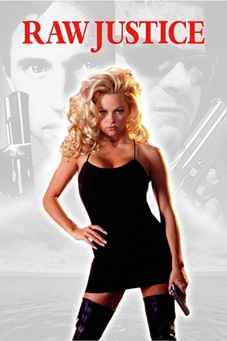
When his daughter is strangled, New Orleans Mayor David Stiles (Charles Napier) hires ex-cop-turned-bounty-hunter Mace (David Keith) to keep an eye on the main suspect, Mitch McCullum (Robert Hays). What the mayor doesn’t know is that his daughter’s murder was ordered by Deputy Mayor Jenkins (Stacy Keach) and now, both Mace and Mitch are being stalked by a crooked cop named Atkins (Leo Rossi). Also getting involved in this mess is a hooker with a heart of gold named Sarah (Pamela Anderson), who is angry because Mace earlier stole his clothes while trying to get the jump on a bail jumper. Sarah and Mitch soon fall in love. Mace is good with a gun and Mitch turns out to know karate (because he watched a lot of Bruce Lee movies growing up) but the film’s high point is when one of the bad guys is taken out with a giant novelty dart.
The plot is dumb and David Keith comes across as being a discount version of Patrick Swayze but this film does give the always likable Robert Hays a good role and fans of Pamela Anderson (and you know who you are) will definitely appreciate at least two scenes in the movie. Actually, Pamela Anderson isn’t bad in Raw Justice. She’s mostly there for her looks but she still has a likable and energetic screen presence. Otherwise, this is a typical low-rent David Prior production, complete with action scenes featuring guns that never run out of bullets (unless it’s convenient for the plot) and a score that is pretty much the same guitar riff over and over again. It’s not exactly good but it is entertaining if you’re in the right mood.
This film was also released under the title Good Cop Bad Cop, which doesn’t make much sense because neither Keith nor Hays is playing a cop.
When I was a kid, I loved the movie KING SOLOMON’S MINES (1985) with Richard Chamberlain and Sharon Stone, along with its follow up ALLAN QUARTERMAIN AND THE LOST CITY OF GOLD (1986). These movies don’t really hold up very well these days, but that does not change the fact that they still hold a special place in my heart. That was during my “Indiana Jones” phase and I wanted to watch any movie with adventurers in jungles. ROMANCING THE STONE (1984) is one of those types of movies that really does hold up; THE FURTHER ADVENTURES OF TENNESSEE BUCK (1988), not so much. While we were watching King Solomon’s Mines, I remember my parents telling us kids that Chamberlain was in a miniseries called THE THORNBIRDS, but I’ve never watched it. It intrigued me though. TV miniseries were a big thing in the 70’s and early 80’s and Chamberlain was a king of the TV miniseries age. I discovered that even further when I became obsessed with Toshiro Mifune. I discovered his great miniseries SHOGUN (1980) that also starred Chamberlain.
As an obsessed Charles Bronson fan, I also discovered that they starred together in an episode of the TV series DR. KILDARE (pictured above). He also worked with Bronson in the film A THUNDER OF DRUMS (1961). Richard Chamberlain may not be one of my all time favorite actors, but he was a part of my life growing up and he worked with my favorite actor of all time a couple of different times. That feeling of nostalgia causes me to mourn his loss. It’s like a part of me is now gone. RIP, Richard Chamberlain. Thanks for sharing your talent with us.
Just for the hell of it, I went on a little Robert Duvall marathon for his birthday on January 5th. I started the marathon off with his superior western with Kevin Costner, OPEN RANGE (2003). Next up was Duvall’s excellent crime film with Joe Don Baker and Robert Ryan, THE OUTFIT (1973). Duvall was in badass mode in this one. Based on one of Richard Stark’s “Parker” books, this was my first time to watch the film and damn, it was excellent. After that, I watched the bleak THE ROAD (2009), starring Viggo Mortensen, where Duvall just had a small part. It was a downer. I finished off the marathon late in the evening with A FAMILY THING (1996). I remember when this movie came out in the 1990’s because it was co-written by Billy Bob Thornton. Thornton was still a year away from his massive success with the movie SLING BLADE, but I knew him from his writing and co-starring in the superior crime film ONE FALSE MOVE (1991), as well as his small role in TOMBSTONE (1993). As an Arkansan, I knew Thornton was from Arkansas so I had taken a particular interest in him. But I was only 22 years old when A FAMILY THING was released, and a movie about a couple of old guys resolving family issues didn’t seem that appealing to me. As a guy into his 50’s, the entire concept seems more interesting to me now, so I gave it a spin for the first time to close out the marathon.
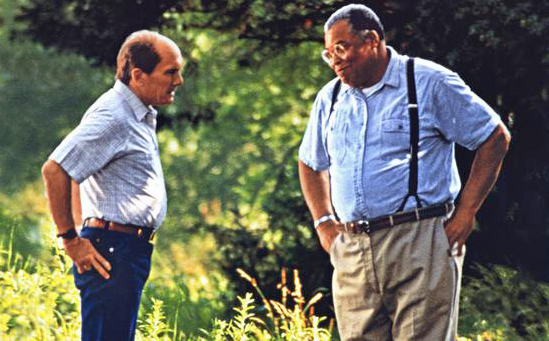
The story opens up in rural Arkansas with Earl Pilcher Jr. (Robert Duvall) getting the shock of his life when his beloved mother writes a final letter to him and instructs her local pastor to deliver it a few days after her death. The letter tells Earl that his biological mother was a black woman named Willa Mae who died in childbirth. It seems that Earl’s dad had gotten Willa Mae pregnant, and since he came out white, his “mother” was able to raise him as her own without having to tell him the truth. The letter also tells him that he has a half-brother named Ray Murdock (James Earl Jones) living in Chicago. It’s her dying wish that he meet Ray and get to know him as family. Pissed at his dad, and wanting to honor his mom, Earl heads to Chicago to meet Ray. Earl knows that Ray is a cop so he’s able to track him down. They immediately don’t like each other, but through a variety of circumstances, Earl ends up staying at Ray’s house for a couple of days. While there, he meets Ray’s wise, old Aunt T., Willa Mae’s sister (Irma P. Hall) and his sullen son Virgil (Michael Beach). Will the two men continue to push each other away, or will they eventually find the family connection that exists under all that messy past?
I was surprised how deeply I was affected by A FAMILY THING. I’d be lying if I said I didn’t get teary-eyed a couple of times. The movie may use issues of adultery and racism to get the ball rolling, but more than anything else, it seems to understand that life is messy and that people are messy. We’ll disappoint ourselves, we’ll disappoint other people, and other people will disappoint us. There’s a reason that many people find their love in dogs and cats instead of people, because real relationships can be tough. The truth about my own life is that I could not have appreciated this film in 1996 at only 22 years of age. I was too naive. That’s no longer the case in 2025, and I can now truly relate to this story of two men who share a painful history, find common ground, and decide it’s worth moving forward together because family really does matter.
A movie like A FAMILY THING has no chance of working without a great cast, and this movie is a thespian jackpot. Robert Duvall is spot on perfect as the good ole guy from Arkansas, with a little bit of a racism engrained down deep into his soul, who now has to deal with the fact that he is half black. The scene where he confronts his dad about the lies that had been told to him all his life is as good as it gets. James Earl Jones matches Duvall in the even trickier role as the man who has always known about his “white” half brother Earl. This man has buried his hatred away for Earl’s father for decades, who he blames for the death of his own mother, and now has to deal with those feelings being dredged back up to the surface when Earl shows up in Chicago. Jones perfectly balances his character’s desire to keep the past in the past, with his decency as a man who doesn’t want to just throw Earl out on the street. He eventually softens towards him no matter how much bitterness he has for Earl’s dad. And neither Duvall or Jones even give the best performance in the film. That honor goes to Irma P. Hall as the blind, but extremely perceptive Aunt T. She sees through all of their bullshit, as she states to each of them on different occasions, and encourages them to get to know each other because they’re family. As they play games of racism and bitterness, she reminds them they are brothers no matter the color of their skin. It’s the performance of a lifetime and was at least worthy of an Oscar nomination in my opinion.
Overall, A FAMILY THING may compress the amount of time and potential therapy it would take to resolve the type of family history presented here, but it does find a certain truth in the power of relationships. Earl and Ray don’t have to recognize the fact that they are brothers. As a matter of fact their lives are just fine without each other. But it’s their willingness to embrace the messy truth and find a way to connect with each other that makes the movie meaningful to me!
Almost everyone knows that one scene from the 1982 film, An Officer and a Gentleman. You can probably guess which scene it is that I’m talking about. It’s been parodied and imitated in so many other shows and movies that it’s one of those pop cultural moments that everyone has “seen” even they haven’t actually watched it. It’s the scene where….
I AIN’T GOT NOWHERE ELSE TO GO!
What?
I AIN’T GOT NOWHERE ELSE TO GO!
I know, Mayo, I’m getting to that! Let me tell everyone about the iconic factory scene first, okay?
I AIN’T GOT NOWHERE ELSE TO GO!
Uhmmm …. right. Where was I? Oh yeah, it’s the scene where Debra Winger is working in a factory and a youngish Richard Gere suddenly shows up and he’s wearing a white uniform and he picks her up and carries her out of the factory while all of her coworkers cheer. Meanwhile, that Up Where We Belong song starts to play on the soundtrack. Even though, up until recently, I had never actually sat down and watched An Officer and a Gentleman, I certainly knew that scene.
Last Friday, I noticed that I had An Officer and a Gentleman saved on the DVR and I thought to myself, “Well, I might as well go ahead and watch it and find out what else happens in the movie.” Add to that, I only had three hours of recording space left on the DVR so I figured I could watch the movie and then delete it and free up some space….
I AIN’T GOT NOWHERE ELSE TO GO!
Goddammit, Mayo, be quiet! I’m getting to it!
Anyway, I watched the film and I discovered that it’s actually about a lot more than just Richard Gere getting Debra Winger fired from her job at the factory. It’s also about how Zack Mayo (the character played by Richard Gere) hopes to make something of himself by graduating from Aviation Officer Candidate School so that he can become not only a Navy pilot but also an officer and a gentleman. His father (Robert Loggia) is an alcoholic, his mother committed suicide when Mayo was a child and Mayo …. well, I’ll let him tell you himself.
I AIN’T GOT NOWHERE ELSE TO GO!
That’s right. Mayo has not got anywhere else to go.
I AIN’T GOT NOWHERE ELSE TO GO!
Ain’t is not a word, Mayo.
As you may have already guessed, we know that Mayo doesn’t have anywhere else to go because there’s a scene where he continually yells, “I ain’t got nowhere else to go!” over and over again. He yells it after being forced to do a thousand push-ups and sit-ups by his drill sergeant, Foley (Louis Gossett, Jr.) Foley thinks that Mayo doesn’t have the right attitude to be either an officer or a gentleman. Mayo is determined to prove him wrong.
I AIN’T GOT–
Oh give it a rest, Mayo!
Debra Winger plays Paula. Paula is a townie. She lives in a dilapidated house with her parents. Her friend, Lynette (Lisa Blount), dreams of marrying a Naval officer and getting to travel the world. Lynette gets involved with Mayo’s friend, Sid Worley (David Keith). Foley warns both Sid and Mayo to stay away from the townie girls because they’re not to be trusted. That turns out to be true in Lynette’s case but Paula’s love provides Mayo with the strength that he needs to believe in something more than just himself.
I AIN’T–
Yes, you do have some place to go, Mayo! That’s the point of the whole goddamn movie!
Anyway, watching An Officer and a Gentleman, I was kind of surprised to discover that it’s actually two movies in one. It’s a traditional army training film, one in which Richard Gere is whipped into shape by a tough drill sergeant. It’s also a film about life in an economically depressed small town, where the only hope of escape comes from marrying the right aviation officer candidate. As a military film it’s predictable if occasionally effective. As a film about small town life, it’s surprisingly poignant. An Officer And A Gentleman doesn’t pull any punches when it comes to depicting just how little life in the town has to offer to people like Paula and Lynette. They have spent their entire lives being told they can either work in a factory for minimum wage and get drunk on the weekend or they can land a man who will hopefully take them away from all that and give them something more to look forward to than cirrhosis of the liver. Lynette has accepted that as being her only option. While Paula dreams of escape, she dreams of escaping on her terms. She may fall in love with Mayo but she’s not going to pretend to be someone that she’s not just to keep him around.
Though he’s evolved into a good character actor, Richard Gere was remarkably blank-faced when he was younger and his performance as Mayo alternates between being bland and shrill. However, Debra Winger brings a welcome edge to her role. She plays Paula as someone who knows she’s stuck in a dead end existence. She’s not happy about it but, at the same time, she’s not going to surrender her principles in order to escape. She holds onto her ideals, even though she appears to be stuck in a crappy situation and that’s something that Mayo learns from her. In the end, Paula saves Mayo just as surely as the Navy does. And, just as Paula saves Mayo, Winger saves the movie.
I AIN’T GOT NOWHERE ELSE TO GO!
Oh, shut the Hell up, Mayo. Go pick up Paula and carry her off to a better life….
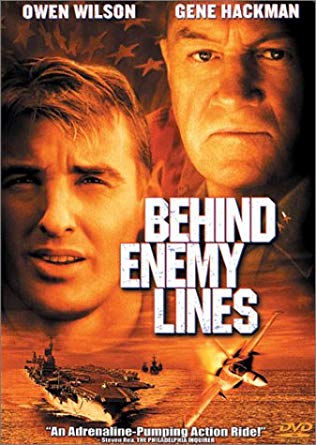
When hotshot Navy flight officer Chis Burnett (Owen Wilson) is shot down while doing a reconnaissance mission over Bosnia, he finds himself stranded behind enemy lines. While Burnett tries to avoid being captured by a Serbian general and find evidence of illegal military operations in yje demilitarized zone, Admiral Leslie Reigart (Gene Hackman) tries to mount a rescue operation. Standing in his way are the NATO bureaucrats who would rather just leave Burnett to his fate than run the risk of disrupting the peace process.
Behind Enemy Lines was released early in Owen Wilson’s acting career and, after years of watching him in buddy comedies and eccentric character roles, it can be strange to see him playing a traditional leading man, much less an action hero. Burnett has his goofball moment but, for the most part, this is probably as dramatic a role as you’re ever going to see Owen Wilson perform. Once you get over the fact that he’s Owen Wilson and still speaking in the same stoner cadences that he’s used in everything from Bottle Rocket to Inherent Vice, Wilson actually gives a decent performance as Burnett. The fact that he’s not a traditional leading man actually makes the film’s action scenes more exciting. If Burnett had been played by someone like Brad Pitt or Tom Cruise, you would never have any doubt about his survival. With Owen Wilson in the role, you’re no longer quite as sure that he’s going to be able to make his way to safety.
Gene Hackman also gave a good performance, even if he didn’t really do anything with the role that he hadn’t already done with all of the other authority figures that he played from Unforgiven on. Hackman’s intimidating as Reigart. When Burnett says that he wants to retire from the Air Force, Reigart looks like he’s about to reach over and rip off his face. But Hackman has so much natural authority that you understand why his men automatically respect Reigart and follow his every order. Burnett is lucky to have him on his side because there’s no way Reigart’s going to let someone from NATO push him around.
When Behind Enemy Lines first came out, it was not loved by the critics. They complained that the movie was heavy-handed and predictable. They were right but it really didn’t matter. Behind Enemy Lines made a lot of money because it was a legitimate crowd pleaser. I remember seeing it when it first came out. This was less than month after 9-11 and the theater was packed with people who, like me, were still dealing with the greatest national trauma of our lifetime. When Owen Wilson killed the men who were trying to kill him, the audience cheered. When Reigart said that there was no way he going to abandon an American behind enemy lines, the audience applauded. By the time the film ended, everyone was on their feet and chanting “USA! USA!” (At least, that’s the way I remembered it.) Critics be damned, at that time, Behind Enemy Lines was the movie that we needed.
Behind Enemy Lines was a huge box office success so, of course, it got a sequel that wasn’t as good. I’ll review Behind Enemy Lines: Axis of Evil tomorrow.
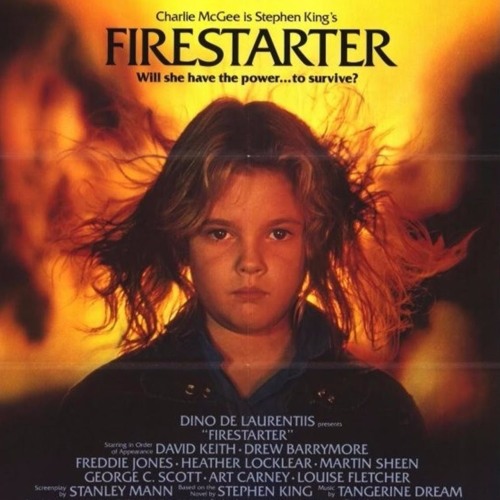
Adapted from Stephen King novel, 1984’s Firestarter is a film about a girl with a very special power.
Back in the day, a bunch of college students needed weed money so they took part in a government experiment. Half of them were told that they were being given a placebo. The other half were told that we would be given a low-grade hallucinogen.
Surprise! The government lied! It turns out that everyone was given the experimental drug! Some of the students ended up going crazy. One unfortunate hippie clawed his eyes out. Meanwhile, Vicky (Heather Locklear) gained the ability to read minds. She also fell in love with Andy McGee (David Keith), a goofy fellow who gained the ability to mentally control people’s actions. They married and had a daughter named Charlie (played by a very young Drew Barrymore). Charlie, it turns out, can set things on fire! She’s a firestarter!
Well, of course, the government can’t just leave the McGees out there, controlling minds and setting things on fire. Soon, the McGees are being pursued by the standard collection of men in dark suits. Vicky is killed off-screen, leaving Charlie and Andy to try to find some place where they’ll be safe.
Good luck with that! This is the government that we’re talking about. The thing with films like this is that the government can do practically anything but it never occurs to them to not all dress in dark suits. I mean, it just seems like it would be easier for all of these secret agents to operate if they weren’t automatically identifiable as being secret agents. Anyway, Andy and Charlie are eventually captured and taken to The Farm, a really nice country estate where Andy and Charlie are kept separate from each other and everyone keeps talking about national security.
Running the Farm is Capt. Hollister and we know that he’s a bad guy because he wears a suit and he’s played by Martin Sheen. Working with Hollister is John Rainbird (George C. Scott), a CIA assassin who kills people with a karate chop across the nose. When Charlie refuses to show off her firemaking abilities unless she’s allowed to talk to her father, Rainbird disguises himself as a custodial engineer and proceeds to befriend Charlie. Of course, Rainbird’s plan is to kill Charlie once she’s displayed the extent of her powers….
Stephen King has written that he considers this film to be one of the worst adaptations of one of his novels but, to be honest, I think the movie is actually a bit of an improvement on the source material. Firestarter is probably the least interesting of Stephen King’s early novels. Supposedly, Charlie was based on King’s youngest daughter and, reading the book, it’s obvious that everyone’s fear of Charlie is mostly a metaphor for a father trying to figure out how to raise a daughter. Unfortunately, instead of concentrating on those primal fears, the book gets bogged down in boomer paranoia about MK-ULTRA experiments.
The movie, however, is just silly enough to be kind of charming. For example, consider the way that Andy grabs his forehead and bugs out his eyes whenever he uses his powers. Andy’s powers may be slowly killing him but he just looks so goofy whenever he uses them that you just can’t help but be entertained. And then you’ve got Drew Barrymore sobbing while setting people on fire and George C. Scott growling through all of his dialogue and even Martin Sheen gets a scene where he gets excited and starts jumping up and down. (And don’t even get me started on Art Carney and Louise Fletcher as the salt-of-the-Earth farmers who try to protect Andy and Charlie….) Some of the special effects are a bit hokey, as you might expect from a film made in 1984 but occasionally, there’s a good shot of something (or someone) burning up. It’s all so over-the-top and relentlessly dumb that you can’t help but be entertained. You can even forgive the fact that basically nothing happens between the first 10 and the last 15 minutes of the movie.
Originally from a small town in Iowa, Frank Macklin (Robert Hays) is a hotshot young executive with The Ellison Group. When Frank is assigned to manage and revitalize a failing brewery in his hometown, it is a chance for Frank to rediscover his roots. His childhood friends (played by actors like David Keith, Tim Thomerson, and Art Carney) may no longer trust him now that Frank wears a tie but it only takes a few monster truck rallies and a football game in a bar for Frank to show that he is still one of them. However, Frank discovers that the only reason that he was sent to make the brewery profitable was so that his bosses could sell it to a buffoonish millionaire who doesn’t know the first thing about how to run a business. Will Frank stand by while his bosses screw over the hardworking men and women of the heartland? Or will he say, “You can take this job and shove it?”
Named after a country music song and taking place almost entirely in places stocked with beer, Take This Job And Shove It is a celebration of all things redneck. This movie is so redneck in nature that a major subplot involves monster trucks. Bigfoot, one of the first monster trucks, gets plenty of screen time and, in some advertisements, was given higher billing than Art Carney.
A mix of low comedy and sentimental drama, Take This Job And Shove It is better than it sounds. In some ways, it is a prescient movie: the working class frustrations and the anger at being forgotten in a “booming economy” is the same anger that, 35 years later, would be on display during the election of 2016. Take This Job And Shove It also has an interesting and talented cast, most of whom rise above the thinly written dialogue. Along with Hays, Keith, Thomerson, Bigfoot, and Carney, keep an eye out for: Eddie Albert, Royal Dano, James Karen, Penelope Milford, Virgil Frye, George “Goober” Lindsey, and Barbara Hershey (who, as usual, is a hundred times better than the material she has to work with).
One final note: Martin Mull plays Hays’s corporate rival. His character is named Dick Ebersol. Was that meant to be an inside joke at the expense of the real Dick Ebersol, who has the executive producer of Saturday Night Live when Take This Job and Shove It was filmed and who later became the president of NBC Sports?
This slice of rural horror is based on H.P. Lovecraft’s The Colour From Outer Space and, somewhat oddly, it was produced by Lucio Fulci. The Curse, in this case, is a meteorite the lands near a farm and poisons all the crops. Mayhem follows.
Seriously, country livin’ sucks. That’s why I’m glad to live in the suburbs, away from all the aliens and the poisoned meteorites.
All Souls Day was part of the wave of zombie films that continues to flood the direct-to-video (and at times straight to cable) market. This particular zombie movie was written by Mark A. Altman who also wrote the campy and very B-movie-like House of the Dead 2. This was a zombie flick which actually improved on Uwe Boll’s own House of the Dead that doesn’t really come as a surprise. All Souls Day was Altman’s second try at another zombie movie and while this second attempt wasn’t as fun as his previous one it still managed to be a watchable and interesting zombie movie.
The film’s set in a dusty Mexican town that hides a dark secret from its past. A young couple (played by Marisa Ramirez and Travis Wester) happen upon what seems like an abandoned town. They soon come across a funeral procession and when they inadvertently interrupt the ritual all hell literally breaks loose. It doesn’t help the couple that the only person who seems to be real in this town was the sheriff whose own past ties in with the secret of the town. It was very good to see genre veteran David Keith in the role of the town sheriff. His limited time in the movie was pretty good.
When the town’s people (who by now have shown themselves to be zombies) begin to lay siege on the young couple in the town’s only hotel the rest of the movie gradually shows more of what made this particular Mexican town a death trap for any passerby who happen to come across it on All Souls Day. Soon enough help comes in the form of the young couple’s two friends who arrive in town only to get themselves stuck in the same dire situation the original couple find themselves in.
The resolution of the movie was handled well and it brought a nice supernatural origin and reason as to why the town’s population has turned into flesh-eating zombies. The performances in the film could be seen as being mixed. The more veteran performers like Jeffrey Combs, David Keith, Danny Trejo (as the town’s manipulative patriarch) and Laura Herring perform their roles well without being too over-the-top. The actors playing the pair of young couples on the other hand go from very good to awful in the span of moments in some of the scenes. It’s really this mixed bag in the cast’s performance which keeps All Souls Day from turning into one of those hidden gems in a hill of crap that most zombie flicks turn out to be.
The gore effects in this film was pretty good in the small amount of sequences where the zombies end up doing what they do best once they get a hold of someone. While I was hoping for more of the grue in this particular zombie movie I wasn’t too surprised why it didn’t have more. Other than the pair of young couple there really wasn’t much living people for these zombies to munch on. The film itself show’s it’s low-budget origins in that it looks like something one would see premiere on a random Saturday night on the SyFy Channel. The film actually did premiere on that channel when it was still called SciFi. It’s a look that says TV instead of film, but despite that little nitpick it doesn’t distract much from the experience.
Now, most zombie films of the low-budget variety tend to just have badly done make-up effects. With All Souls Day the filmmakers seem to have done an end-around that budgetary problem by taking a page out of the classic Italian zombie flicks of the 1980’s by making these undead dry, decayed creatures. It’s something that worked well for the Fulci zombies and here it works as well.
All Souls Day was not a great zombie film by any stretch of the imagination, but it had enough entertaining moments and some genuine scary sequences to make it an enjoyable hour and a half of horror viewing on any October night.
 When his daughter is strangled, New Orleans Mayor David Stiles (Charles Napier) hires ex-cop-turned-bounty-hunter Mace (David Keith) to keep an eye on the main suspect, Mitch McCullum (Robert Hays). What the mayor doesn’t know is that his daughter’s murder was ordered by Deputy Mayor Jenkins (Stacy Keach) and now, both Mace and Mitch are being stalked by a crooked cop named Atkins (Leo Rossi). Also getting involved in this mess is a hooker with a heart of gold named Sarah (Pamela Anderson), who is angry because Mace earlier stole his clothes while trying to get the jump on a bail jumper. Sarah and Mitch soon fall in love. Mace is good with a gun and Mitch turns out to know karate (because he watched a lot of Bruce Lee movies growing up) but the film’s high point is when one of the bad guys is taken out with a giant novelty dart.


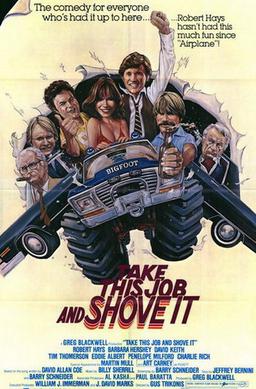 Originally from a small town in Iowa, Frank Macklin (Robert Hays) is a hotshot young executive with The Ellison Group. When Frank is assigned to manage and revitalize a failing brewery in his hometown, it is a chance for Frank to rediscover his roots. His childhood friends (played by actors like David Keith, Tim Thomerson, and Art Carney) may no longer trust him now that Frank wears a tie but it only takes a few monster truck rallies and a football game in a bar for Frank to show that he is still one of them. However, Frank discovers that the only reason that he was sent to make the brewery profitable was so that his bosses could sell it to a buffoonish millionaire who doesn’t know the first thing about how to run a business. Will Frank stand by while his bosses screw over the hardworking men and women of the heartland? Or will he say, “You can take this job and shove it?”
 Through the Shattered Lens