A Movie A Day #191: Blue City (1986, directed by Michelle Manning)


Billy Turner (Judd Nelson) has always been the bad boy but now he just wants to return to his Florida hometown and reconnect with his estranged father.  As soon as he rolls into town, Billy gets into a bar brawl and is arrested.  The chief of police (Paul Winfield) informs Billy that his father has been murdered and that his stepmother has since married the local gangster, Perry Kerch (Scott Wilson).  Everyone knows that Perry murdered Billy’s father but no one can prove it.  He is told to get out-of-town but Billy’s not going out like that.  Instead, he gets together with his childhood friends, gimpy legged Joey (David Caruso) and Annie (Ally Sheedy), and seeks his revenge.

No, it’s not a picture of Judd Nelson hanging out with the a member of the Heaven’s Gate cult.  It’s the DVD cover for Blue City.

An infamous flop, Blue City was meant to show that the members of the infamous Brat Pack could play serious, adult roles.  Unfortunately, Blue City was released right at a time when everyone was starting to get sick of the Brat Pack.  (Even John Hughes had moved on, casting Matthew Broderick as Ferris Bueller, instead of Anthony Michael Hall.)  After countless magazine covers and the monster success of The Breakfast Club and St. Elmo’s Fire, a backlash was brewing and Blue City walked (or, in Joey’s case, limped) straight into it.

It also did not help the film’s prospects that it matched up the least interesting Brat Packer, Judd Nelson, with the member of the Brat Pack most likely to take herself too seriously, Ally Sheedy.  Playing roles that would have been played by Alan Ladd an Veronica Lake in the 40s, both Nelson and Sheedy are miscast and, strangely considering this was their third film together, have no chemistry.  Nelson, in particular, gives one of the most annoying performances in film history.  He never stops smirking, even when there is no reason for Billy Turner to be smirking.  With his wide-eyed stare and his attempts to speak like a tough guy, Nelson comes across like John Bender auditioning for West Side Story.  The scene where he manages to floor Tiny Lister with one punch is simply beyond belief.

When Judd Nelson can beat you up, there is only one thing left to do:

Thanks, Duke.

On a more positive note, David Caruso, long before he could usher in the Who by simply putting on his sunglasses, is better cast as Joey but there is nothing surprising about what eventually happens to him.  The best performance is from Scott Wilson, showing why he used to always play villains before reinventing himself as Herschel on The Walking Dead.  Wilson was so good that I realized, halfway through Blue City, that I actually would not have minded if he succeeded in killing Billy.

The most disappointing thing about Blue City is that it is a Florida noir from the 80s that somehow does not feature even a cameo appearance by Burt Reynolds.  Couldn’t Judd have taken just a few seconds during the filming of Shattered: If Your Kid’s On Drugs to convince Burt to drop by Blue City?

They could have used the help.

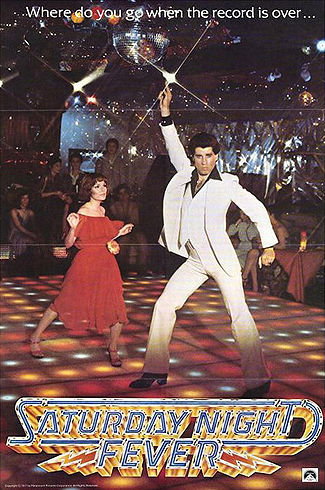
Embracing the Melodrama Part II #57: Saturday Night Fever (dir by John Badham)


Saturday_night_fever_movie_posterHere’s a little bit of trivia about the iconic 1977 film Saturday Night Fever.

First off, according to the imdb, Saturday Night Fever was the first mainstream Hollywood film to ever use the term “blow job.”  That actually took me by surprise.  I mean, with all of the risks that the major studios took in the 70s, it still took them until 1977 to have someone say “blow job” in a movie?  But somehow, it seems appropriate that it would turn up in Saturday Night Fever.  We tend to think of Saturday Night Fever as being a movie where the soundtrack is nonstop disco and John Travolta dances in that iconic white suit.  But actually, Saturday Night Fever is a film about four guys who neither understand nor respect women.

When Tony (John Travolta), Joey (Joseph Cali), Double J (Paul Pape), and Bobby (Barry Miller) go down to that disco, it’s because they want to get laid.   Joey and Double J take turns having sex with insecure Annette (Donna Pescow) and, afterwards, Tony scornfully ask her if she‘s proud of herself.  When Bobby discovers that his girlfriend is pregnant, he is so terrified of having to be a father that he becomes suicidal.  As for Tony, he looks down on the women who are so eager to dance with him.  When he enters a dance contest with Stephanie (Karen Lynn Gorney), he can’t handle the fact that she wants more out of her life than just being his latest partner.

So, it makes sense that this would be the first mainstream movie to feature someone talking about a blow job because that’s what these boys are obsessed with.  Sexually primitive, hypocritically puritanical, and emotionally repressed, a blow job is all the intimacy that these boys can handle.

Another piece of trivia: while John Travolta was always the first choice for Tony Manero, several actors were seen for the roles of Joey and Double J.  At one point, both Ray Liotta and David Caruso were nearly cast in the role of Tony’s friends.  Imagine this: in some alternative universe, while white-suited John Travolta rules over the dance floor, Ray Liotta and David Caruso are standing in the background and cheering him on.

Of course, if Liotta and Caruso had been cast, it would be a totally different movie.  Whenever you watch Saturday Night Fever, you’re surprised by how much John Travolta totally dominates the film.  Even though the film devotes a good deal of time to Annette, Stephanie, Bobby and to Tony’s brother who has recently left the priesthood, Tony Manero is the only character that you remember.  That’s largely because Travolta is the only one of them who gives a truly memorable performance.

In theory, it’s easy to laugh at the thought of Travolta in that white suit, striking a dramatic pose on that cheap-looking dance floor.  But then you watch the film and you realize that Travolta truly did give a great performance.  And, to your surprise, you don’t laugh at Tony with his white suit because you know that the only time Tony has any control over his life is when he’s dancing.  He may work in a paint store.  He may regularly get slapped around by his family.  He may not be very smart or sensitive.  But when Tony’s dancing, he’s a king and you’re happy that he at least has one thing in his life that he can feel good about.

Even if he is kind of a jerk.

Of course, it helps that Tony is a really good dancer.  There’s actually a lot more going on in Saturday Night Fever than you might think but ultimately, it’s a dance movie and it’s one of the best.