Retro Television Review: Homicide: Life On The Street 3.3 “Extreme Unction”


Welcome to Retro Television Reviews, a feature where we review some of our favorite and least favorite shows of the past!  On Sundays, I will be reviewing Homicide: Life On The Street, which aired from 1993 to 1999, on NBC!  It  can be viewed on Peacock.
This week, the White Glove Killer is discovered.

Episode 3.3 “Extreme Unction”

(Dir by Keith Gordon, originally aired on October 28th, 1994)

For all the hours that Pembleton and the other detectives put in and for all the motives that were considered and the suspects were interviewed, the murderer of Katherine Goodrich and two other women is captured not through deductive brilliance but because she herself enters the police station.

When Pamela Wilgis (Lucinda Jenney) first enters the station, she claims to have just witnessed two men dumping the third victim.  Pembleton is dismissive of her until she mentions the white gloves, a detail that has not been released to the public.  While Pembleton talks to her, the other detectives check out Pamela’s apartment and discover 12 sets of white cotton gloves hanging in her bathroom.  Pamela is the murderer.

When Pembleton asks Pamela about the gloves, Pamela suddenly starts speaking in an Irish accent.  Later, she starts speaking like an angry and rebellious child.  Later still, she reverts to being a wide-eyed innocent who says she had no idea how she ended up in the interrogation room.  Pembleton is convinced that she’s faking her alternate personalities but, despite his best efforts, he can never get her to actually confess that she committed the murders.

From the start, Homicide has emphasizes the role of luck in solving murders.  The majority of the show’s murders are solved precisely because someone thought they could outsmart the police or because they made a very obvious error.  For all of Pembleton’s strengths in the Box, his interrogation technique works best when he’s dealing with someone who doesn’t understand how the system works.  Pamela, on the other hand, obviously understands what he’s trying to do.  She knows the system and she knows how to game it.  Pamela does eventually confess but not Pembleton.  Instead, she does an interview with the obnoxious reported played by Tony Todd, blaming her crimes on the abuse she suffered as a child and her dissociative disorder.  Pembleton’s pride is hurt but he also finds himself struggling with his faith.  How can Pamela, after killing three saintly women, now avoid paying for her crimes?  Even with the thrilling interrogation scene between Pembleton and Pamela and the excellent performances of Andre Braugher and Lucinda Jenney, it’s all feels a bit anticlimactic.  But it also feels appropriate for the world in which Homicide takes place.

This episode also wrapped up a few other plotlines.  Munch, Bayliss, and Lewis finally own their bar.  Good for them.  I’m not really a bar person or a drinker but I probably would have enjoyed visiting the Waterfront whenever Munch was working the bar.  Even more importantly, Felton returned to his mentally unstable wife.  And again, that’s a good thing if just because I was getting sick of listening to Felton whine about his marriage.  So was Kay.

This episode was effective enough.  The scenes between Andre Braugher and Lucinda Jenney alone made the episode memorable.  At the same time, as I watched, it occurred to me that, if this episode had aired during the first season, the White Glove Murders probably never would have been solved.  If Adena Watson had died during the third season, one can be sure Bayliss would have gotten a confession out Risley Tucker.

Next week, we find out why Detective Crosetti has yet to return from Atlantic City.

Retro Television Review: Homicide: Life on the Street 3.2 “Fits Like A Glove”


Welcome to Retro Television Reviews, a feature where we review some of our favorite and least favorite shows of the past!  On Sundays, I will be reviewing Homicide: Life On The Street, which aired from 1993 to 1999, on NBC!  It  can be viewed on Peacock.

This week, the investigation into the Catherine Goodrich murder continues.

Episode 3.2 “Fits Like A Glove”

(Dir by Ted Demme, originally aired on October 21st, 1994)

Last week’s episode ended with Bayliss and Pembleton discovering that a supply shed had been broken into near the Goodrich scene.  This episode opens with Bayliss and Pembleton talking to the groundskeeper, who explains that he came across the shed earlier.  He reported that the shed had been broken into to the primary on the case, Detective Gaffney.  Gaffney never bothered to follow-up and the shed has since been cleaned up.

That’s it for Gaffney!  Lt. Russert calls him into the office and tells him he’s no longer heading up the investigation.  She tells him to take a few days off and then to transfer to another department.  She promises him a “fair recommendation.”  Gaffney replies that Russert only get her job because of her sex.  He goes as far as to compare her to a statue of a woman on a boat, except she’s not a mermaid.  “You’ve got legs,” he says.  It’s an odd bit of dialogue and I kind of wish that Gaffney had delivered it Al Pacino style.  “You’ve …. GOT …. LEGGGGGS!”

Pembleton is now the primary and not a moment too soon because another murdered woman has been found, again left in a dumpster outside a Catholic church and only wearing long white gloves.  Pembleton theorizes that the killer hates Catholics.  (So …. Matin Luther, maybe?)  Pembleton continues the investigation but clues are hard to come by and smarmy reporter Matt Rhoades (Tony Todd) keeps threatening to reveal that the killer puts gloves on the victims.  At one point, a murder memorabilia collector (Hugh Hodgin) shows up and claims that the murders are connected to a nationwide crime spree.  The collector turns out to be a flake, exactly the type of person who Russert believes would be driven to give false evidence if the news about the gloves got out.

Meanwhile, Kay finds herself being used as a messenger service by both Beau and his estranged wife.  Beau’s wife, Beth (Mary B. Ward), wants to surprise Beau with a romantic dinner so she asks Kay to tell Beau that Beth wants him to come by and see the kids.  Beau tells Kay to tell Beth that their son needs to tighten the laces on his baseball glove.  (Poor Kay!) Beau goes to the house to see the kids, just to discover that Beth lied and sent them away so she could make Beau dinner.  Beau gets mad and leaves.  Mary feeds Beau’s dinner to the dog.

Bayliss, Munch, and Lewis put in for a liquor license for the bar.  Lewis interrogates Munch as to whether or not he was ever arrested in the 60s but — surprise! — Bayliss is the one with the criminal record, an arrest and conviction for misdemeanor gambling while Bayliss was in college.  Bayliss, you never cease to surprise me!

This episode was a bit frustrating because Pembleton doesn’t seem to be any closer to solving the murders.  As well, Felton’s domestic drama would be a bit more compelling if Felton himself was a more likable character.  But, I still liked this episode.  The season 3 ensemble is amazing and just the pleasure of watching actors like Andre Braugher, Melissa Leo, Yaphet Kotto, Ned Beatty, Clark Johnson, Kyle Secor, and yes, even Daniel Baldwin all on the same show is more than enough of a reason to watch.  Everyone was at the top of their game in this episode.

Will Pembleton catch the killer next week?  I have faith and, judging by the way Pembleton crossed himself when looking at the second victim, so does he.

Lisa Marie Reviews An Oscar Nominee: Born On The Fourth of July (dir by Oliver Stone)


In 1989, having already won an Oscar for recreating his Vietnam experiences in Platoon, director Oliver Stone returned to the war with Born On The Fourth Of July.

Based on the memoir of anti-war activist Ron Kovic, Born on the Fourth of July stars Tom Cruise as Kovic.  When we first meet Kovic, he’s growing up on Long Island in the 50s and 60s.  He’s a clean-cut kid from a nice family.  He’s on the school wrestling team and he’s got a lot of friends.  When he was just 15, he heard John F. Kennedy telling people to ask what they can do for their country and he was inspired.  He decided he wanted to join the Marines, despite the fact that his father (Raymond J. Barry) was still haunted by the combat that he saw in World War II.  (In one of the film’s better scenes, a young Kovic notices that the elderly veterans marching in the Independence Day parade still flinch whenever they hear a firecracker.)  He enlists in the Marines after listening to a patriotic speech from a recruiter (played by Tom Berenger).  Ron runs through the rain to attend his prom and has one dance with Donna (Kyra Sedgwick), on whom he’s always had a crush.  There’s nothing subtle about the way that Stone portrays Kovic’s childhood.  In fact, one might argue that it’s a bit too idealized.  But Stone knows what he’s doing.  The wholesomenss of Kovic’s childhood leaves neither him nor the viewer prepared for what’s going to happen in Vietnam.

Vietnam turns out not to be the grand and patriotic adventure that Kovic thought it would be.  After Sgt. Kovic accidentally shoots one of his own men in a firefight, he is ordered to keep quiet about the incident.  After he is wounded and paralyzed in another firefight, Kovic ends up in a Hellish VA hospital, surrounded by men who will never fully recover from their mental and physical wounds.  Kovic is eventually returns home in wheelchair.  The film then follows Kovic as he goes from defending the war in Vietnam to eventually turning against both the war and the government.  At one point, he ends up with a group of disabled vets in Mexico and there’s a memorable scene where he and another paraplegic (Willem Dafoe) attempt to fight despite having fallen out of their chairs.  Eventually, Kovic returns to America and turns his anger into activism.

There’s nothing subtle about Born On The Fourth Of July.  It’s a loud and angry film and Oliver Stone directs with a heavy-hand.  Like a lot of Stone’s films, it overwhelms the viewer on a first viewing and it’s only during subsequent viewings that one becomes aware of just how manipulative the film is.  Tom Cruise gives a good performance as Ron Kovic but his transformation into a long-haired, profane drunk still feels as if it happens a bit too abruptly.  A good deal of the film centers on Kovic’s guilt about accidentally killing one of his men but the scene where he goes to the soldier’s family and asks them for forgiveness didn’t quite work for me.  If anything, Kovic came across as being rather self-centered as he robs the man’s mother and father of the belief that their son had at least died heroically in combat as opposed to having been shot by his own sergeant.  Did Kovic’s need to absolve himself really give him the right to cause this family more pain?  Born on the Fourth Of July is an effective work of agitprop.  On the first viewing, you’ll want to join Kovic in denouncing the military and demanding peace.  On the second viewing, you’ll still sympathize with Kovic while also realizing that he really owes both his mother and father an apology for taking out his anger on them.  By the third viewing, you’ll be kind of like, “Wow, I feel bad for this guy but he’s still kind of a jerk.”  That said, when it comes to making an effective political film, Adam McKay could definitely take some lessons from Oliver Stone.  Born On The Fourth of July is at its best when it simply captures the feeling of living in turmoil and discovering that the world is not as simple a place as you once believed.  As idealized as the film’s presentation of Kovic’s childhood may be, anyone who has ever felt nostalgia for an earlier and simpler world will be able to relate.

Oliver Stone won his second Best Director Oscar for Born On The Fourth Of July.  The film itself lost Best Picture to far more genteel version of the past, Driving Miss Daisy.


Retro Television Review: Homicide: Life On The Street 3.1 “Nearer My God To Thee”


Welcome to Retro Television Reviews, a feature where we review some of our favorite and least favorite shows of the past!  On Sundays, I will be reviewing Homicide: Life On The Street, which aired from 1993 to 1999, on NBC!  It  can be viewed on Peacock.

This week, we begin the third season!

Episode 3.1 “Nearer My God To Thee”

(Dir by Tim Hunter, originally aired on October 14th, 1994)

The third season of Homicide opens with a disgusted Stan Bolander watching a relatively tame soap opera in the breakroom.  He’s offended by the fact that two of the show’s characters are shown in bed.  To Bolander, that’s the equivalent of pornography on network television.  Lewis points out that television execs force showrunners to add sex in order to bring in ratings.  Munch mentions that it’s strange that television is allowed to show sex but not nudity.  Munch then goes on to predict that there will soon be hundreds of channels, a channel for every interest.  There will be channels about animals and religion and politics and soon, anything you want to see will be at your finger tips and it will lead to people becoming dull and lazy.  John Munch, super prophet!

Hmmm …. do you think maybe Tom Fontana, who wrote this script and was one of Homicide’s executive producers, was maybe venting some of his own frustration over the demands that NBC was making in return for giving a third season to the critically acclaimed but low-rated Homicide?  Because the third season premiere of Homicide is a bit different from the previous two seasons.  For one thing, Jon Polito is no longer in the cast.  (Lewis mentions that Crosetti is on vacation in Atlantic City.)  Isabelle Hofman, who is certainly more attractive than anyone who has previously appeared on the show, has joined the cast as Lt. Megan Russert, the second shift commander.  And this episode features its share of nudity and sex.

At the same time, it’s still an excellent episode of Homicide.  Isabelle Hofman gives a tough and no-nonsense performance as Russert and, by the end of the episode, she seems as if she belongs in the ensemble as much as her less glamorous castmates.  And this episode has its share of sex and nudity but it’s all essential to the plot.  This episode lets us know that, for now, Homicide is a show that can adjust without losing its integrity.

The episode’s case is a red ball (which is a term used to indicate it’s a case that’s going to get media attention).  Katharine Goodrich, the 30 year-old founder of a shelter for battered women, has been found dead in a dumpster, nude except for a pair of long white cotton gloves, the type of gloves that you might expect to see at a royal procession but not at a crime scene.  Russert’s shift has picked up the case and, to everyone’s horror, the incompetent and racist Roger Gaffney (Walt MacPherson) is the primary detective.  The brass ask Giardello to keep an eye on Russert because they feel she’s too inexperienced to handle the investigation.  Giardello (and let’s take a moment to acknowledge just how wonderful Yaphet Kotto was in this role) calls in his own detectives to help out the second shift.  As you might have guessed, the two shifts do not have much respect for each other.  It’s chaos, especially when Gaffney and Pembleton nearly come to blows over Gaffney’s racism,  Russert defuses the situation and the scene, to be honest, is a bit overwritten.  From the first minute she appeared in the episode, Hofman has been credible as a detective and a lieutenant so writing one heavy-handed scene just so she can further prove herself feels almost an insult to the strength of her performance.  Hofman (and Russert) has already proven herself without having to dare Pembleton to shoot Gaffney and throw his life away.

That said, this was a strong episode.  Goodrich was a devout Catholic and Pembleton and Bayliss discuss their own views on religion.  Bayliss has tried out all the Protestant denominations (even the — *snort* — Unitarians) and is a bit of a cynic.  Pembleton was educated by Jesuits and says at one point that, “There are two types of Catholics.  Devout and fallen.  I fell.”  It’s a scene that could have been awkward but Andre Braugher and Kyle Secor pull it off wonderfully.  Secor, especially, has really come into his own.  Bayliss is no longer the awkward and earnest rookie from the first season.  In fact, Bayliss has so come into his own that he agrees to invest in a bar with Lewis and Munch.  They’re burying the Waterfront!

(Before Bayliss offers to invest, there’s a humorous scene where Much and Lewis try to convince Bolander to not only invest but to also be the bar’s mascot.  “A big man deserves a big meal,” Munch says.  Bolander — who I’m happy to say is far less whiny in this episode than he was during the previous two seasons — is not interested.  It’s kind of funny how Munch basically hero worships a guy who really seems like he wants nothing to do with him outside of work.)

Kay spends the episode taking calls from Felton’s wife, Beth (Mary B. Ward).  Beth recently kicked Felton out of the house because she thought Felton was cheating on her.  Felton admits to Kay that he is cheating on her.  When Kay isn’t running interference for her partner, she’s defending Russert when the other detectives insinuate that Russert must be slept her way to the top.  Kay lists all of Russert’s qualifications and commendations.  Yay, Kay!  You tell them!  Later, Russert sees Kay looking exhausted and snaps at her to get to work.  “Bitch,” Kay mutters.  Ouch!  Still, I laughed.

Felton breaks into his house to retrieve a suit, just to be confronted by Beth.  An obviously unstable Beth proceeds to take a pair of scissors to Felton’s jacket before then stripping down to her underwear, getting in bed, and asking Felton to leave so she can get some sleep.  (I’m going to guess that rather disturbing and deliberately anti-erotic scene was Fontana’s subversive answer to the NBC execs who asked him to sex up the show a little.)  Later, Russert finally goes home to get some rest and check in on her daughter.  Felton shows up at her front door and, after he tells her the one of his leads on the Goodrich murder went dry, she responds by passionately kissing him.  Now, we know where Felton has been going whenever Beth kicks him out.

As for the Goodrich murder, it turns out that, despite what everyone assumed, she was not raped.  After a nun tells Pembleton and Bayliss that Katherine never wore gloves, Pembleton deduces the gloves were put on her body after she was killed.  Gaffney insists that Katherine’s murderer was probably the boyfriend of one of the women at the shelter but Pembleton disagrees.  (This leads to the fight that I mentioned earlier.)  While Russert wants to keep the gloves out of the news, a smarmy reporter (Tony Todd) threatens to reveal their existence unless she agrees to come to him first with any developments.  As the episode ends, Pembleton and Bayliss are canvassing the crime scene and it’s hard not to notice that they are now the ones wearing white gloves, rubber in this case.  Bayliss says its pointless to keep canvassing the crime scene.  But then he and Pembleton spot a storage shed with a busted lock.  As they open the door, the end credits begin.

To be continued!

What a great way start to season 3.  Yes, I realize that this case is pretty much the exact opposite of the gritty, pointless murders that the first two seasons focused on but still, I am now very much wondering who killed Katherine Goodrich and why they put the gloves on her hands.  I hope this won’t be another unsolvable Adena Watson case.  Fortunately, I have total faith in Frank Pembleton.

I can’t wait to see what happens next week!


Retro Television Review: Homicide: Life On The Street 2.4 “A Many Splendored Thing”


Welcome to Retro Television Reviews, a feature where we review some of our favorite and least favorite shows of the past!  On Sundays, I will be reviewing Homicide: Life On The Street, which aired from 1993 to 1999, on NBC!  It  can be viewed on Peacock.

This week, season 2 of Homicide comes to a close with an episode directed by John McNaughton, of Henry: Portrait of A Serial Killer fame.

Episode 2.4 “A Many Splendored Thing”

(Dir by John McNaughton, originally aired on January 27th, 1994)

The second season finale of Homicide opens with Bolander in a good mood and Munch feeling that life is pretty much pointless.  It’s a reversal from what we’ve seen over the last few episodes of Homicide and, as annoyed as I got with all the storylines about Bolander’s private life, I was still happy to see Bolander happy in this episode.  As an actor, Ned Beatty’s performance is a lot interesting when Bolander is looking forward to the future.  By that same token, Richard Belzer always seemed to be trying to hard whenever it came to playing Munch’s happiness.  Belzer was born to play a cynic and, in this episode, he delivers his lines with a bitterness that is both funny and authentic.

Bolander is dating Linda and I have to admit that, despite my initial weariness, I really like Ned Beatty and Julianna Margulies as a couple.  Bolander and Linda go on a double date with Kay and Danvers.  Awwww, two couples in love and having dinner together!  How sweet!  Uh-oh, here comes Munch….

While Munch is ruining Bolander’s date, Bayliss is getting in touch with his own dark side.  An investigation into the S&M-related death of a young woman leads to Bayliss and Pembleton arresting a man who killed her during rough (but consensual) sex.  Bayliss and Pembleton spend their investigation in Baltimore’s red light district.  Bayliss claims to be disgusted by the whole scene, leading to Pembleton calling him out for being judgmental.  Pembleton tells Bayliss that he can’t be a good detective unless he’s really in touch with every aspect of his existence.  After the murder is solved, the woman’s co-worker, Tanya, gives Bayliss the gift of a leather jacket.  Tanya is played, in a very good performance, by the actress Adrienne Shelley.  Tragically, Shelley herself would, 12 years later, be murdered in her New York apartment.  And while it’s tempting to write about the irony of Shelley appearing on a show like Homicide, I’d rather recommend that everyone see Waitress instead.  It was the second feature film that Shelley directed and it is very good.

Finally, Lewis investigates a man who committed murder because he felt someone had taken his favorite pen.  Lewis searches for a deeper motive but in the end, it really was all about a pen.  Lewis, I’ve noticed, always seems to get the cases that show just how random life and death can truly be.

The second season of Homicide ends with Lewis giving Felton a pen, Bayliss putting on his new leather jacket and walking the streets of Baltimore, and Munch, Bolander, and Linda watching fireworks explode over the harbor.  It’s a good way to end a season.  As dark as the show was (and as dark as this particular episode was), the season ends on a note of hope.  There is happiness out there for those willing to look for it.


VAMPIRES (1998) – Happy Birthday, John Carpenter!


In celebration of the 77th birthday of the great Director John Carpenter, I decided to watch his 1998 film VAMPIRES, starring one of my favorite actors in James Woods. I specifically remember the first time I ever read that this movie was being made and that it would star Woods. It was 1996, and I had just been hired to work for a company called Acxiom Corporation in Conway, Arkansas. It was at this job that I first had access to this new thing called the Worldwide Web. As far as I know, it was the first time I had ever looked at the internet. Of course, I immediately started completing searches on some of my favorite actors, including James Woods, when I came across VAMPIRES as a movie currently in production. These were the first times in my life that I was able to find out about new film projects without looking in a magazine or watching shows like Entertainment Tonight.

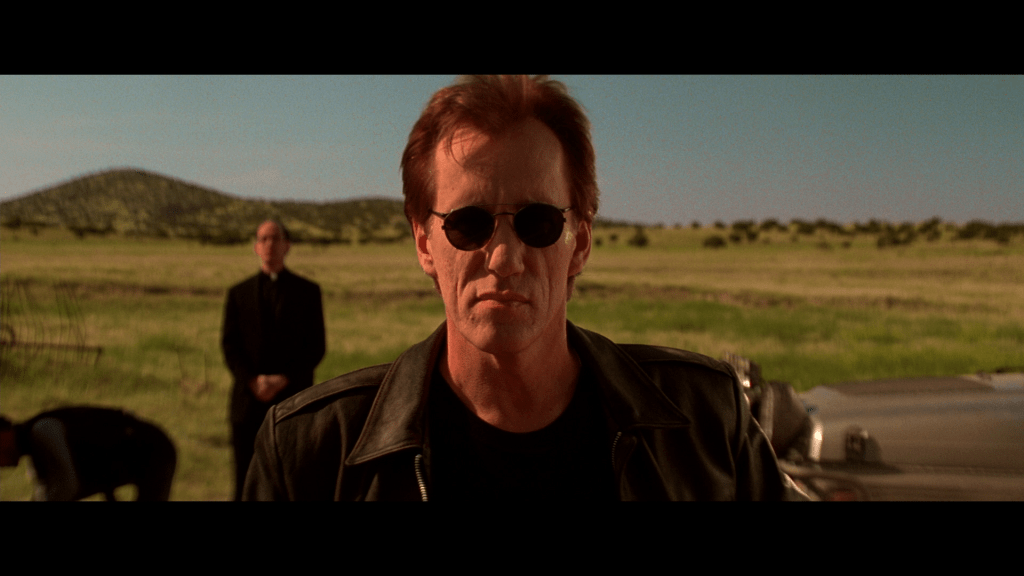
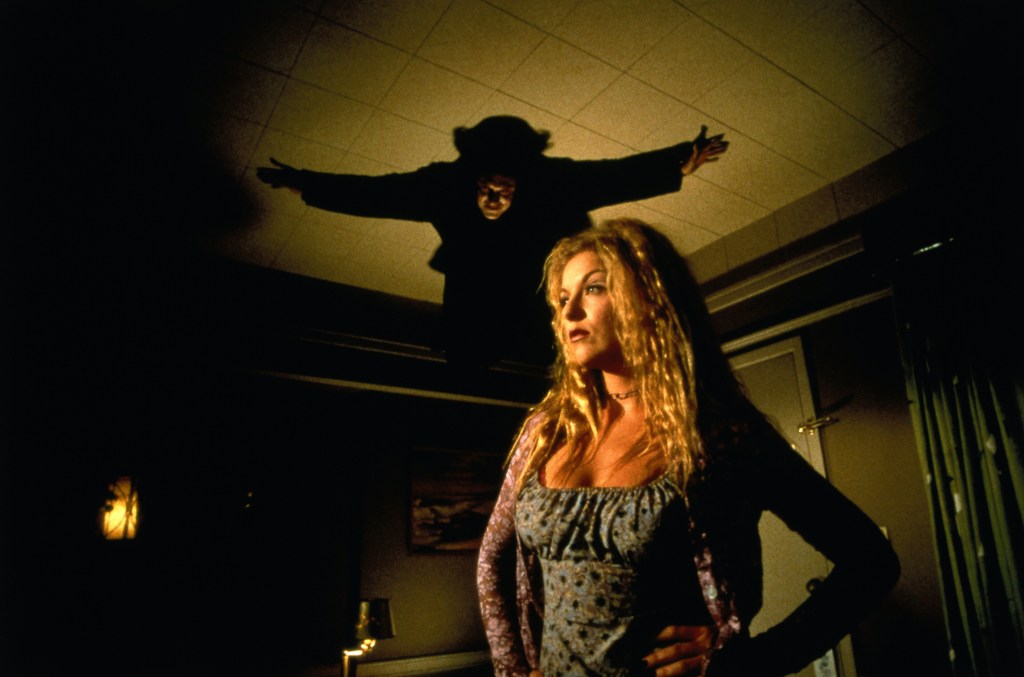
In VAMPIRES, James Woods stars as Jack Crow, the leader of team of vampire hunters who get their funding from the Vatican. We’re introduced to the team when they go into a house in New Mexico and proceed to impale and burn a nest of vampires. While the rest of the team celebrates the mission that night in a hotel filled alcohol, drugs, and whores, Jack can’t escape the feeling that something isn’t right, as he doesn’t believe they got the “master vampire” of the group. Unfortunately, Jack is right to worry. As they’re partying, the master vampire Valek (Thomas Ian Griffith) interrupts the fun and proceeds to kill everyone there, with the exception of Jack, his partner Tony (Daniel Baldwin), and Katrina (Sheryl Lee), a prostitute he decided to just bite on. Valek isn’t just a regular old master vampire, either. As it turns out, he’s the original vampire, and he’s on a quest to find the Berziers Cross, an ancient Catholic relic, that will allow him and other vampires to walk in the daylight. Against this backdrop, Jack, Tony, and a priest named Adam (Tim Guinee) use Katrina, who now has a psychic link with Valek, to try to kill the ultimate master vampire Valek, his cleric accomplice Cardinal Alba (Maximillian Schell), and just hopefully, save mankind in the process!

I know that VAMPIRES is not the most well-known or beloved John Carpenter film. He’s done so many great movies, but VAMPIRES is special to me as it was the first of his films that I ever saw in the movie theater. And the opening 30 minutes of the film is as badass as it gets. Carpenter is a master of the set-up. There’s lots of slow motion as Carpenter’s guitar riffs rock the soundtrack and the camera moves in on James Woods, with his cool sunglasses and black leather jacket, just before his team goes in and destroys a vampire nest at the beginning of the film. I also think the set-up of Thomas Ian Griffith as Valek is awesome, as he strolls up to the hotel room while the vampire hunters celebrate, completely unaware of the carnage about to befall them. Griffith has never looked cooler than he did in his long black coat and long hair, both blowing in the wind. These were awesome moments that illustrated Carpenter’s ability to project a sense of visual cool and power that I was mesmerized with. I wanted to see what happens next. And as a 25-year-old man at the time of VAMPIRE’s Halloween release in 1998, I also gladly admit that I really enjoyed the beauty of a 31-year-old Sheryl Lee. I would have definitely done everything I could do to save and protect her. The remainder of the film may have not been able to keep the same momentum as those first 30 minutes, but it’s a solid, enjoyable film, buoyed by the intense performance of Woods!

Vampires (1998) Directed by John Carpenter Shown: Thomas Ian Griffith, Sheryl Lee

There are several items of trivia that interest me about VAMPIRES:

  1. John Carpenter had a good working relationship with James Woods on the set, but they had a deal: Carpenter could film one scene as it is written, and he would film another scene in which Woods was allowed to improvise. The deal worked great, and Carpenter found that many of Woods’ improvised scenes were brilliant.
  2. VAMPIRES was John Carpenter’s only successful film of the 1990’s. Its opening weekend box office of $9.1 million is the highest of any John Carpenter film.
  3. The screenplay for VAMPIRES is credited to Don Jakoby. Jakoby has some good writing credits, including the Roy Scheider film BLUE THUNDER (1983), the Cannon Films “classic” LIFEFORCE (1985), and the Spielberg produced ARACHNAPHOBIA (1990). The reason Don Jakoby interests me, however, is the fact that he had his name removed from the film I’ve seen more than any other, that being DEATH WISH 3 (1985), starring Charles Bronson. Even though Jakoby provided the script for DEATH WISH 3, due to the drastic number of changes, Jakoby insisted his name be removed. The script is credited to the fake “Michael Edmonds” instead.
  4. As I was typing up my thoughts on VAMPIRES today, I learned of the death of the director David Lynch. This brings special poignancy to the fact that John Carpenter cast Sheryl Lee after seeing her on Lynch’s T.V. series TWIN PEAKS (1990).
  5. Frank Darabont, who directed one of the great films of all time, THE SHAWSHANK REDEMPTION (1994), has a cameo as “Man with Buick.” Fairly early in the film, after Crow, Montoya, and Katrina crash their truck escaping the hotel massacre, they encounter the man at a gas station and forcefully take the Buick. This is a strong sign of just how respected John Carpenter was by other great filmmakers at the time.

John Carpenter has directed some absolute classics like ASSAULT ON PRECINCT 13 (1976), HALLOWEEN (1978), ESCAPE FROM NEW YORK (1981), THE THING (1982), and BIG TROUBLE IN LITTLE CHINA (1986). There’s no wrong way to celebrate a man who has brought such joy into our lives through his work. Today, I’m just thankful that he has been given the opportunity to share his talents with us!   

Retro Television Review: Homicide: Life on the Street 2.3 “Black and Blue”


Welcome to Retro Television Reviews, a feature where we review some of our favorite and least favorite shows of the past!  On Sundays, I will be reviewing Homicide: Life On The Street, which aired from 1993 to 1999, on NBC!  It  can be viewed on Peacock.

This week, Pembleton gets a confession.

Episode 2.3 “Black and Blue”

(Dir by Chris Menaul, originally aired on January 20th, 1994)

In this week’s episode, Pembleton manipulates a man into confessing to a murder that he didn’t commit.  Pembleton does it with the full knowledge that the man is innocent and that, if the man is indicted and goes to trial, he will undoubtedly be found guilty as a result of that coerced confession.  Pembleton does it to prove a point to Giardello.

The man is Lane Staley (Isaiah Washington), who has been identified (by his grandmother, who was just trying to be helpful) as an eyewitness to the shooting of Charles Courtland Cox.  Pembleton is convinced that Cox was shot by a policeman and he only wants to interrogate Staley as a witness.  Giardello, who feels that Pembleton is to obsessed with his cop theory and who, as a proud member of the police force, does not want Pembleton to be right, insists that Pembleton treat Staley as a suspect.  Pembleton responds by going into the Box and pretending to be sympathetic to Staley’s situation.  He and Staley talk about how they’re both expected to always be polite and careful about what they say around white detectives.  Pembleton jokes that he always has to be extra polite when he comes to work.

Staley starts to open up to Pembleton and eventually admits that he was present when Cox was shot.  That’s when Pembleton starts shouting at Staley, accusing him of being responsible and basically browbeating Staley until Staley is in tears.  Pembleton makes Staley feel guilty for not doing more to protect Cox and continues to yell at him until, eventually, Staley feels that Cox’s murder was his fault.  Staley finally signs a confession, even though it’s obvious that the sobbing man is not a murderer.  Pembleton hands Giardello the confession and reminds him that’s the way that the police have been getting confessions out of young black suspects for years.

It’s a powerful moment and one that took me totally by surprise.  Andre Braugher and Yaphet Kotto both gave excellent performances in this episode.  The dynamic between Pembleton and Giardello has always been one of the more interesting parts of the show.  The fact that both of them are black and both of them are portrayed as being fully aware of the racism surrounding them brings an extra edge to their debate as to whether or not the black Cox was shot by a white policeman. (At one point, Giardello snaps at Pembleton to speak to him as respectfully as he speaks to the white lieutenants and it’s the exact type of moment that most shows would never have the courage or insight to portray.)  Pembleton is a great detective because he’s laser-focused on getting a confession, to the exclusion of worrying about anything else.  Giardello is a great lieutenant because he’s enough of a pragmatist to understand that some battles are not worth the price of victory.  In the end, Giardello comes to realize that Pembleton is right about the shooting but one still has to wonder what would have happened in Giardello hadn’t torn up Staley’s confession.  The murder of Cox would have disappeared from the headlines but the innocent Staley would have disappeared into the system.

The scenes with Pembleton and Staley were so electrifying that it made up for the fact that this is yet another episode that features Bolander feeling sorry for himself after his divorce.  Fortunately, for Bolander, he meets and befriends a young waitress named Linda (Julianne Margulies) who mentions that she plays the violin.  Bolander reveals that he plays the cello — WHAT!?  Since when has Bolander, someone who has expressed no interest in art or creativity or even music during his entire time of the show, become a cello player?  The episode ends with Bolander and Linda playing their instruments together and it’s a sweet scene but it’s still a bit hard to buy that apparently every woman in Baltimore is instantly attracted to a middle-aged, balding cop who spends all of his time talking about his divorce.  Ned Beatty was one of the great character actors but it sometimes feels like Homicide wasn’t sure what to do with his character.

But, hey, maybe Bolander will finally stop being so whiny.  That’s my hope.  This episode found Munch breaking up with his girlfriend after he accidentally gave her a carnivorous fish that ate all of her other fish.  At one point, Munch says that he can’t accept the idea of Bolander being happier than him.  Seriously, Munch, don’t jinx this.  I’ve been listening to Bolander complain nonstop for 15 episodes.  If he’s happy now, let him have it!

Next week …. life on the street continues!

Retro Television Review: Homicide: Life on The Street 2.2 “See No Evil”


Welcome to Retro Television Reviews, a feature where we review some of our favorite and least favorite shows of the past!  On Sundays, I will be reviewing Homicide: Life On The Street, which aired from 1993 to 1999, on NBC!  It  can be viewed on Peacock.

This week, no one’s innocent.

Episode 2.2 “See No Evil”

(Dir by Christopher Menual, originally aired on January 13th, 1994)

Watch out!  Stanley Bolander’s whining about his divorce again!

Ned Beatty was one of the great character actors and he is certainly convincing in the role of Stanley Bolander, the veteran Baltimore homicide detective who has seen the worst that humanity has to offer and who spends most of his time annoyed with his partner, John Munch.  But, as good as Beatty is, I still groan whenever Bolander starts to talk about his ex-wife and his divorce.  His bitterness was a recurring theme during the first season.  It was annoying but it was understandable because the divorce was still recent.

But now, we’ve started the second season.  It’s time move on, Big Man!

This episode finds Bolander very reluctantly taking part in sensitivity training.  He avoids meeting with Dr. Carrie Weston (Jennifer Mendenhall) until Giardello threatens to suspend him without pay.  Bolander is stunned when Dr. Weston turns out to be sympathetic to his anger over his divorce.  Bolander ever tries to ask Dr. Weston out, just for Weston to inform him that she’s just gotten out of a bad relationship and that she believes “birds of a feather should flock together” and, speaking of birds, did you know that there are lesbian seagulls?  Bolander gets the hint.  Myself, I would probably lie about being a lesbian just to get out of having to spend any more time listening to him cry about his divorce.

Far more interesting than Bolander’s angst were the two cases at the center of this week’s episode.  Chuckie Prentice (Michael Chaban) shoots his dying father (played, in a powerful and intimidating performance, by Wilford Brimley) in the head.  Though Chuckie claims that his father committed suicide, Lewis has his doubts and takes Chuckie to the station for interrogation.  Detective Beau Felton just happens to be Chuckie’s best friend and, after Chuckie tells him that his father specifically asked to be put out of his misery, Felton tries to convince Lewis to say that the shooting actually was a suicide.  At first, Lewis refuses but eventually, he agrees to look the other way while Felton takes Chuckie to wash his hands and destroy any evidence of gunpowder residue on his skin.  Without any definite evidence proving the he fired the gun, Chuckie is free to go and his father’s death is ruled a suicide.

This was a powerful story and it was all the more effective because it refused to come down on one side or the other.  Both Felton and Lewis presented their positions well and the episode ended not on a note of triumph but on a note of weary resignation.  Chuckie is free to go on with his life and his father is no longer in pain but Lewis is going to be haunted by his decision to allow evidence to be destroyed.  Personally, I’m against assisted suicide and I felt it was selfish for Chuckie’s father to ask Chuckie to pull the trigger.  But, having spent the previous few months trying to come to terms with my own father’s passing, I could understand what Chuckie was feeling.  There really are no easy answers.

As for the other case, it involved the shooting of a drug dealer.  The dealer was shot in the back.  A patrolman claimed that he slipped and his gun accidentally fired during the pursuit of the dealer.  Pembleton had his doubts about whether the shooting was really an accident or a case of police brutality.  Even after Giardello warned him that pursuing the case would turn “brother against brother” in the police force, Pembleton insisted on asking every police officer on the scene to turn in their guns for testing.  “You son of a bitch, Pembleton,” Giardello muttered.

And again, this was a storyline that worked because it refused to present an easy solution.  The dead man was a criminal and he was shot while fleeing the cops.  Even though the cop that slipped was eventually cleared of having fired the shot that killed the dealer, it was obvious that the shot did come from a cop.  Pembleton, with his black-and-white view of his job, was determined to find the truth, regardless of the professional consequences.  Giardello, with years more experience than Pembleton, spoke from the heart when he told Pembleton that investigating the case would bring harm not just to the cop who shot the dealer but to every cop working the streets, regardless of whether they were involved or not.  Felton could convince Lewis to look the other way.  Pembleton was not willing to do the same thing.

It was a strong episode, even with all of Bolander’s nonsense.  Perfectly acted, morally ambiguous, and fiercely intelligent, this is an episode that I’ll be thinking about for a while.

Retro Television Review: Homicide: Life On The Street 2.1 “Bop Gun”


Welcome to Retro Television Reviews, a feature where we review some of our favorite and least favorite shows of the past!  On Sundays, I will be reviewing Homicide: Life On The Street, which aired from 1993 to 1999, on NBC!  It  can be viewed on Peacock.

This week, the second season begins with a special guest star.

Episode 2.1 “Bop Gun”

(Dir by Stephen Gyllenhaal, originally aired on January 6th, 1994)

The 2nd season of Homicide opens with a murder.  That’s not surprising, considering the name of the show and the fact that it’s taking place in Baltimore, which had (and has) one of the highest murder rates in the country.  However, this time, the victim is an innocent tourist from Iowa, gunned down because she and her family took a wrong turn and ended up in a neighborhood that was far from the wharf.  With the press in a feeding frenzy over how unsafe Baltimore is, the bosses want the shooter to be caught and sentenced quickly.

Detective Beau Felton, the primary on the case, is overjoyed.  Sitting in the squad room and joking about how the victim’s husband didn’t even know what type of gun was used in the robbery-turned-murder, Felton brags that he is going to be making so much overtime off of this case.

Unfortunately, the victim’s husband happens to be in the squad room and he overhears Felton.  Angry, tired, and still wearing a shirt stained with his wife’s blood, Robert Ellison (played by special guest star Robin Williams) demands that Felton be taken off the case.

Giardello takes Ellison into his office and explains that Felton is the primary and he can’t be replaced.  Giardello also lists all of the other murders that Felton has recently worked.  Felton deals with violent death every day.  Giardello says that Felton is going to solve the case but he’s not going to “feel” Mrs. Ellison’s death the same way that her family does.

It’s an interesting scene and undoubtedly, a realistic one.  From the very first episode, Homicide has emphasized the gallows humor that goes along with being a homicide detective in a big city.  This episode, though, marks the first time that we get to see how an outsider would react to that attitude.  Significantly, Felton never apologizes and, even after the shooter is arrested, Ellison never forgives Felton for his comments.  Whenever the two interact, it’s obvious that they don’t like each other.  But they’re forever linked by one act of violence.

Felton ends up arresting three men.  Two of them are accused of robbing the Ellison family and being accessories to the murder.  They end up with 30 years in prison.  The accused shooter is Vaughn Perkins (Lloyd Goodman), a teenager who has never had any trouble with the police and who not only tries to write Ellison a note of apology but who also pleads guilty and accepts a life sentence.  (Ellison, in another example of this show choosing realism over sentimentality, refuses to read the note.)

Kay Howard is convinced that Vaughn is covering for the other two men, saying that Vaughn just seems too quiet and meek to be a cold-blooded murderer.  At the end of the episode, she goes down to the prison and meets with Vaughn, who now goes by the name Abu Aziz.  Though he initially tries to act hard, the former Vaughn Perkins finally admits that he was holding the gun during the robbery because he thought he could “control” the situation and keep anyone from getting hurt.  But when Mrs. Ellison refused to give up a locket, he panicked and shot her.  He lost control and, in a split second, he changed the lives of everyone involved.  Feeling defeated by the sad reality of Baltimore, Kay leaves the prison and heads back to work.

When Homicide returned for a second season, it was only given a four-episode order.  With the show on the cusp of cancellation, Homicide only had four hours in which to prove itself.  Originally, Bop Gun was scheduled to be the second season finale.  NBC, wanting to take advantage of having Robin Williams as a guest star, instead decided to move the episode to the start of the season.  That was probably a good idea.  Bop Gun is a good episode that reintroduces us to squad room and also features an excellent performance from Robin Williams.  Williams could, to be honest, be a bit hit-and-miss when it came to dramatic roles but he does wonderful work here, perfectly capturing Ellison’s anger, sadness, and desperation.  He starts the episode as a stunned innocent but, by the end of it, he’s become a much more hardened individual, one who has no interest in Vaughn’s heartfelt but too little and too late apology.  Just Vaughn now has to act hard to survive in a physical prison, Ellison has had to shut off his feelings so that he can survive in his emotional prison.

(As a sidenote, Ellison’s son is played by a very young Jake Gyllenhaal, whose real-life father directed this episode.)

If the first season occasionally felt a bit too much like an insider’s view of the Homicide Department, this episode gives us the point of view of an outsider.  Through Ellison’s eyes, we are reintroduced to the detectives.  Felton may not be a great cop or even a likable human being but he gets the job done in this episode.  And while Felton will now move on to the next case, Robert Ellison will spend the rest of his life thinking about that one day in Baltimore.

Because of the holidays, this is my final Homicide review of 2024!  These reviews will return on January 5th!


Retro Television Review: Homicide: Life On The Street 1.9 “Smoke Gets In Your Eyes”


Welcome to Retro Television Reviews, a feature where we review some of our favorite and least favorite shows of the past!  On Sundays, I will be reviewing Homicide: Life On The Street, which aired from 1993 to 1999, on NBC!  It  can be viewed on Peacock.

This week, season one comes to a close.

Episode 1.9 “Smoke Gets In Your Eyes”

(Dir by Wayne Ewing, originally aired on March 24th, 1993)

It’s another day in Baltimore.

While the rain falls and the cold wind blows, Detectives Howard and Felton investigate another murder and, for once, it’s Detective Howard who is getting distracted and irritable.  Felton lights a cigarette.  The witnesses all light cigarettes.  The uniformed cops light cigarettes.  The medical examiner looks over a body and lights a cigarette.  Howard bites into a celery stick.  To his horror, Felton realizes that Howard is trying to quite smoking and, therefore, she is going to be Hell to work with until she eventually gives up.  Howard swears that she’s not going to give up,  She’s dating State’s Attorney Ed Danvers and he’s not a huge fan of smoking.  Howard later assures Pembleton that sex with Danvers is so mind-blowing that it’s worth giving up cigarettes.

Bayliss is trying to give up cigarettes as well.  He’s doing it for his health.  (Sorry, Danvers!)  His attempt to go smoke-free lasts for a day or two.  He gives in while on a stake-out with Howard, Pembleton, and Felton.  Bayliss is so desperate to bum a cigarette that detectives nearly miss capturing their suspect.

Meanwhile, Lt. Giardello is shocked to discover that the upper flood of the building, the floor right above his department, has been closed for asbestos removal.  No one bothered to tell the detectives that they were working in a toxic environment.  Actually, with all the cigarette smoke, I doubt they would have noticed.  As always, Yaphet Kotto’s performance was one of the highlights of this episode.  Both his outrage over the asbestos and his joy about having found something to hold over the head of Captain Barnfather were wonderful to watch.

Finally, Munch and Bolander investigate the death of a 14 year-old boy who was beaten to death as a part of a gang initiation.  Fortunately, the members of the gang are not very smart.  One suspect confesses all that he knows after Munch and Bolander hook him up to what they claim is an atomic-powered lie detector that causes sterility.  (It’s actually the xerox machine.)  The head of the gang turns out to be a snot-nosed, middle class kid who says that the murder was an act of kindness.  A disgusted Bolander ends the episode, sitting in a bar and talking about how American society destroyed Elvis.  The bartender is played by a bemused John Waters.

This episode was originally meant to be the final episode of season one.  NBC, not wanting to end the first season on such a downbeat note, instead decided that Night of the Dead Living should be the finale, despite the fact that moving the episodes around caused all sorts of continuity problems.  For the purpose of the site, I’m reviewing the episodes in the order that they were meant to be shown.  So, for us, this is indeed the season finale.

And what a dark way to end the season!  But it also feels like the right way to end season one.  In its first season, Homicide was not an optimistic series.  The murder of Adena Watson went unsolved.  Bolander is alone and still pining for his ex-wife.  No matter how many murders are solved, there’s always another one right around the corner.  The first season of Homicide would have been downright depressing if not for the sense of humor of the detectives.  It was gallows humor, of course.  But it was very much needed.

Season one featured some great episodes (Three Men and Adena, the pilot, Night of the Dead Living) but it faltered towards the end.  Bolander’s relationship with Carol was never as interesting as the show’s writers seemed to think and the whole plotline with Chris Thormann getting shot went for an at least one episode more than necessary.  But still, the first season was challenging and frequently compelling.  It was also very low-rated.  Homicide came close to being canceled after the first 9 episodes.  When it did return for a second season, it was only given four episodes in which to prove itself.

We’ll start looking at those four episodes next week.