Retro Television Review: Decoy 1.8 “Escape Into Danger”


Welcome to Retro Television Reviews, a feature where we review some of our favorite and least favorite shows of the past!  On Thursdays, I will be reviewing Decoy, which aired in Syndication in 1957 and 1958.  The show can be viewed on Tubi!
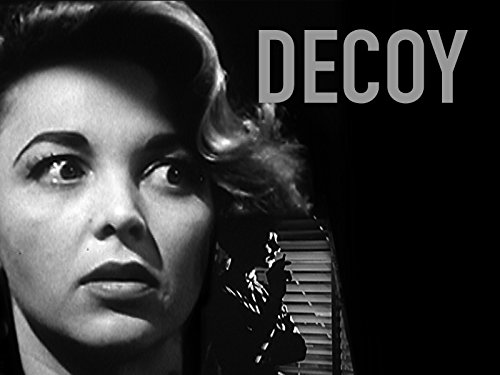
This week, Casey pursues her neighbor and nearly dies.

Episode 1.8 “Escape Into Danger”

(Dir by Teddy Sills, originally aired on December 2nd, 1957)

Casey Jones (Beverly Garland) returns home from a night shift, hoping to get some rest so that she can get over a bad cold.  (I’ve had enough bad colds that I’m fairly confident that Garland herself was suffering from a cold when she filmed this episode and it was written into the script.)  She discovers that her neighbor, Mary (Madeline Sherwood), has hit her abusive and drunken husband across the back of his head.  Mary is convinced that she’s killed her husband and is terrified that she’ll go to jail.  When Casey informs her that her husband is just knocked out and that everything is going to be okay, Mary doesn’t believe her because Casey is a cop and a cop will say anything to make an arrest.  While Casey is in her apartment calling for an ambulance, Mary flees the scene.

Mary’s husband does die but he dies of acute alcohol poisoning so Mary’s off the hook.  (Apparently, this episode take place in a world where assault isn’t a crime.)  Despite her cold, Casey takes to the streets and searches for Mary.  Knowing that Mary is masseuse, Casey checks out all the massage parlors.  In a move that kind of makes me wonder if Casey is really that good at her job, she decides that she might as well get a massage as well.

The woman who gives Casey the massage is Katy Olin (Virginia Kaye), who is Mary’s sister and a bitter ex-con who hates all cops.  While Katy massages Casey, Mary hides in the changing room.  When Casey says that she’s looking for Mary, Katy has Mary sneak out of the dressing room and choke Casey into unconsciousness.  Mary steals Casey’s gun and then makes her escape.

A few thoughts:

First off, after years of being spoiled by shows like Law & Order, I have to say that I was initially surprised that Casey didn’t know that Mary had a sister or that the sister was an ex-con.  But then I remembered that this episode was filmed in 1957, back before all of that information was available at just the touch of a key.

That said, what type of police officer is going to get a massage while on duty?  Even if Casey had looked up from the massage table and seen Mary trying to escape the room, what was Casey going to do?  Chase her through the streets of New York while wearing a towel?  Also, Casey often seems to just drop her purse anywhere, despite the fact that her purse contains a loaded gun.

Third, Katy mentions to Mary that there’s no way for her to leave the room without walking right past Casey.  So, how did Mary get into the room in the first place and how come Casey didn’t notice her when she first arrived?

Fourth, once Casey wakes up, she takes Katy down to the police station.  Katy’s interrogated and refuses to answer any questions.  She asks if she’s being charged with anything and, because she’s not, she’s allowed to go.  Is she not an accessory for hiding Mary and then just standing by while Mary attempted to murder a police officer?

Katy decides that the best thing for Mary to do would be to hide out in her old apartment, the one that is next door to the police officer who Mary just tried to strangle.  (Neither Katy nor Mary appear to be that smart.)  Casey, of course, discovers that two of them hiding there.  She and the neighborhood priest (John McLiam) talk Mary into putting down the gun.  They assure her that she did not kill her husband.  Mary finally believes that Casey is telling the truth….

….which is all good and well except Mary ASSUALTED A POLICE OFFICER!  Indeed, one could argue that what Mary did to Casey counts as attempted murder.  So, really, it seems like Mary should be going to jail regardless.  Unfortunately, we never learn about what happened to Mary after she stop pointing the gun as Casey.  If I was Casey, I would prefer a neighbor who hasn’t tried to kill me.

This episode didn’t really make sense but I’m glad that Casey got over her cold by the end of it.
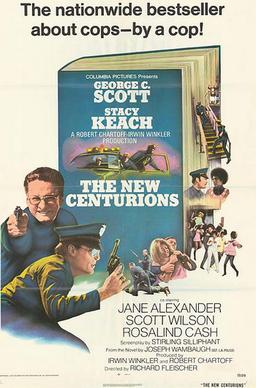

The New Centurions (1972, directed by Richard Fleischer)


Fresh from the police academy, three rookie cops are assigned to a precinct in East L.A.  Gus (Scott Wilson) is a father of three who just wants to do a good job and support his family.  Sergio (Erik Estrada) is a former gang member who saw the police academy as a way to get out of his old neighborhood, and Roy (Stacy Keach) is a new father who is going to law school at night.  Most of the movie centers on Roy, who goes from being an idealistic rookie to being a hardened veteran and who comes to love the job so much that he abandons law school and eventually loses his family.  Roy’s wife (Jane Alexander) comes to realize that Roy will never be able to relate to anyone other than his fellow cops.  Roy’s mentor is Andy Kilvinski (George C. Scott), a tough but warm-hearted survivor who has never been shot once and whose mandatory retirement is approaching.

Based on an autobiographical novel by real-life policeman Joseph Wambaugh, The New Centurion’s episodic structure allows the film to touch on all the issues, good and bad, that come with police work.  Gus is shaken after he accidentally shoots a civilian.  Sergio feels the burden of patrolling the streets on which he grew up.  Roy becomes a good cop but at the cost of everything else in his life and he deals with the stress by drinking.  There are moments of humor and moments of seriousness and then a tragic ending.  Just as Wambaugh’s book was acclaimed for its insight and its realistic portrayal of the pressures of being a policeman, the movie could have been one of the definitive portraits of being a street cop, except that it was directed in a workmanlike fashion by Richard Fleischer.  Instead of being the ultimate cop movie, The New Centurions feels more like an especially good episode of Police Story or Hill Street Blues.  (The New Centurions and Hill Street Blues both feature James B. Sikking as a pipe-smoking, martinet commander.)

George C. Scott, though.  What a great actor!  Scott only has a supporting role but he’s so good as Kilvinski that you miss him when he’s not around and, when he leaves, the movie gets a lot less interesting.  Scott makes Kilvinski the ultimate beat cop and he delivers the closest thing that The New Centurions has to a cohesive message.  A cop can leave the beat but the beat is never going to leave him.

Late Night Retro Television Review: Monsters 3.17 “Leavings”


Welcome to Late Night Retro Television Reviews, a feature where we review some of our favorite and least favorite shows of the past! On Wednesdays, I will be reviewing Monsters, which aired in syndication from 1988 to 1991. The entire series is streaming on YouTube.

This week, Monsters makes even less sense than usual.

Episode 3.17 “Leavings”

(Dir by John Tillinger, originally aired on January 20th, 19991)

Two cops (played by Tony Shalhoub and John Christopher Jones) are concerned about something that they’ve noticed on the streets.  Homeless people who are missing limbs are showing up.  The cops know that the homeless people had all their limbs just a few days ago but now, they’re gone.  There’s no sign of surgery or any sort of trauma.  The limbs are just disappearing apparently.  Meanwhile, there’s some new homeless guy wandering around who appears to be made out of limbs that don’t really seem to go together.

They go to their boss (Clifton James) with this concerns.  Their boss tells them not to worry about it.  However, the cops continue to worry about it.  This leads to their boss revealing the truth of what’s happening.  It turns out that their boss has been stealing body parts and building new people for years.  He’s trying to create a policeman who will be loyal and who won’t ask questions.  (We only see one of these constructed cops in the show.  He wears a jacket that identifies him as being Officer S. Partz.)  The boss then kills the two cops because they’ve seen too much.

This was a weird episode.  How exactly did their boss learn how to remove body parts without leaving any sort of obvious signs of trauma?  How did he learn how to bring his constructed people to life?  How did …. well, it just doesn’t make any sense.  It’s true that a 30-minuet anthology show doesn’t necessarily have to make perfect sense but this episode really does stretch things a bit too far.  The three actors all give good performances but, otherwise, this episode just falls a bit flat.

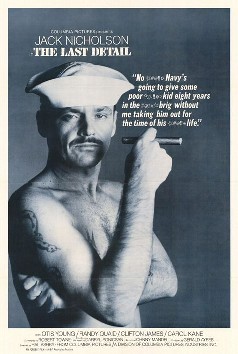
The Last Detail (1973, directed by Hal Ashby)


Billy “Badass” Buddusky (Jack Nicholson) and Richard Mulhall (Otis Young) are two Navy lifers stationed in Virginia.  On shore patrol, they’ve been assigned to transport a 18 year-old seaman to a Naval prison in Maine.  The kid has been dishonorably discharged and sentenced to eight years in the brig for trying to steal $40 from a charity box.  (The charity was a favorite of the wife of his commanding officer.)  Buddusky and Mulhall are expecting to find a hardened punk but instead, they end up escorting Larry Meadows (Randy Quaid), a timid teenager who suffers from kleptomania and who doesn’t seem to understand just how bad things are going to be for him for the rest of his life.  Not only is he going to do eight years in the brig, surrounded by hardened criminals, but his dishonorable discharge is going to follow him for the rest of his life.

Resenting having to take Meadows to prison and also feeling that he’s getting a raw deal, Buddusky and Mulhall decide to make a few stops on their way to Maine, so that Larry can enjoy what little time he has left and hopefully lose his virginity before being locked up.  In between brawling with Marines, visiting a brothel (where a young Carol Kane plays one of the prostitutes), and hanging out with a group of hippies (one of whom is played by Gilda Radner), Meadows comes to think of Buddusky and Mulhall as being his best friends.  Unfortunately, for Meadows, both Buddusky and Mulhall have their job to do.

Hal Ashby’s road picture is a character study of three men who are all lifers, even if they don’t realize that.  Both Buddusky and Mulhall hate the Navy but they also can’t relate to anyone who isn’t a member of the service.  Meadows’s entire future has been pre-determined because he tried to steal $40 but he doesn’t realize it until its too late.  When the film came out, it was controversial due to its “colorful” language.  In an interview, screenwriter Robert Towne defended the frequent profanity because, as he put it, when you’re in a situation you hate, “that’s what you do.  You bitch.”  Hal Ashby’s loose direction captures the road trip feel as the three leads reluctantly head to their ultimate destination.

The Last Detail features one of Jack Nicholson’s best performances.  Buddusky is cynical and doesn’t trust anyone other than Mulhall but even he knows that Larry Meadows deserves better than to spend eight years in the brig.  Along with lending his star power to the film and standing by director Hal Ashby when Ashby was arrested for marijuana possession, Nicholson also played a big role in the casting of Randy Quaid as Larry Meadows.  (The other final contender for the role was John Travolta but Nicholson insisted on Quaid).  The 6’5 Quaid towers of Nicholson and Young, making him look as if he could escape any time that he wants.  But Larry is so naive that he doesn’t want to make any trouble for his “friends.”  Though this wasn’t his first film, The Last Detail is the film that made Quaid one of the busiest character actors of the 70s and 80s and it also, at least temporarily, made him a part of the Jack Nicholson stock company.

Both sad and funny, The Last Detail is one of the best films of the 70s and features Jack Nicholson at his most unforgettable.

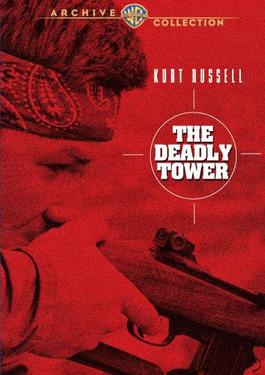
The Deadly Tower (1975, directed by Jerry Jameson)


Made for television, The Deadly Tower is a recreation of the terrible day in 1966 that a 25 year-old former Marine named Charles Whitman shot his wife and mother and then climbed to the top of the tower at the University of Texas in Austin and started to indiscriminately firing on the people below.  It was one of the first mass shootings of its kind.  What drove All-American boy Charles Whitman, who was eventually taken down by the police, to start his rampage is not known though the autopsy revealed that he did have a small brain tumor at the time of his death.

The Deadly Tower focuses mostly on the efforts of the policeman Ramiro Martinez (Richard Yinguez) and civilian Allan Crum (Ned Beatty) to get to the top of the tower and stop Whitman’s shooting rampage.  (Pernell Roberts, John Forsythe, and Clifton James all appear as other police officials, trying to deal with what was then an almost unheard of occurrence.)  Martinez risks his life to stop Whitman’s rampage while Allan worries that other shootings will follow.  One of the first examples of a true crime event being turned into a movie for television, The Deadly Tower a tense and effective docudrama.  Kurt Russell, who was then still known for being Disney’s top-paid star, plays Whitman.  Russell doesn’t have much dialogue in the film.  He’s blandly friendly while buying bullets and, when he’s sitting up in the tower with his rifle, he could just as easily pass for a teenager out hunting with his father during deer season.  Russell’s clean-cut appearance made him ideal for playing the role of someone who no one would have ever suspected could be capable of committing such a terrible crime.  It took courage to cast an actor then known for Disney films as one of America’s worst mass murderers and it also took courage for Russell to accept a role that was the total opposite of his family-friendly image.

The Deadly Tower used to show up on television frequently when I was a kid.  It’s still a scary movie, even if you know how it’s going to end.  Whitman may have been one of the first of his kind but sadly, he wouldn’t be the last.

Late Night Retro Television Reviews: Highway to Heaven 1.5 “Song of the Wild West”


Welcome to Late Night Retro Television Reviews, a feature where we review some of our favorite and least favorite shows of the past!  On Thursdays, I will be reviewing Highway to Heaven, which aired on NBC from 1984 to 1989.  The entire show is currently streaming on Tubi and several other services!

This week, Jonathan and Mark go country!

Episode 1.5 “Song of the Wild West”

(Dir by Victor French, originally aired on October 17th, 1984)

This week’s episode of Highway to Heaven has a country music theme as Mark’s car ends up breaking down outside of a country-western bar.

I have to admit that I had mixed feelings about this theme.  Quite frankly, country music is not my type of music.  As I’ve explained in the past, my musical tastes run the gamut from EDM to more EDM.  Country music has just never really done much for me, though I’ve done a line dance or two.

That said, I grew up all over the Southwest.  I live in Texas.  I’m a city girl but I knw what it’s like to walk through the high grass on a humid day.  I know what it’s like to be woken up at sunrise by the sound of a rooster.  I’ve ridden horses.  I once milked a cow but I really didn’t enjoy it at all.  I know the country and I like the people who live out in the country and, though I’m meant to live in a city, I still feel a bit of nostalgia whenever I see a farmhouse or a muddy pickup truck.  This episode did have a legitimate country feel, which I appreciated.

Jonathan actually had a handful of missions in this episode.  First off, he had to help Trudy Swenson (Joan Kjar) win the bar back from Nick Claybourne (Clifton James), the blowhard who won the bar in a rigged poker game from Trudy’s husband.  Secondly, he had to help gas station owner Tim Higgins (Jerry Hardin) come to terms with the musical ambitions of his teenage daughter, Sara (Michele Greene).  And finally, he had to help Sara reunite with her mother, an alcoholic country music star named Pasty Maynard (Ronee Blakely).  And he had to do all this while also working as a bartender at the bar.  Not only did Jonathan have to solve everyone’s emotional problems but he had to convince the local drunk to drink a cup of coffee as opposed to ordering another shot.

Mark doesn’t do much this week and I assume that’s because Victor French also directed the episode.  As a result, everything pretty much falls on Jonathan and it almost feels as if he’s been given too much to do.  Throughout the episode, he’s rushing back and forth between Tim, Trudy, and Patsy.  Add to that the fact that the action stops for a minutes at a time so that Patsy and Sara can perform and you end up with an episode that feels a bit overstuffed.

This episode didn’t really work for me.  I could appreciate the fact that the episode did a good job capturing the country milieu but country music just doesn’t do much for me.  And this episode had a lot of country music.

Icarus File No. 11: The Bonfire of the Vanities (dir by Brian De Palma)


In 2021, I finally saw the infamous film, The Bonfire of the Vanities.

I saw it when it premiered on TCM.  Now, I have to say that there were quite a few TCM fans who were not happy about The Bonfire of the Vanities showing up on TCM, feeling that the film had no place on a station that was supposed to be devoted to classic films.  While it’s true that TCM has shown “bad” films before, they were usually films that, at the very least, had a cult reputation.  And it is also true that TCM has frequently shown films that originally failed with audiences or critics or both.  However, those films had almost all been subsequently rediscovered by new audiences and often reevaluated by new critics.  The Bonfire of the Vanities is not a cult film.  It’s not a film about which one can claim that it’s “so bad that it’s good.”  As for the film being reevaluated, I’ll just say that there is no one more willing than me to embrace a film that was rejected by mainstream critics.  But, as I watched The Bonfire of the Vanities, I saw that everything negative that I had previously read about the film was true.

Released in 1990 and based on a novel by Tom Wolfe, Bonfire of the Vanities stars Tom Hanks as Sherman McCoy, a superficial Wall Street trader who has the perfect penthouse and a painfully thin, status-obsessed wife (Kim Cattrall).  Sherman also has a greedy mistress named Maria (Melanie Griffith).  It’s while driving with Maria that Sherman takes a wrong turn and ends up in the South Bronx.  When Sherman gets out of the car to move a tire that’s in the middle of the street, two black teenagers approach him.  Maria panics and, after Sherman jumps back in the car, she runs over one of the teens.  Maria talks Sherman into not calling the police.  The police, however, figure out that Sherman’s car was the one who ran over the teen.  Sherman is arrested and finds himself being prosecuted by a power-hungry district attorney (F. Murray Abraham).  The trial becomes the center of all of New York City’s racial and economic strife, with Sherman becoming “the great white defendant,” upon whom blame for all of New York’s problems can be placed.  Bruce Willis plays an alcoholic journalist who was British in the novel.  Morgan Freeman plays the judge, who was Jewish in the novel.  As well, in the novel, the judge was very much a New York character, profanely keeping order in the court and spitting at a criminal who spit at him first.  In the movie, the judge delivers a speech ordering everyone to “be decent to each other” like their mothers taught them to be.

Having read Wolfe’s very novel before watching the film, I knew that there was no way that the adaptation would be able to remain a 100% faithful to Wolfe’s lacerating satire.  Because the main character of Wolfe’s book was New York City, he was free to make almost all of the human characters as unlikable as possible.  In the book, Peter Fallow is a perpetually soused opportunist who doesn’t worry about who he hurts with his inflammatory articles.  Sherman McCoy is a haughty and out-of-touch WASP who never loses his elitist attitude.   In the film, Bruce Willis smirks in his wiseguy manner and mocks the other reporters for being so eager to destroy Sherman.  Hanks, meanwhile, attempts to play Sherman as an everyman who just happens to live in a luxury penthouse and spend his days on Wall Street.  Hanks is so miscast and so clueless as how to play a character like this that Sherman actually comes across as if he’s suffering from some sort of brain damage.  He feels less like a stockbroker and more like Forrest Gump without the Southern accent.  There’s a scene, written specifically for the film, in which Fallow and Sherman ride the subway together and it literally feels like a parody of one of those sentimental buddy films where a cynic ends up having to take a road trip with someone who has been left innocent and naïve as result of spending the first half of their life locked in basement or a bomb shelter.  It’s one thing to present Sherman as being wealthy and uncomfortable among those who are poor.  It’s another thing to leave us wondering how he’s ever been able to successfully cross a street in New York City without getting run over by an angry cab driver.

Because the film can’t duplicate Wolfe’s unique prose, it instead resorts to mixing cartoonish comedy and overwrought melodrama.  It doesn’t add up too much.  At one point, Sherman ends a dinner party by firing a rifle in his apartment but, after it happens, the incident is never mentioned again.  I mean, surely someone else in the apartment would have called the cops about someone firing a rifle in the building.  Someone in the press would undoubtedly want to write a story about Sherman McCoy, the center of the city’s trial of the century, firing a rifle in his own apartment.  If the novel ended with Sherman resigned to the fact that his legal problems are never going to end, the film ends with Sherman getting revenge on everyone who has persecuted him and he does so with a smirk that does not at all feel earned.  After two hours of being an idiot, Sherman suddenly outthinks everyone else.  Why?  Because the film needed the happy ending that the book refused to offer up.

Of course, the film’s biggest sin is that it’s just boring.  It’s a dull film, full of good actors who don’t really seem to care about the dialogue that they are reciting.  Director Brian De Palma tries to give the film a certain visual flair, resorting to his usual collection of odd camera angles and split screens, none of which feel at all necessary to the story.  In the end, De Palma is not at all the right director for the material.  Perhaps Sidney Lumet could have done something with it, though he would have still had to deal with the less than impressive script.  De Palma’s over-the-top, set piece-obsessed sensibilities just add to the film’s cartoonish feel.

The film flopped at the box office.  De Palma’s career never recovered.  Tom Hanks’s career as a leading man was momentarily derailed.  Bruce Willis would have to wait a few more years to establish himself as a serious actor.  Even the normally magnanimous Morgan Freeman has openly talked about how much he hated being involved with The Bonfire of the Vanities.  That said, the film lives on because  De Palma allowed journalist Julie Salomon to hang out on the set and the book she wrote about the production, The Devil’s Candy, is a classic of Hollywood non-fiction.  (TCM adapted the book into a podcast, which is how The Bonfire of the Vanities came to be featured on the station.)  Thanks to Salomon’s book, The Bonfire of the Vanities has gone to become the epitome of a certain type of flop, the literary adaptation that is fatally compromised by executives who don’t read.

Previous Icarus Files:

  1. Cloud Atlas
  2. Maximum Overdrive
  3. Glass
  4. Captive State
  5. Mother!
  6. The Man Who Killed Don Quixote
  7. Last Days
  8. Plan 9 From Outer Space
  9. The Last Movie
  10. 88

An Offer You Can’t Refuse #20: The Untouchables (dir by Brian DePalma)


“Let’s do some good!” Eliot Ness shouts as he and a platoon of Chicago cops raid what they believe is a bootlegger’s warehouse.

That line right there tells you everything that you need to know about the 1987 film, The Untouchables.  In real life, Eliot Ness was known to be an honest member of law enforcement (which did make him a bit of a rarity in 1920s Chicago) but he was also considered to be something of a self-promoter, someone who tried to leverage his momentary fame into an unsuccessful political career.  In the 50s, after Ness had lost most of his money due to a series of bad investments and his own alcoholism, Ness wrote a book about his efforts to take down Al Capone in Chicago.  That book was called The Untouchables and though Ness died of a heart attack shortly before it was published, it still proved popular enough to not only rehabilitate Ness’s heroic image but also to inspire both a television series and the movie that I’m currently reviewing.

None of that is to say that Ness didn’t play a role in Al Capone’s downfall.  He did, though it’s since been argued that Ness had little to do with actual tax evasion case that led to Capone going to prison.  It’s just that, in real life, Eliot Ness was a complicated human being, one who had his flaws.  In The Untouchables, Kevin Costner plays him as a beacon of midwestern integrity, a Gary Cooper-type who has found himself in the very corrupt city of Chicago in the very corrupt decade of the 1920s.  The film version of Eliot Ness has no flaws, beyond his naive belief that everyone is as determined to “do some good” as he is.

So, The Untouchables may not be historically accurate but it’s still an entertaining film.  It’s less concerned with the reality of Eliot Ness’s life and more about the mythology that has risen up around the roaring 20s.  Everything about the film is big and operatic.  In the role of Al Capone, Robert De Niro sneers through every scene with the self-satisfaction of a tyrant looking over the kingdom that he’s just conquered.  While Costner’s Ness tells everyone to do some good, De Niro’s Capone uses a baseball bat to keep his underlings in line.  He goes to the opera and cries until he’s told that one of Ness’s men has been killed.  Then a big grin spreads out across his face.  It’s not exactly a subtle performance but then again, The Untouchables is not exactly a subtle movie.  It’s not designed to be a film that makes you think about whether or not prohibition was a good law.  Instead, everything is bigger-than-life.  It’s a film that takes place in a dream world that appears to have sprung from mix of old movies and American mythology.

In real life, Ness had ten agents working under him.  They were all selected because they were considered to be honest lawmen and they were nicknamed The Untouchables after it was announced to the press that Ness had refused a bribe from one of Capone’s men.  In the film, Ness only has three men working underneath him and they’re all recognizable types.  Sean Connery won an Oscar for playing Jmmy Malone, the crusty old beat cop who teaches Ness about the Chicago Way.  A young and incredibly hot Andy Garcia plays George Stone, the youngest of the Untouchables.  Best of all is Charles Martin Smith, cast as Oscar Wallace, a mild-mannered accountant who first suggests that Capone must be cheating on his taxes.  There’s a great scene in which the Untouchables intercept a liquor shipment on the Canadian border, all while riding horses.  Sitting on the back of his galloping horse and trying not to fall off, both Oscar Wallace and the actor playing him appear to be having the time of their lives.  For Oscar (and probably for much of the audience), it’s a fantasy come to life, a chance to “do some good.”

The Untouchables was directed by Brian DePalma and his stylish approach to the material is perfect for the film’s story.  DePalma fills the film with references to other movies, some from the gangster genre and some not.  (In one of the film’s most famous sequence, DePalma reimagines Battleship Potemkin‘s massacre on The Odessa Steps as a shoot-out between Eliot Ness and Capone’s men.)  DePalma’s kinetic style reminds us that The Untouchables is less about history and more about how we imagine history.  In reality, Capone was succeeded by Frank Nitti and The Chicago Outfit continued to thrive even in Capone’s absence.  In the film, Nitti (played by Billy Drago) brags about killing one of the Untouchables and, as a result, is tossed off the roof of a courthouse by Eliot Ness.  It’s not historically accurate but it makes for a crowd-pleasing scene.

Big, operatic, and always entertaining, The Untouchables is an offer that you can’t refuse.

Previous Offers You Can’t (or Can) Refuse:

  1. The Public Enemy
  2. Scarface (1932)
  3. The Purple Gang
  4. The Gang That Could’t Shoot Straight
  5. The Happening
  6. King of the Roaring Twenties: The Story of Arnold Rothstein 
  7. The Roaring Twenties
  8. Force of Evil
  9. Rob the Mob
  10. Gambling House
  11. Race Street
  12. Racket Girls
  13. Hoffa
  14. Contraband
  15. Bugsy Malone
  16. Love Me or Leave Me
  17. Murder, Inc.
  18. The St. Valentine’s Day Massacre
  19. Scarface (1983)

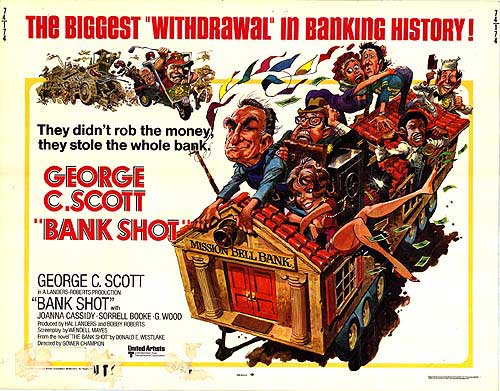
Criminally Underrated: George C. Scott in BANK SHOT (United Artists 1974)


gary loggins's avatarcracked rear viewer

I’m a big fan of the novels and short stories of Edgar Award-winning writer Donald E. Westlake , named a Grand Master by the Mystery Writers of America. His comic-laced crime capers featuring master planner Dortmunder were well suited for films and the first book in the series, THE HOT ROCK, was filmed by Peter Yates in 1972 with Robert Redford as the mastermind. Two years later came BANK SHOT, the second Dortmunder novel, starring George C. Scott but changing the character’s name to Walter Ballentine due to legal issues. Dortmunder or Ballentine, BANK SHOT is a zany film with a fine cast of actors that deserves another look.

Ballentine is doing life in Warden “Bulldog” Streiger’s maximum security prison, but when his shady “lawyer” and confidant Al G. Karp visits with an idea for a new “shot”, the hardened criminal makes his escape. Karp needs Ballentine’s expertise to plan the robbery of Mission Bell…

View original post 334 more words

Film Review: Kid Blue (1973, directed by James Frawley)


KidBlueFor the past week and a half, I have been on a major Warren Oates kick.  The latest Oates film that I watched was Kid Blue, a quirky western comedy that features Warren in a small but key supporting role.

Bickford Warner (Dennis Hopper) is a long-haired and spaced-out train robber who, after one failed robbery too many, decides to go straight and live a conventional life.  He settles in the town of Dime Box, Texas.  He starts out sweeping the floor of a barber shop before getting a better job wringing the necks of chickens.  Eventually, he ends up working at the Great American Ceramic Novelty Company, where he helps to make ashtrays for tourists.

He also meets Molly and Reese Ford (Lee Purcell and Warren Oates), a married couple who both end up taking an interest in Bickford.  Reese, who ignores his beautiful wife, constantly praised Greek culture and insists that Bickford take a bath with him.  Meanwhile, Molly and Bickford end up having an affair.

Bickford also meets the local preacher, Bob (Peter Boyle).  Bob is enthusiastic about peyote and has built a primitive flying machine that he keeps in a field.  The town’s fascist sheriff, Mean John (Ben Johnson), comes across Bob performing a river baptism and angrily admonishes him for using “white man’s water” to baptize an Indian.

Bickford attempts to live a straight life but is constantly hassled by Mean John, who suspects that Bickford might actually be Kid Blue.  When Bickford’s former criminal partner (Janice Rule) shows up in town and Molly announces that she’s pregnant, Bickford has to decide whether or not to return to his old ways.

Kid Blue is one of a handful of counterculture westerns that were released in the early 70s.  The film’s biggest problem is that, at the time he was playing “Kid” Blue, Dennis Hopper was 37 and looked several years older.  It’s hard to buy him as a naïve naif when he looks older than everyone else in the cast.  As for Warren Oates, his role was small but he did great work as usual.  Gay characters were rarely presented sympathetically in the early 70s and counter-culture films were often the worst offenders.  As written, Reese is a one-note (and one-joke) character but Warren played him with a lot of empathy and gave him a wounded dignity that was probably not present in the film’s script.

Kid Blue plays out at its own stoned pace, an uneven mix of quirky comedy and dippy philosophy.  Still, the film is worth seeing for the only-in-the-70s cast and the curiosity factor of seeing Dennis Hopper in full counterculture mode, before he detoxed and became Hollywood’s favorite super villain.

o_kid-blue-dvd-dennis-hopper-warren-oates-5cdc