Horror Review: The Dead Zone (dir. by David Cronenberg)


“Bless me, Father, for I have sinned. I had the power… and I tried to prevent what I saw.”Johnny Smith

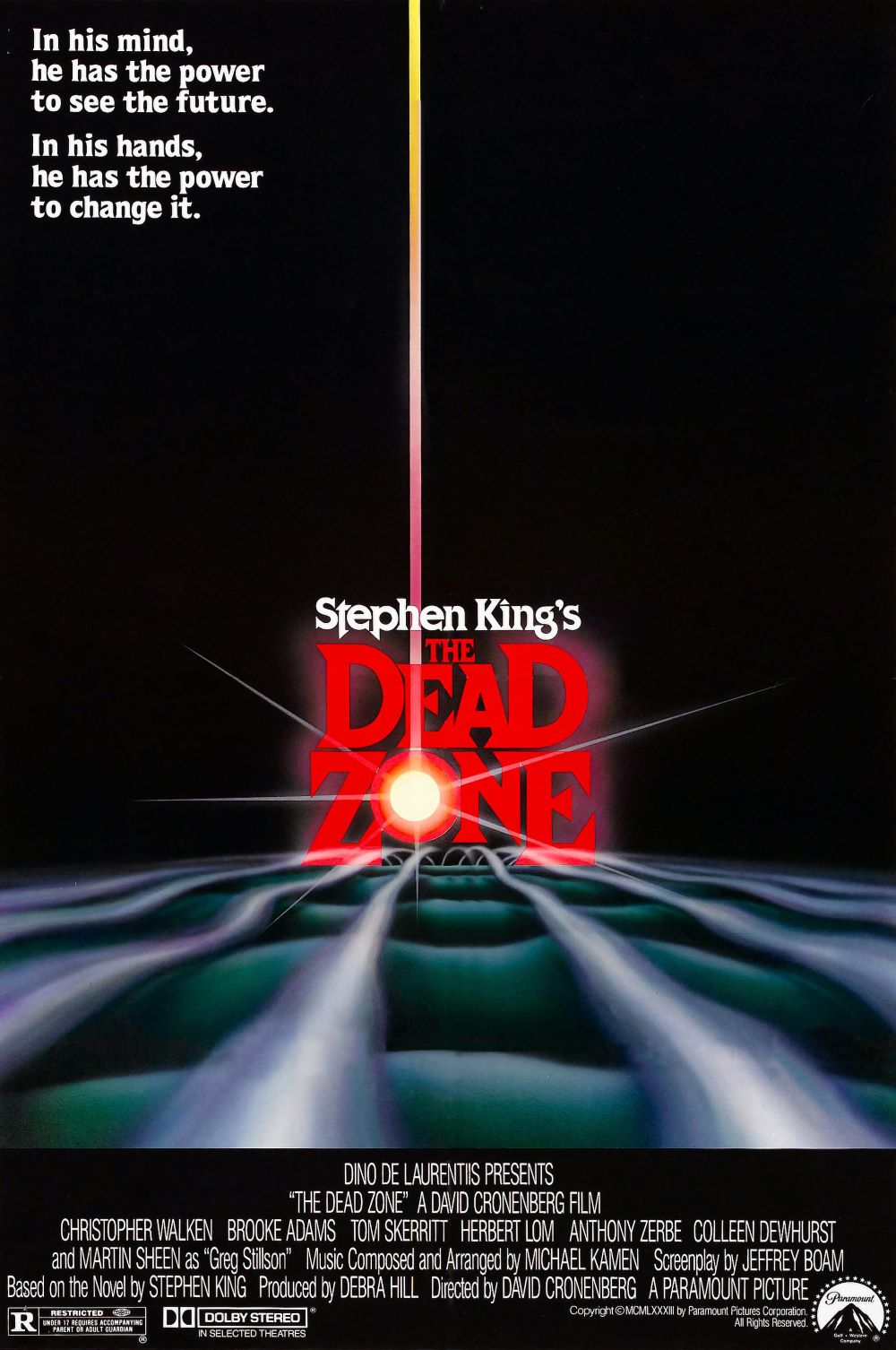
In 1983, David Cronenberg adapted Stephen King’s The Dead Zone with a distinctive emphasis on mood, morality, and psychological depth rather than traditional horror spectacle. The film follows Johnny Smith (Christopher Walken), a small-town schoolteacher whose life transforms irrevocably after a traumatic car accident leaves him in a five-year coma. Upon awakening, Johnny discovers he possesses psychic abilities that allow him to see the past and future by touch. Rather than a gift, this power becomes a heavy burden, isolating him and forcing him into wrenching moral choices.

Cronenberg’s direction is meticulous and deliberately restrained. The film’s muted color palette and stark winter landscapes visually echo Johnny’s emotional isolation and the fragility of human existence. His careful, often gliding camera movements create a mounting sense of quiet dread, while minimalistic sound design underscores moments of revelation with haunting subtlety. This subdued style elevates the film’s psychological impact, transforming it into a thoughtful and melancholy meditation on the cost of harrowing knowledge.

Significantly, The Dead Zone marks a departure from Cronenberg’s signature body horror. Instead of the grotesque physical transformations and visceral mutations that characterize much of his other work, here Cronenberg turns inward. The real horror lies in the malleability of the mind and the elusive nature of perception—how reality, memory, and the future are unstable constructs that can shift and fracture under psychic strain. This thematic focus on the impermanence and distortion of mental reality touches on some of Cronenberg’s deepest artistic fascinations.

The restrained treatment of body horror in The Dead Zone previews the director’s later, more psychologically driven films such as A History of ViolenceEastern Promises, and A Dangerous Method, where character studies and narrative depth take precedence over startling visuals. In this early pivot, Cronenberg demonstrates that his mastery lies not only in visual spectacle but in probing the profound emotional and moral dilemmas faced by his characters. The vision-focused horror here is cerebral and grounded, rooting supernatural phenomena in human frailty and ethical complexity.

Christopher Walken’s nuanced portrayal is the emotional heart of the film. He captures Johnny’s vulnerability, weariness, and profound solitude, portraying a man burdened by a cursed knowledge that isolates him from the world. Martin Sheen plays Greg Stillson, the ambitious and morally bankrupt politician whose rise Johnny must foretell and who embodies the film’s central threat. The supporting cast, including Brooke Adams as Johnny’s lost love Sarah and Tom Skerritt as Sheriff Bannerman, delivers compelling and authentic performances that humanize the film’s intimate, small-town environment.

Several changes from King’s novel sharpen the film’s thematic focus. The novel’s sprawling plot, including a serial killer subplot and a brain tumor storyline symbolizing Johnny’s mortality, is pared down or omitted. Despite this trimming, the serial killer element retained in the film remains chilling and effective. It highlights the darker repercussions of Johnny’s psychic gift and injects a tangible sense of dread, reinforcing the psychological weight Johnny carries. This subplot grounds the supernatural within a disturbing reality, illustrating the violent and tragic circumstances Johnny must grapple with as part of his burden.

The concept of the “dead zone” itself shifts in meaning. Originally, the term referred to parts of Johnny’s brain damaged by the accident, blocking certain visions. Cronenberg reinterprets it as a metaphor for the unknown and unknowable parts of the future—the gaps in psychic clarity that allow for free will and change. This subtle shift reshapes the narrative toward a more ambiguous, hopeful meditation on destiny and human agency.

Compared to King’s novel, Cronenberg’s Johnny is more grounded and isolated. The novel frames Johnny’s struggle within a broader spiritual and fatalistic context, highlighted by the looming presence of a brain tumor and a nuanced exploration of hope versus resignation. The film, by contrast, focuses on the emotional and moral fatigue induced by Johnny’s psychic gift, emphasizing his loneliness and reluctant responsibility rather than supernatural destiny.

Walken’s restrained, haunting performance strips away mythic grandeur to reveal a deeply human character. The film’s narrowed narrative tightens focus on Johnny’s internal anguish and his difficult ethical choices, making his plight intimate and richly relatable.

On a thematic level, The Dead Zone contemplates fate, free will, and sacrifice. Johnny’s psychic abilities act as a draining, almost chthonic force, transforming him into a reluctant prophet who is tasked with intervening in grim futures at great personal cost. The film’s bleak winter setting visually reflects Johnny’s alienation, while its deliberate pacing highlights the exhaustion and heartbreak that comes with such knowledge.

Ultimately, Cronenberg’s The Dead Zone goes beyond supernatural thriller conventions. It is a profound meditation on empathy, sacrifice, and the human condition—where the greatest horrors are internal, and the cost of knowledge is both psychic and emotional. Johnny Smith emerges as a tragic, flawed figure wrestling with unbearable burdens.

Cronenberg’s direction and the impeccable performances make The Dead Zone a standout in King adaptations. The film’s enduring impact lies in its rich thematic texture, its moral ambiguity, and its unflinching exploration of human frailty, all conveyed through a director shifting skillfully from physical body horror to psychological and existential terror. The film remains as haunting and resonant now as it was upon release, a testament to the synergy of Cronenberg and King’s extraordinary talents.

King of New York (1990, directed by Abel Ferrara)


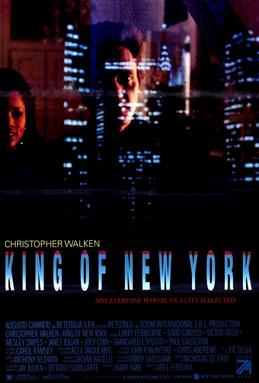
Drug kingpin Frank White (Christopher Walken) has been released from prison and is again on the streets of New York City.  Frank might say that he’s gone straight but, as soon as he’s free, he’s  partying with his old crew (including Laurene Fishburne, Steve Buscemi, Giancarlo Esposito, and others).   While Frank’s agent (Paul Calderon) goes to all of the other city’s gangsters and explains that they can either get out of Frank’s way or die, three detectives (Victor Argo, David Caruso, and Wesley Snipes) make plans to take Frank out by any means necessary.  Meanwhile, Frank is donating money to politicians, building hospitals, and presenting himself as New York’s savior.

King of New York is the epitome of a cult film.  Directed by Abel Ferrara, the dark and violent King of New York was originally dismissed by critics and struggled to find an audience during its initial theatrical run.  (It was lumped in with and overshadowed by other 1990 gangster films like Goodfellas and Godfather Part III.)  But it was later rediscovered on both cable and home video and now it’s rightly considered to be a stone cold crime classic.  Walken gives one of his best performances as Frank White and that’s not a surprise.  The film was clearly made to give Walken a chance to show off what he could do with a lead role and Walken captures Frank’s charisma and humor without forgetting that he’s essentially a sociopath.  Walken gives a performance that feels like James Cagney updated for the end of the 80s.  What’s even more impressive is that all of the supporting characters are just as memorable as Walken’s Frank White.  From Laurence Fishburne’s flamboyant killer to David Caruso’s hotheaded cop to Paul Calderon’s slippery agent to Janet Julian’s morally compromised attorney, everyone gives a strong performance.  (I’m usually not a Caruso fan but he’s legitimately great here.)  They come together to bring the film’s world to life.  Everyone has their own reason for obsessing on Frank White and his return to power.  I’ve always especially appreciated Victor Argo as the weary, veteran detective who finds himself trapped by Caruso and Wesley Snipes’s impulsive plan to take down Frank White.  Frank White and the cops go to war and it’s sometimes hard to know whose side to be on.

Director Abel Ferrara has had a long and storied career, directing films about morally ambiguous people who are often pushed to extremes.  Personally, I think King of New York is his best film, a portrait of not just a criminal but also of a city that combines the best and the worst of human nature.  The action is exciting, the cast is superb, and Frank’s justifications for his behavior sometimes make a surprising amount of sense.  Thought there’s occasionally been speculation that it could happen, there’s never been a sequel to King of New York and it doesn’t need one.  King of New York is a film that tell you all that you need to know about Frank White and the city that he calls home.


Scene That I Love: Christopher Walken in King of New York


Today’s scene is from Abel Ferrara’s 1990 gangster epic, King of New York.  Featuring Christopher Walken and a host of familiar faces, it’s one of those scenes that simply just has to be seen.

Days of Paranoia: The Anderson Tapes (by Sidney Lumet)


In 1971’s The Anderson Tapes, Sean Connery stars as Duke Anderson.

Duke is a career criminal, a safecracker who has just spent ten years in prison.  He’s released, alongside Pops (Stan Gottlieb), who spent so much time behind bars that he missed two wars and the Great Depression, and the quirky Kid (Christopher Walken, making his film debut).  Duke immediately hooks up with his former girlfriend, Ingrid (Dyan Cannon), and decides to rob the luxury apartment building where Ingrid is now living.

Of course, Duke will have to put together a crew.  It’s not a heist film without a quirky crew, is it?  Duke recruits the Kid and Pops.  (The Kid is happy to be in the game but he’s not a fan of violence.  Pops, meanwhile, has none of the skills necessary for living in the “modern” world and would much rather return to prison.)  Duke also brings in the flamboyant Tommy Haskins (an overacting Martin Balsam) and driver Edward Spencer (Dick Anthony Williams).  Duke goes to the mob for backing and Pat Angelo (Alan King) gives it to him on the condition that he take along a sociopathic racist named Socks (Val Avery) and that Duke kills Socks at some point.  Duke reluctantly agrees.

So far, this probably sounds like a conventional heist film.  Director Sidney Lumet mixes comedy and drama with uneven results but, overall, he does a good job of ratcheting up the tension and The Anderson Tapes is a good example of one of my favorite mini-genres, the “New Yorkers will be rude to anyone” genre.  At first glance, Sean Connery seems to be playing yet another super smooth operator, a confident criminal with a plan that cannot fail.  Duke seems like a criminal version of James Bond,  However, as the film progresses, we start to suspect that things might be getting away from Duke.  When Duke has to go the Mafia for support and is told that killing Socks is now a part of the job, we see that Duke isn’t as in-control of the situation as we originally assumed.  This is the rare Sean Connery film where he has someone pushing him around.

(Apparently, Connery took this role as a part of his effort to escape being typecast as Bond.  Perhaps that explains why Duke seems like almost a deconstruction of the James Bond archetype.)

Of course, what really lets us know that Duke isn’t as in-charge as he assumes is the fact that four different law enforcement agencies are following his every move.  From the minute he gets out of prison, Duke is being watched.  The apartment is bugged.  Security cameras records his every move.  Once the heist begins, we’re treated to flash forwards of breathless news reports.  The Anderson Tapes is less a heist film and more a portrait of the early days of the modern Surveillance State.  Of course, none of the agencies make any moves to stop Duke because doing so would reveal their own existence.  The film really does become a portrait of a government that has gotten so big and intrusive that it’s also lost the ability to actually do anything.

The Anderson Tapes is entertaining, even if it’s not really one of Lumet’s best.  Connery is, as always, a fascinating screen presence and it’s always entertaining to see a young Christopher Walken, showing early sings of the quirkiness that would become his signature style.  The Anderson Tapes is a portrait of a world where you never know who might be listening.

Last Man Standing (1996, directed by Walter Hill)


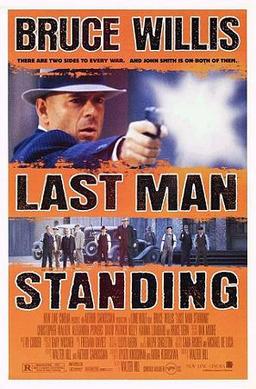
During the 1920s, at the height of prohibition, a mysterious man named John Smith (Bruce Willis) arrives in the dusty town of Jericho.  Jericho sits on the border, between Texas and Mexico, and it is the site of a gang war.  The Italian mob, led by Fred Strozzi (Ned Eisenberg) and Giorgio Carmote (Michael Imperioli), is trying to move in on the Irish mob, led by Doyle (David Patrick Kelly) and his fearsome gunman, Hickey (Christopher Walken).  After the members of the Irish mob destroy his car and leave him stranded in town, Smith offers his services as a gunman to the Italians.  Strozzi hires him but it turns out that Smith has his own agenda and soon, he is manipulating both gangs against each other.

Last Man Standing was Walter Hill’s remake of Yojimbo, with Bruce Willis playing an Americanized version of Toshiro Minfune’s wandering ronin.  (Hill does the right thing and gives Kurosawa credit for the film’s story.)  Now, it should be understood that this is in no way a realistic film.  It makes no sense for two Chicago-style gangs to be fighting over a ghost town in Texas.  Even when it came to smuggling in liquor during the prohibition era, most of it came over the Canadian border rather than the Texas border.  But Walter Hill has always been more about filming the legend than worrying about realism.  He’s the ultimate stylist, creating movies the come together to create an American mythology.  Last Man Standing is a work of pure style, a combination western/gangster movie that pays tribute to the ultimate samurai film.  Gangsters meeting in the desert while tumbleweed rolls past may not make sense but Hill knows a good visual when he sees one and he makes it work.  The plot is taken from Yojimbo.  The western setting is taken from A Fistful of Dollars.  And the gangsters are pure Americana.

Willis, back in his action star heyday, is quick with a gun and a quip and he gets a few scenes that show that, while he may be bad, he’s not as bad as the gangsters in charge of the town.  Hill surrounds Willis with a cast of great character actors, including Bruce Dern as the cowardly sheriff and William Sanderson as the owner of the hotel.  Though he might not be as well-known as some members of the cast, I especially liked Ken Jenkins as the Texas Ranger who informs Willis that he has ten days to finish up his business before the Rangers come to town and kill whoever is still standing.  And then you’ve got Walken, in one of his best villainous roles.  Hickey doesn’t show up until pretty late in the movie but we’ve spent so much time hearing about him that we already know he’s the most dangerous man in Texas and Walken gives a performance that lives up to the hype.

Unappreciated when it was first released, Last Man Standing has stood the test of time as one of Walter Hill’s best.

At Close Range (1986, directed by James Foley)


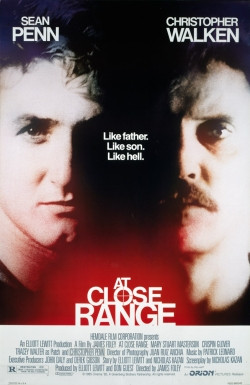
Brad Whitewood, Sr. (Christopher Walken) is known as Big Brad, a rural crime lord who rules the backwoods of Pennsylvania.  When his son, Little Brad (Sean Penn, trying too hard to be James Dean), comes to live with him, Big Brad goes out of his way to try to bring the teenager into his criminal lifestyle.  At first, Little Brad loves being a part of the family business but witnessing a murder and falling in love with Terry (Mary Stuart Masterson) caused Little Brad to start to move away from his father.  With the FBI closing in on the Whitewood family, Brad Sr. starts to eliminate everyone who he considers to be a threat, including the members of his own family.

Based on a true story, this neo-noir features a great cast, including Chris Penn, Millie Perkins, Kiefer Sutherland, Crispin Glover, David Strathairn, Tracey Walter, and Mary Stuart Masterson.  Unfortunately, the movie itself moves at a plodding pace.  There are some good and disturbing scenes, like the montage where Big Brad starts to eliminate the members of his gang.  The film does a good job of showing how seductive Big Brad’s criminal lifestyle can be to a bunch of kids who have basically been written-off by society.  But the story itself is so bleak that most people will end up tuning out long before Little Brad finally turns against his father.

Whatever other flaws it may have, At Close Range does feature one of Christopher Walken’s best performances.  Walken is chillingly evil as Big Brad.  He’s got enough charisma to be believable as someone who could bring a gang together but he’s also frightening as he starts killing anyone who he thinks might talk to the police or the FBI.  Big Brad is a remorseless killer and Walken plays him as being a classic sociopath, someone who cannot understand why the members of his gang and family would get upset when he starts killing some of them.  To Big Brad, that just goes with the territory.  It’s a part of doing business.  With his distinct way of speaking and his trademark tics, Walken is someone who has inspired many impersonators and it can be easy to forget that he’s also a damn good actor.  Films like At Close Range remind us of just how talented Walken actually is.

Music Video of the Day: Weapon of Choice by Fatboy Slim (2001, dir by Spike Jonze)


Val wrote about this music video way back in 2016.  I’m sharing it again because today is Christopher Walken’s 82nd birthday!  Walken trained as a dancer before going into acting and he gets to show off more than a few moves in this video.

Walken also trained as a lion tamer before he went into acting.  I guess he’s a little bit old to play a lion tamer now but still, that’s something I would have liked to have seen.

Enjoy!

Film Review: Heaven’s Gate (dir by Michael Cimino)


First released in 1981 and then re-released in several different versions since then, Heaven’s Gate begins at Harvard University.

The year is 1870 and the graduates of Harvard have got their entire future ahead of them.  At the graduation ceremony, Joseph Cotten gives a speech about how, as men of cultivation, they have an obligation to help the uncultivated.  Student orator Billy Irvine (John Hurt) then gives a speech  in which he jokingly says the exact opposite.  Amongst the graduates, Billy’s friend, Jim Averill (Kris Kristofferson), laughs at Billy’s speech.  It’s a bit of a strange scene, if just because all of the graduates appear to be teenagers except for Hurt and Kristofferson, who are both clearly in their 30s.  The graduates of Harvard sing to their girlfriends and dance under a tree and, for a fleeting moment, all seems to be right with the world.

Twenty years later, all seems to be wrong with the world.  Averill is now the rugged and world-weary marshal of Johnson Country, Wyoming.  Cattle barons are trying to force immigrant settlers to give up their land.  Gunmen, like Nate Champion (Christopher Walken) and Nick Ray (Mickey Rourke), are accepting contracts to execute immigrants who are suspected of stealing cattle.  When Averill stands up for the people of Johnson Country, the head of the Wyoming Stock Grower Association, Frank Canton (Sam Waterston), hires a group of mercenaries to ride into Johnson County and execute 125 settlers.  Billy Irvine, who now is dissolute alcoholic who works with Canton, warns his old friend Averill.  Averill, who has fallen in love with Ella (Isabelle Huppert), the local madam, announces that he will defend the immigrants.  Nate, who is also in love with Ella, considers changing sides.

Heaven’s Gate is loosely based on an actual event.  I actually have three distant ancestors who traveled to Wyoming to take part in the Johnson County War.  All three of them survived, though one of them was shot and killed in an unrelated manner shortly after returning to Ft. Smith, Arkansas.  That said, director Michael Cimino is clearly not that interested in the historical reality of the Johnson County War or the issues that it raised.  Just as he did with Vietnam in The Deer Hunter, Cimino uses the Johnson County War as a way to signify a loss of national innocence.  Averill and Irvine start the film as hopeful “young” men with the future ahead of them.  By the end of the film, one is dead and the other is living on a yacht and dealing with what appears to be crippling ennui.

Heaven’s Gate is a bit of an infamous film.  Though the film was pretty much a standard western, Cimino still went far over-budget and turned in a first cut that was over six hours long.  A four hour version was briefly released in 1980 but withdrawn after a week, due to terrible reviews and audience indifference.  A studio-edited version that ran for two hours and 35 minutes got the widest release in 1981.  Since then, there have been several other versions released.  Cimino’s director’s cut, which was released as a part of the Criterion Collection in 2012, runs for 212-minutes and is considered to now be the “official” version of Heaven’s Gate.

For years, Heaven’s Gate had a terrible reputation.  It’s failure at the box office was blamed for bankrupting United Artists.  After the excesses of the Heaven’s Gate production, studios were far more reluctant to just give a director a bunch of money and let him run off to make his movie.  (They should have learned their lesson with Dennis Hopper and The Last Movie.)  Described by studio execs as being self-indulgent and even mentally unstable, Michael Cimino’s career never recovered and the director of The Deer Hunter went from being an Oscar-winner to being an industry pariah.  (Some who disliked The Deer Hunter’s perceived jingoistic subtext claimed that Heaven’s Gate proved The Deer Hunter was just an overrated fluke.)  However, the reputation of Heaven’s Gate has improved, especially with the release of Cimino’s director’s cut.  Many critics have praised Heaven’s Gate for its epic portrayal of the west and, ironically given the controversy over The Deer Hunter, its political subtext.  It’s anti-immigrant villains made the film popular amongst the Resistance-leaning film historians during the first Trump term.

So, is Heaven’s Gate a masterpiece or a disaster?  To be honest, it’s somewhere in between.  Whereas it was once over-criticized, it’s now over-praised.  Visually, it’s a beautiful film but those who complained that the film was too slow had a point.  As with The Deer Hunter, Cimino takes the time to introduce us to and immerse us in a tight-knit immigrant community.  Personally, I like the much-criticized scenes of the fiddler on skates and Averill and Ella dancing in the roller rink.  Overall though, as opposed to The Deer Hunter, the members of the film’s victimized community still feel less like individual characters and more like symbols.  As for the political subtext, I think that any subtext of that sort is accidental.  (I feel the same way about The Deer Hunter, which I like quite a bit more than Heaven’s Gate.)  Cimino is more interested in the loss of innocence than whether or not the Johnson County War can be fit into some sort of nonsense Marxist framework.

The main problem with the film is that there is no center to keep everything grounded.  Kris Kristofferson had a definite screen presence but, as an actor who was incapable of showing a great deal of emotion, he lacks the gravitas necessary to keep from being swallowed up by Cimino’s epic pretensions.  Isabelle Huppert, an otherwise great actress, also feels lost in the role of Ella and Sam Waterston is not necessarily the most-intimidating villain to ever show up in a western.  Christopher Walken, as the enigmatic and intriguing Nate Champion, gives the best performance in the film but his character still feels largely wasted.

There are some brilliant visual moments to be found in Heaven’s Gate.  I even like the Harvard prologue and the ending on the boat, both of which are not technically necessary to the narrative but still add an extra-dimension to both Averill and Irvine.  But, in the end, Heaven’s Gate is big when it should have been small and epic when its should have been intimate.  It’s a misfire but not a disaster.  Even great directors occasionally have a film that just doesn’t work.  Speilberg had his 1941.  Scorsese has had a handful.  Coppola’s career has been a mess but no one can take his successes away from him.  Michael Cimino, who passed away in 2016, deserved another chance.

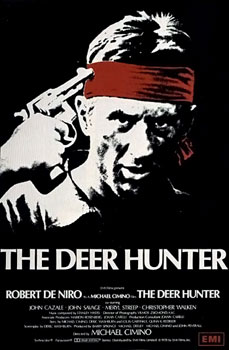
Lisa Reviews An Oscar Winner: The Deer Hunter (dir by Michael Cimino)


The Deer Hunter, which won the 1978 Oscar for Best Picture Of The Year, opens in a Pennsylvania steel mill.

Mike (Robert De Niro), Steve (John Savage), Nick (Chistopher Walken), Stan (John Cazale), and Axel (Chuck Aspegren, a real-life steel worker who was cast in this film after De Niro met him while doing research for his role) leave work and head straight to the local bar, where they are greeted by the bartender, John (George Dzundza).  It’s obvious that these men have been friends for their entire lives.  They’re like family.  Everyone gives Stan a hard time but deep down, they love him.  Axel is the prankster who keeps everyone in a good mood.  Nick is the sensitive one who settles disputes.  Steve is perhaps the most innocent, henpecked by his mother (Shirley Stoler) and engaged to marry the pregnant Angela (Rutanya Alda), even though Steve knows that he’s not actually the father.  And Mike is their leader, a charismatic if sometimes overbearing father figure who lives his life by his own code of honor.  The men are held together by their traditions.  They hunt nearly every weekend.  Mike says that it’s important to only use one shot to kill a deer.  Nick, at one point, confesses that he doesn’t really understand why that’s important to Mike.

Steve and Angela get married at a raucous ceremony that is attended by the entire population of their small town.  The community is proud that Nick, Steve, and Mike will all soon be shipping out to Vietnam.  Nick asks his girlfriend, Linda (Meryl Streep), to marry him when he “gets back.”  At the reception, Mike gets into a fight with a recently returned soldier who refuses to speak about his experiences overseas.  Mike ends up running naked down a street while Nick chases him.

The Deer Hunter is a three-hour film, with the entirety of the first hour taken up with introducing us to the men and the tight-knit community that produced them.  At times, that first hour can seem almost plotless.  As much time is spent with those who aren’t going to Vietnam as with those who are.  But, as the film progresses, we start to understand why the film’s director, Michael Cimino, spent so much time immersing the viewer in that community of steel workers.  To understand who Nick, Mike, and Steve are going to become, it’s important to know where they came from.  Only by spending time with that community can we understand what it’s like to lose the security of knowing where you belong.

If the first hour of the film plays out in an almost cinema verité manner, the next two hours feel like an increasingly surreal nightmare.  (Indeed, there was a part of me that suspected that everything that happened after the wedding was just Michael’s drunken dream as he lay passed out in the middle of the street.)  The film abruptly cuts from the beautiful mountains of Pennsylvania to the violent horror of Vietnam.  A Viet Cong soldier blows up a group of hiding women and children.  Michael appears out of nowhere to set the man on fire with a flame thrower.  An army helicopter lands and, in a coincidence that strains credibility, Nick and Steve just happen to get out.  Somehow, the three friends randomly meet each other again in Vietnam.  Unfortunately, they are soon captured by the VC.

They are held prisoner in submerged bamboo cages.  Occasionally, they are released and forced to play Russian Roulette.  Mike once again becomes the leader, telling Steve and Nick to stay strong.  Eventually, the three men do manage to escape but Steve loses his leg in the process and a traumatized Nick disappears in Saigon.  Only Mike returns home.

The community seems to have changed in Mike’s absence.  The once boisterous town is now quiet and cold.  The banner reading “Welcome Home, Mike” almost seems to be mocking the fact that Mike no longer feels at home in his old world.  Stan, Axel, and John try to pretend like nothing has changed.  Mike falls in love with Linda while continuing to feel guilty for having abandoned Nick in Saigon.  Steve, meanwhile, struggles to come to terms with being in a wheelchair and Nick is still playing Russian Roulette in seedy nightclubs.  Crowds love to watch the blank-faced Nick risk his life.

Eventually, Mike realizes that Nick is still alive.  Somehow, Mike ends up back in Saigon, just as the government is falling.  Oddly, we don’t learn how Mike was able to return to Saigon.  He’s just suddenly there.  It’s the type of dream logic that dominates The Deer Hunter but somehow, it works.  Mike searches for Nick but will he be able to save his friend?

The Deer Hunter was one of the first major films to take place in Vietnam.  Among the pictures that The Deer Hunter defeated for Bet Picture was Coming Home, which was also about Vietnam but which took a far more conventional approach to its story than The Deer Hunter.  Indeed, while Coming Home is rather predictable in its anti-war posture, The Deer Hunter largely ignores the politics of Vietnam.  Mike, Nick, and Steve are all traumatized by what they see in Vietnam.  Mike is destroyed emotionally, Steve is destroyed physically, and Nick is destroyed mentally.  At the same time, the VC are portrayed as being so cruel and sadistic that it’s hard not to feel that the film is suggesting that, even if we did ultimately lose the war, the Americans were on the correct side and trying to do the right thing.  (Many critics of The Deer Hunter have pointed out that there are no records of American POWs being forced to play Russian Roulette.  That’s true.  There are however records of American POWs being forced to undergo savage torture that was just as potentially life-threatening.  Regardless of what one thinks of America’s involvement in Vietnam, there’s no need to idealize the VC.)  Released just a few years after the Fall of Saigon, The Deer Hunter was a controversial film and winner.  (Of course, in retrospect, the film is actually quite brilliant in the way it appeals to both anti-war and pro-war viewers without actually taking a firm position itself.)

In the end, though, The Deer Hunter isn’t really about the reality of the war or the politics behind it.  Instead, it’s a film about discovering that the world is far more complicated that you originally believed it to be.  De Niro is a bit too old to be playing such a naive character but still, he does a good job of portraying Mike’s newfound sense of alienation from his former home.  In Vietnam, everything he believed in was challenged and he returns home unsure of where he stands.  While John, Axel, and Stan can continue to hunt as if nothing happened, Mike finds that he can no longer buy into his own philosophical BS about the importance of only using one shot.  Everything that he once believed no longer seems important.

It’s a good film and a worthy winner, even if it does sometimes feel more like a happy accident than an actual cohesive work of art.  The plot is often implausible but then again, the film takes place in a world gone mad so even the plot holes feel appropriate to the story being told.  Christopher Walken won an Oscar for his haunting performance as Nick and John Savage should have been nominated alongside of him.  This was Meryl Streep’s first major role and she gives a surprisingly naturalistic performance.  During filming, Streep was living with John Cazale and she largely did the film to be near him.  Cazale was dying of lung cancer and he is noticeably frail in this film.  (I cringed whenever Mike hit Stan because Cazale was obviously not well in those scenes.)  Cazale, one of the great character actors of the 70s, died shortly after filming wrapped.  Cazale only appeared in five films and all of them were nominated for Best Picture.  Three of them — The first two Godfathers and The Deer Hunter — won.

The Deer Hunter is a long, exhausting, overwhelming, and ultimately very moving film.  Whatever flaws it may have, it earns its emotional finale.  Though one can argue that some of the best films of 1978 were not even nominated (Days of Heaven comes to mind, as do more populist-minded films like Superman and Animal House), The Deer Hunter deserved its Oscar.

Christopher Walken Reads Edgar Allan Poe’s The Raven!


Have you ever wanted to hear Christopher Walken read The Raven?  Of course you have!  Who hasn’t?

Well, today is your lucky day!  Here is Christopher Walken, reciting Edgar Allan Poe’s The Raven.  This was apparently recorded for a CD entitled Closed For Rabies, which featured several celebrities reading stories and poems by Mr. Poe.