“His only fault is going too far. But his anxiety about the bomb is something we all share.” — Dr. Harada
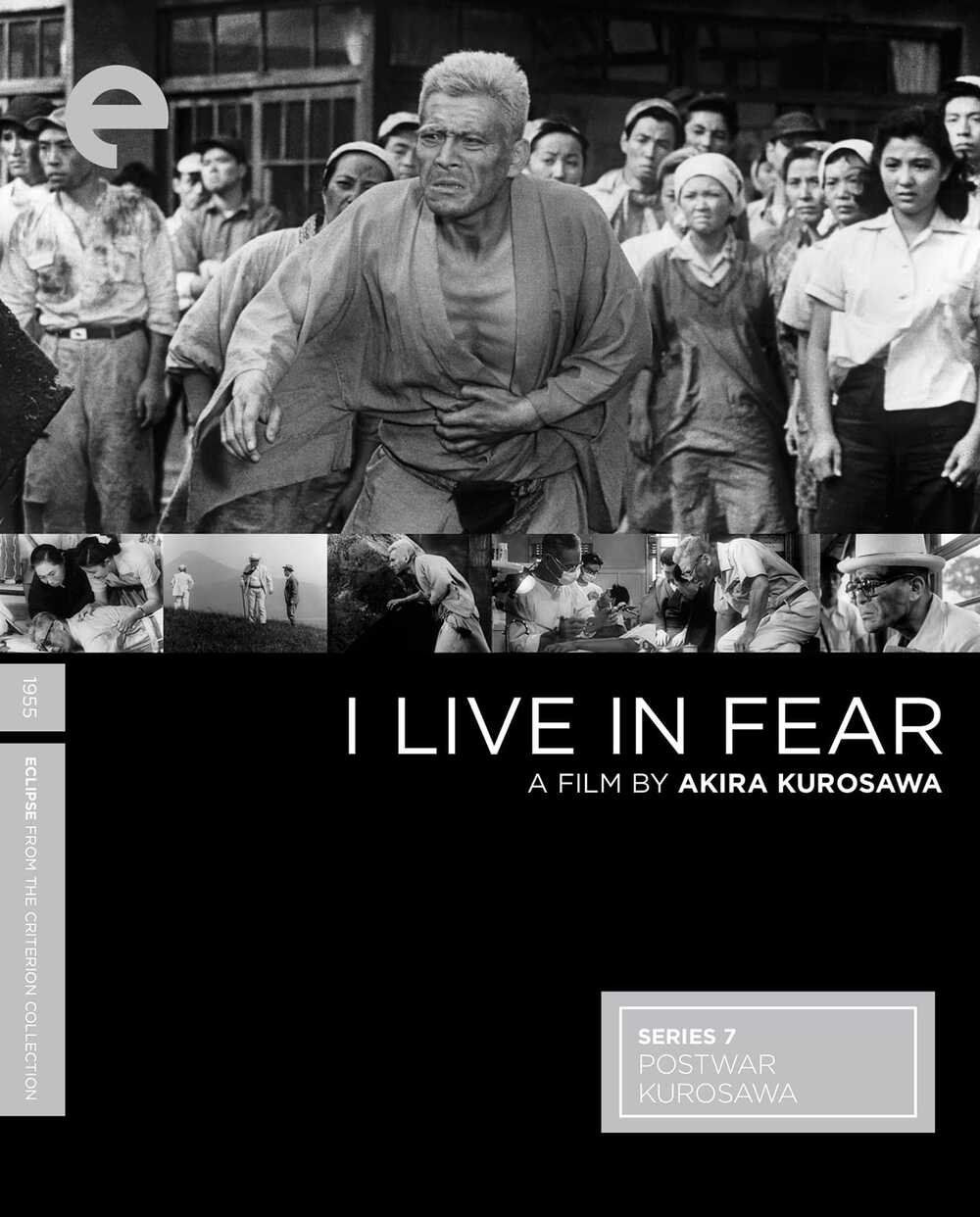
There’s something uncomfortable about watching a family discuss a man’s sanity when his greatest fear makes perfect sense. That discomfort drives Akira Kurosawa’s I Live in Fear (1955), a film in which the threat of nuclear destruction finds its way into arguments about property, responsibility, and who gets to make decisions for everyone else. Kurosawa keeps the apocalypse offscreen and lets its shadow fall across an already strained household. The result is less a warning about some distant disaster than a prickly, intimate study of people trying to live together when they no longer agree on what being reasonable means.
The story revolves around Kiichi Nakajima, an aging foundry owner played by Toshiro Mifune. Convinced that nuclear catastrophe is coming, he wants to sell his business and relocate his sprawling family to Brazil. His relatives, understandably unwilling to have their lives uprooted, petition to have him declared mentally incompetent. What might sound like a straightforward conflict between an unreasonable father and his practical children quickly becomes murkier. Nakajima’s proposed solution may be desperate, but the danger behind it isn’t imaginary. The family can challenge his judgment much more easily than they can disprove the thing he fears.
That distinction gives the film its staying power. Kurosawa isn’t asking us to endorse Nakajima’s escape plan; he’s asking us to notice how readily a legitimate terror becomes somebody else’s embarrassing problem. The film emerged amid renewed Japanese anxiety about nuclear testing, including the exposure of Japanese fishermen to radioactive fallout from tests at Bikini Atoll. This isn’t abstract doomsday speculation floating above the drama. It’s recent history pressing against the walls of an ordinary household. The courtroom can assess a man’s capacity to manage his property, but it cannot make the atmosphere outside those proceedings any safer.
Mifune is the film’s great, fascinating gamble. Playing a man considerably older than himself, he makes Nakajima seem tightly wound even when he’s barely moving. The stooped posture and elderly appearance are conspicuous, sometimes almost too conspicuous, but the performance’s physical tension matters more than its illusion of age. This is a man who has spent years expecting the world to respond to his commands and now faces something that cannot be bullied into submission. Mifune turns that helplessness into irritability, stubbornness, and sudden emotional exposure. You can find Nakajima exhausting without ever feeling safely superior to him.
What keeps the characterization interesting is that fear hasn’t magically made Nakajima a better person. His desire to protect his family is tangled up with his assumption that he should decide its future. The household also extends beyond a tidy domestic unit: his plans include mistresses and children from those relationships, making protection inseparable from a complicated history of patriarchal privilege. He wants everyone saved, but he also wants everyone aboard his solution. That contradiction gives the film a sharper edge than a simple portrait of a misunderstood prophet. Love can be genuine and still arrive wearing the clothes of control.
The relatives benefit from a similarly complicated reading. It would be easy to dismiss them as greedy people guarding an inheritance, and the film certainly makes room for that suspicion. Yet wanting to keep your home, livelihood, and familiar surroundings isn’t automatically moral cowardice. Nakajima’s money supports an existing network of lives; dismantling that network has consequences beyond bruised feelings. The family dispute becomes compelling precisely because almost everyone has something reasonable to say and something less flattering to conceal. Kurosawa lets financial dependence expose the awkward bargains underneath domestic loyalty. Affection doesn’t disappear when property enters the conversation, but it gets harder to recognize.
Takashi Shimura provides the crucial counterweight as Dr. Harada, a dentist serving as a family-court mediator. Where Mifune compresses every feeling into physical agitation, Shimura makes uncertainty visible through listening. Harada initially occupies the reassuring position of the sensible observer, someone who can help sort out another family’s trouble. Gradually, that distance becomes impossible to maintain. He can see the disruption Nakajima causes, yet he cannot dismiss the reasoning beneath it. His importance lies less in supplying an answer than in losing confidence in the available answers. Through him, the case stops being merely a question of one troublesome man.
Visually, the film exchanges the expansive physical excitement associated with Seven Samurai for a more constricted, claustrophobic intensity. Rooms feel occupied not just by people but by their incompatible expectations. Kurosawa’s handling of groups is especially effective: a conversation can feel like a gathering, a negotiation, and a quiet ambush all at once. The settings remain ordinary enough to deny us the comforting distance of spectacle. There’s no need to show civilization collapsing when the possibility of collapse has already changed how a father looks at his children. The catastrophe exists first as pressure, and pressure is something cinema can make almost bodily.
There’s a literary quality to the premise, too: a patriarch discovers that his authority cannot protect the people whose lives he organizes. He resembles a tragic king reduced to arguing over practical arrangements, with emigration plans replacing the grand gestures of an older tragedy. But Kurosawa keeps puncturing that grandeur with mundane complications. Someone must agree, money must move, livelihoods must be considered. That friction is the point. Apocalyptic fear doesn’t exempt anyone from ordinary responsibilities; it makes those responsibilities feel simultaneously urgent and absurd. Nakajima cannot reconcile the scale of his dread with the small, stubborn procedures through which daily life continues.
For all its force, I Live in Fear can be blunt, and its shifts between family drama and moral argument aren’t always graceful. Yet those limitations seem small beside the unease it leaves behind. Mifune gives us a man whose concern for others has become almost impossible for others to bear, while Shimura quietly erodes our confidence in judging him from a comfortable distance. What lingers is not an argument won but a human connection breaking under unbearable pressure. Kurosawa makes that rupture painful to watch, then leaves us to consider how much of ordinary life depends on agreeing not to look too closely at what frightens us.
Kurosawa-Mifune Collaborations

