When renowned radio psychiatrist George Matlin (Charles Grodin) has a nervous breakdown, he takes a trip to Europe with his wife (Mary Gross) to both recover and also work on his marriage. (Matlin’s breakdown was the result of an extramarital affair.) Needing someone to host Dr. Matlin’s radio show, his producers call Dr. Lawrence Baird (David Clennon), who oversees a mental facility in Chicago. They assume that Dr. Baird is just dumb enough that they won’t have to worry about him overshadowing Dr. Matlin while he’s guest-hosting. However, when they call, Dr. Baird is out of his office and the phone is answered by John Burns (Dan Aykroyd), a con artist who has been pretending to be insane so that he can avoid serving time in prison. Pretending to be Baird, Burns accepts their offer and then escapes from the asylum and heads to Beverly Hills. The real Dr. Baird, not knowing about the offer, goes on vacation in Europe. Though Burns had originally only been planning on doing the radio job long enough to get paid enough money to head to Mexico, he soon becomes a celebrity with his non-nonsense, blunt advice.
There’s a lot of talented people in TheCouchTrip, including Walter Matthau as a former priest-turned-kleptomaniac and Aykryod’s wife, Donna Dixon, as Matlin’s colleague and Burns’s eventual love interest. Director Michael Ritchie was responsible for some of the best films of the 70s and radio psychiatry is certainly a ripe subject for satire. Why, then does, The Couch Trip fall flat? Some of it is because the movie never seems to know if it wants to be wacky farce or a dramedy about a criminal who finds a new life helping people. The other big problem is that the talented Dan Aykroyd is miscast as the type of unapologetic smartass that Bill Murray could play in his sleep. (In a version where Murray played John Burns, Aykroyd would have been perfect casting as George Matlin.)
Aykroyd was one of the most talented members of the original Not Ready For Prime Time Players. (His impersonations of Nixon and Jimmy Carter were second-to-none.) Sadly, Hollywood has never figured out what to do with his off-center talent. The Couch Trip is a prime example of that.
Episode 16 opens with Shane (David Carradine) back in Cheyenne, WY. He has joined up with Major Hackett’s (Bradford Dillman) outfit to try to find out the Major’s plans for attacking the homesteaders. The first thing he has to do is have it out with Jed (Charles Grodin) who is still smarting from the ass-whoopin’ he took in the last episode. The two men get into another brawl that ends when Major Hackett shoots Jed in the knee and discharges him from his service for good. The next day, Major Hackett, Shane, the men, and the Gatling Gun head towards the valley after rustlers and homesteaders. Major Hackett assigns Shane to advance scout their next target, Bull O’Reilly. Shane heads out and forces O’Reilly to leave his home before the other men arrive. Shane tells them O’Reilly was gone before he got there, but Major Hackett doesn’t appear to be buying what Shane is selling and tells his men to keep an eye on him. When Shane finds out they are headed for the valley the next day, he beats up the guy he’s on night watch duty with and rides all night back to the Starett ranch. With Tom (Tom Tully) and Marian’s (Jill Ireland) help, he is finally able to convince the homesteaders and the cattlemen, led by Rufe Ryker (Bert Freed), to stand together and take on Major Hackett and his men. But do they have any chance against that gun?
Part 1 of the Great Invasion spent most of its running time setting up the backstory for Major Hackett’s invasion of the valley in order to get rid of all the rustlers and homesteaders. With all of that out of the way, Part 2 mainly focuses on the actions Shane takes in trying to stop Major Hackett from within. He engages in two fistfights. He convinces an old man to leave his home as soon as possible, giving him time to put on his boots but not time to put on his pants, which gave me a chuckle. And he stands with the homesteaders and the cattlemen as they trick Major Hackett into thinking the Ryker ranch is abandoned so they can attack with an element of surprise. David Carradine, of course, handles all of the action and drama very well. Part 2 is a pretty solid episode, but after the setup from Part 1, I was hoping for a little more. I can’t help but question Major Hackett’s judgement when it comes to Shane. There were plenty of red flags that would indicate Shane wasn’t very trustworthy when it came to executing the plan, but Hackett seemed willing to give him the benefit of the doubt anyway. His cockiness and over confidence in his ability to control the Gatling Gun also knocked him down a notch or two. Major Hackett turned out not to be as smart as we originally thought him to be, which was a little disappointing, especially with Bradford Dillman’s interesting performance. On a positive note, I was glad that Little Joey (Christopher Shea) gets a sweet moment in this episode. He’s mostly a background piece in the series but his childlike wisdom comes in handy at one point. He overhears the adults questioning whether or not Shane has really joined the invaders. Joey tells them matter of factly that he knows that Shane has a plan that will help everyone and finishes his statement with, “Y’all just don’t know him as well as I do.” Tom and Marian can’t help but smile with that innocent truth-bomb, and from that point never doubt Shane again. Tom Tully gets another opportunity to shine as well, as his Tom Starett gives an impassioned speech to his fellow homesteaders asking them join together and fight the invaders. It was a good moment for him.
Overall, “The Great Invasion” is an episode that builds a solid foundation in the first part that it doesn’t completely capitalize on in the second. It has its moments, though, especially with some good character moments from both the main cast and its guest stars. I also found the very final shootout to be exciting. The relationship between Shane and Marian does seem to be reaching a breaking point as her patience is wearing thin with his inability to share his true feelings with her. We only have one episode to go, so I’m expecting some sort of action in that department as the series reaches its conclusion.
Episode 15 opens with Shane (David Carradine) at a hotel in Cheyenne, WY. He hears a ruckus in the next room where a guy named Jed (Charles Grodin) is holding court with a group of men and women. Jed, who has clearly been drinking way too much, is going on about the honor of serving with Captain William Quantrill. He asks Shane to have a drink with him and Shane declines. Offended by this, Jed challenges Shane only to get his ass thoroughly kicked in about 10 seconds flat. One of the men in the group recognizes Shane as the great gunfighter. Soon the men force Shane at gunpoint to go see their boss, Major George Hackett (Bradford Dillman). It seems Hackett is putting together a group of men for a project and offers Shane the large sum of $75 per week to join up. Sensing something bad, Shane turns down his offer and leaves. Shane is right to leave as we soon learn that Hackett’s “project” is to eliminate any homesteaders who are not a part of the Cattlemen’s Benevolent Association, a large outfit out of Chicago.
While in Cheyenne, Shane also runs into his old friend Longhorn Jenny (Constance Ford) who is in town selling a herd of cattle. She’s accompanied by her assistant Dan (Archie Moore). The two swap some old stories, with Shane even asking how she came across that herd of cattle. They seem to hint that she didn’t necessarily come across them legally. Shane says goodbye and starts the journey back to the ranch. Before leaving Cheyenne, he reads a story in the paper that specifically mentions Longhorn Jenny, implying that she’s a rustler. The story in the paper, which seems to back the Cattlemen’s Association, plus Major Hackett’s offer convinces Shane that something truly bad is on the way. When he gets back to the ranch, he tells Tom (Tom Tully), Marian (Jill Ireland) and a few other local homesteaders that he’s concerned that they may all be in danger. Unfortunately, everyone he speaks to in the valley about this situation, including cattleman Rufe Ryker (Bert Freed), think he’s overreacting and don’t seem concerned at all. Then Major Hackett and his men ride out to Jenny’s ranch, unveil their Gatling Gun and proceed to kill Jenny and Dan, ultimately hanging her at the gate with a sign that says “Rustler.” Even after Jenny is killed, no one in the valley will listen to Shane and prepare to defend themselves. Marian tells Shane that she’ll prepare to defend their ranch, but she is not leaving. Not knowing what to do to keep those he loves safe, Shane heads back to Cheyenne and accepts Hackett’s offer to work for him. Credits roll for the end of Part 1.
A lot happens in the “The Great Invasion: Part 1.” All the main people are introduced, with Hackett and his plan coming into light. We also spend an inordinate amount of time with Longhorn Jenny as we meet her, learn about her and ultimately see her die. This being the first part of a two part episode, I’ll withhold my larger analysis for the next review, but I am looking forward to seeing where the story goes. I find the characters quite interesting. Bradford Dillman comes off as very odd and extremely dangerous as Major Hackett, a man who seems to relish the opportunity to use his Gatling Gun. Charles Grodin’s Jed appears to be your typical loudmouth killer at this point, but it will be interesting to see what happens to him. And I’m looking forward to seeing what Shane does to stop the madness before it takes out the people in their valley. There’s no way they can compete with Hackett’s Gatling Gun, so Shane will have to figure out a way to stop things from within.
There were a few other interesting things I noted while watching this episode. First, when Shane is heading back to the ranch from Cheyenne, we see the Grand Teton Mountain range behind him for the first time in the series. If you remember, the Tetons are prominently featured in the classic 1953 film SHANE, and it was cool seeing them here. Second, Shane goes on a rant to Marian at one point about how newspapers spin the facts in a way that distorts the truth. Just in case anyone thought that a dishonest media was only a current issue, this should lay that theory to rest. And finally, Marian Starett flat out asks Shane why he continues to stay at the ranch. She’s clearly wanting to know if it’s for her. Once again he won’t give her the satisfaction of confirming her thoughts, and it appears that his reluctance to be honest with her is starting to wear thin. Couple that with a crying Joey who doesn’t understand why Shane left and the interpersonal emotions are running high as the episode fades out. I’m all in for seeing how it plays out.
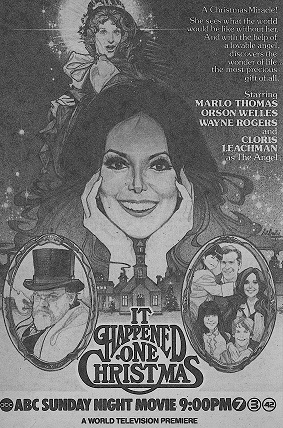
The 1977 made-for-TV movie, It Happened One Christmas, opens in Heaven. We hear the voice of Joseph (Charles Grodin), one of the top angels. Joseph has noticed that, in the town of Bedford Falls, a lot of people seem to be praying and all of their prayers concern one person. They are all worried about Mary Bailey Hatch (Marlo Thomas).
He requests that an angel be sent down to Earth to help Mary with her problems. Unfortunately, the only angel available is Clara (Cloris Leachman) and Clara, despite her optimistic outlook and upbeat personality, is not considered to be a particularly smart angel. She hasn’t even gotten her wings yet! However, Joseph promises her that, should she convince Mary Hatch not to toss away her life on Christmas Eve, Clara will get her wings.
But first, Joseph shows Clara all of the important events in Mary’s life. Clara watches as young Mary saves the life of her brother, Harry. A few weeks later, Mary manages to keep Dr. Gower from accidentally poisoning a patient. Though Mary dreams of leaving Bedford Falls and pursuing a career as a writer, she instead ends up taking over her late father’s old Building and Loan company. With the help of her husband, George (Wayne Rogers), she helps hundreds of people move into affordable housing. She is also one of the few people in town willing to stand up to Old Man Potter (Orson Welles)….
What was that?
Yeah, I know. Just hold on. I’m getting to that.
Anyway, everything is going great in Mary’s life until her irresponsible Uncle Willie (Barney Martin) accidentally loses a deposit on Christmas Eve. Facing embezzlement charges and having yelled at her family, Mary considers jumping off a bridge. Fortunately, Clara is there to show her what her life would be like if she had never been born….
Excuse me? Did you say that this sounds familiar?
Yes, It Happened One Christmas is a remake of It’s A Wonderful Life. The main difference is that the genders are swapped. Jimmy Stewart’s role is played by Marlo Thomas. Wayne Rogers plays the Donna Reed role. This leads to a few changes in the story. For instance, Mary still yells at ZuZu’s teacher but she doesn’t get sucker punched as a result. Whereas the original Mr. Potter treated George Bailey with outright hostility, the remake’s Mr. Potter tends to use a tone of condescending concern when talking to Mary. Since George Hatch doesn’t lose his hearing in one ear, he’s able to serve in World War II and he returns on crutches. In the world where Mary was never born, George still never marries but, instead of working at the library, he becomes a boorish auto mechanic. Violet is no longer an important character and Mary never tries to blame her visions of Pottersville on “bad liquor.” These are cosmetic differences but, otherwise, it’s pretty much the exact same story.
To be honest, it probably sounds more interesting than it actually is. It’s not that It Happened One Christmas is a poorly made or a badly acted film. It’s fine, really! But it’s not It’s A Wonderful Life. Marlo Thomas plays her role with a lot of energy but she’s still no Jimmy Stewart. Stewart, who was still dealing with his own World War II experiences, played up the haunting sadness behind George’s mild-mannered facade and that’s something that Thomas never accomplishes. If Stewart’s George seems like he’s been beaten down by one lost dream after another, Marlo Thomas’s Mary just seems like she’s having a really bad night. By that same token, Wayne Rogers is likable a the love of Mary’s life but he’s no Donna Reed. Even the great Orson Welles can’t escape the shadow of Lionel Barrymore. Barrymore’s Mr. Potter was a pure misanthrope who was at his happiest mocking the dead and approving men for the draft. Oddly, Orson Welles brings an almost avuncular style to Mr. Potter. One gets the feeling that Welles simply couldn’t resist winking at the audience and assuring them that he was still the bigger-than-life showman that they had grown up with.
So, you may be wondering ….. why remake It’s A Wonderful Life in the first place? I was wondering about that so I did a little research and thanks to an obscure web site called Wikipedia (not many people have heard of it), I discovered that It Happened One Christmas was actually made before It’s A Wonderful Life started to regularly air during the holidays. At the time it was made, it was aactually remake of a classic film that was no longer regularly watched. Frank Capra angrily denounced It Happened One Christmas as being “plagarism” but, in 1977, it was enough of ratings success that it was re-aired in both 1978 and 1979. But, by that time, It’s A Wonderful Life had started to regularly air during the holiday season and was being rediscovered by audiences young and old. As a result, the okay remake was soon overshadowed by the vastly superior original.
And really, that’s the way it should be. It Happened One Christmas isn’t a bad movie but it just no replacement for Capra’s Wonderful film.
It was a story that he told often, about how he was a struggling, 30 year-old actor with a few film credits to his name when he was offered the lead role in The Graduate. Even though producer Lawrence Turman said the role would make him a star, Grodin turned it down because of the low salary that Turman offered. The role was then offered to Dustin Hoffman, who went on to become a star and spend several decades as an unlikely box office draw.
It’s easy to imagine Grodin in the role of Benjamin Braddock. He probably wouldn’t have been as insecure as Hoffman was in the role. He would have been a less passive Benjamin. Grodin’s Braddock would probably have been more obviously frustrated with Mrs. Robinson and his parents. Nobody played frustration quite as well as Charles Grodin. Audiences might not have been as quick to sympathize with Benjamin if Grodin had played the role but I think he would have eventually won them over. Grodin was an actor with a talent for making unlikable characters somehow funny and relatable.
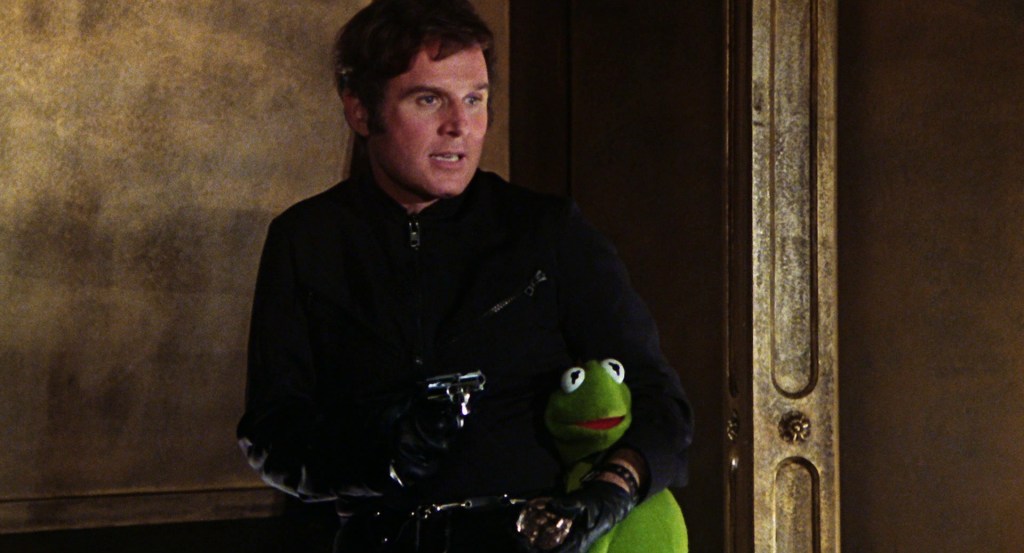
Though Grodin may not have played Benjamin Braddock, he still went on to establish himself as one of the funniest character actors in the business, a master of deadpan humor. He was often the best thing in the moves in which he appeared. In Heaven Can Wait, he was funny even while he was trying to kill Warren Beatty. In Real Life, he was a suburban father who found himself trapped in an early version of reality television. In Seems Like Old Times, he gets more laughs with one annoyed expression than Chevy Chase gets in the entire film. In The Great Muppet Caper, he fell in love with Miss Piggy and tried to kill Kermit. He was one of the few actors to make it through Ishtar with his dignity intact. In Midnight Run, he was the perfect comedic counterbalance to Robert De Niro. In Dave, he taught the government how to balance a budget. Though he was often cast in supporting roles or as a co-lead (as in Midnight Express), he proved that he could carry a film with his starring turn in The Heartbreak Kid.
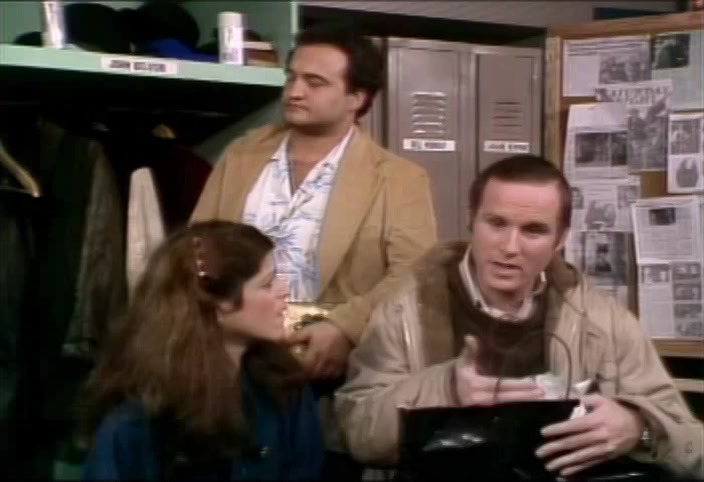
A lot of people knew Grodin best as a late night talk show guest, where he always seemed to be annoyed about something. He would get into mock arguments with the hosts and leave audiences confused as to how serious any of it was. (According to David Letterman, none of it was.) He briefly hosted his own talk show, from 1995 to 1998. Legend has it that Lorne Michaels banned him from Saturday Night Live after he hosted the show, apparently because he was so difficult to work with. How much of that is true and how much of that was just Grodin doing a bit, no one knows. I’ve seen Grodin’s episode. It’s fine. He’s funny.
Charles Grodin died today of bone marrow cancer. He was 85 years old. I’m going to miss him.
Gilda Radner, John Belish, and Charles Grodin on Saturday Night Live
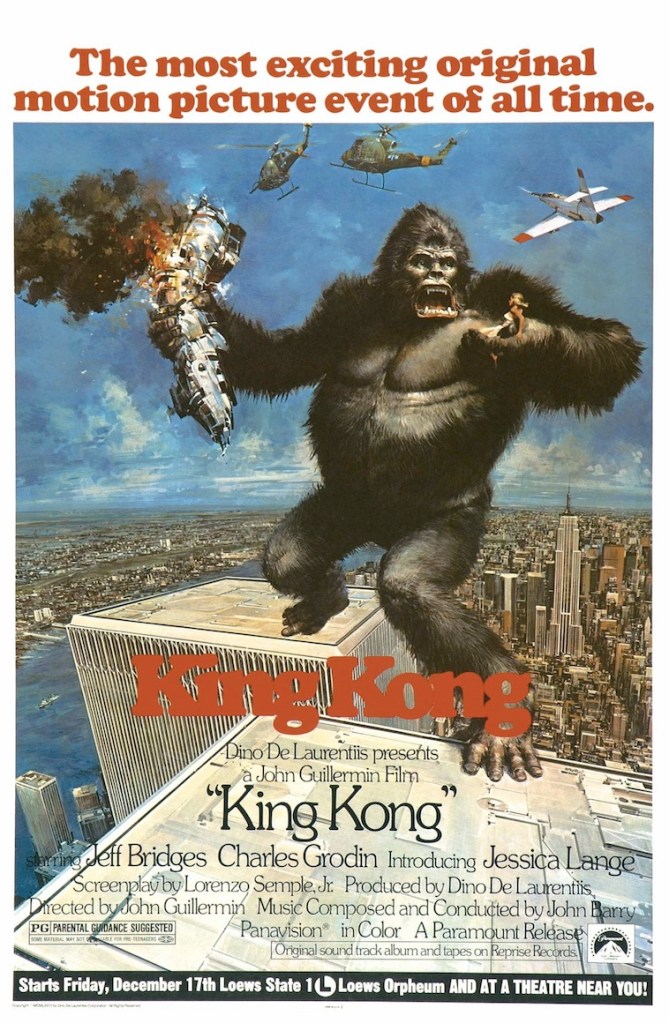
The 1976 remake of King Kong is the version of the great ape’s story that no one ever seems to want to talk about.
Everyone, of course, continues to appreciate the original King Kong from 1933, with its charmingly dated but still somewhat effective special effects. The Japanese King Kong films have their fans, even if it still annoys me that two endings were made for the original King Kong vs. Godzilla. The Peter Jackson-directed remake from 2005 had many admirers, including me. The monsterverse Kong certainly has many fans, as is indicated by the fact that Godzilla vs Kong is the first box office hit of the post-pandemic era. King Kong is a beloved character and yet the 1976 version of his story never seem to get as much attention as all the others.
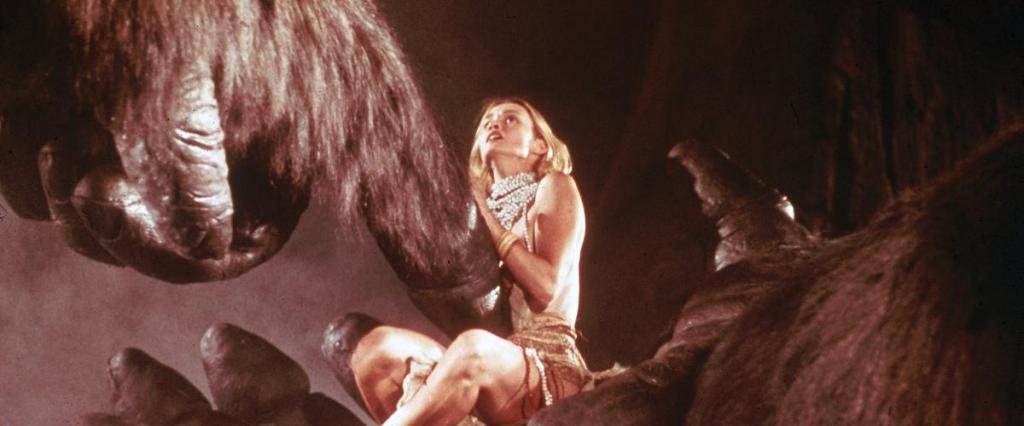
Some of that, of course, is because the 1976 version of King Kong is often described as not being very good. It tells the same basic story as the first King Kong but there’s a few key differences. The expedition to the hidden island is no longer made up of a film crew. Instead, everyone has a separate backstory that doesn’t really make much sense. Fred Wilson (Charles Grodin) is an energy company executive who is looking for a new source of oil. Jack Prescott (Jeff Bridges) is a long-haired hippie environmentalist type who stows away on Wilson’s ship. Prescott apparently thinks that there’s some sort of ancient primate living on the island. Meanwhile, Dwan (future great actress Jessica Lange, making her film debut) is an aspiring actress who is discovered in a life raft, floating out in the middle of the ocean. It turns out that Dwan (that’s not a typo, that’s her name) has escaped from the yacht of a sleazy film producer. Nobody on the ship seems to be surprised when Dwan suddenly shows up in her life raft and Dwan doesn’t seem to have any hesitation about accompanying a bunch of strangers to previously unexplored island. That’s the type of film this is.
After a considerable amount of time, during which Dwan falls in love with Jack and Fred spends a lot of time looking generally annoyed, the island is discovered. As you can already guess, Dwan is kidnapped by the island’s natives, and she’s rescued by a giant ape who falls in love with her after she punches him in the nose and says, “Put me down, you male chauvinist pig ape!” In some shots, Kong is obviously a man in a rubber suit. In others, he’s just as obviously an animatronic model. Unfortunately, the animatronic version of Kong sometimes appears to kind of be leering whenever he looks down at Dwan in the palm of his hand, which bring a definite element of ickiness to a few of the scenes in which Kong carries Dwan across the island.
I would have started praying too.
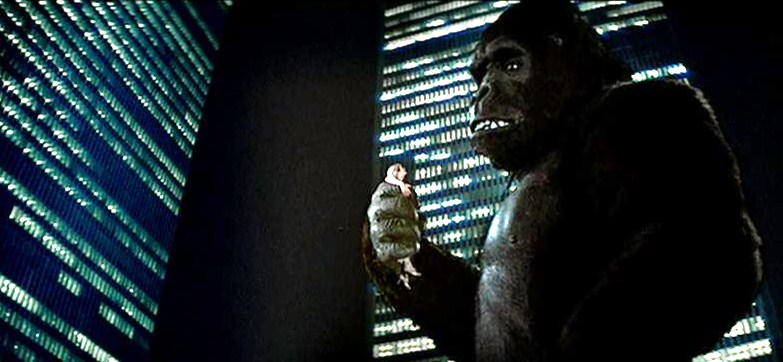
Eventually, just as in the original film, Kong ends up a prisoner in New York. This time, when he escapes, grabs Dwan, and goes on a rampage, he ends up climbing the Two Towers. This leads to scenes of helicopters and fighter planes all firing at the Two Towers, which is a bit difficult to watch today. I remember a few years ago, one of our local stations actually broadcast this version of King Kong on September 11th and it definitely did not feel right.
The 1976 version of King Kong was a hit at the box office and was nominated for three Academy Awards. It won the the award for Best Visual Effects, sharing the Oscar with Logan’s Run. That said, King Kong wasn’t exactly popular with critics, either at the time of its release or today. To a certain extent, it’s understandable why this version of King Kong is so frequently criticized. The script takes a deliberately campy approach to material that, in order to have any real emotional impact, needs to be played straight regardless of how silly the story might seem. Charles Grodin never seems to be sure whether the film is a drama or a comedy. Jeff Bridges is likable but a bit too naturally mellow for his role. Jessica Lange made her film debut in King Kong, famously beating out Meryl Streep for the role. Despite the fact that the film was a box office hit, the reviews of Lange’s performance were so negative that she didn’t work for three years after appearing in the film. (She spent that time studying acting. She went on to win a Tony, two Oscars, and three Emmys so take that, critics.)
And yet, I kind of like this version of King Kong. When taken on its own very silly terms (and not as a remake of a legitimate classic), it’s definitely entertaining. Even the fact that Grodin, Bridges, and Lange are all miscast kind of works to the film’s advantage. You can’t help but appreciate that all three of them are trying so hard to be convincing in roles that they shouldn’t have been playing. For all the criticism of Jessica Lange’s performance, she actually does as well as anyone could with some of the dialogue that she gets stuck with. It’s not easy to pull off a scene where you explain to a giant ape that the relationship is never going to work because you’re a city girl and he’s a …. well, he’s a giant ape. But Lange manages to deliver the lines without laughing and that couldn’t have been easy. Lange’s then-inexperience is obvious whenever she’s having to react to or interact with the other actors but she does fine when she’s having to talk to a guy in a rubber suit or a big animatronic head. (Let’s see Meryl Streep pull that off.) Though it seems to take forever for Kong to actually get captured, the film picks up once he’s transported to New York. If you can look past the awkwardness of how the film uses the Twin Towers, the scenes of Kong rampaging through the city have an over-the-top grandeur that’s both ludicrous and compelling. By the time he reaches the top of the World Trade Center, you will totally be on his side. That’s the way it should be.
This remake of King Kong is deeply, deeply silly but, sometimes, that’s exactly what you’re looking for.
What’s an Insomnia File? You know how some times you just can’t get any sleep and, at about three in the morning, you’ll find yourself watching whatever you can find on cable? This feature is all about those insomnia-inspired discoveries!
If you were having trouble getting to sleep around two in the morning last night, you could have turned over to Starz and watched the 2016 film, The Comedian.
It probably wouldn’t have helped. It’s not that The Comedian is a particularly interesting movie or anything like that. Abysmally paced and full of dull dialogue, The Comedian would be the perfect cure for insomnia if it just wasn’t so damn loud. Robert De Niro plays an aging comedian named Jackie Burke and, in this movie, being an aging comedian means that you shout out your punch lines with such force that you almost seem to be threatening anyone who doesn’t laugh. However, the threats aren’t necessary because everyone laughs at everything Jackie says.
Actually, it’s a bit of an understatement to say that everyone laughs. In The Comedian, Jackie is such a force of pure, unstoppable hilarity that all he has to do is tell someone that they’re fat and literally the entire world will shriek with unbridled joy. The thing with laughter is that, in the real world, everyone laughs in a different way. Not everyone reacts to a funny joke with an explosive guffaw. Some people chuckle. Some people merely smile. But, in the world of The Comedian, everyone not only laughs the same way but they also all laugh at the same time. There’s never anyone who doesn’t immediately get the joke and, by that same token, there’s never anyone who can’t stop laughing once everyone else has fallen silent. The Comedian takes individuality out of laughter, which is a shame because the ability to laugh is one of the unique things that makes us human.
Anyway, The Comedian is about a formerly famous comedian who is now obscure. He used to have a hit TV show but now he’s nearly forgotten. Why he’s forgotten is never made clear because nearly everyone in the movie still seems to think that he’s the funniest guy in the world. Jackie’s an insult comic and people love it when he tells them that they’re overweight or when he makes fun of their sexual preferences. This would probably be more believable if Jackie was played by an actor who was a bit less intense than Robert De Niro. When De Niro starts to make aggressive jokes, you’re natural instinct is not so much to laugh as it is to run before he starts bashing in someone’s head with a lead pipe.
Anyway, the plot of the film is that Jackie gets into a fight with a heckler. The video of the fight is uploaded to YouTube, which leads to a scene where his manager (Edie Falco) stares at her laptop and announces, “It’s going viral!” Later on, in the movie, Jackie forces a bunch of old people to sing an obnoxious song with him and he goes viral a second time. I kept waiting for a shot of a computer screen with “VIRAL” blinking on-and-off but sadly, the movie never provided this much-needed insert.
In between beating up the heckler, ruining his niece’s wedding, and hijacking a retirement home, Jackie finds the time to fall in love with Harmony Schlitz (Leslie Mann), a character whose name alone is enough to The Comedian one of the most annoying films of all time. Harmony’s father is a retired gangster (Harvey Keitel) and you can’t help but wish that Keitel and De Niro could have switched roles. It wouldn’t have made the movie any better but at least there would have been a chance of Keitel going batshit insane whenever he took the stage to deliver jokes.
I’m not sure why anyone thought it would be a good idea to cast an actor like Robert De Niro as a successful comedian. It’s true that De Niro was brilliant playing a comedian in The King of Comedy but Rupert Pupkin was supposed to be awkward, off-putting, and not very funny. I’m not an expert on insult comics but, from what I’ve seen, it appears that the successful ones largely succeed by suggesting that they’re just having fun with the insults, that no one should take it personally, and that they appreciate any member of the audience who is willing to be a good sport. Jackie just comes across like a cranky old misogynist. Watching Jackie is like listening to your bitter uncle play Vegas. I guess it would help if Jackie actually said something funny every once in a while. A typical Jackie joke is to refer to his lesbian niece as being a “prince.” Speaking for myself, when it comes to Robert De Niro being funny, I continue to prefer the scene in Casino where he hosts the Ace Rothstein Show.
Perhaps the funniest thing about The Comedian is that, when it originally released into theaters, it was advertised as being “The Comedian, a Taylor Hackford film,” as if Taylor Hackford is some type of Scorsese-style auteur. Taylor Hackford has been making films for longer than I’ve been alive and he has yet to actually come up with any sort of signature style beyond point and shoot. The second funniest thing is that The Comedian was billed as a potential Oscar contender, up until people actually saw the damn thing.
Though it may have failed at the box office, The Comedian seems to show up on Starz quite frequently. They always seem to air it very late at night, as if they’re hoping people won’t notice.
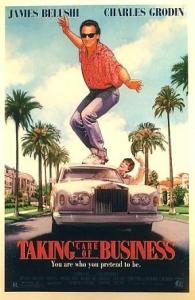
Jimmy Dworski (Jim Belushi) is a convicted car thief who only has a few days left in his criminal sentence but still decides to break out of prison so he can go see the Cubs play in the World Series. Spencer Barnes (Charles Grodin) is an uptight ad executive who needs to learn how to relax and have a good time. When Spencer loses his organizer, Jimmy finds it. Before you can say “The prince and the pauper,” Jimmy has access to all of Spencer’s money and the mansion that Spencer is supposed to be staying at over the weekend. While Spencer tries to survive on the streets and track down his organizer, Jimmy is living it up, spending money, impressing a Japanese businessman (Mako), romancing the boss’s daughter, and taking care of business.
Made in the uncertain period between the end of the culture of 80s materialism and the start of the 90s indie boom, Taking Care of Business is a rip-off of Trading Places that came out six years too late to be effective. Everything that needs to be known about Jimmy and Spencer is apparentl from the minute that Charles Grodin’s and Jim Belushi’s names appear in the credits. Grodin was usually the best when it came to playing uptight yuppies but he seems bored in Taking Care of Business. Belushi mugs through his role, overplaying his character’s blue collar roots. The movie builds up to a huge confrontation between Belushi and Grodin but it never really delivers, instead devolving into a predictable buddy comedy, complete with a trip to Wrigley Field and an elaborate plan to sneak Belushi back into prison before the warden (Hector Elizondo) discovers that he’s been gone for the weekend. Taking Care of Business has a few laughs but it’s never as good as the BTO song.
The Meanest Men In The West may “star” Charles Bronson and Lee Marvin and Sam Fuller may be credited as being one of the film’s two directors but don’t make the same mistake that I made. Don’t get too excited.
There was once a TV western called The Virginian. Starring James Drury as a ranch foreman, The Virginian ran for nine seasons on NBC. A 1962 episode, which was written and directed by Sam Fuller, featured Lee Marvin as a sadistic outlaw who kidnapped The Virginian’s employer, a judge played by Lee J. Cobb. Five years later, another episode features Charles Bronson as a less sadistic outlaw who kidnapped the Judge’s daughter.
The Meanest Men In The West mixes scenes from those two episode with western stock footage, a bank robbery that originally appeared in The Return of Frank James, an intrusive voice-over, and an almost incoherent prologue, all in order to tell an entirely new story. Now, Charles Bronson and Lee Marvin are brothers and rivals. After Marvin snitches on Bronson’s plan to rob a bank, Bronson blames his former friend, The Virginian. In order to get the Virginian to come to his hideout, Bronson kidnaps Cobb’s daughter. The Virginian manages to convince Bronson that he didn’t betray him, just to arrive back at the ranch and discover that Cobb has been kidnapped. Meanwhile, Bronson and his gang set off after Marvin and his gang. It ends with Charles Bronson, in 1967, shooting at Lee Marvin, who is still in 1962.
The Meanest Men In The West is so clumsily edited that the same shot of Charles Bronson holding a gun is spliced into a dozen different scenes. Filmed on different film stocks, the Bronson scenes and the Marvin scenes look nothing alike and, since the two episodes were filmed five years apart, James Drury literally ages backwards over the course of the film.
The Meanest Men In The West is for Charles Bronson and Lee Marvin completists only. I think Bronson and Marvin are two of the coolest individuals who ever existed and even I had a hard time making it through this one. If you do watch it, keep an eye out for a young Charles Grodin, thoroughly miscast as a tough outlaw.
— Rosemary Woodhouse (Mia Farrow) in Rosemary’s Baby (1968)
Yes, Rosemary, it is.
The classic 1968 horror movie Rosemary’s Baby is probably best remembered for a lengthy and wonderfully surreal “dream” sequence in which naive newlywed Rosemary Woodhouse (Mia Farrow) is raped by the Devil while a bunch of naked old people stand around her and chant. At one point, she sees her husband, Guy (John Cassavetes), saying that she’s awake and that she knows what’s going on. Their neighbor, Minnie Castevet (Ruth Gordon), tells him that Rosemary can’t hear anything and that it’s like she’s dead and then snaps at him, “Now, sing!” It’s a great sequence, one of the greatest of Roman Polanski’s career, a perfect blending of horror and dark comedy.
For me, the most interesting part of that dream sequence comes at the start. Rosemary envisions herself naked on a boat and, as she tries to cover herself, who is sitting next to her? None other than John F. Kennedy! Suddenly, Rosemary is wearing a bikini and she’s relaxing out on the deck with a glamorous group of people who I assume were meant to be Kennedy relatives. As the boat leaves the dock, Rosemary sees that her friend and protector, Hutch (Maurice Evans), is standing on the dock.
“Isn’t Hutch coming with us?” Rosemary asks.
“Catholics only,” John F. Kennedy hisses in that famous accent, “I’m afraid we are bound by these prejudices.”
“I understand,” a dazed Rosemary replies.
And it’s a wonderful little moment, though I have to wonder if I’d react as strong if my own background wasn’t Irish Catholic. But still, there’s something so wonderfully subversive about a bunch of elderly Satanists pretending to be the Kennedys.
And really, Rosemary’s Baby is a wonderfully subversive film. I imagine it was even more subversive when it was first released back in 1968. It’s been ripped off and imitated so many times that it has undoubtedly lost some of its impact. (That’s one reason why I wish I had a time machine, so I could go back in the past and see it was truly like to see a classic film for the first time.) But still, 47 years after it was initially released, Rosemary’s Baby is still a surprisingly effective horror film.
The film opens with newlyweds Rosemary and Guy moving into the Bramford, an exclusive New York apartment building. Guy is an actor who, despite having appeared in two off-Broadway shows (one of which was entitled Nobody Likes An Albatross and really, that is so true) and a few motorcycle commercials, is still waiting for his big break. There are hints that, before she married Guy, Rosemary had a very active and interesting life (when we briefly meet her old friends, they all seem to be a lot more exciting than boring old Guy) but, when we meet her, Rosemary appears to have happily settled into a life of domesticity.
Life at the Bramford is strange. For one thing, Guy and Rosemary appear to be the only young people living in the entire building. (There is a young woman named Terry but she ends up jumping out of a window.) The Woodhouses befriend elderly Minnie Castevet and her husband, Roman (Sidney Blackmer.) Roman claims to have traveled all over the world and embarrasses the Catholic Rosemary by criticizing the Pope. Minnie, meanwhile, is the noisiest person in the world. Guy makes fun of both of them and, yet, he still decides to spend his free time with Roman.
One day, Guy gets a role that he had previously lost. Why? Because another actor is struck by a sudden case of blindness. Shortly afterward, Rosemary has her “dream.” She wakes up and discovers that her body is covered with red scratches. Guy claims that he had sex with her while she was asleep and promises to cut his fingernails.
Soon, Rosemary is pregnant but the Castevets insist that she use their doctor, the firm and sinister Dr. Saperstein (Ralph Bellamy, who just 8 year earlier had played FDR in Sunrise at Campobello). Rosemary knows that something is wrong with the baby but she can’t get anyone to listen to her. It all leads to one of the best and most iconic endings in the history of horror cinema.
Rosemary’s Baby is a classic of fear and paranoia and it holds up surprisingly well. See it this October, whether you’re Catholic or not.
(However, do not see the needless 2014 remake. Seriously, what the Hell was up with that?)
(By the way, is anyone else amazed that I made it through this entire review without making a single joke about either Ronan Farrow or Mia’s lame Sharknado live tweet? I am shocked.)
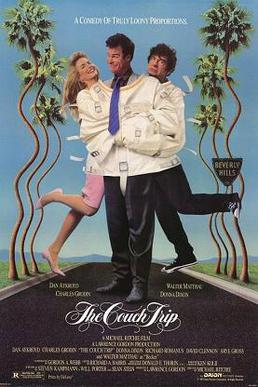 When renowned radio psychiatrist George Matlin (Charles Grodin) has a nervous breakdown, he takes a trip to Europe with his wife (Mary Gross) to both recover and also work on his marriage. (Matlin’s breakdown was the result of an extramarital affair.) Needing someone to host Dr. Matlin’s radio show, his producers call Dr. Lawrence Baird (David Clennon), who oversees a mental facility in Chicago. They assume that Dr. Baird is just dumb enough that they won’t have to worry about him overshadowing Dr. Matlin while he’s guest-hosting. However, when they call, Dr. Baird is out of his office and the phone is answered by John Burns (Dan Aykroyd), a con artist who has been pretending to be insane so that he can avoid serving time in prison. Pretending to be Baird, Burns accepts their offer and then escapes from the asylum and heads to Beverly Hills. The real Dr. Baird, not knowing about the offer, goes on vacation in Europe. Though Burns had originally only been planning on doing the radio job long enough to get paid enough money to head to Mexico, he soon becomes a celebrity with his non-nonsense, blunt advice.


 Jimmy Dworski (Jim Belushi) is a convicted car thief who only has a few days left in his criminal sentence but still decides to break out of prison so he can go see the Cubs play in the World Series. Spencer Barnes (Charles Grodin) is an uptight ad executive who needs to learn how to relax and have a good time. When Spencer loses his organizer, Jimmy finds it. Before you can say “The prince and the pauper,” Jimmy has access to all of Spencer’s money and the mansion that Spencer is supposed to be staying at over the weekend. While Spencer tries to survive on the streets and track down his organizer, Jimmy is living it up, spending money, impressing a Japanese businessman (Mako), romancing the boss’s daughter, and taking care of business.
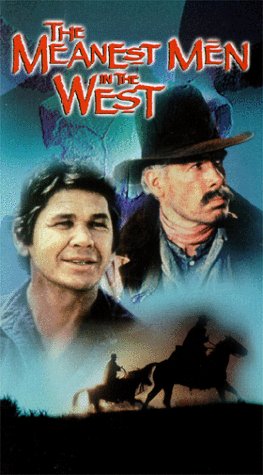 The Meanest Men In The West may “star” Charles Bronson and Lee Marvin and Sam Fuller may be credited as being one of the film’s two directors but don’t make the same mistake that I made. Don’t get too excited.
 Through the Shattered Lens