In 1973’s The Invasion of Carol Enders (Meredith Baxter) is attacked while walking in the park with her boyfriend (Christopher Connelly) and strikes her head. At the same time, Diana Bernard (Sally Kemp) crashes her car while driving home in the rain. Both women end up at the hospital at the same time. Both die but Carol is brought back to life. Except now, there’s someone else in Carol’s head….
This is a bit of an odd made-for-TV movie, even by the standards of the 70s. It’s only 69 minutes long and it was shot on video tape, giving the whole thing the look of an old daytime drama. It’s easy to watch this movie and imagine that it’s just a supernaturally-tinged episode of General Hospital or Days Of Our Lives. Both the acting and the plot add to the daytime drama feel of the production. This is a movie that fully embraces the melodrama.
I think the most interesting thing about this film is that everyone is very quick to accept that Diana has somehow willed her spirit into Carol’s body. There’s very little hesitation about accepting Diana/Carol at her word and no one even thinks to suggest that maybe Carol is having some sort of mental episode as a result of the attack. Adam hears that his girlfriend has been possessed and he immediately gets to work helping out the woman who has possessed her. I mean, good for Adam. I like a man who is willing to do whatever has to be done. Still, everyone acts as if possession happens every day.
This is kind of a silly movie, which is probably why I enjoyed it. It’s short, it’s simple, and it embraces the melodrama. What’s not to enjoy?
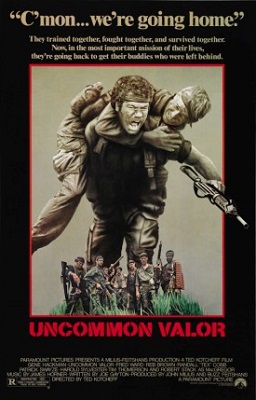
Retired Marine Colonel Jason Rhodes (Gene Hackman) and oilman Harry MacGregor (Robert Stack) share a tragic bonf. Both of them have sons that served in Vietnam and are listed as being MIA. Believing that their sons are still being secretly held in a POW camp in Loas, Rhodes and MacGregor put together a team to sneak into Southeast Asia and rescue them.
With MacGregor supplying the money and Rhodes leading the mission, the team includes Blaster (Red Brown), Wilkes (Fred Ward), Sailor (Randall “Tex” Cobb), and Charts (Tim Thomerson), all of whom served with Rhodes’s son. Also joining in his helicopter pilot Curtis Johnson (Harold Sylvester) and former Marine Kevin Scott (Patrick Swayze), whose father was also listed as being MIA in Vietnam. After a rough start, the group comes together and head into Laos to bring the prisoners home!
UncommonValor is one of the many movies released in the 80s in which Vietnam vets returned to Asia and rescued those who were left behind. In the 80s, there was a very strong belief amongst many Americans that soldiers were still being held prisoner in Vietnam, Cambodia, and Laos and Hollywood was quick to take advantage of it. The box office success of UncommonValor set the stage for films like Rambo and Missing In Action, film in which America got the victory that it had been denied in real life.
What set UncommonValor apart from the films that followed was the cast. Not surprisingly, Gene Hackman brings a lot more feeling and nuance to his performance as the obsesses Col. Rhodes than Sylvester Stallone and Chuck Norris brought to their trips to Vietnam. The film surrounds Hackman with a quirky supporting cast, all of whom represent different feelings about and reactions to the war in Vietnam. Fred Ward’s character suffers from PTSD. Randall “Tex” Cobb, not surprisingly, is a wild man. Patrick Swayze’s character is trying to make the father he’ll never know proud. Robert Stack and Gene Hackman represent the older generation, still trying to come to terms with everything that was lost in Vietnam and still mourning their sons. The raid on the POW camp is exciting but it doesn’t feature the type of superhuman action that’s present in other POW-rescue films. Col. Rhodes and his soldiers are ordinary men. Not all of them survive and not all of them get what they want.
UncommonValor started out as a screenplay from Wings Hauser, though he’s not present in the cast of the final film and he was only given a “story” credit. John Milius served as producer. Director Ted Kotcheff is best-known for FirstBlood, another action film about America’s struggle to come to terms with the Vietnam War.
AGCK! That’s a scary title that just brings to mind all sorts of disturbing images. And this 1973 made-for-television film does get off to a rather disturbing start, with Carol Enders (Meredith Baxter) and her boyfriend, Adam Reston (Christopher Connelly), getting attacked in the park by a random criminal. Carol falls and strikes her head. She is rushed to the hospital in a coma and is not expected to survive.
Meanwhile, Diana Bernard (Sally Kemp) has an argument with her former lover (John Karlen) and then goes for a drive in the rain. When the car crashes, Diana is rushed to the same hospital as Carol. Ironically, it’s the same hospital where her husband, Peter (Charles Aidman), works. Like Carol, Diana is not expected to survive.
Diana and Carol both appear to die at the same time. Except Carol doesn’t actually die. Instead, she has a miraculous recovery. She comes out of her coma and she is remarkably articulate for someone who has just suffered serious brain damage. However, there is one problem. Carol swears that she’s never seen Adam before, that she’s married to Peter, and that her name is Diana!
That’s the invasion of Carol Enders. When Diana died, her spirit moved into Carol’s body and took control. Diana is convinced that her car accident was not actually an accident. She thinks that she was set up by her ex and she sets out to try to prove that the accident was actually attempted murder. (Actually, it’s only attempted from Diana’s point of view. As far as the rest of the world is concerned, Diana is dead.) While Adam tries to help Diana solve her murder out of a hope that she’ll go away and allow Carol to once again be in control of her own body, Diana runs off to her husband. However, it turns out that there’s a lot more going on than even Diana realizes.
This is a bit of an odd made-for-TV movie, even by the standards of the 70s. It’s only 69 minutes long and it was shot on video tape, giving the whole thing the look of an old daytime drama. It’s easy to watch this movie and imagine that it’s just a supernaturally-tinged episode of General Hospital or Days Of Our Lives. Both the acting and the plot add to the daytime drama feel of the production. This is a movie that fully embraces the melodrama.
I think the most interesting thing about this film is that everyone is very quick to accept that Diana has somehow willed her spirit into Carol’s body. There’s very little hesitation about accepting Diana/Carol at her word and no one even thinks to suggest that maybe Carol is having some sort of mental episode as a result of the attack. Adam hears that his girlfriend has been possessed and he immediately gets to work helping out the woman who has possessed her. I mean, good for Adam. I like a man who is willing to do whatever has to be done. Still, everyone acts as if possession happens every day.
This is kind of a silly movie, which is probably why I enjoyed it. It’s short, it’s simple, and it embraces the melodrama. What’s not to enjoy?
Carl Archer (Charles Aidman) is a recovering alcoholic who returns home after an extended stay in a rehab. His wife (Julie Adams, of Creature of the Black Lagoon and The Last Movie fame) is skeptical about whether or not Carl has really sobered up and is prepared to be a responsible father to their son, Steve (Charles Herbert). When Steve gets trapped in a cave, will Carl be able to use their psychic connection to find and rescue him?
Can you prove this didn’t happen!?
This episode originally aired on February 24th, 1959.
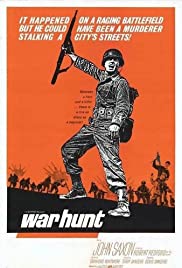
In the last days of the Korean War, Pvt. Roy Loomis (Robert Redford) is assigned to an infantry unit that’s serving on the front lines. Loomis is an idealist who believes in always doing the right thing and who believes that he’s truly fighting for the American way of life in Korea. The company’s commander (Charles Aidman) is more cynical. As he explains it, the job of the soldiers is not to win the war. Their job is to stall the advance of the enemy long enough to let the politicians and the diplomats get what they want out of a peace settlement. The soldiers are merely there to be sacrificed.
Loomis soon finds himself in conflict with Pvt. Endore (John Saxon). Endore spends his night sneaking around behind enemy lines, killing soldiers, and gathering intelligence. No one goes with Endore on these missions and Endore makes it clear that he doesn’t want to have anything to do with the other solders in the unit. Because Endore usually returns with valuable intelligence, he’s allowed to do what he wants but it becomes clear that gathering intelligence is not what motivates Endore. Endore loves war and killing. In the United States, he would probably be on death row. In Korea, at the height of the war, he’s a valuable asset.
Charlie (Tommy Matsuda) is an orphan boy who has been adopted as the company’s mascot. Both Loomis and Endore have a bond with Charlie. Loomis wants Charlie to go to an orphanage after the war so that he can hopefully be adopted and maybe brought over the United States. Endore, however, plans to stay in Korea even after the war ends and he wants to keep Charlie with him. He wants to turn Charlie into as efficient a killing machine as he is.
This low-budget but effective anti-war film may be best known for featuring Robert Redford in his first starring role but the film is stolen by John Saxon, who is frighteningly intense as Endore. Endore is so in love with war that he continues to fight it even after the Armistice is declared. Saxon plays him like a cool and calculating predator, a natural born killer. He’s an introvert who rarely speaks to the other members of the company. Even though he helps them by killing the enemy before the enemy can kill them, it’s clear that Endore doesn’t really care about the other members of the unit. He just cares about killing. He’s close to Charlie because Charlie is too young to realize just how dangerous Endore actually is.
Along with Saxon and Redford, War Hunt also features early performances from Tom Skerritt, Sydney Pollack, and Francis Ford Coppola. (Coppola, who goes uncredited, plays an ambulance driver.) Pollack and Redford met while they were both acting in this film and Pollack would go on to direct Redford in several more films. One of those films, The Electric Horseman, would reunite Redford and Saxon. Again, they would play adversaries.
Last night, when I heard John Saxon had died, I tried to pick his best performance. I know that most people know him from his horror work and his role in Enter the Dragon. Those are all good performances but, for me, Saxon was at his absolute best in War Hunt.
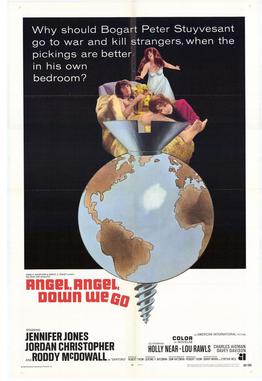
Listen, I’ve seen some bad movies before. I’ve seen some annoying films before. I’ve seen some pretentious movies before. I don’t know if I’ve ever seen a movie as dedicated to being all three of them as 1969’s Angel, Angel, Down We Go appears to be.
Yes, this movie came out in 1969 and it’s one of those late 60s, counter culture films that’s so intent on impressing you by being daring that it doesn’t bother to actually come up with an interesting story or anything like that. It’s a film that talks a lot but has nothing to say. It’s a film that’s obviously meant to be very counter cultural and left-wing but it has a streak of such cruel misogyny running through it that it’s nearly impossible to watch certain scenes.
Singer Holly Near stars as Tara Steele, the teenage daughter of two wealthy parents. Tara’s mother (Jennifer Jones) is a former actress who brags about having starred in over a hundred stag film without ever “faking an orgasm.” Tara’s father (Charles Aidman) is a former military man who knew Douglas MacArthur and who is gay but closeted. (The film handles the issue of his sexuality with all of the sensitivity that you would expect from an episode of the 700 Club.) Tara is insecure because she’s overweight and her family doesn’t show her any love. The film, it should be said, doesn’t really show her any love either. Whether its the close-ups of her messily eating with food smeared across her face or the scenes in which other characters casually insult her, the film seems to have little sympathy for her.
Tara meets a rock singer named …. seriously, this is his fucking name …. Bogart Peter Stuyvesant (Jordan Christopher). With his tight leather pants and his shirtless performances, Bogie (yes, he’s called Bogie) is supposed to be a Jim Morrison-style sex symbol. Unfortunately, Jordan Christopher doesn’t have enough screen presence to pull off the role. Bogie pretends to be in love with Tara (“Your breath stinks!” he shouts, “I dig it!”) but it’s just so he can seduce her mother and her father and make off with all of their money. It’s supposed to have something to do with the hypocrisy of the American establishment or something but …. oh, who cares?
So, this movie is annoying for any number of reasons. Robert Thom directs as if he was getting paid extra for every time he used a zoom lens or tossed in a jump cut. Yet, despite all of the camera trickery, the story drags like you wouldn’t believe. The walls of Jordan’s pad are decorated with a collage of American icons like Humphrey Bogart and Dwight Eisenhower and Thom often pointlessly zooms into the collage whenever he thinks it will help him make his point but since the film doesn’t really seem to have a point, the collage itself gets as boring as Bogie playing a harp. Yes, Bogie does play a harp. It goes over forever.
As I watched the film, I found myself growing more and more pissed off. Every pretentious line of dialogue and arty camera angle just made me angrier and angrier. Didn’t Jennifer Jones and Holly Near deserve better than this? Who the Hell decided to cast bland, doughy Jordan Christopher as a sex symbol? WHY WAS RODDY MCDOWALL IN THIS MOVIE!? WHY CAST RODDY MCDOWALL AND THEN NOT HAVE HIM DO ANYTHING!? Why did every scene have to drag on? Why couldn’t the film just get to the freaking point!? WHY WERE THEY SKY DIVING!? WHY DID WE HAVE TO SIT THROUGH FIVE SONGS FROM JORDAN CHRISTOPHER!? WHY? WHY? WHY!?
Chicago gangsters are turning up dead! Is it a mob war or is it something else? Kolchak suspects the latter and, as you can guess from this episode’s title, he’s right. This episode features gangsters, numbers runners, and voodoo!
For tonight’s trip into the world of televised horror, we have an episode from a 1986 attempt to revive The Twilight Zone.
This episode is a remake of one of my favorite episodes of the original series, Shadow Play. That’s the one where the guy is on death row but he says he’s not worried about being executed because he knows he’s just having a reoccuring nightmare. Of course, this kind of freaks out some of the people around him because, if he’s just having a dream, what happens to them when the dream ends?
While the remake is nowhere near as good as the original, it’s still fairly well done. Plus, it’s on YouTube and the original isn’t.
This episode was directed by Paul Lynch, the Canadian director who also directed the original Prom Night.
In Montana, four men have infiltrated and taken over a top-secret ICBM complex. Three of the men, Hoxey (William Smith), Garvas (Burt Young), and Powell (Paul Winfield) are considered to be common criminals but their leader is something much different. Until he was court-martialed and sentenced to a military prison, Lawrence Dell (Burt Lancaster) was a respected Air Force general. He even designed the complex that he has now taken over. Dell calls the White House and makes his demands known: he wants ten million dollars and for the President (Charles Durning) to go on television and read the contents of top secret dossier, one that reveals the real reason behind the war in Vietnam. Dell also demands that the President surrender himself so that he can be used as a human shield while Dell and his men make their escape.
Until Dell made his demands known, the President did not even know of the dossier’s existence. His cabinet (made up of distinguished and venerable character actors like Joseph Cotten and Melvyn Douglas) did and some of them are willing to sacrifice the President to keep that information from getting out.
Robert Aldrich specialized in insightful genre films and Twilight’s Last Gleaming is a typical example: aggressive, violent, sometimes crass, and unexpectedly intelligent. At two hours and 30 minutes, Twilight’s Last Gleaming is overlong and Aldrich’s frequent use of split screens is sometimes distracting but Twilight’s Last Gleaming is still a thought-provoking film. The large cast does a good job, with Lancaster and Durning as clear stand-outs. I also liked Richard Widmark as a general with his own agenda and, of course, any movie that features Joseph Cotten is good in my book! Best of all, Twilight’s Last Gleaming‘s theory about the reason why America stayed in Vietnam is entirely credible.
The Vietnam angle may be one of the reasons why Twilight’s Last Gleaming was one of the biggest flops of Aldrich’s career. In 1977, audiences had a choice of thrilling to Star Wars, falling in love with Annie Hall, or watching a two and a half hour history lesson about Vietnam. Not surprisingly, a nation that yearned for escape did just that and Twilight’s Last Gleaming flopped in America but found success in Europe. Box office success or not, Twilight’s Last Gleaming is an intelligent political thriller that is ripe for rediscovery.
Earlier tonight, on TCM, I watched the 1968 science fiction film, Countdown.
Who will be the first man to walk on the moon? Will it be Chiz (Robert Duvall), who is a colonel in the Air Force and who has been training for years and who really should get the chance just because he has a really cool name like Chiz? Or will it be Chiz’s best friend, Lee (James Caan)? Lee may not have Chiz’s experience but he’s a scientist and selecting him would allow NASA to portray the mission of being one of peace as opposed to one of war. Add to that, Lee has a full head of hair and he looks like a young James Caan, who was an undeniably handsome man back in his younger days! I mean, seriously — who would you rather have as the face of the space program: Tom Hagen or Sonny Corleone?
Of course, it might not really matter who NASA picks because the Russians are determined to get to the moon as well. And you know what that means! If the Russians land on the moon first, they’ll turn it into a Socialist utopia and that’ll mean ugly architecture, bread lines, and a three-month wait for toilet paper. The stakes have never been higher!
Countdown was made and released at the height of the space race, at a time when Americans really did feel that they were competing with the Russians to be the first to reach the moon. (Of course later, it would be learned that the Russian space program actually managed to kill far more cosmonauts than it successfully sent into orbit.) It came out a year before Apollo 11 landed on the moon and Neil Armstrong became the first Earthling since Stanley Kubrick to ever step on the lunar surface. As such, it’s interesting to see how Countdown imagines the experience of exploring the moon. I won’t spoil who reaches the moon first but I will say that he moves remarkably quickly and with great ease for someone in a gravity-free environment.
Countdown is a good example of what I like to call a “time capsule” film. Seen today, it’s kinda slow and a bit predictable. For all the time that is spent on getting the astronauts ready to go into space, very little time is actually spent in orbit. This is a very Earth-bound film. And yet, if you’re a history nerd like me, it’s hard not to be a little bit fascinated by a movie like this. In everything, from its fashions to its dialogue to its cultural outlook, this is very much a document of its time. It may be a while until we have the technology necessary to travel through time. Until then, watching a film like this might be as close as I’ll ever get to experiencing what the straight, non-Hippie crowd was doing in 1968.
If you’re a student of film history, Countdown is significant for being one of the first films to be directed by Robert Altman. To be honest, if not for his name in the opening credits, you would probably never guess that Countdown was directed by one of America’s most influential and iconic directors. Altman specialized in making film that were almost defiantly iconaclastic and there’s very little of that to be found in Countdown. Admittedly, there are a few scenes that make use of overlapping dialogue and there’s a party scene that’s definitely Altmanesque. However, the only reason I really noticed that party scene is because I was specifically looking for evidence of Altman’s style. For the most part, the most identifiably Altmanesque element of Countdown is the casting of Michael Murphy in a small role.
The film is dominated by Robert Duvall and James Caan and, especially if you’re a fan of The Godfather, it’s undeniably fun to see these two acting opposite each other in something other than an epic gangster film. (Duvall and Caan also acted together in The Rain People and The Killer Elite and were reportedly great friends off-camera as well.) Duvall is especially good in Countdown, playing Chiz as a man torn between an innate sense of loyalty and his own competitive nature. The scenes between Duvall and Caan have a charge to them that occasionally bring some much-needed life to this film.
In the end, Countdown is a fairly forgettable film but it’s worth seeing as a piece of history.


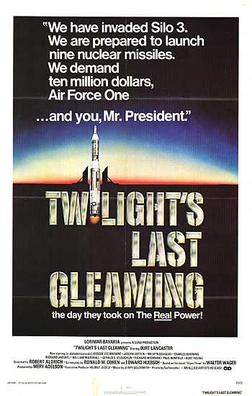 In Montana, four men have infiltrated and taken over a top-secret ICBM complex. Three of the men, Hoxey (William Smith), Garvas (Burt Young), and Powell (Paul Winfield) are considered to be common criminals but their leader is something much different. Until he was court-martialed and sentenced to a military prison, Lawrence Dell (Burt Lancaster) was a respected Air Force general. He even designed the complex that he has now taken over. Dell calls the White House and makes his demands known: he wants ten million dollars and for the President (Charles Durning) to go on television and read the contents of top secret dossier, one that reveals the real reason behind the war in Vietnam. Dell also demands that the President surrender himself so that he can be used as a human shield while Dell and his men make their escape.
 Through the Shattered Lens