October Positivity: Me Again (dir by David A.R. White)


In 2011’s Me Again, David A.R. White stars as Rich.

Rich is a typical David A.R. White character.  He’s a preacher with a young family and he has lost his ability to excite his congregation.  His sermons are dry and boring and show little connection with the concerns or lives of those listening.  Rich is burned out and his wife, April (Ali Landry), is tired of listening to him complain.  When they were children, April promised Rich that they were meant to be together.  Now that they are adults and married, April and Rich are separated and April wants to make the divorce final.

Poor Rich!  No one respects him and he’s about to lose his family.  His one friend, Tony (Tommy Blaze), tries to offer some good advice but Rich doesn’t want to hear it.  Rich just wants to feel sorry for himself and watch an odd infomercial hosted by Big Earl (Bruce McGill).  Big Earl says that if you call his number, he can change your life.  Rich doesn’t call the number but his life gets changed anyways.

Rich finds himself being transported from one body to another.  When he wakes up, he’s a wealthy man who has no friends and who has a heart condition.  Just as quickly, he finds himself in the body of Chloe (Andrea White Logan), an insecure super model with an eating disorder.  Then, suddenly, he’s in the body of a fish floating in a fish tank in Tony’s restaurant.  Then he’s his daughter’s teen boyfriend, who is pressuring her to start taking birth control.  (AGCK!)  Then he’s in his wife’s body.  Briefly, he takes control of Della Reese.  He even spends some time in jail, talking to Big Earl.

And I guess the idea is that, from going to body to body, Rich learns why he needs to stop feeling sorry for himself and actually make the effort to make his marriage work.  He also comes to understand the problems of a few other people.  The rich man needs to go to church.  The model needs to do something about all the disparaging post-it notes that she has hanging around her house.  Her daughter’s boyfriend needs to be handcuffed with a sock in his mouth.  The fish need as new home.  You get the idea.

This movie …. well, let’s give credit where credit is due.  David A.R. White is not a bad actor and his comedic timing is adequate.  There were a few moments when he did make me smile.  I laughed out loud when he suddenly became a fish.  As a director, though, White goes a bit overboard.  The whole thing with Rich becoming a model starts out as relatively humorous but then it just goes on and on.  As well, I appreciated the message of taking care of other people but I’m not sure that the best way to communicate that message was for the very white Rich to briefly inhabit the body of a black housekeeper.  The intentions may have been good but the execution often left me cringing.

Me Again is like a lot of faith-based comedies.  There are a few humorous moments but, in the end, it’s just too uneven to really work.
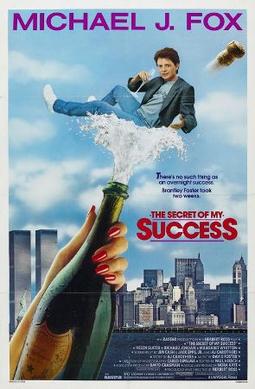
The Secret of My Success (1987, directed by Herbert Ross)


ȋ‚˜é

Brantley Foster (Michael J. Fox) heads to New York City with his business degree from the University of Kansas and the promise of an entry-level job as a financier.  He arrives to discover that the company that hired him no longer exists and that Brantley is out of a job.  New York is a harsh town for someone who is down on his luck and all of out of money.  Brantley eventually gets a job working in the mail room of a company owned by his wealthy uncle (Richard Jordan).  His uncle doesn’t even know who he is but soon, Brantley becomes just as rich and successful as he always dreamed.

What’s the secret of Brantley’s success?

Screwing his Aunt Vera (played by Margaret Whitton).

What’s the other other secret of his success?

Pretending to be named Carlton Whitfield and claiming that he’s a new executive at the corporation.

I remember when Kramer did the same thing on Seinfeld.  It didn’t work out for Kramer.  He got fired after turning in his first report.

“This is gibberish,” his boss said, “It’s almost as if you have no business training at all.  I’m afraid we have to let you go.”

“I don’t actually work here,” Kramer replied.

“That’s what makes this so hard.”

Seinfeld, never topped.

Back to The Secret of My Success, this is the most 80s film ever made, complete with montages of Brantley exploring New York and a saxophone playing on the soundtrack.  Brantley’s all about TCB, taking care of business.  He screws his aunt but falls in love with Christy Wills (Helen Slater).  Brantley doesn’t learn anything but he gets the best office and becomes a success without actually doing any real work.  It’s the ultimate fantasy and, like many fantasies, The Secret of My Success is superficially appealing.  Michael J. Fox is likable as Brantley.  Margaret Whitton is outrageously sexy as Vera.  Helen Slater is pretty and boring, traits that made her the ideal “good” girlfriend for Brantley’s story.

The Secret of My Success is your ticket to the 80s.

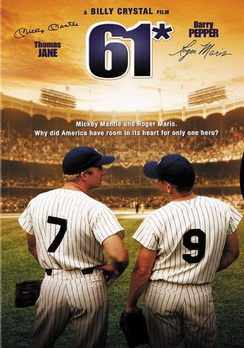
I Watched 61* (2001, Dir. by Billy Crystal)


61* is about two baseball player and two friends who couldn’t seem to be more different.

Roger Maris (Barry Pepper) is an introverted family man who doesn’t like it when reporters show up at his house in search of a story or a quote.  He’s a good ball player, one of the best, but he doesn’t want to be a celebrity.  Mickey Mantle (Thomas Jane) is a larger-than-life personality, a beloved figure on the field and in the dugout.  Mickey loves being famous and the fans love him.  Both Maris and Mantle are members of the New York Yankees.  Because Mantle is struggling with his drinking, he becomes Maris’s roommate when they’re on the road.  In 1961, the two friends both go after Babe Ruth’s record of 60 home runs in a season.  The press presents their season as a battle, a race to see who will be the first to hit the sixty-first home run of the season.  Mantle and Maris, though, are just swinging the bat and making plays.

I really enjoyed 61*, which is a baseball film made by and for people who love baseball.  I liked the contrast between the quiet Maris and the charismatic Mantle.  Even though Maris is a hard worker and a good ballplayer, Mantle is the fan favorite and the one that people actually want to break the record.  I appreciated that Maris and Mantle remained friends even when the press tried to turn them into rivals.  That’s what teamwork is all about.  Barry Pepper and Thomas Jane were great as Maris and Mantle and the movie showed how each man dealt with the stress of possibly breaking Babe Ruth’s record.

(Why is there an asterisk in the title?  Babe Ruth set his record in a season that only had 154 games.  The 1961 baseball season was 8 games longer.  The asterisk was added as a reminder that Maris and Mantle had 8 more games than Ruth did to try to break the record.  Baseball fans understand how important accurate statistics are to a player’s career and a team’s season.)

61* celebrates the way baseball used to be, a game played by athletes who had to depend on skill and teamwork instead of performance enhancing drugs.  The movie opens with Maris’s family watching as Mark McGuire closes in on breaking the record.  McGuire would only briefly hold the record.  He would lose it, for 48 minutes, to Sammy Sosa and then, three years after winning it back, he would lose it a second time to Barry Bonds.  Of course, Roger Maris won the record without using steroids so, as far as I’m concerned, it still belongs to him.

If you’re a baseball fan, 61* is a film that you have to see.

April Noir: Collateral (dir by Michael Mann)


In 2004’s Collateral, Jamie Foxx stars as Max, a taxicab driver who is hoping, in those days before Uber, to start his own limousine company.  When we first see him, he’s giving a ride to a federal prosecutor named Annie (Jada Pinkett Smith) and he’s even getting her phone number after he drops her off at work.  Unfortunately, for Max, his next passenger is a bit less friendly.

Vincent (Tom Cruise), with his gray hair that matches his suit, is polite, quiet, and direct when he speaks.  He carries a briefcase with him everywhere that he goes and anyone who tries to take the briefcase soon discovers just how far Vincent will go to hold onto it.  Vincent pays Max $600 to drive him around Los Angeles for the night.  Vincent has a lot of business that he needs to attend to.  Max agrees, not realizing until it’s too late that Vincent is a hired assassin and that his business is killing people.  Vincent has been hired to wipe out a collection of crooks and lawyers and, though Vincent is careful not to reveal his emotions, it’s obvious that he’s looking forward to the challenge.

To his credit, Max doesn’t really have any interest in being a part of Max’s killing spree but he soon finds himself unable to escape from Vincent and being forced to drive from location to location.  Along the way, Vincent and Max engage in debates of both morality and philosophy.  Vincent sees death as just being a part of the job.  Max is horrified, especially when people who haven’t done anything wrong end up as collateral damage in Vincent’s killing spree.  The truth of the matter is that, even if Max hadn’t picked up Vincent, there’s no guarantee that he wouldn’t have picked up some other madman.  As a taxi driver, Max surrenders his control once he unlocks the door and allows someone to get in the backseat.  Sometimes, he gets a passenger like Annie.  Other times, he’s going to get a passenger like Vincent.  Somewhat improbably, Vincent and Annie turns out to be connected and Max’s chance encounter with her becomes even more important.

Because this is a Michael Mann film, Los Angeles is as much a character in this film as Max and Vincent.  Mann captures the shadowy darkness of the city at the night and the feeling that both opportunity and danger could lurk around every corner.  Claustrophobic scenes in the taxi cab are mixed with scenes in an equally claustrophobic (though for different reasons) club.  The film’s haunting final image takes place not in the cab but instead on a train.  Everyone is heading somewhere and, at some point during the film, both Vincent and Max deal with the feeling of having no control over where they’ll end up.

When Collateral first came out in 2004, I remember that a lot of people were shocked to see Cruise playing a villain.  Cruise does give one of his best performances here, playing yet another one of Mann’s cool and efficient professionals.  Strangely enough, Jamie Foxx is the one who was nominated for an Oscar, even though he’s actually a little on the boring side as Max.  (In all fairness, Max is meant to be the conventional member of the film’s involuntary partnership.)  The film is dominated by Cruise and his performance is still powerful to this day.

Ghosts of Sundance Past: Waiting For The Moon (dir by Jill Godmilow)


The Sundance Film Festival is currently underway in Utah.  For the next few days, I’ll be taking a look at some of the films that have previously won awards at Sundance.

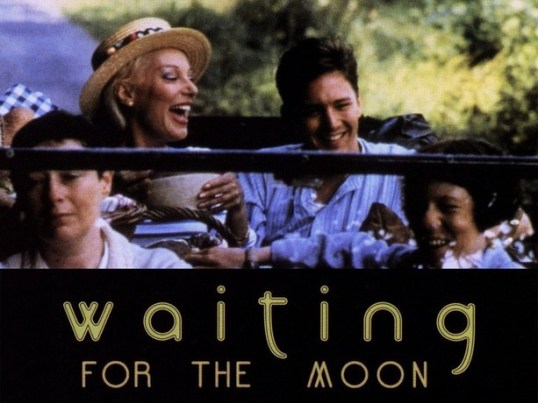
First released in 1987, Waiting For The Moon is a lowkey and fictionalized account of the relationship between Gertrude Stein (Linda Bassett) and Alice B. Toklas (Linda Hunt).

The film takes place in 1936, almost entirely at the home that Stein and Toklas shared in France.  Back in the years immediately following World War I, their home was a stopping spot for almost every writer who no longer felt at home in the conventional world.  It was the place where the members of the so-called Lost Generation met to socialize and discuss their art.  (Ernest Hemingway memorably wrote about visiting Stein and Toklas in A Moveable Feast.)  However, Waiting For The Moon takes place long after those exciting years.  Gertrude and Alice are now living a rather comfortable and settled life.  Occasionally, someone will stop by.  Hemingway (played by Bruce McGill) shows up.  Picasso stops by for a visit, though we only hear him.  But, for the most part, the film focuses on Gertrude and Alice.  The film follows them as they bicker like the old married couple that they essentially are, even if society in 1936 wasn’t willing to acknowledge it.  Alice proofreads Gertrude’s latest writing.  Gertrude waits for word from her doctor.  They talk about old times and old friends.  At one point, an aspiring writer named Henry Hopper (Andrew McCarthy) pays the two women a visit and, for a day at least, it’s like old time.  Henry is earnest and idealistic and full of plans for the future.  Unfortunately, he’s also planning on fighting in the Spanish Civil War and it doesn’t take a genius to guess that probably won’t go well.  Indeed, we learn that several of Gertrude and Alice’s old acquaintances are now fighting and dying in the Spanish Civil War.  For the so-called Lost Generation, the battle against Franco is a chance to find themselves but students of history already know how the war is going to end.  For that matter, students of history will also realize that World War II is right around the corner.  (Needless to say, the film itself offers up not a hint of the controversy that would surround Stein’s activities during the Vichy regime,)

Waiting For The Moon is a deliberately paced film, which is a polite way of saying that it’s a bit on the slow side.  That said, the scenery is beautiful and both Linda Hunt and Linda Bassett give good performances as the film’s versions of Alice and Gertrude.  Bruce McGill steals the film as the blustery Hemingway.  I’m sure Ernest would have approved.  (Could Ernest Hemingway ever be played as being anything other than blustery?)  The film captures the daydream that I think captures the fancy of many aspiring writers, the idea of being in a place where your thoughts are the center of life and all of your friends understand what it’s like to be a creative soul.

Waiting For The Moon won the Dramatic Grand Jury Prize at the 1987 Sundance Film Festival.  It’s not an easy film to find.  On Amazon, a copy on DVD runs about $52.00.  I was fortunate enough to find a copy at Half-Price Books.


Lisa Marie Reviews An Oscar Nominee: The Insider (dir by Michael Mann)


In the 1999 Best Picture Nominee, The Insider, the American media takes a beating.

Al Pacino plays Lowell Bergman.  Bergman is a veteran newsman who, for several years, has been employed as a producer at 60 Minutes.  He is a strong believer in the importance of the free press and he’s proud to be associated with both 60 Minutes and CBS News.  He’s one of the few people who can manage the famously prickly correspondent, Mike Wallace (Christopher Plummer).  When we first see Bergman, he and Wallace are in the Middle East and arranging a tense interview with the head of Hezbollah.  It’s easy to see that Bergman is someone who will go anywhere and take any risk to get a story.  It’s also apparent that Bergman thinks that the people that he works with feel the same way.

That all changes when Bergman meets Jeffery Wigand (Russell Crowe), a recently fired tobacco company executive who initially agrees to serve as a consultant for one of Bergman’s story but who leaves Bergman intrigued when he reveals that, due to a strict confidentiality agreement, he’s not allowed to discuss anything about his time as an executive.  As the tobacco companies are currently being sued by ambitious state attorney generals like Mississippi’s Mike Moore (who plays himself in the film), Bergman suspects that Wigand knows something that the companies don’t want revealed.

And, of course, Bergman is right.  Wigand was fired for specifically objecting to his company’s effort to make cigarettes more addictive, something that the tobacco industry had long claimed it wasn’t doing.  Wigand’s pride was hurt when he was fired but he knows that breaking the confidentiality agreement will mean losing his severance package and also possibly losing his marriage to Liane (Diane Venora) as well.  However, Wigand is angered by the heavy-handed techniques that his former employer uses to try to intimidate him.  He suspects that he’s being followed and he can’t even work out his frustrations by hitting a few golf balls without someone watching him.  When Wigand starts to get threats and even receives a bullet in the mail, he decides to both testify in court and give an interview to Wallace and 60 Minutes.

The only problem is that CBS, after being pressured by their lawyers and facing the risk of taking a financial loss in an upcoming sell, decides not to run the interview.  Bergman is outraged and assumes that both Mike Wallace and veteran 60 Minutes producer Don Hewitt (Philip Baker Hall) will support him.  Instead, both Wallace and Hewitt side with CBS.  Left out in the cold is Jeffrey Wigand, who has sacrificed almost everything and now finds himself being attacked as merely a disgruntled employee.

Directed by Michael Mann and based on a true story, The Insider is what is usually described as being “a movie for adults.”  Instead of dealing with car chases and super villains and huge action set pieces, The Insider is a film about ethics and what happens when a major media outlet like CBS News fails to live up to those ethics.  (No one is surprised when the tobacco company tries to intimidate and silence Wigand but the film makes clear that people — or at least people in the 90s — expected and hoped for more from the American press.)  Wigand puts his trust in Bergman and 60 Minutes largely because he believed Bergman’s promise that he would be allowed to tell his story.  It’s a promise that Bergman made in good faith but, in the end, everyone from the CBS executives to the tobacco companies is more interested in protecting their own financial future than actually telling the truth.  Wigand loses his family and his comfortable lifestyle and Bergman loses his faith in the network of Edward R. Murrow.  It’s not a particularly happy film but it is a well-made and thought-provoking one.

Pacino and Crowe both give excellent performances in the two lead roles.  Pacino, because he spends most of the film outraged, has the flashier role while Crowe plays Wigand as a rather mild-mannered man who suddenly finds himself in the middle of a national news story.  (Crowe’s performance here is one of his best, precisely because it really is the opposite of what most people expect from him.)  Crowe does not play Wigand as being a crusader but instead, as an ordinary guy who at times resents being put in the position of a whistleblower.  (Director Mann does not shy away from showing how Bergman manipulates, the reluctant Wigand into finally testifying, even if Bergman’s motives were ultimately not malicious.)  That said, the strongest performance comes from Christopher Plummer, who at first seems to be playing Mike Wallace as being the epitome of the pompous television newsman but who eventually reveals the truth underneath Wallace’s sometimes fearsome exterior.

The Insider was nominated for Best Picture.  Somehow, it lost to American Beauty.

Film Review: The Last Innocent Man (dir by Roger Spottiswoode)


In 1987’s The Last Innocent Man, Ed Harris plays Harry Nash.

Harry is a criminal defense attorney, one who specializes in defending people who have been charged with committing murder.  He’s good at his job but he’s not sure that he’s happy with his life.  He went into the law to save people from Death Row but years of getting acquittals for guilty people have taken their toll on Harry’s psyche.  His most recent client was Jonathan Gault (David Suchet), a man accused of having killed his wife.  The verdict was “not guilty” but Harry suspects that Gault may have been guilty of both what he was charged with and also countless crimes for which he hasn’t been charged.  It doesn’t help that Gault confronts Harry in a parking lot and says he wants Harry to co-write a book about how he got Gault acquitted.  Gault proceeds to tell Harry that he did kill his wife, before suddenly laughing and saying that he’s only joking.

Despite all of the money and the fame, Harry needs a break from dealing with guilty people.  He tells his shocked partner that he will be temporarily stepping back from their practice.  Along with being burned out, Harry is also interested in pursuing a romantic relationship with Jenny Stafford (Roxanne Hart).  Jenny is married but she assures Harry that she is in the process of getting a divorce from her husband, Philip (Darrell Larson).

However, when Philip is arrested and accused of murdering a policewoman who was working undercover as a prostitute, Harry finds himself defending Philip in court.  Philip swears that he’s innocent of the crime and that he’s never even been with a prostitute.  He claims that, when the murdered occurred, he was at home with his wife.  Jenny is willing to collaborate Philip’s alibi, even though Harry suspects that she’s lying.

As you can probably guess, there are plenty of twists and turns to the plot of The Last Innocent Man.  Unfortunately, they’re not exactly shocking twists and turns.  The Last Innocent Man is a courtroom drama and it pretty much sticks to the rules of the genre, which means a lot of snarky comments between Harry and the prosecutor and also plenty of scenes of various lawyers snapping “Objection!” and demanding a recess.  This is the type of film where people fall apart on the witness stand and the audience in the courtroom murmurs whenever something shocking happens.  The Judge can’t pound that gavel hard enough to make The Last Innocent Man anything more than a standard courtroom drama.

That said, director Roger Spottiswoode keeps the action moving at a quick-enough pace and Ed Harris is ideally cast in the role of the morally conflicted Harry Nash.  As well, there’s an entertaining supporting performance from Clarence Williams III, cast here as a cocky pimp, and David Suchet is chillingly evil as the worst of Harry’s clients.  The Last Innocent Man doesn’t quite reach the Hitchcockian heights that it was reaching for but, still, fans of courtroom dramas will enjoy it or, at the very least, show a little leniency in their judgment.

January True Crime: Shoot First: A Cop’s Vengeance (dir by Mel Damski)


Made for television in 1991 and possessing a rather unwieldy title, Shoot First: A Cop’s Vengeance tells the story of two friends in San Antonio in the early 80s.

Farrell Tucker (Dale Midkiff) and Stephen Smith (Alex McArthur) are both cops.  They entered the police academy together, they graduated as a part of the same class, and they both hope to be partners while working to keep the streets of San Antonio safe.  Tucker is laid back and friendly and not one to worry too much about following all of the regulations.  Stephen Smith, on the other hand, is uptight and, at first, by-the-book.  He grew up in a poverty-stricken, crime-riddled neighborhood and it left a definite impression on him.  He hates crime and criminals but what he really can’t stand is a justice system that seems to be more concerned with the victimizers than with the victims.  Tucker and Smith enjoy spending their time together, drinking at the local cop bars and practicing their shooting on the weekends.  Tucker’s not much of a shot, whereas Smith is a sharpshooter who rarely misses.

At first, no one notices or even cares that some of San Antonio’s less upstanding citizens are getting gunned down in the streets.  But when Smith somehow manages to be first on the scene to a series of shootings, it gets the attention of Internal Affairs.  With Sergeant Nicholas (Terry O’Quinn) investigating the possibility of a cop-turned-vigilante and Chief Hogan (G.D. Spradlin) announcing that no one is above the law, Smith starts to get a bit paranoid and Tucker is forced to consider that his friend could very well be a murderer.

And, of course, Tucker’s right!  The first scene features Tucker confronting Smith and then the majority of the film is told in flashback.  Even if not for that narrative choice, one could guess at Smith’s guilt just from the title of the film.  When Shoot First: A Cop’s Vengeance was released on home video, the title was changed to Vigilante Cop, which made Smith’s guilt even more obvious.  Finally, some viewers will guess that Smith is guilty because the film is based on a true story.  Officer Stephen Smith actually did go on a killing spree, gunning down men who he felt had escaped the law and even sending threatening letters to his chief when the latter announced that vigilante activity would not be tolerated.  Officer Stephen Smith went from being a follower of the rules to someone who attempted to write his own rules.  It’s an interesting story for anyone who wants to google it.

As for the film, it’s adequate without being particularly memorable.  Alex McArthur and Dale Midkiff both give good performance as Tucker and Smith and the cast is full of talented people like Terry O’Quinn, G.D. Spradlin, Bruce McGill, and Lynn Lowry.  Observant viewers will even notice a long-haired Jeremy Davies, showing up for a split-second.  I liked the performance of Loryn Locklin, as the waitress who marries Smith and then discovers that her charming husband actually has some very serious issues.  The main problem with the film is that the story moves a bit too slowly for its own good and some of the Texas accents were more than a little dodgy.  If you’re looking for an action film, this won’t be for you, though the shootings are surprisingly graphic for something that was made for television.  Shoot First: A Cop’s Vengeance is a rather routine telling of an interesting story.

MY COUSIN VINNY (1992) – Joe Pesci heads way down south!


There are certain movies in my life that I consider “comfort movies.” These are the movies that I love so much that they always help me relax because I feel better just by watching them. I often turn on a comfort movie when I really need to fall asleep. Examples in my life include most of Charles Bronson’s filmography, RIO BRAVO, the ZATOICHI films, THE OTHER GUYS, and pretty much anything directed by Alex Kendrick. MY COUSIN VINNY fits comfortably under my categorization of a comfort movie.

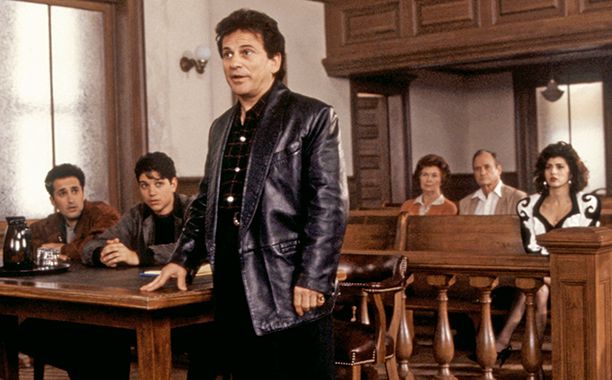
The movie opens with friends Bill Gambini (Ralph Macchio) and Stanley Rothenstein (Mitchell Whitfield) taking the scenic route down south as part of a cross-country trip to attend college at UCLA. Unfortunately, while in Alabama, the two are arrested soon after leaving a convenience store. Thinking they are being charged for accidentally shoplifting a can of tuna, it turns out the actual charges are robbery and murder as the place was robbed and the clerk killed soon after they left. Knowing they are in big trouble, Bill calls his cousin Vinny Gambini (Joe Pesci), who’s pretty much the only lawyer that he knows. The problem, Vinny has never actually tried a murder case. Vinny heads down south with his fiance Mona Lisa Vito (Marisa Tomei) where he must contend with a judge (Fred Gwynne) who doesn’t like him, a prosecutor (Lane Smith) who has way more experience than him, and a mountain of circumstantial evidence that he has almost no hope of contradicting. Will Vinny be able to prove his cousin’s innocence before they end up with life in prison, or even worse?

There are many reasons that I love MY COUSIN VINNY. The cast consists of a couple of my personal favorite actors in Joe Pesci and Ralph Macchio. GOODFELLAS is certainly one of the best movies ever made, and Joe Pesci gives an unbelievably powerful performance, a performance that would win him the Academy Award. Pesci took a short break from filming MY COUSIN VINNY to attend the Acadamy Award ceremony and pick up the gold. He even took the statue to the set to show the cast and crew. Maybe that helped inspire Marisa Tomei to give her own Academy Award winning performance in this film. My favorite scene of the entire movie is when Vinny is treating Mona Lisa as a hostile witness on the stand, just before she proceeds to prove that nobody knows more about cars than she does. It’s such a satisfying scene as she makes the prosecutor’s “expert” look like a novice. As for Ralph Macchio, many times in my life I’ve made the statement that I wanted to be the karate kid when I was growing up. I think I was in the fifth grade when I saw the film for the very first time. I’ve been a fan of Ralph Macchio, and in love with Elisabeth Shue, ever since. It’s the kind of movie I’d just sit around thinking about when I was a kid. I even wanted to learn karate, but being just a little over 4 feet tall at the time, I didn’t need to be getting into any fights. I also like that MY COUSIN VINNY was partially filmed in the town of Covington, GA. My wife and I were driving from Arkansas to Myrtle Beach back in 2020 and we stayed the night in Covington. I had done a little research while I was looking for a place to stop for the night, and I found out that Covington is sometimes referred to the “Hollywood of the South” due to the large number of movies and TV shows that are filmed there. We snapped a couple of shots of the downtown before heading on down the road. But I think the thing I love most about MY COUSIN VINNY is also the reason I love movies like THE KARATE KID and ROCKY so much. I love movies where a person is completely underestimated, and rightfully so. But then, through some combination of intelligence, hard work, heart, and will, that same person is able to rise to the occasion and prevail against those very same people who underestimated them. Vinny has no business in the courtroom, but somehow, he’s able to win the case, and he does it in a smart, funny and exciting way. I love an underdog, and MY COUSIN VINNY just makes me feel good!  

Retro Television Review: Miami Vice 2.4 “Out Where The Buses Don’t Run”


Welcome to Retro Television Reviews, a feature where we review some of our favorite and least favorite shows of the past!  On Mondays, I will be reviewing Miami Vice, which ran on NBC from 1984 to 1989.  The entire show is currently streaming on Tubi!

This week, we learn the cost of working Vice.

Episode 2.4 “Out Where The Buses Don’t Run”

(Dir by Jim Johnston, originally aired on October 18th, 1985)

This is it.  This is the episode that is regularly cited as being one of the best, if not the best, episodes that Miami Vice ever aired.  Out Where The Buses Don’t Run takes a look at the psychological costs of spending one’s life obsessing on crime and justice.  What starts out as a comedy turns into the bleakest episode of the show so far.

Things get off to a great start, with Crockett and Tubbs pursuing a drug dealer on the beach.  While The Who’s Baba O’Riley plays on the soundtrack, the dealer roller skates down a sidewalk and a preacher (played by Little Richard) sends his young congregation out to collect money.  As Crockett and Tubbs wait for their chance to arrest the dealer, someone watches them from a nearby window and takes pictures.  Crockett asks Tubbs if he ever gets the feeling that he’s being watched.

The man taking the pictures turns out to be Hank Weldon (Bruce McGill), a former Vice cop who quit the force six years prior when a case that he had spent three years making fell apart and a drug lord was set free on a technicality.  The drug lord vanished after the case against him was thrown out and it’s assumed that he was murdered by his associates.  Hank, however, insists that the drug lord is still alive and he’s returned to Miami.  He wants Crockett and Tubbs to help him finally catch the criminal that evaded him all those years before.

A quick check with Weldon’s former partner, Marty Lang (David Strathairn), reveals that Weldon left the force after he had a nervous breakdown and he’s spent the past few years in a mental facility.  The loud and flamboyant Weldon is obviously still unstable but Crockett and Tubbs cannot shake the feeling that he might know what he’s talking about.

And, as is revealed at this end of this episode, they’re right …. kind of.  Weldon does know where the missing drug lord is.  The drug lord is walled up in an abandoned building.  He’s been there since 1979.  At the end of episode, with Tubbs, Crockett, Castillo, and Lang watching, Weldon tears down the wall and reveals the decayed skeleton of the drug lord.  Weldon announces that he murdered him and walled him up.  Lang then reveals that he helped.

“He was my partner,” Lang says, “Understand?”

Crockett understands and the audience understands as well.  When Weldon’s obsession drove him crazy, Lang was the only one to whom he could turn.  And Lang, being his partner, was the only one who understood how he felt.  Lang may have been a cop but his number one loyalty was to his partner, just as Crockett’s number one loyalty will always be to Tubbs.

As played by Bruce McGill, Hank Weldon goes from being a cheerful eccentric to a bitter and paranoid lunatic to, finally, a man who can no longer stand to hide what he’s done.  It’s an excellent performance that keeps the audience guessing.  He may be a murderer and he’s obviously still unstable but your heart can’t help but break for him.  The combination of Jim Johnston’s moody direction, a perfect collection of songs on the soundtrack, and the performances of Bruce McGill and David Strathairn really do come together to make this an excellent episode.  In the end, it’s hard not to feel that Crockett and Tubbs are both one step away from becoming Weldon and Lang themselves.