4 (or more) Shots From 4 (or more) Films is just what it says it is, 4 (or more) shots from 4 (or more) of our favorite films. As opposed to the reviews and recaps that we usually post, 4 (or more) Shots From 4 (or more) Films lets the visuals do the talking.
115 years ago today, Billy Wilder was born in what was-then Austria-Hungary and what is today Poland. Having started his film career as a screenwriter in Germany, Wilder fled to the United States after the rise of Hitler. (Many members of Wilder’s family would subsequently die in the Holocaust.) He went on to establish himself as one of the great studio directors, a filmmaker who could seemingly master any genre and whose films were often distinguished by an irreverent wit and a welcome skepticism when it came to accepting any sort of conventional wisdom. He made the type of films that could only be made by someone who had seen humanity at its worst but who also understood what people were capable of at their best. Wilder made dramas that could make you laugh and comedies that could make you cry. He was a master filmmaker, one whose work continues to influence directors to this day.
Today, in honor of Billy Wilder’s legacy, the Shattered Lens presents….
4 Shots From 4 Billy Wilder Films
Double Indemnity (1944, dir by Billy Wilder, DP: John Seitz)
Sunset Boulevard (1950, dir by Billy Wilder, DP; John F. Seitz)
The Apartment (1960, dir by Billy Wilder, DP: Ernest Laszlo)
The Private Life of Sherlock Holmes (1970, dir by Billy Wilder, DP: Christopher Challis)
-Gloria Swanson as Norma Desmond in SUNSET BOULEVARD
I hadn’t seen Billy Wilder’s SUNSET BOULEVARD for quite some time until a recent rewatching. I’ve told you before how much I love a good Hollywood behind-the-scenes movie, and this one is no exception. But as I watched the tale unfold, I began to see the film in a different light. SUNSET BOULEVARD is always called a film noir classic, but this go-round found me viewing it through a lens of horror.
It’s certainly got all the elements of film noir. There’s protagonist William Holden, trapped in a bottomless downward spiral. Gloria Swanson is the femme fatale who ensnares Holden and pulls him into her dark web. The cinematography of John F. Seitz portrays a shadow-world of despair. And we’ve got Billy Wilder directing, the man behind noir masterpiece DOUBLE INDEMNITY, working…
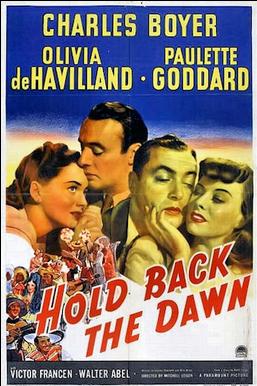
(With the Oscars scheduled to be awarded on March 4th, I have decided to review at least one Oscar-nominated film a day. These films could be nominees or they could be winners. They could be from this year’s Oscars or they could be a previous year’s nominee! We’ll see how things play out. Today, I take a look at the 1941 best picture nominee, Hold Back the Dawn!)
Hold Back The Dawn is a historically important film for many reasons.
First off, this was the last film to be written by Billy Wilder before he launched his own legendary directorial career and, with its mix of sharp comedy and tearful melodrama, Hold Back The Dawn definitely feels like a Wilder film. Wilder, himself, claimed that he was never happy with the way his script was adapted. For instance, Wilder wrote a scene in which Charles Boyer, playing a Romanian who is stranded in a Mexican border town, was meant to deliver a monologue to a cockroach. Boyer felt that the scene was ridiculous and the film’s director, Mitchell Leisen, never filmed it. Wilder was so incensed that he declared that he would never again allow any of his scripts to be filmed by anyone other than himself.
Hold Back The Dawn also played a part in one of the most legendary feuds in Hollywood history, though there are some who claim that it was more the product of an overzealous pr agent’s imagination than anything else. For her role as the shy school teacher with whom Boyer falls in love, Olivia de Havilland was nominated for Best Actress and was considered to be one of the front-runners for the reward. (If nothing else, it was felt that giving her the Oscar would make up for not giving it to her when she was nominated for Gone With The Wind.) However, that same year, Joan Fontaine was nominated for her role in Hitchock’s Suspicion and many felt that, after losing the previous year for her performance in Rebecca, Fontaine was owed an Oscar as well. An Oscar night, Joan Fontaine beat Olivia de Havilland. What complicated matters it that, beyond issues of professional jealousy, de Havilland and Fontaine were sisters. For years, there were stories that de Havilland had never gotten over losing her Oscar to Fontaine and that, as a result, the two sisters had little to do with each other. (The truth, as is always the case with siblings, appears to have been a lot more complicated. de Havilland herself said it was less about the Oscars and more about just not having much in common with her sister.)
Beyond all that, however, Hold Back The Dawn is a charming dramedy that holds up remarkably well. Boyer is Georges Iscoveu, a Romanian gigolo who has spent eight years living in a Mexican hotel, waiting to be allowed to enter the U.S. Olivia de Havilland is Emmy Brown, an unmarried teacher who has nearly given up on ever finding love. At first, Georges just wants to trick Emmy into marrying him so that he can legally enter the United States. However, he soon finds himself truly falling in love with her. Unfortunately, his partner-in-crime — Anita (Paulette Goddard) — is also in love with Georges and is not at all prepared to lose him to Emmy. I know it all sounds very melodramatic but Wilder frames his story with a meeting between Georges and a Hollywood producer, a move the assures us that Hold Back The Dawn is content to be pure entertainment and we really should just sit back, not get too caught up on the specifics of the plot, and enjoy ourselves. Charles Boyer is all befuddled charm as Georges while de Havilland is both poignantly likable as Emmy. For me, as good as they are, the best performance came from Paulette Goddard, who is sharp-tongued and wonderfully cynical as Anita. All three performers are helped by a wonderful script. Even if Boyer never does talk to a cockroach, Wilder’s dialogue is still sharp and witty. This is a film that is as much fun to listen to as it is to look at.
I’m currently stuck at home on this beautiful day, dealing with a really bad cold. (Even as I sit here typing this up, I am currently in a feverish haze.) It’s frustrating but, fortunately, I’ve got a lot of movies to watch. After all, TCM is wrapping up their 31 Days of Oscars and my DVR is currently full of nominated films waiting to be reviewed.
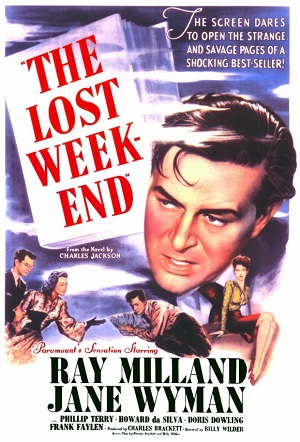
For instance, I just watched the 1945 best picture winner, The Lost Weekend. The Lost Weekend was directed by Billy Wilder, a director who is most often associated with sad-eyed comedies like Some Like It Hot, The Apartment, and The Seven Year Itch. However, The Lost Weekend is most definitely not a comedy. Instead, it’s an incredibly harrowing and rather depressing portrait of addiction and lost promise.
Don Birnan (Ray Milland) is a struggling writer. When we first meet him, he’s packing for a weekend trip with his brother, Wick (Philip Terry). The conversation between Don and Wick at first sounds friendly but soon, we start to hear hints of suspicion in Wick’s voice. Wick seems incredibly concerned about what exactly Don is packing and Don starts to get defensive. Don says that it’s been ten days since he had a drink and that there is no more liquor in the apartment. However, whenever Wick turns his back, Don starts to search for the bottles that he’s hidden around his bedroom. (He’s even got a bottle of whiskey hanging on a rope outside the window.) It gets to the point that, whenever Wick isn’t looking, Don is holding a bottle.
And while that may sound potentially humorous, there’s nothing funny about the scene. Don’s desperation is too real. As someone who grew up having to deal with an alcoholic father, I recognized Don and his addiction immediately. Everything about him — from his fast smile to his continual assurances that he’s cleaned himself up — is a facade, designed to help him survive until he can get his next drink.
The main thing about alcoholics is that they’re extremely clever. Don knows that Wick wants to get him away for the weekend so that he can’t drink. When Don’s girlfriend, Helen (Jane Wyman), mentions that she has two tickets for a concert, Don convinces Wick to go to the show with her. Once Wick is out of the apartment, Don can sneak down to the neighborhood bar. When it comes time to leave for that dry weekend vacation, Don manages to accidentally on purpose miss the train.
Left alone for the weekend, Don can now do what he wants. He tries to write about his life as an alcoholic but discovers that his brain is too muddled for him to think straight. So, instead, he drinks. Unfortunately, Wick hasn’t left him any money and has also ordered all the local bars and liquor stores to not allow his brother to run up a tab. As a result, Don finds himself scrounging for money.
In perhaps the film’s most famous scene, Don carries his typewriter down to the local pawnshop so that he can get money to buy a drink. However, the pawnshop is closed for Yom Kippur. The camera follows Don as he staggers around New York City, looking for an open pawnshop. Wilder shot this scene on the streets of New York City, using a hidden camera. The people who we see reacting to Don are not Hollywood extras but instead are actual New Yorkers who had no idea that the pathetic drunk they were gawking at was actually film star Ray Milland.
As the weekend plays out, Don transforms. He goes from being smooth and outwardly confident to being unshaven and desperate. Eventually, Don ends up in a sanitarium, where he’s taunted by a sadistic nurse. (The nurse is played by Frank Faylen, who played Ernie the cab driver in It’s A Wonderful Life.) Even when Don manages to get back to his apartment, he finds himself screaming as he hallucinates a bat eating a mouse. Blood runs down the walls.
Does the film, at least, have a happy ending? It depends. The local bartender, Nat (Howard Da Silva), returns Don’s typewriter to him. Helen convinces Don to write about his lost weekend. Don says that he’s never going to drink again but, at the same time, we can’t help but remember that the movie started with Don saying the same thing…
As directed by Billy Wilder, The Lost Weekend plays out like a noir thriller, full of menacing shadows. The score, composed by Miklos Rozsa, uses a theremin to let us hear the addiction-fueled chaos within Don’s head. Best of all, Ray Milland totally loses himself in the role of Don Birnan, with the vanity of film stardom soon replaced with the pathos of addiction. Even watching the film today, it’s easy to understand how The Lost Weekend won the Oscar for Best Picture of 1945.
“All right, Mr. De Mille, I’m ready for my close-up!”
— Norma Desmond (Gloria Swanson) in Sunset Boulevard (1950)
First released in 1950 and nominated for Best Picture, Billy Wilder’s Sunset Boulevard is one of the greatest and most influential films of all time. It’s also something of a difficult film to review because, in order for one to truly understand its greatness, it needs to be seen. A description simply will not do. You have to experience, first hand, the performances of Gloria Swanson, William Holden, and Eric Von Stroheim. You have to see, with your own eyes, the way that Billy Wilder perfectly balances drama, satire, and horror. I can tell you about how cinematographer John F. Seitz perfectly contrasts the empty glossiness of Hollywood with the dark shadows that fill the ruined mansion of Norma Desmond but, again, it’s something that you owe it to yourself to see. You need to hear the perfectly quotable dialogue with your own ears. You need to experience Sunset Boulevard for yourself.
And, while you’re watching it, think about how easily one bad decision could have screwed up the entire film. Sunset Boulevard is famous for being narrated by a dead man, a screenwriter named Joe (William Holden). When we first see Joe, he’s floating in a pool. Originally, however, the film was to open with the dead Joe sitting up in the morgue and telling us his story. Reportedly, preview audiences laughed at the scene and it was cut out of the film. And Wilder made the right decision to remove that scene. Sunset Boulevard may be famous for being a strange film but, when you actually watch it, you realize just how controlled and disciplined Wilder’s direction actually is. Sunset Boulevard may be weird but it’s never less than plausible.
Joe Gillis is a former newspaper reporter-turned-screenwriter. He may have started out as an idealist but, as the film begins, he’s now just another Hollywood opportunist. While trying to hide from a man looking to repossess his car, Joe stumbles upon a dilapidated old mansion. The owner of the mansion is none other than Norma Desmond (Gloria Swanson), a silent film star who has sent been forgotten but who still dreams of making a comeback. (When Joe tells her that she used to be big, Norma famously responds that she’s still big and it’s the pictures that have gotten small.) Norma has written a script and the opportunistic Joe convinces her to hire him as a script doctor.
Joe moves into the mansion and discovers a world that has never moved past the 1920s. Norma’s butler and former director, Max (played by Gloria Swanson’s former director Erich Von Stroheim) writes letters that he claims were sent by Norma’s fans. Norma spends her time watching her old movies. Occasionally, other forgotten silent screen stars (including Buster Keaton) drop by to play cards.
Encouraged by Joe’s vapid flattery and a mysterious phone call from a Paramount exec, Norma has Max drive her down to the studio. Greeted by the older employees and ignored by the younger, Norma visits with director Cecil B. DeMille (who plays himself). In a rather sweet scene, she and DeMille remember their shared past. DeMille obviously understands that she’s unstable but he treats her with real respect, in contrast to the manipulative Joe.
As for Joe, he’s fallen for a script reader named Betty (Nancy Olson) and wants to escape from being dependent on Norma. However, Norma has invested too much in her “comeback” to just allow Joe to leave…
Sunset Boulevard is a wonderful mix of film noir and Hollywood satire. And, though the film may be narrated by Joe and told from his point of view, it’s firmly on Norma’s side. As easy as it is to be dismissive of Norma’s delusions, she’s right in the end. It is the pictures that have gotten small and, as she proves towards the end of the film, she is still as capable of making a grand entrance as she ever was.
Joe may have been too stupid to realize it but Norma Desmond never stopped being a star.
The 1944 best picture nominee Double Indemnity is probably one of the most imitated films ever made. While it may not be the first film noir, it is one of the most influential and its plot has been duplicated in countless films. In fact, it’s such an influential film that all one has to do is say, “Indemnity” and you automatically know that they’re talking about murder.
Most people assume that the film is the story of Walter Neff (Fred MacMurray), an insurance agent who thinks that he’s smarter and smoother than he actually is. When Phyllis Deitrich (Barbara Stanwyck) approaches him with questions about how much her husband’s life insurance would pay off if his death was accidental, Walter immediately figures out that she’s talking about murder. At first, Walter tells her that he’s not interested but actually he’s very interested. Soon, he and Phyllis are lovers (though Walter, from the start, seems to know that Phyllis is just using him) and he’s plotting out her husband’s murder. After he does kill Phyllis’s husband, Walter makes it look as if he fell from a train. At first, the death is ruled a suicide but, just as Walter hoped, his best friend and fellow insurance agent, Barton Keyes (Edward G. Robinson), announces that it wouldn’t make any sense for a suicidal man to jump from a slow-moving train. Instead, Keyes successfully argues that the death should be ruled an accident and, as a result, the life insurance pays out for double of its value.
However, the money makes Walter paranoid. He starts to worry that Phyllis will betray him. Even worse, he’s approached by the dead man’s daughter, Lola (Jean Heather). Lola tells Walter that she believes that Phyllis not only killed her father but her mother as well. Soon, Walter is involved with both Lola and Phyllis. Walter claims that he feels guilty and protective of Lola but MacMurray’s wonderfully ambiguous performance leaves us wondering just how much we should trust anything that he has to say.
Now, as I said before, the film may be narrated by Walter Neff and it may be set into motion by his affair with Phyllis but ultimately, the film is not about his relationship with Phyllis. Instead, it’s about Walter’s friendship with Barton Keyes. When we first see Walter, he’s recording a confession specifically for Keyes to hear and the film ends not with Walter and Phyllis but instead with Walter and Keyes.
In many ways, Keyes is the opposite of Walter. Whereas Walter is slick and amoral, Keyes is rather nerdy and ethical to a fault. Walter respects Keyes for his brilliant mind and, to a large extent, he does what he does because he wants to prove that he’s just as smart as Keyes. Keyes is the type of man that Walter aspires to be while Walter is the dark side of Keyes’s own obsession with mystery. It’s only appropriate that the film ends with Walter and Keyes because, ultimately, their friendship is the heart of the film.
Double Indemnity is a classic. Barbara Stanwyck and Fred MacMurray set the standard by which all future illicit couples would be judged. But really, the film is stolen by Edward G. Robinson. Over the course of his long and remarkable career, Robinson was never once nominated for an Oscar. Watching Double Indemnity, you can’t help but wonder how such an injustice could have happened.
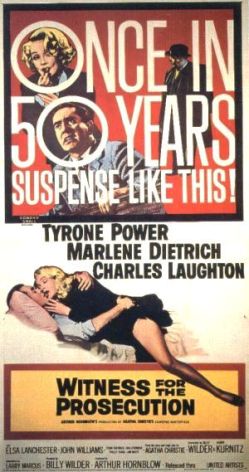
Earlier today, I DVRed the 1957 best picture nominee, Witness for the Prosecution, off of TCM. I watched the film as soon as I finished dinner and, having now seen Witness for the Prosecution, I am prepared to give you my professional and erudite review.
Okay, are you ready for it? Here we go:
🙂 Oh my God, I freaking love this movie!!!!!!!!! 🙂
Witness for the Prosecution is many things. It’s a courtroom drama. It’s a domestic comedy. It’s a twisty murder mystery. It’s a showcase for three great performers. It’s crowd pleaser that will make you think and, even if it does involve people killing each other, it will probably make you smile as well. Don’t let that 1957 date fool you. Witness For the Prosecution is a lot of fun.
Leonard Vole (Tyrone Power) is a somewhat sleazy man who has two claims to fame. One is that he claims to be responsible for inventing the egg beater. The other is that he’s been accused of murdering Mrs. French (Norma Varden), a wealthy widow who had recently named Leonard as the beneficiary of her will. Everyone assumes that Leonard must have been having an affair with Mrs. French but Leonard claims that he’s innocent.
Suspecting that he is soon going to be arrested, Leonard hires Sir Wilfred Robarts (Charles Laughton) to serve as his attorney. Though Sir Wilfred is recovering from a heart attack and has been ordered to not take on any more stressful criminal cases, he agrees to defend Leonard. He proceeds to do just that, under the watchful eye of his nurse, the protective Mrs. Plimsoll (Elsa Lanchester).
(The testy relationship between Sir Wilfred and Mrs. Plimsoll provides the film with its comedic relief. Laughton and Lanchester were married in real life and, watching the film, you can tell that they had a lot of fun acting opposite each other.)
Sir Wilfred is convinced that he can win acquittal for Leonard, especially since Leonard’s German wife, Christine (Marlene Dietrich), is willing to provide an alibi for him. (In one of the film’s best moments, Sir Wilfred talks about how distraught Christine will be to discover that Leonard has been arrested just to then have the very calm and self-possessed Christine step into the room.) However, to everyone’s shock, Christine is called as a witness for the prosecution. She testifies that Leonard confessed the murder to her and that she only provided an alibi out of fear and love.
Things aren’t looking good for Leonard but then, a mysterious woman with a cockney accent contacts Sir Wilfred and reveals that Christine may have had reasons of her own for not giving Leonard an alibi…
Witness For The Prosecution ends with a voice over that says, “The management of this theater suggests that for the greater entertainment of your friends who have not yet seen the picture, you will not divulge, to anyone, the secret of the ending of Witness for the Prosecution.” And I have to say that, when I heard that, it just made me love the film even more. I had enjoyed the film so much and had so much fun following all the twists and the turns of the mystery that I found myself nodding in agreement.
“Sure, 58 year-old voice over,” I said, “I will not divulge the secret ending of Witness For The Prosecution.”
And I’m not going to! Though, to be honest, you’ll probably guess the secret before it’s revealed. It’s a plot twist that has been imitated by so many other courtroom dramas that it’s probably not as much of a mind-blower today as it may have been back in 1957.
But no matter! Witness For The Prosecution is still a lot of fun. Even if you figure out the mystery early, you can still watch the film and enjoy Laughton’s wonderfully theatrical performance.
Witness for the Prosecution was nominated for best picture and, interestingly enough, another theatrical courtroom drama — 12 Angry Men— was also nominated that year. It’s interesting to compare the low-key drama of 12 Angry Men to the cheerful flamboyance of Witness For The Prosecution. They are both great films about the law but each is told from a very different perspective.
Of course, in the end, both of these great films ended up losing to The Bridge On The River Kwai.
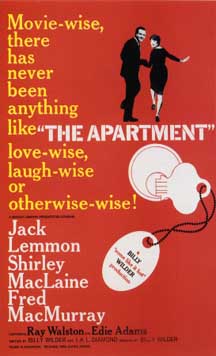
After the Nun’s Story, I continued to experience TCM’s 31 Days of Oscar by watching the 1960 best picture winner, The Apartment. The Apartment is unique among Oscar winners in that it’s one of the few comedies to win best picture. (Though, in all honesty, it would probably be more appropriate to call The Apartment a dramedy.) It was also, until the victory of The Artist, the last completely black-and-white film to win best picture.
(And, as long as we’re sharing trivia, it was also the first best picture winner to feature a character watching a previous best picture winner. At the start of the film, Jack Lemmon deals with insomnia by watching Grand Hotel.)
The Apartment tells the story of C.C. “Bud” Baxter (Jack Lemmon), an anonymous officer worker who is determined to climb the corporate ladder despite not being very good at his job. However, Baxter does have one advantage over his co-workers. He’s single and therefore, his apartment has become the place to go for corporate executives who need a place where they can safely cheat on their wives. Bud spends his day trying to coordinate who is going to be in his apartment and when. Meanwhile, he spends his nights exiled from his own home and wandering around New York. In fact, the only beneficial thing about this arrangement is that all of Bud’s supervisors have been giving him good evaluations in return for using his apartment. (Well, that and Bud’s neighbor, played by Jack Kruschen, is convinced, based on the thinness of the apartment walls, that Bud must be a great lover.)
When Bud finally does get his promotion, it’s only because the personnel director, Jeff D. Sheldrake (an amazingly sleazy Fred MacMurray), wants to use Bud’s apartment. Bud celebrates his promotion by finally working up the courage to ask out Fran (Shirley MacClaine), an elevator operator who works in the office. What Bud doesn’t realize is that Fran is also the woman who Sheldrake wants to bring to the apartment….
Fran is convinced that Sheldrake is going to leave his wife for her. What she doesn’t realize — and what Fred MacMurray’s performance makes disturbingly clear — is that Jeff Sheldrake is basically just a guy having a midlife crisis. He’s the type of middle-aged guy that every woman has had to deal with at some point, the guy who pulls up next to you in a red convertible and stares at you from behind his sunglasses, attempting his best to entice you into helping him relive the youth that he never had. When Fran eventually learns the truth about Sheldrake, it leads both to near tragedy and to Bud having to decide whether he wants to be a decent human being or if he wants to keep climbing the corporate ladder.
When one looks over a chronological list of all of the best picture winners, it’s a bit strange to see The Apartment listed in between Ben-Hurand West Side Story. As opposed to those two grandly produced and vibrantly colorful films, The Apartment is a rather low-key film, one that devotes far more time to characterization than to spectacle. And while both Ben-Hur and West Side Story are ultimately very idealistic films, The Apartment is about as cynical as a film can get. The Apartment may be a comedy but the laughs come from a place of profound sadness.
Because it’s more interested in people than in spectacle, The Apartment holds up better than many past best picture winners. We’ve all known someone like Bud. We’ve all had to deal with men like Sheldrake. And, in one way or another, we all know what it’s like to be someone like Fran. The Apartment remains a truly poignant and relevant film.
Last year, I gave up control to the reader of the site and you know what? I kinda liked it in a sneaky, dirty little way. So I figured, why not do it again?
Here’s how it works. Earlier today, I put on a blindfold and then I randomly groped through my DVD collection until I had managed to pull out ten movies. I then promptly stubbed my big toe on the coffee table, fell down to the floor, and spent about 15 minutes cursing and crying. Because, seriously, it hurt! Anyway, I then took off the blindfold and looked over the 10 movies I had randomly selected. Two of them — Dracula A.D. 1972 and A Blade in the Dark — were movies that I had already reviewed on this site. So I put them back and I replaced them with two movies of my own choosing — in this case, Eternal Sunshine of the Spotless Mind and The Unbearable Lightness of Being.
Between now and next Sunday (March 27th), people will hopefully vote in this poll. On Sunday, I will watch and review whichever movie has received the most votes. Even if that movie turns out to be Incubus. *shudder* (Have I mentioned how much I love Eternal Sunshine of the Spotless Mind?)
Now, of course, there’s always the possibility that no one will vote in this poll and I’ll end up looking silly. Those are the risks you take when you set up an online poll. However, I have a backup plan. If nobody votes, I will just spend every day next week shopping for purses at Northpark Mall and then blogging about it. And by that, I mean blogging every single little detail. So, it’s a win-win for me.
Anyway, here’s the list of the 10 films:
1) Barbarella— From 1968, Jane Fonda plays Barbarella who flies around space while getting molested by …. well, everyone. Directed by Roger Vadim.
2) Barry Lyndon — From 1975, this best picture nominee is director Stanley Kubrick’s legendary recreation of 18th-century Europe and the rogues who live there.
3) Caligula — Yes, that Caligula. From 1979, it’s time for decadence, blood, and nudity in the Roman Empire. Starring Malcolm McDowell, Helen Mirren, Peter O’Toole, John Gielgud, John Steiner, and Theresa Ann Savoy.
4) Eternal Sunshine of the Spotless Mind — Oh my God, I love this movie. Jim Carrey breaks up with Kate Winslet and deals with the pain by getting his mind erased by Tom Wilkinson, Mark Ruffalo, Kirsten Dunst, and an amazingly creepy Elijah Wood.
5) Incubus — From 1969, this low-budget supernatural thriller not only stars a young William Shatner but it also features the entire cast speaking in Esperanto. For. The. Entire. Movie.
6) Inland Empire — If you want to give Lisa nightmares, you can vote for David Lynch’s disturbing 3-hour film about lost identity, sexual repression, human trafficking, and talking rabbits.
7) Kiss Me Deadly — From 1955, this Robert Aldrich-directed cult classic features hard-boiled P.I. Mike Hammer and a host of others chasing after a mysterious glowing box and accidentally destroying the world in the process.
8 ) Mandingo — From 1975, this infamous little film is a look at slavery, incest, and rheumatism in the pre-Civil War South. Starring James Mason, Ken Norton, Perry King, and Susan George. Supposedly a really offensive movie, one I haven’t sat down and watched yet.
9) Sunset Boulevard — From 1950, hack screenwriter William Holden ends up the kept man of psychotic former screen goddess Gloria Swanson. Directed by Billy Wilder.
10) The Unbearable Lightness of Being — From 1988, Philip L. Kaufman’s adaptation of Milan Kundera’s classic novel (one of my favorite books, by the way) features Daniel Day-Lewis, Juliette Binoche, and Lena Olin having sex and dealing with ennui. After I first saw this movie, I insisted on wearing a hat just like Lena Olin did.
Everyone, except for me, is eligible to vote. Vote as often as you want. The poll is now open until Sunday, March 27th.
(Edit: Voting is now closed but check below for the results! — Lisa)





 Through the Shattered Lens