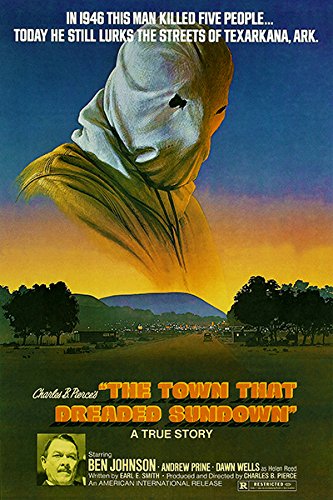
In 1946, the town of Texarkana, on the Texas-Arkansas border, was rocked by a series of brutal attacks on its citizens from February to May that left five people dead and three seriously wounded. The psycho, who wore what seemed to be a white pillowcase with eyeholes cut in it, caused quite a panic among the townsfolk, and the local and national press had a field day sensationalizing the gruesome events. The case was dubbed “The Texas Moonlight Murders”, and the mysterious maniac “The Phantom Killer”. Famed Texas Ranger M.T. “Lone Wolf” Gonzaullus was brought in to lead the investigation and rounded up a few suspects, but no one was ever formally charged with the grisly crimes. To this day, the case has never officially been solved.
Forty years later, Texarkana native Charles B. Pierce produced, directed, and costarred in THE TOWN THAT DREADED SUNDOWN, a film based on those…
How else do you explain the prank that begins the 1980 slasher film, Terror Train? At a party, awkward pledge Kenny (Derek MacKinnon) is told that Alana Maxwell (Jamie Lee Curtis) is waiting for him in an upstairs bedroom and she totally wants to have sex with him! Poor Kenny. Really, he should have been able to figure that this was a prank but I guess he’s just naive. Anyway, he goes upstairs, strips down to his underwear, and listens as Alana says, “Don’t be shy …. kiss me!”
Kenny thinks that Alana is waiting for him in the bed but actually, she’s hiding behind a curtain. So, what’s in the bed? Well, as Kenny soon discovers, it’s a limbless corpse! Oh, those wacky pre-med students! Under the direction of Doc (Hart Bochner), they’ve stolen a cadaver from the medical school and they’ve used it to play the joke of the century! Everyone bursts into the room, laughing.
Ha ha! Funny joke, right?
Well, not to Kenny. Kenny totally freaks out and starts spinning around and gets all wrapped up in the sheets. Needless to say, Kenny does not get laid that night.
In fact, Kenny ends up losing his mind. And that’s unfortunate but, as they say, life goes on. Three years later, the pranksters are all due to graduate so they’re going to throw a costume party on a train! The conductor (Ben Johnson) watches as these rich, costumed college kids get on his train and you can just tell that he’s thinking, “There better not be no funny business.” He need not worry! Alana is on the train and she still feels so bad over what happened to Kenny that you can be sure that there won’t be any pranks during this graduation party!
Unfortunately for everyone else, Kenny’s decided to get on the train as well. While his former classmates are smoking weed, getting drunk, dancing to the best disco music of 1980, and taunting a magician (David Copperfield), Kenny is killing people and stealing their costumes.
Kenny’s first victim actually dies before the train leaves. When he comes staggering up to everyone with a sword sticking out of him, everyone assumes that it’s just another joke. Nope! Turns out the sword is real but everyone’s too busy boarding to notice as the guy collapses to the ground and is promptly dragged underneath the train. In a scene that always makes me cringe, the train slowly crushes him as it starts to move forward. I mean, seriously …. Agck!
So, now Kenny is wandering around the train, dressed like Grouch Marx and killing people. It takes people a while to notice because we’re not exactly dealing with the smartest group of college graduates. And, once they do realize …. well, what are they going to do? They’re stuck on a train in the middle of nowhere! Even if they do get off the train, it’s snowing and below freezing outside! I mean, it’s almost as bad as Minnesota in January out there….
Of the many slasher films that Jamie Lee Curtis appeared in after Halloween, Terror Train is definitely the best. After making his directorial debut here, Roger Spottiswoode went on to become one of the busiest directors in Hollywood and you can tell why when you watch this movie. Spottiswoode’s makes great and atmospheric use of the train and Kenny’s habit of constantly changing his costume keeps you guessing just where he might be at any given time. Even more importantly, Spottiswoode takes the time to develop the characters so that they become more than just cardboard victims. Jamie Lee Curtis, Hart Bochner, Sandee Curris, and Timothy Webber all give excellent performance as the objects of Kenny’s wrath while old veteran Ben Johnson brings some gravitas to the film as the wise conductor.
(My only objection is that the worst of the pranksters is named Doc, which happens to be the name of our cat. And let me just say that Doc the cat would never pull as cruel a prank as Doc the medical student.)
As we all know, Jamie Lee Curtis will be returning to the horror genre later this month. She’ll be playing Laurie Strode in David Gordon Green’s Halloween remake or reboot or sequel or whatever it is. Famously, Curtis refused to appear in horror films for several years, saying that she didn’t want to be typecast. That was understandable on her part and, as much as I love horror movies, it was probably a smart career move. That said, the slasher films that Curtis appeared are some of the best of the genre. Halloween, Terror Train, and even Prom Night are all classics of their kind. Terror Train is a suspense masterpiece, perfect for any cold and snowy night when you want to scream a little.
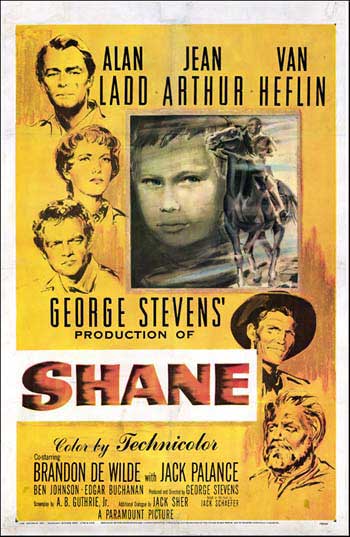
There’s a few ways in which you can view the 1953 film, Shane.
The more popular view is that it’s a Western about a man named Shane (Alan Ladd) who rides into town and gets a job working for the Starretts, Joe (Van Heflin) and Marian (Jean Arthur). Joe is a farmer who is determined to hold onto his land, despite the efforts of cattle baron Rufus Ryker (Emile Meyer) to force him off of it. While we don’t learn much about Shane’s background, it becomes apparent that he’s a man who can fight. That comes in handy when Ryker brings in a sinister gunfighter named Wilson (Jack Palance).
Another view is that Shane is the story of a man who just wants to settle down but, instead, finds himself continually hounded by an annoying little kid, to the extent that he finally gets involved in a gun battle just so he’ll have an excuse to leave town and get away from the little brat. Little Joey Starrett (Brandon deWilde) idolizes Shane from the minute that he comes riding up. When he hears that Shane refused to get into a fight at the local saloon, Joey demands to know whether it was true. He tells his mom that he loves Shane almost as much as he loves his father. When Shane does get into a brawl with all of Ryker’s men, Joey stands in the corner and eats candy. And then, when Shane tries to leave town, Joey runs behind him shouting, “Come back, Shane! Come back!”
Myself, I think of it as being the story of Frank Torrey (Elisha Cook, Jr.). Frank is the farmer that’s been nicknamed “Stonewall,” due to his status as a former Confederate and his quick temper. Stonewall may be smaller than the other farmers but he’s usually the quickest to take offense. Still, it’s impossible not to like him, largely because he’s played by Elisha Cook, Jr. When Wilson feels the need to put the farmers in their place, he does so by picking a fight with Torrey. Standing on a porch in the rain, looking down on the smaller man, Wilson starts to insult both him and the South. When Torrey finally starts to reach for his gun, Wilson shoots him dead. While Torrey lies in the mud, Wilson smirks. It’s a shocking scene, all the more so for being shown in a long shot. (By forcing those of us in the audience to keep our distance from the shooting, the film makes us feel as powerless as the farmers.) If you didn’t already hate Wilson and Ryker, you certainly will after this scene.
Shane is a deceptively simple film, one in which many of the details are left open for interpretation. We never learn anything about Shane’s background. He’s a man who shows up, tries to make a life for himself, and then leaves. He’s a marksman and an obviously experienced brawler but, unlike Ryker’s men, he never specifically looks for violence. In fact, he often seems to avoid it. Why? The film doesn’t tell us but there are hints that Shane is haunted by his past. Shane seems to want a chance to have a life like the Starretts but, once he’s forced to again draw his gun, he knows that possibility no longer exists.
Is Shane in love with Marian Starrett? It certainly seems so but, again, the film never specifically tells us. Instead, it all depends on how one interprets the often terse dialogue and the occasional glances that Marian and Shane exchance. When Shane and Joe get into a fist fight to determine who will face Ryker and Wilson, is Shane really trying to protect Joe or is it that he knows Marian will be heart-broken if her husband is killed?
One thing’s for sure. Little Joey sure does love Shane. “Come back, Shane!” Little Joey follows Shane everywhere, with a wide-eyed look on his face. To be honest, it didn’t take too long for me to get sick of Little Joey. Whenever director George Stevens needed a reaction shot, he would cut to Joey looking dumb-founded. Brandon deWilde was 11 years when he appeared in Shane and he was nominated for an Oscar but he’s actually pretty annoying in the role. Elisha Cook, Jr. was far more impressive and deserving of a nomination.
I know that many people consider Shane to be a classic. I thought it was good, as long as the action was focused on the adults. Alan Ladd plays Shane like a man who is afraid to get too comfortable in any situation and the film works best when it compares his reticence to Wilson’s cocky confidence. Whenever Joey took center stage, I found myself wanting to cover my ears.
Shane was nominated for Best Picture but lost to From Here To Eternity.
Remember how, a few nights ago, I watched and reviewed something called Prison Planet? No? Well, I don’t blame you. I wish I could forget about it too. Anyway, the movie that aired right before Prison Planet was yet another futuristic tale that was largely set in a desert wasteland. This movie was originally released in 1988 and the title was Cherry 2000.
Cherry 2000 takes place in 2017, or perhaps I should say that it takes place in 2017 as imagined by someone in 1988. In this film’s version of 2017, both the economy and the environment are a mess, America is divided into warring urban and rural zones, and all human emotion and creativity is being stifled by government bureaucracy. In short, Cherry 2000‘s version of 2017 is a lot like the real world’s version of 2017…
In the future, everyone’s still obsessed with getting laid but all of the bureaucratic red tape has made things difficult. Having sex now means first getting a lawyer to draw up a contract. In order to avoid all of the legal complications, men are now marrying specially designed sex robots. Again, this probably seemed way out there in 1988 but, in the current world, it just looks like my twitter timeline.
(Do they have sex robots for women in the world of Cherry 2000? As far as I could tell, all of the sex robots in the film were designed for men’s pleasure, which doesn’t seem quite fair.)
Anyway, Sam Treadwell (David Andrews) is a business executive who thinks that he is deeply in love with his robot wife, Cherry 2000 (Pamela Gidley). However, a mix of sex and a broken washing machine causes Cherry to short-circuit. When Sam tries to get her repaired, he’s told that it’s a lost cause. Cherry is beyond repair. Add to that, apparently the Cherry 2000 model is no longer being manufactured. If Sam wants a new Cherry, he’s going to have to go into Zone 7 and get one out of an abandoned factory.
So, of course, that’s what Sam does. The only problem is that Sam is a business guy and Zone 7 is the most dangerous place in the world. Why is it so dangerous? Because it’s ruled by a warlord named …. Lester. (No offense meant to anyone named Lester but that’s not exactly the most intimidating name in the world.) Lester is played by B-movie mainstay Tim Thomerson, who appears to be having fun whenever he appears on-screen.
To help guide him through Zone 7, Sam hires E (Melanie Griffith). E is the film’s saving grace, largely because she kicks everyone’s ass. The great thing about E is that, from the minute she first appears, she makes no secret of the fact that she finds Sam and his sex robot to be just as pathetic and ridiculous as we do. Griffith plays the role with just the right mix of humor and annoyance. If I ever have to guide anyone through a desert wasteland to a sex robot factory, I hope that I can do it with half as much style and panache as E.
Anyway, Cherry 2000 is a weird little mix of the western and science fiction genres. For a film about sex robots, it actually has a rather goofy and almost innocent feel to it. It’s a film that raises a lot of issues but which is also smart enough not to spend too much time on any of them. Director Steve De Jarnatt also directed one of my favorite 80s movies, the charming apocalyptic love story Miracle Mile. Cherry 2000 may be a mess but it’s definitely a watchable mess.
Welcome to the American frontier. The time is the 1880s and men and women everywhere are heading out west in search of their fortune. While stowing away on a train, veteran cowboy Johnny Wade (Brian Keith) meets the naive Steve Hill (Gary Clarke) and becomes a mentor to the younger man. Johnny teaches Steve how to shoot a gun and, when they get off the train at Medicine Bow, Wyoming, they get jobs working on the ranch of Georgia Price (Geraldine Brooks). When Georgia and Johnny plot to overgraze the land, Steve must decide whether he’s with them or with a rival rancher, Judge Garth (Lee J. Cobb).
At the same time, Ben Justin (Charles Bronson) has arrived in town with his son, Will (Robert Random), and his new wife (Lois Nettleton). Ben is determined to start his own ranch but, because of his taciturn and stubborn personality, he alienates the Cattleman’s Association, which led by Judge Garth and Bear Suchette (George Kennedy). Will wants to help his father but Ben keeps pushing him away. It’s up to Judge Garth’s foreman, the Virginian (James Drury), to bring the family together.
Just like The Meanest Men In The West,The Bull of the West was created by editing together footage from two unrelated episodes of The Virginian. It works better for the Bull of the West because the two episodes had similar themes and the footage mixes together less awkwardly than it did in The Meanest Men In The West. But Bull of the West is still just a TV show edited into a movie. The main reason to see it is because of all the familiar western faces in the cast. Along with Bronson, Keith, Cobb, and Kennedy, keep an eye out for Ben Johnson, DeForest Kelley, and Clu Gulager.
California. The 1870s. Sheriff Pearce (Ben Johnson) boards a train with his prisoner, an alleged outlaw named John Deakin (Charles Bronson). The train is mostly full of soldiers, under the command of Major Claremont (Ed Lauter), who are on their way to Fort Humboldt. The fort has suffered a diphtheria epidemic and the soldiers are supposedly transporting medical supplies.
However, it’s not just soldiers on the train. There’s also Gov. Fairchild (Richard Crenna) of Nevada, his fiancée (Jill Ireland), the Reverend Peabody (Bill McKinney), and a conductor named O’Brien (Charles Durning). As the train continues on its journey, it becomes obvious that all is not as it seems. People start to disappear. A man is thrown from the train. Two cars full of soldiers are separated from the train and plunge over a cliff. There is also more to Deakin than anyone first realized and soon, he is the only person who can bring the murderers to justice.
In both real life and the movies, Charles Bronson was the epitome of a tough guy, so it’s always interesting to see him playing a more cerebral character than usual. There are some exciting and surprisingly brutal action scenes, including a scene where Bronson fights a cook (played by former professional boxer Archie Moore) on top of the speeding train, but Breakheart Pass is more of a murder mystery than a typical action film. If Louis L’Amour and Agatha Christie had collaborated on a story, the end result would be much like Breakheart Pass. Bronson spends as much time investigating as he does swinging his fists or shooting a gun. It’s not a typical Bronson role but he does a good job, showing that he could think as convincingly as he could kill. Acting opposite some of the best character actors around in the 70s, Bronson more than holds his own.
Apparently, back in 1975, audiences were not interesting in watching Bronson think so Breakheart Pass was a disappointment at the box office and it is still not as well known as Bronson’s other films. However, even if you’re not already a fan of the great Bronson, Breakheart Pass is worth discovering.
My all-time favorite actor was born Marion Mitchell Morrison on May 26, 1907 in Winterset, Iowa. But John Wayne the movie star was born in 1930 when, after years of bit parts, he landed the lead role in Raoul Walsh’s THE BIG TRAIL. The movie flopped at the box office, but it got Wayne noticed. After scuffling along in low-budget, juvenile B-Westerns for most of the 30’s, Wayne was cast as The Ringo Kid in John Ford’s blockbuster STAGECOACH , and his career took off like a wild stallion.
“The Duke” (a nickname he picked up as a kid) was an A-Lister now, the biggest star at Republic Pictures. Wayne and Ford continued their film collaborations throughout the 40’s. At the end of the decade RKO released the second of the Wayne/Ford “Cavalry Trilogy”, SHE WORE A YELLOW RIBBON. The film was a smash hit, a rousing adventure bolstered by Wayne’s portrayal of…
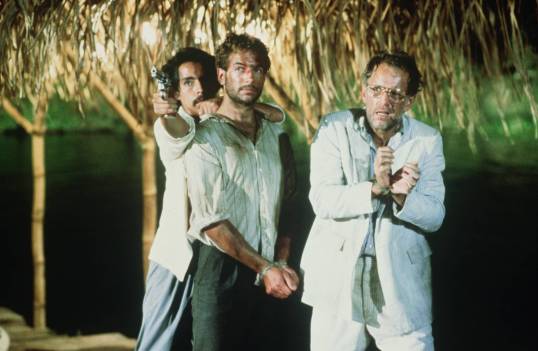
Let’s Get Harry opens deep in the jungles of Columbia. The newly appointed American Ambassador (Bruce Gray) is touring a newly constructed water pipeline when suddenly, terrorist drug smugglers attack! The Ambassador, along with chief engineer Harry Burck (Mark Harmon, long before NCIS), is taken hostage. Drug Lord Carlos Ochobar announces that both the Ambassador and Harry will be executed unless the U.S. government immediately releases Ochobar’s men. However, the policy of the U.S. government is to not negotiate with terrorists. As grizzled mercenary Norman Shrike (Robert Duvall) explains it, nobody gives a damn about a minor ambassador.
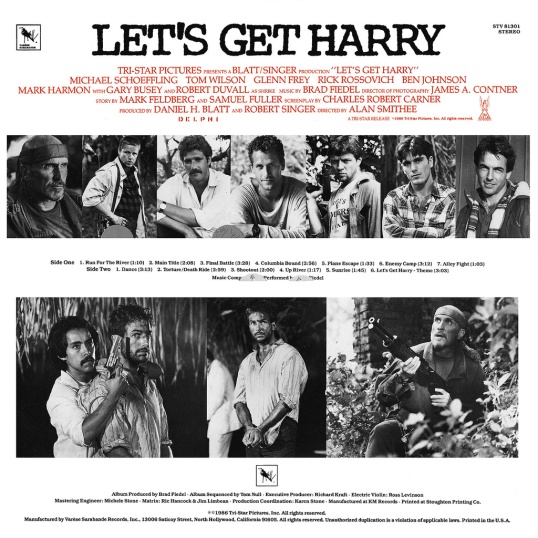
Nobody in a small blue-collar town in Illinois gives a damn about the ambassador either. But they do give a damn about their friend Harry! When its obvious that the bureaucrats up in Washington are not going to do anything, Harry’s younger brother, Corey (Michael Shoeffling, Sixteen Candles), decides that he and his friends are going to go to Columbia themselves and get Harry! Helping him out are Bob (Thomas F. Wilson, Back to the Future), Kurt (Rick Rossovich, Top Gun), Spence (Glenn Frey!), and Jack (Gary Busey). If Jake Ryan, Biff Tannen, Slider, Buddy Holly, and the guy from the Eagles who wasn’t Don Henley can’t get Harry, then who can!?
There were a lot of these “American rescue mission” movies made in the 80s, everything from Uncommon Valor to The Delta Force to the Rambo films. Plotwise, Let’s Get Harry adds little to the genre. It’s about as simplistic and implausible as a Donald Trump campaign speech. A bunch of terrorists are holding American hostages and making us all look bad while the establishment refuses to do anything about it? Don’t worry! Here come a bunch of heavily armed, no-nonsense American citizens to save the day and make America great again!
There are two things that distinguish Let’s Get Harry. First, Let’s Get Harry is one of the many films to have been credited to Alan Smithee. From 1968 to 2000, Alan Smithee was the official pseudonym used by directors who wanted to disown a project. Smithee has been credited as directing everything from Solar Crisis to Morgan Stewart’s Coming Home to The O.J. Simpson Story. In the case of Let’s Get Harry, Smithee was standing in for veteran director Stuart Rosenberg (probably best known for Cool Hand Luke). Rosenberg originally only planned for Mark Harmon to be seen only at the end of the film, much like Matt Damon in Saving Private Ryan. When TriStar Pictures demanded extra scenes featuring Harmon being taken and held hostage, Rosenberg took his name off the film.
(Before Rosenberg signed on to direct, Let’s Get Harry started out as a Sam Fuller project and he received a story credit on the film. With the exception of some of the scenes with Harmon, which may have been shot by a different director, Rosenberg’s direction was adequate but Let’s Get Harry really does cry out for a director like Sam Fuller.)
Secondly, there is the cast, which is a lot more interesting than would be typically found in a low-budget, 80s action film. Not surprisingly, by respectively underplaying and overplaying, Duvall and Busy give the two best performances. Meanwhile, lightweight Mark Harmon gives the worst. Perhaps because of the conflict between Rosenberg and the studio over his character, Harmon spends the entire movie looking lost.
As an exercise in patriotic wish fulfillment, Let’s Get Harry is pure 80s hokum. It may be dumb but it is also entertaining. After all, any film that features not only Robert Duvall, Gary Busey, and Ben Johnson, but also Glenn Frey is going to be worth watching. Let’s Get Harry has never been released on DVD and is currently only available on VHS. Somebody needs to do something about this.
For the past week and a half, I have been on a major Warren Oates kick. The latest Oates film that I watched was Kid Blue, a quirky western comedy that features Warren in a small but key supporting role.
Bickford Warner (Dennis Hopper) is a long-haired and spaced-out train robber who, after one failed robbery too many, decides to go straight and live a conventional life. He settles in the town of Dime Box, Texas. He starts out sweeping the floor of a barber shop before getting a better job wringing the necks of chickens. Eventually, he ends up working at the Great American Ceramic Novelty Company, where he helps to make ashtrays for tourists.
He also meets Molly and Reese Ford (Lee Purcell and Warren Oates), a married couple who both end up taking an interest in Bickford. Reese, who ignores his beautiful wife, constantly praised Greek culture and insists that Bickford take a bath with him. Meanwhile, Molly and Bickford end up having an affair.
Bickford also meets the local preacher, Bob (Peter Boyle). Bob is enthusiastic about peyote and has built a primitive flying machine that he keeps in a field. The town’s fascist sheriff, Mean John (Ben Johnson), comes across Bob performing a river baptism and angrily admonishes him for using “white man’s water” to baptize an Indian.
Bickford attempts to live a straight life but is constantly hassled by Mean John, who suspects that Bickford might actually be Kid Blue. When Bickford’s former criminal partner (Janice Rule) shows up in town and Molly announces that she’s pregnant, Bickford has to decide whether or not to return to his old ways.
Kid Blue is one of a handful of counterculture westerns that were released in the early 70s. The film’s biggest problem is that, at the time he was playing “Kid” Blue, Dennis Hopper was 37 and looked several years older. It’s hard to buy him as a naïve naif when he looks older than everyone else in the cast. As for Warren Oates, his role was small but he did great work as usual. Gay characters were rarely presented sympathetically in the early 70s and counter-culture films were often the worst offenders. As written, Reese is a one-note (and one-joke) character but Warren played him with a lot of empathy and gave him a wounded dignity that was probably not present in the film’s script.
Kid Blue plays out at its own stoned pace, an uneven mix of quirky comedy and dippy philosophy. Still, the film is worth seeing for the only-in-the-70s cast and the curiosity factor of seeing Dennis Hopper in full counterculture mode, before he detoxed and became Hollywood’s favorite super villain.
Continuing our journey into the dark Hell of the 1970s, we now take a quick look at the 1975 cop film, Hustle.
Taking place in Los Angeles, Hustle tells the story of several different people who find their lives intertwined in the desperate dance of existence. (Does that sound overdramatic? Well, that’s the type of film that this is.)
There’s Leo Sellers (Eddie Albert), a lawyer with bright rosy cheeks and a friendly manner. You look at Leo and you automatically assume that he must be a nice guy, the type of guy who puts on a fake beard and plays Santa Claus down at the local orphanage. But actually, Leo is a lawyer for the mob. He’s gotten rich through crime and his mansion hides all sorts of secrets. He also has a weakness for violently abusing prostitutes.
Speaking of prostitutes, one of Leo’s favorite is Nicole (Catherine Deneuve), an icy French beauty who survives by holding the world at a distance. Though Nicole doesn’t like Leo, she has to keep him happy because Leo could easily arrange for her to be deported back to France.
Nicole is also the girlfriend of Phil Gaines (Burt Reynolds), a cynical homicide detective who, like her, tries to keep the world at a distance. Phil is obsessed with old films and frequently speaks of how much he wishes the real world could be like a movie. Throughout the film, he talks about eventually moving to Rome.
Phil’s partner is Louis Belgrave (Paul Winfield), who is not quite as cynical as Phil but who is definitely getting there. Whereas Phil is always talking about how much the world has disappointed him, Louis mostly accepts things without complaint. He just wants to do his job and go home at the end of the day.
Phil and Louis’s boss is Santoro (Ernest Borgnine, giving a typical Ernest Borgnine performance). Santoro is not a bad guy but, in order to hold onto his job, he has to keep powerful men like Leo Sellers happy.
Santoro also has to deal with the complaints of people like the Hollingers. Marty Hollinger (Ben Johnson) is a veteran of the Korean War and handles the world in a gruff and suspicious manner. Paula (Eileen Brennan) is Marty’s wife and, as a result of his emotional distance, has recently started having an affair.
And then there’s Gloria (Colleen Brennan), Marty and Paula’s daughter. Gloria ran away from home a while ago and soon found herself working as a stripper, a porn actress, and eventually as a prostitute. When Gloria is found dead, Phil and Louis get the case. It’s obvious to them that Gloria committed suicide. It’s not so obvious to Marty, who is convinced that his daughter was murdered and, disgusted by Phil’s cynical attitude, sets out to investigate the case on his own.
One of the more interesting things about Hustle is that really is no murder mystery. Despite what Marty believes, Gloria really did commit suicide. Marty’s insistence that she was murdered has more to do with his guilt over being a bad father than it does with any real evidence. As Marty investigates his daughter’s life, he is exposed to a sordid world of strip clubs and prostitution. He discovers that Gloria’s clients included many powerful men and he decides that the last client she saw must have murdered Gloria.
That client is Leo Sellers. And while Leo may not have murdered Gloria, he is willing to kill Marty to keep his secret life from being exposed. Phil and Louis are forced to choose between remaining detached or protecting Marty from himself.
And, since this film was made in the 70s, it all ends on a really dark note!
Hustle shows up on Encore occasionally. It’s a strange film to watch, as it alternates between being a fairly predictable cop film and being a portrait of existential dread. The movie doesn’t really work; it’s too long, it features some amazingly pretentious dialogue, and Reynolds, Winfield, and Deneuve all seem to be bored with their characters. Probably the film’s best performance comes from Ben Johnson. I imagine that has to do with the fact that Johnson is playing the only character who behaves in a fairly consistent way.
And yet, if you’re like me and you’re fascinated with the nonstop fatalism of 70s cinema, Hustle does have some historical value. It’s one of those films that you watch and you wonder how anyone survived the 1970s!




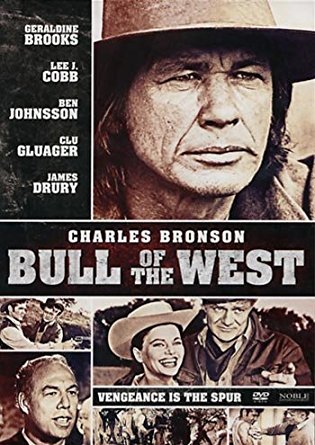 Welcome to the American frontier. The time is the 1880s and men and women everywhere are heading out west in search of their fortune. While stowing away on a train, veteran cowboy Johnny Wade (Brian Keith) meets the naive Steve Hill (Gary Clarke) and becomes a mentor to the younger man. Johnny teaches Steve how to shoot a gun and, when they get off the train at Medicine Bow, Wyoming, they get jobs working on the ranch of Georgia Price (Geraldine Brooks). When Georgia and Johnny plot to overgraze the land, Steve must decide whether he’s with them or with a rival rancher, Judge Garth (Lee J. Cobb).
 California. The 1870s. Sheriff Pearce (Ben Johnson) boards a train with his prisoner, an alleged outlaw named John Deakin (Charles Bronson). The train is mostly full of soldiers, under the command of Major Claremont (Ed Lauter), who are on their way to Fort Humboldt. The fort has suffered a diphtheria epidemic and the soldiers are supposedly transporting medical supplies.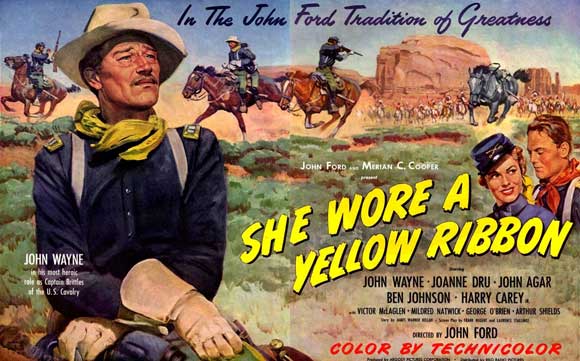
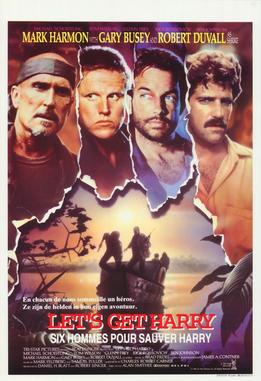 Let’s Get Harry opens deep in the jungles of Columbia. The newly appointed American Ambassador (Bruce Gray) is touring a newly constructed water pipeline when suddenly, terrorist drug smugglers attack! The Ambassador, along with chief engineer Harry Burck (Mark Harmon, long before NCIS), is taken hostage. Drug Lord Carlos Ochobar announces that both the Ambassador and Harry will be executed unless the U.S. government immediately releases Ochobar’s men. However, the policy of the U.S. government is to not negotiate with terrorists. As grizzled mercenary Norman Shrike (Robert Duvall) explains it, nobody gives a damn about a minor ambassador.


 Through the Shattered Lens