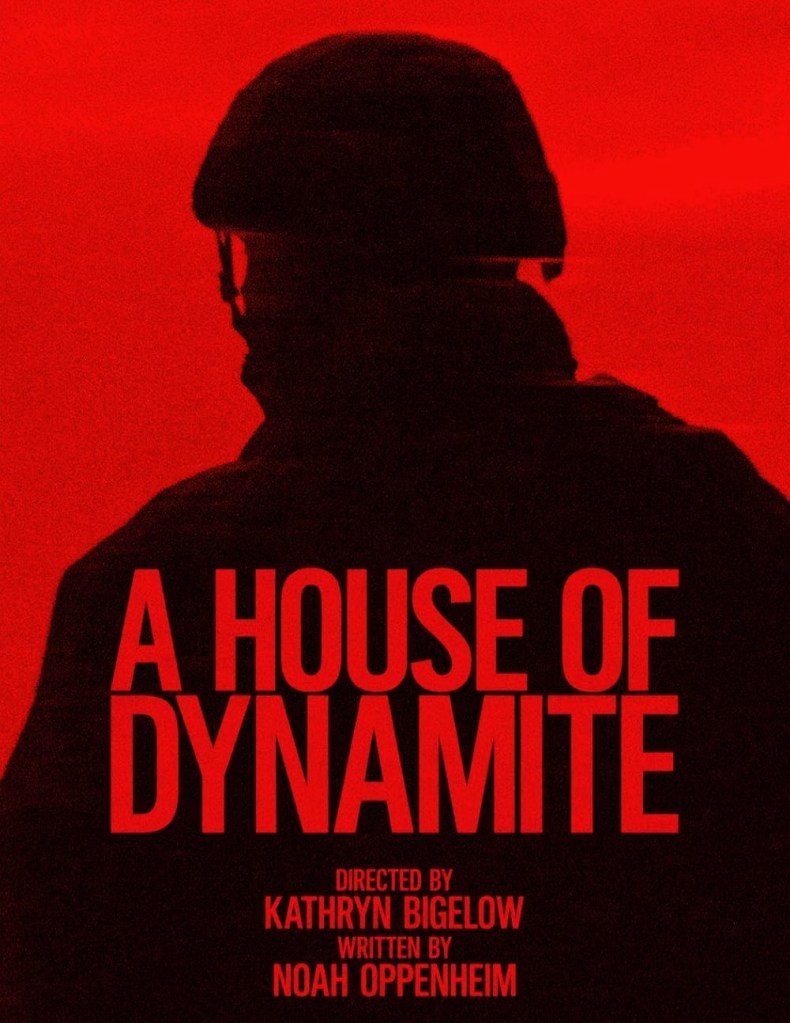
Horror Review: A House of Dynamite (dir. by Kathryn Bigelow)


“So it’s a fucking coin toss? That’s what 50 billion dollars buys us?” — Secretary of Defense Reid Baker

The end of the Cold War was supposed to close a chapter of fear. With the superpowers stepping back from the brink, the world briefly believed it had entered an era of stability. Yet that promise never held. The weapons remained, the rivalries adapted, and the global machinery of deterrence continued to hum beneath the surface. Kathryn Bigelow’s A House of Dynamite faces this reality head-on, transforming the mechanics of modern nuclear defense into something unnervingly human. On the surface, it plays as a high-tension political technothriller, but beneath that precision lies a deeply existential horror film—one built not on shadows or monsters, but on daylight, competence, and the narrow margins of human fallibility.

The premise is piercingly simple. An unidentified missile is detected over the Pacific. Analysts assume it’s a test or a glitch—another false alarm in a world overflowing with them. But within minutes, as conflicting data streams converge, what seemed routine begins to look real. The film unfolds in real time over twenty excruciating minutes, charting the reactions of those charged with interpreting and responding to the potential catastrophe. Bigelow divides the film into three interwoven perspectives: the White House Situation Room, the missile intercept base at Fort Greely, and the President’s mobile command aboard Marine One. The structure allows tension to grow from every direction at once, each perspective magnifying the other until the screen feels ready to collapse under its own pressure.

Capt. Olivia Walker (Rebecca Ferguson), commanding officer of the Situation Room, anchors the story with calm professionalism that gradually frays into disbelief. Ferguson’s performance is clear-eyed and tightly modulated—precise, disciplined, and quietly devastating. She stands as the rational center inside chaos, her composure the last gesture of control in a world that no longer follows reason.

Over her is Adm. Mark Miller (Jason Clarke), Director of the Situation Room, who represents the institutional embodiment of confidence. Clarke plays him with methodical restraint, a man who trusts procedure long after it stops earning trust. Miller’s authority is both comforting and horrifying: a portrait of leadership built on ritual rather than certainty.

At Fort Greely, Anthony Ramos brings an intimate immediacy as the officer charged with the missile intercept. His scenes hum with kinetic dread—the physical execution of decisions made thousands of miles away. Through him, the film captures the most primal kind of fear: acting when hesitation could mean extinction, knowing that success and failure are separated only by chance.

The President, portrayed by Idris Elba, spends much of the crisis in motion—first within the cocoon of the presidential limousine, and later, aboard Marine One as it carves through blinding daylight. Elba gives a performance of subtle, steady erosion. At first, he embodies unshakeable calm, a figure of poise and authority; but as the situation deepens, his steadiness wanes. Words become shorter, pauses longer. Every decision carries consequences too vast for resolution. It is a measured, understated portrait of power giving way to human uncertainty.

Bigelow’s direction is stripped of ornament and focused on precision. Barry Ackroyd’s cinematography heightens the claustrophobia of command centers—the sterile light, the reflective glass, the sense that every surface observes its occupants—while his exterior scenes pierce with harsh brightness, suggesting that no sanctuary exists under full exposure. Kirk Baxter’s editing maintains an unrelenting pulse, cutting with mathematical precision while preserving the eerie stillness of the moments where no one dares to speak.

​A House of Dynamite also shows how even with the most competent experts—military, intelligence, and political—working to manage an escalating crisis, there is no path to victory. The professionals at every level stop seeking to prevent the worst and instead focus on saving what they can when the worst becomes inevitable. The film’s scariest revelation is not the potential for destruction, but the paralysis that intelligence creates. If the brightest, most disciplined people in the world cannot find an answer, what happens when power falls into the hands of those less prepared or less rational? In its quiet way, the film poses that question that we see more and more each day on the news and on social media and we are left with silence and realization of the horror of it all.

Despite its precision, the film isn’t without flaws. Bigelow’s triptych structure—cutting between the three perspectives—works brilliantly to escalate tension, yet the repetition of similar beats slightly blunts the impact. Each segment revisits the same crisis rhythms—a data discrepancy, an argument over authority, another uncertain update—sometimes slowing the natural momentum. While the repetition underlines the futility of bureaucratic systems in chaos, the transitions don’t flow as fluidly as the rest of the film’s airtight craftsmanship. The result is a film that is gripping overall, occasionally uneven in rhythm, but never less than absorbing.

When the final minutes arrive, Bigelow declines to deliver resolution. No mushroom clouds, no catharsis. The President sits in Marine One, head down with the weight of the world on his shoulders as he contemplates his options in the Black Book (options in how to retaliate) and knowing that he has no good choices in front of him. The world remains suspended between survival and oblivion, and the silence that follows feels heavier than sound. The ending resists closure because endings, in the nuclear age, are an illusion—the fear continues no matter what happens next.

In a year crowded with strong horror releases—SinnersWeapons, The Long Walk and Frankenstein among them—A House of Dynamite stands apart. Dressed in the crisp realism of a technothriller, it’s a horror film defined by procedure, light, and silence. Bigelow builds terror from competence, from the steady voices and confident gestures of people trying to manage the unmanageable. This is not the chaos of fiction but the dread of reality, a reminder that the systems meant to preserve and protect might one day fail to deliver on its promise. For all its precision and restraint, A House of Dynamite shakes in the memory long after it ends—the year’s most quietly terrifying film.

Nuclear Close Calls: The situation and question brought up in the film has basis in history as there has been many instances of close calls and false alarms. The film itself doesn’t confirm that the missile detonated, but the implications in past confirmed events just shows how close the world has been to a completed catastrophe.

The team is back in The Bad Guys 2 Trailer!


It looks like the 2nd greatest heist team (after the Crimson Paw) is back for another go around in The Bad Guys 2! Director Pierre Perifel and the cast have returned and the story finds our newly released & reformed thieves trying to do good. Of course, it doesn’t help that a heist team of admirers have asked The Bad Guys for assistance on a caper. Will the team stay reformed? Will the movie finally use Billie Eillish’s “Bad Guy” in the film, for a change?

We’ll find out when the movie releases next summer.

The Bad Guys (dir by Pierre Perifel)


I’ve always loved movies about heists, and The Bad Guys hits the mark on so many levels. Based on the Scholastic books by Aaron Blabey, The Bad Guys focuses on a group of thieves known for their dastardly deeds. They also happen to be some of the scariest animals around. We have Mr. Wolf (Sam Rockwell, Moon), the charismatic leader of the group. Mr. Shark (Craig Robinson, This is the End) is a master of disguise. Mr. Snake (Marc Maron, Netflix’s Glow) can slither through any vent and doubles as rope when necessary. Mr. Piranha (Anthony Ramos, In the Heights) is the brute force / muscle of the team. And finally, my favorite is Ms. Tarantula, a.k.a. “Webs” (Awkwafina, Jumanji: The Next Level), who can hack into any computer system. They are the 2nd most wanted thieves in the city (the top spot going to the elusive jewel thief , The Crimson Paw) and Officer Misty Luggins (Alex Bornstein, Amazon’s The Marvelous Mrs. Maisel) is doing her best to apprehend them.

After a cool opening that introduces us to the team, they’re challenged by Mayor Diane Foxington (Zazie Beetz, Deadpool 2) as being off their game. This turns the crew’s attention to Professor Marmalade (Richard Ayoade, The Watch) and his Golden Dolphin as a possible trophy. When their plot fails and they are arrested, Professor Marmalade strikes a deal with the Mayor to help turn The Bad Guys into The Good Guys. Will the team put their thieving ways behind them or are they incapable of change?

Pierre Perifel previously worked on Kung Fu Panda 2 and directed the animated short film Bilby, the latter of which is closer in style to The Bad Guys. It’s almost a comic book style that reminds me of Spider-Man: Into the Spider Verse, mostly. I liked it overall, but there are some moments where it seems like the anthropomorphic characters have better designs to them than their human counterparts. It’s not terrible (It’s not even truly noticeable unless you’re really paying attention), but just a nitpick.

Where The Bad Guys shines is the cast. Each main character has a good match with the voice actor behind it. Robinson’s Shark is a huggable bear at heart. The only one who threw me off in the cast was Ayoade’s Marmalade, who reminded me a lot of Rhys Darby (Jumanji). He’s still great, though, trying to help the group turn over a new leaf. It’s Rockwell and Maron’s performances that are the strongest here, even from the start of the film. Rockwell’s Wolf is charismatic and smooth (and is a great dancer). Maron’s gruff and grumbly, unless the moment brings a guinea pig in view. I couldn’t imagine anyone else for these roles.

Ms. Tarantula (Akwafina) is an expert hacker and a member of The Bad Guys.

The pacing for the film is pretty quick, for a movie that runs an hour and 40 minutes. I would have preferred a few more heists in the film, but the story we are given works. Although the last 3rd of the film is a little over the top and I would have liked to have seen more with the ending, The Bad Guys comes with a number of twists and surprises that had me laughing and cheering on the team. Much of the dialog and style seems like it could have come from films like Tarantino’s Pulp Fiction, Mann’s Thief or Soderbergh’s Out of Sight, but set in such a way that it’s tailored to younger audiences. While the story does have some morals to it, the film never really reaches early Pixar levels of emotion. Only the youngest of fans may want to reach for a tissue or two at some point, if that. I wouldn’t mind seeing this get a sequel at some point.

Daniel Pemberton (Spider-Man: Into the Spider Verse) brings a blues/jazzy tone to the score of The Bad Guys. It almost channels David Holmes’ Ocean’s 11 in some ways, but again, that just the genre. Additionally, tracks like “Brand New Day” by The Heavy, “Good Tonight” by Anthony Ramos, and “Stop Drop Roll” by Can’t Stop Won’t Stop help are great touches to the movie. One nitpick I did have was that the trailer used Billie Eilish’s “Bad Guy” to promote the film, but it wasn’t actually used in the movie. I thought it would have made a perfect fit.

Overall, The Bad Guys is a great little heist film for kids (and adults alike), with a great set of characters. The redemption arc isn’t a heavy hitting one, but it does offer the notion that even the scariest of characters aren’t as bad as they appear.

Lisa Reviews An Oscar Nominee: A Star Is Born (dir by Bradley Cooper)


Happy birthday, Bradley Cooper!

Bradley Cooper is 45 years old today.  With all the recent talk about how people’s lives have changed over the past decade, let’s take a minute to appreciate just how spectacularly things have gone for Bradley Cooper, career-wise.  Ten years ago, Bradley Cooper was probably best-known for playing the smarmiest member of The Hangover‘s quartet of friends.  Now, Cooper is known for not only being one of the best actors working today but also for making an acclaimed directorial debut with the 2018 Best Picture nominee, A Star Is Born.

Cooper not only directed A Star is Born but he also starred in it.  He played Jackson Maine, a country musician who has been drinking for as long as he can remember.  He used to drink with his father and when his father died, Jackson continued to drink alone.  (At one point, Jackson says that he was a teenager when his father died.)  Managed by his older brother, Bobby (Sam Elliott), Jackson became a star but his career has been in decline for a while.  For all of his talent and for all of his belief that he has something worth saying, Jackson is drinking his life away.  He stumbles from show to show and is often dependent upon Bobby to tell him what he missed while he was blacked out.

When Jackson stumbles into a drag bar and sees Ally (Lady Gaga, making her film debut) singing a song by Edith Piaf, he is immediately captivated by her talent.  Ally, whose father (Andrew Dice Clay) is a limo driver who once aspired to be bigger than Sinatra, is at first weary of Jackson but he wins her over.  After she punches a drunk and he takes her to a grocery store to construct a makeshift cast for her hand, she sings a song that she wrote and Jackson decides to take her on tour.  Soon, they’re in love and, before you know it, they’re married!

Unfortunately, Jackson’s alcoholism threatens both their happiness and their future.  While Ally’s star rises, his continues to dim.  Will Ally sacrifice her career for Jackson or will Jackson sacrifice his life for Ally?

It’s a familiar story, one that’s been told many times.  The first version was 1932’s What Price Hollywood, which featured aspiring actress Constance Bennett falling in love with an alcoholic director played by Lowell Sherman.  In 1937, What Price Hollywood? was unofficially remade as A Star Is Born, with Janet Gaynor as Esther, the actress who falls in love with faded matinee idol, Norman Maine (Fredric March).  The next version came out in 1954 and featured Judy Garland as Esther and James Mason as Norman.  Significantly, the 1954 version added music to the plot, with Judy Garland singing The Man That Got Away.  

In 1976, the story was told a third time.  This version of A Star is Born starred Barbra Streisand as singer Esther Hoffman and Kris Kristofferson as a self-destructive rock star named John Norman Howard.  The 1976 version was terrible, largely because there was zero chemistry between Streisand and Kristofferson.  And yet, one gets the feeling that the 1976 version is the one that had the most influence on the 2018 version.  Not only does Bradley Cooper’s version of A Star Is Born make the story about aspiring singers but one gets the feeling that Cooper watched the 1976 version, saw the lack of chemistry between Kristofferson and Streisand, and said, “There’s no way that’s going to happen in my movie!”

Indeed, it’s the chemistry between Bradley Cooper and Lady Gaga that makes the latest version of A Star Is Born so compulsively watchable.  I mean, we already know the story.  From the minute that Jackson and Ally meet for the first time, we know what’s going to happen.  But Cooper and Lady Gaga have got such an amazing chemistry, that it almost doesn’t matter whether the movie surprises us or not.  There’s a scene where Ally says that she’s always been told that her nose is too big and Jackson responds by nonchalantly touching her nose and, with that one simple and very naturalistic gesture, the film convinces us that Jackson and Ally are meant to be together, even if just for a while.  It also makes it all the more upsetting when a drunk and jealous Jackson later uses Ally’s insecurities against her.

(Of course, I should admit that I’ve always been insecure about my own nose so, at that moment, I totally understood what Ally was feeling.)

It’s an unabashedly romantic and sentimental film but it works because, as a director, Cooper brings just enough of an edge to the story.  Cooper, who has been sober since 2004, has been open about his past struggle with alcoholism and, as both an actor and director, he’s smart enough not to romanticize Jackson’s addictions.  In many ways, Jackson Maine is a pain in the ass to be around.  We watch as he goes from being a fun drunk to a sad drunk to a mean drunk, all the while lashing out at anyone who gets too close to him.  At the same time, Cooper also captures the spark of genius and the hints of inner goodness that would explain why he is never totally rejected by those that he’s hurt.  Cooper offers up hints of who Jackson could have been if he hadn’t surrendered to pain and addiction.  We understand why Ally and Bobby stick with him, even if we wouldn’t blame either one of them if they refused to have anything more to do with him.

Lady Gaga, meanwhile, gives a performance is that is down-to-Earth and instantly relatable.  Anyone who has ever been insecure or who has ever felt as if she was being punished for being independent or thinking for herself will understand what Ally’s going through.  At some point, we’ve all been Ally and we’ve all had a Jackson Maine in our lives.  Sadly, these stories rarely have happy endings.

For most of 2018, it was assumed that A Star Is Born would be the film to beat at the Oscars.  While it was eventually nominated for 8 Oscars, Bradley Cooper did not receive a nomination for Best Director.  (Cooper, Lady Gaga, and Sam Elliott were all nominated in the acting categories.)  In the end, Green Book won Best Picture while A Star Is Born only won one award, for Best Original Song.

Of course, Bradley Cooper and Lady Gaga’s performance of that song was perhaps the highlight of the entire Oscar ceremony.

That’s the power of good chemistry.


Lin-Manuel Miranda and Jon M. Chu make some magic in the In the Heights trailer


Lin-Manuel Miranda brings his Hamilton magic to Washington Heights, New York. Under the direction of Crazy Rich Asians’ Jon M. Chu, In the Heights looks to be a sweet summer film. Just look at this cast:

Anthony Ramos (She’s Gotta Have it)
Melissa Barrera (Starz’ Vida)
Marc Anthony (No introduction needed)
Jimmy Smits (Come on, should I even try?)
Daphne Rubin-Vega (Rent, Wild Things)
Dascha Polanco (The Irishman, Orange is the New Black)
Stephanie Beatriz (Brooklyn Nine-Nine, One Day at a Time)
Corey Hawkins (Kong: Skull Island, Straight Outta Compton)

Of course, having directed both Step Up 2: The Streets and Step Up 3D, Chu looks like he makes easy work of handling the dance numbers and musical arrangements. You couldn’t ask for a better pairing between him and Miranda.

The film is an adaptation of the Tony Award Winning Best Musical  by Miranda, based off of Quiara Alegria Hudes’ novel. If this works out, here’s hoping we get a theatrical version of Hamilton as well.

Enjoy.


Playing Catch-Up: White Girl (dir by Elizabeth Wood)


white_girl_film_poster

Ever since it premiered at the Sundance Film Festival, I’ve read the White Girl was the most “shocking” film of 2016.  You can take a look at the poster above and see that, according to The Hollywood Reporter, White Girl is “SHOCKING … AND SEXY AS HELL!”

Well, I finally got a chance to watch White Girl on Netflix and the only thing shocking about it is that so many (male) critics were apparently convinced that it was the most shocking movie ever made.  I certainly wouldn’t call it shocking.  (And considering that White Girl features two graphic rapes, I’d love to know why the critic thought “sexy as Hell” would be an appropriate description.)  A better description of White Girl would be “honest.”  Then again, considering the way that the movies usually present the experience of being young, female, and in the city, perhaps the fact that White Girl is an honest film is the most shocking thing of all.

Morgan Saylor plays Leah, a college student who, along with her friend, Katie (India Meneuz), moves into a New York apartment.  The apartment is located in a largely Spanish neighborhood, one that has yet to surrender to gentrification.  While Katie and Leah’s hipster friends are immediately suspicious of everyone else in the neighborhood, the Oklahoma-born Leah is far more adventurous (or perhaps reckless).  She approaches Blue (Brian Marc) on a street corner and asks him if he has any weed.

Blue has weed and a lot more.  He’s the neighborhood drug dealer and soon, he’s also Leah’s boyfriend.  When Leah isn’t getting high and having sex with Blue, she’s working as an intern at a magazine where, early on in the film, she’s sexually assaulted by her boss, Kelly (Justin Bartha, playing a predator who, for many, will seem disturbingly familiar).  Leah invites Blue to a party given by the magazine and Blue is able to make a lot of money selling cocaine to Leah’s wealthy co-workers.

For Blue, drugs are a business and he refuses to do hard drugs himself.  To Leah, it’s an adventure, one that she believes doesn’t have any real consequences.  Or, at least, that’s the way she sees it until Blue is arrested.  With Blue, a repeat offender, facing a life sentence, Leah manages to find a lawyer (Chris Noth, who will make you skin crawl) but she needs to raise the money to pay him.  Fortunately, Leah has a stash of cocaine that Blue was supposed to sell.  Blue tells Leah that she needs to return the cocaine to his dealer but instead, Leah decides to sell the cocaine herself.  Or, at the very least, she’s going to sell whatever cocaine she doesn’t end up snorting herself…

White Girl has been called shocking because of its open and nonjudgmental portrayal of both drugs and sex but, honestly, there’s nothing shocking about it.  It may be a generational thing but, to me, Leah’s story was a familiar one.  I’ve known a lot of Leahs and, personally, there were moments in White Girl that left me cringing just because I could relate to one of Leah’s naive notions or I could remember what it was like to feel like, no matter what I did, there would never be any consequences.  Leah may not always be a likable character but it’s not because she has sex or experiments with drugs.  Instead, it’s because she spends most of the film blissfully unaware of her own privilege.  Leah thinks that she understands the realities of Blue’s world but, as she learns by the end of the film, she’s really just a tourist.  And, unlike Blue and the rest of her neighbors, Leah can always leave whenever she wants.

So, White Girl was not a shocking film to me.  Instead, it was a very honest film.  It can currently be viewed on Netflix.