When it comes to Psycho, everyone always talk about the first half of the film, in which Marion Crane steals the money, gets interrogated by the highway patrolman, meets Norman Bates, and eventually takes that fateful shower.
Those are all great scenes that are wonderfully acted and directed. But they’re also the scenes that always get shared whenever anyone shares something about Psycho. So, for today’s scene that I love, I’m sharing a scene from the 2nd half of the film. In this scene, Milton Arborgast (Martin Balsam) attempts to question Norman (Anthony Perkins, of course!) about whether or not Marion came by the motel. Detective Arborgast thinks that Norman is hiding something. Norman thinks that he can out talk the detective.
This scene is a master class in great acting. Balsam and Perkins are like two tennis players, just knocking the ball back and forth without missing a beat. What I love is that both men are pretending as if they’re having a friendly conversation, whereas they both know that they’re not. Of course, when audience saw this movie for the first time (before the famous ending became common knowledge), they probably thought that Norman was trying to protect Arborgast from his mother.
Anyway, here’s the scene. It’s Arborgast vs. Bates, Balsam vs. Perkins, and it’s rather brilliant:
No, I don’t mean Freddie Highmore from Bates Motel or Vince Vaughn from the odd Psycho remake that I keep seeing on Showtime. No, I’m talking about the original Norman Bates, Anthony Perkins!
First released in 1983, Psycho II is a direct sequel to the classic shocker from Alfred Hitchcock. The film opens with a replay of the original film’s famous shower scene and then immediately jumps forward 22 years. Having been found not guilty by reason of insanity, Norman Bates has been in a mental institution ever since he was arrested for the murders of Marion Crane and Milton Arborgast. However, Norman’s psychiatrist, Dr. Raymond (Robert Loggia, who was considered for the role of Sam Loomis in the original film), now feels that Norman has been cured and is no longer a danger to himself or others. A judge agrees. Marion Crane’s sister, Lila Loomis (Vera Miles, reprising her role from the original) does not. She presents the judge with a petition demanding that Norman not be released. When the judge ignores her, Lila yells that Norman will murder again!
Now free, Norman returns to the Bates Motel and discovers that it’s now being run by the sleazy Warren Toomey (Dennis Franz). When Norman finds various party favors in the motel rooms and asks Warren what they are, Warren laughs and says, “They’re drugs, Norman.” Norman’s not too happy about that. As Dr. Raymond tells him, the world has changed considerably over the past two decades.
However, Norman has other issues to deal with. For the most part, most of the people in town are not happy that their most famous resident has returned. Emma Spool (Claudia Bryar) gets Norman a job at a local diner because, in her words, she believes in forgiveness and second chances. Norman gets to know the new waitress, Mary Samuels (Meg Tilly) and, when Mary tells him that she’s had a fight with her boyfriend, he invites her to stay at the hotel until she can get things together.
From the minute that he returns home, Norman is struggling to keep it together. When he first reenters his former house, he hears his mother’s voice but he tells himself that she’s not really there. But if his mother isn’t there, then who keeps calling him on the phone and yelling at him about the state of the motel? Who keeps taunting him about his awkward (yet rather sweet) relationship with Mary? And when two teenagers are attacked after breaking into the house, who else could it possibly be but Norman’s mother?
I was really surprised by Psycho II, which turned out to be a really entertaining little movie, an effective thriller with a healthy dash of dark humor. It’s a very plot-heavy film, with almost every scene introducing a new twist to the story. With the exception of the sleazy Warren Toomey, no one in this film turns out to be who you initially expected them to be, including Norman. Meg Tilly does a good job in the somewhat oddly written role of Mary Samuels and even manages to make an awkward line like “Norman, you’re as mad as a hatter” sound natural. Not surprisingly, the film is dominated by Perkins’s performance as Norman Bates and what a great performance it is. The best moments are the ones where Norman awkwardly tries to fit back in with society, nervously laughing at his own jokes and struggling to maintain eye contact with whoever he’s talking to. You really can’t help but feel sorry for him, especially as the film progresses.
Wisely, Psycho II set out to establish it own identity as a film, as opposed to just trying to duplicate the shocks of Psycho. (There is a shower scene that’s filmed similarly to the one from the first scene, with a key difference that I won’t spoil.) It’s what a sequel should be, not a remake but a continuation of the original’s story. This is definitely a film that’s far better than you may expect.
Deadly Companion starts with John Candy sitting in a mental institution and snorting cocaine while happily talking to his roommate, Michael Taylor (Michael Sarrazin). Michael has been in the institution ever since the night that he walked in on his estranged wife being murdered. Because of the shock, he can’t remember anything that he saw that night. When his girlfriend Paula (Susan Clark) comes to pick Michael up, Michael leaves the institution determined to get to the truth about his wife’s murder. Once Michael leaves, John Candy disappears from the movie.
Michael suspects that his wife was killed by her lover, Lawrence Miles (Anthony Perkins) but there is more to that night than Michael is remembering. Deadly Companion is a typical low-budget shot-in-Toronto thriller from the early 80s, with familiar Canadian character actors like Michael Ironside, Al Waxman, Kenneth Welsh, and Maury Chaykin all playing small roles. Michael Sarrazin is a dull lead but Anthony Perkins gets to do what he did best at the end of his career and plays a thoroughly sarcastic bastard who gets the only good lines in the film.
What’s interesting about Deadly Companion isn’t the predictable plot and it’s certainly not Michael Sarrazin. Instead, what’s strange is that several cast members of SCTV show up in tiny supporting roles, though none of them get as much of a chance to make as big an impression as John Candy. Deadly Companion is a serious thriller that just happens to feature Candy, Joe Flaherty, Eugene Levy, Catherine O’Hara, and Dave Thomas. It’s strange to see Michael Sarrazin trying to figure out who killed his wife while Eugene Levy loiters in the background. It leaves you waiting for a punchline that never comes.
The SCTV people are in the film because it was directed by George Bloomfield, who also directed several episodes of SCTV. Since this film was made before SCTV really broke into the American marketplace, it was probably assumed that no one outside of Canada would ever find the presence of John Candy in a dramatic murder mystery distracting. Of course, when Deadly Companion was later released on VHS in the late 80s, Candy and the SCTV crew were all given top billing.
Dr. Laurence Jeffries (Anthony Perkins) is an American-born neurosurgeon living in the UK. One night, as Dr. Jeffries is preparing to head home, he meets a confused and frightened man who is identified in the credits as being The Stranger and who is played by Charles Bronson. The Stranger has no memory of who he is or how he came to be where he is. Dr. Jeffries takes the Stranger back to his house. Dr. Jeffries says that he often takes patients back home for overnight observation but it turns out that he has more than treatment on his mind. Dr. Jeffries knows that his wife, Frances (Jill Ireland, who was Bronson’s offscreen wife), has been cheating on him with her French lover. What if Dr. Jeffries can convince the Stranger that Frances is married to and cheating on him? Could The Stranger, who may have already attacked another woman on the beach, be manipulated into murdering Frances’s lover?
Before Death Wish made Charles Bronson a box office force in the United States, he was a huge star in Europe. Someone Behind The Door is one of many films that Bronson made in France before he returned to America. It’s always interesting to see Bronson’s European films because European directors were willing to cast him as something other than just a vengeance-driven vigliante. In Someone Behind The Door, Bronson actually gets to play someone who isn’t in control of his fate and who doesn’t always have the perfect tough guy quip on the end of his tongue and Bronson gives a surprisingly good performance. He brings The Stranger’s inarticulate fear and eventual rage to life. Indulging in his usual nervous mannerisms, Anthony Perkins matches him every step of the way.
Someone Behind The Door largely takes place in just one location and it’s really too stage-bound to be successful. Still, fans of Perkins and Bronson should find the pairing of the two to be interesting. The pair play off each other surprisingly well, with Perkins nervy energy bouncing off of Bronson’s physicality. It’s too bad that this was the only time that these two actors appeared opposite each other.
57 years after it was first released, Alfred Hitchcock’s Psycho remains one of the most influential films ever made.
Certainly, every horror film ever released since 1960 owes a debt to Psycho. The infamous shower scene has been duplicated so many times that I’ve lost count. Whenever a big-name actor is unexpectedly killed during the first half of a movie, it’s because of what happened to Janet Leigh in that shower. If not for Psycho, Drew Barrymore would have survived Scream and that shark would never have eaten Samuel L. Jackson in Deep Blue Sea. Every giallo film that has ended with someone explaining the overly complex psychological reasons that led to the killer putting on black gloves and picking up a scalpel owes a debt to Simon Oakland’s monologue at the end of Psycho. Psycho is so influential and popular that, decades later, A&E could broadcast a show called Bates Motel and have an instant hit.
What goes into making a classic? That is question that is both asked and answered by Stephen Rebello’s Alfred Hitchcock and The Making of Psycho. Starting with the real-life crimes of Ed Gein, Rebello’s book goes on to examine the writing of Robert Bloch’s famous novel and then the struggle to adapt that novel for the screen.
This book is a dream for trivia lovers. Ever wanted to know who else was considered for the role of Marion Crane or Sam Loomis or even Norman Bates? This is the book to look to. Read this book and then imagine an alternate world where Psycho starred Dean Stockwell, Eva Marie Saint, and Leslie Neilsen?
(That’s right. Leslie Neilsen was considered for the role of Sam Loomis.)
The book also confronts the controversy over who deserves credit for the shower scene, Alfred Hitchcock or Saul Bass. And, of course, it also provides all the glorious details of how Hitchcock handled the film’s pre-release publicity. Ignore the fact that this book was cited as being the inspiration for the rather forgettable Anthony Hopkins/Helen Mirren film, Hitchcock. This is a fascinating read about a fascinating movie and a fascinating director.
First published in 1990 and still very much in print, Alfred Hitchcock and The Making of Psycho is a must-read for fans of film, horror, true crime, history, Alfred Hitchcock, Anthony Perkins, Janet Leigh, and Psycho.
A year and a half ago, serial killer Ivan Mosser (Lyle Alzado) was sent to the electric chair for murdering 23 people. On the night that he was electrocuted, the worst prison riot in American history broke out. The prison was closed and abandoned. A year and a half later, a film crew has entered the prison to make a women in prison film. Robert Edwards (Anthony Perkins) is the sleazy director. David Harris (Clayton Rohner) is the screenwriter who fights to maintain the integrity of his script and who is an expert on the prison’s history. Susan Malone (Deborah Foreman) is a stuntwoman and David’s girlfriend. And Ivan is the murderer who is still half-alive and full of electricity.
Watching a forgettable, direct-to-video movie like Destroyer, it is impossible not to feel sorry for Anthony Perkins, who went from getting nominated from Oscars and working with Hitchcock to appearing in films like this. According to the Perkins biography, Split Image, Perkins was brought in at the last minute to replace Roddy McDowall and was miserable during most of the shoot. Since Perkins spent a good deal of his later career working with directors like the one he plays in Destroyer, it’s not surprising that he gives one of the two good performances in Destroyer and he also gets the movie’s only memorable death scene. The other good performance comes from Lyle Alzado, a former football player who had exactly the right look for his role and who plays Ivan like a ghost who is in the throes of roid rage. Unfortunately, both Alzado and Perkins would die within months of each other in 1992, four years after co-starring in Destroyer.
What’s an Insomnia File? You know how some times you just can’t get any sleep and, at about three in the morning, you’ll find yourself watching whatever you can find on cable? This feature is all about those insomnia-inspired discoveries!
If you were having trouble sleeping last Tuesday, around one in the morning, you could have turned over to TCM and watched Remember My Name, an odd and sometimes frustrating little thriller from 1978.
Remember My Name opens with Emily (Geraldine Chaplin) showing up in a small town in California. From the minute we first see and hear Emily, something seems to be off about her. She views the world through suspicious eyes. Whenever anyone talks to her, you’re never quite sure whether she’s going be friendly or if she’s going to lash out. When she speaks, there’s something weird about her vocal inflection, as if she’s always struggling to figure out what she’s supposed to say. She seems to be separated from the world, almost as if she’s walking through a living dream and only talking to figments of her imagination. There’s nothing about her that feels at all authentic.
She moves into a small apartment and enters into a relationship with her handyman (Moses Gunn), a relationship that seems to be largely defined by her refusal to open up about herself. She gets a job at a grocery story that’s managed by a Mr. Nudd (Jeff Goldblum). Mr. Nudd mentions something about Emily knowing his mother. Apparently, they met in prison.
Soon, Emily is stalking a construction worker named Neil Curry (Anthony Perkins). When Neil spots her, he calls out her name and Emily runs away. And yet, Neil doesn’t bother to tell his wife, Barbara (Berry Berenson), about Emily. Soon, Emily is even breaking into the Curry home, silently shadowing Barbara as she walks through the house.
I described Remember My Name as being a thriller and I guess that, technically it is. There are a few moments of tension, especially when Emily is stalking Barbara. However, the film itself is directed in a detached manner by Alan Rudolph. Rudolph was a protegé of director Robert Altman (who also produced Remember My Name) and Rudolph’s approach is very Altmanesque, often to the detriment of the film. (Chaplin and Jeff Goldblum had both appeared in several Altman films, most famously in Nashville.) Though the film is dominated by Chaplin and Perkins, it’s still very much an ensemble film and the action plays out in a deceptively casual, almost random manner. It tries so hard to be Altmanesque that Remember My Name gets a bit frustrating, to be honest. Chaplin gives such a good and memorable performance and she works very hard to make Emily a character who is both frightening and, at times, surprisingly sympathetic but, for the most part, Rudolph’s technique makes it difficult to get emotionally involved in any of the action unfolding on-screen. Rudolph observes the action but refuses to comment on it. As a result, Remember My Name is occasionally intriguing but, just as often, it’s rather boring. Just like real life, I suppose. And, just like real life, it’s not for everyone.
That said, it was interesting to see Anthony Perkins playing a role other than a knife-wielding inn manager. Without resorting to any of the familiar tics or the neurotic speech patterns that typecast him forever as Norman Bates, Perkins plays Neil as just being a regular, blue collar guy and he actually does a pretty good job. Watching the film, I got the feeling that this was perhaps Perkins’s attempt to change his image. (Whenever Neil appears shirtless, both the film and Perkins seem to be saying, Check out this physique! Would someone only capable of playing a psycho have abs like this?) Neil’s wife, Barbara, was played Perkins’s wife, Berry Berenson. Neither one of them is with us any longer. Perkins died of AIDS in 1990 while Berry Berenson was on one of the planes that flew into the World Trade Center on 9-11. They both did good work in this film, as did Chaplin and Goldblum and, really, the entire cast. It’s just a pity that the film itself isn’t as good as the performances.
Sweet and repressed Amy (Madchen Amick) is a college student who has too much on her plate. She has to take care of her greedy grandmother (Natalie Schaefer, of Gilligan’s Island fame). She has to read a book for her study partner (Corey Parker). She has to sew a dress for her older sister, Gloria (Daisy Hall). She has to find props for the school play. It is her search for props that leads to her buying an old chest at an estate sale. Inside the chest is a red cloak. Amy turns the red cloak into a dress but what she does not know is that the red cloak was previously won by Aztec priests while they conducted human sacrifices. As Professor Buchanan (Anthony Perkins) later explains, anyone who wears the dress will be driven to do evil.
Like Hitler’s Daughter and Deadly Game, I’m Dangerous Tonight was a USA original film. Like those two films, and despite the combined talents of the star of Psycho and the director of The Texas Chainsaw Massacre, I’m Dangerous Tonight is not very good. Perkins is mostly just used for exposition while Hooper’s direction suggests that his main concern was picking up his paycheck. I’m Dangerous Tonight will be best appreciated by fans of Madchen Amick. Amick is not only beautiful here but she also plays a character far different from Twin Peaks’s Shelly Johnson.
Also, be sure to keep an eye out for R. Lee Ermey, playing a tough, cigar-chomping police detective as only he can.
A group of terrorists, led by Lou Kramer (Anthony Perkins, at his bitchiest) and Harold Schulman (Michael Parks), have hijacked Esther, a supply ship that services two North Sea oil rigs, Ruth and Jennifer. Kramer demands that the British government pay him 25 millions pounds. If he’s not paid, he’ll blow up the two oil rigs, destroying the British economy and causing a catastrophic environmental disaster. Kramer has also rigged the Esther with explosives. If anyone tries to board the boat, he will blow both the ship and himself up, taking the crew with him.
The British Prime Minister (Faith Brook, playing Margaret Thatcher) could pay the ransom or she could call in counter terrorism expert, Rufus Excalibur ffolkes (Roger Moore).
(Though the name undoubtedly looked odd to American audiences, ffolkes is a common Welsh surname and is often spelled with both fs lowercase.)
Made in between The Spy Who Loved Me and Moonraker, ffolkes was Roger Moore’s attempt to defy the typecasting that had defined his career. Other than his loyalty to Queen and country, ffolkes has very little in common with James Bond. James Bond was a suave smoker who bedded several women per film, lived in a hip London flat, drank Martinis, and was always ready with a quip. ffolkes is humorless, drinks Scotch, hates cigarette smoke, and lives in an isolated castle. The biggest difference between Bond and ffolkes? Embittered by one bad marriage, ffolkes has no interest in women and refuses to work with them. Instead, ffolkes loves cats.
ffolkes had always been overshadowed by Moore’s work as James Bond but it holds up well as a good, old-fashioned adventure film. In many ways, Anthony Perkins’s Kramer feels like a predecessor to Die Hard‘s Hans Gruber and, if ffolkes had been released ten years later, it probably would have been referred to as being “Die Hard at sea.” If you can get used to him playing someone other than James Bond, Roger Moore does a good job as the eccentric ffolkes and James Mason provides welcome support as ffolkes’s only friend.
Though ffolkes was a box office disappointment, it retains a cult following and it used to show up regularly on British television. (I saw it at least once every summer that I went to the UK.) When it was originally released in the U.K., it was called North Sea Hijack. When it was released in the U.S., presumably under the assumption that American audiences wouldn’t be able to find the North Sea on a map, the title was changed to ffolkes, which probably left audiences more confused than the North Sea ever would have. When the movie was first broadcast on American television, the title was changed yet again, this time to Assault Force.
To quote Roger Moore: “The film has so many title changes that I’ve lost count. But everyone seems to like the character I played.”
For tomorrow’s movie a day, it’s another film where Roger Moore did not play James Bond, The Cannonball Run.
Professor David Sokarev (Rod Steiger) is a nuclear physicist who is scheduled to give a lecture in London. When he is informed by Mossad that a Palestinian splinter group is planning on assassinating him, Sokarev wants to cancel his trip. However, the Israeli government insists that he go to London and put his life in danger. To do otherwise would only serve to embolden the terrorists. Accompanied by two Mossad bodyguards, Sokarev reluctantly leaves for London.
Three Palestinians are intercepted as they attempt to sneak into England. Two of them are killed but the youngest, Famy (Gary Brown), survives and makes his way to London. He meets up with McCoy (Aaron Harris), a world-weary member of the Irish Republican Army. Though McCoy would rather just spend his time with his innocent girlfriend, Norah (Sallyanne Law), he has agreed to help the Palestinians but is shocked to discover that Famy is so inexperienced that he doesn’t even know how to drive.
The head of MI5, Mr. Jones (Alfred Burke), is tasked with keeping Prof. Sokarev safe. He recruits Jimmy (Anthony Perkins), a retired agent. Jimmy once saved Jones’s life but now he is an alcoholic and is considered to be unpredictable and insubordinate. Once Jimmy comes out of retirement, Jones worries that Jimmy is so obsessed with violence that he’s willing to use Sokarev as bait to draw out the terrorists.
The Glory Boys was originally a three-part miniseries that was made for Yorkshire Television. It was later re-edited into a 104 minute movie that was released in the United States. Even late into the 1990s, it was not unusual to come across the edited version of The Glory Boys on late night television. Based on a novel by Gerald Seymour, The Glory Boys holds up well and the issues that it raises, about how far the government should go to battle terrorism, remain relevant today. Rod Steiger brings a lot of dignity to the role of Sokarev and Joanna Lumley has a small role as Jimmy’s girlfriend. But ultimately, the main reason to see The Glory Boys is because of the strange casting of Psycho‘s Anthony Perkins as a British intelligence agent. Perkins’s accent is dodgy but his jittery persona works surprisingly well for the role. Jimmy (Is the name meant to be a swipe at the infallible persona of James Bond?) is ruthless, paranoid, and possibly sociopathic, which makes him perfect for intelligence work but worthless for almost every thing else.
For tomorrow’s movie a day, Anthony Perkins returns in another British spy film, ffolkes.


 Deadly Companion starts with John Candy sitting in a mental institution and snorting cocaine while happily talking to his roommate, Michael Taylor (Michael Sarrazin). Michael has been in the institution ever since the night that he walked in on his estranged wife being murdered. Because of the shock, he can’t remember anything that he saw that night. When his girlfriend Paula (Susan Clark) comes to pick Michael up, Michael leaves the institution determined to get to the truth about his wife’s murder. Once Michael leaves, John Candy disappears from the movie.
 Dr. Laurence Jeffries (Anthony Perkins) is an American-born neurosurgeon living in the UK. One night, as Dr. Jeffries is preparing to head home, he meets a confused and frightened man who is identified in the credits as being The Stranger and who is played by Charles Bronson. The Stranger has no memory of who he is or how he came to be where he is. Dr. Jeffries takes the Stranger back to his house. Dr. Jeffries says that he often takes patients back home for overnight observation but it turns out that he has more than treatment on his mind. Dr. Jeffries knows that his wife, Frances (Jill Ireland, who was Bronson’s offscreen wife), has been cheating on him with her French lover. What if Dr. Jeffries can convince the Stranger that Frances is married to and cheating on him? Could The Stranger, who may have already attacked another woman on the beach, be manipulated into murdering Frances’s lover?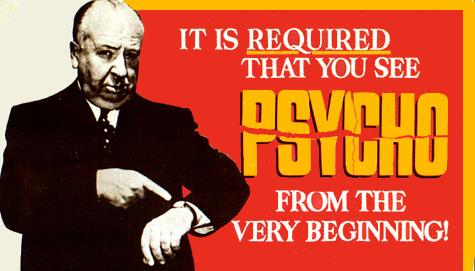
 A year and a half ago, serial killer Ivan Mosser (Lyle Alzado) was sent to the electric chair for murdering 23 people. On the night that he was electrocuted, the worst prison riot in American history broke out. The prison was closed and abandoned. A year and a half later, a film crew has entered the prison to make a women in prison film. Robert Edwards (Anthony Perkins) is the sleazy director. David Harris (Clayton Rohner) is the screenwriter who fights to maintain the integrity of his script and who is an expert on the prison’s history. Susan Malone (Deborah Foreman) is a stuntwoman and David’s girlfriend. And Ivan is the murderer who is still half-alive and full of electricity.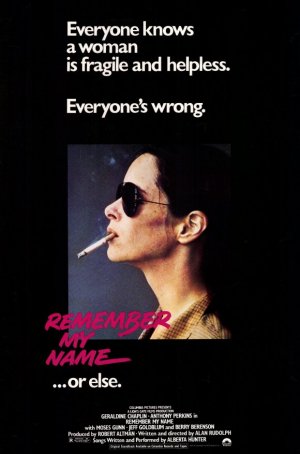
 Sweet and repressed Amy (Madchen Amick) is a college student who has too much on her plate. She has to take care of her greedy grandmother (Natalie Schaefer, of Gilligan’s Island fame). She has to read a book for her study partner (Corey Parker). She has to sew a dress for her older sister, Gloria (Daisy Hall). She has to find props for the school play. It is her search for props that leads to her buying an old chest at an estate sale. Inside the chest is a red cloak. Amy turns the red cloak into a dress but what she does not know is that the red cloak was previously won by Aztec priests while they conducted human sacrifices. As Professor Buchanan (Anthony Perkins) later explains, anyone who wears the dress will be driven to do evil.


 Through the Shattered Lens