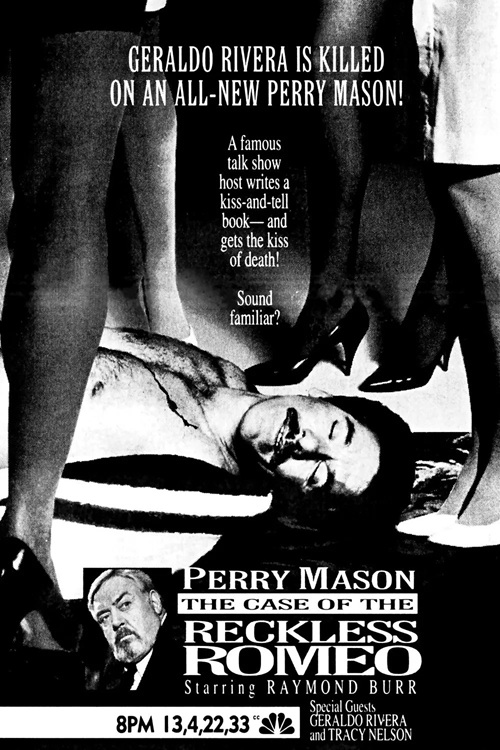
Sleazy talk show host Ted Mayne (Geraldo Rivera) writes a tell-all book about all of the famous women with whom he has had affairs. One of the women, Roxanne Shields (Amy Steel), is filmed threatening to kill him with a knife. When Ted is later found stabbed to death, Roxanne is arrested. Luckily, Perry Mason (Raymond Burr) is willing to take the case and reveal the true killer of the reckless Romeo.
This was one of the last of the Perry Mason movies. (Burr only did four more after this before he died.) The plot is okay, even if this is the third movie to feature Ken (William R. Moses) getting in trouble with the mob while investigating the the murder. It didn’t take me long to guess who the murderer was but the scene where Perry got his courtroom confession was still really well-done. Not surprisingly, the main pleasure of this film was seeing Geraldo Rivera as the victim. Geraldo may have been a terrible actor but he was still totally believable as a sleazy talk show host who went out of his way to embarrass every woman that he had ever had sex with. Geraldo is in the film long enough for you to get sick of him and then he goes away and isn’t seen again. That’s the way it should always be with Geraldo Rivera.
Perry does a few more courtroom tricks than usual in this movie. As the hapless district attorney, Kenneth Kimmins is no David Ogden Stiers. He’s not even Scott Baio. It’s really enjoyable to watch him get continually outsmarted by Perry. Raymond Burr was obviously not doing well physically when he made this movie but it’s still fun to watch him trick witness after witness into identifying the wrong woman.
When it comes to reviewing mob movies, I usually describe them as either being “an offer you can refuse” or “an offer you can’t refuse.”
Usually, it’s not that difficult to decide which ranking I should use. If the film is well-acted and if the action unfolds at a steady pace and if there’s plenty of tommy gun action and/or a stylish recreation of the Golden Age of American Gangsterism, chances are that the film will be an offer that you can’t refuse.
Now, if it’s a movie that just features a bunch of guys sitting around trying to sound tough and if it doesn’t really do much to recreate the gangster milieu and if the dialogue sounds like it was cribbed from a hundred other gangster films, it’ll probably be an offer you can refuse.
It’s simple and usually, it only takes me a few minutes to realize which description I’m going to use. But I have to admit that I went back and forth on 1975’s Lepke. To refuse or not to refuse, that was the question.
Lepke is a biographic film about Louis “Lepke” Buchalter, an early American gangster who came to prominence in the early days of the National Crime Syndicate. An ally of Lucky Luciano’s, Lepke was the mastermind behind what became known, in the press, as Murder, Inc. (Lepke himself was smart enough not to name the organization.) If the Mob wanted someone killed, they would contact Albert Anastasia who would then contact Lepke who would then assign the job to someone else. The actual assassin rarely knew who had actually ordered the hit and Lepke was such a feared figure that it was assumed that no one was ever going to turn informant. Lepke was responsible for some of the most infamous gangland killings of the 20s and 30s, including the murder of Dutch Schultz. Unfortunately, for Lepke, someone eventually did turn informant and he ended up as one of the few gangster to meet his end in the electric chair.
Lepke features Tony Curtis as the title character. The film follows him from his youth as a member of a street gang to his early days with the National Crime Syndicate and eventually to his final days at Sing Sing. Michael Callan plays Lepke’s childhood friend, who goes straight. Gianni Russo plays Albert Anastasia while Vic Tayback plays Lucky Luciano. Lepke’s wife, Bernice, is played by Anjanette Comer. Though the beefy and rather loud Tayback is miscast as Luciano, the cast does a fairly good job. Comedian Milton Berle gives a surprisingly strong performance as Lepke’s father-in-law. There’s a great scene in which he interrogates his future son-in-law about what he’s going to get in exchange for giving away his daughter. Curtis is convincingly tough and menacing as Lepke, who this film presents as being a working class family man whose job just happens to be killing people. (Tony Curtis later wrote that he was on a cocaine high while filming Lepke, which perhaps explains the intensity of his performance.)
Lepke definitely holds your interest. There’s enough mob hits and bursts of gunfire to satisfy most gang movie aficionados. At the same time, the film’s recreation of the 20s and 30s is almost too generic and clean. For all the tough talk and the gangland violence, there’s a definite lack of grittiness to the film’s recreation of one of the most violent eras in American history, which is why I found myself conflicted on whether to recommend it or not. I decided that, in the end, the film does enough right to make it worth watching, even if it does still feel more like a made-for-TV crime flick than the gangster epic that so obviously aspires to be,
Historically, this film is important because it was the first American film to be directed by Menahem Golan and produced by Golan and Yoram Globus. Four years after Lepke, Golan and Globus would purchase Cannon Films and go on to make some of the most deliriously entertaining films of all time.
For today’s horror on television, we’re very happy to present to you, Dead of Night!
From 1977, this television film is a horror anthology, made up of three stories directed by Dan Curtis and written by Richard Matheson. In the first story, a youngish Ed Begley, Jr. travels through time. In the 2nd story, Patrick Macnee plays a man whose wife is apparently being menaced by a vampire. And in the third story, Joan Hackett plays a mother who brings her dead son back to life, just to discover that sometimes it’s best to just let sleeping corpses lies.
The entire anthology is good, though the third story is clearly the best and the most frightening. Not only is it scary but it’s got a great twist ending.
Welcome to Retro Television Reviews, a feature where we review some of our favorite and least favorite shows of the past! On Sundays, I will be reviewing the made-for-television movies that used to be a primetime mainstay. Today’s film is 1971’s Five Desperate Women! It can be viewed on YouTube!
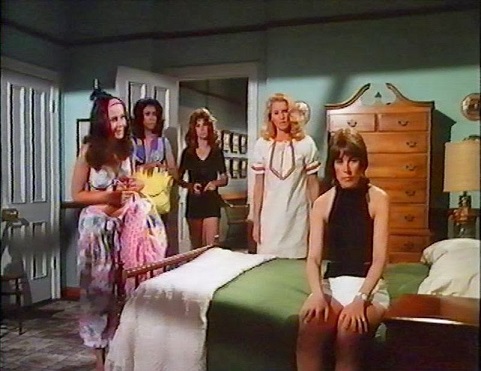
Five women, who all went to college together, reunite for the first time in five years. They’re planning on spending a weekend at a cabin on a private island. Lucy (Anjanette Comer) is the alcoholic who talks too much. Dorian (Joan Hackett) is the pill popper who lies about having a handsome husband and two beautiful children. Joy (Denise Nicholas) is the former activist turned trashy model. Gloria (Stefanie Powers) is bitchy and self-centered. And Mary Grace (Julie Sommars) is the one with the mentally ill mother who refuses to speak to her. Upon reuniting on the dock, the five women all immediately gather in a circle sing an old sorority song. It’s going to be one of those weekends!
The private island is lovely and the women believe that they have it to themselves, with the exception of the two men who are also on the island. Wylie (Robert Conrad) is the caretaker and he seems to be a trustworthy gentleman and exactly the type of guy who you would want to be stranded on an island with. And then there’s Meeker (Bradford Dillman), who drove the boat to the island and who is the type of overbearing jerk who has to be specifically told not to bother the women. While the women stay in the main house, the men stay in the nearby caretaker’s cottage.
From the start, it proves to be a stressful weekend. All of the women have secrets and long-buried resentments that come out at the slightest provocation. Not helping the fact is that there’s a murderer on the island, one that goes from killing a dog to strangling Dorian while the rest of the women are at the beach. The woman, figuring that the murderer has to be either Meeker or Wylie, lock themselves into their house for the night but it turns out that it’s going to take more than a locked door to defeat a killer.
Five Desperate Women has an intriguing premise but it also has an extremely short running time. With only 70 minutes to tell its story and 7 major characters to deal with, the film doesn’t leave much room for character development and, as a result, each woman is only given one personality trait and each actress ends up portraying that trait as broadly as possible. As a result, it doesn’t take long for the movie to go from being Five Desperate Women to Five Annoying Women. As for Robert Conrad and Bradford Dillman, the two of them give effective performances but anyone with a hint of genre savvy will be able to guess who the killer is going to turn out to be. There is one unintentionally funny moment where the desperate women attempt to fight off the killer by throwing rocks at him and none of the rocks come close to reaching their target but otherwise, Five Desperate Women is not particularly memorable.
For today’s horror on the lens, we’re very happy to present to you, Dead of Night!
From 1977, this television film is a horror anthology, made up of three stories directed by Dan Curtis and written by Richard Matheson. In the first story, a youngish Ed Begley, Jr. travels through time. In the 2nd story, Patrick Macnee plays a man whose wife is apparently being menaced by a vampire. And in the third story, Joan Hackett plays a mother who brings her dead son back to life, just to discover that sometimes it’s best to just let sleeping corpses lies.
The entire anthology is good, though the third story is clearly the best and the most frightening. Not only is it scary but it’s got a great twist ending.
What’s an Insomnia File? You know how some times you just can’t get any sleep and, at about three in the morning, you’ll find yourself watching whatever you can find on cable? This feature is all about those insomnia-inspired discoveries!
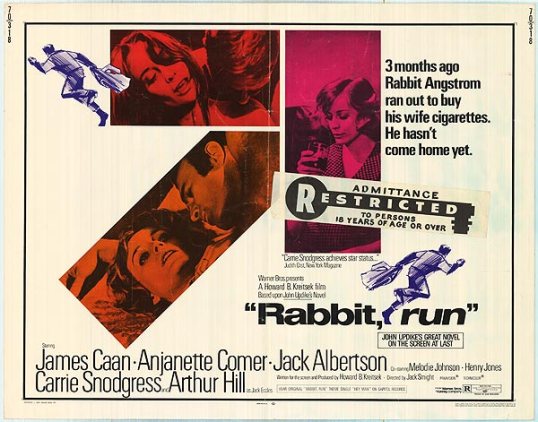
If, at one in the morning on Wednesday, you were suffering from insomnia, you could have turned over to TCM and watched the 1970 film, Rabbit Run. That’s what I did.
Rabbit Run is the epitome of a dumb lug film. In a dumb lug film, a male character finds himself living an unfulfilling life but he can’t figure out the reason. Why can’t he figure it out? Because he’s a dumb lug, with the emphasis on dumb. Usually, the viewer is supposed to sympathize with the dumb lug because he doesn’t mean to hurt anyone and everyone else in his world is somehow even more annoying than he is. Typically, the dumb lug will have an emotionally distant wife who refuses to have sex with him and who is usually portrayed as being somehow at fault for everything bad that has happened in the dumb lug’s face. (Want to see a more recent dumb lug film than Rabbit Run?American Beauty.) Ever since the silent era, there have been dumb lug films. In particular, male filmmakers and critics seem to love dumb lug films because they allow them to pat themselves on the back for admitting to being dumb while, at the same time, assuring them that everything is the fault of the wife or the girlfriend or the mother or the mother-in-law.
In Rabbit Run, the dumb lug is named Harry Angstrom (James Caan), though most people still remember him as Rabbit, the high school basketball star. Harry’s life peaked in high school. Now, he’s 28 and he can’t hold down a job. He’s married to Janice (Carrie Snodgress), who spends all of her time drinking and watching TV. He has a son and another baby is on the way. One day, when the pregnant Janice asks him to go out and get her a pack of cigarettes, Harry responds by getting in his car and driving all the way from Pennsylvania to Virginia.
When he returns to Pennsylvania, Rabbit doesn’t go back to his wife. Instead, he drops in on his former basketball coach (Jack Albertson) and begs for advice on what he should do. The coach, it turns out, is more than little creepy. He also has absolutely no practical advise to give. He does introduce Rabbit to a part-time prostitute named Ruth (Anjanette Comer). Rabbit quickly decides that he’s in love with Ruth and soon, he’s moved in with her.
Meanwhile, there’s all sorts of little things going on. Rabbit gets a job working as a gardener. Rabbit befriends the local Episcopal minister (Arthur Hill), even while the minister’s cynical wife (Melodie Johnson) tries to tempt Rabbit away from both his wife and his mistress. Rabbit both resents and envies the sexual freedom of the counter culture, as represented by his younger sister. And, of course, Janice is pregnant…
Rabbit Run is based on a highly acclaimed novel by John Updike. I haven’t read the novel so I can’t compare it to the film, beyond pointing out that many great works of literature have been turned into mediocre movies, largely because the director never found a way to visually translate whatever it was that made the book so memorable in the first place. Rabbit Run was directed by Jack Smight, who takes a rather frantic approach to the material. Since Rabbit Run is primarily a character study, it needed a director who would be willing to get out of the way and let the actors dominate the film. Instead, Smight overdirects, as if he was desperately trying to prove that he could keep up with all the other trendy filmmakers. The whole movie is full of extreme close-ups, abrupt jump cuts, intrusive music, and delusions of ennui. You find yourself wishing that someone had been willing to grab Smight and shout, “Calm down!”
(On the plus side, as far as the films of 1970 are concerned, Smight’s direction of Rabbit Run still isn’t as bad as Richard Rush’s direction of Gettting Straight.)
James Caan actually gives a likable performance as Rabbit, which is good because Rabbit would be totally unbearable if not played by an actor with at least a little genuine charisma. There’s nothing subtle about Caan’s performance but he makes it work. You never like Rabbit but, at the same time, you don’t hate him.
Unfortunately, there’s nothing subtle about the rest of the cast either. Something rather tragic happens about 80 minutes into the film and, as much as I knew I shouldn’t, I still found myself giggling because Carrie Snodgress’s performance was so bad that it was impossible for me to take any of it seriously. Even worse is Arthur Hill, as the minister who won’t stop trying to help Rabbit out. I eventually reached the point where, every time that sanctimonious character started to open his mouth, I found myself hoping someone would hit him over the head and knock him out. Among the major supporting players, only Anjanette Comer is allowed a chance to be something more than just a sterotype. Like Caan, she does the best that she can but ultimately. this is James Caan’s movie.
It’s a disappointing movie but it did not put me to sleep. Give credit for that to James Caan, who is the only reason to see Rabbit Run.
(Lisa recently discovered that she only has about 8 hours of space left on her DVR! It turns out that she’s been recording movies from July and she just hasn’t gotten around to watching and reviewing them yet. So, once again, Lisa is cleaning out her DVR! She is going to try to watch and review 52 movies by the end of Thursday, December 8th! Will she make it? Keep checking the site to find out!)
On October 30th, I recorded The Baby off of TCM.
First released back in 1973, The Baby is a seriously strange little movie. It’s about a 21 year-old man named Baby (played by David Manzy). Why is he called Baby? Because he lives in a crib. And he wears a diaper that occasionally needs changing. And he sounds exactly like a baby. (Whenever he opens his mouth, the sound of an actual baby is dubbed in.) When he’s alone with his babysitter, he eagerly sucks on her breast, half-nursing and half-perving.
Baby is the only son of Mrs. Wadsworth (Ruth Roman, giving a chillingly evil performance). Mrs. Wadsworth was abandoned by her husband shortly after Baby was born and the film implies that she’s taken a lot of her hatred towards her ex out on her son. Despite not liking her son, Mrs. Wadsworth is determined to hold onto him. She gets a weekly welfare check from the state. The money is supposed to be used to take care of Baby but Mrs. Wadsworth uses it to take care of herself and her two daughters.
Who are her daughters? Alba Wadsworth (Suzanne Zenor) is an implied nymphomaniac who has a way with a cattle prod. Germaine Wadsworth (Marianna Hill) is an actress and model who, it’s suggested, has incestuous designs on her brother.
That’s right — they’re a messed up family! However, they do throw great parties, the type that are full of all the typical characters who you would expect to appear in a low-budget film from 1973. Hippies, hipsters, aspiring disco dancers, they all show up. Michael Pataki shows up as well! You my not know the name but if you’re a fan of 70s exploitation films like me, you’ll immediately recognize Michael Pataki.
In order to continue receiving money from the government, the Wadsworths have to impress their case worker. They’ve moved through several social workers and, for the most part, they’ve survived by being so strange that no one wants to spend too much time dealing with them. However, their case has just been assigned to Ann Gentry (Anjanette Comer) and she actually takes an interest in Baby and his life with the Wasdworths.
Ann says that she thinks Baby could benefit from going to a special school. The Wadsworths suggest that she mind her own business. Ann, however, has no intention of doing that. Ann refuses the give up on giving Baby a chance at a better life.
Sounds heart-warming, right?
Well, no.
At first, Ann seems like just another concerned do-gooder. But, at the film progresses, we start to suspect that Ann might have some secrets of her own. We’re told that she lost her husband in a car accident but the details are left intentionally vague. What we do know is that Ann lives in a huge house with her mother-in-law (Beatrice Manley Blau) and we find ourselves wondering why, if her husband is gone, are the two of them still living together.
We also fin ourselves wondering: Does Ann have Baby’s best interests in mind? For that matter, does anyone?
Being a 70s movie, it all ends with a violent home invasion that’s followed by a surprise twist. The twist caught me totally off-guard and forced me to reconsider everything that I had previously seen. It was shocking, it was borderline offensive, it was just a little bit ludicrous, and it was rather brilliant in its odd way.
The same can be said for The Baby as a whole. This is one weird movie and you’ll never see another like it. For that reason alone, The Baby is worth seeing at least once.
Leon Alastray (Anthony Quinn) is an outlaw in 18th century Mexico who is given sanctuary and hidden from the Spanish authorities by a kindly priest, Father Joseph (Sam Jaffe). In return, Leon agrees to escort the priest to a peasant village that is under siege from the Yaqui Indians. During the journey, Joseph dies and when Leon arrives at the village, he is mistaken for the priest. Even though Leon’s an atheist and a womanizer, he pretends to be a man of God and tries to broker a peace with the Yaqui’s bloodthirsty leader, Golden Lance (Jaime Fernandez). Standing in the way is Teclo (Charles Bronson), a mestizo rebel who wants to keep the Spanish and the Yaqui at war.
Because it features a score by Ennio Morricone and co-stars Charles Bronson, Guns For San Sebastian is often mistakenly referred to as being a spaghetti western. Instead, it was a big budget American-French co-production that was filmed, on location, in Mexico. (The majority of spaghettis were filmed in Spain.) While revolution in Mexico was a popular backdrop for many spaghetti westerns, none of them were as sympathetic to the church or the government as Guns for San Sebastian. If Guns For San Sebastian were a true spaghetti western, Teclo would be the hero.
Guns For San Sebastian is an above average western that starts out slow but gets better as it approaches the exciting final battle between the villagers and Yaqui. Morricone provides another great and rousing score but the main reason to watch Guns For San Sebastian is to see Anthony Quinn and Charles Bronson, two legendary tough guys, acting opposite each other and competing to see who can be the most intimidating. In the movie, Quinn may win but you can still see the determined presence that led to Bronson becoming an unlikely movie star in the 70s.


 Leon Alastray (Anthony Quinn) is an outlaw in 18th century Mexico who is given sanctuary and hidden from the Spanish authorities by a kindly priest, Father Joseph (Sam Jaffe). In return, Leon agrees to escort the priest to a peasant village that is under siege from the Yaqui Indians. During the journey, Joseph dies and when Leon arrives at the village, he is mistaken for the priest. Even though Leon’s an atheist and a womanizer, he pretends to be a man of God and tries to broker a peace with the Yaqui’s bloodthirsty leader, Golden Lance (Jaime Fernandez). Standing in the way is Teclo (Charles Bronson), a mestizo rebel who wants to keep the Spanish and the Yaqui at war.
 Through the Shattered Lens