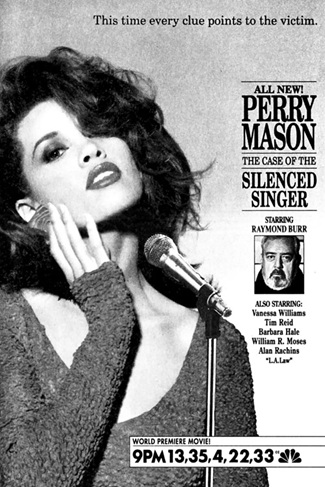
When singer Terri Knight (Vanessa Williams) is shot and murdered, her husband and manager, Jack (Tim Reid), is arrested. It’s a good thing that Jack’s professor in law school was Perry Mason (Raymond Burr)! Perry and Ken Malansky (William R. Moses) take the case and investigate to see who silenced the singer. (Does Perry know anyone who hasn’t been accused of murder? Someone even tried to fame Della!)
This Perry Mason movie was slightly different than those that came before it. It was full of flashbacks, showing how Terri became a star and went from being nice and innocent to being a diva. Every time that Perry or Ken would interrogate someone, it would lead to scene of Vanessa Williams wearing a wig and playing Terri at a different time in her life and career. There was also a lot singing and the movie actually seemed to be more focused on the music and showing Terri’s rise to fame than it did on solving the actual mystery. It was was if Perry Mason got dropped into the middle of a production of Dreamgirls. It didn’t really work for me because Terri wasn’t an interesting enough character to carry the flashbacks but it was still interesting to see a Perry Mason movie trying to do something different.
The most memorable thing about this movie was Angela Bassett, playing a fellow singer and a former friend of Terri’s. She even told off Perry Mason at one point! It was early in her career but it was easy to see that, from the start, Angela Bassett was obviously going to be a star.
1977’s Record City opens with a montage of rear-focused close-ups of women wearing short shorts and that pretty much tells you all that you really need to know about the film. It’s crass, shameless, and very much a product of its time.
The film takes place over the course of one day at a California vinyl record shop. It’s tempting to compare the film to something like Empire Records but, unlike Empire Records, Record City suggests that working in a record store is perhaps the worst thing that could ever happen to anyone. The store is dirty and grimy. The customers are rude and played by vaguely familiar comedy actors, all of whom seem to have been bitten by the overacting bug before stepping in front of the camera. The employees all seem to hate each other. Marty (Tim Thomerson) keeps getting slapped and kicked by Vivian (Deborah White). Vivian keeps getting groped by almost every customer and employee who walks by her. The only thing that Vivian hates more than men is other women. The store’s owner (Jack Carter) is in trouble with the mob. The store’s manager (Michael Callan) is lech who wears gold chains, keeps his shirt unbuttoned, and who expects the new cashier, Lorraine (Wendy Schaal), to sleep with him because, after all, he did hire her. Danny (Dennis Bowen) is the shy guy with a crush on Lorraine. Rupert (Stuart Goetz) is the nerdy virgin who goes from wearing a bowtie to dressing like a swinger but he still can’t get laid. Both the customers and the employees are paranoid about “fairies” coming into Record City. Pokey (Ed Begley, Jr.) wants to hold the place up and who can blame him? Really, the only likable employee is a black man known only as The Wiz and that’s just because he’s played by Ted Lange. (Yes, Isaac the Bartender from The Love Boat.) Lange gets to perform a song at the end of the film.
When the film isn’t focused on the antics inside Record City, it’s all about the talent show that’s taking place in a nearby parking lot. The talent show is hosted by radio DJ Gordon Kong (Rick Dees) and it gives the film an excuse to trot out a bunch of cameos, some of whom are more recognizable than others. For instance, Gallagher — the comedian with the sledgehammer — shows up. Kinky Friedman also shows up, playing himself and looking for records at Record City. When he spots a woman with a blonde bowl cut and glasses, he accuses her of being John Denver and then grabs her breasts. And to think — less than 30 years later, Kinky Friedman would run for governor of my homestate.
Anyway, this is a terrible and rather boring movie but I did find it interesting for one reason. It’s the reason why I find so many grindhouse films to be interesting. Shot on location and for no other reason than to make money, Record City is a true product of its time. There’s no attempt to try to make the 70s look nicer than they were. There’s no attempt to try to make the record store look like anything more than a tacky establishment. There’s an honesty to how low-rent the whole thing is. Watching the movie is like stepping into a time machine and getting a chance to experience the past firsthand. I was born long after the 70s but, after watching this film, I now feel like I’ve been there.
After watching 1967’s The Graduate, I defy anyone to listen to Simon and Garfunkel sing about the darkness without immediately picturing a young-looking Dustin Hoffman (he was 30 when the film was made but he was playing 22) standing on a moving airport walkway with a blank expression on his face.
If you don’t picture that, maybe you’ll picture Dustin Hoffman floating in a pool, wearing dark glasses and barely listening to his parents asking him about graduate school.
Or maybe you’ll remember him driving his car across the Golden Gate bridge. Or perhaps sitting at the bottom of his pool with a scuba mask on. Or maybe you’ll see him awkwardly standing at the desk in the lobby of a fancy hotel, trying to work up the courage to get a room. Or maybe you’ll just see him and Katharine Ross sitting at the back of that bus with a “what do we do now?” expression on their faces.
(Supposedly, that expression was not planned and was just a result of the shot running longer than expected.)
Ah, The Graduate. Based on a novel by Charles Webb, Buck Henry’s script remains one of the quotable in history. “Mrs. Robinson, you’re tying to seduce me …. aren’t you?” “Plastics.” “Elaine!” Myself, I have an odd feeling of affection for the line “Shall I get the cops? I’ll get the cops.” Perhaps that’s because the line is delivered by a young and uncredited Richard Dreyfuss, appearing in his second film and adding to the film’s general atmosphere of alienation.
Alienation is the main theme of The Graduate. As played by Hoffman, Benjamin Braddock feels alienated from everything. He was a track star. He was a top student in high school and college. Now, he’s just a college graduate with no idea what he wants to do with the rest of his life. One can argue, of course, that Braddock brings a lot of his alienation on himself. He can be a bit judgmental, even though he’s the one who is having an adulterous affair with Mrs. Robinson (Anne Bancroft) while also falling for Mrs. Robinson’s daughter, Elaine (Katharine Ross). His parents (William Daniels and Elizabeth Wilson) can be overbearing but it’s possible they have a point. Is he planning on spending the rest of his life floating in their swimming pool? Benjamin says that he just needs time to finally relax. After being pushed and pushed to be the best, he just wants time to do what he wants to do before his life becomes about plastics. When I first saw this movie, I was totally on Benjamin’s side. Now, as I’ve gotten older, I’ve started to understand where his parents were coming from. Still, it’s hard not to feel that Benjamin deserves at least a little bit of time to enjoy himself. That’s what Mr. Robinson (Murray Hamilton) thinks, at least initially.
Mrs. Robinson is the most interesting character in the film, a force of chaos who lives to disrupt the staid world around her. She’s bored with her marriage and her conventional but empty lifestyle so she has an affair with Benjamin. Later, she grows bored with Benjamin and his desire to “just talk” for once and she moves on from him. Benjamin and Elaine are both likable and you find yourself wishing the best for them but Mrs. Robinson is the character who you really remember. Mrs. Robinson grew up without losing her sense of rebellion. One doubts that Benjamin and Elaine are going to do the same.
A portrait of American suburbia and 60s alienation, The Graduate would prove to be one of the most influential social satires ever made. A box office hit, it was nominated for seven Academy Awards. It was nominated for Best Picture, Best Director (Mike Nichols), Best Actor (Dustin Hoffman), Best Actress (Anne Bancroft), Best Supporting Actress (Katharine Ross), Best Adapted Screenplay (Buck Henry and Calder Willingham), and Best Cinematography (Robert Surtees). The Simon and Garfunkel songs that set the film’s mood were, for the most part, not eligible. (Only Mrs. Robinson was written specifically for the film.) I would argue that the film deserved to be nominated for its editing as well. In the end, the film only won one Oscar, for Mike Nichols. But, regardless of what awards it won or lost, The Graduate‘s legacy lives on.
Welcome to Late Night Retro Television Reviews, a feature where we review some of our favorite and least favorite shows of the past! On Thursdays, I will be reviewing Highway to Heaven, which aired on NBC from 1984 to 1989. The entire show is currently streaming on Freevee and several other services!
This week, Jonathan and Mark travel to Hollywood …. again.
Episode 2.4 “Cindy”
(Dir by Michael Landon, originally aired on October 23rd, 1985)
Vincent DeGeralimo (Bill Macy) is a fast-talking, good-hearted talent agent who is still trying to sell acts that were out-of-style during Vaudeville. He wants to get a booking for a lion tamer but Jonathan appears to him and says that Vincent’s main concern should be helping out his daughter.
Cindy DeGeralimo (Hallie Todd) is an aspiring actress who is currently working as a waitress in a diner. Her evil boss (Alice Ghostley) has three untalented daughters who all want to be actresses as well. Cindy’s newest coworker, Mark Gordon, just wants to meet a movie star.
Pretending to work in the mailroom of a major Hollywood studio, Jonathan convinces producer Maxim Prince (Kip Gilman) that the best way to find a star for his new picture would be to hold a ball and invite every aspiring actress in town to attend.
Can you see where this is going? Yep, it’s a remake of Cinderella, except this time Cinderella has a pushy father who keeps trying to change her before she goes to the ball. Cindy finally gets fed up and says that she wants to be a star but she also doesn’t want to be some sort of Hollywood phony. Vincent accepts Cindy’s feelings and everything works out in the end.
Usually, I’m pretty lenient when it comes to reviewing this show but this episode just annoyed me. Even by the standards of Highway to Heaven, it was overly sentimental and heavy-handed. Bill Macy gave such a frantic performance as Vincent that it was hard to watch him. As well, Mark was so excited about being in Hollywood that I found myself wondering if he forgot about all the time he spent in Hollywood during the first season.
Indeed, this is not the first episode of Highway to Heaven to feature Jonathan dealing with the entertainment industry and I imagine it won’t be the last. Considering how much control Michael Landon had over this show, I always get the feeling that the Hollywood episodes were personal for him, especially as they always seemed to deal with parents regretting the fact that they put work ahead of their families. That said, the portrayal of Hollywood in this episode was so old-fashioned and idealized that I get the feeling that it was Landon’s way of showing what he wished Hollywood was like as opposed to what it actually was. Landon’s Hollywood is a town where anyone can be a star and anyone can find a happiness.
As for this episode, it was a bit too corny for its own good. Next week, though, Jonathan battles the Devil for Mark’s soul! That should be fun.
Welcome to Late Night Retro Television Reviews, a feature where we review some of our favorite and least favorite shows of the past! On Mondays, I will be reviewing CHiPs, which ran on NBC from 1977 to 1983. The entire show is currently streaming on Freevee!
This week, CHiPs makes me cry!
Episode 1.14 “Rustling”
(Dir by Phil Bondelli, originally aired on January 12th, 1978)
This week’s episode of CHiPs featured a scene that brought tears to my mismatched eyes.
A drunk driver (played by G.W. Bailey) swerves across the highway and causes another car to flip over. While Ponch chases after the driver, Baker goes to investigate the crash. He discovers that the car’s driver is a 17 year-old girl named Susie (Pamelyn Ferdin) and she has been pinned under the wreckage. He manages to free her and carry her away from the car before it explodes. YAY! Another life saved by Jon Baker, right?
That’s when Susie says that she can’t feel her legs.
That scene got to me. It was far more well-acted than anything that I think one would normally expect to find on a episode of CHiPs, with both Ferdin and Larry Wilcox bringing a lot of emotional sincerity to their roles. Susie realizes that she may never walk again. Baker realizes that, just because he saved her from the car, he can’t save Susie from the other consequences of the accident. I wanted to cry. Actually, I did cry.
Now, I should admit that I’m recovering from a sprained ankle and I was doing my ankle exercises while watching this scene. So, not only did I already have tears in my eyes (seriously, some of those exercises hurt!) but I was also feeling pretty emotional. But still, even if I was just watching this scene while sitting on a couch, I think it would have had the same effect on me.
Of course, for the record, Ponch does capture the drunk driver (and the driver starts to sob when he realizes what he has done). And, by the end of the episode, Baker is informed that Susie is going to be okay. I was happy about that.
Excuse me, I’m starting to cry again….
Okay, believe it or not, that was only a small part of the episode. The main storyline featured the great L.Q. Jones as a cattle rustler who, when he’s not driving his truck full of stolen cattle, rides a motorcycle. Fortunately, after a lengthy chase, Baker and Ponch are able to capture him and his accomplice (Paul Tuerpe). It was a pretty simple story but, at the same time, L.Q. Jones was one of those brilliant character actors who make even the most mundane of characters interesting.
Also, over the course of the episode, Ponch and Baker deal with an irate driver (Mill Watson) who claims that he was only speeding because his gear shift failed. In court, Ponch is able to prove that the gear shift didn’t break by pointing out that the brake lights would have come on in that case. (“Your honor,” the defense attorney says, “my client would like to change his plea to guilty.”) Ponch and Baker also stop a magician and his assistant and are so fascinated by the magician’s tricks that they nearly forget to write his assistant a ticket.
Finally, Ponch arranges for everyone to meet at Baker’s apartment to throw him a surprise birthday party. Whoops! Baker’s birthday isn’t for another three months. Ponch looked at Baker’s personnel file and misread his employment number as being his birthdate. Oh, Ponch! Still, the party is a success. Getraer shows up with zucchini. The magician shows up and performs a trick that involves tossing milk on Ponch and Baker. What? Well, whatever.
What’s important is that one scene that brought tears my eyes. The rest of the episode may have been generic but that one scene was beautifully done and I’ll never forget it.
Tonight’s episode of Ghost Story stars Patricia Neal as a woman who wakes up one morning in a hotel and discovers that her husband is missing. She’s told that her husband checked out without her but no one will give her a straight answer as to where he went.
This episode was written by Jimmy Sangster, who also wrote several Hammer films. It originally aired on December 22nd, 1972.
On tonight’s episode of Kolchak: The Night Stalker, wealthy women are dying in Chicago and Carl Kolchak is on the case! It turns out that it’s all connected to priceless jewels and a legendary monster known as the Diabelro, a creature has been cursed to roam the Earth and search for gems.
The Diabelro is played by Richard Kiel, who might be best known for playing Jaws in The Spy Who Loved Me and Moonraker.
This episode originally aired on November 29th, 1974.
Sometimes, the story behind a movie is more interesting than the movie itself.
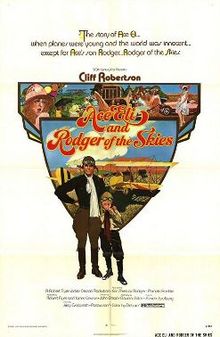
A young Steven Spielberg received a “story by” credit for Ace Eli and Rodger of the Skies but, at one time, he was going to be credited with much more. Spielberg wrote the treatment for Ace Eli and sold it to 20th Century Fox because he was hoping to make his directorial debut with the film. However, shortly after selling the story, there was an executive shakeup at the studio. Spielberg’s supporters were out and the men who replaced them gave the treatment to another screenwriter and director. Spielberg was so angered by his treatment that it would be close to thirty years before he ever again worked with 20th Century Fox. (In 2002, 20th Century Fox co-produced Minority Report with Dreamworks.) Ace Eli ended up being directed by television veteran John Erman, who was so upset by the studio’s final edit of the film that he demanded to be credited under a pseudonym.
The plot of Ace Eli and Rodger of the Skies is recognizably Spielbergian. Ace Eli (Cliff Robertson, who was a pilot in real life and who, after he won his Oscar of Charly, was involved in several flying films) is a stunt pilot in the 1920s. After his wife is killed in a crash, Eli and his 11 year-old son, Rodger (Eric Shea), set off on a barnstorming tour. Going from small town to small town, Eli deals with his pain through nonstop womanaizer. With Eli refusing to take any responsibility for his actions, Rodger is forced to grow up quickly. It is a typical Spielberg coming of age story, combining a nostalgia for the past with a clear-eyed portrayal of irresponsible adulthood.
In fact, it is easy to imagine the approach the Spielberg would have taken if he had been allowed to direct his story. Unfortunately, Spielberg did not get to direct the film and John Erman takes an impersonal approach to the material. Whereas Spielberg would have captured the excitement of both flying and life on the road, Erman keeps the audience at a distance. An underrated actor, Cliff Robertson is still miscast as the irresponsible Ace Eli. The reason why Cliff Robertson was perfect for the role of Uncle Ben in Spider-Man is the same reason why he feels all wrong as Ace Eli. He is just too upstanding a citizen to be as impulsive as Eli often is. An actor like Warren Oates would have been perfect for the role.
Steven Spielberg directing Warren Oates in Ace Eli and Rodger of the Skies? That would have been something worth seeing!
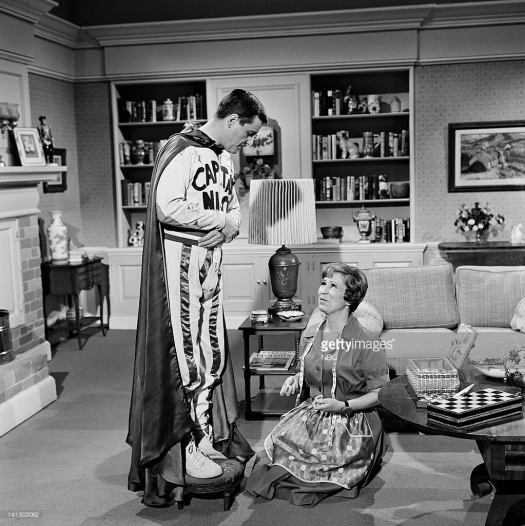
Yes, that’s distinguished actor William Daniels in those long-johns as CAPTAIN NICE, which aired Monday nights on NBC-TV for eight months and fifteen episodes during the height of the superhero camp craze in 1967. Similar in theme to MISTER TERRIFIC on rival CBS, I preferred this one as a kid because of it’s MAD Magazine-level of jokes and gags – which ain’t a bad thing, in my book! The silly superhero series was created by Buck Henry, who also (along with pal Mel Brooks ) was responsible for another campy sitcom, the 60’s spy spoof GET SMART!
Mild -mannered chemist Carter Nash works for the Big Town Police Department, and invents a super-secret super-formula that transforms him into Captain Nice. His domineering mother (Alice Ghostley) sews him up a super-suit and tells him to go out and fight crime like a good boy. Carter’s got all the powers of Superman, except he’s a bit…
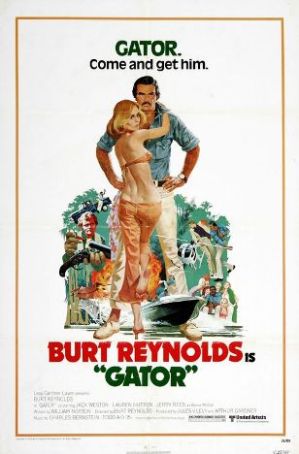
Since the events in White Lightning, Gator (Burt Reynolds) has been released from prison and he’s now living in the Okefenokee Swamp. Other than running moonshine, Gator is laying low and keeping to himself. Gator may be done with the feds but the feds are not done with him.
Gator’s old friend, Bama McCall (Jerry Reed), is now unofficial boss of Dunston County and both the Department of Justice and the Governor of Georgia (played by talk show host Mike Douglas) are determined to take him down. Federal agent Irving Greenfield (Jack Weston) is convinced that he can get Bama on charges of tax evasion. But Irving’s from New York and he does not know how to talk to the good ol’ boys. He needs someone on the inside and that’s where Gator comes in.
Gator not only starred Burt Reynolds but it was his directorial debut as well. Though it’s a sequel to White Lightning, Gator feels like a very different movie. Whereas Joseph Sargent kept White Lightning relatively serious, Reynolds take a more jokey approach with Gator. Reynolds has his famous mustache and his hairpiece in Gator and the self-amused attitude that went along with them. Gator is full of car chases, fist fights, willing women, and corny jokes. It also has Lauren Hutton, playing a familiar character who would appear in all of Reynolds’s movies, the sophisticate who cannot resist Burt’s good ol’ boy, country charm. In the 1970s, audiences couldn’t resist Burt’s good old boy charm, either. Critics hated Gator but it made a lot of money.
Gator is dumb but fun. The most interesting part of the movie is seeing Jerry Reed playing a ruthless villain. Reed is thoroughly convincing as a Dixie Mafia crime boss, the type of redneck who earlier inspired Buford Pusser to pick up a baseball bat and destroy pool halls. One year later, Jerry would play Burt Reynolds’s best friend in Smoky and the Bandit so it’s interesting to see them playing deadly rivals in Gator.
For tomorrow’s movie a day, Burt’s a football player in jail in The Longest Yard.




 Gator McClusky is back!
 Through the Shattered Lens